by
Tom Gurney
Tom Gurney BSc (Hons) is an art history expert with over 20 years experience
Published on June 19, 2020 / Updated on October 22, 2026
Email:
tomgurney1@gmail.com
/ Phone:
+44 7429 011000
Lute-playing Angel: Introduction
The wings almost fill the sheet, yet Albrecht Dürer makes us attend to the smaller action between them: a musician bending his attention towards the strings of a lute. His face turns to our left, his fingers settle on the instrument, and a broad sleeve falls below its neck. Drawn in 1497, the Lute-playing Angel belongs to the Kupferstichkabinett in Berlin. Its fine silverpoint lines and white highlights lie on paper prepared with a grey-violet ground. At 26.8 × 19.7 centimetres, it is an intimate work whose outstretched wings give it an unexpectedly expansive presence. [1]
At a Glance
- Date 1497 [1]
- Materials Silverpoint and white highlights on grey-violet prepared paper [1]
- Collection Kupferstichkabinett, Berlin [1]
This work across Albrecht Dürer’s career
Young Hare
1502Praying Hands
1508Melencolia I
1514Four Apostles
1526Contents
- A figure held between movement and stillness
- The practical business of playing
- Drawing with silver and light
- Wings, nature and invention
- A familiar face in a different role?
- A small signature and a long collecting history
- Frequently Asked Questions
A figure held between movement and stillness
The angel's body faces us more directly than his head. This slight difference creates an absorbing tension: the shoulders offer the instrument outward while the face withdraws towards the act of playing. There is no answering glance to the spectator. The lowered eyes, closed mouth and firmly shaped nose give the head a particular character, though they cannot tell us whether Dürer portrayed a named person. A narrow band passes across the forehead beneath an abundance of small curls. The uncovered neck and the loose opening of the garment keep the head connected to the working body below.
The instrument supplies a strong horizontal counterweight to the wings. Its rounded body occupies the lower left of the figure; its neck travels across the chest towards the hand at the right. Above it, the feathers open in two rising fans. Below, the garment drops in a much narrower band. Dürer has therefore packed three different directions into a compact arrangement: upward expansion, sideways reach and downward weight. The figure feels poised because these directions hold one another in check.
A projecting rectangular support introduces another kind of order. Its top runs beneath the lute, while its tall front descends towards the bottom edge of the paper. Curving strokes shade that face. Against the repeated organic forms of curls, feathers and fingers, the block is conspicuously plain. It locates the instrument in a space with depth and gives the composition a firm lower anchor. Almost everything around the angel remains empty, so this one substantial object carries unusual weight.
The practical business of playing
The lute has a broad, pear-shaped soundboard, a circular rose and a narrow, fretted neck. Dürer gives considerable attention to the relationship between this object and the hands. The angel's right forearm comes over the body of the instrument; the hand bends towards the strings. His left fingers gather at different positions along the neck. The fingers appear engaged in distinct tasks, and the stretch between the hands helps make the action convincing. Neither a written score nor an accompanying player identifies a particular piece of music.
Lute maker and researcher David van Edwards explored this playing posture in an essay republished on his website in 1998. He argued that the free right-hand thumb and forefinger, together with the active left hand, suited the performance of polyphonic music, with several musical lines sounding together. He also treated the block as a practical support: freeing the hands for this technique meant finding another way to bear the lute's weight. His suggestion that the arrangement contains a joke about an angel obeying physical necessity is an interpretation, and a particularly engaging one. [12]
Van Edwards also recognised the limits of the evidence. The drawing's viewing angle leaves the exact relationship of thumb and forefinger ambiguous, while altered lines around the pegbox complicate the count of the instrument's courses, or groups of strings. His discussion makes the sheet valuable for musical history without turning it into an exact performing manual. A specific chord, tuning or repertoire would require more evidence than this view supplies. [12]
Drawing with silver and light
Silverpoint depends on a prepared surface. As the National Gallery of Art explains, a metal stylus passing over a slightly abrasive ground leaves minute particles behind. Silver produces a fine line whose character differs from the more readily varied mark of a pen or chalk. Shading can be built through the accumulation of strokes, and erasing may be difficult or impossible, depending on the preparation. Silver lines also commonly change colour through tarnishing. A reproduction's warm or cool appearance is therefore a poor basis for identifying the original ingredients of this sheet's ground. [13]
Dürer's drawing allows three tonal resources to work together: the coloured preparation, darker silverpoint marks and added white. The Berlin museum identifies the ground as grey-violet and the drawing as heightened with white. The ground is visible throughout the unoccupied background and between the drawn marks. It provides a middle value from which the figure can emerge. Dark hatching gathers under the jaw, across the shaded clothing and within the wings, while light touches pick out projecting surfaces. [1]
Look at the sleeve on the left. The rounded forearm is described through a succession of folds, with pale accents along their exposed ridges. Near the shoulder, a stronger patch of white makes the fabric turn towards the light. Elsewhere the garment becomes darker and more densely worked, especially beneath the lute's neck. This uneven distribution of attention makes the hands and instrument feel nearer. The drawing does not need an elaborately described room or landscape to create an encounter with a bodily presence.
The wings receive similarly varied treatment. Small overlapping feathers gather near the shoulders; long feathers extend towards the upper corners. Their curved edges form repeated steps, but the intervals and angles vary. White accents help separate certain rows, while other feathers merge into shadow. They give the angel a substantial apparatus of flight, although the figure is occupied with the precise, grounded activity of making music.
Wings, nature and invention
Dürer's surviving bird studies make it tempting to identify a particular natural model for these wings. The connection has indeed entered scholarly discussion. Heinz Widauer's ALBERTINA catalogue essay on the roller studies records an argument that their close examination of plumage preceded early winged figures, including this Berlin angel. The dating and original purpose of those bird studies remain disputed; the essay does not establish that this drawing was copied from one of them. [14]
The distinction matters when looking at the angel. Dürer has organised feathers into a clear hierarchy of short and long forms, creating a believable passage from shoulder to extended wing. Yet their placement serves the human figure and the rectangular sheet. The wings frame the head, leave the hands unobstructed and rise into the available corners. Observation and arrangement work together here. Their convincing detail need not imply a single identifiable bird specimen, just as the convincing musician need not be a portrait of a documented sitter.
The wings also make the subject legible immediately. A musician absorbed in a lute could belong to ordinary human life; these vast feathered forms carry the action into a sacred imaginative setting. No halo or surrounding congregation is needed for the figure to read as an angel. The empty space concentrates attention on his activity while leaving its larger devotional setting unspecified.
A familiar face in a different role?
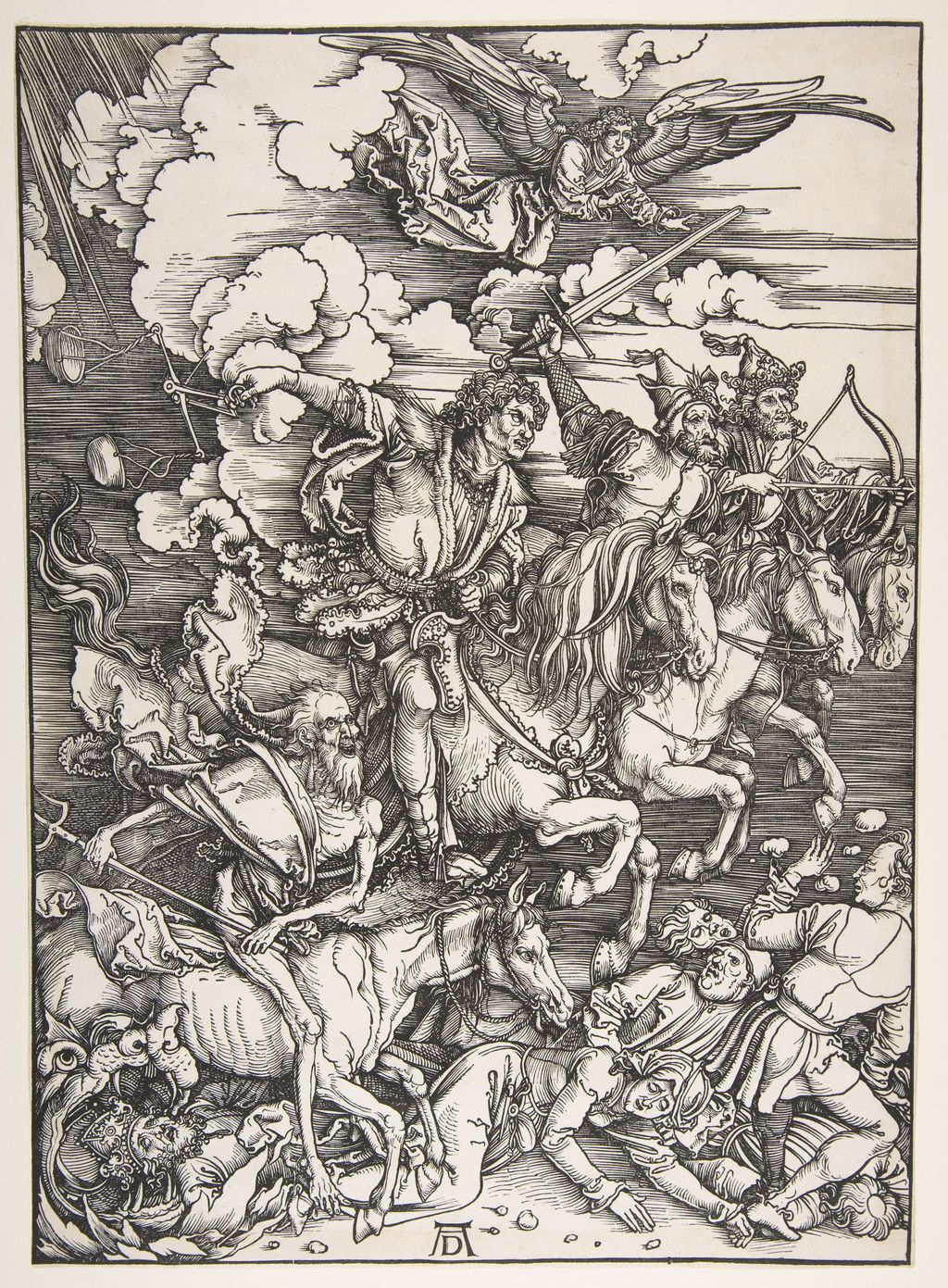
In his 1921 catalogue of the Berlin drawings, Elfried Bock called the sheet a model study and noted its close relationship with the destroying angels in Dürer's Apocalypse , published in 1498. He also reported an older suggestion by Moritz Thausing that the model was Hans Frey. Bock's report preserves a history of interpretation; it does not establish Frey's identity. [15]
A comparison with The Four Avenging Angels makes the broader connection understandable. In the woodcut, angels with curly hair, strong profiles and elaborately folded garments wield swords above a mass of falling people. The Metropolitan Museum's 1498 impression shows how forcefully those human forms can be turned towards destructive action. The musician's downward attention and the avengers' concentrated faces belong to a related expressive world, although their actions and the overall movement of the compositions differ sharply. [16]
The Berlin sheet contains no sword, victims or arrangement corresponding to the woodcut's crowded foreground. Its lute, hands and supporting block form a coherent subject of their own. Bock's comparison is useful evidence of a relationship recognised by earlier scholarship, but it cannot by itself prove that Dürer made the drawing as preparation for that particular print. The resemblance opens a question about the reuse of figure types and observed features, leaving the drawing's precise initial function unresolved.
A small signature and a long collecting history
At the top, the date and AD monogram occupy a quiet area between the wings. Their small scale rewards closer inspection after the figure has claimed our attention. Ksenija Tschetschik-Hammerl's study of Dürer's monogram identifies this sheet among the early works bearing his joined initials. The compact form, with the D enclosed within the A, became a persistent sign of the artist's authorship. Here it sits above the imagined scene, giving the expansive figure a modest but definite authorial marker. [17]
The drawing later passed through major British collections. Berlin's present record names Thomas Lawrence, Samuel Woodburn, John Heywood Hawkins, William Coningham and William Mitchell. Its documented museum acquisition took place in 1890, through the Berlin dealers Amsler & Ruthardt, from Mitchell's collection in London. Those names trace a substantial later life for a fragile sheet, although they do not explain its original commission or use. [1]
What survives is unusually self-contained: a face with individual character, hands occupied by a credible task, wings opening across an otherwise spare field, and a musical instrument given both delicate attention and solid support. The drawing's unresolved early history leaves room to look closely at these relationships. Its angel commands space with his wings while concentrating on the few inches of strings beneath his fingers.
Frequently Asked Questions
Artworks directory
These 187 records include individual works, reverse sides, detail views, paired panels and reconstructed arrangements. Three additional catalogue images repeat works already listed. Related views are not counted as separate originals; qualified attributions and published dating are retained.
Discussion
Look again at the images and ideas explored in Lute-playing Angel. These editorial prompts invite your observations.
Reader Insights
Which detail or idea in Lute-playing Angel most changed your reading, and why?
How does the discussion of “A figure held between movement and stillness” affect your understanding?
What comparison would you bring to the discussion of “A small signature and a long collecting history”?
Join the Conversation
Share a detail, comparison or question about Lute-playing Angel below.
References
- Staatliche Museen zu Berlin , Kupferstichkabinett, Laute spielender Engel , KdZ 3877, collection record, updated 9 October 2026. German. View source .
- ALBERTINA, Selbstbildnis als Dreizehnjähriger, inv. 4839 (German). View source.
- Metropolitan Museum, Four Horsemen from The Apocalypse, 19.73.209 (English). View source.
- Bayerische Staatsgemäldesammlungen, Selbstbildnis im Pelzrock, inv. 537 (German). View source.
- ALBERTINA, Feldhase, inv. 3073 (German). View source.
- ALBERTINA, Das große Rasenstück, inv. 3075 (German). View source.
- Metropolitan Museum, Adam and Eve, 19.73.1 (English). View source.
- ALBERTINA, Betende Hände, inv. 3113 (German). View source.
- Metropolitan Museum, Knight, Death, and the Devil, 43.106.2 (English). View source.
- Metropolitan Museum, Melencolia I, 43.106.1 (English). View source.
- Bayerische Staatsgemäldesammlungen, inventory 545: current collection record (German; descriptive citation). View source.
- David van Edwards , “Dürer's drawing ‘Angel with a Lute’”, Lute of the Month , November 1998; revised republication of an essay in the Lute Society Journal , 1976. View source .
- National Gallery of Art , Drawing in Silver and Gold: From Leonardo to Jasper Johns , exhibition overview and technical introduction, 2015. View source .
- Heinz Widauer , catalogue essay on Tote Blauracke and Blaurackenflügel , in Albrecht Dürer , edited by Klaus Albrecht Schröder and Maria Luise Sternath, ALBERTINA, 2003, pp. 272–274; reproduced in the ALBERTINA collection record. German. View source .
- Elfried Bock , Die Deutschen Meister: beschreibendes Verzeichnis sämtlicher Zeichnungen , vol. 1, Berlin: Julius Bard, 1921, p. 24, entry 3877. German. View source .
- The Metropolitan Museum of Art , The Four Avenging Angels, from “The Apocalypse” , 1498, woodcut, accession 1975.653.66. View source .
- Ksenija Tschetschik-Hammerl , “Das Dürer-Monogramm als Gegenstand der Nachahmung im 16. und frühen 17. Jahrhundert”, kunsttexte.de , 3/2018, pp. 5–7 and note 35, pp. 20–21. German. View source .
- Germanisches Nationalmuseum, Barbara Dürer (German and English). View source.
- Web Gallery of Art, Tucher–Rieter reverse (English). View source.
- National Gallery of Art, Portrait of a Clergyman (English). View source.
- Dürer Art, Portrait of a Man (English). View source.
- Hessen Kassel Heritage, Elsbeth Tucher (German). View source.
- Web Gallery of Art, Hans Tucher (English). View source.
- Germanisches Nationalmuseum, Emperor Maximilian I (German and English). View source.
- National Gallery of Art, Lot and His Daughters, reverse (English). View source.
- Bayerische Staatsgemäldesammlungen, Glim Lamentation (German). View source.
- Museo Nacional del Prado, Portrait of a Man (Spanish). View source.
- Bayerische Staatsgemäldesammlungen, Madonna of the Carnation (German). View source.
- Städel Museum, Job on the Dungheap (German). View source.
- Wallraf-Richartz-Museum, Piper and Drummer (German). View source.
- Italian Ministry of Culture / Uffizi, Head of Saint James (Italian). View source.
- Klassik Stiftung Weimar, Dresden Altarpiece (German). View source.
- Staatliche Museen zu Berlin, Girl with a Red Beret (German and English). View source.
- Dresden State Art Museums / Roland Enke, Bernhard von Reesen (German). View source.
- Royal Collection Trust, Burkhard von Speyer (English). View source.
- Dresden State Art Museums, Seven Sorrows of the Virgin (English). View source.
- Bayerische Staatsgemäldesammlungen, Mater Dolorosa (German). View source.
- Bayerische Staatsgemäldesammlungen, Lucretia (German). View source.
- Städel Museum, Young Woman with Her Hair Down (English). View source.
- ALBERTINA, Portrait of a Young Man (German). View source.