by Tom Gurney
Tom Gurney BSc (Hons) is an art history expert with over 20 years experience
Page Created on / Page Updated on
Email: tomgurney1@gmail.com / Phone: +44 7429 011000
Maude Adams as Joan of Arc: A Stage Role in Oil Paint
Alphonse Mucha's Maude Adams as Joan of Arc looks at first like one of his tall theatre posters. The actor stands within flowers and decorative borders, her name runs along a panel at the foot, and her lifted hands make the image feel like a moment from a play. Yet the object catalogued by the Metropolitan Museum of Art is a 1909 oil painting on canvas. It was made to promote Adams in Friedrich Schiller's The Maid of Orleans at Harvard University Stadium. Mucha also designed its complementary frame.[1] The painting's promotional purpose and its material identity both matter.
At a Glance
- ObjectMaude Adams (1872–1953) as Joan of Arc, Met object 20.33[1]
- Date1909[1]
- Mediumoil on canvas; Met painting 208.9 × 76.2 cm[1]
- Purposepromotion of Adams in Schiller's The Maid of Orleans at Harvard University Stadium[1][3]
- Related objectseparate 1908 hand-coloured lithograph, Mucha Foundation object 332[2]
- Local imageinherited 400 × 1117-pixel reproduction; exact digital file lineage untraced
Maude Adams as Joan of Arc in Mucha’s career
Gismonda
1894 designLorenzaccio
1896 posterMédée
1898Hamlet
1899Maude Adams as Joan of Arc
1909 paintingContents
- An actor shown at the moment of a call
- Flowers, frame and the name panel
- Painting, print and staged photograph
- A commission beyond the Paris posters
- What the image leaves open
An actor shown at the moment of a call
The image names Maude Adams in the role of Joan of Arc. It is not a portrait of the fifteenth-century Joan from life. The Met explains that Mucha's painting was made for Adams's performance in a translation of Schiller's The Maid of Orleans. The institution connects the image to a gala at Harvard University Stadium on 22 June 1909.[1] That date belongs to the advertised event; the Met dates the painting itself broadly to 1909. The role and event give the picture a theatrical purpose even though its medium is oil rather than the colour lithography of many earlier Mucha posters.
Adams lifts both hands beside her face and looks upward. Behind her, a pale figure appears among the branches. The Met reads this as an apparition encouraging Joan to lead French troops.[1] In the local image the face is faint, and the figure is easier to miss than the actor in the foreground. That visual balance lets the viewer encounter Joan's response before fully finding what she sees. The museum description identifies the subject of the encounter, but the small inherited reproduction does not warrant assigning a more precise identity to the apparition.
The pose creates a pause rather than showing a battle. Adams is presented at a threshold: someone hears or sees a summons and has not yet acted. This is a reading of the composition and the Met's account, not a claim that the painting records an exact stage gesture from the Harvard performance. Mucha offers an image that can announce the character and the drama in one glance, while still leaving the viewer to follow Adams into the play.[1]
That choice of moment becomes more pointed beside contemporary descriptions of the production. A retrospective account published by Charles Frohman's circle says Schiller's outdoor pageant opened with Joan in a pastoral setting and her vision, then moved through courts and battle to her death.[8] The Met painting addresses the opening call, before the later military spectacle. It does not attempt to summarise every act in one image. The period account is enthusiastic publicity as well as testimony, so its grand claims about the show's scale should be read as its promoters' account rather than an independent measurement.
The vision was also a practical staging problem. Theatre historian Yvonne Shafer reports that Adams considered a moving-picture effect to show a vision near the Druid oak in the play, but rejected the filmed sequence after it was made.[15] Shafer draws that detail from a later recollection, so it should not be treated as a surviving film or as proof of what the audience saw. It clarifies the difference between Mucha's fixed image and Adams's live production: both addressed Joan's call, but the painted apparition did not depend on a projected stage effect that was ultimately discarded.
Flowers, frame and the name panel
The tall composition encloses Adams in flowering trees. Pale blossoms cross behind her head and body; small flowers and grasses fill the lower edge. Her loose hair and clothing curve through the space rather than making a hard outline against the landscape. The Met points to the stylised floral pattern, movement of hair and garments, and flat graphic quality as characteristics of Mucha's commercial illustration.[1] Here those qualities are carried by a painting made for a public theatrical purpose.
Two circular fleur-de-lis ornaments appear high in the surrounding design. They connect the stage character to a familiar French emblem. The border's plant pattern and repeated curves keep the viewer's attention inside the vertical format, while the lowest panel spells out “Maude Adams as Joan of Arc.” The wording is not an added museum label. It is part of the work's visual address: an actor and role are named for people who may not have seen the performance yet.
Mucha designed the complementary frame, according to the Met.[1] That fact changes how the border should be read. The ornaments are not merely a later dealer's choice around a painting. They belong to the intended presentation of the work as recorded by its holding museum. At the same time, the Met's dimensions describe its physical canvas; the 400-pixel web reproduction here cannot reveal the frame's construction, surface or scale in a gallery. The page therefore relies on the Met for those object facts and uses the local image for close reading of the visible composition.
Painting, print and staged photograph
The Mucha Foundation catalogues a related 1908 hand-coloured lithograph titled Maude Adams, measuring 63 × 23 cm.[2] Its record explains the same Schiller performance and mentions the original painting held by the Met, but its listed medium, date and measurements belong to the Foundation's print. They cannot be copied onto the 1909 oil painting. Looking at the two as related objects is useful: a design created for an actor and production could move between a painted presentation and printed forms. It does not make them one physical object.
A German sale catalogue provides another layer of the design history. Lempertz describes two signed pastel-and-gouache designs on brownish paper, dating them 1908–09: Jeanne d’Arc. Erscheinung (“Apparition”), about 59.2 × 19 cm, and Jeanne d’Arc. Vor der Schlacht (“Before the Battle”), about 58.8 × 18.6 cm. The catalogue says the apparition composition was developed into the large painting, while the sword-raising before-battle design was not carried through in that form.[5] Those measurements and media belong to the two catalogued pastels, not to the Foundation lithograph or Met canvas. The account also mentions an intervening watercolour-and-gouache version, but does not give that version a current holding or catalogue number. It should therefore remain a reported design stage, not a newly identified object on this page.[5]
There is also a 1909 Foundation photograph of a model posing as Joan of Arc for an unrealised poster for The Maid of Orleans.[4] The title is precise. It describes a staged model photograph and an unrealised poster project, not a photograph of Adams and not a proven direct template for the Met painting. The relation is thematic and preparatory; the source does not establish a one-to-one transfer of pose or sitter. No photograph or hand-coloured Trust print has been imported to this local page. Readers can follow the catalogues through the references below.
These distinctions guard against a common error. A page may call everything with a large performer and printed name a “poster,” but function is not medium. The Met holds an oil painting; the Foundation separately holds a hand-coloured lithograph and a staged-model photograph. The painting promoted a performance and was framed to present that purpose. Each record tells us something different about how Mucha worked with a theatre image.[1][2][4]
The term “poster” also appears in contemporary documentation without settling which physical state it means. A 1913 Joan of Arc loan exhibition catalogue lists a poster used for Adams's Harvard production, lent by producer Charles Frohman, and separately lists a programme, admission card, pictures and reviews lent by a Harvard professor.[9] The entry does not give the poster's artist, material, dimensions or later whereabouts. It confirms that promotional matter circulated and was collected, but it cannot by itself identify the loan as the Met oil painting, the Foundation print or another edition.
An older Met catalogue provides a modest but useful check on the oil painting's own identity: it records a “Mucha/1909” signature and date at the lower left of object 20.33.[14] That inscription agrees with the present object record's broad date and the Harvard event year.[1] It does not date the 1908 Foundation print or tell us when the separate pastels were made. Keeping even a signed year attached to its particular support is part of distinguishing the objects in this commission.
A commission beyond the Paris posters
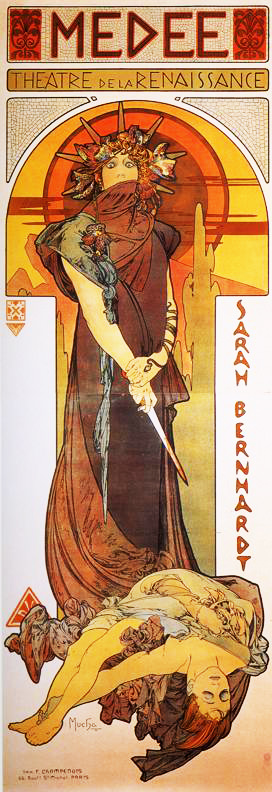
Mucha became widely known for theatre designs for Sarah Bernhardt, including Gismonda, Médée and Hamlet. Those posters established a public language of long figures, controlled gestures, ornament and prominent performer names. The Maude Adams commission carries some of that language into a different setting and object type. It was made for an American actor and a production at Harvard University Stadium rather than for a Bernhardt play at the Théâtre de la Renaissance.[1][3]
The Mucha Foundation timeline says Mucha was commissioned to paint Adams in the role and also designed the production's costumes and sets.[3] The painting was thus one part of a wider theatrical project. The local image cannot show those costumes and sets in use, so it would be misleading to treat its flowers as a literal record of the stage. Its purpose was to give the role a memorable public image and to promote the event, while the performance itself depended on people, space and scenery beyond the canvas.
The design credits are not entirely consistent across sources. In a producer-side retrospective, Isaac Frederick Marcosson and Daniel Frohman say that artist John W. Alexander was engaged to design the costumes.[8] The Foundation assigns costume and set work to Mucha.[3] Neither short account itemises which garments, drawings or built pieces each man supplied. They may describe different parts of a collaborative production, but the documents quoted here do not prove a division of labour. Adams's own practical control over the staging, recorded by the USPTO, adds another layer of authorship.[6] The safest conclusion is that Mucha's painting belonged to a production with several creative hands, rather than reading it as evidence that he designed every costume seen on stage.
Adams herself was more than the subject of that publicity. A US Patent and Trademark Office history of her stagecraft describes her close control over the Harvard production's scenery and lighting. The huge playing area required coloured cue lights visible to performers and coordination among stage managers, extras and scenery workers.[6] This gives the painting's single poised figure a useful counterpoint: it advertised an actress who also helped organize a complex outdoor theatrical machine. Mucha's painted invitation had to work at a glance; the live play unfolded through changing light, movement and crowds.
The production was planned before the painting was finished. In December 1908, The Harvard Crimson reported that the university had approved stadium use for performances on 21 and 22 June 1909, under the Germanic Museum Association, with Adams offering her services for the museum's benefit.[7] A later Crimson notice announced extra seating for the 22 June performance, while The Billboard reviewed a five-act performance on that date and named Anna Swanwick as translator of the verse.[10][11] Thus the Met's one-night gala statement describes the well-documented 22 June event; it should not erase the earlier two-night plan. A Harvard archive catalogue still labels the production as performed on both dates, so the exact status of 21 June remains a source question rather than a fact to settle from the painting.[12]
Frohman's retrospective reproduces an introduction to a photographic record of the production that dates the performance it documents to Tuesday, 22 June 1909 and says it was given for the Germanic Museum's building fund.[8] That contemporary wording strengthens the identification of the main gala night, although it does not by itself disprove an earlier performance or rehearsal. The event's financial result is clearer. In 1911, a Crimson report on plans for the museum's new building said about $10,000 of its subscriptions had come from Adams's Joan of Arc presentation.[13] This connects the advertised role to a specific institutional outcome. Mucha's painted actor was part of a benefit campaign, not simply publicity for a commercial run.
The same contemporary review names Adams as Joan and lists other roles, including Charles VII, Queen Isabeau and Talbot.[11] Those names belong to the staged drama, not to hidden portraits in Mucha's floral border. Keeping that distinction matters because the painting deliberately concentrates a five-act cast and pageant into one recognisable performer. The theatrical context expands our understanding of its purpose without making it an illustration of the entire production.
The Met records the painting as a 1920 gift from A. J. Kobler, object number 20.33.[1] That is useful provenance, but it tells us nothing about why Kobler gave it. The old page speculated about motives for museum donations and broad American cultural trends. Neither helps identify what is shown or how this particular work was made. The documented facts are enough: a 1909 Mucha oil painting connected to Adams's Schiller role, subsequently held by the Met, with a separate related print in the Foundation catalogue.[1][2]
What the image leaves open
This painting invites comparison with Mucha's Bernhardt poster for Hamlet. Both present an actor in a male role through an elongated figure and a carefully controlled mood. Their mediums, productions and narrative signs differ. Hamlet is a lithographic theatre poster with the ghost and Ophelia placed around Bernhardt. Maude Adams as Joan of Arc is a Met oil painting whose flowers, frame and faint apparition focus attention on a moment of calling.[1] The comparison tests Mucha's recurring methods without making the two objects interchangeable.
The inherited picture on this page preserves the overall arrangement, not the full material experience of a tall painted canvas and designed frame. The Met's catalogue supplies the medium and size, while the Foundation supplies a related print and photograph. Together they offer several ways to follow the commission without asserting that one small JPEG represents every state of the work.[1][2][4] From here, the artist biography and the linked theatre pages provide the wider career context.
Watch: Alphonse Mucha
Explore Mucha’s theatre posters and his collaboration with Sarah Bernhardt.
Alfons Mucha: Gismonda
A National Gallery Prague highlight centred on the breakthrough Sarah Bernhardt poster.
Watch on YouTubeArtworks directory
| Name | Date | Medium |
|---|---|---|
| 'Accept Love and Enthusiasm from Your Son, Mother of the Holy Nation': study for the mural 'By Own Strength III' at the Lord Mayor's Hall, Obecní Dům, Prague | 1910-1911 | Pencil and charcoal on canvas |
| 'By force towards freedom, with love towards unity!': study for the mural 'By Own Strength II' at the Lord Mayor's Hall, Obecní Dům, Prague | 1910-1911 | Pencil and charcoal on canvas |
| 'The Passing Wind Takes Youth Away': design for a fan and the façade of the 'Pavilion of Man' (unrealised) | 1899 | Colour lithograph |
| 'Through humiliated and tortured, you will live again, my country!': study for the mural 'By Own Strength II' at the Lord Mayor's Hall, Obecní Dům, Prague | 1910-1911 | Pencil and charcoal on canvas |
| 1918-1928: Poster for the 10th Anniversary of the Independence of the Republic of Czechoslovakia | 1928 | Colour lithograph |
| 6th Sokol Festival | 1912 | Colour lithograph |
| 8th Sokol Festival | 1925 | Colour lithograph |
| After the Battle of Grunwald | 1924 | egg tempera on canvas |
| After the Battle of Vitkov Hill | 1923 | egg tempera on canvas |
| Age of Love | 1936–1938 | |
| Age of Reason | 1936–1938 | |
| Age of Wisdom | 1936–1938 | |
| Amants | 1895 | Colour lithograph |
| Apotheosis of the Slavs | 1926 | Egg tempera on canvas |
| As Hamlet | 1899 | colour lithograph |
| Au Quartier Latin | 1898 | Magazine cover |
| Banknotes of Czechoslovakia, designed by Mucha: 500 crown; 50 Crown; 10 Crown | 1929 | Banknotes |
| Bieres de la Meuse | 1897 | Colour lithograph |
| Biscuits Champagne Lefevre Utile | 1896 | Colour lithograph |
| Biscuits Lefevre Utile | 1896 design for 1897 calendar; Foundation object/Carnavalet 1897 | Colour lithograph |
| Blessed are the Pure in Heart | 1906 | Printed magazine illustration |
| Bleu Deschamps | 1903 (deposit) | Colour lithograph |
| Bosnia & Herzegovina Pavilion - illustration featured in 'Le Figaro Illustré' (1 March 1900) | 1900 | Reproduction from Le Figaro Illustré after watercolour original |
| Bosnia-Herzegovina Pavilion: cartoon for the mural 'The Roman Period and the Arrival of the Slavs' | 1899-1900 | ink and crayon on paper |
| Bosnia-Herzegovina Pavilion: fragment of the upper frieze featuring Ivo and Anica, characters from Bosnian legends | 1899-1900 | tempera and watercolour on canvas |
| Bosnian Legends: Death of Hasanaga's Bride | 1899 | Charcoal on paper |
| Bosnian Legends: Murcia - The Plague Lady | 1899 | Charcoal on paper |
| Bosnian Pavilion Restaurant at the Paris Exhibition 1900: design for the menu | 1900 | Pencil and watercolour on paper |
| Boutique Fouquet (interior design) | 1901 | Shop interior design |
| Boutique Fouquet: sketches of the shop's signboard and decorative details | c.1900 | Pencil, ink and watercolour on paper |
| Box for Lefèvre-Utile biscuits: Gaufrettes Vanille | c.1900 | Tin box covered with lithographed label |
| Box for Lefèvre-Utile biscuits: Madère | c.1900 | Tin box covered with lithographed label |
| Brightness of the Day | 1899 | Colour lithograph |
| Broach with Pendant | 1900 | Gold, ivory, mother-of-pearl and semi-precious stones |
| Byzantine Head - The Blonde | 1897 | Colour lithograph |
| Byzantine Heads (pair) | 1897 | Colour lithograph |
| Byzantine Heads: Brunette | 1897 | Colour lithograph |
| Bénédictine | 1898 (BnF deposit); Hamburg 1899; MNAC 1896 or 1898 | Colour lithograph |
| Champagne Ruinart | 1896 | Colour lithograph |
| Chocolat Ideal | before or in 1897 (catalogue conflict) | Colour lithograph |
| Chocolat Masson (1897 calendar) | 1896–1897 | Colour lithograph |
| Choirboys at Petrov Church, Brno | 1905 | Watercolour on cardboard |
| Cloches de Noel | 1900 | Illustrated book |
| Comedy: study for a mural for the German Theatre, New York | 1908 | Oil on canvas |
| Cours Mucha: poster advertising Mucha's art classes held at the Académie Colarossi, Paris | 1900 | colour lithograph |
| Creative Force - Jan z Pernštýna: study for a pendentive of the Lord Mayor’s Hall, Obecní Dům, Prague | 1910-1911 | Oil on canvas |
| Crucifixion | c.1868 | Pencil, crayon and watercolour on paper |
| Cycles Perfecta | 1897 or 1902 (catalogue conflict) | Colour lithograph |
| Dance | 1898 | Colour lithograph |
| Dead Couple - Abandoned | c.1899-1900 | Charcoal and pastel on blue paper |
| Defense of Sziget against the Turks by Nicholas Zrinsky | 1914 | egg tempera on canvas |
| Design for a champagne poster | c. 1896 | Charcoal and pastel on paper |
| Design for a display stand at the Paris Exhibition 1900 | c.1899-1900 | Pencil and wash on paper |
| Design for Champagne Ruinart | c. 1896 | Pencil, watercolour and gold leaf on paper |
| Design for the cover of the magazine 'Fantaz' | 1882 | Ink and watercolour on paper |
| Design for the heading of the cover of the magazine 'Krokodil' | 1885 | Pen and ink on cardboard |
| Design for the poster for the Mucha Exhibition at the Brooklyn Museum, New York, January-February 1921 | 1920 | Pen and ink and watercolour on paper |
| Designs for cutlery | c.1900 | Charcoal and white on card |
| Designs for tableware | c.1900 | Charcoal, coloured pencil and white on card |
| Diadem for 'La princesse lointaine' | 1895 | metal and pearls |
| Diploma of Ivančice: Mock diploma honouring a local celebrity, with illustration of the first line of 'May', a poem by Karel Hynek Mácha | 1882 | Pen and ink and watercolour on paper |
| Documents décoratifs: designs for a watch and accessories (unused) | 1901-1902 | Pencil, ink and white on paper |
| Documents décoratifs: final study for Plate 25, featuring studies of lily | 1901-1902 | Pencil on paper |
| Documents décoratifs: final study for Plate 43 | 1901-1902 | Pencil, ink and wash, heightened with white on paper |
| Documents décoratifs: final study for Plate 49 | 1901-1902 | Pencil and white on paper |
| Documents décoratifs: final study for Plate 50 | 1901-1902 | Pencil and white on paper |
| Documents décoratifs: final study for Plate 60 | 1901-1902 | Pencil, ink and wash, heightened with white on paper |
| Documents décoratifs: final study for Plate 63 | 1901-1902 | Pencil and white on paper |
| Documents décoratifs: final study for Plate 67 | 1901-1902 | Pencil and white on paper |
| Documents décoratifs: final study for Plate 71 | 1901-1902 | Pencil and white on paper |
| Documents décoratifs: final study for Plate 72 | 1901-1902 | Pencil and wash, heightened with white on paper |
| Documents décoratifs: line drawing for Plate 33, featuring lily motifs | 1901-1902 | Pencil, pen and ink on paper |
| Documents décoratifs: Plate 54 | 1902 | Lithograph |
| Dreaming of Freedom: study for a Panel of the Small Reception Room at the Lord Mayor’s Hall, Obecní Dům, Prague | 1910-1911 | Pen and ink and watercolour on paper |
| Dusk | 1899 | Colour lithograph |
| Evening | 1899 | Colour lithograph |
| F. Champenois (Rêverie imprint) | 1898 | Colour lithograph |
| F. Guillot-Pelletier calendar (1898) | 1897–1898 | Colour lithograph |
| Feather | 1899 | Colour lithograph |
| Figures décoratives: final study for Plate 2 | 1904-1905 | Pencil and white on paper |
| Figures décoratives: final study for Plate 3 | 1904-1905 | Pencil and white on paper |
| Figures décoratives: final study for Plate14 | 1904-1905 | Pencil with white on paper |
| Figures décoratives: sketch study for Plate14 | 1904-1905 | Blue pencil on paper |
| Flirt Lefevre Utile | 1899 (Foundation design); BnF legal deposit 1900 | Colour lithograph |
| Flower | 1897 | Colour lithograph |
| Flower: final study for decorative panel | 1897 | Pencil, ink and watercolour on paper |
| France Embraces Bohemia | 1918 | oil on canvas |
| Fruit | 1897 | Colour lithograph |
| Georges Fouquet (1858-1929), Paris, after design by Mucha: Ornamental Chain with pendants | 1900 | Gold, enamel, fresh-water pearls, mother of pearl and semi-precious stones |
| Georges Fouquet (1858-1929), Paris, after Mucha design: 'Peacock' Ring (Exhibited at the Paris Exhibition 1900) | 1900 | Opal and gold |
| Girl Weeping | c.1899-1900 | Black chalk and pastel on paper |
| Girl with Loose Hair and Tulips | 1920 | Oil on canvas |
| Gismonda | 1894 | Colour lithograph |
| Head of a Girl, statue for the stand of the Houbigant Perfumery at the Paris Exhibition 1900 | 1900 | Bronze, silver and parcel gilt |
| Head of Sarah Bernhardt: Study for 'Lorenzaccio' | 1896 | Pencil on paper |
| Heather from Coastal Cliffs | 1902 | Colour lithograph |
| Heidsieck & Co | 1901 | Colour lithograph |
| Holy Mount Athos | 1926 | Egg tempera on canvas |
| Ilsée, Princesse de Tripoli | 1897 | Illustrated book |
| In the Desert: Study for an illustration for the Světozor magazine | 1889 | Pencil, watercolour and gouache on paper |
| Incantation (Salammbô) | 1897 | Lithograph |
| Independence - Jiří z Poděbrad: study for a pendentive of the Lord Mayor’s Hall, Obecní Dům, Prague | 1910-1911 | Oil on canvas |
| Interior and furniture designs | c.1900 | Pencil on paper |
| Interior of Boutique Fouquet: design for a wall-mounted display cabinet with statuette and mirror | c.1900 | Pencil on paper |
| Interior of Boutique Fouquet: design for the fireplace with statuettes, mirror, and the ornamental details of the wall | c.1900 | Pencil and watercolour on cardboard |
| Interior of Boutique Fouquet: sketches of the fireplace with statue, mirror, display cabinet, and the ornamental details of the wall | c.1900 | Pencil, pen and ink on paper |
| Ivy | 1901 | Colour lithograph |
| Jan Milic of Kromeriz | 1916 | egg tempera on canvas |
| Jaroslava and Jiří, the Artist’s Children | 1918 | Oil on canvas |
| JOB poster | 1896 | Colour lithograph |
| Judgement of Paris (calendar for Vieillemard printing company) | 1895 | Colour lithograph |
| Justice - Master Jan Hus: study for a pendentive of the Lord Mayor's Hall, Obecní dům, Prague | 1910-1911 | Oil on canvas |
| L'Annee Qui Vient | 1897 | red chalk on paper |
| L'Illustration magazine - cover for Christmas 1896/1897 | 1896 | Magazine cover |
| L'Illustré Soleil du Dimanche | 1897 | Magazine cover |
| La Dame aux Camélias: designs for cover and interior of special programme | 1896 | Pencil and watercolour on paper |
| La Nature | 1899-1900 | Bronze and amethyst |
| La Plume | 1897 | Magazine cover |
| La Samaritaine | 1897 | colour lithograph |
| Lance Parfum Rodo | 1896; Albertina print c. 1900 | Colour lithograph |
| Laurel | 1901 | Colour lithograph |
| Le Monde Illustré | 1900 | Magazine cover |
| Le Pater | 1899 | Illustrated book |
| Le Pater: early study for the 1st allegorical scene 'Our Father who art in Heaven' (1899) (Mucha Foundation object 300) | 1899 | Pencil on paper |
| Le Pater: early study for the 1st allegorical scene 'Our Father who art in Heaven' (1899) (Mucha Foundation object 302) | 1899 | Pastel on paper |
| Le Pater: study for the 6th allegorical scene 'Forgive us our debts, as we forgive our debtors' | 1899 | Charcoal and ink wash on paper |
| Lefevre Utile | 1904 | Advertisement |
| Leslie Carter | 1908 | Colour lithograph |
| Letem Českým Světem | 1898 | Printed book |
| Lorenzaccio | 1896 | Colour lithograph |
| Luchon poster (attributed to Mucha) | 1895 | Colour lithograph |
| Madonna of the Lilies | 1905 | Tempera on canvas |
| Master Jan Hus Preaching at the Bethlehem Chapel | 1916 | egg tempera on canvas |
| Maude Adams | 1908 | Lithograph, hand-coloured in watercolour and gouache |
| Maude Adams as Joan of Arc | 1909 | Oil on canvas |
| Medea | 1898 | Colour lithograph |
| Menu for the Bosnian Pavilion Restaurant at the Paris Exhibition 1900 | 1900 | Colour lithograph |
| Militancy - Jan Žižka: study for a pendentive of the Lord Mayor's Hall, Obecní dům, Prague | 1910-1911 | Oil on canvas |
| Military Camp in Winter, near a City on Fire | c.1899-1900 | Pastel on paper |
| Moet et Chandon | 1899 | Colour lithograph |
| Monaco Monte Carlo | 1897 | Colour lithograph |
| Moon | 1902 | |
| Moravian Teachers' Choir | 1911 | Colour lithograph |
| Morning Alphonse Mucha Painting / AlphonseMucha.org | 1899 | Colour lithograph |
| Morning Star | 1902 | Colour lithograph |
| Moët & Chandon White Star | 1899 | Colour lithograph |
| Mrs Mucha’s Necklace | 1906 | gold, enamel and semi-precious stones |
| Mural for the Bosnia-Herzegovina Pavilion: The Roman Period and the Arrival of the Slavs | 1900 | tempera and watercolour on canvas |
| Murals by Mucha in the Lord Mayor's Hall, Obecní Dům (Municipal House), Prague (1910-1911) | ||
| Music | 1898 | Colour lithograph |
| Nativity | c. 1934 | oil on canvas |
| Nestle's Food for Infants | 1897 | Colour lithograph |
| Night | 1899 | Colour lithograph |
| Nude on a Rock | 1898-1899 | Bronze |
| Official Banquet of the Paris Exhibition 1900: design for the menu featuring a fashionable woman wearing a Mucha-style jewellery | 1900 | Pencil, gouache and wash on grey paper |
| Ornamental motifs designed for 'Combinaisons Ornementales se Multipliant à l'Infini à l'Aide du Miroir' (1901) | c.1900-1901 | Blue and red pencil on paper |
| Packaging for 'Savon Mucha Violette' | 1906 | Colour lithograph |
| Packaging for Lefèvre-Utile biscuits: Boudoir | 1901 | Colour lithograph |
| Page's Costume: study for an illustration for 'Le Costume au Théâtre' | 1890 | Pencil and watercolour on cardboard |
| Painting | 1898 | Colour lithograph |
| Peonies | 1897–1898 | Ink and watercolour |
| Petr Chelcicky at Vodnany | 1918 | egg tempera on canvas |
| Poetry | 1898 | Colour lithograph |
| Portrait of Jaroslava | c.1927-1935 | Oil on canvas |
| Portrait of Josephine Crane Bradley as Slavia | 1908 | Oil and tempera on canvas |
| Portrait of Marie Chytilová (Maruška), Mucha's Future Wife | 1903 | pastel on paper |
| Portrait of Mucha's Sister, Angela | c.1880 | Oil on canvas |
| Portrait of Mucha's Sister, Anna | c.1885 | Oil on canvas |
| Portrait of Mucha's Son, Jiří | 1925 | Oil on canvas |
| Portrait of Mucha's Wife, Maruška | 1908/17 | Oil on canvas |
| Portrait of Woman | c. mid 1910s - 1925 | Blue pastel on grey paper |
| Poster for 'Hommage Respectueux de Nestlé' (the Nestlé Company's tribute to Queen Victoria's 60th Jubilee) | 1897 | Colour lithograph |
| Poster for 'Imprimerie Cassan Fils' | 1896 | Colour lithograph |
| JOB poster (1898) | 1898 | Colour lithograph |
| Poster for 'La Dame aux Camélias' | 1896 | Colour lithograph |
| Poster for 'La Tosca' | 1899 | Colour lithograph |
| Poster for 'Regional Exhibition at Ivančice 1913' | 1912 | Colour lithograph |
| Poster for 'The Slav Epic Exhibition, Brno, 1930' | 1928-1930 | Colour lithograph |
| Poster for 'Waverley Cycles' | 1898 | Colour lithograph |
| Poster for the 'Lottery of the Union of Southwestern Moravia' | 1912 | Colour lithograph |
| Poster for the Austrian Pavilion at the Paris Exhibition 1900 | 1900 | Colour lithograph |
| Prague Subjugated: study for a Panel of the Small Reception Room at the Lord Mayor’s Hall, Obecní Dům, Prague | 1910-1911 | Pen and ink and watercolour on paper |
| Primrose | 1899 | Colour lithograph |
| Primrose and Feather (paired image) | 1899 | Colour lithographs (paired image) |
| Princess Hyacinth (Princezna Hyacinta) | 1911 | Colour lithograph |
| Print proof for the Biscuits Lefèvre-Utile tin | 1899 | Lithograph |
| Reverie | 1898 | Colour lithograph |
| Russia Restituenda [Russia Must Recover] | 1922 | Colour lithograph |
| Salome | 1897 | Colour lithograph |
| Salon des Cent | 1896 | Colour lithograph |
| Salon of the Hundred | 1897 | Colour lithograph |
| Sarah Bernhardt - La Princesse Lointaine - Lefevre Utile | 1903 | Colour lithograph |
| Sarah Bernhardt as La Princesse Lointaine: poster for 'La Plume' magazine | 1897 | Colour lithograph |
| Sarah Bernhardt in the role of the Duc de Reichstadt in L’Aiglon | 1900 | Pencil on paper |
| Sarah Bernhardt: study of her full-standing figure | c.1896 | Pen and ink on paper |
| Savonnerie de Bagnolet calendar | 1898 (calendar) | Printed advertising calendar |
| Self-portrait (1899) | 1899 | Oil on board |
| Self-portrait (1907) | 1907 | Blue and white crayon on blue Ingres paper |
| Self-portrait, sketching in his apartment, Paris | late 1880s | oil on canvas |
| Sketches of flowers for Documents décoratifs | c.1900-1901 | Pen and ink on paper |
| Slavia insurance poster | 1907 | Poster |
| Slavs in their Original Homeland | 1912 | Egg tempera on canvas |
| Snake Bracelet with a Ring | 1899 | Gold, enamel, opal, ruby and diamond |
| Société Populaire des Beaux Arts | 1897 | Colour lithograph |
| Song of Bohemia | 1918 | oil on canvas |
| St. Vitus Cathedral Stained-glass Window, Prague: final design for the central panels, featuring SS Cyril and Methodius | 1931 | Ink and watercolour on paper |
| St. Vitus Cathedral Stained-glass Window, Prague: final design for the central panels, featuring St. Ludmila | 1931 | Ink and watercolour on paper |
| St. Vitus Cathedral Stained-glass Window, Prague: final design for the central panels, featuring St. Wenceslas (Duke of Bohemia) kneeling next to his Grandmother, St. Ludmila | 1931 | Ink and watercolour on paper |
| St.Vitus Cathedral Stained-glass Window, Prague: final design for the bottom left panels | 1931 | Ink and watercolour on paper |
| St.Vitus Cathedral Stained-glass Window, Prague: final design for the bottom right panels | 1931 | Ink and watercolour on paper |
| Stained-glass Window designed by Mucha at St. Vitus Cathedral, Prague | Early 1930s | N/A |
| Study for 'The Age of Reason' | 1936-1938 | Pencil and watercolour on paper |
| Study for 'The Slav Epic cycle' No.19: The Abolition of Serfdom in Russia | 1913-1914 | Watercolour and gouache on paper |
| Study for 'The Slav Epic' cycle No.14: The Sacrifice at Szigetvár by Nikola Zrinski | c.1913-1914 | Photographed drawings stuck together, tinted with watercolour and gouache |
| Study for 'The Slav Epic' cycle No.17: The Holy Mount Athos (1926) | c.1925-26 | Charcoal heightened with white on cardboard |
| Study for 'The Slav Epic' cycle No.18: The Oath of Omladina under the Slavic Linden Tree | c.1925-1926 | Pencil and watercolour on paper |
| Study for 'The Slav Epic' cycle No.1: The Slavs in Their Original Homeland (1912) | c.1910-1912 | Oil on canvas |
| Study for 'The Slav Epic' cycle No.2: The Celebration of Svantovít | c.1910-1912 | Oil on canvas |
| Study for 'The Slav Epic' cycle No.7: Jan Milíč of Kroměříž | c.1915-1916 | Oil on canvas |
| Study for 'The Slav Epic' cycle No.9: Master Jan Hus Preaching at the Bethlehem Chapel. The Magic of the Word: Truth Prevails (1412). | c.1915-1916 | Oil on canvas |
| Study for 'The Three Ages' triptych: Reason, Wisdom and Love [unfinished project] | 1936-1938 | Pencil and watercolour on paper |
| Study for 'Woman in the Wilderness' (c. 1922-1923) (Mucha Foundation object 315) | c. 1922-1923 | oil on canvas |
| Study for 'Woman in the Wilderness' (c. 1922-1923) (Mucha Foundation object 316) | c. 1922-1923 | oil on canvas |
| Study for Savon Notre Dame | c. 1896 | pencil and watercolour on paper |
| Study for the poster 'Russia Restituenda [Russia Must Recover]' | 1922 | Pen and ink and watercolour on paper |
| Study of a Male Nude | 1885-1887 | Oil on canvas |
| The Abolition of Serfdom in Russia | 1914 | Egg tempera on canvas |
| The Arts (series) | 1898 | Colour lithograph |
| The Arts: study for 'Dance' | 1898 | Pencil and watercolour on paper |
| The Arts: study for 'Music' | 1898 | Pencil and watercolour on paper |
| The Arts: study for 'Painting' | 1898 | Pencil and watercolour on paper |
| The Arts: study for 'Poetry' | 1898 | Pencil and watercolour on paper |
| The Bohemian King Premysl Otakar II | 1924 | egg tempera on canvas |
| The Bulgarian Tsar Simeon | 1923 | egg tempera on canvas |
| The Burr McIntosh Monthly, 1907 | 1907 | Magazine cover |
| The Celebration of Svantovit | 1912 | egg tempera on canvas |
| The Coronation of the Serbian Tsar Stefan Dusan as East Roman Emperor | 1923 | egg tempera on canvas |
| The Devil and Mr Twardowsky: study for an illustration for 'The Tale of Pan Twardowsky' (a variation of 'Faust') | c.1887-1888 | Charcoal on paper |
| The Flowers (series) | 1898 | Colour lithographs |
| The Flowers: Carnation | 1898 | Colour lithograph |
| The Flowers: Iris | 1898 | Colour lithograph |
| The Flowers: Lily | 1898 | Colour lithograph |
| The Flowers: Rose | 1898 | Colour lithograph |
| The Hussite King Jiri of Podebrady | 1923 | Egg tempera on canvas |
| The Introduction of the Slavonic Liturgy | 1912 | egg tempera on canvas |
| The Last Days of Jan Amos Komensky (Comenius) in Naarden | 1918 | Egg tempera on canvas |
| The Light of Hope | 1933 | Oil on canvas |
| The Meeting at Krizky | 1916 | egg tempera on canvas |
| The Months (January-June) | 1899 | Colour lithograph |
| The Months (July-December) | 1899 | Colour lithograph |
| The Moon and the Stars (four-panel montage) | 1902 | Colour lithographs (four-panel montage) |
| The Moon and the Stars (series) | 1902 | Colour lithograph |
| The Moon and the Stars: study for 'The Evening Star' | 1902 | Ink and watercolour on paper |
| The Moon and the Stars: study for 'The Pole Star' | 1902 | Ink and watercolour on paper |
| The New York Daily News art supplement | 1904 | Printed art supplement |
| The Oath of Concord of the Slavs (unfinished) | 1939 | oil on canvas |
| The Oath of Omladina under the Slavic Linden Tree | 1926, unfinished | Egg tempera on canvas |
| The Precious Stones (four-panel montage) | 1900 | Colour lithographs (four-panel montage) |
| The Precious Stones (series) | 1900 | Colour lithograph |
| The Precious Stones: Amethyst | 1900 | Colour lithograph |
| The Precious Stones: Emerald | 1900 | Colour lithograph |
| The Precious Stones: Ruby | 1900 | Colour lithograph |
| The Printing of the Bible of Kralice in Ivancice | 1914 | egg tempera on canvas |
| The Seasons (series) | 1896 | Colour lithograph |
| The Seasons (series) (1900) | 1900 | Colour lithograph |
| The Seasons (variation in screen format) | 1896 | Colour lithograph |
| The Seasons: Autumn (1896) | 1896 | Colour lithograph |
| The Seasons: Autumn (1900) | 1900 | Colour lithograph |
| The Seasons: Spring | 1900 | Colour lithograph |
| The Seasons: Spring (1896) | 1896 | Colour lithograph |
| The Seasons: Summer | 1900 | Colour lithograph |
| The Seasons: Summer (1896) | 1896 | Colour lithograph |
| The Seasons: Winter | 1900 | Colour lithograph |
| The Seasons: Winter (1896) | 1896 | Colour lithograph |
| The Slavonic Concord: study for the ceiling painting for the Lord Mayor's Hall, Obecní Dům, Prague | 1910-1911 | Oil on canvas |
| The Threat | 1912 | Colour lithograph |
| The Times of the Day (series) | 1899 | Colour lithograph |
| The West End Review | 1897 (Foundation); 1898 promotional cover | Colour lithograph |
| Thistle from the Sands | 1902 | Colour lithograph |
| Théâtre de la Renaissance: design for poster advertising Sarah Bernhardt's theatre | c.1895 | Pen and ink on paper |
| Tin for Lefèvre-Utile biscuits | 1899 | Circular tin with lid and handle; colour print on metal |
| Topaz | 1900 | Colour lithograph |
| Tragedy - study for a mural for the German theatre New York | 1908 | Oil and tempera on canvas |
| Trappistine Liquors | 1897 | colour lithograph |
| Wiener Chic | 1905 | Magazine cover |
| Woman in the Wilderness | 1923 | Oil on canvas |
| Woman masked in white head-scarf - study for the illustration of the Bosnia & Herzegovina Pavilion featured in 'Le Figaro Illustré' (1 March 1900) | 1899 | Pencil and wash heightened with white on paper |
| Woman with a Daisy - textile designed by Mucha | 1900 | Printed upholstery fabric |
| Zdenka Cerny | 1913 | Colour lithograph |
| Zodiac (La Plume calendar) | 1896–97 | Colour lithograph |
| Zodiac (textless decorative panel) | 1896 | Colour lithograph |
| ‘At the sight of the two storks the owl rose.’ Study for an illustration for Contes de Grand-mères | 1891 | Watercolour and gouache on paper |
Frequently Asked Questions
Is Maude Adams as Joan of Arc a poster or painting?
What is Joan seeing?
Did Mucha design the frame?
Discussion
The Met catalogues a 1909 oil painting made to promote Maude Adams in Schiller’s play.
A separate 1908 lithograph and a staged-model photograph belong to the wider commission.
Reader Insights
Where do you notice the faint apparition behind Adams?
How does the designed frame guide your eye toward the actor?
What changes when you distinguish the painting from the related print?
Join the Conversation
Share a detail that helps you read the role or the painting’s public purpose.
References
- The Metropolitan Museum of Art, Maude Adams (1872–1953) as Joan of Arc, object 20.33; 1909 oil on canvas, dimensions, frame, performance context and 1920 gift. Met object record.
- Mucha Foundation, Maude Adams (1908), object 332; separate hand-coloured lithograph and relation to the Met painting. Foundation object record.
- Mucha Foundation, artist timeline, Maude Adams commission and Mucha's stage/costume design work. Foundation timeline.
- Mucha Foundation, Model posing as Joan of Arc for the poster (unrealised) ‘The Maid of Orleans’ featuring Maude Adams, New York (1909), object 39. Foundation photograph record.
- Lempertz, catalogue for Jeanne d’Arc. Vor der Schlacht/Jeanne d’Arc. Erscheinung, two signed pastel-and-gouache designs, sale 1256, lot 1, November 2024; object-specific measurements and the cataloguer's design-sequence account. Sale catalogue.
- United States Patent and Trademark Office, “Out of the Limelight,” historical account of Adams's production and lighting work at Harvard. Read source.
- The Harvard Crimson, “Maude Adams to Play in Stadium,” 10 December 1908, original announcement of the proposed 21–22 June dates and Germanic Museum benefit. Read notice.
- Isaac Frederick Marcosson and Daniel Frohman, Charles Frohman: Manager and Man, retrospective producer-side account of the 22 June pageant and its opening vision. Read digitised book.
- Joan of Arc Statue Committee, Joan of Arc Loan Exhibition Catalogue (1913), entries 637 and 642 for the programme group and Frohman-lent poster. Read digitised catalogue.
- The Harvard Crimson, “Additional Seats for ‘Joan of Arc’,” 15 June 1909. Read notice.
- The Billboard, “Maude Adams Scores in Role of Joan of Arc,” 3 July 1909, contemporary review with cast and Anna Swanwick translation credit. Read digitised issue.
- Harvard University Archives, Photograph Collection: Subjects: Panoramas, p. 24, catalogue description of a 1909 stadium photograph, recording the production as performed on 21 and 22 June. View archive inventory.
- The Harvard Crimson, “Germanic Museum Plans,” 9 June 1911, reporting about $10,000 raised through Adams's Joan of Arc presentation for the new museum building. Read report.
- The Metropolitan Museum of Art, A Concise Catalogue of the European Paintings (1954), p. 70, records the painting's lower-left “Mucha/1909” signature and the Kobler gift. Met catalogue PDF.
- Yvonne Shafer, “Maude Adams as Joan of Arc at the Harvard Stadium,” Journal of American Drama and Theatre 11, no. 3 (Fall 1999), pp. 30–46, especially p. 36 on a proposed film effect that Adams rejected. Digitised journal issue.