by Tom Gurney
Tom Gurney BSc (Hons) is an art history expert with over 20 years experience
Page Created on / Page Updated on
Email: tomgurney1@gmail.com / Phone: +44 7429 011000
Monaco–Monte-Carlo: A Railway Poster Without a Train
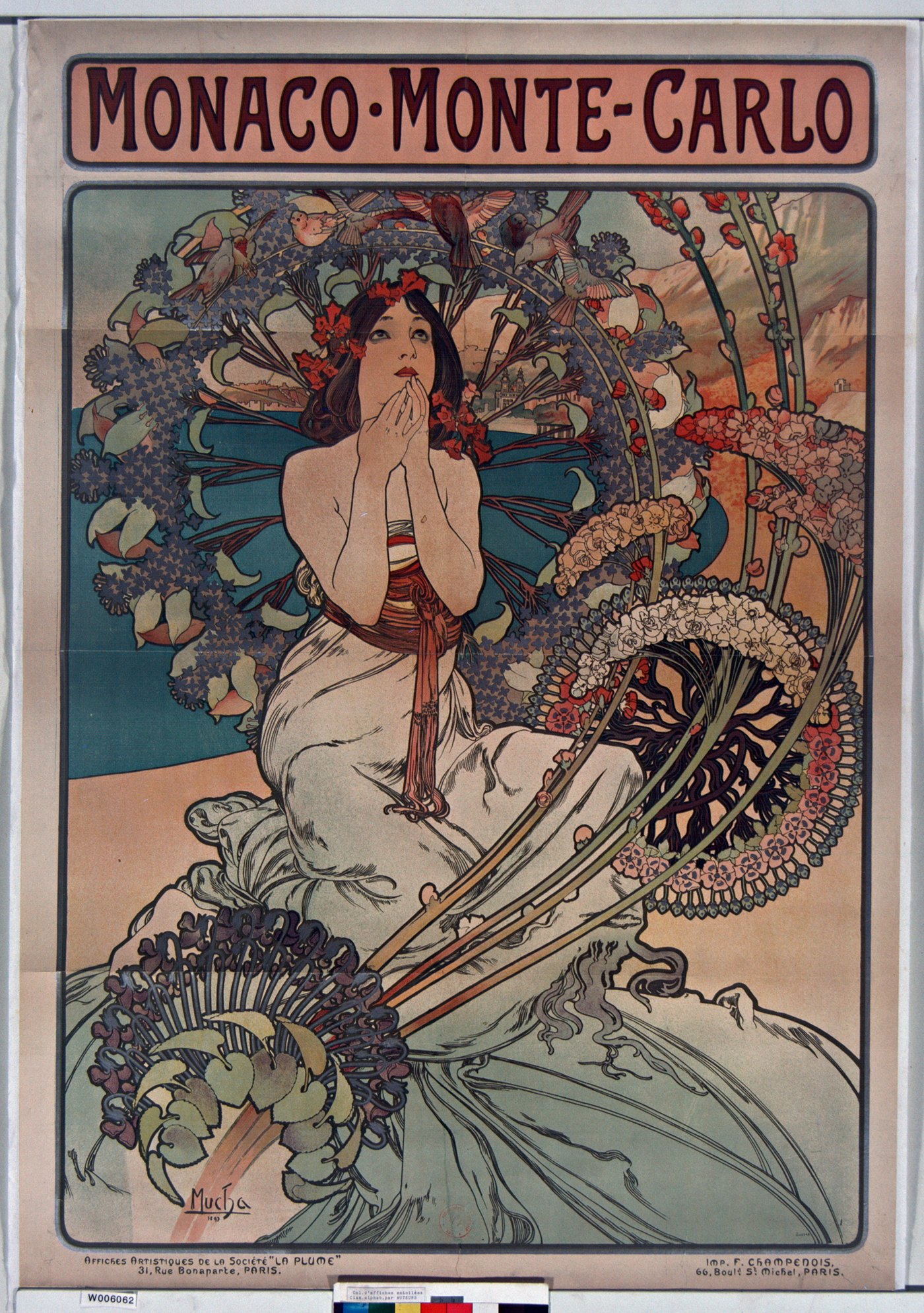
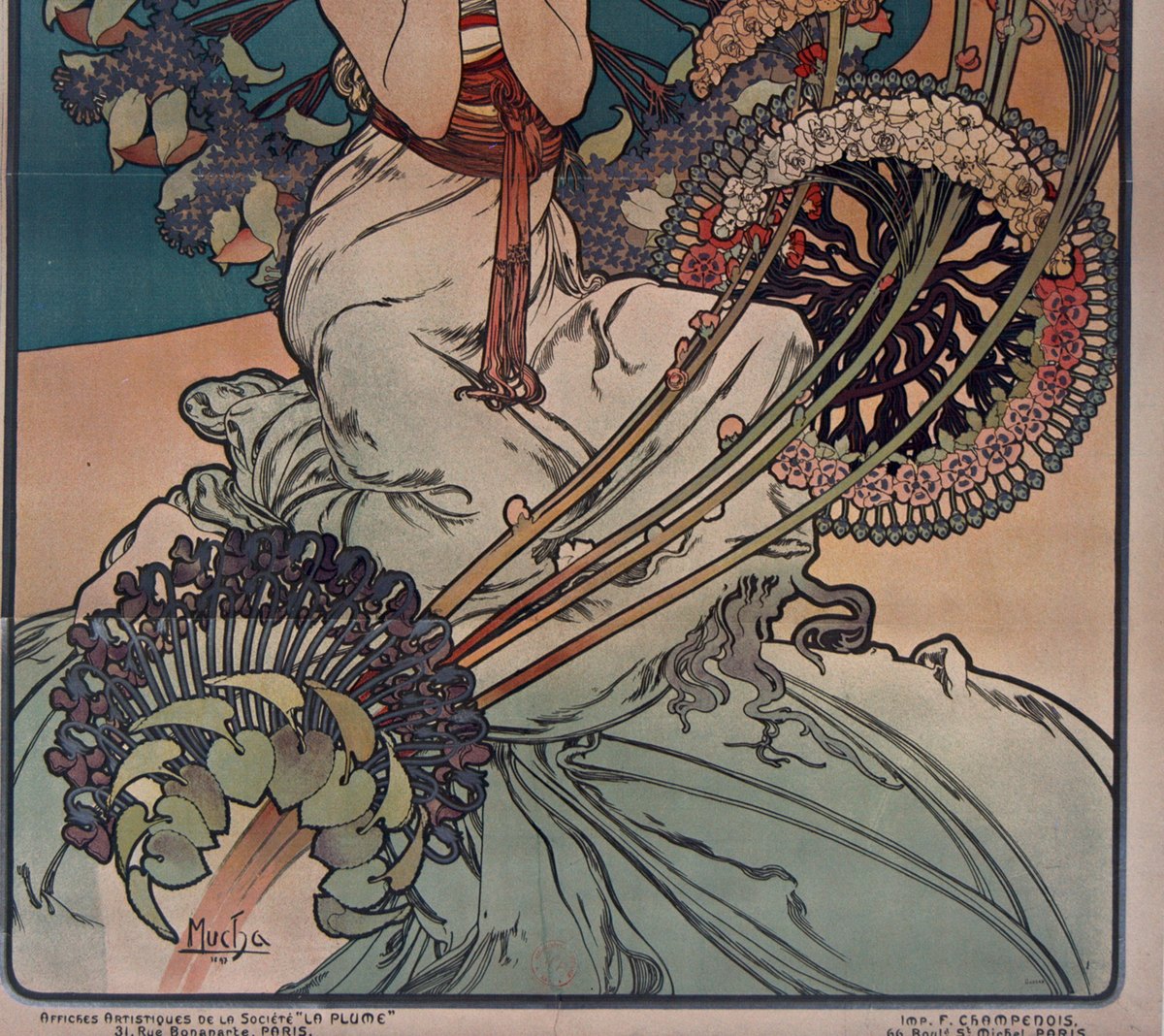
Alphonse Mucha's Monaco–Monte-Carlo invites a journey by showing its imagined pleasure rather than the vehicle. A woman kneels before blue sea and a mountainous coast, her hands raised to her face as flowers, birds and long curving stems gather around her. Across the top, the destination's name fills a narrow panel. The Mucha Foundation identifies the 1897 design as a poster for P.L.M. railway services, printed in colour lithography by F. Champenois in Paris.[1] The version reproduced on this page has no P.L.M. lettering. That detail matters: the Bibliothèque nationale de France catalogues a separate no-lettering state offered to collectors by La Plume, alongside a state naming the railway.[2][3]
At a Glance
- WorkMonaco–Monte-Carlo, designed for P.L.M. railway services[1]
- Date1897[1][2]
- Mediumcolour lithograph; Mucha Foundation dimensions 110.5 × 76.5 cm for its catalogued poster[1]
- Printed byF. Champenois, Paris[1][2]
- Version shownwithout P.L.M. lettering, corresponding to BnF notice FRBNF40461174 and Gallica ark:/12148/btv1b9016307c[2]
- Related statewith P.L.M. lettering, BnF notice FRBNF40461169[3]
- Local imageinherited 400 × 587-pixel JPEG; sourced close-reading details come from a separate high-resolution BnF scan of the no-lettering state[2]
Monaco–Monte-Carlo in Mucha’s career
Contents
- A destination advertised through anticipation
- Flowers, birds and curves
- One design, two lettering states
- The design in *La Plume*'s Mucha publication
- What the poster makes visible and leaves out
A destination advertised through anticipation
The large title gives the viewer the place immediately: Monaco·Monte-Carlo. The rest of the poster lets that name acquire a mood. Instead of a timetable, platform or locomotive, Mucha places a woman at the centre of a landscape of sea, coast and flowers. The Foundation describes her hands-to-face pose as one of wonder.[1] The Phillips Collection's Timeless Mucha exhibition text says the railway's promotion invoked a 16-hour luxury train journey from Paris to Monte-Carlo and interprets the woman as anticipating a holiday.[4] The visible poster does not state that journey time in the state shown here; it is supplied by the exhibition's account of the campaign.
The woman is close to the viewer, while the coastline is compressed into the distance behind her. That change of scale is part of the advertising work. The traveler need not read a map to imagine arrival. Mucha makes the destination feel personal before it feels geographic. The sea's blue area opens behind her shoulders, and a line of mountains closes the horizon. The Foundation also identifies the small towers of Monte-Carlo's casino in the background.[1] They are a specific marker of place, though easy to miss in the small inherited image.
The figure's pose does not prove that Mucha visited Monaco, witnessed this scene or drew a named model. The page's older text claimed that the commission gave him an opportunity to travel there; the object records used here do not establish such a trip. This is an advertising image designed to turn a rail destination into an attractive prospect. Its figure and landscape should be read as crafted invitations, not as a documentary account of a particular traveler.
Flowers, birds and curves
The woman is surrounded by a dense arrangement of plants. The Mucha Foundation names lilac, hydrangea, dianthus and violet among the flowers; it describes the design as a meeting of relatively realistic figure and highly stylised decoration.[1] In the print, some stems rise behind the figure and others sweep from the lower left toward a round wreath at the right. The wreath almost repeats the curve around the woman's head. Birds appear near the upper branches. These details reward close viewing because they turn what could be a simple coastal portrait into a composition that seems to move around and past the figure.
The flowers are not just a frame placed over a view. They compete with the coast for attention and create pathways through the poster. A viewer can follow the long stems upward from the lower corner, circle the wreath, cross the woman's blue background and return to the title. The hand and face remain the emotional centre, yet the plant lines do much of the work of carrying the eye. Mucha uses the rectangular poster format as a field for movement rather than leaving its edges empty.
The Phillips exhibition text interprets the stems and flower wreath as allusions to rail tracks and wheels.[4] The Mucha Museum in Prague offers a similar reading but phrases it as likely rather than certain.[5] That distinction is useful. The curves can suggest mechanical travel without depicting a machine, but they also remain flowers and decorative forms. We can recognise the institutional interpretation while treating it as a reading of the image, not a documented statement of Mucha's private intention.
The woman's pale dress and red accents stand out against the sea blue. Her raised hands bring attention back to her expression after the eye has travelled through the ornament. In the larger BnF scan of this no-lettering state, the fine birds and distant architecture are easier to distinguish than in the 400-pixel inherited image.[2] The two files are different digital reproductions of the same typographic state; their colour and surface texture should not be treated as measurements of one physical impression.
One design, two lettering states
The BnF makes a decisive distinction between two 1897 states. Its notice FRBNF40461169 describes a version with the P.L.M. mention. Its notice FRBNF40461174 describes a version without that mention and says the no-lettering variant was offered to collectors by the journal La Plume.[2][3] The local poster has the title at the top but no railway name, matching the latter state. This is more precise than calling the image merely “the P.L.M. poster” or assuming every surviving print carries the same words.
The no-lettering state still belongs to the railway commission. Removing a line of advertiser text changes how the design is encountered, not the origin of the composition. A passer-by seeing a railway-marked sheet could immediately link the destination with a service. A collector offered a sheet without that line could enjoy the same design as a decorative print. This is an inference from the BnF's two notices and its statement about La Plume; neither notice documents how any particular viewer used a specific impression.[2][3]
The BnF records La Plume as commercial publisher and Champenois as printer for both its with-P.L.M. and without-P.L.M. states.[2][3] Those roles should not be collapsed into one. The changed lettering identifies what is printed on each sheet; it does not, by itself, establish that the printer or commercial publisher changed. The BnF even links the records as another state or printing of the same poster. Its shared publication date of 1897 does not tell us which state appeared first or how many copies of either were made. The Mucha Foundation gives F. Champenois as printer of the poster design and dimensions of 110.5 × 76.5 cm.[1] The BnF rounds its sheets to 111 × 77 cm.[2][3] These numbers are close but refer to different institutional cataloguing of physical impressions. They are not measurements of this page's 400 × 587-pixel JPEG or of the separate digital source scan used for the annotations.
A 2025 Swiss auction catalogue transcribes the lettering on a particular P.L.M. impression in much fuller detail.[6] Below the printed area it names the Affiches Artistiques de la Société La Plume at 31 rue Bonaparte, Paris; within the design it promotes return and circular tickets, reduced-price family return tickets, and a 16-hour luxury journey. That copy explains what the railway-marked state actually offered, beyond the broad invitation conveyed by the destination title. It also shows that the 16-hour figure in the Phillips exhibition account has a basis in lettering recorded on a surviving print, even though it is absent from the no-P.L.M. state discussed on this page.[4][6]
The journey time is an advertising promise documented by the poster transcription. The records consulted for this page do not include a contemporary P.L.M. timetable that would independently establish a particular train's departure, stops or arrival. Likewise, the fare categories indicate the kinds of tickets promoted, not their prices or the conditions of purchase.[6]
The Kornfeld catalogue measures its canvas-mounted colour lithograph at 110.8 × 75.6 cm and names Ferdinand Champenois as printer.[6] Its folds, small paper losses and partly lifting mount are condition notes about that one sheet. They should not be turned into features of the design or used to dismiss the different Foundation and BnF sizes. The notice also gives a documented private-collection provenance, which is useful for that impression but does not establish the origin of every surviving poster.
A French sale record offers a particularly clear warning about reading dimensions in isolation. Rouillac catalogued a no-P.L.M. lithograph at 95 × 70 cm, substantially shorter than the BnF's sheets, but expressly said that its upper title band was missing. The same description notes folds, tears and fading from light.[11] The smaller measurement therefore describes an incomplete surviving impression. It is not evidence for a third, originally smaller edition, nor for a design issued without the destination title. The sale record confirms the no-P.L.M. identification, yet its printed address for La Plume says 31 boulevard Bonaparte. Kornfeld's transcription of the railway-marked impression gives 31 rue Bonaparte.[6][11] Because these two later catalogues disagree, the address should be quoted with its source rather than silently standardised.
Other public collections preserve further objects from the poster's long afterlife. Japan's National Center for Art Research lists a Monaco Monte-Carlo lithograph in Shimonoseki City Art Museum, accession P-802-001, at 105 × 70 cm.[7] Its Japanese provenance field records a museum purchase in fiscal 1982, citing the museum's 1996 print catalogue. That is an acquisition history for the Shimonoseki work, not evidence that the print itself was made in 1982 or that it has the same lettering as the BnF sheet. The University of Michigan Museum of Art separately lists a 1970 museum purchase, accession 1970/2.117.[8] Its dimensions include a 3.81 cm depth, so the full 134.94 × 96.84 × 3.81 cm entry describes a three-dimensional presented object and should not be equated with a bare paper sheet. Neither short record specifies the P.L.M. text state.[7][8]
The Mucha Foundation also records receiving a Monaco Monte-Carlo poster from Gail and Charles Lucky in 2014.[9] Its gift notice establishes the donation, but does not say whether that object is the impression measured in the Foundation's separate poster record. These accession and gift records show how the railway advertisement entered collections across different countries without supplying a chain of custody for the local reproduction.[1][7][8][9]
The Phillips exhibition checklist also includes a pencil sketch for the composition dated 1897 alongside a colour lithograph.[4] It is evidence that the poster passed through a drawing stage; it is not an additional printed state and is not reproduced on this page. The sketch's presence in the exhibition offers a useful route for comparing design and print, but the checklist alone does not justify narrating every change between them.
The design in La Plume's Mucha publication
The poster's circulation extended beyond full-size sheets. A Czech museum's conservation documentation describes La Plume's special Mucha publication, Alphonse Mucha et son oeuvre, and separates its serial instalments from three separately issued versions.[10] In the third separate version, a reproduction of Monaco–Monte-Carlo replaces a Mucha illustration for Le Monde Moderne on page 45. That is a reproduction inside a publication, not another full-size poster state. It also makes the design's relationship with La Plume more concrete than the collector-state catalogue notice alone: the publisher reused it in its printed presentation of Mucha's work.
The same bibliographic account says that all of these versions carry 1897 dates, while the third separate version did not actually appear until 1899.[10] Thus the date printed on a bound copy and the date of its issue may differ. Neither changes the poster's established 1897 design date. The report also distinguishes the first version's journal pagination from later separately numbered pages, which helps explain why a reference to “page 45” applies to the third separate version rather than every copy of the special publication. This afterlife should not be mistaken for proof of a second Monaco commission or for evidence that the no-P.L.M. street sheet was first sold in 1899.
What the poster makes visible and leaves out
Railway advertising could have shown its service directly. Mucha instead relies on the title, a memorable central figure and ornament that can imply movement. The Phillips text notes that he avoided a conventional image of travelers.[4] That helps explain why the poster can survive the removal of P.L.M. lettering without losing its visual coherence. Its destination and promise remain legible even when the company name is absent.
The picture also balances specificity and imagination. The named resort, sea, mountains and casino towers place it in Monte-Carlo; the woman's expression makes that setting feel like an experience yet to be had.[1][4] The long stems and circular flowers let an advertising poster work as a richly patterned image. Readers can compare it with Mucha's Gismonda or JOB to see how he repeatedly used figures and curved ornament while changing the message, product and audience.
The sourced scan used below is a no-P.L.M. BnF impression, not a blown-up copy of the inherited JPEG. Its actual pixel dimensions support close inspection of the title, landscape and floral structure. It does not turn every shape into a proven symbol, and it cannot prove Mucha's itinerary or the identity of his model. The value of a closer view is simpler: it lets the railway commission, collector variant and visual choices be read at the right scale and kept distinct.[1][2]
Look closer: the no-P.L.M. poster
These details are derived directly from the BnF’s high-resolution scan of its 1897 collector variant without P.L.M. lettering. The scan is a separate impression from the inherited image above.
 1
2
3
Details from the no-P.L.M. poster
Select a detail image to open the full-size gallery, then use the arrows to compare views.
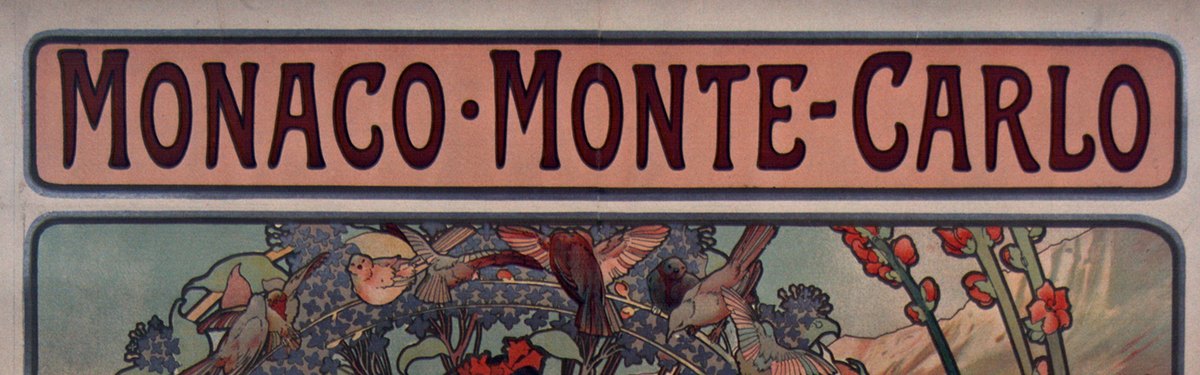
Destination before company
The place name dominates the top band. This state omits the P.L.M. name; the BnF says La Plume offered the variant to collectors.[2]
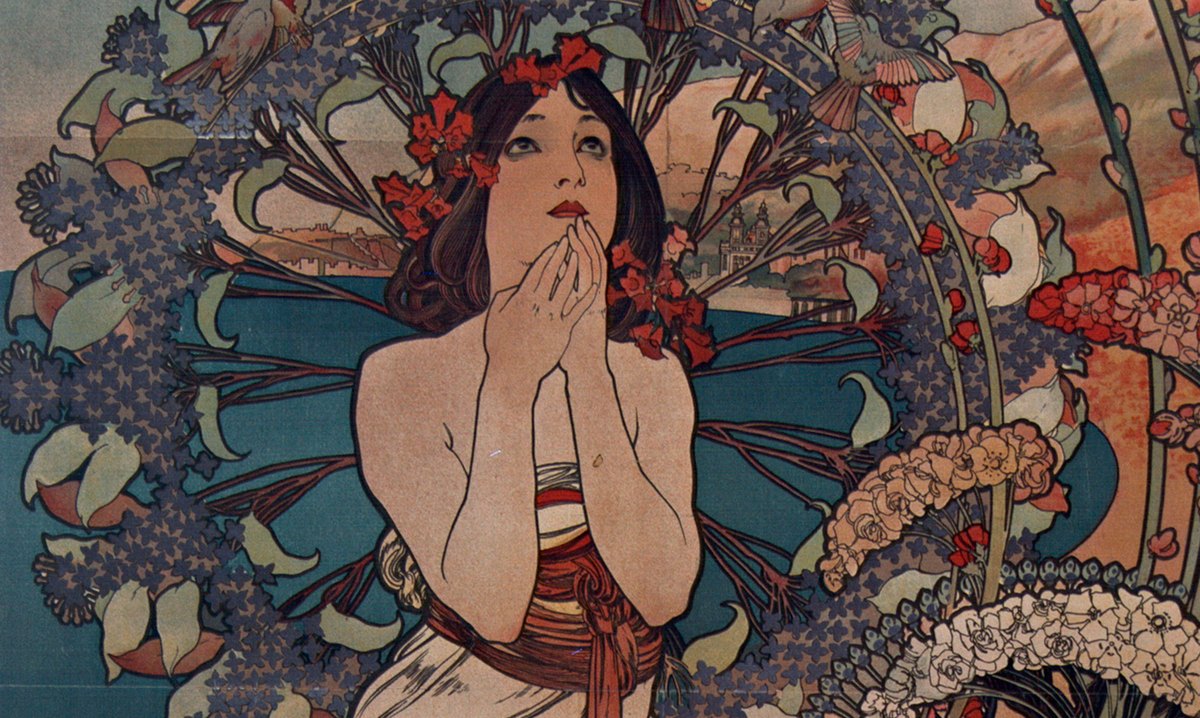
An imagined arrival
The sea and distant buildings sit behind the woman's face. The Mucha Foundation identifies casino towers in this backdrop.[1]
Lines that carry the eye
Stems sweep into a round floral form. The Phillips Collection interprets them as allusions to tracks and wheels; that is a reading of the design.[4]
Watch: Alphonse Mucha
See how Mucha’s commercial design grew from the same Paris visual language as his theatre posters.
Alphonse Mucha: Plongez dans l’Art nouveau !
A French museum introduction to Mucha’s Art Nouveau years, poster work and decorative language.
Watch on YouTubeArtworks directory
| Name | Date | Medium |
|---|---|---|
| 'Accept Love and Enthusiasm from Your Son, Mother of the Holy Nation': study for the mural 'By Own Strength III' at the Lord Mayor's Hall, Obecní Dům, Prague | 1910-1911 | Pencil and charcoal on canvas |
| 'By force towards freedom, with love towards unity!': study for the mural 'By Own Strength II' at the Lord Mayor's Hall, Obecní Dům, Prague | 1910-1911 | Pencil and charcoal on canvas |
| 'The Passing Wind Takes Youth Away': design for a fan and the façade of the 'Pavilion of Man' (unrealised) | 1899 | Colour lithograph |
| 'Through humiliated and tortured, you will live again, my country!': study for the mural 'By Own Strength II' at the Lord Mayor's Hall, Obecní Dům, Prague | 1910-1911 | Pencil and charcoal on canvas |
| 1918-1928: Poster for the 10th Anniversary of the Independence of the Republic of Czechoslovakia | 1928 | Colour lithograph |
| 6th Sokol Festival | 1912 | Colour lithograph |
| 8th Sokol Festival | 1925 | Colour lithograph |
| After the Battle of Grunwald | 1924 | egg tempera on canvas |
| After the Battle of Vitkov Hill | 1923 | egg tempera on canvas |
| Age of Love | 1936–1938 | |
| Age of Reason | 1936–1938 | |
| Age of Wisdom | 1936–1938 | |
| Amants | 1895 | Colour lithograph |
| Apotheosis of the Slavs | 1926 | Egg tempera on canvas |
| As Hamlet | 1899 | colour lithograph |
| Au Quartier Latin | 1898 | Magazine cover |
| Banknotes of Czechoslovakia, designed by Mucha: 500 crown; 50 Crown; 10 Crown | 1929 | Banknotes |
| Bieres de la Meuse | 1897 | Colour lithograph |
| Biscuits Champagne Lefevre Utile | 1896 | Colour lithograph |
| Biscuits Lefevre Utile | 1896 design for 1897 calendar; Foundation object/Carnavalet 1897 | Colour lithograph |
| Blessed are the Pure in Heart | 1906 | Printed magazine illustration |
| Bleu Deschamps | 1903 (deposit) | Colour lithograph |
| Bosnia & Herzegovina Pavilion - illustration featured in 'Le Figaro Illustré' (1 March 1900) | 1900 | Reproduction from Le Figaro Illustré after watercolour original |
| Bosnia-Herzegovina Pavilion: cartoon for the mural 'The Roman Period and the Arrival of the Slavs' | 1899-1900 | ink and crayon on paper |
| Bosnia-Herzegovina Pavilion: fragment of the upper frieze featuring Ivo and Anica, characters from Bosnian legends | 1899-1900 | tempera and watercolour on canvas |
| Bosnian Legends: Death of Hasanaga's Bride | 1899 | Charcoal on paper |
| Bosnian Legends: Murcia - The Plague Lady | 1899 | Charcoal on paper |
| Bosnian Pavilion Restaurant at the Paris Exhibition 1900: design for the menu | 1900 | Pencil and watercolour on paper |
| Boutique Fouquet (interior design) | 1901 | Shop interior design |
| Boutique Fouquet: sketches of the shop's signboard and decorative details | c.1900 | Pencil, ink and watercolour on paper |
| Box for Lefèvre-Utile biscuits: Gaufrettes Vanille | c.1900 | Tin box covered with lithographed label |
| Box for Lefèvre-Utile biscuits: Madère | c.1900 | Tin box covered with lithographed label |
| Brightness of the Day | 1899 | Colour lithograph |
| Broach with Pendant | 1900 | Gold, ivory, mother-of-pearl and semi-precious stones |
| Byzantine Head - The Blonde | 1897 | Colour lithograph |
| Byzantine Heads (pair) | 1897 | Colour lithograph |
| Byzantine Heads: Brunette | 1897 | Colour lithograph |
| Bénédictine | 1898 (BnF deposit); Hamburg 1899; MNAC 1896 or 1898 | Colour lithograph |
| Champagne Ruinart | 1896 | Colour lithograph |
| Chocolat Ideal | before or in 1897 (catalogue conflict) | Colour lithograph |
| Chocolat Masson (1897 calendar) | 1896–1897 | Colour lithograph |
| Choirboys at Petrov Church, Brno | 1905 | Watercolour on cardboard |
| Cloches de Noel | 1900 | Illustrated book |
| Comedy: study for a mural for the German Theatre, New York | 1908 | Oil on canvas |
| Cours Mucha: poster advertising Mucha's art classes held at the Académie Colarossi, Paris | 1900 | colour lithograph |
| Creative Force - Jan z Pernštýna: study for a pendentive of the Lord Mayor’s Hall, Obecní Dům, Prague | 1910-1911 | Oil on canvas |
| Crucifixion | c.1868 | Pencil, crayon and watercolour on paper |
| Cycles Perfecta | 1897 or 1902 (catalogue conflict) | Colour lithograph |
| Dance | 1898 | Colour lithograph |
| Dead Couple - Abandoned | c.1899-1900 | Charcoal and pastel on blue paper |
| Defense of Sziget against the Turks by Nicholas Zrinsky | 1914 | egg tempera on canvas |
| Design for a champagne poster | c. 1896 | Charcoal and pastel on paper |
| Design for a display stand at the Paris Exhibition 1900 | c.1899-1900 | Pencil and wash on paper |
| Design for Champagne Ruinart | c. 1896 | Pencil, watercolour and gold leaf on paper |
| Design for the cover of the magazine 'Fantaz' | 1882 | Ink and watercolour on paper |
| Design for the heading of the cover of the magazine 'Krokodil' | 1885 | Pen and ink on cardboard |
| Design for the poster for the Mucha Exhibition at the Brooklyn Museum, New York, January-February 1921 | 1920 | Pen and ink and watercolour on paper |
| Designs for cutlery | c.1900 | Charcoal and white on card |
| Designs for tableware | c.1900 | Charcoal, coloured pencil and white on card |
| Diadem for 'La princesse lointaine' | 1895 | metal and pearls |
| Diploma of Ivančice: Mock diploma honouring a local celebrity, with illustration of the first line of 'May', a poem by Karel Hynek Mácha | 1882 | Pen and ink and watercolour on paper |
| Documents décoratifs: designs for a watch and accessories (unused) | 1901-1902 | Pencil, ink and white on paper |
| Documents décoratifs: final study for Plate 25, featuring studies of lily | 1901-1902 | Pencil on paper |
| Documents décoratifs: final study for Plate 43 | 1901-1902 | Pencil, ink and wash, heightened with white on paper |
| Documents décoratifs: final study for Plate 49 | 1901-1902 | Pencil and white on paper |
| Documents décoratifs: final study for Plate 50 | 1901-1902 | Pencil and white on paper |
| Documents décoratifs: final study for Plate 60 | 1901-1902 | Pencil, ink and wash, heightened with white on paper |
| Documents décoratifs: final study for Plate 63 | 1901-1902 | Pencil and white on paper |
| Documents décoratifs: final study for Plate 67 | 1901-1902 | Pencil and white on paper |
| Documents décoratifs: final study for Plate 71 | 1901-1902 | Pencil and white on paper |
| Documents décoratifs: final study for Plate 72 | 1901-1902 | Pencil and wash, heightened with white on paper |
| Documents décoratifs: line drawing for Plate 33, featuring lily motifs | 1901-1902 | Pencil, pen and ink on paper |
| Documents décoratifs: Plate 54 | 1902 | Lithograph |
| Dreaming of Freedom: study for a Panel of the Small Reception Room at the Lord Mayor’s Hall, Obecní Dům, Prague | 1910-1911 | Pen and ink and watercolour on paper |
| Dusk | 1899 | Colour lithograph |
| Evening | 1899 | Colour lithograph |
| F. Champenois (Rêverie imprint) | 1898 | Colour lithograph |
| F. Guillot-Pelletier calendar (1898) | 1897–1898 | Colour lithograph |
| Feather | 1899 | Colour lithograph |
| Figures décoratives: final study for Plate 2 | 1904-1905 | Pencil and white on paper |
| Figures décoratives: final study for Plate 3 | 1904-1905 | Pencil and white on paper |
| Figures décoratives: final study for Plate14 | 1904-1905 | Pencil with white on paper |
| Figures décoratives: sketch study for Plate14 | 1904-1905 | Blue pencil on paper |
| Flirt Lefevre Utile | 1899 (Foundation design); BnF legal deposit 1900 | Colour lithograph |
| Flower | 1897 | Colour lithograph |
| Flower: final study for decorative panel | 1897 | Pencil, ink and watercolour on paper |
| France Embraces Bohemia | 1918 | oil on canvas |
| Fruit | 1897 | Colour lithograph |
| Georges Fouquet (1858-1929), Paris, after design by Mucha: Ornamental Chain with pendants | 1900 | Gold, enamel, fresh-water pearls, mother of pearl and semi-precious stones |
| Georges Fouquet (1858-1929), Paris, after Mucha design: 'Peacock' Ring (Exhibited at the Paris Exhibition 1900) | 1900 | Opal and gold |
| Girl Weeping | c.1899-1900 | Black chalk and pastel on paper |
| Girl with Loose Hair and Tulips | 1920 | Oil on canvas |
| Gismonda | 1894 | Colour lithograph |
| Head of a Girl, statue for the stand of the Houbigant Perfumery at the Paris Exhibition 1900 | 1900 | Bronze, silver and parcel gilt |
| Head of Sarah Bernhardt: Study for 'Lorenzaccio' | 1896 | Pencil on paper |
| Heather from Coastal Cliffs | 1902 | Colour lithograph |
| Heidsieck & Co | 1901 | Colour lithograph |
| Holy Mount Athos | 1926 | Egg tempera on canvas |
| Ilsée, Princesse de Tripoli | 1897 | Illustrated book |
| In the Desert: Study for an illustration for the Světozor magazine | 1889 | Pencil, watercolour and gouache on paper |
| Incantation (Salammbô) | 1897 | Lithograph |
| Independence - Jiří z Poděbrad: study for a pendentive of the Lord Mayor’s Hall, Obecní Dům, Prague | 1910-1911 | Oil on canvas |
| Interior and furniture designs | c.1900 | Pencil on paper |
| Interior of Boutique Fouquet: design for a wall-mounted display cabinet with statuette and mirror | c.1900 | Pencil on paper |
| Interior of Boutique Fouquet: design for the fireplace with statuettes, mirror, and the ornamental details of the wall | c.1900 | Pencil and watercolour on cardboard |
| Interior of Boutique Fouquet: sketches of the fireplace with statue, mirror, display cabinet, and the ornamental details of the wall | c.1900 | Pencil, pen and ink on paper |
| Ivy | 1901 | Colour lithograph |
| Jan Milic of Kromeriz | 1916 | egg tempera on canvas |
| Jaroslava and Jiří, the Artist’s Children | 1918 | Oil on canvas |
| JOB poster | 1896 | Colour lithograph |
| Judgement of Paris (calendar for Vieillemard printing company) | 1895 | Colour lithograph |
| Justice - Master Jan Hus: study for a pendentive of the Lord Mayor's Hall, Obecní dům, Prague | 1910-1911 | Oil on canvas |
| L'Annee Qui Vient | 1897 | red chalk on paper |
| L'Illustration magazine - cover for Christmas 1896/1897 | 1896 | Magazine cover |
| L'Illustré Soleil du Dimanche | 1897 | Magazine cover |
| La Dame aux Camélias: designs for cover and interior of special programme | 1896 | Pencil and watercolour on paper |
| La Nature | 1899-1900 | Bronze and amethyst |
| La Plume | 1897 | Magazine cover |
| La Samaritaine | 1897 | colour lithograph |
| Lance Parfum Rodo | 1896; Albertina print c. 1900 | Colour lithograph |
| Laurel | 1901 | Colour lithograph |
| Le Monde Illustré | 1900 | Magazine cover |
| Le Pater | 1899 | Illustrated book |
| Le Pater: early study for the 1st allegorical scene 'Our Father who art in Heaven' (1899) (Mucha Foundation object 300) | 1899 | Pencil on paper |
| Le Pater: early study for the 1st allegorical scene 'Our Father who art in Heaven' (1899) (Mucha Foundation object 302) | 1899 | Pastel on paper |
| Le Pater: study for the 6th allegorical scene 'Forgive us our debts, as we forgive our debtors' | 1899 | Charcoal and ink wash on paper |
| Lefevre Utile | 1904 | Advertisement |
| Leslie Carter | 1908 | Colour lithograph |
| Letem Českým Světem | 1898 | Printed book |
| Lorenzaccio | 1896 | Colour lithograph |
| Luchon poster (attributed to Mucha) | 1895 | Colour lithograph |
| Madonna of the Lilies | 1905 | Tempera on canvas |
| Master Jan Hus Preaching at the Bethlehem Chapel | 1916 | egg tempera on canvas |
| Maude Adams | 1908 | Lithograph, hand-coloured in watercolour and gouache |
| Maude Adams as Joan of Arc | 1909 | Oil on canvas |
| Medea | 1898 | Colour lithograph |
| Menu for the Bosnian Pavilion Restaurant at the Paris Exhibition 1900 | 1900 | Colour lithograph |
| Militancy - Jan Žižka: study for a pendentive of the Lord Mayor's Hall, Obecní dům, Prague | 1910-1911 | Oil on canvas |
| Military Camp in Winter, near a City on Fire | c.1899-1900 | Pastel on paper |
| Moet et Chandon | 1899 | Colour lithograph |
| Monaco Monte Carlo | 1897 | Colour lithograph |
| Moon | 1902 | |
| Moravian Teachers' Choir | 1911 | Colour lithograph |
| Morning Alphonse Mucha Painting / AlphonseMucha.org | 1899 | Colour lithograph |
| Morning Star | 1902 | Colour lithograph |
| Moët & Chandon White Star | 1899 | Colour lithograph |
| Mrs Mucha’s Necklace | 1906 | gold, enamel and semi-precious stones |
| Mural for the Bosnia-Herzegovina Pavilion: The Roman Period and the Arrival of the Slavs | 1900 | tempera and watercolour on canvas |
| Murals by Mucha in the Lord Mayor's Hall, Obecní Dům (Municipal House), Prague (1910-1911) | ||
| Music | 1898 | Colour lithograph |
| Nativity | c. 1934 | oil on canvas |
| Nestle's Food for Infants | 1897 | Colour lithograph |
| Night | 1899 | Colour lithograph |
| Nude on a Rock | 1898-1899 | Bronze |
| Official Banquet of the Paris Exhibition 1900: design for the menu featuring a fashionable woman wearing a Mucha-style jewellery | 1900 | Pencil, gouache and wash on grey paper |
| Ornamental motifs designed for 'Combinaisons Ornementales se Multipliant à l'Infini à l'Aide du Miroir' (1901) | c.1900-1901 | Blue and red pencil on paper |
| Packaging for 'Savon Mucha Violette' | 1906 | Colour lithograph |
| Packaging for Lefèvre-Utile biscuits: Boudoir | 1901 | Colour lithograph |
| Page's Costume: study for an illustration for 'Le Costume au Théâtre' | 1890 | Pencil and watercolour on cardboard |
| Painting | 1898 | Colour lithograph |
| Peonies | 1897–1898 | Ink and watercolour |
| Petr Chelcicky at Vodnany | 1918 | egg tempera on canvas |
| Poetry | 1898 | Colour lithograph |
| Portrait of Jaroslava | c.1927-1935 | Oil on canvas |
| Portrait of Josephine Crane Bradley as Slavia | 1908 | Oil and tempera on canvas |
| Portrait of Marie Chytilová (Maruška), Mucha's Future Wife | 1903 | pastel on paper |
| Portrait of Mucha's Sister, Angela | c.1880 | Oil on canvas |
| Portrait of Mucha's Sister, Anna | c.1885 | Oil on canvas |
| Portrait of Mucha's Son, Jiří | 1925 | Oil on canvas |
| Portrait of Mucha's Wife, Maruška | 1908/17 | Oil on canvas |
| Portrait of Woman | c. mid 1910s - 1925 | Blue pastel on grey paper |
| Poster for 'Hommage Respectueux de Nestlé' (the Nestlé Company's tribute to Queen Victoria's 60th Jubilee) | 1897 | Colour lithograph |
| Poster for 'Imprimerie Cassan Fils' | 1896 | Colour lithograph |
| JOB poster (1898) | 1898 | Colour lithograph |
| Poster for 'La Dame aux Camélias' | 1896 | Colour lithograph |
| Poster for 'La Tosca' | 1899 | Colour lithograph |
| Poster for 'Regional Exhibition at Ivančice 1913' | 1912 | Colour lithograph |
| Poster for 'The Slav Epic Exhibition, Brno, 1930' | 1928-1930 | Colour lithograph |
| Poster for 'Waverley Cycles' | 1898 | Colour lithograph |
| Poster for the 'Lottery of the Union of Southwestern Moravia' | 1912 | Colour lithograph |
| Poster for the Austrian Pavilion at the Paris Exhibition 1900 | 1900 | Colour lithograph |
| Prague Subjugated: study for a Panel of the Small Reception Room at the Lord Mayor’s Hall, Obecní Dům, Prague | 1910-1911 | Pen and ink and watercolour on paper |
| Primrose | 1899 | Colour lithograph |
| Primrose and Feather (paired image) | 1899 | Colour lithographs (paired image) |
| Princess Hyacinth (Princezna Hyacinta) | 1911 | Colour lithograph |
| Print proof for the Biscuits Lefèvre-Utile tin | 1899 | Lithograph |
| Reverie | 1898 | Colour lithograph |
| Russia Restituenda [Russia Must Recover] | 1922 | Colour lithograph |
| Salome | 1897 | Colour lithograph |
| Salon des Cent | 1896 | Colour lithograph |
| Salon of the Hundred | 1897 | Colour lithograph |
| Sarah Bernhardt - La Princesse Lointaine - Lefevre Utile | 1903 | Colour lithograph |
| Sarah Bernhardt as La Princesse Lointaine: poster for 'La Plume' magazine | 1897 | Colour lithograph |
| Sarah Bernhardt in the role of the Duc de Reichstadt in L’Aiglon | 1900 | Pencil on paper |
| Sarah Bernhardt: study of her full-standing figure | c.1896 | Pen and ink on paper |
| Savonnerie de Bagnolet calendar | 1898 (calendar) | Printed advertising calendar |
| Self-portrait (1899) | 1899 | Oil on board |
| Self-portrait (1907) | 1907 | Blue and white crayon on blue Ingres paper |
| Self-portrait, sketching in his apartment, Paris | late 1880s | oil on canvas |
| Sketches of flowers for Documents décoratifs | c.1900-1901 | Pen and ink on paper |
| Slavia insurance poster | 1907 | Poster |
| Slavs in their Original Homeland | 1912 | Egg tempera on canvas |
| Snake Bracelet with a Ring | 1899 | Gold, enamel, opal, ruby and diamond |
| Société Populaire des Beaux Arts | 1897 | Colour lithograph |
| Song of Bohemia | 1918 | oil on canvas |
| St. Vitus Cathedral Stained-glass Window, Prague: final design for the central panels, featuring SS Cyril and Methodius | 1931 | Ink and watercolour on paper |
| St. Vitus Cathedral Stained-glass Window, Prague: final design for the central panels, featuring St. Ludmila | 1931 | Ink and watercolour on paper |
| St. Vitus Cathedral Stained-glass Window, Prague: final design for the central panels, featuring St. Wenceslas (Duke of Bohemia) kneeling next to his Grandmother, St. Ludmila | 1931 | Ink and watercolour on paper |
| St.Vitus Cathedral Stained-glass Window, Prague: final design for the bottom left panels | 1931 | Ink and watercolour on paper |
| St.Vitus Cathedral Stained-glass Window, Prague: final design for the bottom right panels | 1931 | Ink and watercolour on paper |
| Stained-glass Window designed by Mucha at St. Vitus Cathedral, Prague | Early 1930s | N/A |
| Study for 'The Age of Reason' | 1936-1938 | Pencil and watercolour on paper |
| Study for 'The Slav Epic cycle' No.19: The Abolition of Serfdom in Russia | 1913-1914 | Watercolour and gouache on paper |
| Study for 'The Slav Epic' cycle No.14: The Sacrifice at Szigetvár by Nikola Zrinski | c.1913-1914 | Photographed drawings stuck together, tinted with watercolour and gouache |
| Study for 'The Slav Epic' cycle No.17: The Holy Mount Athos (1926) | c.1925-26 | Charcoal heightened with white on cardboard |
| Study for 'The Slav Epic' cycle No.18: The Oath of Omladina under the Slavic Linden Tree | c.1925-1926 | Pencil and watercolour on paper |
| Study for 'The Slav Epic' cycle No.1: The Slavs in Their Original Homeland (1912) | c.1910-1912 | Oil on canvas |
| Study for 'The Slav Epic' cycle No.2: The Celebration of Svantovít | c.1910-1912 | Oil on canvas |
| Study for 'The Slav Epic' cycle No.7: Jan Milíč of Kroměříž | c.1915-1916 | Oil on canvas |
| Study for 'The Slav Epic' cycle No.9: Master Jan Hus Preaching at the Bethlehem Chapel. The Magic of the Word: Truth Prevails (1412). | c.1915-1916 | Oil on canvas |
| Study for 'The Three Ages' triptych: Reason, Wisdom and Love [unfinished project] | 1936-1938 | Pencil and watercolour on paper |
| Study for 'Woman in the Wilderness' (c. 1922-1923) (Mucha Foundation object 315) | c. 1922-1923 | oil on canvas |
| Study for 'Woman in the Wilderness' (c. 1922-1923) (Mucha Foundation object 316) | c. 1922-1923 | oil on canvas |
| Study for Savon Notre Dame | c. 1896 | pencil and watercolour on paper |
| Study for the poster 'Russia Restituenda [Russia Must Recover]' | 1922 | Pen and ink and watercolour on paper |
| Study of a Male Nude | 1885-1887 | Oil on canvas |
| The Abolition of Serfdom in Russia | 1914 | Egg tempera on canvas |
| The Arts (series) | 1898 | Colour lithograph |
| The Arts: study for 'Dance' | 1898 | Pencil and watercolour on paper |
| The Arts: study for 'Music' | 1898 | Pencil and watercolour on paper |
| The Arts: study for 'Painting' | 1898 | Pencil and watercolour on paper |
| The Arts: study for 'Poetry' | 1898 | Pencil and watercolour on paper |
| The Bohemian King Premysl Otakar II | 1924 | egg tempera on canvas |
| The Bulgarian Tsar Simeon | 1923 | egg tempera on canvas |
| The Burr McIntosh Monthly, 1907 | 1907 | Magazine cover |
| The Celebration of Svantovit | 1912 | egg tempera on canvas |
| The Coronation of the Serbian Tsar Stefan Dusan as East Roman Emperor | 1923 | egg tempera on canvas |
| The Devil and Mr Twardowsky: study for an illustration for 'The Tale of Pan Twardowsky' (a variation of 'Faust') | c.1887-1888 | Charcoal on paper |
| The Flowers (series) | 1898 | Colour lithographs |
| The Flowers: Carnation | 1898 | Colour lithograph |
| The Flowers: Iris | 1898 | Colour lithograph |
| The Flowers: Lily | 1898 | Colour lithograph |
| The Flowers: Rose | 1898 | Colour lithograph |
| The Hussite King Jiri of Podebrady | 1923 | Egg tempera on canvas |
| The Introduction of the Slavonic Liturgy | 1912 | egg tempera on canvas |
| The Last Days of Jan Amos Komensky (Comenius) in Naarden | 1918 | Egg tempera on canvas |
| The Light of Hope | 1933 | Oil on canvas |
| The Meeting at Krizky | 1916 | egg tempera on canvas |
| The Months (January-June) | 1899 | Colour lithograph |
| The Months (July-December) | 1899 | Colour lithograph |
| The Moon and the Stars (four-panel montage) | 1902 | Colour lithographs (four-panel montage) |
| The Moon and the Stars (series) | 1902 | Colour lithograph |
| The Moon and the Stars: study for 'The Evening Star' | 1902 | Ink and watercolour on paper |
| The Moon and the Stars: study for 'The Pole Star' | 1902 | Ink and watercolour on paper |
| The New York Daily News art supplement | 1904 | Printed art supplement |
| The Oath of Concord of the Slavs (unfinished) | 1939 | oil on canvas |
| The Oath of Omladina under the Slavic Linden Tree | 1926, unfinished | Egg tempera on canvas |
| The Precious Stones (four-panel montage) | 1900 | Colour lithographs (four-panel montage) |
| The Precious Stones (series) | 1900 | Colour lithograph |
| The Precious Stones: Amethyst | 1900 | Colour lithograph |
| The Precious Stones: Emerald | 1900 | Colour lithograph |
| The Precious Stones: Ruby | 1900 | Colour lithograph |
| The Printing of the Bible of Kralice in Ivancice | 1914 | egg tempera on canvas |
| The Seasons (series) | 1896 | Colour lithograph |
| The Seasons (series) (1900) | 1900 | Colour lithograph |
| The Seasons (variation in screen format) | 1896 | Colour lithograph |
| The Seasons: Autumn (1896) | 1896 | Colour lithograph |
| The Seasons: Autumn (1900) | 1900 | Colour lithograph |
| The Seasons: Spring | 1900 | Colour lithograph |
| The Seasons: Spring (1896) | 1896 | Colour lithograph |
| The Seasons: Summer | 1900 | Colour lithograph |
| The Seasons: Summer (1896) | 1896 | Colour lithograph |
| The Seasons: Winter | 1900 | Colour lithograph |
| The Seasons: Winter (1896) | 1896 | Colour lithograph |
| The Slavonic Concord: study for the ceiling painting for the Lord Mayor's Hall, Obecní Dům, Prague | 1910-1911 | Oil on canvas |
| The Threat | 1912 | Colour lithograph |
| The Times of the Day (series) | 1899 | Colour lithograph |
| The West End Review | 1897 (Foundation); 1898 promotional cover | Colour lithograph |
| Thistle from the Sands | 1902 | Colour lithograph |
| Théâtre de la Renaissance: design for poster advertising Sarah Bernhardt's theatre | c.1895 | Pen and ink on paper |
| Tin for Lefèvre-Utile biscuits | 1899 | Circular tin with lid and handle; colour print on metal |
| Topaz | 1900 | Colour lithograph |
| Tragedy - study for a mural for the German theatre New York | 1908 | Oil and tempera on canvas |
| Trappistine Liquors | 1897 | colour lithograph |
| Wiener Chic | 1905 | Magazine cover |
| Woman in the Wilderness | 1923 | Oil on canvas |
| Woman masked in white head-scarf - study for the illustration of the Bosnia & Herzegovina Pavilion featured in 'Le Figaro Illustré' (1 March 1900) | 1899 | Pencil and wash heightened with white on paper |
| Woman with a Daisy - textile designed by Mucha | 1900 | Printed upholstery fabric |
| Zdenka Cerny | 1913 | Colour lithograph |
| Zodiac (La Plume calendar) | 1896–97 | Colour lithograph |
| Zodiac (textless decorative panel) | 1896 | Colour lithograph |
| ‘At the sight of the two storks the owl rose.’ Study for an illustration for Contes de Grand-mères | 1891 | Watercolour and gouache on paper |
Frequently Asked Questions
What did Monaco–Monte-Carlo advertise?
Why is P.L.M. missing from this image?
Does the poster show a train?
Discussion
The Mucha Foundation identifies an 1897 colour lithograph for P.L.M. railway services.
The local image matches the BnF no-P.L.M. lettering variant offered by La Plume.
Reader Insights
Where do you first find the distant coastline and casino towers?
How do the long stems and flower ring lead your eye?
What changes when the railway name is absent?
Join the Conversation
Share a visible detail that affects your reading of this travel poster.
References
- Mucha Foundation, Poster for 'Monaco - Monte Carlo', P.L.M. railway services, object 47; commission, 1897 lithograph, dimensions, printer and description. Foundation object record.
- Bibliothèque nationale de France, Monaco-Monte-Carlo, notice FRBNF40461174; no-P.L.M. lettering variant offered to collectors by La Plume, with Gallica scan ark:/12148/btv1b9016307c. BnF catalogue notice.
- Bibliothèque nationale de France, Monaco, Monte-Carlo. Chemins de Fer P.L.M., notice FRBNF40461169; related state with P.L.M. lettering. BnF catalogue notice.
- The Phillips Collection / Mucha Foundation, Timeless Mucha: The Magic of Line, 2025 press kit, checklist and wall text on the poster and separate composition sketch. Exhibition press kit.
- Mucha Museum, Prague, exhibition text for Monaco Monte-Carlo, including its qualified reading of track and wheel forms. Museum exhibition page.
- Galerie Kornfeld, 2025 Moderne Kunst catalogue, lot 429, Monaco Monte-Carlo: transcription of P.L.M. and La Plume lettering, 110.8 × 75.6 cm for the canvas-mounted impression, Champenois printer and Eberhard W. Kornfeld collection provenance. Catalogue PDF.
- National Center for Art Research, Art Platform Japan, Shimonoseki City Art Museum Monaco Monte-Carlo, P-802-001, 105 × 70 cm and fiscal-1982 museum purchase, citing the museum's 1996 collection catalogue (Japanese). Collection record.
- University of Michigan Museum of Art, Monaco, Monte-Carlo, accession 1970/2.117, museum purchase and three-dimensional catalogue measurement. Collection record.
- Mucha Foundation, “Gifts and Legacies,” 2014 Monaco Monte-Carlo poster gift from Gail and Charles Lucky. Foundation account.
- Muzeum Brněnska, 2019 conservation documentation for the Mucha collection at Ivančice, bibliography of La Plume's special Mucha publication; distinguishes serial and separate versions, the page-45 Monaco reproduction, and the third separate version's 1899 issue despite its 1897 date (Czech). Published document, PDF.
- Rouillac, 36th Garden Party sale, lot 87, 2024; no-P.L.M. Monaco–Monte-Carlo lithograph, 95 × 70 cm with the upper title band missing and condition notes (French). Auction record.