by Tom Gurney
Tom Gurney BSc (Hons) is an art history expert with over 20 years experience
Page Created on / Page Updated on
Email: tomgurney1@gmail.com / Phone: +44 7429 011000
Alphonse Mucha Posters
Alphonse Mucha's posters reached audiences in streets, theatres, shops and railway advertising before many of them became familiar as images for the home. His breakthrough Gismonda design, made for Sarah Bernhardt in 1894 and displayed at the start of 1895, led to a series of theatre commissions. By 1896 Mucha had an exclusive contract with the Paris printer F. Champenois, and his designs were appearing across commercial and decorative formats.[1][2] Mucha's reputation as a poster artist rests on this ability to join a figure, a name and an occasion in an image that could be read quickly in public.
The reproduction above shows his 1897 Monaco–Monte-Carlo design. A woman kneels among flowers and curves before a coastal view, with the destination named across the top. It began as a railway commission, though the small inherited image shows no visible P.L.M. company lettering. The dedicated Monaco–Monte-Carlo article compares documented lettered and unlettered print states. Here the image is an entry point into the wider question: what did Mucha's posters advertise, and how did their printed forms change as they circulated?[5]
At a Glance
- ArtistAlphonse Mucha, Czech artist and designer active in Paris during the poster boom of the 1890s[1]
- BreakthroughGismonda for Sarah Bernhardt, designed in 1894 and displayed in January 1895[1][4]
- Main techniquecolour lithography for the best-known printed posters and decorative panels[1]
- PrinterF. Champenois, Paris, Mucha's exclusive publisher-printer from 1896 for many designs[1][2]
- Usestheatre, advertising, exhibitions, magazines and decorative panels; their purposes and printed states differ[1][2][3]
- Hero imagesmall inherited reproduction of the 1897 Monaco–Monte-Carlo design, with no visible P.L.M. lettering[5]
- Local image limit338 × 450 pixels; exact printed source and reproduction lineage untraced
Contents
- Why posters mattered to Mucha
- Theatre posters: a performer in a role
- Advertising travel and goods
- Exhibition notices and public art
- A poster for public art teaching
- Exhibition posters beyond Paris
- Decorative panels are a related category
- Following the printed work
Why posters mattered to Mucha
Posters were a public medium in late nineteenth-century Paris. They competed for attention on walls and hoardings, and improvements in colour lithography helped make large, vivid designs practicable.[1][2] A poster had to identify a play, product, place or event while making someone stop and look. Mucha answered that task with strong outlines, carefully placed lettering, rhythmic curves and figures that could hold a composition even at street scale. The commercial message and the image were planned together.
Lithography helps explain both the reach of these designs and their variety. In its account of the nineteenth-century Paris poster, Musée d’Orsay describes drawing on a stone with a greasy medium and printing through the repulsion of grease and water.[6] That is the basic process; a catalogue description of a “colour lithograph” identifies a print method, not the exact number of stones or colours used for every Mucha sheet. Orsay also describes a specialised collector market alongside street display. Some prints were made for enthusiasts and never pasted outdoors.[6] A clean surviving sheet is therefore not necessarily a poster rescued from a wall.
The Victoria and Albert Museum places this practice in a longer history of public notices. It credits Jules Chéret's three-stone colour process and relatively transparent inks with making large, colourful posters more workable, and notes his integration of drawn lettering into the design.[17] That background explains why Mucha inherited a mature visual medium rather than inventing colour poster printing. His achievement lay in applying it to commissions with unusually recognisable figures and framing. The V&A also catalogues a Champenois-printed Bières de la Meuse sheet, showing how a named commercial design belongs to the general history of posters as well as to Mucha's own career.[17]
Gismonda made the approach famous. Mucha placed Bernhardt in an elongated format, nearly life-size, with a stillness that stood apart from more forceful street advertising. The Mucha Foundation says its success led to a contract for stage and costume work as well as further posters.[4] That gave Mucha repeated opportunities to design the same star in different roles. His posters did not merely copy a theatrical photograph. Costume, gesture, ornament and the play's name worked together to promise a particular performance.
The Paris printer F. Champenois then became central to Mucha's wider output. The Foundation records an exclusive contract from 1896 and says Mucha produced more than 100 designs for advertisements, decorative panels and calendars under it.[1] That number spans several kinds of object. It is not a count of one hundred Bernhardt theatre posters. The printer could also issue related images in different forms, which is why a design's familiar appearance does not, on its own, establish the exact date, lettering or dimensions of every surviving print.
Theatre posters: a performer in a role
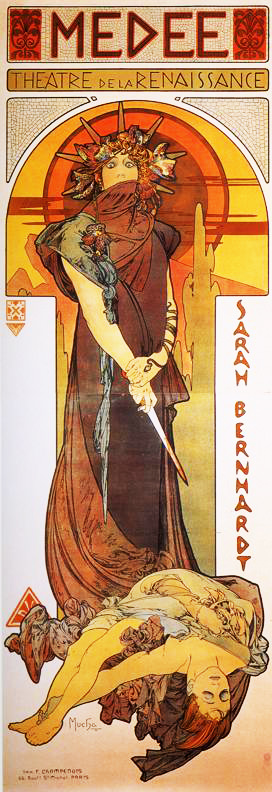
The Sarah Bernhardt collaboration guide follows the seven production posters listed by the Foundation: Gismonda and six more ending with Hamlet in 1899.[4] Their tall figures could be recognised from a distance, while changes in costume and pose signalled the plays. Lorenzaccio shows Bernhardt in a male Renaissance role; Médée puts tragedy into a tense composition; Hamlet gives the actor another male role under a troubled, ghostly image. Each poster belongs to a theatre production, even when collectors later prize it as an artwork.
Counts depend on the category being counted. The German Digital Library's exhibition of early posters also calls Gismonda the first of seven Mucha prints with Bernhardt as the title figure.[7] Musée d’Orsay, in a broader account of their collaboration, says eight posters.[6] Neither short overview supplies an item-by-item list that reconciles the numbers. This guide uses the Foundation's defined sequence of seven production posters and leaves the broader Orsay count attributed, rather than adding an unidentified eighth play or pretending that the institutions have agreed on one tally.
The material scale of the theatre campaign is visible in an identified object: the BnF catalogues Hamlet as a 210 × 78 cm colour lithograph printed by Champenois in 1899.[18] It names both the tragedy and Bernhardt's theatre in the title. That is a useful corrective to treating the long, narrow figure as a free-standing portrait. This particular sheet carried a play, a performer and a venue into the street. Its dimensions describe the BnF's catalogued print, not every later reproduction of the composition.
This is different from every image of Bernhardt made by Mucha. The bust-length design for her 1896 honouring banquet and La Plume magazine was a colour lithograph, but not one of those seven production advertisements. Its tiara, lilies, stars and name-filled arch promoted her public identity in another setting.[4] Distinguishing purpose makes the relationship clearer: one artist and one performer could collaborate on a play poster, a stage object and a tribute image without turning them into interchangeable editions.
Advertising travel and goods
Mucha's posters also promoted railway travel, rolling paper, food, drink and other products. The Foundation's advertising theme describes a Parisian environment where companies sought memorable large-scale images and Mucha worked with printers to produce them.[2] A woman's figure, flowers and an ornamental disk might draw attention, but the words still named a destination or product. In JOB, the flowing hair and tobacco smoke carry the eye back to the brand's bold letters. In Monaco–Monte-Carlo, the flower-laden curves and coastline bring the destination into view.
The Monaco design shows why printed state matters. The Foundation catalogues the 1897 colour lithograph as a railway-services poster for P.L.M.[5] The BnF records a related variant without P.L.M. lettering, offered to collectors through La Plume, as well as a variant with P.L.M. lettering.[5] Both connect to the railway commission, but they do not convey exactly the same amount of company information. The inherited hero has no visible P.L.M. letters; its exact physical print or modern reproduction source has not been traced. The Monaco article uses an identified BnF scan to show the distinction more closely.
Other named commissions carried their own messages. A Slavia colour lithograph advertised a Prague mutual insurance bank in 1907, beyond Mucha's best-known Paris poster years. Its Czech text and symbolic seated figure serve an institution, while the later portrait of Josephine Crane Bradley as Slavia is a separate canvas.[1] The similarity of a figure or title should never erase a work's material form and audience.
Beer advertising supplies a second, more specific example of variant evidence. The Regional Museum in Chrudim catalogues a 1897 Bières de la Meuse colour lithograph printed by Champenois, measuring 147 × 98 cm, and calls its sheet a bianko plakát—a blank poster form.[8] The BnF separately records a 156 × 107 cm colour-lithograph format under the same design title and labels that entry a format variant.[9] Those measurements describe catalogued objects or formats, not a universal size for the image. The Czech wording and BnF classification both warn against collapsing all surviving Bières sheets into a single issue, but the records alone do not establish the exact printing sequence or a direct relationship between these two impressions.
The product could be present more directly than a modern shorthand of “Mucha's women” suggests. Les Arts Décoratifs catalogues an 1898 Bénédictine advertisement at 207 × 77.5 cm, commissioned by the liqueur maker and printed by Champenois. Its indexed features include a bottle, packaging, a mitre and abbey arms alongside the female figure.[19] The unusually tall sheet resembles the theatre format in scale, but the signs around its figure point to a named drink and the Abbey of Fécamp. The museum says its 1898 date is restored from the Mucha Foundation, so that precision depends on a later catalogue identification rather than a dated inscription on the sheet. Reading the commission and product cues together gives the poster its commercial meaning.
Exhibition notices and public art
A poster could also invite people to see art. Mucha designed distinct advertisements for the twentieth Salon des Cent exhibition in 1896 and for his own June 1897 Salon des Cent exhibition. The 1896 poster names a group exhibition and includes its venue and dates; the 1897 poster announces Mucha's show. Their designs and events differ, even though the English wording of the two local routes looks similar. Reading the printed text is as important as recognising Mucha's line.
These exhibition posters reveal another side of commercial printing. They were functional notices, but their makers and viewers also treated them as art objects. The Foundation notes that six Mucha posters appeared in Jules Chéret's Les Maîtres de l'Affiche, a publication that reproduced admired posters for collectors.[3] A sheet could therefore move from a street communication into a portfolio or private collection. That later reception helps explain why many original posters survive, but it can obscure the first event they were made to announce. The event, printer and state still matter.
The BnF identifies the six Mucha subjects in its Maîtres de l’Affiche group: Gismonda, Lorenzaccio, La Dame aux camélias, La Samaritaine, Bières de la Meuse and JOB. It records Chaix as printer and the six colour lithographs at 39.5 × 28 cm, with a dry stamp.[10] Those are portfolio-scale reproductions, materially distinct from the large public sheets and from Champenois's printing of particular originals. The catalogue even gives each design its number in the series. A collector's JOB or Gismonda can thus have an authentic nineteenth-century publishing history without being the same print as the street poster it reprises.
This small format has another consequence for reading a work. The lithographic portfolio sheet preserves the recognised composition, but its reduced dimensions change the encounter: someone could inspect it in a collection rather than look up at it on a wall. A dry stamp and series number identify that publishing context. They do not certify that the sheet came from a theatrical or commercial posting campaign. The same caution applies in reverse to a large poster that later entered a museum: its present collection location tells us where it survived, while the original lettering and contemporary commission establish what it first asked the public to see or buy.[6][10]
An 1898 publication by the Société Anonyme La Plume makes the selling side unusually concrete. Its back-of-book catalogue offers an assortment of artistic posters for wholesale and retail purchase, lists two Mucha exhibition entries as five-colour lithographs, and asks readers to request a fuller catalogue.[11] It also lists a separate Mucha colour print, Le Carillon de Pâques réveillant la nature, as an artist-retouched edition of 50, priced at 25 francs per impression.[11] That price and edition size apply to the named print, not to the Salon posters or to Mucha posters generally. The juxtaposition matters because La Plume was selling wall advertisements, collectors' prints and limited editions through the same publishing network. It is direct period evidence for a commercial afterlife beyond the original exhibition announcement.
The Metropolitan Museum of Art holds an 1897 La Plume publication titled Alphonse Mucha et son oeuvre.[12] A Czech museum conservation dossier distinguishes its magazine instalments from later separate editions, whose covers and pagination changed.[13] That bibliographic detail cautions against treating every surviving “Mucha number” as one identical object. A publication could promote the artist, reproduce designs and itself become a collectible in more than one form. The posters guide therefore treats a catalogue reproduction, a print offered for sale and a street-size exhibition notice as different evidence, even when they refer to the same design.
A poster for public art teaching
The purposes of a poster extended beyond theatres, travel and brands. In 1897, Mucha designed L'Art enseigné au peuple par les projections for the Société Populaire des Beaux-Arts. The BnF catalogues a 63 × 46 cm colour lithograph printed by Champenois and classifies its subject as art education.[14] The institution explains that projected images were being used to support public lectures. Here the advertised attraction was a way to teach art to a broad audience, making the poster part of the same visual education it announced.[15]
Les Arts Décoratifs holds another catalogued example, inventory 12572.2, donated in 1901 by Georges Pochet. It calls this a poster with space reserved at the right for the programme and records a 62.5 × 77.5 cm sheet.[16] The reserved space suggests that the Society could supply changing programme information without redesigning the main lithograph; the record does not identify a particular completed programme for this impression. Its dimensions differ markedly from the BnF's, and neither catalogue establishes whether this is a different layout, a format variant or a measurement convention. The honest conclusion is narrower: the two institutions preserve differently described objects associated with the same commission. Both show how practical information shaped poster design, rather than being added as an afterthought.
Exhibition posters beyond Paris
Mucha also made posters for events addressed across national boundaries. Les Arts Décoratifs catalogues his Oesterreich auf der Weltausstellung. Paris 1900 as an 1899 colour lithograph for Austria's presence at the coming Paris Exposition. Its record describes a 101 × 70 cm sheet, printed by Kunstanstalt S. Czieger in Vienna, with a printed “Mucha Paris” signature and the Viennese printer's line.[20] The BnF independently records the design and Vienna printer, though it gives the height as 102 cm.[21] These are catalogue measurements of holdings, not evidence of a meaningful one-centimetre design change.
The French museum attributes the commission to the Austrian Ministry of Railways, but explicitly says that patron identification was reconstructed from bibliography.[20] That distinction matters: the printed poster names the Austrian World Exhibition subject, while the exact commissioning department is a cataloguer's researched attribution. The same record identifies a reserved area within the graphic design and indexes Austria and Paris as symbolised places. A poster here served an exhibition and a national presentation; it was neither a Bernhardt theatre bill nor a domestic decorative panel. Its Vienna production also shows that Mucha's poster work cannot be described as exclusively printed at Champenois, even though that Paris firm was central to his commercial career.
Another commission makes the later range clear. Les Arts Décoratifs catalogues a 1903 Mucha lithograph for the 1904 Saint Louis international exhibition. Its long printed title gives the event's dates and tells French viewers that Saint Louis was six days away by steamer plus one day by train. The museum identifies the French Ministry of Commerce, Industry, Posts and Telegraphs as commissioner, Champenois as printer, and France as the posting location in 1904.[22] The BnF independently records a 106 × 78 cm colour lithograph with the same event and Champenois printer.[23]
Those travel-time words show a different way a poster could persuade. A viewer was invited to imagine not only the attraction overseas but the practical journey from Paris. The museum record also indexes a handshake and industrial emblems in the design; they place international exchange and industry beside the journey promised in the text.[22] The poster is dated 1903 as a design or printed sheet while the advertised fair ran in 1904. Keeping those dates separate avoids mislabelling a promotional work by the year of the event alone. Set beside the 1899 Austria sheet, it shows Mucha adapting the poster for international expositions on either side of 1900, with different printers, patrons and target audiences.
Decorative panels are a related category
Not every Mucha image commonly sold today as a “poster” began as an advertisement. The Foundation distinguishes decorative panels—often printed without a headline or product text—from posters that originally advertised a play, product or event.[3] Champenois issued these textless works for artistic appreciation and domestic display. They helped make colour images available beyond those who could buy unique paintings.
The Seasons of 1896 was Mucha's first major decorative-panel series. The Foundation identifies later groups including The Flowers, The Arts, The Times of the Day, The Precious Stones and The Moon and the Stars.[3] A four-part series has its own internal order and panel identities. The same design might also appear in different printed forms, so an unlettered panel should not be silently captioned as the same physical edition as a lettered calendar or advertisement. The dedicated artwork pages and the directory below let readers follow those differences.
The BnF's catalogue for The Times of the Day provides a concrete example of a series existing in more than one physical arrangement. It describes four colour lithographs printed by Champenois in 1899, each 60 × 19 cm, and also records a 67 × 86 cm complete sheet. Its holding notes distinguish the intact group from panels kept separately.[24] The subjects are the same sequence, yet an intact four-panel sheet and a separated morning panel are different material objects. The BnF calls the work a decorative panel, rather than an advertisement.
The boundary between public and private use was porous. A theatre or advertising image could be collected after its original purpose, while a decorative panel was intended for walls from the start. Mucha's success depended partly on designs that carried across these settings. For accurate history, however, the first question is still what the particular sheet says and how the source catalogue describes it. That keeps a 1900 decorative panel from being mistaken for an 1890s theatre bill merely because both use long hair, flowers and curved lines.
Following the printed work
Start with a named work and its verified printed state. Gismonda opens the Bernhardt sequence; JOB shows product advertising; Monaco–Monte-Carlo makes a lettered/unlettered state comparison; the two Salon des Cent posters separate an 1896 group exhibition from an 1897 Mucha show. The Seasons introduces the decorative-panel market.[1][2][3]
The small Monaco reproduction above is useful for recognising the whole design, but it cannot support detailed claims about its physical paper, impression or printer's marks. The related BnF scan and print-state evidence live on the dedicated page. The work directory below gives a wider route through Mucha's posters and other media; it should be used with each article's source and image caption, not as a reason to treat every decorative sheet as one kind of poster.
Watch: Alphonse Mucha
Follow Mucha’s work from Art Nouveau Paris to his later Czech projects.
Alphonse Mucha: Plongez dans l’Art nouveau !
A French museum introduction to Mucha’s Art Nouveau years, poster work and decorative language.
Watch on YouTubeArtworks directory
| Name | Date | Medium |
|---|---|---|
| 'Accept Love and Enthusiasm from Your Son, Mother of the Holy Nation': study for the mural 'By Own Strength III' at the Lord Mayor's Hall, Obecní Dům, Prague | 1910-1911 | Pencil and charcoal on canvas |
| 'By force towards freedom, with love towards unity!': study for the mural 'By Own Strength II' at the Lord Mayor's Hall, Obecní Dům, Prague | 1910-1911 | Pencil and charcoal on canvas |
| 'The Passing Wind Takes Youth Away': design for a fan and the façade of the 'Pavilion of Man' (unrealised) | 1899 | Colour lithograph |
| 'Through humiliated and tortured, you will live again, my country!': study for the mural 'By Own Strength II' at the Lord Mayor's Hall, Obecní Dům, Prague | 1910-1911 | Pencil and charcoal on canvas |
| 1918-1928: Poster for the 10th Anniversary of the Independence of the Republic of Czechoslovakia | 1928 | Colour lithograph |
| 6th Sokol Festival | 1912 | Colour lithograph |
| 8th Sokol Festival | 1925 | Colour lithograph |
| After the Battle of Grunwald | 1924 | egg tempera on canvas |
| After the Battle of Vitkov Hill | 1923 | egg tempera on canvas |
| Age of Love | 1936–1938 | |
| Age of Reason | 1936–1938 | |
| Age of Wisdom | 1936–1938 | |
| Amants | 1895 | Colour lithograph |
| Apotheosis of the Slavs | 1926 | Egg tempera on canvas |
| As Hamlet | 1899 | colour lithograph |
| Au Quartier Latin | 1898 | Magazine cover |
| Banknotes of Czechoslovakia, designed by Mucha: 500 crown; 50 Crown; 10 Crown | 1929 | Banknotes |
| Bieres de la Meuse | 1897 | Colour lithograph |
| Biscuits Champagne Lefevre Utile | 1896 | Colour lithograph |
| Biscuits Lefevre Utile | 1896 design for 1897 calendar; Foundation object/Carnavalet 1897 | Colour lithograph |
| Blessed are the Pure in Heart | 1906 | Printed magazine illustration |
| Bleu Deschamps | 1903 (deposit) | Colour lithograph |
| Bosnia & Herzegovina Pavilion - illustration featured in 'Le Figaro Illustré' (1 March 1900) | 1900 | Reproduction from Le Figaro Illustré after watercolour original |
| Bosnia-Herzegovina Pavilion: cartoon for the mural 'The Roman Period and the Arrival of the Slavs' | 1899-1900 | ink and crayon on paper |
| Bosnia-Herzegovina Pavilion: fragment of the upper frieze featuring Ivo and Anica, characters from Bosnian legends | 1899-1900 | tempera and watercolour on canvas |
| Bosnian Legends: Death of Hasanaga's Bride | 1899 | Charcoal on paper |
| Bosnian Legends: Murcia - The Plague Lady | 1899 | Charcoal on paper |
| Bosnian Pavilion Restaurant at the Paris Exhibition 1900: design for the menu | 1900 | Pencil and watercolour on paper |
| Boutique Fouquet (interior design) | 1901 | Shop interior design |
| Boutique Fouquet: sketches of the shop's signboard and decorative details | c.1900 | Pencil, ink and watercolour on paper |
| Box for Lefèvre-Utile biscuits: Gaufrettes Vanille | c.1900 | Tin box covered with lithographed label |
| Box for Lefèvre-Utile biscuits: Madère | c.1900 | Tin box covered with lithographed label |
| Brightness of the Day | 1899 | Colour lithograph |
| Broach with Pendant | 1900 | Gold, ivory, mother-of-pearl and semi-precious stones |
| Byzantine Head - The Blonde | 1897 | Colour lithograph |
| Byzantine Heads (pair) | 1897 | Colour lithograph |
| Byzantine Heads: Brunette | 1897 | Colour lithograph |
| Bénédictine | 1898 (BnF deposit); Hamburg 1899; MNAC 1896 or 1898 | Colour lithograph |
| Champagne Ruinart | 1896 | Colour lithograph |
| Chocolat Ideal | before or in 1897 (catalogue conflict) | Colour lithograph |
| Chocolat Masson (1897 calendar) | 1896–1897 | Colour lithograph |
| Choirboys at Petrov Church, Brno | 1905 | Watercolour on cardboard |
| Cloches de Noel | 1900 | Illustrated book |
| Comedy: study for a mural for the German Theatre, New York | 1908 | Oil on canvas |
| Cours Mucha: poster advertising Mucha's art classes held at the Académie Colarossi, Paris | 1900 | colour lithograph |
| Creative Force - Jan z Pernštýna: study for a pendentive of the Lord Mayor’s Hall, Obecní Dům, Prague | 1910-1911 | Oil on canvas |
| Crucifixion | c.1868 | Pencil, crayon and watercolour on paper |
| Cycles Perfecta | 1897 or 1902 (catalogue conflict) | Colour lithograph |
| Dance | 1898 | Colour lithograph |
| Dead Couple - Abandoned | c.1899-1900 | Charcoal and pastel on blue paper |
| Defense of Sziget against the Turks by Nicholas Zrinsky | 1914 | egg tempera on canvas |
| Design for a champagne poster | c. 1896 | Charcoal and pastel on paper |
| Design for a display stand at the Paris Exhibition 1900 | c.1899-1900 | Pencil and wash on paper |
| Design for Champagne Ruinart | c. 1896 | Pencil, watercolour and gold leaf on paper |
| Design for the cover of the magazine 'Fantaz' | 1882 | Ink and watercolour on paper |
| Design for the heading of the cover of the magazine 'Krokodil' | 1885 | Pen and ink on cardboard |
| Design for the poster for the Mucha Exhibition at the Brooklyn Museum, New York, January-February 1921 | 1920 | Pen and ink and watercolour on paper |
| Designs for cutlery | c.1900 | Charcoal and white on card |
| Designs for tableware | c.1900 | Charcoal, coloured pencil and white on card |
| Diadem for 'La princesse lointaine' | 1895 | metal and pearls |
| Diploma of Ivančice: Mock diploma honouring a local celebrity, with illustration of the first line of 'May', a poem by Karel Hynek Mácha | 1882 | Pen and ink and watercolour on paper |
| Documents décoratifs: designs for a watch and accessories (unused) | 1901-1902 | Pencil, ink and white on paper |
| Documents décoratifs: final study for Plate 25, featuring studies of lily | 1901-1902 | Pencil on paper |
| Documents décoratifs: final study for Plate 43 | 1901-1902 | Pencil, ink and wash, heightened with white on paper |
| Documents décoratifs: final study for Plate 49 | 1901-1902 | Pencil and white on paper |
| Documents décoratifs: final study for Plate 50 | 1901-1902 | Pencil and white on paper |
| Documents décoratifs: final study for Plate 60 | 1901-1902 | Pencil, ink and wash, heightened with white on paper |
| Documents décoratifs: final study for Plate 63 | 1901-1902 | Pencil and white on paper |
| Documents décoratifs: final study for Plate 67 | 1901-1902 | Pencil and white on paper |
| Documents décoratifs: final study for Plate 71 | 1901-1902 | Pencil and white on paper |
| Documents décoratifs: final study for Plate 72 | 1901-1902 | Pencil and wash, heightened with white on paper |
| Documents décoratifs: line drawing for Plate 33, featuring lily motifs | 1901-1902 | Pencil, pen and ink on paper |
| Documents décoratifs: Plate 54 | 1902 | Lithograph |
| Dreaming of Freedom: study for a Panel of the Small Reception Room at the Lord Mayor’s Hall, Obecní Dům, Prague | 1910-1911 | Pen and ink and watercolour on paper |
| Dusk | 1899 | Colour lithograph |
| Evening | 1899 | Colour lithograph |
| F. Champenois (Rêverie imprint) | 1898 | Colour lithograph |
| F. Guillot-Pelletier calendar (1898) | 1897–1898 | Colour lithograph |
| Feather | 1899 | Colour lithograph |
| Figures décoratives: final study for Plate 2 | 1904-1905 | Pencil and white on paper |
| Figures décoratives: final study for Plate 3 | 1904-1905 | Pencil and white on paper |
| Figures décoratives: final study for Plate14 | 1904-1905 | Pencil with white on paper |
| Figures décoratives: sketch study for Plate14 | 1904-1905 | Blue pencil on paper |
| Flirt Lefevre Utile | 1899 (Foundation design); BnF legal deposit 1900 | Colour lithograph |
| Flower | 1897 | Colour lithograph |
| Flower: final study for decorative panel | 1897 | Pencil, ink and watercolour on paper |
| France Embraces Bohemia | 1918 | oil on canvas |
| Fruit | 1897 | Colour lithograph |
| Georges Fouquet (1858-1929), Paris, after design by Mucha: Ornamental Chain with pendants | 1900 | Gold, enamel, fresh-water pearls, mother of pearl and semi-precious stones |
| Georges Fouquet (1858-1929), Paris, after Mucha design: 'Peacock' Ring (Exhibited at the Paris Exhibition 1900) | 1900 | Opal and gold |
| Girl Weeping | c.1899-1900 | Black chalk and pastel on paper |
| Girl with Loose Hair and Tulips | 1920 | Oil on canvas |
| Gismonda | 1894 | Colour lithograph |
| Head of a Girl, statue for the stand of the Houbigant Perfumery at the Paris Exhibition 1900 | 1900 | Bronze, silver and parcel gilt |
| Head of Sarah Bernhardt: Study for 'Lorenzaccio' | 1896 | Pencil on paper |
| Heather from Coastal Cliffs | 1902 | Colour lithograph |
| Heidsieck & Co | 1901 | Colour lithograph |
| Holy Mount Athos | 1926 | Egg tempera on canvas |
| Ilsée, Princesse de Tripoli | 1897 | Illustrated book |
| In the Desert: Study for an illustration for the Světozor magazine | 1889 | Pencil, watercolour and gouache on paper |
| Incantation (Salammbô) | 1897 | Lithograph |
| Independence - Jiří z Poděbrad: study for a pendentive of the Lord Mayor’s Hall, Obecní Dům, Prague | 1910-1911 | Oil on canvas |
| Interior and furniture designs | c.1900 | Pencil on paper |
| Interior of Boutique Fouquet: design for a wall-mounted display cabinet with statuette and mirror | c.1900 | Pencil on paper |
| Interior of Boutique Fouquet: design for the fireplace with statuettes, mirror, and the ornamental details of the wall | c.1900 | Pencil and watercolour on cardboard |
| Interior of Boutique Fouquet: sketches of the fireplace with statue, mirror, display cabinet, and the ornamental details of the wall | c.1900 | Pencil, pen and ink on paper |
| Ivy | 1901 | Colour lithograph |
| Jan Milic of Kromeriz | 1916 | egg tempera on canvas |
| Jaroslava and Jiří, the Artist’s Children | 1918 | Oil on canvas |
| JOB poster | 1896 | Colour lithograph |
| Judgement of Paris (calendar for Vieillemard printing company) | 1895 | Colour lithograph |
| Justice - Master Jan Hus: study for a pendentive of the Lord Mayor's Hall, Obecní dům, Prague | 1910-1911 | Oil on canvas |
| L'Annee Qui Vient | 1897 | red chalk on paper |
| L'Illustration magazine - cover for Christmas 1896/1897 | 1896 | Magazine cover |
| L'Illustré Soleil du Dimanche | 1897 | Magazine cover |
| La Dame aux Camélias: designs for cover and interior of special programme | 1896 | Pencil and watercolour on paper |
| La Nature | 1899-1900 | Bronze and amethyst |
| La Plume | 1897 | Magazine cover |
| La Samaritaine | 1897 | colour lithograph |
| Lance Parfum Rodo | 1896; Albertina print c. 1900 | Colour lithograph |
| Laurel | 1901 | Colour lithograph |
| Le Monde Illustré | 1900 | Magazine cover |
| Le Pater | 1899 | Illustrated book |
| Le Pater: early study for the 1st allegorical scene 'Our Father who art in Heaven' (1899) (Mucha Foundation object 300) | 1899 | Pencil on paper |
| Le Pater: early study for the 1st allegorical scene 'Our Father who art in Heaven' (1899) (Mucha Foundation object 302) | 1899 | Pastel on paper |
| Le Pater: study for the 6th allegorical scene 'Forgive us our debts, as we forgive our debtors' | 1899 | Charcoal and ink wash on paper |
| Lefevre Utile | 1904 | Advertisement |
| Leslie Carter | 1908 | Colour lithograph |
| Letem Českým Světem | 1898 | Printed book |
| Lorenzaccio | 1896 | Colour lithograph |
| Luchon poster (attributed to Mucha) | 1895 | Colour lithograph |
| Madonna of the Lilies | 1905 | Tempera on canvas |
| Master Jan Hus Preaching at the Bethlehem Chapel | 1916 | egg tempera on canvas |
| Maude Adams | 1908 | Lithograph, hand-coloured in watercolour and gouache |
| Maude Adams as Joan of Arc | 1909 | Oil on canvas |
| Medea | 1898 | Colour lithograph |
| Menu for the Bosnian Pavilion Restaurant at the Paris Exhibition 1900 | 1900 | Colour lithograph |
| Militancy - Jan Žižka: study for a pendentive of the Lord Mayor's Hall, Obecní dům, Prague | 1910-1911 | Oil on canvas |
| Military Camp in Winter, near a City on Fire | c.1899-1900 | Pastel on paper |
| Moet et Chandon | 1899 | Colour lithograph |
| Monaco Monte Carlo | 1897 | Colour lithograph |
| Moon | 1902 | |
| Moravian Teachers' Choir | 1911 | Colour lithograph |
| Morning Alphonse Mucha Painting / AlphonseMucha.org | 1899 | Colour lithograph |
| Morning Star | 1902 | Colour lithograph |
| Moët & Chandon White Star | 1899 | Colour lithograph |
| Mrs Mucha’s Necklace | 1906 | gold, enamel and semi-precious stones |
| Mural for the Bosnia-Herzegovina Pavilion: The Roman Period and the Arrival of the Slavs | 1900 | tempera and watercolour on canvas |
| Murals by Mucha in the Lord Mayor's Hall, Obecní Dům (Municipal House), Prague (1910-1911) | ||
| Music | 1898 | Colour lithograph |
| Nativity | c. 1934 | oil on canvas |
| Nestle's Food for Infants | 1897 | Colour lithograph |
| Night | 1899 | Colour lithograph |
| Nude on a Rock | 1898-1899 | Bronze |
| Official Banquet of the Paris Exhibition 1900: design for the menu featuring a fashionable woman wearing a Mucha-style jewellery | 1900 | Pencil, gouache and wash on grey paper |
| Ornamental motifs designed for 'Combinaisons Ornementales se Multipliant à l'Infini à l'Aide du Miroir' (1901) | c.1900-1901 | Blue and red pencil on paper |
| Packaging for 'Savon Mucha Violette' | 1906 | Colour lithograph |
| Packaging for Lefèvre-Utile biscuits: Boudoir | 1901 | Colour lithograph |
| Page's Costume: study for an illustration for 'Le Costume au Théâtre' | 1890 | Pencil and watercolour on cardboard |
| Painting | 1898 | Colour lithograph |
| Peonies | 1897–1898 | Ink and watercolour |
| Petr Chelcicky at Vodnany | 1918 | egg tempera on canvas |
| Poetry | 1898 | Colour lithograph |
| Portrait of Jaroslava | c.1927-1935 | Oil on canvas |
| Portrait of Josephine Crane Bradley as Slavia | 1908 | Oil and tempera on canvas |
| Portrait of Marie Chytilová (Maruška), Mucha's Future Wife | 1903 | pastel on paper |
| Portrait of Mucha's Sister, Angela | c.1880 | Oil on canvas |
| Portrait of Mucha's Sister, Anna | c.1885 | Oil on canvas |
| Portrait of Mucha's Son, Jiří | 1925 | Oil on canvas |
| Portrait of Mucha's Wife, Maruška | 1908/17 | Oil on canvas |
| Portrait of Woman | c. mid 1910s - 1925 | Blue pastel on grey paper |
| Poster for 'Hommage Respectueux de Nestlé' (the Nestlé Company's tribute to Queen Victoria's 60th Jubilee) | 1897 | Colour lithograph |
| Poster for 'Imprimerie Cassan Fils' | 1896 | Colour lithograph |
| JOB poster (1898) | 1898 | Colour lithograph |
| Poster for 'La Dame aux Camélias' | 1896 | Colour lithograph |
| Poster for 'La Tosca' | 1899 | Colour lithograph |
| Poster for 'Regional Exhibition at Ivančice 1913' | 1912 | Colour lithograph |
| Poster for 'The Slav Epic Exhibition, Brno, 1930' | 1928-1930 | Colour lithograph |
| Poster for 'Waverley Cycles' | 1898 | Colour lithograph |
| Poster for the 'Lottery of the Union of Southwestern Moravia' | 1912 | Colour lithograph |
| Poster for the Austrian Pavilion at the Paris Exhibition 1900 | 1900 | Colour lithograph |
| Prague Subjugated: study for a Panel of the Small Reception Room at the Lord Mayor’s Hall, Obecní Dům, Prague | 1910-1911 | Pen and ink and watercolour on paper |
| Primrose | 1899 | Colour lithograph |
| Primrose and Feather (paired image) | 1899 | Colour lithographs (paired image) |
| Princess Hyacinth (Princezna Hyacinta) | 1911 | Colour lithograph |
| Print proof for the Biscuits Lefèvre-Utile tin | 1899 | Lithograph |
| Reverie | 1898 | Colour lithograph |
| Russia Restituenda [Russia Must Recover] | 1922 | Colour lithograph |
| Salome | 1897 | Colour lithograph |
| Salon des Cent | 1896 | Colour lithograph |
| Salon of the Hundred | 1897 | Colour lithograph |
| Sarah Bernhardt - La Princesse Lointaine - Lefevre Utile | 1903 | Colour lithograph |
| Sarah Bernhardt as La Princesse Lointaine: poster for 'La Plume' magazine | 1897 | Colour lithograph |
| Sarah Bernhardt in the role of the Duc de Reichstadt in L’Aiglon | 1900 | Pencil on paper |
| Sarah Bernhardt: study of her full-standing figure | c.1896 | Pen and ink on paper |
| Savonnerie de Bagnolet calendar | 1898 (calendar) | Printed advertising calendar |
| Self-portrait (1899) | 1899 | Oil on board |
| Self-portrait (1907) | 1907 | Blue and white crayon on blue Ingres paper |
| Self-portrait, sketching in his apartment, Paris | late 1880s | oil on canvas |
| Sketches of flowers for Documents décoratifs | c.1900-1901 | Pen and ink on paper |
| Slavia insurance poster | 1907 | Poster |
| Slavs in their Original Homeland | 1912 | Egg tempera on canvas |
| Snake Bracelet with a Ring | 1899 | Gold, enamel, opal, ruby and diamond |
| Société Populaire des Beaux Arts | 1897 | Colour lithograph |
| Song of Bohemia | 1918 | oil on canvas |
| St. Vitus Cathedral Stained-glass Window, Prague: final design for the central panels, featuring SS Cyril and Methodius | 1931 | Ink and watercolour on paper |
| St. Vitus Cathedral Stained-glass Window, Prague: final design for the central panels, featuring St. Ludmila | 1931 | Ink and watercolour on paper |
| St. Vitus Cathedral Stained-glass Window, Prague: final design for the central panels, featuring St. Wenceslas (Duke of Bohemia) kneeling next to his Grandmother, St. Ludmila | 1931 | Ink and watercolour on paper |
| St.Vitus Cathedral Stained-glass Window, Prague: final design for the bottom left panels | 1931 | Ink and watercolour on paper |
| St.Vitus Cathedral Stained-glass Window, Prague: final design for the bottom right panels | 1931 | Ink and watercolour on paper |
| Stained-glass Window designed by Mucha at St. Vitus Cathedral, Prague | Early 1930s | N/A |
| Study for 'The Age of Reason' | 1936-1938 | Pencil and watercolour on paper |
| Study for 'The Slav Epic cycle' No.19: The Abolition of Serfdom in Russia | 1913-1914 | Watercolour and gouache on paper |
| Study for 'The Slav Epic' cycle No.14: The Sacrifice at Szigetvár by Nikola Zrinski | c.1913-1914 | Photographed drawings stuck together, tinted with watercolour and gouache |
| Study for 'The Slav Epic' cycle No.17: The Holy Mount Athos (1926) | c.1925-26 | Charcoal heightened with white on cardboard |
| Study for 'The Slav Epic' cycle No.18: The Oath of Omladina under the Slavic Linden Tree | c.1925-1926 | Pencil and watercolour on paper |
| Study for 'The Slav Epic' cycle No.1: The Slavs in Their Original Homeland (1912) | c.1910-1912 | Oil on canvas |
| Study for 'The Slav Epic' cycle No.2: The Celebration of Svantovít | c.1910-1912 | Oil on canvas |
| Study for 'The Slav Epic' cycle No.7: Jan Milíč of Kroměříž | c.1915-1916 | Oil on canvas |
| Study for 'The Slav Epic' cycle No.9: Master Jan Hus Preaching at the Bethlehem Chapel. The Magic of the Word: Truth Prevails (1412). | c.1915-1916 | Oil on canvas |
| Study for 'The Three Ages' triptych: Reason, Wisdom and Love [unfinished project] | 1936-1938 | Pencil and watercolour on paper |
| Study for 'Woman in the Wilderness' (c. 1922-1923) (Mucha Foundation object 315) | c. 1922-1923 | oil on canvas |
| Study for 'Woman in the Wilderness' (c. 1922-1923) (Mucha Foundation object 316) | c. 1922-1923 | oil on canvas |
| Study for Savon Notre Dame | c. 1896 | pencil and watercolour on paper |
| Study for the poster 'Russia Restituenda [Russia Must Recover]' | 1922 | Pen and ink and watercolour on paper |
| Study of a Male Nude | 1885-1887 | Oil on canvas |
| The Abolition of Serfdom in Russia | 1914 | Egg tempera on canvas |
| The Arts (series) | 1898 | Colour lithograph |
| The Arts: study for 'Dance' | 1898 | Pencil and watercolour on paper |
| The Arts: study for 'Music' | 1898 | Pencil and watercolour on paper |
| The Arts: study for 'Painting' | 1898 | Pencil and watercolour on paper |
| The Arts: study for 'Poetry' | 1898 | Pencil and watercolour on paper |
| The Bohemian King Premysl Otakar II | 1924 | egg tempera on canvas |
| The Bulgarian Tsar Simeon | 1923 | egg tempera on canvas |
| The Burr McIntosh Monthly, 1907 | 1907 | Magazine cover |
| The Celebration of Svantovit | 1912 | egg tempera on canvas |
| The Coronation of the Serbian Tsar Stefan Dusan as East Roman Emperor | 1923 | egg tempera on canvas |
| The Devil and Mr Twardowsky: study for an illustration for 'The Tale of Pan Twardowsky' (a variation of 'Faust') | c.1887-1888 | Charcoal on paper |
| The Flowers (series) | 1898 | Colour lithographs |
| The Flowers: Carnation | 1898 | Colour lithograph |
| The Flowers: Iris | 1898 | Colour lithograph |
| The Flowers: Lily | 1898 | Colour lithograph |
| The Flowers: Rose | 1898 | Colour lithograph |
| The Hussite King Jiri of Podebrady | 1923 | Egg tempera on canvas |
| The Introduction of the Slavonic Liturgy | 1912 | egg tempera on canvas |
| The Last Days of Jan Amos Komensky (Comenius) in Naarden | 1918 | Egg tempera on canvas |
| The Light of Hope | 1933 | Oil on canvas |
| The Meeting at Krizky | 1916 | egg tempera on canvas |
| The Months (January-June) | 1899 | Colour lithograph |
| The Months (July-December) | 1899 | Colour lithograph |
| The Moon and the Stars (four-panel montage) | 1902 | Colour lithographs (four-panel montage) |
| The Moon and the Stars (series) | 1902 | Colour lithograph |
| The Moon and the Stars: study for 'The Evening Star' | 1902 | Ink and watercolour on paper |
| The Moon and the Stars: study for 'The Pole Star' | 1902 | Ink and watercolour on paper |
| The New York Daily News art supplement | 1904 | Printed art supplement |
| The Oath of Concord of the Slavs (unfinished) | 1939 | oil on canvas |
| The Oath of Omladina under the Slavic Linden Tree | 1926, unfinished | Egg tempera on canvas |
| The Precious Stones (four-panel montage) | 1900 | Colour lithographs (four-panel montage) |
| The Precious Stones (series) | 1900 | Colour lithograph |
| The Precious Stones: Amethyst | 1900 | Colour lithograph |
| The Precious Stones: Emerald | 1900 | Colour lithograph |
| The Precious Stones: Ruby | 1900 | Colour lithograph |
| The Printing of the Bible of Kralice in Ivancice | 1914 | egg tempera on canvas |
| The Seasons (series) | 1896 | Colour lithograph |
| The Seasons (series) (1900) | 1900 | Colour lithograph |
| The Seasons (variation in screen format) | 1896 | Colour lithograph |
| The Seasons: Autumn (1896) | 1896 | Colour lithograph |
| The Seasons: Autumn (1900) | 1900 | Colour lithograph |
| The Seasons: Spring | 1900 | Colour lithograph |
| The Seasons: Spring (1896) | 1896 | Colour lithograph |
| The Seasons: Summer | 1900 | Colour lithograph |
| The Seasons: Summer (1896) | 1896 | Colour lithograph |
| The Seasons: Winter | 1900 | Colour lithograph |
| The Seasons: Winter (1896) | 1896 | Colour lithograph |
| The Slavonic Concord: study for the ceiling painting for the Lord Mayor's Hall, Obecní Dům, Prague | 1910-1911 | Oil on canvas |
| The Threat | 1912 | Colour lithograph |
| The Times of the Day (series) | 1899 | Colour lithograph |
| The West End Review | 1897 (Foundation); 1898 promotional cover | Colour lithograph |
| Thistle from the Sands | 1902 | Colour lithograph |
| Théâtre de la Renaissance: design for poster advertising Sarah Bernhardt's theatre | c.1895 | Pen and ink on paper |
| Tin for Lefèvre-Utile biscuits | 1899 | Circular tin with lid and handle; colour print on metal |
| Topaz | 1900 | Colour lithograph |
| Tragedy - study for a mural for the German theatre New York | 1908 | Oil and tempera on canvas |
| Trappistine Liquors | 1897 | colour lithograph |
| Wiener Chic | 1905 | Magazine cover |
| Woman in the Wilderness | 1923 | Oil on canvas |
| Woman masked in white head-scarf - study for the illustration of the Bosnia & Herzegovina Pavilion featured in 'Le Figaro Illustré' (1 March 1900) | 1899 | Pencil and wash heightened with white on paper |
| Woman with a Daisy - textile designed by Mucha | 1900 | Printed upholstery fabric |
| Zdenka Cerny | 1913 | Colour lithograph |
| Zodiac (La Plume calendar) | 1896–97 | Colour lithograph |
| Zodiac (textless decorative panel) | 1896 | Colour lithograph |
| ‘At the sight of the two storks the owl rose.’ Study for an illustration for Contes de Grand-mères | 1891 | Watercolour and gouache on paper |
Frequently Asked Questions
What made Alphonse Mucha famous as a poster artist?
Are all Mucha decorative panels advertising posters?
What does the image at the top of this page show?
Discussion
The Mucha Foundation distinguishes lettered advertising posters from textless decorative panels.
The hero reproduces the Monaco–Monte-Carlo design; its exact printed source is untraced.
Reader Insights
How does the destination name work with the figure?
Where do the flowers and curved lines direct your eye?
What information is missing when P.L.M. lettering is absent?
Join the Conversation
Share a visible detail that helps you read this poster as a public message.
References
- Mucha Foundation, poster catalogue introduction on colour lithography, Gismonda, the Champenois contract and cross-format output. Foundation poster catalogue.
- Mucha Foundation, “Advertising Posters,” thematic account of Paris street display, printing and commercial commissions. Foundation advertising theme.
- Mucha Foundation, “Art Posters,” thematic account distinguishing textless decorative panels, series and collector circulation. Foundation art-posters theme.
- Mucha Foundation, “Sarah Bernhardt,” thematic catalogue of the seven production posters and related work; Foundation Bernhardt theme and separate La Plume image.
- Mucha Foundation and Bibliothèque nationale de France, Monaco–Monte-Carlo design and variant records: Foundation object 47, BnF no-P.L.M. state, and BnF with-P.L.M. state.
- Musée d’Orsay, L’art est dans la rue, on lithographic printing, specialist collectors and its broader eight-poster Bernhardt count.
- Deutsche Digitale Bibliothek / Staatliche Museen zu Berlin, Frauen in der frühen Plakatgestaltung, on Gismonda as the first of seven Bernhardt title-figure posters.
- Regional Museum in Chrudim, Bières de la Meuse, U 2375, 1897; Czech object record for a blank-form colour lithograph printed by Champenois, 147 × 98 cm.
- Bibliothèque nationale de France, Bières de la Meuse format-variant record, legal deposit 1897, colour lithograph, 156 × 107 cm.
- Bibliothèque nationale de France, Mucha's six Maîtres de l’Affiche subjects, 1896–1900; Chaix colour lithographs, 39.5 × 28 cm, series numbers and dry stamp.
- Société Anonyme La Plume, publisher's poster and print sales list in Adolphe Retté, Oeuvres complètes, vol. 2 (Paris, 1898), back matter pp. 196–197; two Mucha exhibition listings and separately priced Carillon de Pâques print. Read the BnF digitisation.
- Metropolitan Museum of Art, Alphonse Mucha et son oeuvre, published by Société Anonyme La Plume, Paris, 1897, object 62.652.8.
- Muzeum Brněnska, conservation dossier for a 1897 La Plume Mucha publication, pp. 28–29; distinguishes periodical instalments and separate editions. The document is a later bibliographic assessment, not a contemporary print-run record.
- Bibliothèque nationale de France, L'Art enseigné au peuple par les projections, cb40461643k, 1897, Champenois colour lithograph, 63 × 46 cm.
- Bibliothèque nationale de France, Sciences pour tous: Mucha's Society poster, on projected images in public lectures.
- Les Arts Décoratifs, L'Art enseigné au peuple par les projections, inventory 12572.2, 1897; reserved programme area, 62.5 × 77.5 cm, Champenois, Pochet gift 1901.
- Victoria and Albert Museum, “A short history of the poster”, on Chéret's three-stone process and Mucha's Champenois-printed Bières de la Meuse in the V&A collection.
- Bibliothèque nationale de France, Hamlet poster record, 1899; Champenois colour lithograph, 210 × 78 cm.
- Les Arts Décoratifs, Bénédictine de l'Abbaye de Fécamp, inventory 12465.2, 1898; commissioned by Bénédictine, Champenois, 207 × 77.5 cm; date restored from the Foundation.
- Les Arts Décoratifs, Oesterreich auf der Weltausstellung. Paris 1900, inventory 12895, 1899; Vienna printer and reconstructed ministry attribution.
- Bibliothèque nationale de France, Austrian Exposition poster record, 1899; Vienna printer, colour lithograph, 102 × 70 cm.
- Les Arts Décoratifs, Saint Louis international exhibition poster, inventory 19250, 1903; event dates and printed Paris-to-Saint-Louis travel claim, ministry commissioner and Champenois printer.
- Bibliothèque nationale de France, Saint Louis exhibition poster record, 1903; Champenois colour lithograph, 106 × 78 cm.
- Bibliothèque nationale de France, The Times of the Day panel-set record, 1899; four 60 × 19 cm panels and a 67 × 86 cm complete sheet.