 by Tom Gurney
Tom Gurney BSc (Hons) is an art history expert with over 20 years experience
Page Created on / Page Updated on
Email: tomgurney1@gmail.com / Phone: +44 7429 011000
The Precious Stones and Their Flowers by Alphonse Mucha
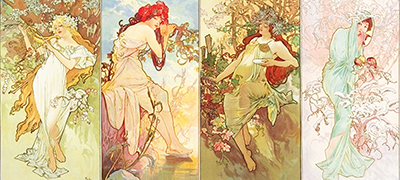
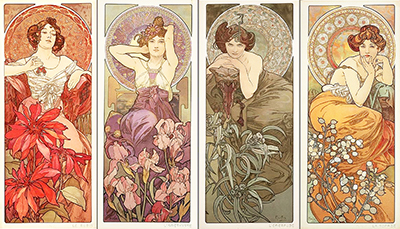
Four tall panels stand side by side in the local image, moving through red, purple, green and gold. The Mucha Foundation calls the 1900 series The Precious Stones: Topaz, Ruby, Amethyst and Emerald, printed as colour lithographs by F. Champenois in Paris.[1] Flowers appear within each design; they are not a second series. This file is a digital montage of the four designs, so measurements of an individual held sheet cannot describe it.
At a Glance
- Date1900
- SeriesThe Precious Stones
- PanelsTopaz, Ruby, Amethyst, Emerald[1]
- Mediumcolour lithographs[1]
- PrinterF. Champenois, Paris[1]
- Local imagedigital four-panel montage
The Precious Stones and Their Flowers in Mucha’s career
Contents
- Gemstones without literal jewels
- Series, panels and a digital montage
- Printed sets and their separate records
- Colour does the identifying
- Four characters within one pattern
- Looking again
Gemstones without literal jewels
The Foundation explains that each panel gives a gemstone a female personification. Dress, hair ornaments, mosaic halo and even eye colour take cues from the named stone. A flower in the lower part echoes that colour and gives the long design an earthly counterweight.[1] These repeated elements make the quartet coherent, while changes in hue, pose and plant keep the panels distinct.
The local image lets a reader compare the four colour worlds in one glance. Red, violet, green and gold are not merely labels applied after the fact; they shape robe, background and ornament. The figures stand or lean differently, and the lower plants vary. Looking across the set shows Mucha working through a repeatable format rather than producing four copies of one woman with changed titles.
The route's inherited “and Flowers” wording points to a real visual feature but can sound like two combined collections. The Foundation's title is The Precious Stones. The flowers belong inside its four panels.[1] Naming that distinction matters when matching the local file to the catalogue and when navigating to an individual work such as Topaz.
Series, panels and a digital montage
The Foundation's series record dates the quartet to 1900, gives the medium as colour lithograph, names F. Champenois, Paris as printer and links the four named panels.[1] Individual panel records describe held objects with their own physical measurements. The local four-panel file is a web assembly; it does not prove that the original prints circulated as one horizontal sheet or that each segment derives from the same edition.
The distinction between series-level facts and object-level facts is useful. A series date and list of designs can be given confidently from the Foundation record. A measured size belongs to a particular museum sheet, and a print-state claim needs evidence for the exact reproduced impression. This page stays at the level supported by the montage and the series record.
The Topaz page considers one of the panels in detail, including its honesty plant. Here the value of the image is comparative: the same design system produces four personalities. The flowers are part of that system. They ground the idealised figures in recognisable natural forms while repeating the stones' colours.[1][2]
Compare The Moon and the Stars, another four-panel project. Both sets use related long formats and female figures, but the stones organise colour through minerals and plants, whereas the later celestial series explores light and fabric. That comparison does not imply the same publication state for the two montages.[1][3]
Printed sets and their separate records
A Japanese exhibition checklist documents the four 1900 colour lithographs as separate items, each 67.2 × 30 cm.[4] Its catalogue wording confirms that the named stones belong together as a set, without requiring the website's side-by-side montage to represent one nineteenth-century sheet. A Bunkamura exhibition text likewise calls them four decorative panels and describes Topaz specifically as a yellow-brown-robed woman leaning on an ornamented armrest.[5] That account shows why the series title matters: Mucha represents a stone through colour, pose and setting rather than displaying a mineral specimen.
A French auction house catalogued a different surviving quartet under the names la Topaze, le Rubis, l'Améthyste and l'Emeraude. It lists 63.7 × 28.2 cm for each sheet and 60 × 24 cm for each printed area, and says the group included a grey portfolio with gold lettering and Champenois's initials.[6] Those details concern that particular lot. They show why “the size of the series” is not one uncomplicated number: a sheet and its printed field can have different measurements, and another held set has another catalogue dimension. The auction description alone cannot prove the format of every copy made around 1900.
The BnF records a periodical offcut or reduced reproduction naming the same four stones within a collection of Mucha-related printed fragments.[7] It is a bibliographic trace of the designs beyond the four full-size Foundation panels, but the record does not establish that it was printed from the same plates or included with an original portfolio. The evidence is useful when tracing circulation only if the different objects—published panels, periodical fragment, and today's digital montage—remain distinct.
A second BnF record documents a full four-panel Champenois set rather than a detached periodical fragment.[9] It names Topaze, Emeraude, Améthyste and Rubis, gives a maximum size of 115 × 51 cm, and lists separate archive holdings for each panel. The library notes that its set is without the illustrated cover; this cannot verify the cover said to accompany the smaller auctioned set.[6][9] Its publication field says 1902, whereas the Foundation dates the quartet to 1900.[1][9] The sources do not explain whether the BnF date represents a later edition, a cataloguing convention or a separate issue. The discrepancy should remain visible until a contemporary Champenois document or more specific BnF item record resolves it. Phillips's 2023 sale adds two object-specific 1902 catalogue dates: separate Ruby and Amethyst colour lithographs laid to canvas.[15][16] The auction house describes both as signed, titled and dated in the plate, but does not transcribe the printed year. It records visible areas of 102.6 × 36.8 cm for Ruby and 102.6 × 42.2 cm for Amethyst; these are sight measurements of mounted works, not sheet dimensions or a measure of this montage. The listings strengthen the evidence that 1902 is more than an isolated BnF field, but do not establish first publication in that year or displace the Foundation's 1900 dating. A French 2012 Aguttes catalogue describes two different panels, Topaz and Emerald, as satin variants measuring 62 × 27 cm, and calls the underlying series a Champenois printing of 1900.[17] This is a later specialist's date and material attribution, not an original printer's ledger. It documents another reported support and size while leaving the sequence of paper, satin and 1902-attributed impressions unresolved.
Colour does the identifying
The Foundation explains the programme through coordinated eyes, robes, hair ornaments, halos and lower flowers.[1] A 2013 Japanese exhibition note adds a useful caution: except for Ruby, the women need not hold a literal gemstone, so the colour of the lower plant and the overall palette do much of the identifying.[8] This is a curatorial reading of the set, not a rule that a gem can never appear in another impression. Ruby is described there with a jewel-like accessory and a red flower. Topaz's honesty plant and warm robe provide a different solution to the same design problem.[2][8]
The lower plants therefore have two roles. They make the long panels feel rooted in nature, and their colour helps match each allegory to its stone. The inherited route title can be retained for navigation, but the historical series remains The Precious Stones; the plants are integral motifs within it. Reading the quartet as four variations makes its repetition more exact than a general claim that Mucha often drew women with flowers.[1][5]
A further institutional checklist shows how individual works keep circulating outside the assembled quartet. The Phillips Collection's 2025 Timeless Mucha exhibition listed Mucha Trust impressions of Topaz and Emerald separately, both as 1900 colour lithographs, each measured 33¼ × 18½ inches.[18] The catalogue does not identify those two sheets as the same objects in the Foundation's online panel records or in the BnF's larger, 1902-dated set. Nor does a pair exhibited in 2025 prove that only two panels were produced in that format. It does, however, give a documented later exhibition context for two specific members of the series and another precise size attached to identifiable held works rather than to this site's digital montage.
Placed beside the BnF record and sale descriptions, the Phillips entries reinforce the need to keep design date, catalogue attribution and measurement of a surviving sheet separate. The Foundation and Phillips date their respective works to 1900; the BnF assigns 1902 to a set; auction listings use both dates for particular examples.[1][9][15][16][18] None of those catalogues supplies the Champenois production ledger that would establish a full sequence of printings.
Four characters within one pattern
The individual Foundation records make the differences more precise. Ruby touches an ornate ruby necklace, so her identifying stone appears as an object as well as a pervasive red hue. The Foundation reads that red as an emblem of love and passion.[10] Amethyst raises her hands to her hair; the foreshortened left arm and outward-pointing elbow disrupt the otherwise balanced arrangement.[11] Emerald sits in an armchair whose animal-headed arms, the Foundation says, derive from a chair Mucha owned and used in drawings and photographs.[12] Such details give each panel a distinct gesture and setting without dissolving the quartet's shared structure.
Amethyst also preserves a rare account of a change during design. The Mucha Foundation says a preliminary sketch and correspondence indicate that Mucha initially intended her upper body to be bare, and that printer F. Champenois requested covering her breasts to avoid moral objections.[11] A later exhibition works list quotes the Rennert and Weill catalogue's discussion of the Champenois letter; a Spanish study also cites Petr Wittlich's account.[13][14] These are published descriptions of the evidence, not a transcription of the original letter here. The episode shows that the published allegory was shaped partly by the printer's judgement about its audience. It does not establish that an uncensored edition was printed.
A Spanish art-history study identifies more of the plants than the series-level Foundation account: lunaria for Topaz; cherries and a poinsettia for Ruby; passion flowers in Amethyst's hair and irises lower down; and eucalyptus for Emerald.[14] These are the author's botanical identifications, rather than captions printed on the panels. They sharpen the distinction between the quartet's shared device—plants keyed to a colour—and four different botanical arrangements. The study's identification of Ruby's cherries also shows why “flowers” in this route title is convenient shorthand rather than a literal inventory of every motif.
The Prague exhibition list catalogues a Precious Stones lithograph entry at 102 × 43.7 cm from the WOOD & Company collection and quotes Rennert and Weill on the set.[13] Its entry does not explain how that measurement relates to the Foundation's 67.2 × 30 cm panels or the BnF's larger recorded set. It is another object-specific catalogue size, not a corrected universal measurement for all four designs.[4][9][13]
Looking again
Move from the upper figure to the flower below in each panel, then compare that pairing across the set. The montage makes Mucha's repetition and variation visible at once. Each panel still has an individual identity beyond the shared format.[1]
Watch: Alphonse Mucha
Follow Mucha’s work from Art Nouveau Paris to his later Czech projects.
Alphonse Mucha: Plongez dans l’Art nouveau !
A French museum introduction to Mucha’s Art Nouveau years, poster work and decorative language.
Watch on YouTubeArtworks directory
| Name | Date | Medium |
|---|---|---|
| 'Accept Love and Enthusiasm from Your Son, Mother of the Holy Nation': study for the mural 'By Own Strength III' at the Lord Mayor's Hall, Obecní Dům, Prague | 1910-1911 | Pencil and charcoal on canvas |
| 'By force towards freedom, with love towards unity!': study for the mural 'By Own Strength II' at the Lord Mayor's Hall, Obecní Dům, Prague | 1910-1911 | Pencil and charcoal on canvas |
| 'The Passing Wind Takes Youth Away': design for a fan and the façade of the 'Pavilion of Man' (unrealised) | 1899 | Colour lithograph |
| 'Through humiliated and tortured, you will live again, my country!': study for the mural 'By Own Strength II' at the Lord Mayor's Hall, Obecní Dům, Prague | 1910-1911 | Pencil and charcoal on canvas |
| 1918-1928: Poster for the 10th Anniversary of the Independence of the Republic of Czechoslovakia | 1928 | Colour lithograph |
| 6th Sokol Festival | 1912 | Colour lithograph |
| 8th Sokol Festival | 1925 | Colour lithograph |
| After the Battle of Grunwald | 1924 | egg tempera on canvas |
| After the Battle of Vitkov Hill | 1923 | egg tempera on canvas |
| Age of Love | 1936–1938 | |
| Age of Reason | 1936–1938 | |
| Age of Wisdom | 1936–1938 | |
| Amants | 1895 | Colour lithograph |
| Apotheosis of the Slavs | 1926 | Egg tempera on canvas |
| As Hamlet | 1899 | colour lithograph |
| Au Quartier Latin | 1898 | Magazine cover |
| Banknotes of Czechoslovakia, designed by Mucha: 500 crown; 50 Crown; 10 Crown | 1929 | Banknotes |
| Bieres de la Meuse | 1897 | Colour lithograph |
| Biscuits Champagne Lefevre Utile | 1896 | Colour lithograph |
| Biscuits Lefevre Utile | 1896 design for 1897 calendar; Foundation object/Carnavalet 1897 | Colour lithograph |
| Blessed are the Pure in Heart | 1906 | Printed magazine illustration |
| Bleu Deschamps | 1903 (deposit) | Colour lithograph |
| Bosnia & Herzegovina Pavilion - illustration featured in 'Le Figaro Illustré' (1 March 1900) | 1900 | Reproduction from Le Figaro Illustré after watercolour original |
| Bosnia-Herzegovina Pavilion: cartoon for the mural 'The Roman Period and the Arrival of the Slavs' | 1899-1900 | ink and crayon on paper |
| Bosnia-Herzegovina Pavilion: fragment of the upper frieze featuring Ivo and Anica, characters from Bosnian legends | 1899-1900 | tempera and watercolour on canvas |
| Bosnian Legends: Death of Hasanaga's Bride | 1899 | Charcoal on paper |
| Bosnian Legends: Murcia - The Plague Lady | 1899 | Charcoal on paper |
| Bosnian Pavilion Restaurant at the Paris Exhibition 1900: design for the menu | 1900 | Pencil and watercolour on paper |
| Boutique Fouquet (interior design) | 1901 | Shop interior design |
| Boutique Fouquet: sketches of the shop's signboard and decorative details | c.1900 | Pencil, ink and watercolour on paper |
| Box for Lefèvre-Utile biscuits: Gaufrettes Vanille | c.1900 | Tin box covered with lithographed label |
| Box for Lefèvre-Utile biscuits: Madère | c.1900 | Tin box covered with lithographed label |
| Brightness of the Day | 1899 | Colour lithograph |
| Broach with Pendant | 1900 | Gold, ivory, mother-of-pearl and semi-precious stones |
| Byzantine Head - The Blonde | 1897 | Colour lithograph |
| Byzantine Heads (pair) | 1897 | Colour lithograph |
| Byzantine Heads: Brunette | 1897 | Colour lithograph |
| Bénédictine | 1898 (BnF deposit); Hamburg 1899; MNAC 1896 or 1898 | Colour lithograph |
| Champagne Ruinart | 1896 | Colour lithograph |
| Chocolat Ideal | before or in 1897 (catalogue conflict) | Colour lithograph |
| Chocolat Masson (1897 calendar) | 1896–1897 | Colour lithograph |
| Choirboys at Petrov Church, Brno | 1905 | Watercolour on cardboard |
| Cloches de Noel | 1900 | Illustrated book |
| Comedy: study for a mural for the German Theatre, New York | 1908 | Oil on canvas |
| Cours Mucha: poster advertising Mucha's art classes held at the Académie Colarossi, Paris | 1900 | colour lithograph |
| Creative Force - Jan z Pernštýna: study for a pendentive of the Lord Mayor’s Hall, Obecní Dům, Prague | 1910-1911 | Oil on canvas |
| Crucifixion | c.1868 | Pencil, crayon and watercolour on paper |
| Cycles Perfecta | 1897 or 1902 (catalogue conflict) | Colour lithograph |
| Dance | 1898 | Colour lithograph |
| Dead Couple - Abandoned | c.1899-1900 | Charcoal and pastel on blue paper |
| Defense of Sziget against the Turks by Nicholas Zrinsky | 1914 | egg tempera on canvas |
| Design for a champagne poster | c. 1896 | Charcoal and pastel on paper |
| Design for a display stand at the Paris Exhibition 1900 | c.1899-1900 | Pencil and wash on paper |
| Design for Champagne Ruinart | c. 1896 | Pencil, watercolour and gold leaf on paper |
| Design for the cover of the magazine 'Fantaz' | 1882 | Ink and watercolour on paper |
| Design for the heading of the cover of the magazine 'Krokodil' | 1885 | Pen and ink on cardboard |
| Design for the poster for the Mucha Exhibition at the Brooklyn Museum, New York, January-February 1921 | 1920 | Pen and ink and watercolour on paper |
| Designs for cutlery | c.1900 | Charcoal and white on card |
| Designs for tableware | c.1900 | Charcoal, coloured pencil and white on card |
| Diadem for 'La princesse lointaine' | 1895 | metal and pearls |
| Diploma of Ivančice: Mock diploma honouring a local celebrity, with illustration of the first line of 'May', a poem by Karel Hynek Mácha | 1882 | Pen and ink and watercolour on paper |
| Documents décoratifs: designs for a watch and accessories (unused) | 1901-1902 | Pencil, ink and white on paper |
| Documents décoratifs: final study for Plate 25, featuring studies of lily | 1901-1902 | Pencil on paper |
| Documents décoratifs: final study for Plate 43 | 1901-1902 | Pencil, ink and wash, heightened with white on paper |
| Documents décoratifs: final study for Plate 49 | 1901-1902 | Pencil and white on paper |
| Documents décoratifs: final study for Plate 50 | 1901-1902 | Pencil and white on paper |
| Documents décoratifs: final study for Plate 60 | 1901-1902 | Pencil, ink and wash, heightened with white on paper |
| Documents décoratifs: final study for Plate 63 | 1901-1902 | Pencil and white on paper |
| Documents décoratifs: final study for Plate 67 | 1901-1902 | Pencil and white on paper |
| Documents décoratifs: final study for Plate 71 | 1901-1902 | Pencil and white on paper |
| Documents décoratifs: final study for Plate 72 | 1901-1902 | Pencil and wash, heightened with white on paper |
| Documents décoratifs: line drawing for Plate 33, featuring lily motifs | 1901-1902 | Pencil, pen and ink on paper |
| Documents décoratifs: Plate 54 | 1902 | Lithograph |
| Dreaming of Freedom: study for a Panel of the Small Reception Room at the Lord Mayor’s Hall, Obecní Dům, Prague | 1910-1911 | Pen and ink and watercolour on paper |
| Dusk | 1899 | Colour lithograph |
| Evening | 1899 | Colour lithograph |
| F. Champenois (Rêverie imprint) | 1898 | Colour lithograph |
| F. Guillot-Pelletier calendar (1898) | 1897–1898 | Colour lithograph |
| Feather | 1899 | Colour lithograph |
| Figures décoratives: final study for Plate 2 | 1904-1905 | Pencil and white on paper |
| Figures décoratives: final study for Plate 3 | 1904-1905 | Pencil and white on paper |
| Figures décoratives: final study for Plate14 | 1904-1905 | Pencil with white on paper |
| Figures décoratives: sketch study for Plate14 | 1904-1905 | Blue pencil on paper |
| Flirt Lefevre Utile | 1899 (Foundation design); BnF legal deposit 1900 | Colour lithograph |
| Flower | 1897 | Colour lithograph |
| Flower: final study for decorative panel | 1897 | Pencil, ink and watercolour on paper |
| France Embraces Bohemia | 1918 | oil on canvas |
| Fruit | 1897 | Colour lithograph |
| Georges Fouquet (1858-1929), Paris, after design by Mucha: Ornamental Chain with pendants | 1900 | Gold, enamel, fresh-water pearls, mother of pearl and semi-precious stones |
| Georges Fouquet (1858-1929), Paris, after Mucha design: 'Peacock' Ring (Exhibited at the Paris Exhibition 1900) | 1900 | Opal and gold |
| Girl Weeping | c.1899-1900 | Black chalk and pastel on paper |
| Girl with Loose Hair and Tulips | 1920 | Oil on canvas |
| Gismonda | 1894 | Colour lithograph |
| Head of a Girl, statue for the stand of the Houbigant Perfumery at the Paris Exhibition 1900 | 1900 | Bronze, silver and parcel gilt |
| Head of Sarah Bernhardt: Study for 'Lorenzaccio' | 1896 | Pencil on paper |
| Heather from Coastal Cliffs | 1902 | Colour lithograph |
| Heidsieck & Co | 1901 | Colour lithograph |
| Holy Mount Athos | 1926 | Egg tempera on canvas |
| Ilsée, Princesse de Tripoli | 1897 | Illustrated book |
| In the Desert: Study for an illustration for the Světozor magazine | 1889 | Pencil, watercolour and gouache on paper |
| Incantation (Salammbô) | 1897 | Lithograph |
| Independence - Jiří z Poděbrad: study for a pendentive of the Lord Mayor’s Hall, Obecní Dům, Prague | 1910-1911 | Oil on canvas |
| Interior and furniture designs | c.1900 | Pencil on paper |
| Interior of Boutique Fouquet: design for a wall-mounted display cabinet with statuette and mirror | c.1900 | Pencil on paper |
| Interior of Boutique Fouquet: design for the fireplace with statuettes, mirror, and the ornamental details of the wall | c.1900 | Pencil and watercolour on cardboard |
| Interior of Boutique Fouquet: sketches of the fireplace with statue, mirror, display cabinet, and the ornamental details of the wall | c.1900 | Pencil, pen and ink on paper |
| Ivy | 1901 | Colour lithograph |
| Jan Milic of Kromeriz | 1916 | egg tempera on canvas |
| Jaroslava and Jiří, the Artist’s Children | 1918 | Oil on canvas |
| JOB poster | 1896 | Colour lithograph |
| Judgement of Paris (calendar for Vieillemard printing company) | 1895 | Colour lithograph |
| Justice - Master Jan Hus: study for a pendentive of the Lord Mayor's Hall, Obecní dům, Prague | 1910-1911 | Oil on canvas |
| L'Annee Qui Vient | 1897 | red chalk on paper |
| L'Illustration magazine - cover for Christmas 1896/1897 | 1896 | Magazine cover |
| L'Illustré Soleil du Dimanche | 1897 | Magazine cover |
| La Dame aux Camélias: designs for cover and interior of special programme | 1896 | Pencil and watercolour on paper |
| La Nature | 1899-1900 | Bronze and amethyst |
| La Plume | 1897 | Magazine cover |
| La Samaritaine | 1897 | colour lithograph |
| Lance Parfum Rodo | 1896; Albertina print c. 1900 | Colour lithograph |
| Laurel | 1901 | Colour lithograph |
| Le Monde Illustré | 1900 | Magazine cover |
| Le Pater | 1899 | Illustrated book |
| Le Pater: early study for the 1st allegorical scene 'Our Father who art in Heaven' (1899) (Mucha Foundation object 300) | 1899 | Pencil on paper |
| Le Pater: early study for the 1st allegorical scene 'Our Father who art in Heaven' (1899) (Mucha Foundation object 302) | 1899 | Pastel on paper |
| Le Pater: study for the 6th allegorical scene 'Forgive us our debts, as we forgive our debtors' | 1899 | Charcoal and ink wash on paper |
| Lefevre Utile | 1904 | Advertisement |
| Leslie Carter | 1908 | Colour lithograph |
| Letem Českým Světem | 1898 | Printed book |
| Lorenzaccio | 1896 | Colour lithograph |
| Luchon poster (attributed to Mucha) | 1895 | Colour lithograph |
| Madonna of the Lilies | 1905 | Tempera on canvas |
| Master Jan Hus Preaching at the Bethlehem Chapel | 1916 | egg tempera on canvas |
| Maude Adams | 1908 | Lithograph, hand-coloured in watercolour and gouache |
| Maude Adams as Joan of Arc | 1909 | Oil on canvas |
| Medea | 1898 | Colour lithograph |
| Menu for the Bosnian Pavilion Restaurant at the Paris Exhibition 1900 | 1900 | Colour lithograph |
| Militancy - Jan Žižka: study for a pendentive of the Lord Mayor's Hall, Obecní dům, Prague | 1910-1911 | Oil on canvas |
| Military Camp in Winter, near a City on Fire | c.1899-1900 | Pastel on paper |
| Moet et Chandon | 1899 | Colour lithograph |
| Monaco Monte Carlo | 1897 | Colour lithograph |
| Moon | 1902 | |
| Moravian Teachers' Choir | 1911 | Colour lithograph |
| Morning Alphonse Mucha Painting / AlphonseMucha.org | 1899 | Colour lithograph |
| Morning Star | 1902 | Colour lithograph |
| Moët & Chandon White Star | 1899 | Colour lithograph |
| Mrs Mucha’s Necklace | 1906 | gold, enamel and semi-precious stones |
| Mural for the Bosnia-Herzegovina Pavilion: The Roman Period and the Arrival of the Slavs | 1900 | tempera and watercolour on canvas |
| Murals by Mucha in the Lord Mayor's Hall, Obecní Dům (Municipal House), Prague (1910-1911) | ||
| Music | 1898 | Colour lithograph |
| Nativity | c. 1934 | oil on canvas |
| Nestle's Food for Infants | 1897 | Colour lithograph |
| Night | 1899 | Colour lithograph |
| Nude on a Rock | 1898-1899 | Bronze |
| Official Banquet of the Paris Exhibition 1900: design for the menu featuring a fashionable woman wearing a Mucha-style jewellery | 1900 | Pencil, gouache and wash on grey paper |
| Ornamental motifs designed for 'Combinaisons Ornementales se Multipliant à l'Infini à l'Aide du Miroir' (1901) | c.1900-1901 | Blue and red pencil on paper |
| Packaging for 'Savon Mucha Violette' | 1906 | Colour lithograph |
| Packaging for Lefèvre-Utile biscuits: Boudoir | 1901 | Colour lithograph |
| Page's Costume: study for an illustration for 'Le Costume au Théâtre' | 1890 | Pencil and watercolour on cardboard |
| Painting | 1898 | Colour lithograph |
| Peonies | 1897–1898 | Ink and watercolour |
| Petr Chelcicky at Vodnany | 1918 | egg tempera on canvas |
| Poetry | 1898 | Colour lithograph |
| Portrait of Jaroslava | c.1927-1935 | Oil on canvas |
| Portrait of Josephine Crane Bradley as Slavia | 1908 | Oil and tempera on canvas |
| Portrait of Marie Chytilová (Maruška), Mucha's Future Wife | 1903 | pastel on paper |
| Portrait of Mucha's Sister, Angela | c.1880 | Oil on canvas |
| Portrait of Mucha's Sister, Anna | c.1885 | Oil on canvas |
| Portrait of Mucha's Son, Jiří | 1925 | Oil on canvas |
| Portrait of Mucha's Wife, Maruška | 1908/17 | Oil on canvas |
| Portrait of Woman | c. mid 1910s - 1925 | Blue pastel on grey paper |
| Poster for 'Hommage Respectueux de Nestlé' (the Nestlé Company's tribute to Queen Victoria's 60th Jubilee) | 1897 | Colour lithograph |
| Poster for 'Imprimerie Cassan Fils' | 1896 | Colour lithograph |
| JOB poster (1898) | 1898 | Colour lithograph |
| Poster for 'La Dame aux Camélias' | 1896 | Colour lithograph |
| Poster for 'La Tosca' | 1899 | Colour lithograph |
| Poster for 'Regional Exhibition at Ivančice 1913' | 1912 | Colour lithograph |
| Poster for 'The Slav Epic Exhibition, Brno, 1930' | 1928-1930 | Colour lithograph |
| Poster for 'Waverley Cycles' | 1898 | Colour lithograph |
| Poster for the 'Lottery of the Union of Southwestern Moravia' | 1912 | Colour lithograph |
| Poster for the Austrian Pavilion at the Paris Exhibition 1900 | 1900 | Colour lithograph |
| Prague Subjugated: study for a Panel of the Small Reception Room at the Lord Mayor’s Hall, Obecní Dům, Prague | 1910-1911 | Pen and ink and watercolour on paper |
| Primrose | 1899 | Colour lithograph |
| Primrose and Feather (paired image) | 1899 | Colour lithographs (paired image) |
| Princess Hyacinth (Princezna Hyacinta) | 1911 | Colour lithograph |
| Print proof for the Biscuits Lefèvre-Utile tin | 1899 | Lithograph |
| Reverie | 1898 | Colour lithograph |
| Russia Restituenda [Russia Must Recover] | 1922 | Colour lithograph |
| Salome | 1897 | Colour lithograph |
| Salon des Cent | 1896 | Colour lithograph |
| Salon of the Hundred | 1897 | Colour lithograph |
| Sarah Bernhardt - La Princesse Lointaine - Lefevre Utile | 1903 | Colour lithograph |
| Sarah Bernhardt as La Princesse Lointaine: poster for 'La Plume' magazine | 1897 | Colour lithograph |
| Sarah Bernhardt in the role of the Duc de Reichstadt in L’Aiglon | 1900 | Pencil on paper |
| Sarah Bernhardt: study of her full-standing figure | c.1896 | Pen and ink on paper |
| Savonnerie de Bagnolet calendar | 1898 (calendar) | Printed advertising calendar |
| Self-portrait (1899) | 1899 | Oil on board |
| Self-portrait (1907) | 1907 | Blue and white crayon on blue Ingres paper |
| Self-portrait, sketching in his apartment, Paris | late 1880s | oil on canvas |
| Sketches of flowers for Documents décoratifs | c.1900-1901 | Pen and ink on paper |
| Slavia insurance poster | 1907 | Poster |
| Slavs in their Original Homeland | 1912 | Egg tempera on canvas |
| Snake Bracelet with a Ring | 1899 | Gold, enamel, opal, ruby and diamond |
| Société Populaire des Beaux Arts | 1897 | Colour lithograph |
| Song of Bohemia | 1918 | oil on canvas |
| St. Vitus Cathedral Stained-glass Window, Prague: final design for the central panels, featuring SS Cyril and Methodius | 1931 | Ink and watercolour on paper |
| St. Vitus Cathedral Stained-glass Window, Prague: final design for the central panels, featuring St. Ludmila | 1931 | Ink and watercolour on paper |
| St. Vitus Cathedral Stained-glass Window, Prague: final design for the central panels, featuring St. Wenceslas (Duke of Bohemia) kneeling next to his Grandmother, St. Ludmila | 1931 | Ink and watercolour on paper |
| St.Vitus Cathedral Stained-glass Window, Prague: final design for the bottom left panels | 1931 | Ink and watercolour on paper |
| St.Vitus Cathedral Stained-glass Window, Prague: final design for the bottom right panels | 1931 | Ink and watercolour on paper |
| Stained-glass Window designed by Mucha at St. Vitus Cathedral, Prague | Early 1930s | N/A |
| Study for 'The Age of Reason' | 1936-1938 | Pencil and watercolour on paper |
| Study for 'The Slav Epic cycle' No.19: The Abolition of Serfdom in Russia | 1913-1914 | Watercolour and gouache on paper |
| Study for 'The Slav Epic' cycle No.14: The Sacrifice at Szigetvár by Nikola Zrinski | c.1913-1914 | Photographed drawings stuck together, tinted with watercolour and gouache |
| Study for 'The Slav Epic' cycle No.17: The Holy Mount Athos (1926) | c.1925-26 | Charcoal heightened with white on cardboard |
| Study for 'The Slav Epic' cycle No.18: The Oath of Omladina under the Slavic Linden Tree | c.1925-1926 | Pencil and watercolour on paper |
| Study for 'The Slav Epic' cycle No.1: The Slavs in Their Original Homeland (1912) | c.1910-1912 | Oil on canvas |
| Study for 'The Slav Epic' cycle No.2: The Celebration of Svantovít | c.1910-1912 | Oil on canvas |
| Study for 'The Slav Epic' cycle No.7: Jan Milíč of Kroměříž | c.1915-1916 | Oil on canvas |
| Study for 'The Slav Epic' cycle No.9: Master Jan Hus Preaching at the Bethlehem Chapel. The Magic of the Word: Truth Prevails (1412). | c.1915-1916 | Oil on canvas |
| Study for 'The Three Ages' triptych: Reason, Wisdom and Love [unfinished project] | 1936-1938 | Pencil and watercolour on paper |
| Study for 'Woman in the Wilderness' (c. 1922-1923) (Mucha Foundation object 315) | c. 1922-1923 | oil on canvas |
| Study for 'Woman in the Wilderness' (c. 1922-1923) (Mucha Foundation object 316) | c. 1922-1923 | oil on canvas |
| Study for Savon Notre Dame | c. 1896 | pencil and watercolour on paper |
| Study for the poster 'Russia Restituenda [Russia Must Recover]' | 1922 | Pen and ink and watercolour on paper |
| Study of a Male Nude | 1885-1887 | Oil on canvas |
| The Abolition of Serfdom in Russia | 1914 | Egg tempera on canvas |
| The Arts (series) | 1898 | Colour lithograph |
| The Arts: study for 'Dance' | 1898 | Pencil and watercolour on paper |
| The Arts: study for 'Music' | 1898 | Pencil and watercolour on paper |
| The Arts: study for 'Painting' | 1898 | Pencil and watercolour on paper |
| The Arts: study for 'Poetry' | 1898 | Pencil and watercolour on paper |
| The Bohemian King Premysl Otakar II | 1924 | egg tempera on canvas |
| The Bulgarian Tsar Simeon | 1923 | egg tempera on canvas |
| The Burr McIntosh Monthly, 1907 | 1907 | Magazine cover |
| The Celebration of Svantovit | 1912 | egg tempera on canvas |
| The Coronation of the Serbian Tsar Stefan Dusan as East Roman Emperor | 1923 | egg tempera on canvas |
| The Devil and Mr Twardowsky: study for an illustration for 'The Tale of Pan Twardowsky' (a variation of 'Faust') | c.1887-1888 | Charcoal on paper |
| The Flowers (series) | 1898 | Colour lithographs |
| The Flowers: Carnation | 1898 | Colour lithograph |
| The Flowers: Iris | 1898 | Colour lithograph |
| The Flowers: Lily | 1898 | Colour lithograph |
| The Flowers: Rose | 1898 | Colour lithograph |
| The Hussite King Jiri of Podebrady | 1923 | Egg tempera on canvas |
| The Introduction of the Slavonic Liturgy | 1912 | egg tempera on canvas |
| The Last Days of Jan Amos Komensky (Comenius) in Naarden | 1918 | Egg tempera on canvas |
| The Light of Hope | 1933 | Oil on canvas |
| The Meeting at Krizky | 1916 | egg tempera on canvas |
| The Months (January-June) | 1899 | Colour lithograph |
| The Months (July-December) | 1899 | Colour lithograph |
| The Moon and the Stars (four-panel montage) | 1902 | Colour lithographs (four-panel montage) |
| The Moon and the Stars (series) | 1902 | Colour lithograph |
| The Moon and the Stars: study for 'The Evening Star' | 1902 | Ink and watercolour on paper |
| The Moon and the Stars: study for 'The Pole Star' | 1902 | Ink and watercolour on paper |
| The New York Daily News art supplement | 1904 | Printed art supplement |
| The Oath of Concord of the Slavs (unfinished) | 1939 | oil on canvas |
| The Oath of Omladina under the Slavic Linden Tree | 1926, unfinished | Egg tempera on canvas |
| The Precious Stones (four-panel montage) | 1900 | Colour lithographs (four-panel montage) |
| The Precious Stones (series) | 1900 | Colour lithograph |
| The Precious Stones: Amethyst | 1900 | Colour lithograph |
| The Precious Stones: Emerald | 1900 | Colour lithograph |
| The Precious Stones: Ruby | 1900 | Colour lithograph |
| The Printing of the Bible of Kralice in Ivancice | 1914 | egg tempera on canvas |
| The Seasons (series) | 1896 | Colour lithograph |
| The Seasons (series) (1900) | 1900 | Colour lithograph |
| The Seasons (variation in screen format) | 1896 | Colour lithograph |
| The Seasons: Autumn (1896) | 1896 | Colour lithograph |
| The Seasons: Autumn (1900) | 1900 | Colour lithograph |
| The Seasons: Spring | 1900 | Colour lithograph |
| The Seasons: Spring (1896) | 1896 | Colour lithograph |
| The Seasons: Summer | 1900 | Colour lithograph |
| The Seasons: Summer (1896) | 1896 | Colour lithograph |
| The Seasons: Winter | 1900 | Colour lithograph |
| The Seasons: Winter (1896) | 1896 | Colour lithograph |
| The Slavonic Concord: study for the ceiling painting for the Lord Mayor's Hall, Obecní Dům, Prague | 1910-1911 | Oil on canvas |
| The Threat | 1912 | Colour lithograph |
| The Times of the Day (series) | 1899 | Colour lithograph |
| The West End Review | 1897 (Foundation); 1898 promotional cover | Colour lithograph |
| Thistle from the Sands | 1902 | Colour lithograph |
| Théâtre de la Renaissance: design for poster advertising Sarah Bernhardt's theatre | c.1895 | Pen and ink on paper |
| Tin for Lefèvre-Utile biscuits | 1899 | Circular tin with lid and handle; colour print on metal |
| Topaz | 1900 | Colour lithograph |
| Tragedy - study for a mural for the German theatre New York | 1908 | Oil and tempera on canvas |
| Trappistine Liquors | 1897 | colour lithograph |
| Wiener Chic | 1905 | Magazine cover |
| Woman in the Wilderness | 1923 | Oil on canvas |
| Woman masked in white head-scarf - study for the illustration of the Bosnia & Herzegovina Pavilion featured in 'Le Figaro Illustré' (1 March 1900) | 1899 | Pencil and wash heightened with white on paper |
| Woman with a Daisy - textile designed by Mucha | 1900 | Printed upholstery fabric |
| Zdenka Cerny | 1913 | Colour lithograph |
| Zodiac (La Plume calendar) | 1896–97 | Colour lithograph |
| Zodiac (textless decorative panel) | 1896 | Colour lithograph |
| ‘At the sight of the two storks the owl rose.’ Study for an illustration for Contes de Grand-mères | 1891 | Watercolour and gouache on paper |
Frequently Asked Questions
What are the four Precious Stones?
Are the flowers a separate series?
Is the local image one measured print?
Discussion
The Precious Stones uses four related figures, colours and flowers.
The local montage shows the quartet together, not one physical sheet.
Reader Insights
Which colour first draws you in?
How do the flowers echo the figures?
What changes between panels?
Join the Conversation
Share how the set holds together.
References
- Mucha Foundation, “The Precious Stones (series) (1900),” series record with four panel links. View source.
- Mucha Foundation, “The Precious Stones: Topaz (1900),” individual panel account. View source.
- Mucha Foundation, “The Moon and the Stars (series) (1902),” comparison series. View source.
- Mucha Foundation exhibition, Japanese checklist, items 143–146. View source.
- Bunkamura, Japanese exhibition text on Topaz and the quartet. View source.
- AZ Auction, French catalogue entry for a surviving Champenois quartet and portfolio. View source.
- Bibliothèque nationale de France, Collection Jaquet volume 5, periodical offcut listed with the four gemstone names. View source.
- Mucha Foundation exhibition, Japanese curatorial essay on the four gemstones. View source.
- Bibliothèque nationale de France, Les Pierres précieuses, record FRBNF40461603 for a four-panel Champenois set with separate holdings, 1902 catalogue date and missing illustrated cover. View record.
- Mucha Foundation, individual Ruby record, on the necklace, pose and red symbolism. View source.
- Mucha Foundation, individual Amethyst record, on pose, preliminary sketch and Champenois correspondence. View source.
- Mucha Foundation, individual Emerald record, on the animal-headed armchair. View source.
- Prague Mucha exhibition works list, entry 26.76, WOOD & Company lithograph and Rennert/Weill commentary. View PDF.
- Beatriz Teresa Álvarez Arias, “Sensualidad y naturaleza: Mujer y botánica en los paneles decorativos de Alfons Mucha,” 2012, pp. 385–386; cites Petr Wittlich on the Amethyst correspondence. View article.
- Phillips, Le Rubis, lot 40, 2023 Design online sale; catalogued as a 1902 colour lithograph laid to canvas, with sight measurement. View lot.
- Phillips, L'Améthyste, lot 42, same sale; catalogued as a 1902 colour lithograph laid to canvas, with sight measurement. View lot.
- Aguttes, 3 February 2012 auction catalogue, lot 218, two satin Topaz and Emerald panels, PDF p. 42 / printed p. 41. Catalogue PDF.
- The Phillips Collection, Timeless Mucha: The Magic of Line, 2025 exhibition checklist, p. 18, separate Topaz and Emerald sheets from the Mucha Trust. Catalogue PDF.