by Tom Gurney
Tom Gurney BSc (Hons) is an art history expert with over 20 years experience
Page Created on / Page Updated on
Email: tomgurney1@gmail.com / Phone: +44 7429 011000
Zodiac by Alphonse Mucha: The *La Plume* Calendar
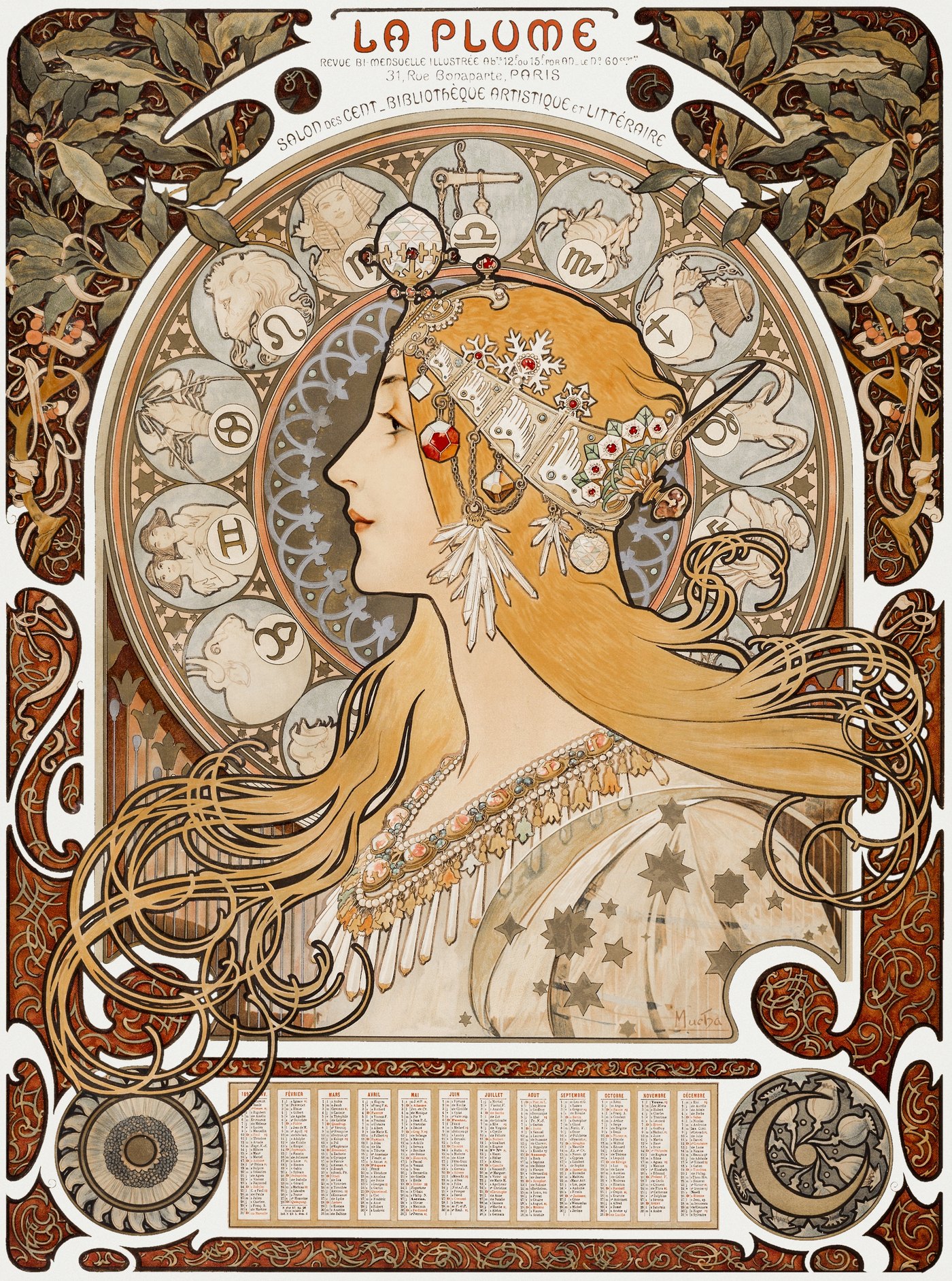
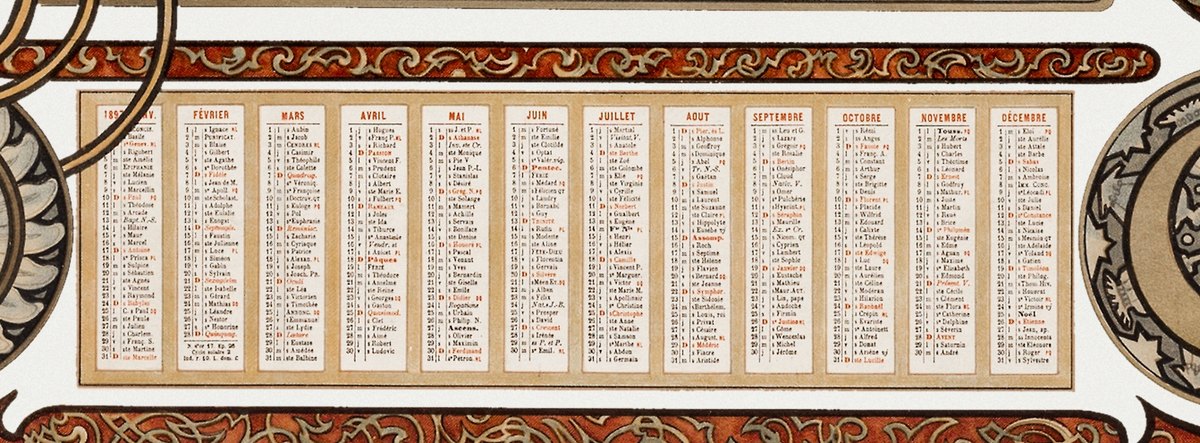
A woman turns into profile inside a great circular field of signs. Her hair flows beyond it, curling around the patterned frame, while a narrow calendar runs across the foot of the sheet. At the top is the name LA PLUME. This version of Alphonse Mucha’s Zodiac was made to be seen and used: it carried the months of 1897 for readers of the Paris arts magazine. Its beauty made it suitable for a wall, but its letters and date grid also tell us why it was printed.[1][2]
Mucha designed the composition in 1896 for his printer, F. Champenois, as a company calendar. Léon Deschamps, editor of La Plume, acquired the rights to distribute it as the magazine’s calendar for 1897. The design circulated in several printed states, including versions without the magazine’s words or the month grid. The sheet pictured here belongs to the La Plume calendar family; it should be read as that issue rather than as a textless decorative panel.[1][2]
A French Musée du Luxembourg exhibition guide specifies that Champenois intended the original 1897 calendar for his employees.[14] That makes the commission more particular than an unspecified poster for sale: it began as an object for people working within the printing business. Deschamps's purchase then placed the same design in a publisher's calendar. The change of audience is part of the print's history, even though the central woman and zodiac ring remained recognisable.[1][14]
At a Glance
- ArtistAlphonse Mucha
- DesignZodiac, made in 1896
- Pictured issueLa Plume calendar for 1897
- Mediumcolour lithograph
- PrinterF. Champenois, Paris
- Functionan illustrated calendar that also promoted La Plume
The Bibliothèque nationale de France catalogues a La Plume version with the months of 1897 as variant 1; its notice gives 65 × 48 centimetres.[2] The Art Institute of Chicago holds another calendar impression, dated 1896–97 and measuring 63 × 47 centimetres.[3] The Pushkin Museum records a La Plume calendar sheet at 64 × 47.5 cm, with a 63.2 × 47.2 cm impression area.[6] Those numbers describe three held objects and, in the Pushkin record, two ways of measuring one of them. They are not universal dimensions for every printing.
An exhibition catalogue published by Brazil's Centro Cultural Banco do Brasil also records an 1896 study for Zodiac in pencil, pen, ink and watercolour on paper, alongside a colour lithograph.[15] The study belongs to the design process; it is not another printed calendar or a proof on satin. Keeping those categories separate helps explain why a date attached to a preparatory drawing, a date attached to a lithograph and the year printed in a month grid need not be identical.
Zodiac in Mucha’s career
Contents
- A face within the circle
- Reading the printed calendar
- How the image changed from issue to issue
- The British Cachou de Luxe version
- A later American use
- A design for time and display
Look closer: Zodiac: La Plume calendar
This is the lettered La Plume calendar image. It should be distinguished from proof-before-letters and textless decorative-panel versions of Zodiac.
 123
Details from Zodiac: La Plume calendar
Select a detail image to open the full-size gallery, then use the arrows to compare views.
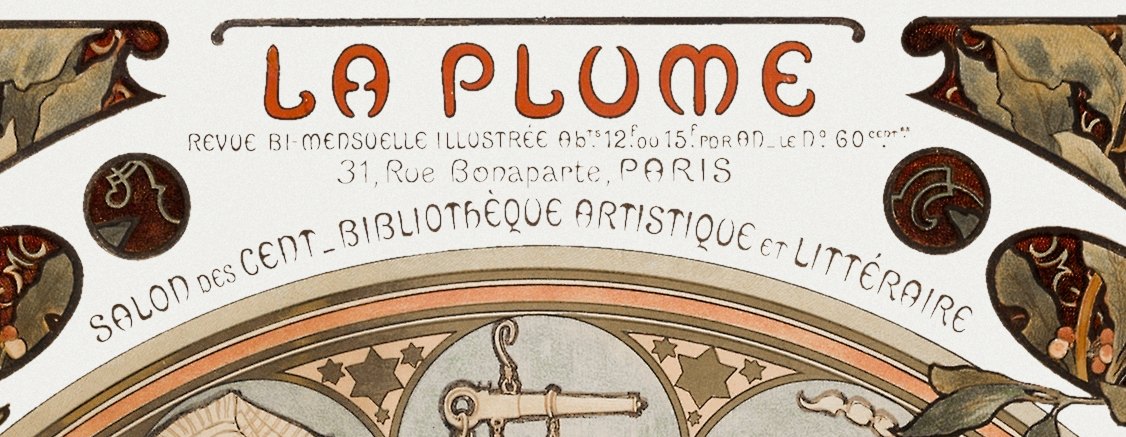
La Plume above the portrait
The publisher's name and address occupy the white upper band, tying the design to this magazine use.
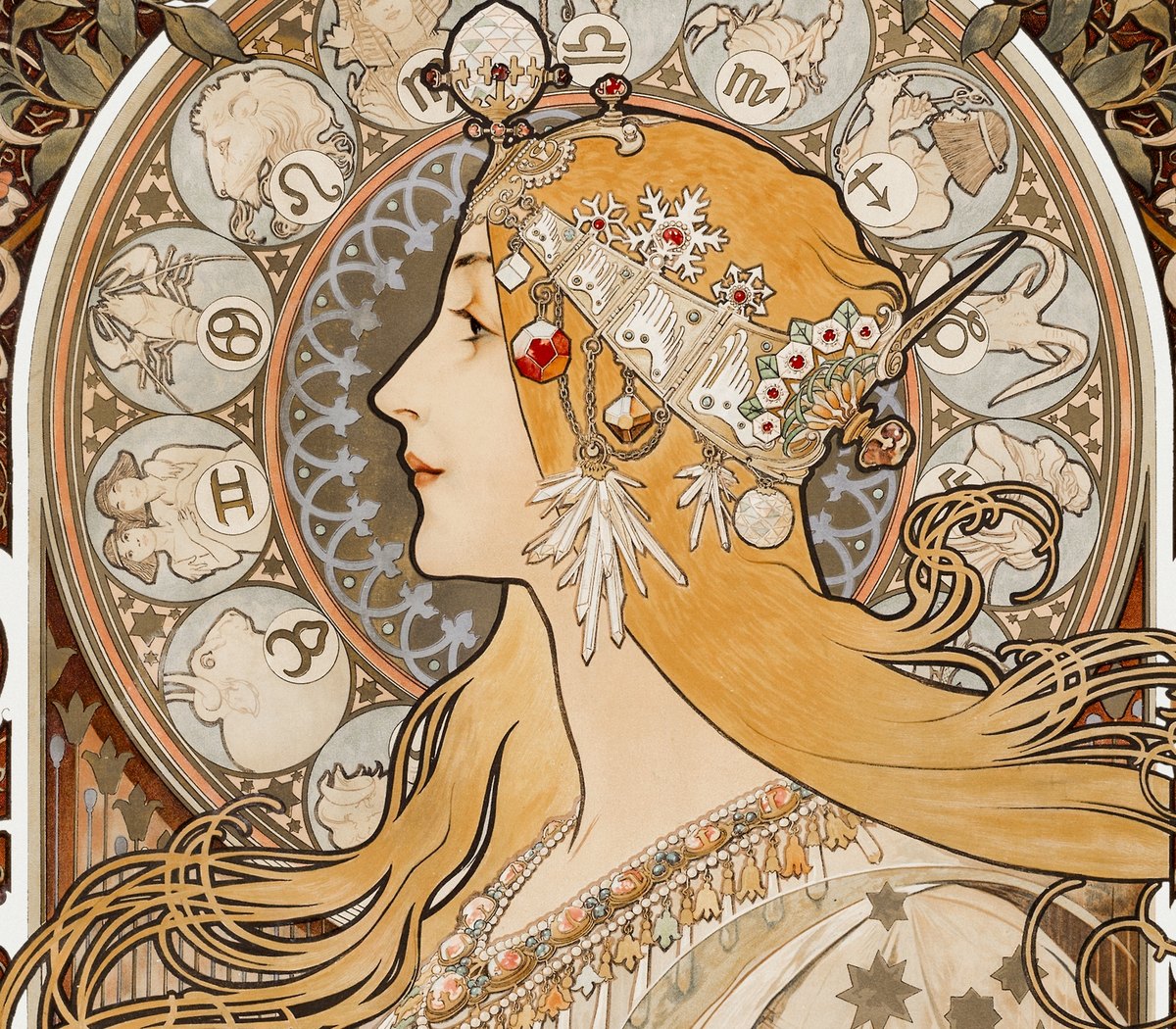
Twelve signs around the profile
Small zodiac figures circle the woman's head; jewellery, hair and the inner ring overlap them rather than sitting in separate compartments.
The calendar at the foot
A narrow month grid runs below the main picture. Its presence is the clearest visible difference from the textless decorative panel.
A face within the circle
The woman’s face is strikingly still amid the busy design. She looks to the left, her features held in a clean profile. Behind her head, a ring contains the twelve signs of the zodiac. Smaller circular compartments break the large disk into readable parts, so the pattern has an order rather than becoming a mass of decoration. Mucha places the figure in front of the ring: her profile gives the eye a starting point, while the signs invite it to travel around her.[1]
The arrangement can suggest a halo, and the Mucha Foundation uses that comparison to describe the disk. Yet the symbols also have a practical relation to a calendar. A viewer knows at once that the picture concerns the turning year. The woman need not be identified as one zodiac sign, or as a portrait of a named sitter, for the design to work. She provides a human centre to an image about recurring time.[1]
An Australian exhibition label offers a more detailed reading of the circular band. Alongside the twelve zodiac signs, it identifies hexagrams and describes the theme as the harmonious working of the universe.[17] That reading draws attention to how the ring holds more than a set of month markers: its small symbols also enrich the decorative field around the profile. The label relates Mucha's decorative vocabulary to Japanese, Celtic, Islamic, Greek, Gothic and Rococo sources, as well as to Slavic traditions. These are the exhibition's broad art-historical comparisons, not a key assigning each visible detail to a single culture or evidence of a personal horoscope devised by Mucha.[17]
Her headdress and jewellery make that centre richly detailed. Small ornaments gather near her hair and forehead; longer shapes hang beside her face and across her shoulders. The hair then loosens into strands that sweep outward and curl back into the border. It joins the central figure to the outer frame without losing the distinction between a person and a pattern. Where the signs are contained in neat compartments, the hair seems to resist such limits.
This play between control and movement gives Zodiac much of its energy. The profile can be taken in quickly, while the loops, jewels and symbols reward a closer look. A calendar needs to remain on a wall for months, so a design that offers both instant recognition and repeated detail has a purpose beyond one passing glance.
Reading the printed calendar
The La Plume issue gives the picture an unmistakable setting. The magazine name appears above the figure, with publication information below it. At the bottom, the months occupy a long rectangular strip between roundels bearing the sun and moon. The calendar is small beside the woman, but it changes the sheet’s identity. This is a dated publication intended for a particular year, not merely an undated image with astrological symbols.[2]
The position of that strip is carefully judged. It sits below the large portrait and circular disk, giving the eye a clear place to find the practical information after taking in the illustration. Sun and moon at its ends continue the celestial theme at a smaller scale. Above, foliage fills the corners and the border holds the whole arrangement together. Magazine title, symbolic image and month table are parts of one designed sheet.
La Plume was an arts magazine with an exhibition culture of its own. The Mucha Foundation records its association with the Salon des Cent and the magazine’s attention to Mucha’s work in 1897. In the calendar, the magazine’s name rides above an image that could make the publication memorable in a reader’s room. The calendar brought a useful object and a promotional one together.[4]
The design also entered the magazine's pages. Pavel Nosek's bibliography identifies a colour reproduction on page 144 of La Plume's 1897 volume, captioned as Mucha's composition for the magazine calendar.[8] That is evidence for a periodical reproduction of the calendar design, distinct from the large calendar sheet a reader could hang up. Nosek also identifies the magazine's six Mucha-focused issues, numbers 197–202, published from 1 July to 15 September 1897.[8] The page-144 reproduction and the special-issue sequence show two further ways the periodical presented his work. Their existence should not turn every La Plume item from that year into a physical Zodiac calendar.
How the image changed from issue to issue
The history of Zodiac is a history of reuse. Its first purpose was an in-house calendar for Champenois; Deschamps then took it into La Plume’s circulation. The Foundation says at least nine variants of the lithograph are known. Its own catalogue image is a version printed without text for use as a decorative panel. The pictured sheet here has the magazine heading and month grid, so the two images share a composition while serving different printed purposes.[1]
The BnF's record makes the differences unusually concrete. It groups three held variants and labels the La Plume calendar with months as variant 1. Another is textless. In a further variant, the lower calendar area is replaced by two small figures.[2] LACMA catalogues a more specific textless object: an 1896 proof before lettering on satin, printed in eleven colours including metallic silver and gold.[7] A proof made before letters, a magazine calendar and a decorative issue should not be described as the same print state just because they share the central profile and zodiac ring. The upper wording and lower field are vital to identifying the issue.
The Brazilian exhibition catalogue states that Deschamps sold the composition under the La Plume name as both a calendar and a decorative panel.[15] This is a useful distinction within the publisher's own distribution, not merely a later art-historical label applied to an attractive old advertisement. A person buying the panel and a reader obtaining the calendar could encounter much the same image but use it differently. The panel did not need a dated strip, while the calendar gained its specific use from that strip.[1][15]
A textless version could remain on a wall after 1897 without announcing an expired calendar. That suited the decorative-panel market that Champenois helped develop. The Mucha Foundation describes such panels as images made or republished for interior display without an advertising message. Zodiac demonstrates the flexibility of one composition: a company calendar, a magazine calendar and a decorative print could reach different buyers and viewers.[1][5]
The changes also affect how we read the design. In the La Plume issue, the woman is part of a working year and a named publication. Without those words, the signs and the figure carry more of the meaning themselves. The artist’s lines remain, but the printed context shifts around them. This is why an exact caption matters, especially when a small web reproduction can make the lettering hard to read.
Calendar years after 1897
The Richard Fuxa collection describes its own Zodiac impression as variant 4 of Rennert and Weill's catalogue, measuring 65 × 48.5 cm. Its collection text says that calendar versions of the composition were prepared for 1897 through 1901. It describes a change in the lower field: month columns occupy the space where two small figures appear in a decorative version. The upper field could also carry the name of a client rather than the title of La Plume.[18] This account gives a broader span for the calendar's reuse than the single 1897 issue on this page. It does not, by itself, identify an extant sheet for each of those five years or establish that each used identical lettering elsewhere.
One later year has a separately catalogued example. Swann Galleries recorded a 1898 Zodiac calendar for P. Ploton & D. Chave, a printer and lithographer, bearing that firm's name and an 1898 calendar at the bottom. The auction description attributes the printing to F. Champenois and measures its offered sheet at 61.75 × 45.75 cm.[19] It is evidence for a named commercial calendar beyond La Plume, and for a year-specific alteration of the month table. This reuse is especially suggestive because the named client, like Champenois, worked in the printing trade: the design could advertise the capabilities of another firm while still serving as a calendar. The auction's dimensions describe that particular offered copy, whose condition report includes repairs and overpainting; they should not replace the measurements of the BnF, Chicago or Pushkin impressions.[2][3][6][19]
These records also explain why variant totals require care. The Mucha Foundation reports at least nine lithographic variants, while Swann's lot text says at least ten variations have been identified.[1][19] The two statements need not use the same counting rules for changed client names, calendar years, paper and pre-lettering proofs. Neither provides a complete numbered list in the cited record, so a confident total cannot be derived from them here. A reader identifying a particular sheet should start with the actual wording at the top, the presence and year of its calendar, and whether figures occupy the lower field. Its printer line, support and measurements then help distinguish the surviving impression from a reproduction or another issue.[1][2][7][18][19]
The British Cachou de Luxe version
The relettering reached beyond La Plume. Pavel Nosek's specialist bibliography identifies “Cachou de Luxe” on page 204 of the November 1898 British journal The Poster as a variant of Zodiac.[8] A Newberry Library catalogue describes a 1999 Mucha Trust postcard reproduction of a “Cachou de Luxe” Zodiac variant and says the original design was also used for Carmichael's Luxuria Bath Tablets.[9] The postcard is a modern reproduction, not a nineteenth-century poster in the library's collection. Its record and Nosek's bibliography support a separate commercial use of the composition, but neither establishes which of the Foundation's nine variants matches this site's La Plume calendar.
The business setting can be traced in period print. A 4 September 1897 advertisement in The Chemist and Druggist marketed Carmichael's Luxuria bath tablets and Cachou de Luxe breath perfume to retailers. It offered a 16-colour cardboard showcard with qualifying orders of either product.[10] The advertisement does not name Mucha or call that showcard Zodiac, so its terms cannot be assigned to a particular impression without further evidence. An October 1898 review in The Poster does name Mucha's Carmichael's Cachous advertisement among the designs seen on London hoardings.[11] Together the sources document a British advertising channel and the poster's contemporary reception, while leaving the exact relationship between the showcard, street poster and later catalogued Zodiac variant open.
A later American use
The Library of Congress catalogues a 1924 Whitman's Salmagundi Chocolates advertisement that reproduced Mucha's Zodiaque La Plume profile on a candy tin.[12] The library identifies the surviving advertisement as a 27 × 38 cm colour offset lithograph, commissioned by Stephen F. Whitman & Son of Philadelphia. Its record gives a patent publication date of 15 May 1924 and registration on 5 August 1924. Those dates belong to the American advertising design, not the creation of Zodiac in 1896 or the La Plume calendar for 1897.[1][12]
Library staff note that the tin adaptation omitted the zodiac signs.[13] That observation describes the later packaging, while the held 1924 sheet is an advertisement showing the product. It demonstrates another commercial reuse of the familiar profile decades after the calendar. The catalogue does not establish that Mucha personally reworked the 1924 packaging, or that Whitman's offset print was another Champenois lithographic state. It is a later design using his earlier image in a different medium and market.[12][13]
A design for time and display
The zodiac was a familiar way to picture the cycle of a year. Mucha did not need to draw twelve large scenes to evoke it. He placed the signs around one composed figure, then gave the calendar a separate place below. The ring, hair and outer frame move the eye through the image; the month table gives that movement an everyday use. We can appreciate the symbolic decoration without assuming that the picture sets out Mucha’s personal beliefs about astrology.
The sheet also shows why a colour lithograph could travel so effectively. The same design could be printed in different states for different purposes, retaining its recognisable profile and circular signs. For the held La Plume sheet, the Art Institute of Chicago identifies a colour lithograph printed from multiple stones on tan wove paper.[3] The Pushkin Museum's calendar record is still more specific, describing chromolithography from six stones and recording its acquisition in 1924 from the former collection of Nikolai Mosolov.[6] That museum history belongs to its own impression, not to the production date of the design. Printing process, lettering, paper and later ownership all affect how an individual Zodiac object is described.
An Ehime exhibition press dossier in Japanese lists a La Plume calendar from the OGATA Collection, with 1896 as its artwork date.[16] That date is consistent with the design year used by the Mucha Foundation; it does not change the 1897 year printed in the calendar.[1][2][16] The listing adds another documented collection context, but it provides neither a full variant sequence nor evidence that the Chicago, Pushkin and OGATA sheets came from the same print run. Treating collection records as descriptions of held or exhibited objects is more precise than flattening their different dates, sizes and materials into a single supposed original.
Mucha returned to recurring time in other decorative work. The Seasons gave spring, summer, autumn and winter separate personified panels; Rêverie also moved between a dated printed commission and a version for decorative display. Zodiac compresses a year into one face, one ring and a slim row of months. Its success rests on that economy: it works at once as an image of time, an attractive object and a calendar readers could keep close at hand.[1][5]
For more of Mucha’s printed commissions, see the poster collection. Mucha and Art Nouveau follows the line, framing and ornament that make Zodiac recognisable even when its lettering changes.
Watch: Alphonse Mucha
Follow Mucha’s work from Art Nouveau Paris to his later Czech projects.
Alphonse Mucha: Plongez dans l’Art nouveau !
A French museum introduction to Mucha’s Art Nouveau years, poster work and decorative language.
Watch on YouTubeArtworks directory
| Name | Date | Medium |
|---|---|---|
| 'Accept Love and Enthusiasm from Your Son, Mother of the Holy Nation': study for the mural 'By Own Strength III' at the Lord Mayor's Hall, Obecní Dům, Prague | 1910-1911 | Pencil and charcoal on canvas |
| 'By force towards freedom, with love towards unity!': study for the mural 'By Own Strength II' at the Lord Mayor's Hall, Obecní Dům, Prague | 1910-1911 | Pencil and charcoal on canvas |
| 'The Passing Wind Takes Youth Away': design for a fan and the façade of the 'Pavilion of Man' (unrealised) | 1899 | Colour lithograph |
| 'Through humiliated and tortured, you will live again, my country!': study for the mural 'By Own Strength II' at the Lord Mayor's Hall, Obecní Dům, Prague | 1910-1911 | Pencil and charcoal on canvas |
| 1918-1928: Poster for the 10th Anniversary of the Independence of the Republic of Czechoslovakia | 1928 | Colour lithograph |
| 6th Sokol Festival | 1912 | Colour lithograph |
| 8th Sokol Festival | 1925 | Colour lithograph |
| After the Battle of Grunwald | 1924 | egg tempera on canvas |
| After the Battle of Vitkov Hill | 1923 | egg tempera on canvas |
| Age of Love | 1936–1938 | |
| Age of Reason | 1936–1938 | |
| Age of Wisdom | 1936–1938 | |
| Amants | 1895 | Colour lithograph |
| Apotheosis of the Slavs | 1926 | Egg tempera on canvas |
| As Hamlet | 1899 | colour lithograph |
| Au Quartier Latin | 1898 | Magazine cover |
| Banknotes of Czechoslovakia, designed by Mucha: 500 crown; 50 Crown; 10 Crown | 1929 | Banknotes |
| Bieres de la Meuse | 1897 | Colour lithograph |
| Biscuits Champagne Lefevre Utile | 1896 | Colour lithograph |
| Biscuits Lefevre Utile | 1896 design for 1897 calendar; Foundation object/Carnavalet 1897 | Colour lithograph |
| Blessed are the Pure in Heart | 1906 | Printed magazine illustration |
| Bleu Deschamps | 1903 (deposit) | Colour lithograph |
| Bosnia & Herzegovina Pavilion - illustration featured in 'Le Figaro Illustré' (1 March 1900) | 1900 | Reproduction from Le Figaro Illustré after watercolour original |
| Bosnia-Herzegovina Pavilion: cartoon for the mural 'The Roman Period and the Arrival of the Slavs' | 1899-1900 | ink and crayon on paper |
| Bosnia-Herzegovina Pavilion: fragment of the upper frieze featuring Ivo and Anica, characters from Bosnian legends | 1899-1900 | tempera and watercolour on canvas |
| Bosnian Legends: Death of Hasanaga's Bride | 1899 | Charcoal on paper |
| Bosnian Legends: Murcia - The Plague Lady | 1899 | Charcoal on paper |
| Bosnian Pavilion Restaurant at the Paris Exhibition 1900: design for the menu | 1900 | Pencil and watercolour on paper |
| Boutique Fouquet (interior design) | 1901 | Shop interior design |
| Boutique Fouquet: sketches of the shop's signboard and decorative details | c.1900 | Pencil, ink and watercolour on paper |
| Box for Lefèvre-Utile biscuits: Gaufrettes Vanille | c.1900 | Tin box covered with lithographed label |
| Box for Lefèvre-Utile biscuits: Madère | c.1900 | Tin box covered with lithographed label |
| Brightness of the Day | 1899 | Colour lithograph |
| Broach with Pendant | 1900 | Gold, ivory, mother-of-pearl and semi-precious stones |
| Byzantine Head - The Blonde | 1897 | Colour lithograph |
| Byzantine Heads (pair) | 1897 | Colour lithograph |
| Byzantine Heads: Brunette | 1897 | Colour lithograph |
| Bénédictine | 1898 (BnF deposit); Hamburg 1899; MNAC 1896 or 1898 | Colour lithograph |
| Champagne Ruinart | 1896 | Colour lithograph |
| Chocolat Ideal | before or in 1897 (catalogue conflict) | Colour lithograph |
| Chocolat Masson (1897 calendar) | 1896–1897 | Colour lithograph |
| Choirboys at Petrov Church, Brno | 1905 | Watercolour on cardboard |
| Cloches de Noel | 1900 | Illustrated book |
| Comedy: study for a mural for the German Theatre, New York | 1908 | Oil on canvas |
| Cours Mucha: poster advertising Mucha's art classes held at the Académie Colarossi, Paris | 1900 | colour lithograph |
| Creative Force - Jan z Pernštýna: study for a pendentive of the Lord Mayor’s Hall, Obecní Dům, Prague | 1910-1911 | Oil on canvas |
| Crucifixion | c.1868 | Pencil, crayon and watercolour on paper |
| Cycles Perfecta | 1897 or 1902 (catalogue conflict) | Colour lithograph |
| Dance | 1898 | Colour lithograph |
| Dead Couple - Abandoned | c.1899-1900 | Charcoal and pastel on blue paper |
| Defense of Sziget against the Turks by Nicholas Zrinsky | 1914 | egg tempera on canvas |
| Design for a champagne poster | c. 1896 | Charcoal and pastel on paper |
| Design for a display stand at the Paris Exhibition 1900 | c.1899-1900 | Pencil and wash on paper |
| Design for Champagne Ruinart | c. 1896 | Pencil, watercolour and gold leaf on paper |
| Design for the cover of the magazine 'Fantaz' | 1882 | Ink and watercolour on paper |
| Design for the heading of the cover of the magazine 'Krokodil' | 1885 | Pen and ink on cardboard |
| Design for the poster for the Mucha Exhibition at the Brooklyn Museum, New York, January-February 1921 | 1920 | Pen and ink and watercolour on paper |
| Designs for cutlery | c.1900 | Charcoal and white on card |
| Designs for tableware | c.1900 | Charcoal, coloured pencil and white on card |
| Diadem for 'La princesse lointaine' | 1895 | metal and pearls |
| Diploma of Ivančice: Mock diploma honouring a local celebrity, with illustration of the first line of 'May', a poem by Karel Hynek Mácha | 1882 | Pen and ink and watercolour on paper |
| Documents décoratifs: designs for a watch and accessories (unused) | 1901-1902 | Pencil, ink and white on paper |
| Documents décoratifs: final study for Plate 25, featuring studies of lily | 1901-1902 | Pencil on paper |
| Documents décoratifs: final study for Plate 43 | 1901-1902 | Pencil, ink and wash, heightened with white on paper |
| Documents décoratifs: final study for Plate 49 | 1901-1902 | Pencil and white on paper |
| Documents décoratifs: final study for Plate 50 | 1901-1902 | Pencil and white on paper |
| Documents décoratifs: final study for Plate 60 | 1901-1902 | Pencil, ink and wash, heightened with white on paper |
| Documents décoratifs: final study for Plate 63 | 1901-1902 | Pencil and white on paper |
| Documents décoratifs: final study for Plate 67 | 1901-1902 | Pencil and white on paper |
| Documents décoratifs: final study for Plate 71 | 1901-1902 | Pencil and white on paper |
| Documents décoratifs: final study for Plate 72 | 1901-1902 | Pencil and wash, heightened with white on paper |
| Documents décoratifs: line drawing for Plate 33, featuring lily motifs | 1901-1902 | Pencil, pen and ink on paper |
| Documents décoratifs: Plate 54 | 1902 | Lithograph |
| Dreaming of Freedom: study for a Panel of the Small Reception Room at the Lord Mayor’s Hall, Obecní Dům, Prague | 1910-1911 | Pen and ink and watercolour on paper |
| Dusk | 1899 | Colour lithograph |
| Evening | 1899 | Colour lithograph |
| F. Champenois (Rêverie imprint) | 1898 | Colour lithograph |
| F. Guillot-Pelletier calendar (1898) | 1897–1898 | Colour lithograph |
| Feather | 1899 | Colour lithograph |
| Figures décoratives: final study for Plate 2 | 1904-1905 | Pencil and white on paper |
| Figures décoratives: final study for Plate 3 | 1904-1905 | Pencil and white on paper |
| Figures décoratives: final study for Plate14 | 1904-1905 | Pencil with white on paper |
| Figures décoratives: sketch study for Plate14 | 1904-1905 | Blue pencil on paper |
| Flirt Lefevre Utile | 1899 (Foundation design); BnF legal deposit 1900 | Colour lithograph |
| Flower | 1897 | Colour lithograph |
| Flower: final study for decorative panel | 1897 | Pencil, ink and watercolour on paper |
| France Embraces Bohemia | 1918 | oil on canvas |
| Fruit | 1897 | Colour lithograph |
| Georges Fouquet (1858-1929), Paris, after design by Mucha: Ornamental Chain with pendants | 1900 | Gold, enamel, fresh-water pearls, mother of pearl and semi-precious stones |
| Georges Fouquet (1858-1929), Paris, after Mucha design: 'Peacock' Ring (Exhibited at the Paris Exhibition 1900) | 1900 | Opal and gold |
| Girl Weeping | c.1899-1900 | Black chalk and pastel on paper |
| Girl with Loose Hair and Tulips | 1920 | Oil on canvas |
| Gismonda | 1894 | Colour lithograph |
| Head of a Girl, statue for the stand of the Houbigant Perfumery at the Paris Exhibition 1900 | 1900 | Bronze, silver and parcel gilt |
| Head of Sarah Bernhardt: Study for 'Lorenzaccio' | 1896 | Pencil on paper |
| Heather from Coastal Cliffs | 1902 | Colour lithograph |
| Heidsieck & Co | 1901 | Colour lithograph |
| Holy Mount Athos | 1926 | Egg tempera on canvas |
| Ilsée, Princesse de Tripoli | 1897 | Illustrated book |
| In the Desert: Study for an illustration for the Světozor magazine | 1889 | Pencil, watercolour and gouache on paper |
| Incantation (Salammbô) | 1897 | Lithograph |
| Independence - Jiří z Poděbrad: study for a pendentive of the Lord Mayor’s Hall, Obecní Dům, Prague | 1910-1911 | Oil on canvas |
| Interior and furniture designs | c.1900 | Pencil on paper |
| Interior of Boutique Fouquet: design for a wall-mounted display cabinet with statuette and mirror | c.1900 | Pencil on paper |
| Interior of Boutique Fouquet: design for the fireplace with statuettes, mirror, and the ornamental details of the wall | c.1900 | Pencil and watercolour on cardboard |
| Interior of Boutique Fouquet: sketches of the fireplace with statue, mirror, display cabinet, and the ornamental details of the wall | c.1900 | Pencil, pen and ink on paper |
| Ivy | 1901 | Colour lithograph |
| Jan Milic of Kromeriz | 1916 | egg tempera on canvas |
| Jaroslava and Jiří, the Artist’s Children | 1918 | Oil on canvas |
| JOB poster | 1896 | Colour lithograph |
| Judgement of Paris (calendar for Vieillemard printing company) | 1895 | Colour lithograph |
| Justice - Master Jan Hus: study for a pendentive of the Lord Mayor's Hall, Obecní dům, Prague | 1910-1911 | Oil on canvas |
| L'Annee Qui Vient | 1897 | red chalk on paper |
| L'Illustration magazine - cover for Christmas 1896/1897 | 1896 | Magazine cover |
| L'Illustré Soleil du Dimanche | 1897 | Magazine cover |
| La Dame aux Camélias: designs for cover and interior of special programme | 1896 | Pencil and watercolour on paper |
| La Nature | 1899-1900 | Bronze and amethyst |
| La Plume | 1897 | Magazine cover |
| La Samaritaine | 1897 | colour lithograph |
| Lance Parfum Rodo | 1896; Albertina print c. 1900 | Colour lithograph |
| Laurel | 1901 | Colour lithograph |
| Le Monde Illustré | 1900 | Magazine cover |
| Le Pater | 1899 | Illustrated book |
| Le Pater: early study for the 1st allegorical scene 'Our Father who art in Heaven' (1899) (Mucha Foundation object 300) | 1899 | Pencil on paper |
| Le Pater: early study for the 1st allegorical scene 'Our Father who art in Heaven' (1899) (Mucha Foundation object 302) | 1899 | Pastel on paper |
| Le Pater: study for the 6th allegorical scene 'Forgive us our debts, as we forgive our debtors' | 1899 | Charcoal and ink wash on paper |
| Lefevre Utile | 1904 | Advertisement |
| Leslie Carter | 1908 | Colour lithograph |
| Letem Českým Světem | 1898 | Printed book |
| Lorenzaccio | 1896 | Colour lithograph |
| Luchon poster (attributed to Mucha) | 1895 | Colour lithograph |
| Madonna of the Lilies | 1905 | Tempera on canvas |
| Master Jan Hus Preaching at the Bethlehem Chapel | 1916 | egg tempera on canvas |
| Maude Adams | 1908 | Lithograph, hand-coloured in watercolour and gouache |
| Maude Adams as Joan of Arc | 1909 | Oil on canvas |
| Medea | 1898 | Colour lithograph |
| Menu for the Bosnian Pavilion Restaurant at the Paris Exhibition 1900 | 1900 | Colour lithograph |
| Militancy - Jan Žižka: study for a pendentive of the Lord Mayor's Hall, Obecní dům, Prague | 1910-1911 | Oil on canvas |
| Military Camp in Winter, near a City on Fire | c.1899-1900 | Pastel on paper |
| Moet et Chandon | 1899 | Colour lithograph |
| Monaco Monte Carlo | 1897 | Colour lithograph |
| Moon | 1902 | |
| Moravian Teachers' Choir | 1911 | Colour lithograph |
| Morning Alphonse Mucha Painting / AlphonseMucha.org | 1899 | Colour lithograph |
| Morning Star | 1902 | Colour lithograph |
| Moët & Chandon White Star | 1899 | Colour lithograph |
| Mrs Mucha’s Necklace | 1906 | gold, enamel and semi-precious stones |
| Mural for the Bosnia-Herzegovina Pavilion: The Roman Period and the Arrival of the Slavs | 1900 | tempera and watercolour on canvas |
| Murals by Mucha in the Lord Mayor's Hall, Obecní Dům (Municipal House), Prague (1910-1911) | ||
| Music | 1898 | Colour lithograph |
| Nativity | c. 1934 | oil on canvas |
| Nestle's Food for Infants | 1897 | Colour lithograph |
| Night | 1899 | Colour lithograph |
| Nude on a Rock | 1898-1899 | Bronze |
| Official Banquet of the Paris Exhibition 1900: design for the menu featuring a fashionable woman wearing a Mucha-style jewellery | 1900 | Pencil, gouache and wash on grey paper |
| Ornamental motifs designed for 'Combinaisons Ornementales se Multipliant à l'Infini à l'Aide du Miroir' (1901) | c.1900-1901 | Blue and red pencil on paper |
| Packaging for 'Savon Mucha Violette' | 1906 | Colour lithograph |
| Packaging for Lefèvre-Utile biscuits: Boudoir | 1901 | Colour lithograph |
| Page's Costume: study for an illustration for 'Le Costume au Théâtre' | 1890 | Pencil and watercolour on cardboard |
| Painting | 1898 | Colour lithograph |
| Peonies | 1897–1898 | Ink and watercolour |
| Petr Chelcicky at Vodnany | 1918 | egg tempera on canvas |
| Poetry | 1898 | Colour lithograph |
| Portrait of Jaroslava | c.1927-1935 | Oil on canvas |
| Portrait of Josephine Crane Bradley as Slavia | 1908 | Oil and tempera on canvas |
| Portrait of Marie Chytilová (Maruška), Mucha's Future Wife | 1903 | pastel on paper |
| Portrait of Mucha's Sister, Angela | c.1880 | Oil on canvas |
| Portrait of Mucha's Sister, Anna | c.1885 | Oil on canvas |
| Portrait of Mucha's Son, Jiří | 1925 | Oil on canvas |
| Portrait of Mucha's Wife, Maruška | 1908/17 | Oil on canvas |
| Portrait of Woman | c. mid 1910s - 1925 | Blue pastel on grey paper |
| Poster for 'Hommage Respectueux de Nestlé' (the Nestlé Company's tribute to Queen Victoria's 60th Jubilee) | 1897 | Colour lithograph |
| Poster for 'Imprimerie Cassan Fils' | 1896 | Colour lithograph |
| JOB poster (1898) | 1898 | Colour lithograph |
| Poster for 'La Dame aux Camélias' | 1896 | Colour lithograph |
| Poster for 'La Tosca' | 1899 | Colour lithograph |
| Poster for 'Regional Exhibition at Ivančice 1913' | 1912 | Colour lithograph |
| Poster for 'The Slav Epic Exhibition, Brno, 1930' | 1928-1930 | Colour lithograph |
| Poster for 'Waverley Cycles' | 1898 | Colour lithograph |
| Poster for the 'Lottery of the Union of Southwestern Moravia' | 1912 | Colour lithograph |
| Poster for the Austrian Pavilion at the Paris Exhibition 1900 | 1900 | Colour lithograph |
| Prague Subjugated: study for a Panel of the Small Reception Room at the Lord Mayor’s Hall, Obecní Dům, Prague | 1910-1911 | Pen and ink and watercolour on paper |
| Primrose | 1899 | Colour lithograph |
| Primrose and Feather (paired image) | 1899 | Colour lithographs (paired image) |
| Princess Hyacinth (Princezna Hyacinta) | 1911 | Colour lithograph |
| Print proof for the Biscuits Lefèvre-Utile tin | 1899 | Lithograph |
| Reverie | 1898 | Colour lithograph |
| Russia Restituenda [Russia Must Recover] | 1922 | Colour lithograph |
| Salome | 1897 | Colour lithograph |
| Salon des Cent | 1896 | Colour lithograph |
| Salon of the Hundred | 1897 | Colour lithograph |
| Sarah Bernhardt - La Princesse Lointaine - Lefevre Utile | 1903 | Colour lithograph |
| Sarah Bernhardt as La Princesse Lointaine: poster for 'La Plume' magazine | 1897 | Colour lithograph |
| Sarah Bernhardt in the role of the Duc de Reichstadt in L’Aiglon | 1900 | Pencil on paper |
| Sarah Bernhardt: study of her full-standing figure | c.1896 | Pen and ink on paper |
| Savonnerie de Bagnolet calendar | 1898 (calendar) | Printed advertising calendar |
| Self-portrait (1899) | 1899 | Oil on board |
| Self-portrait (1907) | 1907 | Blue and white crayon on blue Ingres paper |
| Self-portrait, sketching in his apartment, Paris | late 1880s | oil on canvas |
| Sketches of flowers for Documents décoratifs | c.1900-1901 | Pen and ink on paper |
| Slavia insurance poster | 1907 | Poster |
| Slavs in their Original Homeland | 1912 | Egg tempera on canvas |
| Snake Bracelet with a Ring | 1899 | Gold, enamel, opal, ruby and diamond |
| Société Populaire des Beaux Arts | 1897 | Colour lithograph |
| Song of Bohemia | 1918 | oil on canvas |
| St. Vitus Cathedral Stained-glass Window, Prague: final design for the central panels, featuring SS Cyril and Methodius | 1931 | Ink and watercolour on paper |
| St. Vitus Cathedral Stained-glass Window, Prague: final design for the central panels, featuring St. Ludmila | 1931 | Ink and watercolour on paper |
| St. Vitus Cathedral Stained-glass Window, Prague: final design for the central panels, featuring St. Wenceslas (Duke of Bohemia) kneeling next to his Grandmother, St. Ludmila | 1931 | Ink and watercolour on paper |
| St.Vitus Cathedral Stained-glass Window, Prague: final design for the bottom left panels | 1931 | Ink and watercolour on paper |
| St.Vitus Cathedral Stained-glass Window, Prague: final design for the bottom right panels | 1931 | Ink and watercolour on paper |
| Stained-glass Window designed by Mucha at St. Vitus Cathedral, Prague | Early 1930s | N/A |
| Study for 'The Age of Reason' | 1936-1938 | Pencil and watercolour on paper |
| Study for 'The Slav Epic cycle' No.19: The Abolition of Serfdom in Russia | 1913-1914 | Watercolour and gouache on paper |
| Study for 'The Slav Epic' cycle No.14: The Sacrifice at Szigetvár by Nikola Zrinski | c.1913-1914 | Photographed drawings stuck together, tinted with watercolour and gouache |
| Study for 'The Slav Epic' cycle No.17: The Holy Mount Athos (1926) | c.1925-26 | Charcoal heightened with white on cardboard |
| Study for 'The Slav Epic' cycle No.18: The Oath of Omladina under the Slavic Linden Tree | c.1925-1926 | Pencil and watercolour on paper |
| Study for 'The Slav Epic' cycle No.1: The Slavs in Their Original Homeland (1912) | c.1910-1912 | Oil on canvas |
| Study for 'The Slav Epic' cycle No.2: The Celebration of Svantovít | c.1910-1912 | Oil on canvas |
| Study for 'The Slav Epic' cycle No.7: Jan Milíč of Kroměříž | c.1915-1916 | Oil on canvas |
| Study for 'The Slav Epic' cycle No.9: Master Jan Hus Preaching at the Bethlehem Chapel. The Magic of the Word: Truth Prevails (1412). | c.1915-1916 | Oil on canvas |
| Study for 'The Three Ages' triptych: Reason, Wisdom and Love [unfinished project] | 1936-1938 | Pencil and watercolour on paper |
| Study for 'Woman in the Wilderness' (c. 1922-1923) (Mucha Foundation object 315) | c. 1922-1923 | oil on canvas |
| Study for 'Woman in the Wilderness' (c. 1922-1923) (Mucha Foundation object 316) | c. 1922-1923 | oil on canvas |
| Study for Savon Notre Dame | c. 1896 | pencil and watercolour on paper |
| Study for the poster 'Russia Restituenda [Russia Must Recover]' | 1922 | Pen and ink and watercolour on paper |
| Study of a Male Nude | 1885-1887 | Oil on canvas |
| The Abolition of Serfdom in Russia | 1914 | Egg tempera on canvas |
| The Arts (series) | 1898 | Colour lithograph |
| The Arts: study for 'Dance' | 1898 | Pencil and watercolour on paper |
| The Arts: study for 'Music' | 1898 | Pencil and watercolour on paper |
| The Arts: study for 'Painting' | 1898 | Pencil and watercolour on paper |
| The Arts: study for 'Poetry' | 1898 | Pencil and watercolour on paper |
| The Bohemian King Premysl Otakar II | 1924 | egg tempera on canvas |
| The Bulgarian Tsar Simeon | 1923 | egg tempera on canvas |
| The Burr McIntosh Monthly, 1907 | 1907 | Magazine cover |
| The Celebration of Svantovit | 1912 | egg tempera on canvas |
| The Coronation of the Serbian Tsar Stefan Dusan as East Roman Emperor | 1923 | egg tempera on canvas |
| The Devil and Mr Twardowsky: study for an illustration for 'The Tale of Pan Twardowsky' (a variation of 'Faust') | c.1887-1888 | Charcoal on paper |
| The Flowers (series) | 1898 | Colour lithographs |
| The Flowers: Carnation | 1898 | Colour lithograph |
| The Flowers: Iris | 1898 | Colour lithograph |
| The Flowers: Lily | 1898 | Colour lithograph |
| The Flowers: Rose | 1898 | Colour lithograph |
| The Hussite King Jiri of Podebrady | 1923 | Egg tempera on canvas |
| The Introduction of the Slavonic Liturgy | 1912 | egg tempera on canvas |
| The Last Days of Jan Amos Komensky (Comenius) in Naarden | 1918 | Egg tempera on canvas |
| The Light of Hope | 1933 | Oil on canvas |
| The Meeting at Krizky | 1916 | egg tempera on canvas |
| The Months (January-June) | 1899 | Colour lithograph |
| The Months (July-December) | 1899 | Colour lithograph |
| The Moon and the Stars (four-panel montage) | 1902 | Colour lithographs (four-panel montage) |
| The Moon and the Stars (series) | 1902 | Colour lithograph |
| The Moon and the Stars: study for 'The Evening Star' | 1902 | Ink and watercolour on paper |
| The Moon and the Stars: study for 'The Pole Star' | 1902 | Ink and watercolour on paper |
| The New York Daily News art supplement | 1904 | Printed art supplement |
| The Oath of Concord of the Slavs (unfinished) | 1939 | oil on canvas |
| The Oath of Omladina under the Slavic Linden Tree | 1926, unfinished | Egg tempera on canvas |
| The Precious Stones (four-panel montage) | 1900 | Colour lithographs (four-panel montage) |
| The Precious Stones (series) | 1900 | Colour lithograph |
| The Precious Stones: Amethyst | 1900 | Colour lithograph |
| The Precious Stones: Emerald | 1900 | Colour lithograph |
| The Precious Stones: Ruby | 1900 | Colour lithograph |
| The Printing of the Bible of Kralice in Ivancice | 1914 | egg tempera on canvas |
| The Seasons (series) | 1896 | Colour lithograph |
| The Seasons (series) (1900) | 1900 | Colour lithograph |
| The Seasons (variation in screen format) | 1896 | Colour lithograph |
| The Seasons: Autumn (1896) | 1896 | Colour lithograph |
| The Seasons: Autumn (1900) | 1900 | Colour lithograph |
| The Seasons: Spring | 1900 | Colour lithograph |
| The Seasons: Spring (1896) | 1896 | Colour lithograph |
| The Seasons: Summer | 1900 | Colour lithograph |
| The Seasons: Summer (1896) | 1896 | Colour lithograph |
| The Seasons: Winter | 1900 | Colour lithograph |
| The Seasons: Winter (1896) | 1896 | Colour lithograph |
| The Slavonic Concord: study for the ceiling painting for the Lord Mayor's Hall, Obecní Dům, Prague | 1910-1911 | Oil on canvas |
| The Threat | 1912 | Colour lithograph |
| The Times of the Day (series) | 1899 | Colour lithograph |
| The West End Review | 1897 (Foundation); 1898 promotional cover | Colour lithograph |
| Thistle from the Sands | 1902 | Colour lithograph |
| Théâtre de la Renaissance: design for poster advertising Sarah Bernhardt's theatre | c.1895 | Pen and ink on paper |
| Tin for Lefèvre-Utile biscuits | 1899 | Circular tin with lid and handle; colour print on metal |
| Topaz | 1900 | Colour lithograph |
| Tragedy - study for a mural for the German theatre New York | 1908 | Oil and tempera on canvas |
| Trappistine Liquors | 1897 | colour lithograph |
| Wiener Chic | 1905 | Magazine cover |
| Woman in the Wilderness | 1923 | Oil on canvas |
| Woman masked in white head-scarf - study for the illustration of the Bosnia & Herzegovina Pavilion featured in 'Le Figaro Illustré' (1 March 1900) | 1899 | Pencil and wash heightened with white on paper |
| Woman with a Daisy - textile designed by Mucha | 1900 | Printed upholstery fabric |
| Zdenka Cerny | 1913 | Colour lithograph |
| Zodiac (La Plume calendar) | 1896–97 | Colour lithograph |
| Zodiac (textless decorative panel) | 1896 | Colour lithograph |
| ‘At the sight of the two storks the owl rose.’ Study for an illustration for Contes de Grand-mères | 1891 | Watercolour and gouache on paper |
Frequently Asked Questions
When did Mucha design Zodiac?
What are the symbols around the woman?
Do all Zodiac prints have a calendar?
Discussion
Zodiac joins a richly ornamented portrait to the practical information of a calendar.
The magazine lettering and month grid identify this particular printed state.
Reader Insights
Do you look first at the woman’s face or the ring of zodiac signs?
How does the calendar strip change your sense of the image?
What would change if the magazine name and months were absent?
Join the Conversation
Share how you read the balance between image, ornament and printed use.
References
- Mucha Foundation, “Zodiac,” object record and publication history, 1896. View source.
- Bibliothèque nationale de France, “Zodiaque,” catalogue notice FRBNF40470445, including the La Plume calendar variant 1. View source.
- Art Institute of Chicago, “Zodiaque ("La Plume"),” object 111986, official collection API record. View source.
- Mucha Foundation, “La Plume,” object record and publication context, 1897. View source.
- Mucha Foundation, “Art Posters,” thematic collection. View source.
- Pushkin State Museum of Fine Arts, collection object Г-68816, La Plume 1897 Zodiac calendar, chromolithograph from six stones with sheet/impression sizes and 1924 acquisition. View source.
- Los Angeles County Museum of Art, Zodiac (1896), accession M.87.294.44, proof before letters on satin in eleven colours. View source.
- Pavel Nosek, Alfons Mucha: Books and Periodicals (1993; English translation 2012), entry 58, November 1898 The Poster listing. Read transcription.
- Newberry Library, Curt Teich Postcard Archives record 773, 1999 Mucha Trust postcard of the Cachou de Luxe variant. Collection record.
- The Chemist and Druggist, 4 September 1897 supplement, Carmichael trade advertisement for Luxuria and Cachou de Luxe with a colour showcard offer. Issue text.
- The Poster, October 1898, “The Hoardings,” p. 135, contemporary notice of Mucha's Carmichael's Cachous advertisement. Volume text.
- Library of Congress, Whitman's Salmagundi Chocolates, item 2024641575, 1924 offset advertisement and patent record. Catalogue record.
- Library of Congress Prints & Photographs Division, “Looking at Mucha,” 2025 collection account describing the adaptation of Zodiaque. Read account.
- Musée du Luxembourg, Alphonse Mucha exhibition education dossier, p. 5, on the Champenois employee calendar and Deschamps's purchase of distribution rights. Read dossier.
- Centro Cultural Banco do Brasil, Mucha: O legado da Art Nouveau, pp. 88–89, bilingual exhibition catalogue recording the 1896 study and Deschamps's calendar and panel distribution. Read catalogue.
- Ehime Alphonse Mucha exhibition organising committee, Japanese press dossier, pp. 3 and 6, OGATA Collection listing for Zodiac: La Plume Calendar. Read dossier.
- Art Gallery of New South Wales, Alphonse Mucha: Spirit of Art Nouveau, exhibition large-print labels, p. 48, Zodiac label and thematic interpretation. Read labels.
- Art Nouveau Production / Richard Fuxa collection, “About the collection,” Zodiac entry, catalogued as Rennert–Weill 19, variant 4, with calendar-year and lower-field account. Read collection entry.
- Swann Auction Galleries, Vintage Posters sale, 18 February 2021, lot 60, Zodiac / P. Ploton & D. Chave, an 1898 calendar impression. Read lot record.