 by Tom Gurney
Tom Gurney BSc (Hons) is an art history expert with over 20 years experience
Published on June 19, 2020 / Updated on November 29, 2026
Email: tomgurney1@gmail.com / Phone: +44 7429 011000
Christ Appearing to Saint Anthony Abbot: Introduction
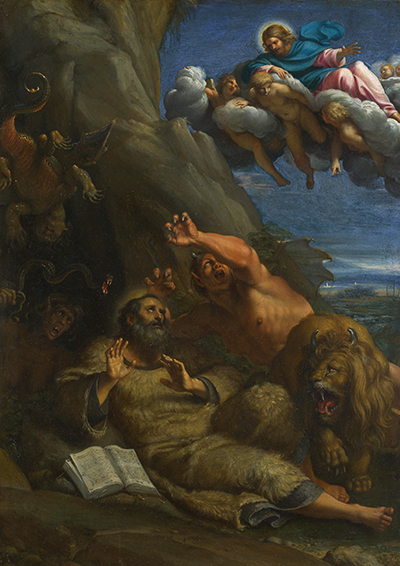
An open book lies on a rock beside Saint Anthony's elbow. His bare feet reach towards one edge of the picture, and he lifts his hands towards Christ, who appears among angels above a rocky cave full of demons. Annibale Carracci painted Christ Appearing to Saint Anthony Abbot about 1598, in oil on copper. The plate is 49.5 centimetres high and 34.4 wide. The National Gallery in London holds it as NG198 under the full title Christ appearing to Saint Anthony Abbot during his Temptation. [1]
At a Glance
- ArtistAnnibale Carracci
- DateAbout 1598
- MediumOil on copper
Contents
- Anthony's ordeal and the answer he receives
- How the eye travels from the cave to the sky
- A study for the recoiling demon
- Painting at the scale of a copper plate
- From the Borghese collection to London
- Prints after the copper and other temptations
- Annotated details
Anthony's ordeal and the answer he receives
The saint is Anthony of Egypt, also known as Anthony the Great or Anthony Abbot, whose life became a model for early Christian monks. He is a different saint from Anthony of Padua. In the fourth-century Life of Anthony, Athanasius says that Anthony gave away his property and took up a life of prayer and self-discipline. He withdrew to a tomb, where demons beat him so badly that a companion brought him back to the village. Anthony asked to be taken back. There he endured a fresh attack by apparitions in the form of wild animals, including a lion. A shaft of light then came down through what seemed to be an opening in the roof. The demons vanished. Anthony asked why the help had come so late, and the voice answered that it had been there throughout his struggle. Athanasius puts Anthony at about thirty-five at the time of the ordeal. Carracci gives him the full greying beard of the familiar elderly hermit, making his identity clear to a viewer who knows the saint from other pictures. [1] [2]
Carracci gives the voice a visible body and keeps the assailants in the picture after help has arrived. This makes two successive moments in Athanasius's account visible at once. The central demon's raised hands seem as readily read as a recoil from Christ as a threat to Anthony. The saint's expression carries some of the strain of the attack even as he turns his attention upwards. A viewer can follow his gaze to Christ and then look back at the creatures with a different sense of what is about to happen. [1] [2]
The book gives Anthony’s interrupted prayers a visible form. Its pale pages stand out against the rough fabric of his garment. As an emblem of his solitary religious life, it helps place the viewer in the moments before the commotion. By keeping it open and within reach, Carracci makes the break in that routine palpable. The pages sit near the lower edge, where a viewer standing close to the copper can notice them before looking up with Anthony. [1]
Annotated Details from Christ Appearing to Saint Anthony Abbot
The numbered points identify visible features discussed in this article. Return from each detail to the numbered overview. Benoît Farjat after Annibale Carracci, The Temptation of Saint Anthony. The print reverses the London painting. Rijksmuseum, RP-P-2018-1325. Image source. Public domain.
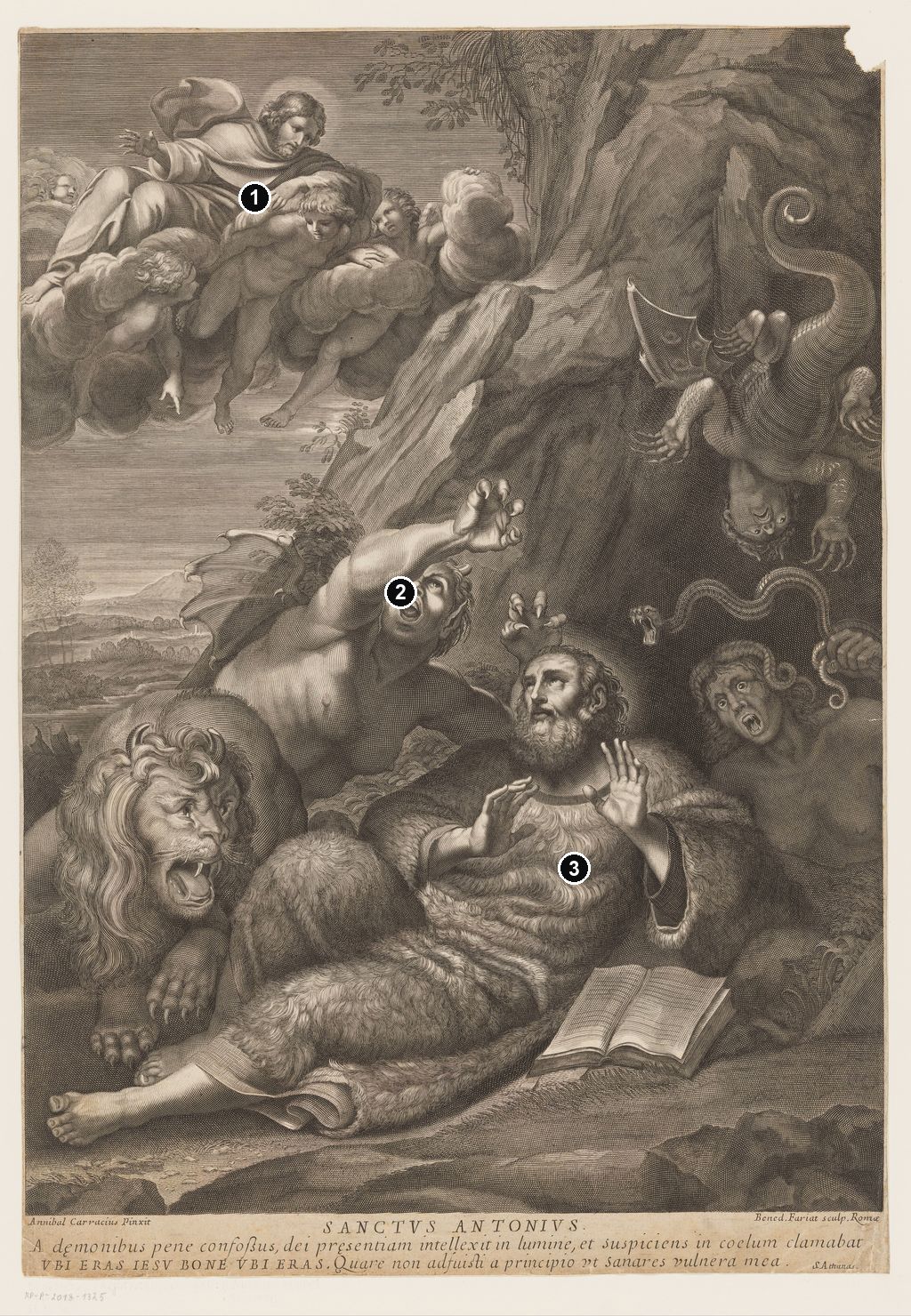
Details from CHRIST APPEARING TO SAINT ANTHONY ABBOT
Compare the cropped details with the source images above. Notice how their colours, shapes and positions contribute to the larger compositions.
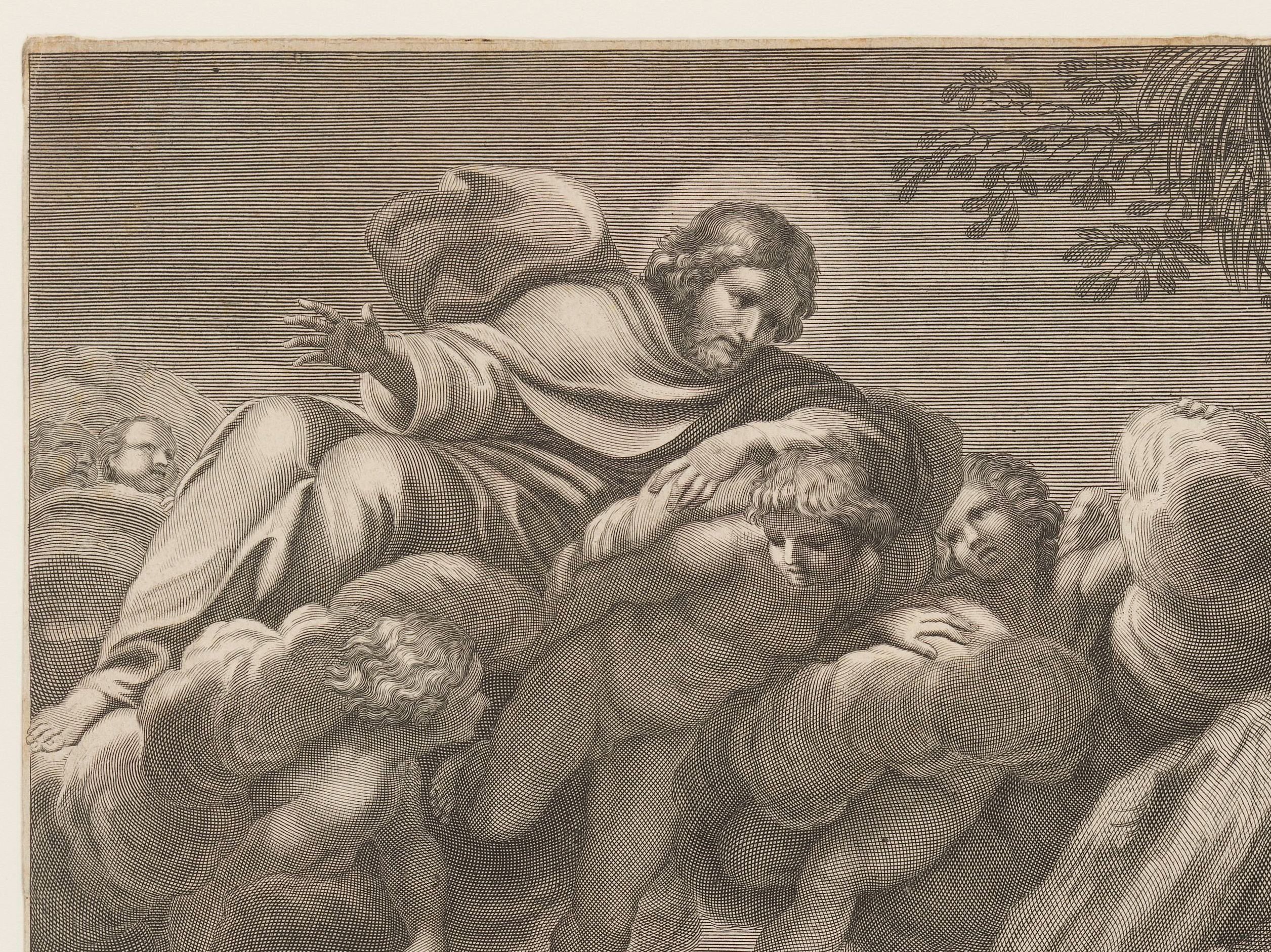
The vision at the upper left
Farjat shows Christ and the surrounding figures in open sky. In Carracci’s copper the vision appears on the other side because the print reverses the design.
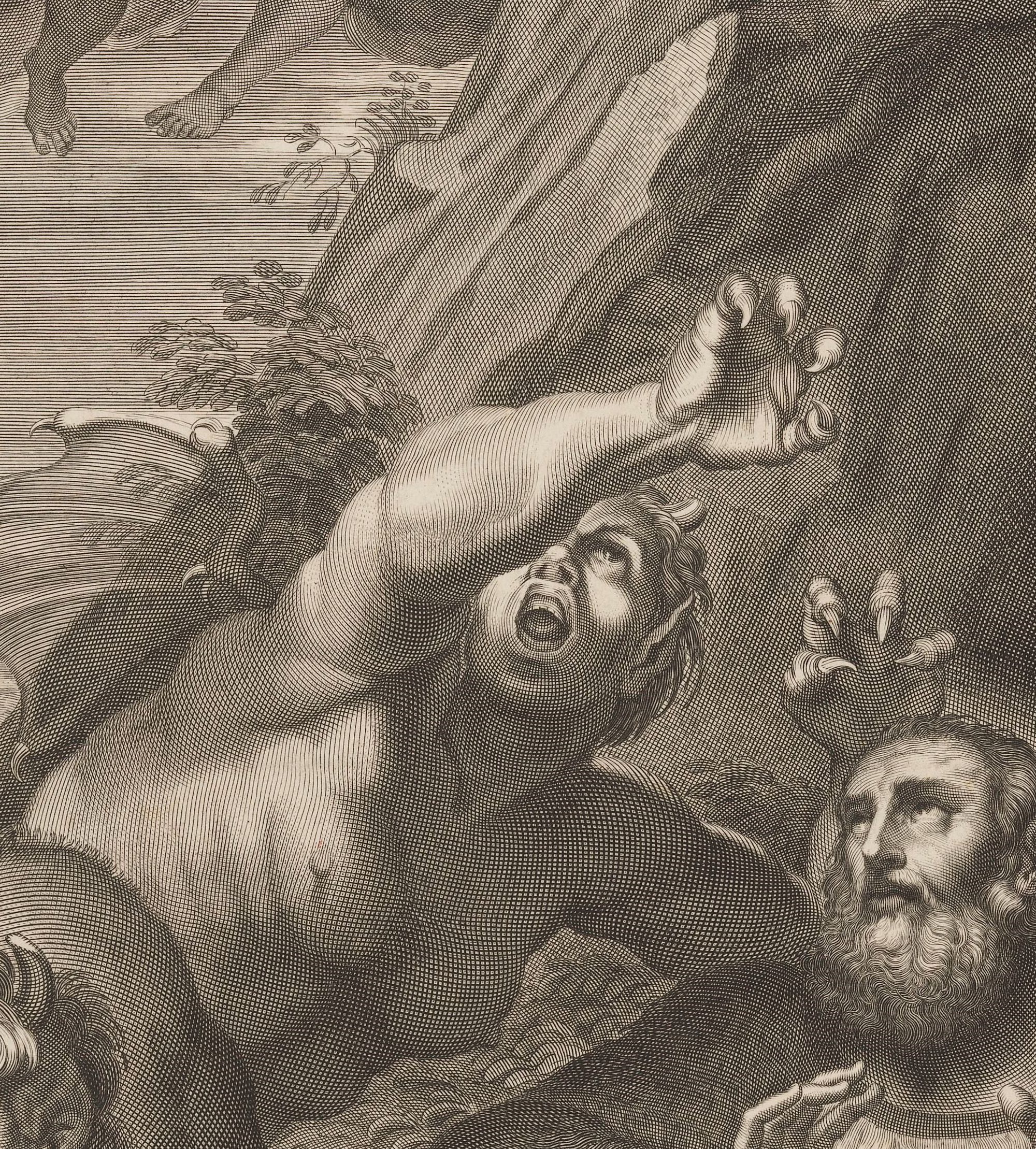
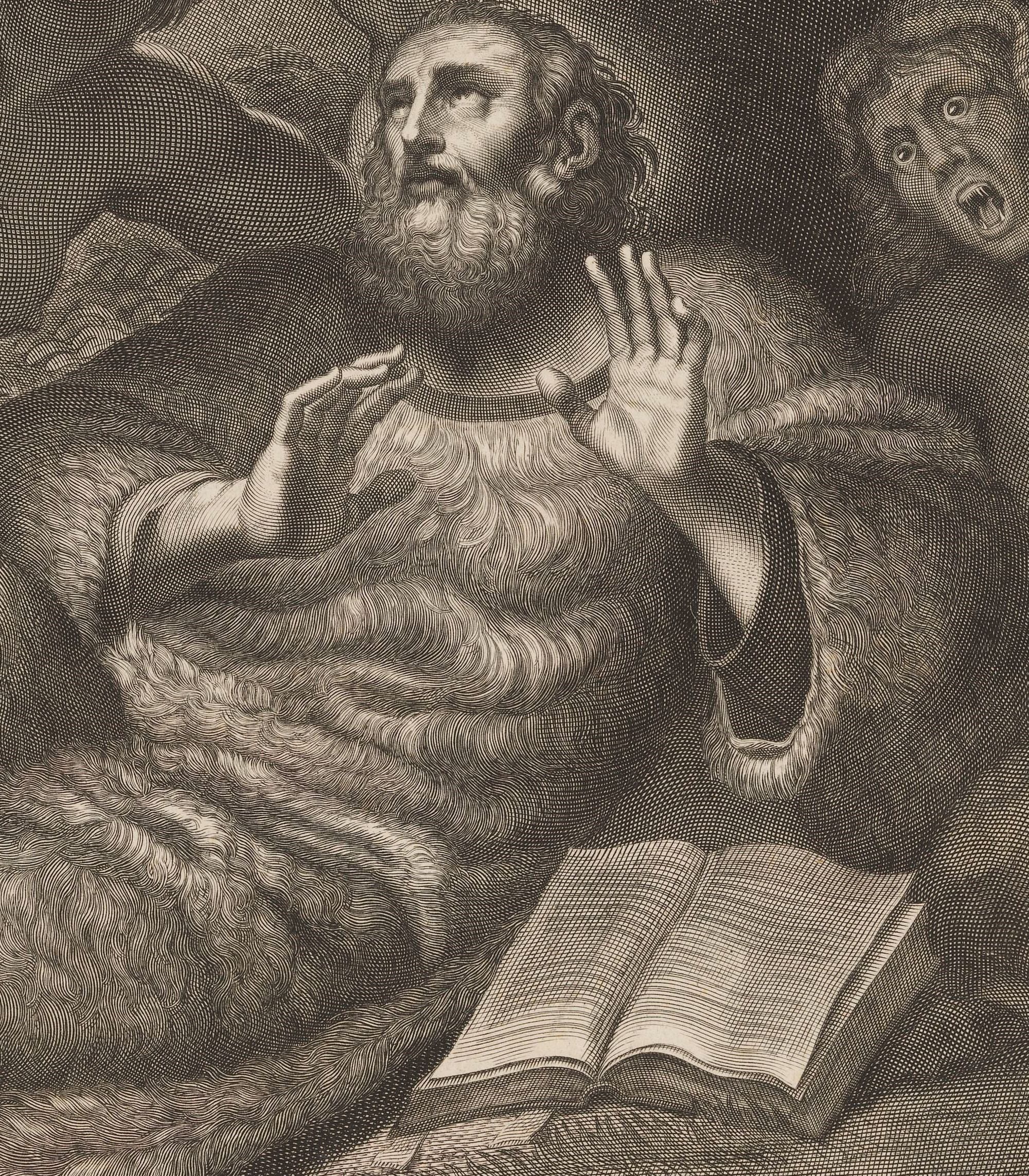
The demon draws back
A lifted forearm cuts across the engraved lines of the slope. Its contour links the darker central figure with the vision above.
Anthony’s hands and open book
Farjat keeps the saint’s hands, face and book distinct from the surrounding creatures. The open pages form a bright patch beneath the two raised palms.
How the eye travels from the cave to the sky
A steep face of rock fills much of the upper left and slopes down towards the opening at the right. The central demon throws one arm over its head along a related diagonal. Anthony's extended body makes another slant across the bottom. That repetition binds the rock and the demon to the saint's vulnerable body. The opening above the demon is narrow enough to keep the action crowded, yet broad enough for the blue of the sky to separate Christ and his attendants from the cave. A strip of distant country at the right gives the scene a measure of depth beyond the closely packed figures. [1]
Look at how differently the hands read. Anthony's are held close to his chest and face with the palms visible. The demon above him reaches farther, curling the fingers on its upper hand and turning its other palm forward. Christ's extended hand is farther up and to the right, in clear sky. The succession of raised hands carries the eye across a difficult jump in height and draws a distinction among appeal, agitation and calm. Anthony's face, tipped towards Christ, gives that movement a human point of departure. [1]
Christ's blue mantle and pink robe are conspicuous beside the browns of rock, hide and flesh. Carracci nevertheless lets light in on the demons. It catches an extended arm, glints on claws and teeth and picks out the mouth of the lion-like creature beside the saint's feet. These small bright touches make creatures emerge from the cave in stages. The upper group can be taken in at a glance, but the lower group rewards a slower look. The same light that makes rescue visible allows us to register what Anthony has faced. [1]
A study for the recoiling demon
A sheet in the Louvre, INV 7370, is catalogued by Catherine Loisel as a study for one of the demons in the London copper. It measures 32.5 by 38 centimetres and uses black chalk with white highlights on blue paper. The drawing concentrates on a torso, a head thrown back and two hands raised with the fingers bent. The wide sheet gives the arms room to open out. In the painting the same figure is compressed into the space between the saint, the rock and the creature at the right. [3]
Comparing the drawing with the copper clarifies what Carracci had to solve. The figure has to lift a forearm above its head, turn the face out for the viewer, and keep both hands expressive while the rib cage twists below them. The black and white chalk lets Carracci work through where flesh catches the light and where the head falls beneath the shadow of the arm. The finished demon's force depends on that coherent anatomy. A small point of light on a claw can make the figure strange because the larger movement already makes physical sense. [1] [3]
Painting at the scale of a copper plate
The smooth metal support suits effects that register in a short distance. At the saint's shoulder, coarse strands in the hair garment have a different edge and rhythm from the sweep of Christ's mantle above. Near the bottom, the corners of the book's pages are legible against a similar range of browns. Attention to surface lets separate textures remain legible even where the shadows gather them into one mass. In the National Gallery's Technical Bulletin, conservator Larry Keith singled out NG198's meticulous finish and observed an affinity with the work of northern painters in Rome such as Adam Elsheimer. Elsheimer's later Flight into Egypt, a copper dated 1609 in Munich's Alte Pinakothek, likewise asks a close viewer to pick out small incidents of light, here dispersed through a nocturnal landscape. [1] [4] [5]
Carracci's own Montalto Madonna gives a comparison closer in date. London catalogues it as NG6597, an oil on copper measuring 35 by 27.5 centimetres, painted about 1600. Its quieter scene gathers a family around the Virgin and Child, with the figures and light arranged to draw the eye into the centre. Where the Anthony copper sends our attention repeatedly between a figure on the ground and a figure in the sky, the Montalto Madonna invites it to return to faces and gestures at close quarters. The difference shows how readily Carracci could adapt a small format to different kinds of attention. [4] [6]
Keith's article examines the Montalto Madonna in the course of its restoration. In that work, study of the paint alongside provenance and comparisons with other versions helped support the identification of the rediscovered copper as Carracci's original. His discussion of the Anthony painting establishes its place among the Roman coppers and characterises its finish. For NG198, the public evidence consists here of the documented support and scale, the visible handling, and the independently catalogued drawing. The conservation examination that identified later repaint and studied the priming pertains to NG6597. [3] [4] [6]
From the Borghese collection to London
The earliest secure record places the painting at the Villa Borghese in Rome in 1650. The National Gallery raises Cardinal Scipione Borghese as a possible first patron, but the commission is undocumented. In 1672, the biographer Giovan Pietro Bellori praised the painting in his account of Annibale's works for private patrons. The 1693 Borghese inventory lists it as number 282, and Friedrich Wilhelm Basilius von Ramdohr recorded it at the Palazzo Borghese in 1787. It probably left the Borghese collection around 1800. Michael Levey’s National Gallery catalogue considers an 1805 London sale a possible match and connects the painting more securely with the Panné sale of 1819. [1]
At Admiral Lord Radstock's sale in 1826, the painting was bought for William Legge, fourth Earl of Dartmouth. Dartmouth lent it to the British Institution in 1828 and 1844, and the National Gallery purchased it from him in 1846. It went to the 1956 Carracci exhibition in Bologna and travelled again for the 2006–07 retrospective in Bologna and Rome, alongside the Montalto Madonna and The Dead Christ Mourned. The National Gallery also lists it among the works in the 2022–23 tour of Sin. At the retrospective, visitors could compare the two coppers with the grief of the three women on canvas. The later exhibition brought the picture into a wider inquiry about sin in art. [1] [7] [8]
Prints after the copper and other temptations
Prints carried the design beyond the Borghese collection. The Rijksmuseum has an engraving by Benoît Farjat after the painting, and Fondazione Carisbo describes its own impressions of his print as reversed relative to the copper. In such an impression, the apparition moves to the opposite side of the image. The direction we read Anthony's gaze changes, while the long line between him and Christ survives. Fine lines and closely spaced hatching do the work that layers of colour and small touches of light do in the painting. At about 51 by 35 centimetres at the plate mark, the Rijksmuseum impression is close to the size of the original. The Istituto Centrale per la Grafica in Rome catalogues a later impression from the same seventeenth-century matrix, which survives as M-342. [9] [10] [11]
Fondazione Carisbo also lists engravings by Gérard Audran and Claudine Bouzonnet Stella among the copies. The Bibliothèque nationale de France catalogues a Temptation of Saint Anthony signed by Stella after Annibale Carracci and queries its exact connection to the London picture. The Farjat engraving gives the securely identified comparison. [10] [12]
The shorthand title The Temptation of Saint Anthony covers several different episodes and designs. Annibale's brother Agostino made a print after Tintoretto in which horned women surround the hermit, a pig stands at the right and God the Father appears overhead. That print has its own composition and comes from Tintoretto's design. There is also an early seventeenth-century Vision of Saint Anthony Abbot still in the Galleria Borghese. That painting, catalogued as the work of a Roman artist and executed on alabaster, exploits the stone's veining to suggest the apparition of a woman. The London copper and the Roman stone share the saint and a history in the Borghese collection, with different visions and materials. [13] [14]
An even earlier engraving, Martin Schongauer’s Tribulations of Saint Anthony, sends the hermit and his assailants into the air. His body is upright, hemmed in by the fur, leather and scales of the creatures. Carracci gives the saint a ledge of solid ground and reserves the sky for Christ. The comparison shows how a long-established subject could become a picture about the instant when a saint sees a way out. [1] [15]
Carracci also painted Christ appearing to Saint Peter on the Appian Way, another small work in the National Gallery, on wood. Peter sees Christ on a road as he leaves Rome. Anthony, brought low in his refuge, receives help while the demons still crowd around him. The moment Carracci chose for NG198 explains why Christ's arrival occupies a corner of the copper. The eye must cross the space of the attack to reach him, just as Anthony's gaze crosses it. [1] [16]
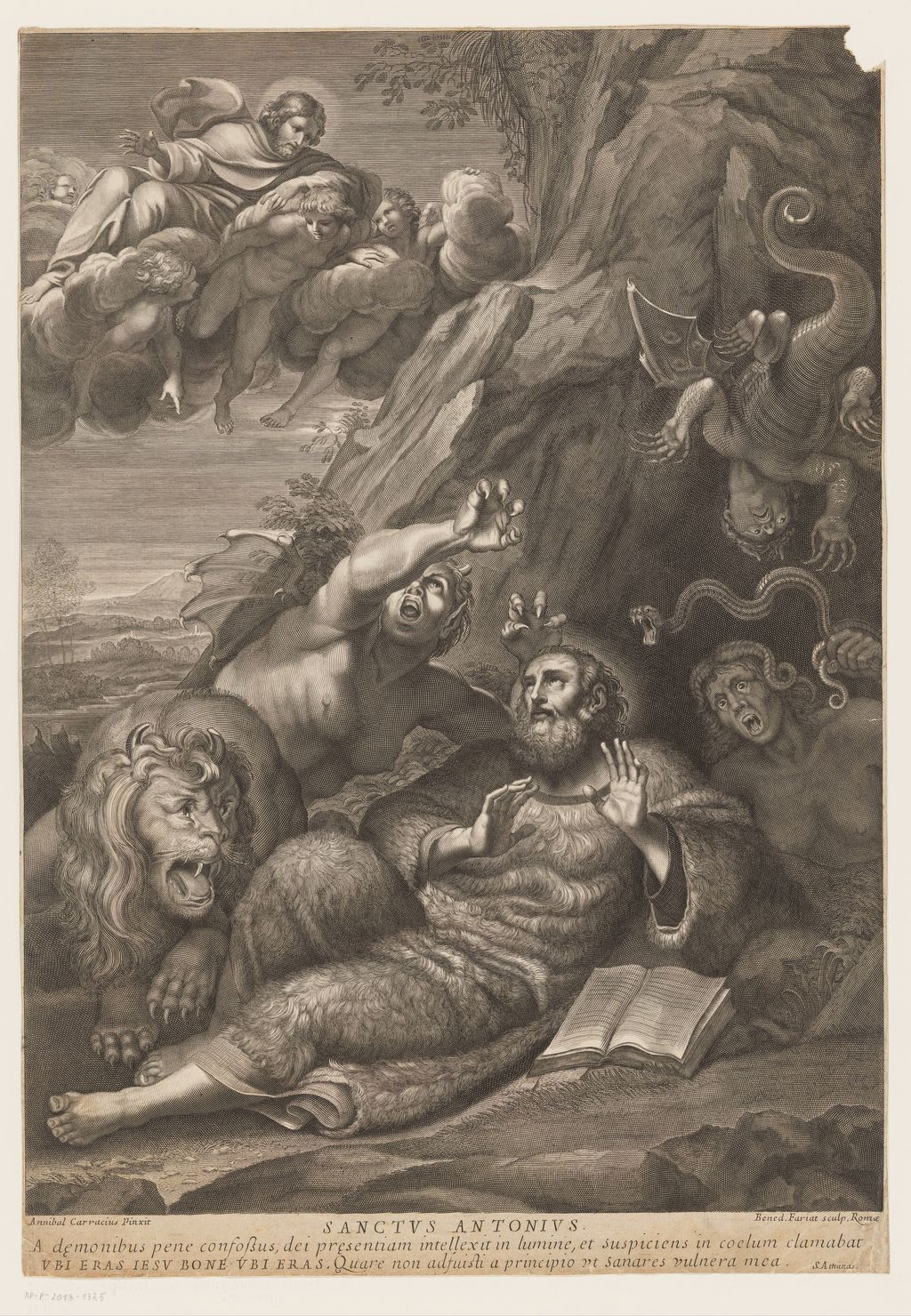
Benoît Farjat after Annibale Carracci, The Temptation of Saint Anthony. The print reverses the London painting. Rijksmuseum, RP-P-2018-1325. Image source. Public domain.
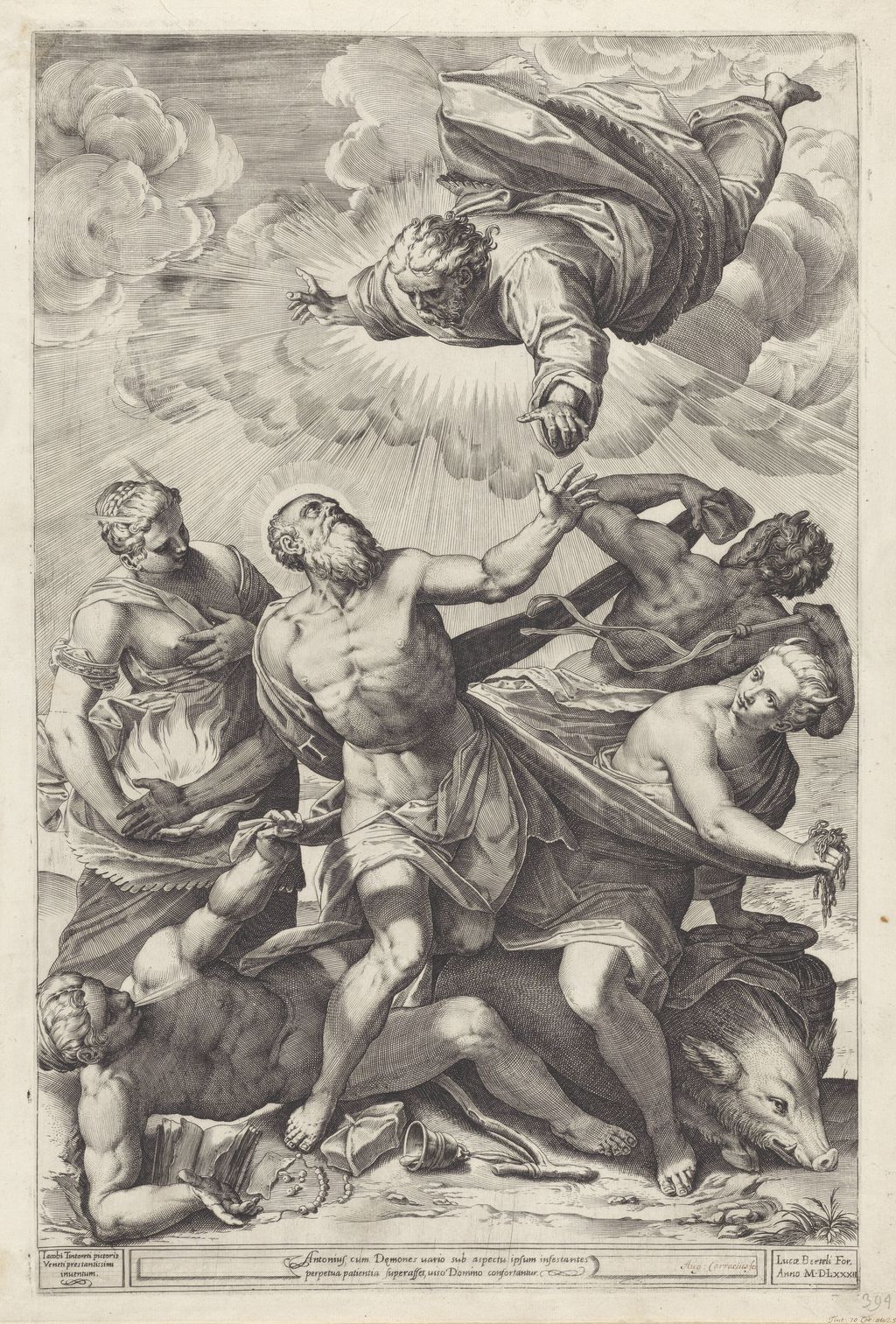
Agostino Carracci after Tintoretto, The Temptation of Saint Anthony, 1582. Rijksmuseum, RP-P-OB-35.734. Image source. Public domain.
Artworks directory
Paintings, frescoes, drawings and prints, with separate entries for documented versions and collaborative projects.
Discussion
Look again at the images and ideas explored in Christ Appearing to Saint Anthony Abbot. These editorial prompts invite your observations.
Reader Insights
Which small detail makes the ordeal most vivid?
How does the copper painting make room for the saint, the apparition and the varied creatures?
Join the Conversation
Share a detail, comparison or question about Christ Appearing to Saint Anthony Abbot below.
References
- National Gallery, London, Christ appearing to Saint Anthony Abbot during his Temptation, NG198, including Michael Levey's provenance catalogue extract View source.
- Athanasius of Alexandria, Life of St. Anthony, translated by H. Ellershaw, especially sections 1–3 and 8–10 View source.
- Musée du Louvre, Démon pour la Tentation de saint Antoine, INV 7370 recto, citing Catherine Loisel's catalogue raisonné entry View source.
- Larry Keith, Annibale Carracci's Montalto Madonna, National Gallery Technical Bulletin 29, 2008, pp. 46–59 View source.
- Bayerische Staatsgemäldesammlungen, Alte Pinakothek, Adam Elsheimer, The Flight into Egypt View source.
- National Gallery, London, The Holy Family with the Infant Saint John the Baptist, NG6597 View source.
- National Gallery, London, Loans to Special Exhibitions 2007–2008, including the Carracci retrospective in Bologna and Rome View source.
- National Gallery, London, Sin, exhibition overview View source.
- Rijksmuseum, Benoît Farjat after Annibale Carracci, Verzoeking van Antonius, RP-P-OB-43.334 View source.
- Fondazione Carisbo, Benoît Fariat, Le tentazioni di Sant'Antonio abate View source.
- Istituto Centrale per la Grafica, Benoît Farjat, Sanctvs Antonivs, S-CL2207_2176 and matrix M-342 View source.
- Bibliothèque nationale de France, Claudine Bouzonnet Stella after Annibale Carracci, La Tentation de S. Antoine View source.
- Rijksmuseum, Agostino Carracci after Jacopo Tintoretto, Verzoeking van de heilige Antonius, RP-P-OB-35.734 View source.
- Galleria Borghese, Visione di sant'Antonio abate, inv. 474 View source.
- National Gallery of Art, Washington, Martin Schongauer, The Tribulations of Saint Anthony View source.
- National Gallery, London, Christ appearing to Saint Peter on the Appian Way, NG9 View source.