 by Tom Gurney
Tom Gurney BSc (Hons) is an art history expert with over 20 years experience
Published on June 19, 2020 / Updated on September 6, 2026
Email: tomgurney1@gmail.com / Phone: +44 7429 011000
Bathsheba at Her Bath by Artemisia Gentileschi
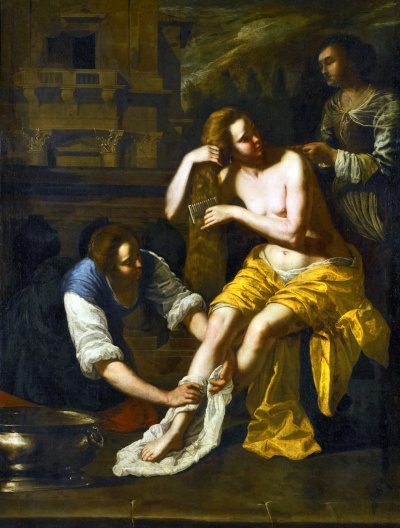
Artemisia Gentileschi's Bathsheba at Her Bath belongs to one of the most complicated groups in her late career. This article treats the version sold by Sotheby's in 2020 as the central object: a large oil on canvas, formerly in the Deichmann collection, presented by Sotheby's as Bathsheba at Her Bath by Artemisia Gentileschi. [1]
That object focus matters. The site also has a separate page for the Columbus Museum of Art Bathsheba, a public-collection painting dated around 1636-37 and connected in source records with Viviano Codazzi and Domenico Gargiulo. [2][3][5] The present page is not that Columbus work. It follows a private-collection Bathsheba-at-the-bath route, where auction records, version comparisons and attribution discussion carry much of the evidence.
The subject comes from the Second Book of Samuel. David sees Bathsheba bathing, desires her and sets in motion a chain of coercion, adultery, concealment and death. Artemisia's Bathsheba pictures matter because they turn that famous look into a pictorial problem. Bathsheba is seen at a moment that ought to be private, while the viewer knows that power outside the scene will soon enter it.
Image reference: Sotheby's lot record.
At a Glance
- ArtistArtemisia Gentileschi. [1]
- TitleBathsheba at Her Bath. [1]
- Object focusthe ex-Deichmann / Sotheby's 2020 version.
- Mediumoil on canvas. [1]
- Dimensions80 1/2 x 61 1/4 in. (204.5 x 155.5 cm). [1]
- Date cautionSotheby's discusses a probable 1640s date, while noting earlier scholarly dating. [1]
- Provenancelinked to Baron Heinrich von Deichmann and later private ownership. [1]
- Related variantChristie's records another Bathsheba at her bath. [4]
- Version cautionnot the Columbus Museum of Art Bathsheba. [2][3]
Contents
- Identifying This Bathsheba Version
- The Bathing Scene
- Composition, Privacy and the Viewer
- Date, Attribution and Version Caution
- Women Under Pressure
- Bathsheba at Her Bath and Bathsheba
- How to Read the Painting Today
- Where to Go Next
Identifying This Bathsheba Version
The governing source for this page is Sotheby's 2020 lot record for Bathsheba at Her Bath. The record attributes the painting to Artemisia Gentileschi, gives the medium as oil on canvas and records dimensions of 80 1/2 by 61 1/4 inches, or 204.5 by 155.5 cm. It also preserves a provenance line through Baron Heinrich von Deichmann, who acquired the painting in Italy in the nineteenth century, followed by family descent and later private ownership. [1]
Sotheby's also makes the version problem clear. The record places the work within a wider group of Bathsheba paintings and discusses date, collaboration and relationship to other examples. It does not support treating every Bathsheba by or associated with Artemisia as one interchangeable picture. It asks for object-by-object reading.
For that reason, this article keeps a strict boundary between Bathsheba at Her Bath and the Columbus Bathsheba. The Columbus painting has a public collection anchor, a different scale and a different recorded collaborator structure. [2][3] The Sotheby's painting has its own auction history, dimensions and version discussion. The shared subject does not erase those differences.
Christie's later record for another Bathsheba at her bath helps confirm that the subject circulated through related versions and private-collection histories. [4] It is useful comparison evidence, not permission to collapse the variant material into a single object.
The Bathing Scene
Bathsheba's story begins before she speaks. David sees her bathing. The biblical text makes his look the turning point: he is the king, and his desire becomes command. Bathsheba is not merely a beautiful body in a bathing scene. She is a woman whose privacy is converted into royal possession.
Early modern painters often used Bathsheba as a way to paint a nude or semi-nude woman while retaining a biblical subject. Artemisia's interest lies in the moral pressure of that arrangement. The viewer is invited to look, but the story tells us that looking is not innocent. It can become an act of power.
In a Bathsheba-at-the-bath composition, the bath is usually a place of preparation, service and feminine privacy. Attendants, vessels, cloth and the handling of hair or feet can all turn the scene into a ritual of care. Yet the viewer knows that this enclosure is already compromised by David's gaze. The subject is therefore not simply bathing. It is the collapse of private space.
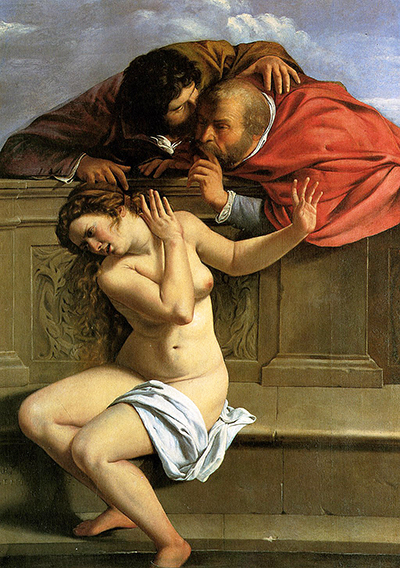
That is why the painting belongs near Susanna and the Elders in Artemisia's cluster. Both stories involve women seen at vulnerable moments. But Susanna's pressure is immediate and confrontational; Bathsheba's is mediated by distance, court power and the consequences of a king's desire.
Composition, Privacy and the Viewer
The title Bathsheba at Her Bath places the body and the act of bathing at the centre, but the subject should be read through its surrounding conditions. Bathsheba is not alone in an abstract space. The bathing scene is shaped by attendants, cloth, water and the implied world beyond the foreground.
The viewer occupies an uneasy position. On one level, the painting offers a carefully staged view of a female figure at the bath, a subject with a long artistic tradition. On another level, the story makes the act of looking ethically charged. The viewer's gaze risks echoing David's gaze unless the painting is read as a scene about power rather than merely an image of display.
Sotheby's describes the heroine at her toilet, attended by two maidservants, and singles out the female form and the yellow drapery as central to the painting's effect. [1] Those details matter because they make privacy visible. The scene is intimate and carefully arranged, yet the story around it tells us that no private arrangement is secure against David's command.
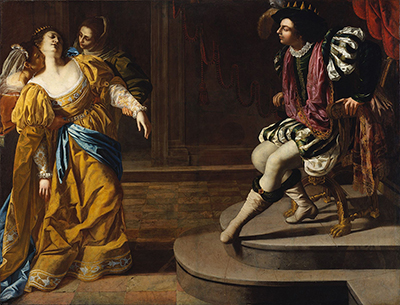
Artemisia's best heroine paintings often make viewers aware of their own position. In Susanna and the Elders, the viewer cannot comfortably admire Susanna without recognising the pressure placed on her. In Lucretia, the viewer faces a tragic moment after sexual violence without reducing it to spectacle. Bathsheba at Her Bath works in a quieter register, but the question is similar: how does a painted body become the site of another person's power?
Date, Attribution and Version Caution
The Sotheby's record is the governing source for the object facts used here, but it also shows why caution is necessary. The record discusses the painting in relation to Artemisia's later career and describes it as probably painted in the 1640s, while acknowledging earlier dating proposed by scholars such as Ward Bissell. [1] The page therefore should not flatten the evidence into a single unsupported date.
The same caution applies to collaboration. Sotheby's discusses possible collaboration in relation to the work and its versions, including the difficulty of separating individual hands in large Neapolitan collaborative works. [1] That is not unusual for large late works associated with Artemisia, but collaboration language must be tied to the source that makes the claim.
Provenance needs the same care. The Deichmann history helps distinguish this object from other Bathsheba variants, but it belongs to the Sotheby's painting. It does not belong automatically to the Columbus Bathsheba or to the Christie's-related example.
This care is not a distraction from the art. It is the condition for reading the art responsibly. Artemisia's reputation has been shaped by rediscoveries, revised attributions, workshop questions, private collections and auction histories. A useful Bathsheba page needs to help readers see that complexity without drowning them in it.
Bathsheba and Artemisia's Women Under Pressure
Bathsheba is often discussed beside Artemisia's other women from biblical, classical and devotional stories. The comparison is useful, but only if each figure keeps her own story.
Susanna resists harassment and false accusation. Judith acts violently to save her people. Esther risks entering royal presence without permission. Lucretia faces a tragic decision after rape and dishonour. Bathsheba is different. Her story begins with being seen by a king whose power can turn desire into command.
That difference makes Bathsheba especially important for thinking about privacy. Susanna's attackers enter her space and confront her. David's gaze begins from elsewhere, but it reaches just as powerfully into Bathsheba's life. The danger is not only bodily exposure. It is the transformation of another person's looking into authority.
Artemisia's art is often reduced to women fighting back. Bathsheba complicates that shorthand. She is not Judith with a sword. She is not a triumphant emblem. She is a woman caught at the beginning of a chain of events that she does not control. The painting's seriousness lies in that vulnerability.
Bathsheba at Her Bath and Bathsheba
The companion Columbus article and this one work best as a pair, but not as a merger. The Columbus Bathsheba has a public museum collection anchor, a c. 1636-37 date in A&AePortal, and named collaborators Codazzi and Gargiulo. [2][3][5] This Bathsheba at Her Bath article follows the Sotheby's ex-Deichmann object and the private/auction version field. [1]
The difference is not just a matter of title. It affects size, provenance, source type, possible dating, comparison material and later image decisions. A reader who moves between the two pages should understand that Artemisia's Bathsheba subject survives through more than one object pathway.
This is also why image evidence needs special care. File names can sound as if they settle the matter, but image labels are not object evidence. The illustration should be read alongside the Sotheby's object record rather than treated as proof by title alone.
The two Bathsheba pages therefore have a useful job in the cluster. They show how version discipline works. Artemisia's subjects are not just themes; they are objects with histories, sizes, owners, scholarly debates and changing source records.
How to Read the Painting Today
Begin with the title. Bathsheba at Her Bath tells us the scene is not the aftermath, the pregnancy, Uriah's death or David's repentance. It is the moment of bathing, the moment in which sight becomes the start of the drama.
Then think about the bath as a protected space. Cloth, vessels and attendants can make the scene feel ceremonial, but they also intensify the intrusion. The more carefully Bathsheba's world is staged, the more troubling David's gaze becomes.
Look next at the painting as a late-career problem. Sotheby's places the work in the orbit of Artemisia's mature years and discusses it through version relationships and possible collaboration. [1] That means the painting belongs not only to biblical iconography but also to the practical history of large Baroque pictures: studios, patrons, copies, revisions and collectors.
Finally, compare it with the Columbus Bathsheba and Susanna and the Elders. The Columbus painting gives the subject a monumental architectural world. Susanna gives a sharper scene of direct threat. Bathsheba at Her Bath sits between those poles: intimate in subject, complex in history, and still charged by the problem of being seen.
Where to Go Next
For the safest overview of Artemisia's career, read the biography and paintings hub. For the closest thematic comparison, read Susanna and the Elders, where Artemisia's early handling of a bathing story turns the viewer's attention toward coercive looking. For another image of a woman under severe moral pressure, read Lucretia.
The paired Bathsheba page follows the Columbus Museum of Art object and should be kept distinct from this one. Reading the two together is useful precisely because they are not the same painting.
Related Pages
- Artemisia Gentileschi
- Artemisia Gentileschi Biography
- Artemisia Gentileschi Paintings
- Susanna and the Elders
- Lucretia
- Bathsheba
Frequently Asked Questions
Discussion
What should readers notice when looking closely at Artemisia Gentileschi's Bathsheba at Her Bath?
Reader Insights
Which details help keep this ex-Deichmann version separate from the Columbus Bathsheba?
How does the bathing scene make looking feel powerful rather than neutral?
What do the auction records reveal about Artemisia's wider Bathsheba group?
Join the Conversation
Share your reading of this painting below.
References
- Sotheby's, Artemisia Gentileschi, Bathsheba at Her Bath, Master Paintings Evening Sale, lot 41.
- A&AePortal, Bathsheba image detail, recording the Columbus Museum of Art Bathsheba.
- Getty Exhibitions, Artemisia's Strong Women: Rescuing a Masterpiece, selected works entry for the Columbus Bathsheba and David.
- Christie's, Artemisia Gentileschi, Bathsheba at her bath, lot 6381788.
- Columbus Museum of Art, Collection highlights, including Artemisia Gentileschi, Bathsheba, c. 1636-37.
 Artemisia Gentileschi.jpg)
 Artemisia Gentileschi.jpg)