 by Tom Gurney
Tom Gurney BSc (Hons) is an art history expert with over 20 years experience
Published on June 19, 2020 / Updated on September 6, 2026
Email: tomgurney1@gmail.com / Phone: +44 7429 011000
Cleopatra by Artemisia Gentileschi
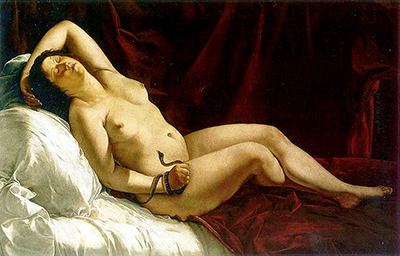
Artemisia Gentileschi painted Cleopatra as a woman at the edge of death, but not as a smooth classical emblem. The Cleopatra treated on this page is the version associated with the Museo di Palazzo Doebbing / Fondazione Cavallini-Sgarbi route, a work whose modern attribution history is unusually important. It was once connected with Guido Cagnacci, then restored to Artemisia in twentieth-century scholarship, with Gianni Papi publishing the attribution in 1994. [1]
This article is separate from Cleopatra Rome, the Museo di Roma image record identified as La morte di Cleopatra, dated 1630-35 and listed as a private collection in Rome. [2] Both works belong to Artemisia's Cleopatra problem, but their evidence paths are not the same. The safest way to read them is as related versions, not as a single object with interchangeable facts.
The subject itself is one of the most famous deaths in ancient history. Cleopatra VII, queen of Egypt, died after the defeat of Antony and the arrival of Octavian's power. Later art often turned her death into a scene of theatrical beauty: a royal woman, a serpent, bare flesh, luxury and the final assertion of self-command. Artemisia's painting makes that tradition heavier, stranger and more bodily.
Image reference: Museo di Palazzo Doebbing article.
At a Glance
- ArtistArtemisia Gentileschi. [1]
- TitleCleopatra. [1]
- Object focusPalazzo Doebbing / Cavallini-Sgarbi route.
- Attribution historyknown through Longhi material under Cagnacci, then returned to Artemisia by Gianni Papi. [1]
- Publication notePapi published the attribution in Paragone in 1994. [1]
- Date cautionPalazzo Doebbing points toward about 1620; the Rome version has a different 1630-35 record. [1][2]
- SubjectCleopatra at or near death, traditionally linked with the asp and the queen's final act.
- Related pageCleopatra Rome, a distinct companion route. [2]
Contents
- Which Cleopatra Is This?
- Cleopatra's Death as a Subject
- Body, Emotion and Theatrical Stillness
- Realism, Caravaggio and Orazio
- Cleopatra and Lucretia
- Version Boundaries and Evidence Limits
- How to Read Cleopatra Today
- Where to Go Next
Which Cleopatra Is This?
The strongest public source for this page is the Palazzo Doebbing article on Artemisia's Cleopatra. It describes a painting bought in Rome in the 1960s and known to Roberto Longhi through photographic material under the name of Guido Cagnacci. The text says Gianni Papi returned the work to Artemisia and published the attribution in Paragone in 1994. [1]
That attribution story should shape the page. This is not a work whose public identity can be reduced to "Artemisia painted Cleopatra." Its modern life includes misattribution, photographic memory, rediscovery, cleaning and reassessment. Those details are not decorative background. They are part of why the object must be handled carefully.
The same source also stresses the painting's physical realism: a body that refuses easy elegance, a red drapery that holds the figure, and a force that the text connects with Artemisia's mature encounter with Caravaggio and with Orazio's example. [1] The useful point for readers is clear: this Cleopatra is not treated as distant royal beauty. She is a dying body, painted with blunt immediacy.
The separate Rome page needs to remain separate. Museo di Roma identifies La morte di Cleopatra, 1630-35, Rome, private collection, as an image from the 2016-17 Artemisia Gentileschi e il suo tempo exhibition. [2] That route supports Cleopatra Rome, but it should not supply object facts for this page unless a later object review proves the works are the same.
Cleopatra's Death as a Subject
Cleopatra's death gave early modern painters a subject that joined politics, sexuality, defeat and self-possession. She was queen of Egypt, lover and ally of Julius Caesar and Mark Antony, and the last ruler of the Ptolemaic kingdom. After Antony's defeat and death, Octavian's victory made her future one of humiliation, captivity or self-chosen death.
The familiar story says that Cleopatra died by the bite of an asp or cobra. Artists used that detail to create an image at once intimate and political: a queen's body, the sign of death, attendants or drapery, and the knowledge that the Roman world is about to claim Egypt.
Artemisia's version belongs to this tradition, but it does not make Cleopatra merely beautiful. The subject may involve nudity, fabric and sensuality, yet the painting's force lies in bodily collapse and psychological pressure. Cleopatra's body is not simply offered to the viewer. It is shown at a moment when power, desire and mortality have become inseparable.
That makes Cleopatra different from Judith or Esther. Judith acts. Esther intervenes. Cleopatra reaches the end of a political story in which the remaining choice is how to die. The painting asks the viewer to read self-command and vulnerability together.
Body, Emotion and Theatrical Stillness
The Palazzo Doebbing text emphasizes the painting's rejection of graceful, lyrical beauty. In paraphrase, it presents Artemisia's Cleopatra as physically heavy, sensuous, exposed and aggressively real. [1] That is a useful starting point because it tells readers what not to expect. This is not a cool antique heroine arranged for serene admiration.
The body matters because the death is physical. Cleopatra's story can easily become an emblem of royal pride or tragic love, but Artemisia keeps the viewer close to flesh, drapery, weight and pain. The red fabric described by the source does not merely decorate the figure. It contains and intensifies the body, making the scene feel both theatrical and uncomfortably near. [1]
The stillness is also important. Cleopatra is not shown in public ceremony or battle. She is alone with the consequences of history, reduced to the final threshold. The painting's drama comes from the way the body seems to yield while the subject remains morally forceful. The queen is defeated politically, but the death scene preserves a last form of agency.
This is where Artemisia's Cleopatra differs from a purely decorative nude. The viewer is not asked only to admire. The viewer is asked to confront the cost of looking at a body made vulnerable by defeat.
Realism, Caravaggio and Orazio
Palazzo Doebbing's text connects this Cleopatra with Artemisia's realism, her knowledge of Caravaggio and the force of Orazio Gentileschi's mature example. [1] The safest public reading is to treat those as interpretive coordinates, not as a simple formula.
Caravaggio's legacy mattered across Artemisia's world: close bodies, dramatic light, ordinary flesh made intense, and religious or historical subjects stripped of courtly distance. Orazio's art mattered too, because Artemisia trained in his household and spent her career both inheriting and transforming the Gentileschi family language.
In Cleopatra, that inheritance becomes sharp. The figure does not dissolve into ideal beauty. The body remains awkward, physical and mortal. The painting's power comes from that refusal of polish. Cleopatra's royal identity is still present, but Artemisia does not allow it to protect the viewer from the fact of death.
Orazio is useful context for the painting's visual ancestry, but this article keeps its internal links within verified local Artemisia targets.
Cleopatra and Lucretia
Museo di Roma's educational event La morte ti fa bella: Cleopatra e Lucrezia is useful because it places Cleopatra and Lucretia together as women whose deaths carried moral, political and gendered meaning in Artemisia's exhibition context. The event page describes the meeting as part of the Artemisia e le altre cycle and links Cleopatra and Lucretia around the delicate theme of suicide as moral redemption. [3]
That comparison needs care. Cleopatra and Lucretia are not the same figure. Lucretia is a Roman heroine whose death follows rape and becomes tied to the founding story of the Republic. Cleopatra is a queen whose death follows political defeat and Roman conquest. One story turns on chastity, tyranny and public honour; the other on sovereignty, desire, empire and the refusal of humiliation.
Artemisia's art makes both women serious. Neither should be treated as a decorative excuse for death. In Lucretia, the body is caught before the irreversible act. In Cleopatra, death appears as collapse, sensuality, power and self-possession at once. Both paintings ask how a woman becomes a historical image when her body is placed under extreme pressure.
The comparison also helps resist a simple "strong women" slogan. Cleopatra's strength is not victory. It is the last choice remaining to a defeated ruler. Artemisia makes that choice feel human rather than polished.
Version Boundaries and Evidence Limits
The Cleopatra material around Artemisia is version-sensitive. The cluster keeps Cleopatra and Cleopatra Rome as separate active articles because the evidence points to distinct identities or, at minimum, unresolved version evidence. This article follows the Palazzo Doebbing / Cavallini-Sgarbi path. The Rome article follows the Museo di Roma image record for La morte di Cleopatra, 1630-35, Rome, private collection. [1][2]
The distinction affects everything: date, collection, image, provenance and interpretation. If the works are later shown to be connected more directly, that belongs in a future object/version review. It cannot be assumed here.
Image handling is especially delicate. File names such as Cleopatra Artemisia Gentileschi.jpg and Cleopatra (Rome) Artemisia Gentileschi.jpg are helpful clues, but file names are not proof. The visible image for this page should be read against the Palazzo Doebbing article and kept separate from the Rome version.
For readers, the important point is simpler: Artemisia's Cleopatra paintings sit in a field of rediscovery, private ownership and scholarly correction. A responsible page makes that field visible without turning the article into a catalogue dispute.
How to Read Cleopatra Today
Begin with the body. This Cleopatra is not idealised into smooth heroism. The painting's force lies in physical presence: exposed flesh, fabric, weight, pain and the awareness that death is close.
Then think about the subject's political scale. Cleopatra dies as a defeated queen, not as a private person only. Her body carries the end of a kingdom and the victory of Rome. That does not make the scene impersonal; it makes the private moment historically loaded.
Look also at the painting's attribution history. A work once seen through another artist's name and then restored to Artemisia tells a larger story about how her reputation has been rebuilt. Misattribution is not a side issue in Artemisia studies. It has shaped which paintings were visible, how they were valued and how her career was understood.
Finally, compare the page carefully with Lucretia, Judith and Cleopatra Rome. Lucretia clarifies the theme of death and moral pressure. Judith shows action rather than collapse. Cleopatra Rome gives the reader another version route, but not the same object. Together these pages show Artemisia's range: violence, self-command, vulnerability, realism and the difficult dignity of women under historical pressure.
Where to Go Next
For the broader shape of Artemisia's career, read the biography and paintings hub. For a close comparison around death, body and moral pressure, read Lucretia. For an action-driven heroine, read the Florence version of Judith Slaying Holofernes.
Cleopatra Rome is the natural companion route, but it should be read as a distinct version page. The two Cleopatra pages are most useful when they make the differences clear.
Related Pages
- Artemisia Gentileschi
- Artemisia Gentileschi Biography
- Artemisia Gentileschi Paintings
- Lucretia
- Judith Slaying Holofernes, Florence
- Cleopatra Rome
Frequently Asked Questions
Discussion
What should readers notice when looking closely at Artemisia Gentileschi's Cleopatra?
Reader Insights
How does the Longhi/Cagnacci/Papi history change the way you approach this picture?
Where does the painting resist a polished or idealised image of Cleopatra?
What details help keep this page separate from the Rome Cleopatra route?
Join the Conversation
Share your reading of this painting below.
References
- Museo di Palazzo Doebbing, Artemisia Gentileschi, Cleopatra.
- Museo di Roma, Artemisia Gentileschi, La morte di Cleopatra, 1630-35. Roma, Coll. Privata.
- Museo di Roma, La morte ti fa bella: Cleopatra e Lucrezia.
 Artemisia Gentileschi.jpg)
 Artemisia Gentileschi.jpg)