by Tom Gurney
Tom Gurney BSc (Hons) is an art history expert with over 20 years experience
Published on June 19, 2020 / Updated on October 14, 2023
Email: tomgurney1@gmail.com / Phone: +44 7429 011000
Meadows near Greifswald: Introduction
Two horses break into a gallop across a green field. A third keeps its head down a little farther to the right. Behind them a strip of water catches the light, and beyond that the roofs of Greifswald stretch across the horizon. The tallest church spire rises into a pale sky that takes up more than half the picture. Caspar David Friedrich painted this view of his birthplace in 1821/22.[1][2]
At a Glance
- Artist Caspar David Friedrich
- Title Meadows near Greifswald (Wiesen bei Greifswald).[1][2]
- Date 1821/22.[1][2]
- Medium Oil on canvas.[1][2]
- Dimensions 34.5 cm high × 48.3 cm wide.[1]
- Collection Hamburger Kunsthalle, HK-1047, acquired 1904.[2]
Contents
- Introduction
- Across the former wetlands
- The three churches and the light
- From a drawing made near Greifswald
- The town in other light
- The university town seen from a field
- From the market square to the outskirts
- From Greifswald to Hamburg
- Annotated Details
- Image Details
Across the former wetlands
The meadow begins in shadow. The grass is dark and uneven, and bushes at the right edge stand out against a lighter field. Farther in, the land seems almost level. The water behind the horses is so narrow from this angle that it registers chiefly as a pale horizontal stroke. Its irregular banks and small bushes bring a change of texture to the broad bands of green. Together these details let us measure the space from the shadowed rise in front to the low buildings beyond.
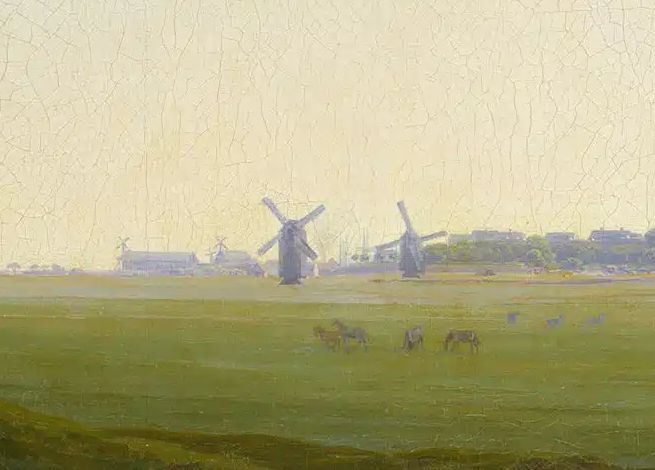
The Metropolitan Museum of Art identifies the site as drained peatland used for grazing. Its exhibition label places the painting at a time when scientists were beginning to study the ecology of the marshes around Greifswald. That history makes the apparent flatness of the terrain worth a second look. The land in the picture has been put to use. Animals are scattered at different distances, and a pair of conspicuous windmills stands on the left, with smaller sails visible farther out. The nearest mill's sails make a broad cross, while the next mill's blades are pitched at a different angle. Each interrupts the horizon briefly, at the point where the open pasture begins to give way to buildings and trees.[3]
The nearest horses are especially legible because Friedrich set them against a nearly unbroken green. One stretches forward low to the ground as the other lifts its forequarters. Their silhouettes nearly touch. The grazing horse has enough space around it for the bend of its neck to register at once. A few smaller animals to the left lead the eye deeper into the field. There is no need for a prominent human figure to establish scale. The sizes of the animals and the intervals between them give the pasture depth, while the mills and houses place that pasture at the edge of a working town.
The three churches and the light
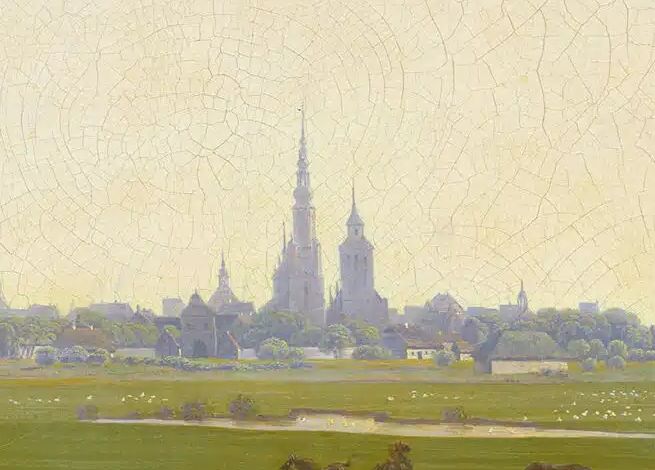
From left to right, the major church towers belong to St. Marien, Dom St. Nikolai and St. Jacobi. St. Marien has a broad, comparatively low crown and stands apart from the other two. The slender, tiered spire of St. Nikolai is the highest point in the painting. St. Jacobi's compact tower and pointed cap stand just to its right. Among the lower forms is the little roof turret of the town hall. These are Greifswald's three medieval Brick Gothic churches. St. Nikolai was also the church where Friedrich was baptised, a connection that gives the most conspicuous landmark a particular place in his biography.[4][5]
Their contours are clearest where they break into the light. Lower down, roofs, trees and walls share a cool blue-grey, making the city harder to separate from the air around it. The Met points to aerial perspective, the way distant forms tend to look bluer. The effect here depends on the neighbouring colours too. There is a warmer strip of light at the foot of the town, and the sky grades from yellow near the roofs to a cooler blue higher up. Clara Blomeyer relates those gradual transitions to Friedrich's practice with sepia washes. The comparison helps explain how a canvas with so few large divisions can sustain such a long look. The eye can pick out a spire immediately and still have trouble saying where the blue of the sky gives way to yellow.[2][3]
Johannes Grave calls attention to the position of the city along the horizon. The church towers mark where distances we can estimate on the ground open into a sky with no comparable measure. The visible water has banks, the animals have a familiar size, and a mill tower marks the transition between pasture and buildings. Above the spires the colour continues upward with scarcely an interruption. On a canvas small enough to take in at close range, Friedrich uses that difference to make the sky feel much larger than the stretch of land underneath.[4]
From a drawing made near Greifswald
Friedrich settled in Dresden after his training in Copenhagen and returned regularly to Greifswald. He probably made the preparatory drawing for this view around 1806, looking from west of the town. The Pomeranian State Museum received the sheet as a gift in 2017 and identifies it as the drawing Friedrich used in his Dresden studio. The city later opened a viewpoint near the New Cemetery, to bring that historical view into comparison with the present-day skyline.[2][6][7]
The drawing was squared, meaning that a grid divided it into sections. Working square by square helps an artist preserve relationships across a wide view, such as the gap between the two outer church towers or the point at which a roofline meets a tower. Blomeyer finds that the spacing, scale and proportions of the old skyline carry over into the painting, along with its position a little below the midpoint. The sheet also gave Friedrich something to change. His note identified a cow pasture, and he substituted the grazing horse on the right for the cow in the study. He also added the two galloping horses. The distance between landmarks could therefore remain as he had recorded it while the movements that enliven the land beneath them belonged to the later painting. The main church towers retain their recognisable profiles even where the haze softens the streets and houses below.[2]
The town in other light
In Greifswald in Moonlight, the small oil dated 1817 by the Nasjonalmuseet in Oslo, Friedrich placed fishing nets and shore boats in the foreground and let the town lie across a stretch of water. The Oslo museum describes the skyline in that picture as reversed and calls attention to how the nets interrupt access to the city. Blomeyer traces both oils to the study made west of town. The two paintings show how much the route towards a familiar group of buildings matters. In the daylight canvas, the shifting greens and the changing scale of the animals offer a succession of points across the meadow. In the nocturne, the dark poles and draped nets make the viewer stop at the shore.[2][8]

A third view, the watercolour View of Greifswald in the Museum Georg Schäfer, places the town to the left. It looks from the east, probably from the River Ryck, and Blomeyer discusses it in connection with a possible visit in 1818. The masts of a boat occupy the other side of the sheet. The watercolour makes the lateral balance between boat and town part of the experience of looking, whereas the broad pasture in the Hamburg oil keeps drawing the eye back towards the central churches.[2]
In The Port of Greifswald, a separate oil in Berlin's Alte Nationalgalerie, a large sailing ship stands in front of the familiar towers. Its masts and rigging take over the space that Friedrich left to the unbroken sky above much of the meadow. The Pomeranian State Museum brought the Hamburg and Berlin canvases together for Hometown, which opened on 16 October 2024 and ran until 5 January 2025. Preparatory drawings and views by other artists accompanied the two loans, placing Friedrich's versions alongside other records of the town.[9][10]
The university town seen from a field
The largest landmarks are churches, but the skyline also includes buildings belonging to the civic and university town. Art historian Kilian Heck identifies the roof of the university's college building just to the right of St. Jacobi. Its position is easy to overlook because it sits below the church tower and because so much of the town is painted within a narrow band. Once the roof is located, the skyline becomes easier to read as a group of buildings with different uses. The church towers organise the view from a distance, while the smaller roofs retain enough definition to put the university and town hall in relation to them.[2][4][12]
Heck connects the precision of those forms with Friedrich's early lessons under Johann Gottfried Quistorp, the university's drawing instructor and building master. The training included the study of nature and models as well as architectural drawing. In the meadow painting we can see those skills working together. A tower must remain recognisable as an individual building even when it is small and partly absorbed into the haze. The ground in front asks for a different attention, to such things as the irregular line of a bank and the way a horse distributes its weight. Friedrich could make the two kinds of detail cooperate without bringing the town closer.[2][12]
Heck also reads the shrubs as a threshold between the viewer and the distant town. They matter because the foreground already offers several possible routes for the eye. The galloping pair draws attention across the field, while the blue roofs invite it farther back. The nearer dark plants interrupt that progression. Looking from the shrubs to the narrow gleam of water, and only then to the buildings, makes the impression of distance depend on several changes in texture and colour. The scene holds the specificity of the town together with an impression that its buildings might almost be suspended above the meadow.[2][12]
From the market square to the outskirts
Friedrich's 1818 watercolour of the Greifswald market square gives another view of what he remembered and recorded about his birthplace. The Pomeranian State Museum describes it as a view towards the town hall and council pharmacy, with family groups in the foreground and a carriage at the right. Friedrich made the work in the year he travelled to Greifswald with Caroline. The foreground gives the eye people to distinguish, and the scale of the buildings lets us see features that would disappear in the distant prospect. In the meadow painting the town hall can still be picked out, but its position among the roofs is more important to the composition than the detail of its façade.[4][13]
The two works also establish where the viewer stands in different ways. The market-square view opens at the level of people and a carriage, as if there were room to approach the groups. In the oil we approach only as far as the higher ground at the front. Fields, water and the low roofs supply a series of distances from that position. The pasture gains much of its vitality from the paired horses, which carry the eye sideways for a moment before it returns to the town. That movement is especially apparent alongside the market-square sheet, where the people in the foreground and the façades beyond them hold the eye among the buildings.[2][3][13]
The picture made from the outskirts keeps much of its sense of place in the interval between the viewer and the buildings. Identifying the college roof or the town hall rewards a closer look, but bringing them closer would change the effect. Their small size lets them share the blue of the distance. The horses, painted at a larger scale and in sharper profile, belong to the usable land below. Together the two distances make Greifswald recognisable as a town and the meadow recognisable as part of its surroundings.[2][12]
From Greifswald to Hamburg
Alfred Lichtwark, the director of the Hamburger Kunsthalle, acquired Meadows near Greifswald in Greifswald in 1904. He also acquired Friedrich's Mountain Landscape in Bohemia. These were the museum's first two Friedrich paintings. More followed as Lichtwark and the director of Berlin's Nationalgalerie, Hugo von Tschudi, competed to build their holdings of the artist's work. The modest size of the meadow picture makes its place in that history striking. It takes close viewing to see the depth of the foreground and the intervals in the skyline, the very details that carry the sweep of the landscape on a canvas less than half a metre wide.[11]
Annotated Details from Meadows near Greifswald
Use the numbered details to trace the forms and light in this work.
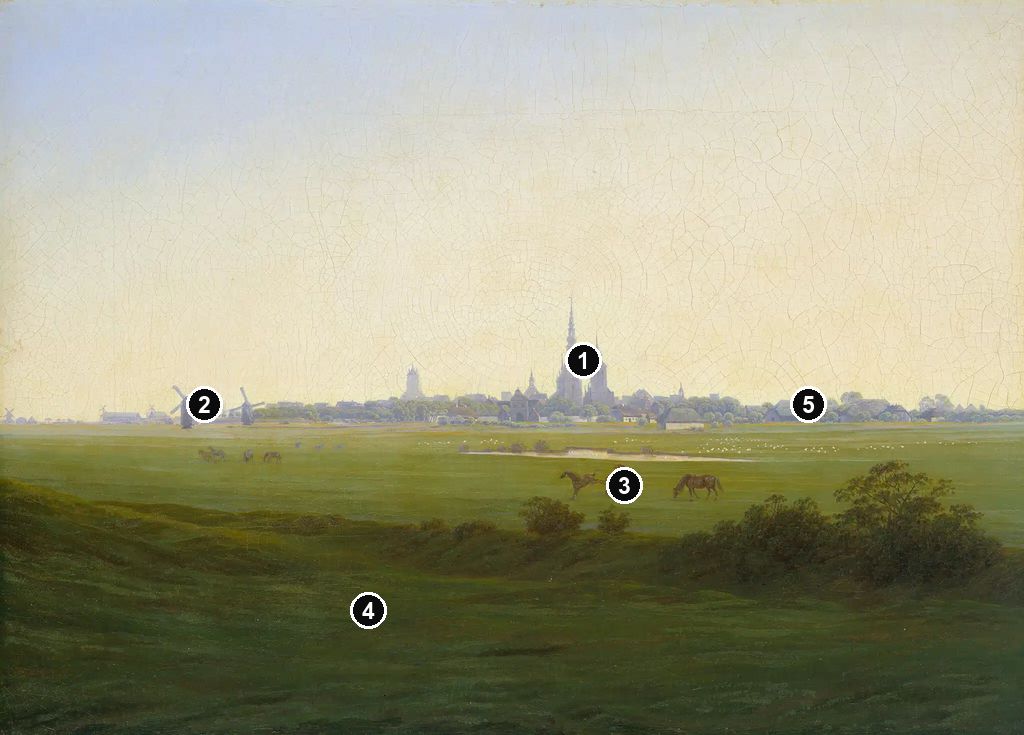
Details from MEADOWS NEAR GREIFSWALD
The detail crops show parts of the work at a larger scale.
Greifswald’s skyline
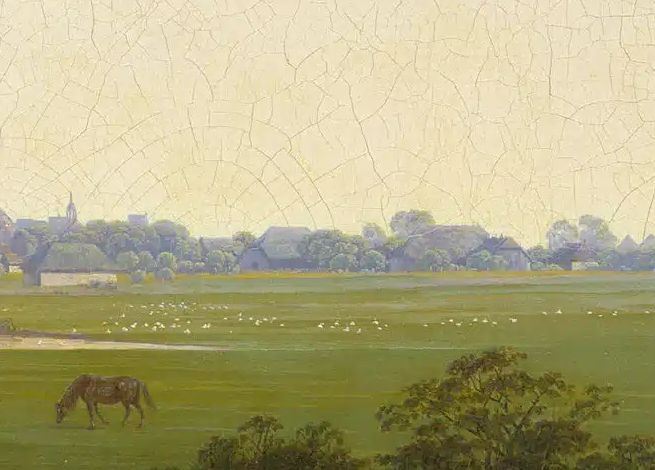
The church towers rise above a low and nearly continuous line of buildings.
Windmills at the left
The windmill sails mark the open western edge of the distant town.
Horses in the meadow
Two horses run across the pale green field. A third lowers its head further to the right.
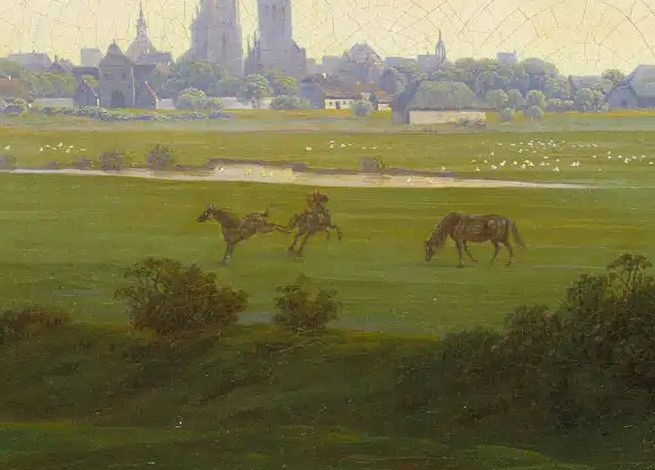
The shaded foreground
The uneven ground in shadow occupies the lower part of the picture and frames the flat meadow beyond.
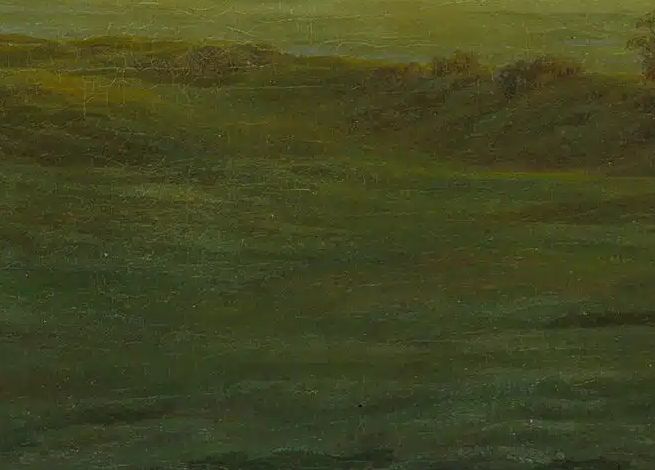
The open horizon
A thin band of trees and houses separates the meadow from the luminous sky.
Frequently Asked Questions
Discussion
Reader insights are welcome, especially close-looking observations about how the skyline, meadows, horses and pale sky turn Greifswald into a charged landscape.
Reader Insights
Where does the skyline begin to assert itself across the low horizon?
How do the field, windmill and horses keep the foreground alive?
How does the sky make this precise city view feel atmospheric?
Does Meadows near Greifswald feel most powerful as a hometown image, a composed skyline, or a study in summer light?
Join the Conversation
Share a source-grounded close reading of the Greifswald skyline, meadows, horses, drawing-transfer evidence or hometown context.
References
- Hamburger Kunsthalle, Caspar David Friedrich. Kunst für eine neue Zeit, exhibition entry and painting dimensions
- Clara Blomeyer, Meadows near Greifswald, Hamburg exhibition catalogue essay and object data
- Metropolitan Museum of Art, Caspar David Friedrich: The Soul of Nature, gallery labels, p. 15
- Johannes Grave, Wiesen bei Greifswald, German anniversary essay
- City of Greifswald, the three churches of the historic town centre
- Pomeranian State Museum, Friedrich in den Wiesen, history of the preparatory drawing
- City of Greifswald, opening of the Wiesen bei Greifswald viewpoint
- Nasjonalmuseet, Greifswald in Moonlight, NG.M.00387
- Alte Nationalgalerie, Der Greifswalder Hafen, A II 356
- Pomeranian State Museum, Caspar David Friedrich. Hometown
- Caspar David Friedrich anniversary chronicle, the first two Kunsthalle acquisitions in 1904
- Kilian Heck, Buildings, Portraits and Trees. The University Landscape of Greifswald in Pomerania, Baltic Journal of Art History 16, pp. 5–6.
- Pomeranian State Museum, 1818 – Greifswald und die Familie Friedrich, with a reproduction of the market-square watercolour.