



 by Tom Gurney
Tom Gurney BSc (Hons) is an art history expert with over 20 years experience
Published on June 19, 2020 / Updated on October 14, 2023
Email: tomgurney1@gmail.com / Phone: +44 7429 011000
Caspar David Friedrich Prints: Introduction
In Caspar David Friedrich’s Footpath with a Bridge, a traveller crosses a stream on a narrow span. The scene is small enough to take in at a glance, but the bridge, the cross and the church in the distance give the eye several places to stop. Friedrich made the etching early in his career, during a brief period of experimenting with prints. The woodcuts he designed at about the same time have a different look. In Boy Sleeping on a Grave, the figure lies close to us, and a butterfly matters as much as anything on the horizon. Looking at the two prints together shows how much Friedrich could do with a few familiar things and how differently the etched plate and the cut block put those things on paper. [1][2][3]
At a Glance
- Media · Etching and woodcut
- Examples · Self-portraits, landscapes and grave subjects
Contents
- Introduction
- Etchings by Friedrich
- A self-portrait in ink and wood
- A sleeping boy and a grave
- The woman and the spiderweb
- Prints made after Friedrich
Etchings by Friedrich
An etched line begins in a metal plate. Acid bites into the areas exposed by the artist, and the resulting recesses hold ink. In a woodcut the raised surface carries the ink, and areas cut away leave the paper showing. Both processes produce an impression when the ink transfers to paper. Friedrich could work out the scene on an etching plate himself. For the woodcuts discussed here, his brother Christian cut the blocks after Friedrich’s designs. [3][4]
A trial proof in Berlin gives a glimpse of what an early etching could be used for. In Farmhouse with Hills and Trees, with Hilly Landscape Above, dated 25 November 1799, the etching is pasted into a sketchbook and bears a dedication to Quistorp. Berlin’s Kupferstichkabinett catalogues the page as SZ CD.Friedrich 100 recto. Here the print sits among the artist’s drawings, and the dedication gives this particular impression an association with a named person. An image made on a plate that could yield several impressions could also have a very personal destination. [5]
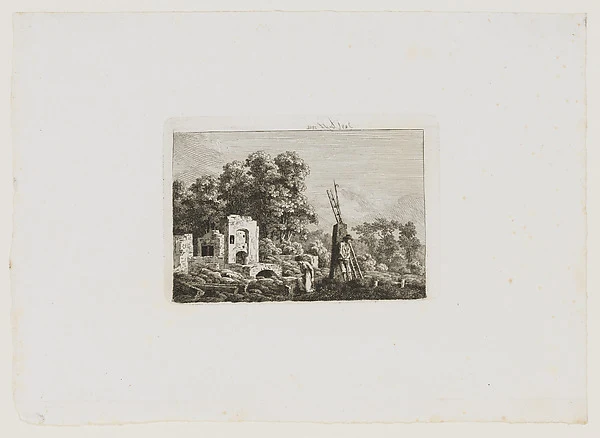
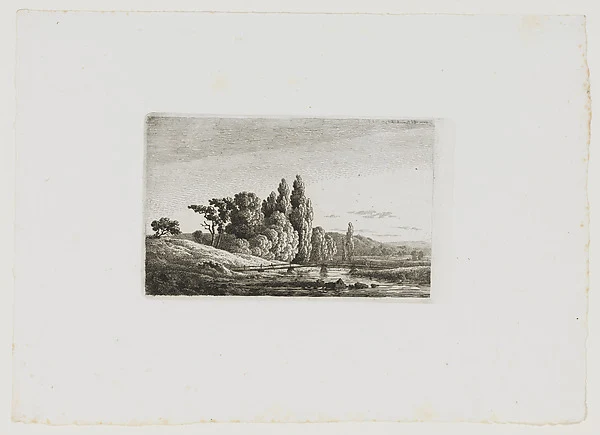
In the Met’s Footpath with a Bridge (27.36.2), the dark foreground gives way to lighter ground around the crossing. A clump of trees gives the bridge a backdrop, while the more lightly worked distances let the eye follow the route beyond the traveller. The Met’s exhibition labels place the wayfarer, cross and church within an established tradition of landscape prints. It is possible to see the passage across the water as carrying a religious meaning, but the composition also works as an invitation to follow the path from one patch of light to the next. [1][3]
The Met tentatively dates its Footpath to 20–22 November 1802. The Hamburger Kunsthalle’s example (1966-12) is dated 1803–04 and titled Steg mit Brückenkreuz vor Baumgruppe am Fluss, which names the cross on the bridge and the trees behind it. Cleveland’s impression (2006.133), catalogued about 1803, gives separate measurements for the image, the plate mark and the sheet. The dark and pale lines of the landscape occupy only part of the paper. A full view of the sheet lets you see the size of the image in relation to the plate and the surrounding margin. [1][6][7]
Friedrich used etching for a much less tranquil scene in Site of a Fire. A man and woman stand amid the wreckage, where empty buckets hint at attempts to put out the fire. The Met dates the work to 29 September 1802 and its impression (27.36.1) to 1803 or later. The same museum calls Footpath the only known state and Site of a Fire a second state. A state is one version of the image on the plate. Further work on the plate can produce a new state, and each state can yield several impressions. The date of a particular sheet can be later than the date of the work on the plate. [1][3][4][8]
A self-portrait in ink and wood
Friedrich’s profile self-portrait survives in several forms. The Hamburger Kunsthalle has the pen-and-ink drawing over pencil (41087), dated about 1802, and the printing block (DP 80), dated about 1803. The chronicle links the block to the museum’s paper impression (37225), which it dates after 1803 and credits to Caspar David Friedrich as designer and Christian Friedrich as block cutter. Klassik Stiftung Weimar dates its own woodcut (DK 30/02) about 1803. The sequence of objects shows how a portrait passed from a drawing to a block and then to paper. [9][10][11][12]
The Hamburg drawing has also been called a portrait of Christian. The museum’s catalogue essay traces the history of that identification and explains why the drawing is generally accepted as the self-portrait that furnished the model. The printed profile faces the opposite way. The face and hair retain much of the pen drawing’s character, while the collar and hatched background are more fully worked in the print. Helmut Börsch-Supan proposed a lost drawing between the surviving sheet and the block. The catalogue essay treats the differences as small enough to be accounted for in the cutting, so the missing drawing remains a hypothesis. The preserved sheet lets us see where the brothers followed the model closely and where the image took on a different finish. [9][10][11]
A sleeping boy and a grave
The Met’s impression of Boy Sleeping on a Grave (27.35) is a woodcut on wove paper dated 1803. The image is just 7.8 by 11.4 centimetres. The Hamburger Kunsthalle’s impression (49804) is dated about 1802, and the same collection has a printing block (DP 79) catalogued to 1801–03. An inscription on the Albertina’s impression (DG1923/363), dated about 1802, names the landscape painter as the draughtsman and says his brother cut the design. It preserves the distinction between their roles in writing on a surviving sheet. [2][13][14][15]
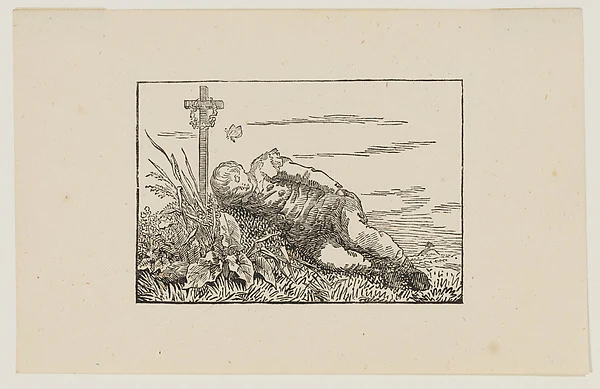
A drawing in the Kunsthalle Bremen shows how much the setting changed before the print was made. In the 1802 sheet Boy Sleeping, the boy leans against a stump, under a bare branch with a raven on it. The museum points to blackening on the back and traced lines around the figure and the folds of his clothes. In the woodcut the pose carries over, but the stump gives way to a grave with a crucifix. The butterfly takes the place of the bird. The Met reads the butterfly here as a sign of the soul released at death and draws attention to its appearance in Woman with a Spiderweb, where the web threatens to catch it. The designs reward comparison because the same small creature has a different relationship to the figure in each setting. [2][3][16]
The Met exhibited those two sheets with Woman with a Raven at a Precipice (27.11.3), a third woodcut from 1803 that it also credits to Christian as cutter and Caspar David as designer. The three put a single figure in close relation to something in the landscape. That relationship is worth carrying into a look at the later Abbey in the Oakwood, where the burial setting is much larger and the people are small beside the trees and the ruined wall. The grave could set the scale of a whole landscape or sit so close to a child that it bears his weight. [2][3][17][18]
The woman and the spiderweb
In Woman with a Spiderweb, a woman sits between bare trunks in a print designed by Caspar David Friedrich and cut by his brother Christian. The Met dates its impression to 1803, while Saint Louis gives its impression a date of about 1801–03. The titles also vary. Saint Louis includes Melancholy in parentheses, naming a mood that the Met's shorter title leaves for the viewer to discover. Both records give the cutting of the block to Christian, whose training and work in furniture making provide a practical context for the collaboration.[23][24]
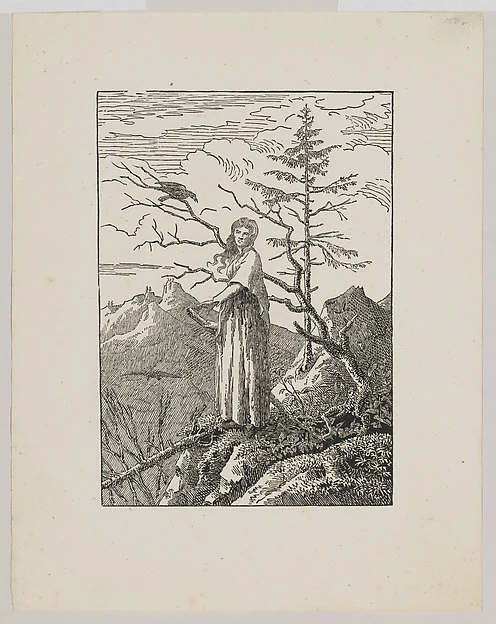
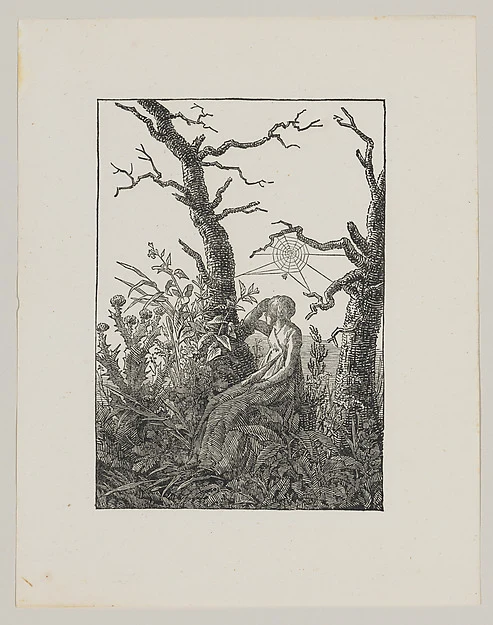
The tall format puts the woman low between two dark uprights. Bare branches and fine lines give the area above her a delicate structure. The web can take longer to notice than the figure or the trees. That delay gives it a particular force once found. What seemed to be an open space between branches turns out to contain a trap. The Met's exhibition label calls attention to a butterfly near the web and connects it with the butterfly in Boy Sleeping on a Grave. In the first print, the insect is small and vulnerable beside a structure capable of catching it. In the second, the label interprets it as an image of the soul released through death. The relationship emerges through a detail repeated across sheets whose figures and settings otherwise differ.[2][3][23]
The Cleveland impression gives another view of how the design works in black ink. The broad dark trunks establish the position of the seated woman, while thinner printed lines describe growth, drapery and the web. A woodcut has to preserve these different scales in the raised areas that receive ink. The opening between the trunks is largely the colour of the paper, yet it can register as air because the web and twigs cross it. The light that seems to fall on the woman's face is likewise made from the spacing of ink and unprinted paper.[4][25]
This early print offers a useful comparison with Woman with a Raven at a Precipice. In both, the viewer first has to locate a relatively small person in a setting organised by larger natural forms. The spiderweb occupies a confined interval. The precipice opens onto a depth the viewer can only imagine, and the raven sits where its dark outline can register against the space beyond. The same collaboration between designer and cutter produced two very different ways to give a small creature weight in a landscape.[3][17][23]
Prints made after Friedrich
Benedikt Piringer’s Arkona on the Island of Rügen offers another way a Friedrich image reached paper. Klassik Stiftung Weimar holds an impression (Gr-2017/584) dated 1809, published by Rittners Kunsthandlung in Dresden. Its catalogue identifies Piringer as the maker of the aquatint and Friedrich as the artist of the source image. The chronicle’s account of Friedrich’s Arkona drawings identifies a sepia view from around 1806 as the model. Aquatint can print areas of tone, a quality suited to carrying the shading of a sepia wash into a new medium. [19][20][21]
There is a similar division of credit in Hamburg’s Evening on the Elbe (72037), dated 1833–36. Friedrich is credited with the composition and Philipp Veith with making the print, which the catalogue describes as an etching. The word etching describes a process, so it can apply both to Veith’s rendering of a Friedrich composition and to the bridge scene Friedrich etched himself. In the drawings, a line of ink or a wash is on the sheet where the artist laid it down. In a print it helps to look at the sheet and the catalogue credit together. The margins and plate mark can tell you how much paper surrounds the image. The names beside it tell you whose decisions you are seeing in the composition and in its printed form. [1][4][22]
Frequently Asked Questions
Discussion
Reader insights are welcome, especially source-grounded observations about how Friedrich's printmaking motifs connect to his drawings and paintings.
Reader Insights
Where does printmaking change the feeling of Friedrich's familiar motifs?
How do bare trees, graves or ravens behave in the print examples?
Where can you see Friedrich’s drawing practice in the prints?
Which printmaking subject most clearly anticipates the mood of Friedrich's later landscape paintings?
Join the Conversation
Share a source-grounded observation about one Friedrich print or print-related object.
References
- The Metropolitan Museum of Art, Footpath with a Bridge, 27.36.2. View source.
- The Metropolitan Museum of Art, Boy Sleeping on a Grave, 27.35. View source.
- The Metropolitan Museum of Art, Caspar David Friedrich: The Soul of Nature, exhibition labels for the woodcuts and etchings. View source.
- The Metropolitan Museum of Art, Materials and Techniques, introductions to printmaking, woodcut and etching. View source.
- Staatliche Museen zu Berlin, Kupferstichkabinett, Farmhouse with Hills and Trees, with Hilly Landscape Above, SZ CD.Friedrich 100 recto, Friedrich anniversary chronicle. View source.
- Hamburger Kunsthalle, Kupferstichkabinett, Steg mit Brückenkreuz vor Baumgruppe am Fluss, 1966-12, Friedrich anniversary chronicle. View source.
- The Cleveland Museum of Art, Footbridge with Cross before Trees at a River, 2006.133. View source.
- The Metropolitan Museum of Art, Site of a Fire, 27.36.1. View source.
- Hamburger Kunsthalle, Kupferstichkabinett, Bildnis des Bruders Christian Friedrich (Selbstbildnis?), 41087, Friedrich anniversary chronicle. View source.
- Hamburger Kunsthalle, Kupferstichkabinett, Selbstbildnis, printing block DP 80, Friedrich anniversary chronicle. View source.
- Hamburger Kunsthalle, Kupferstichkabinett, Self-Portrait, woodcut impression 37225, Friedrich anniversary chronicle. View source.
- Klassik Stiftung Weimar, Selbstbildnis Caspar David Friedrichs, DK 30/02. View source.
- Hamburger Kunsthalle, Kupferstichkabinett, Knabe auf einem Grab schlafend, woodcut impression 49804, Friedrich anniversary chronicle. View source.
- Hamburger Kunsthalle, Kupferstichkabinett, Boy Sleeping on a Grave, printing block DP 79, Friedrich anniversary chronicle. View source.
- Albertina, Vienna, Knabe auf einem Grab schlafend, DG1923/363. View source.
- Kunsthalle Bremen, Boy Sleeping, 1802, collection interpretation on Google Arts & Culture. View source.
- The Metropolitan Museum of Art, Woman with a Raven at a Precipice, 27.11.3. View source.
- Staatliche Museen zu Berlin, Alte Nationalgalerie, Abbey in the Oakwood, Friedrich anniversary chronicle. View source.
- Klassik Stiftung Weimar, Arkona auf der Insel Rügen, Gr-2017/584, Friedrich anniversary chronicle. View source.
- Hamburger Kunsthalle, Kupferstichkabinett, Blick auf Arkona bei aufgehender Sonne, Friedrich anniversary chronicle, catalogue essay on the related Arkona views and reproductive aquatints. View source.
- Colta Feller Ives, “The Printed Image in the West: Aquatint,” The Metropolitan Museum of Art. View source.
- Hamburger Kunsthalle, Kupferstichkabinett, Evening on the Elbe, 72037, Friedrich anniversary chronicle. View source.
- Metropolitan Museum of Art, Woman with a Spiderweb, 27.11.2.
- Saint Louis Art Museum, The Woman with the Spider’s Web between Bare Trunks (Melancholy).
- Cleveland Museum of Art, The Woman with the Spider Web between Bare Trees, 1995.68.