by Tom Gurney
Tom Gurney BSc (Hons) is an art history expert with over 20 years experience
Published on June 19, 2020 / Updated on October 14, 2023
Email: tomgurney1@gmail.com / Phone: +44 7429 011000
Moonrise over the Sea: Introduction
Three people have settled on a boulder at the water’s edge. To their left, two sailing ships approach across dark water. The rim of a full moon emerges from behind a bank of cloud, and a strip of its light reaches across the sea behind the seated group. Caspar David Friedrich painted this evening scene in 1822 for a Berlin collector who also asked for a morning landscape. In Moonrise over the Sea, the people share a view that extends beyond anything they could reach from shore. Their closeness gives the scene much of its warmth. [1][2]
At a Glance
- Artist — Caspar David Friedrich
- German title — Mondaufgang am Meer
- Date and medium — 1822, oil on canvas
- Dimensions — 55 cm high × 71 cm wide
- Collection — Alte Nationalgalerie, Staatliche Museen zu Berlin, W.S. 53 [1]
- Companion — The Solitary Tree (Der einsame Baum), 1822, Alte Nationalgalerie, W.S. 52 [3]
Contents
- Introduction
- Three figures on the shore
- How the moon lights the sea
- The morning painting and the evening painting
- The surviving figure drawings
- From Wagener’s collection to the Nationalgalerie
- Other moonrises by Friedrich
- Annotated Details
- Image Details
- What a letter tells us about the approaching boat
- From the Berlin horizon to the rocks at Prague
Three figures on the shore
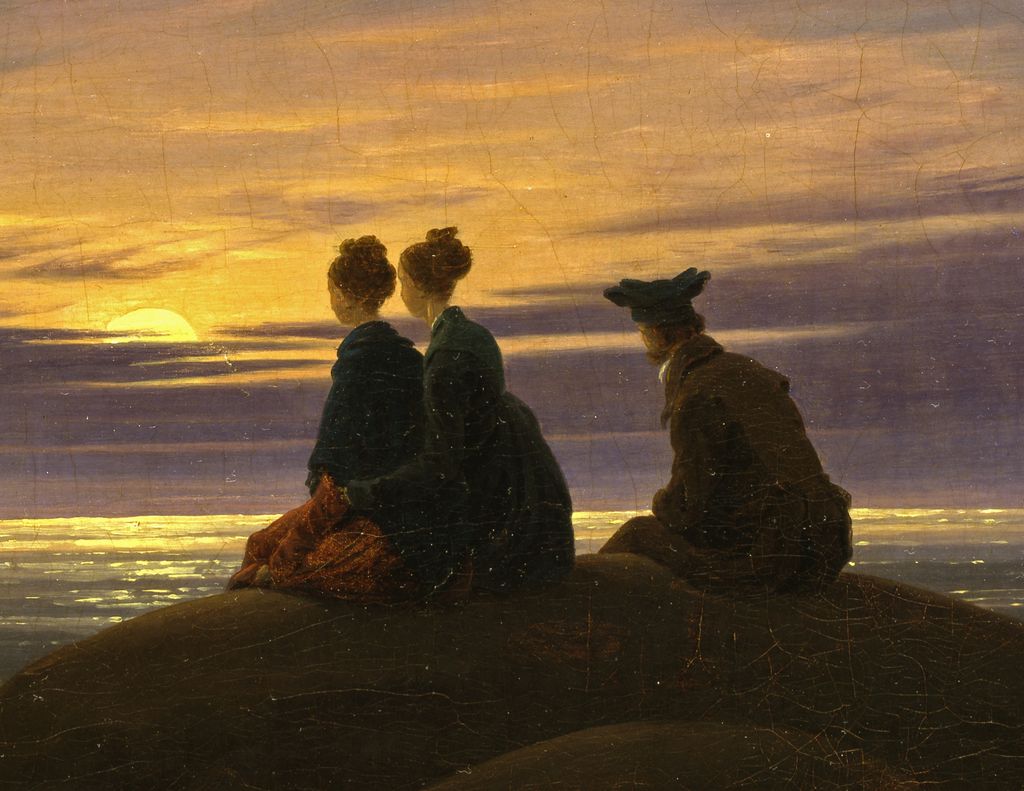
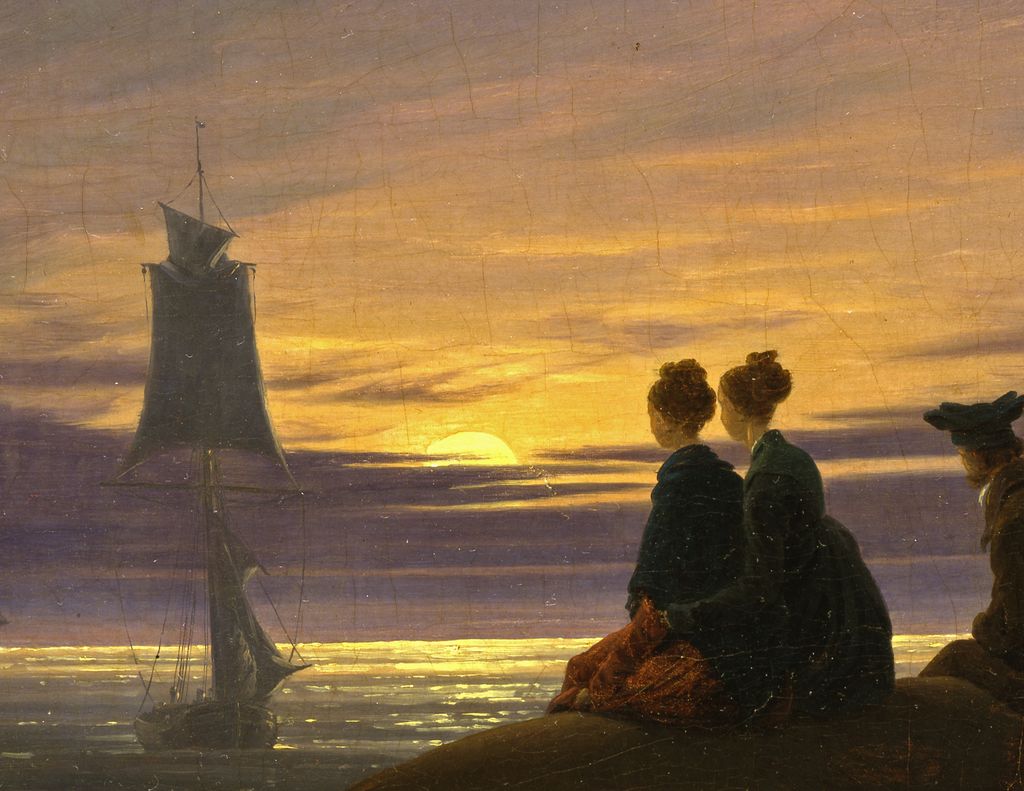
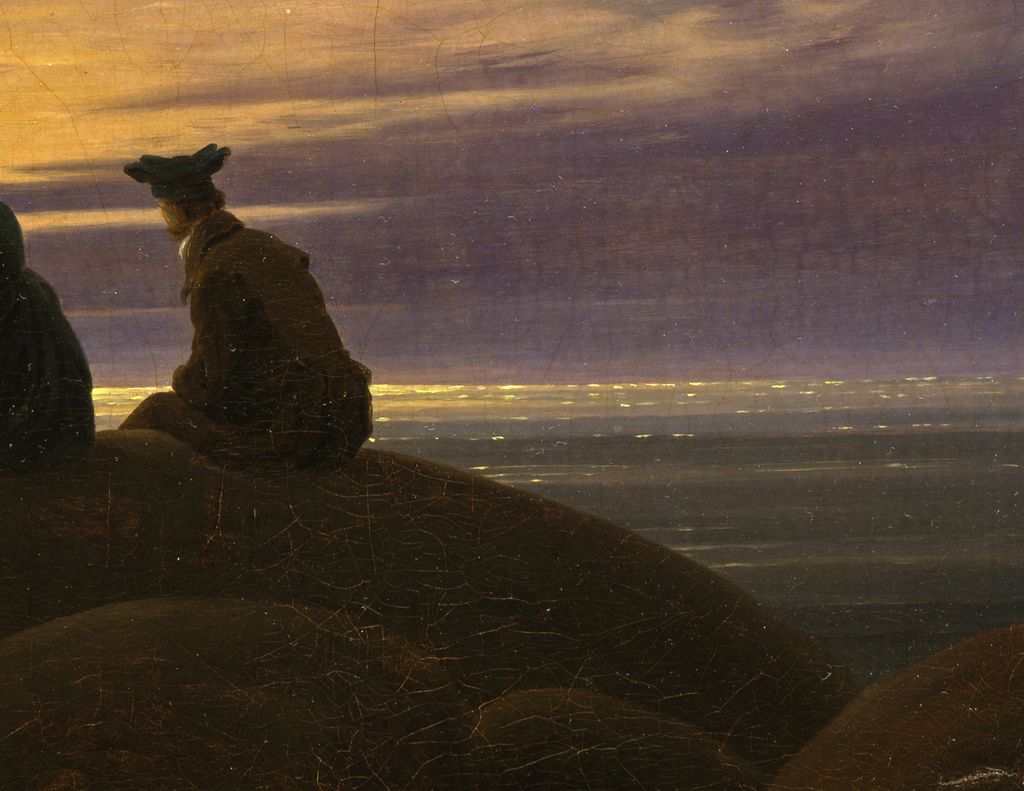
The boulders fill much of the lower half of the painting. Their rounded tops overlap, with patches of brown and russet emerging from the dark. The people sit high enough on the central rock for their heads and shoulders to break into the light. Two women sit close together on the left, while a man in a cap sits a little apart on the right and leans toward the view. The small patch of warm colour below the women’s dark upper bodies makes their place on the rock easier to pick out. Seen from behind and at a slight angle, all three direct attention out across the water. [1][4]
Friedrich lets us see just enough of each person to register a distinct posture. The two women’s heads are nearly level. The man’s hat gives his silhouette a wider top, and the forward inclination of his body echoes the direction of their gaze. The shared orientation binds the three figures more closely than any exchange of looks or gestures. From the position Friedrich gives us, we can follow their attention and still see how they sit together. The painting makes the act of watching part of its subject. [1][4]
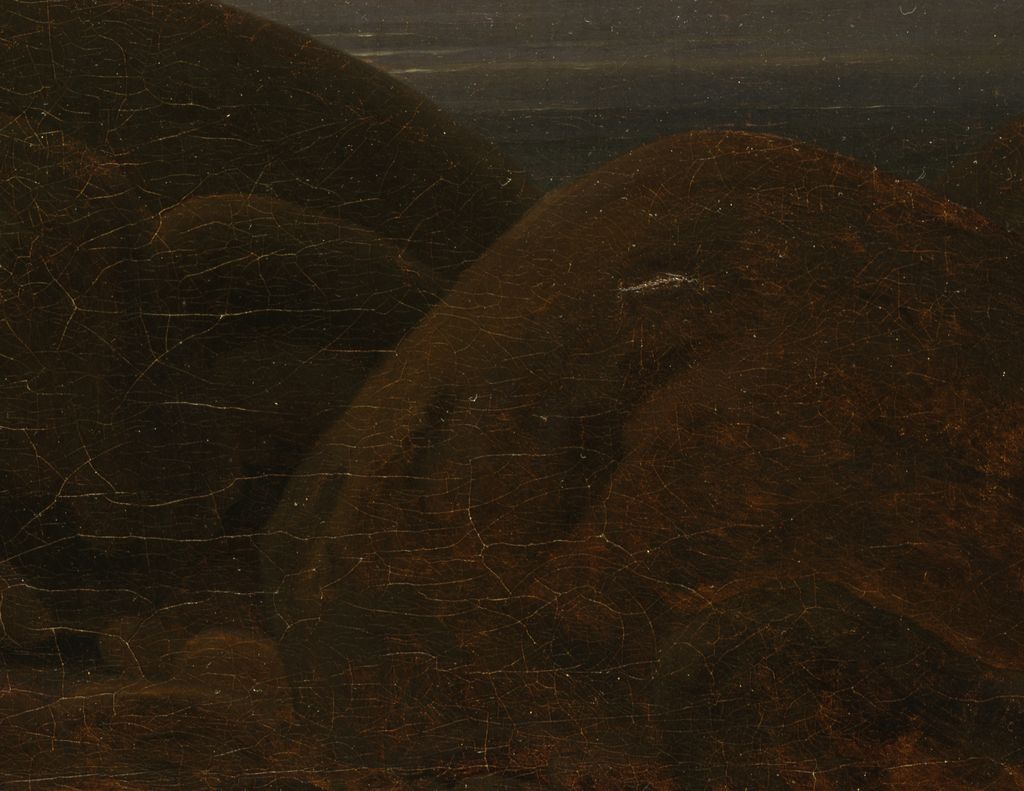
Follow the upper edge of the rocks across the painting. Where the rise beneath the figures drops away, a strip of water becomes visible again. The dark foreground gives the seated group a firm footing while the breaks in the rock line open onto the sea. Beyond them the horizon is difficult to trace continuously. Clouds, haze and reflected light soften it, especially to the left where the ships sit close to it. The outlines of the people consequently seem very definite beside the more uncertain distances they are looking into. [4]
How the moon lights the sea
The brightest part of the sky is low and slightly left of the centre. Cloud cuts across the face of the moon, leaving a bright curve and a glow that fans upward. The colours thin into mauve and grey toward the edges. Across the water the illumination takes a different shape. Thin horizontal marks catch the light, and the brighter strip passes behind the watchers and out to their right. The upright shapes of heads, shoulders and sails register clearly against these stretches of horizontal light. [1][4]
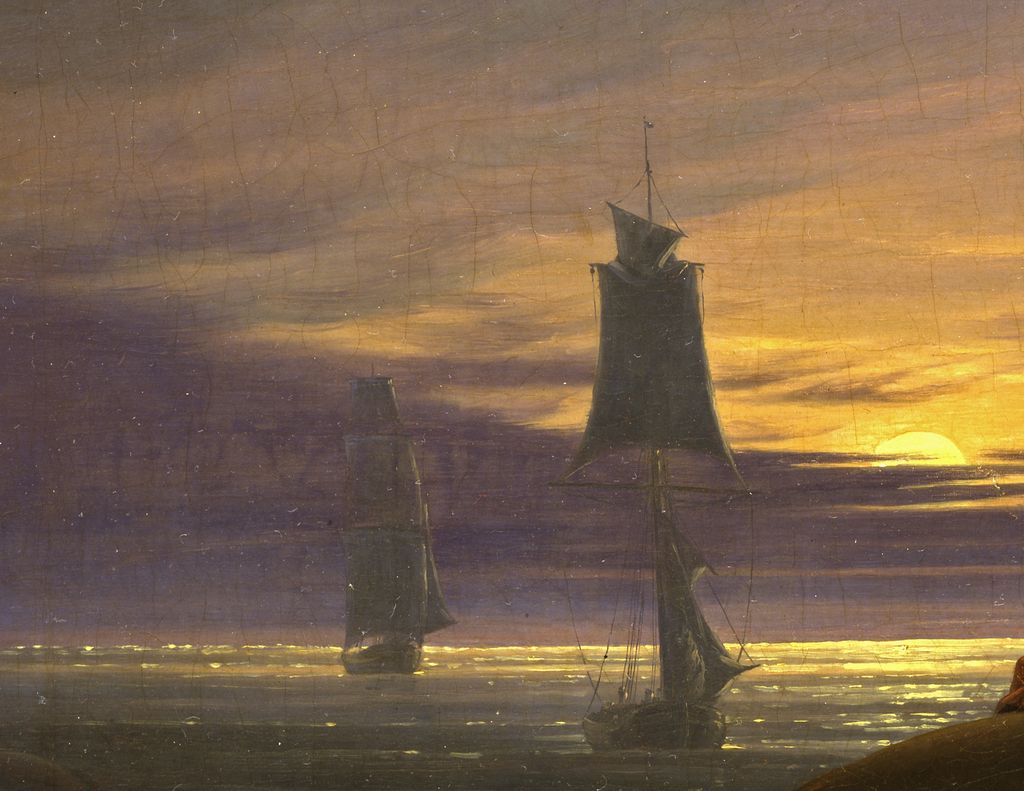
The two ships give the eye a way to judge the distance. The larger sail stands out against the brighter sky, while the vessel farther left is much less distinct against the cloud and water. Both interrupt the broad horizontal bands, but their visibility changes with the tones behind them. The eye can go from the solid rock and the seated bodies to those sails and then to a moon that is itself partly screened. Every step outward asks the eye to make a little more out of a little less. [4]
Birgit Verwiebe, writing for the Nationalgalerie, reads the vessels as returning home and the moon as a sign of hope. The painting gives that interpretation two points of support. The people already have one another’s company, and the movement of the ships suggests that others may soon reach shore. Yet the arriving vessels are still some way off, and most of the sea remains in shadow. The sense of anticipation comes from that gap between being able to see something and being able to reach it. Kunst Museum Winterthur sets the picture within a wider Romantic interest in how changes in the natural world might express the passage of a human life. [1][2][4]
The morning painting and the evening painting
The Berlin banker and collector Joachim Heinrich Wilhelm Wagener commissioned the two landscapes. He visited Friedrich in Dresden in early August 1822, and on 1 November Friedrich wrote to him to report that both pictures were finished. The Alte Nationalgalerie records a further stage in their history. In April 1823 the canvases were still in Dresden, where the Academy showed them in a special exhibition during a visit by King Max I of Bavaria. The museum accordingly places their arrival with Wagener after that exhibition. [1][2][3]
The morning picture, The Solitary Tree, has the same dimensions as the seascape. Its oak fills the centre, with a shepherd sheltering near the trunk and sheep scattered over the meadow. The land opens in stages through pools, trees and settlements toward the mountains. In the evening picture the compact group and boulder occupy the centre much lower down, leaving the cloud bank and the glow above it to fill the space where the oak would stand. The matching format makes the redistribution of dark and light especially easy to see. [1][3][4]
Water also works differently in the two canvases. In the morning scene a pool beside the oak catches the sky, a bounded reflection within a landscape that can be followed toward villages and distant peaks. In Moonrise, glints run across a single body of water with no visible opposite shore. Both paintings make room for quiet human activity, from a shepherd keeping his flock to three people watching the sea. Seen together, they lead the eye through places where people live and work and then out to a distance marked by sails and light. The oak’s dead upper branches also complicate the idea of morning as a simple beginning. The museum’s reading of the evening moon as hopeful gives the end of the day an openness of its own. [1][3]
The surviving figure drawings
The figures’ outlines have a history of their own. The Nationalgalerie records that Friedrich used contour drawings on tracing paper to prepare the underdrawing for all three figures. The Kupferstichkabinett in Berlin preserves two sheets associated with the painting. In the Alte Nationalgalerie’s 2024 exhibition checklist, the drawing of the two seated women is dated to about 1818, while the one of the seated man leaning forward is dated to about 1822. The women are already grouped on their sheet, and the man is drawn separately. [1][5][6]
The two sheets let us see a decision that is hard to recover from the finished painting alone. The closeness of the women and the separate silhouette of the man were available to Friedrich as distinct arrangements on paper. He could bring them together on the rock and judge how much space to leave between them. The approximate dates also allow for the possibility that he returned to a motif from several years earlier while making the Wagener picture. In the painting, the figures’ relation to the moon and water depends on where those contours meet the bright band behind them. What began as the outline of a shoulder or a hat becomes part of the seascape’s distribution of light and shadow. [1][5][6]
From Wagener’s collection to the Nationalgalerie
Wagener’s 1861 bequest to the Prussian king brought the two Friedrich paintings into the Nationalgalerie’s founding collection. The letters W.S. in their inventory numbers come from the catalogue of the Wagener collection prepared by Gustav Friedrich Waagen. Its entry for the evening picture describes two ships sailing on quiet water and three people watching the moon rise. In the gallery’s 1876 catalogue Max Jordan described the ships as moving toward land and picked out the dark bands of cloud from which the full moon rises. [1][3][7][8]
The relationship between the figures and the spectator gained emphasis in a later account. In his 1932 guide Ludwig Justi wrote about the way the three people carry the spectator’s gaze across the water, and linked the picture’s effect to the arrangement of warm and cool colour, masses of light and dark, and curved rocks and clouds. His account gives a reader something to look for in the canvas. The line of the foreground rock rises under the seated group, while the cloud edges spread outward above them. The painting draws the eye into the space between these forms before letting it travel along the water. [4][8]
Other moonrises by Friedrich
The State Hermitage Museum in Saint Petersburg holds another oil painting of the subject, dated 1821. That canvas measures 135 × 170 cm. It divides the watchers into two pairs, with two men standing farther out among the rocks and two women seated at the right. An anchor stands out in the left foreground. In the smaller Berlin oil the three people occupy the same boulder and the ships gather to the left of the group. The difference in the placement of the people changes where the viewer seems to stand in relation to the water. [1][4][9]
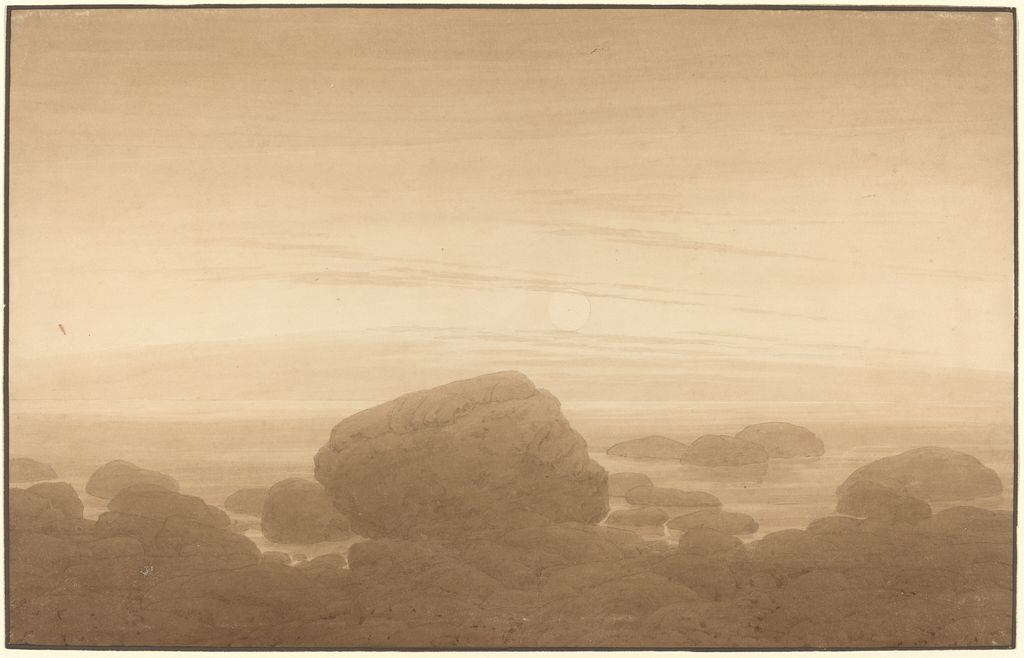
Friedrich returned to the subject on paper in a brown wash over pencil, dated about 1835–39 and held by the Hamburger Kunsthalle. In that drawing, also titled Moonrise by the Sea, the view starts in open water with scattered rocks, and the moon’s reflection runs toward the foreground. Where the wash invites the eye to follow the reflected light directly, the Berlin oil places the seated group at the edge of that light, making their shared experience of the scene visible. [1][4][10]
What a letter tells us about the approaching boat
Johan Christian Dahl's Mother and Child by the Sea, painted in 1830, puts two figures on a shore near a boat in moonlight. Dahl described the picture to its first owner. The Met identifies the figures from that letter as the wife and child of a fisherman in the approaching vessel. That evidence gives the waving gesture a particular purpose. A spectator can follow the line of attention from the people on land to a boat whose arrival has a personal consequence for them.[11] [12]
The documentation for Friedrich's Berlin painting gives a different kind of information. The letter to Wagener identifies the pair as completed works, and the commission establishes the hour each was to represent. It does not give us a comparable relationship between the people and anyone aboard the ships. The Met's 2025 label considers both yearning for distant places and a sense of homecoming. Those possibilities can coexist because the painting provides figures who attend to the water and vessels that appear to be approaching. It leaves the connection between the two groups much less definite than Dahl's letter allows in his case.[2] [11] [13]
There is a further difference in the preparation of the gesture. The Moonwatchers catalogue compares Dahl's oil with a drawing of a woman and child made in 1827. The curators read the earlier daytime figures as waving to a departing boat. A recognizable movement of the arms could therefore serve both an arrival and a departure, depending on the position of the boat and the context supplied around it. Friedrich's seated figures give fewer outward signs of a practical exchange. The light and the ships can remain important to them without the spectator knowing whether they expect to meet someone.[6] [11] [12]
From the Berlin horizon to the rocks at Prague
Friedrich's The North Sea in Moonlight, dated 1823–24 by the National Gallery Prague, makes the coast visible under a different arrangement of light. The Met connects its forms to Dahl's work and to drawings of the Norwegian coast by Carl Friedrich Naumann. Friedrich had no firsthand view of the North Sea to consult. The Prague exhibition catalogue of 1824 nonetheless named the sea, giving the audience a geographical reference even though the painter had constructed the view through other artists' material.[13] [14]
In the Berlin painting the moonlight clarifies the long boundary between water and sky. The Prague view gives the eye a more particular route from the vicinity of the mast towards the rocks and the open water. Its light allows the outline of a coastal obstruction to become part of the passage into distance. Seen beside it, the Berlin horizon's unusually broad reach becomes easier to notice. The pale band can continue beyond both vessels and past the people seated on shore, so the picture keeps an open direction even when those smaller forms are sharply enough placed to catch the eye.[1] [13] [14]
The two paintings also show what can change when a moonlit scene is presented on its own or as part of a commission for two hours. The Prague view has a historically documented name for its setting. The Berlin view has a documented relationship to a morning landscape. One description asks the spectator to consider the kind of coast that is being imagined. The other brings the dark rocks and the light across the sea into comparison with a meadow and an oak. Those records offer different starting points from which to look closely at the same basic elements of water, vessel and night light.[2] [3] [13] [14]
Annotated Details from Moonrise over the Sea
Look closely at the three seated figures, the ships and the narrow bands of light in Friedrich’s 1822 painting in Berlin.
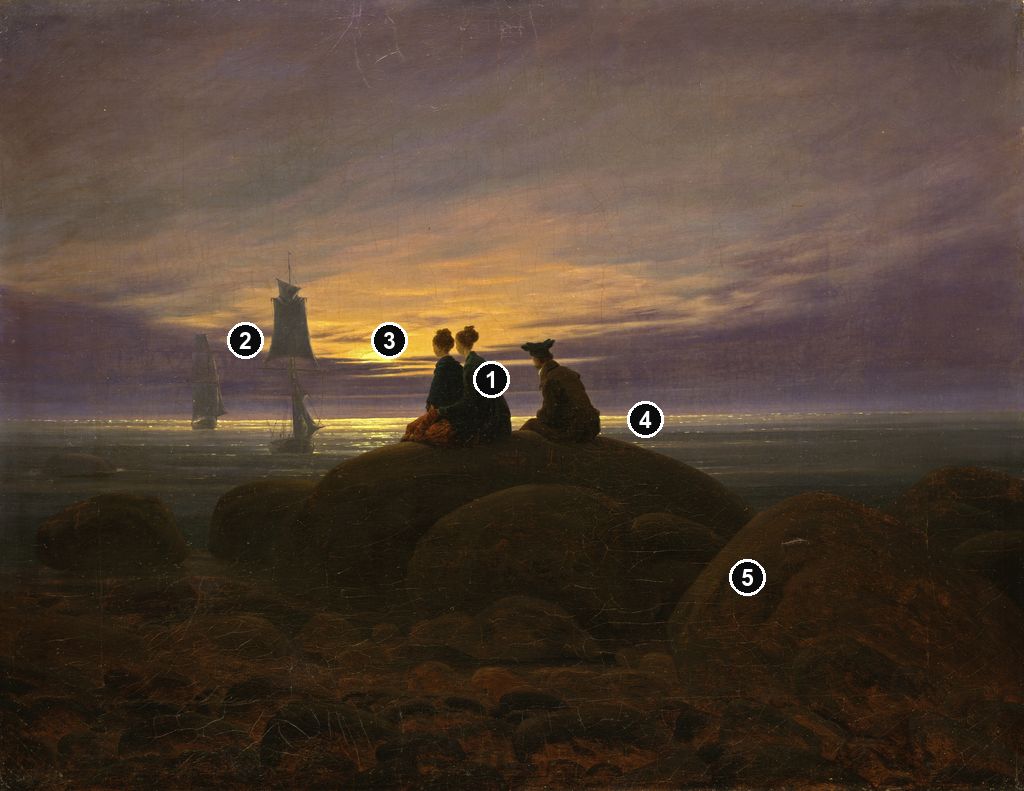
Details from MOONRISE OVER THE SEA
The details move from the dark shore to the line where the sea and sky meet.
Three seated figures
Three figures sit on the dark rock, their faces turned toward the horizon. The two on the left are grouped close together.
The two ships
The nearer vessel carries a broad dark sail. The second is smaller and farther left, above a pale strip of water.
Light between the clouds
A low opening lets yellow light through. Clouds above and below break the light into bands.
A lit strip of water
Narrow strokes pick out the surface of the sea beyond the figures. The glow continues across the horizon.
Rocks along the shore
Rounded foreground rocks sit at different angles. Their dark contours make the distant light appear brighter.
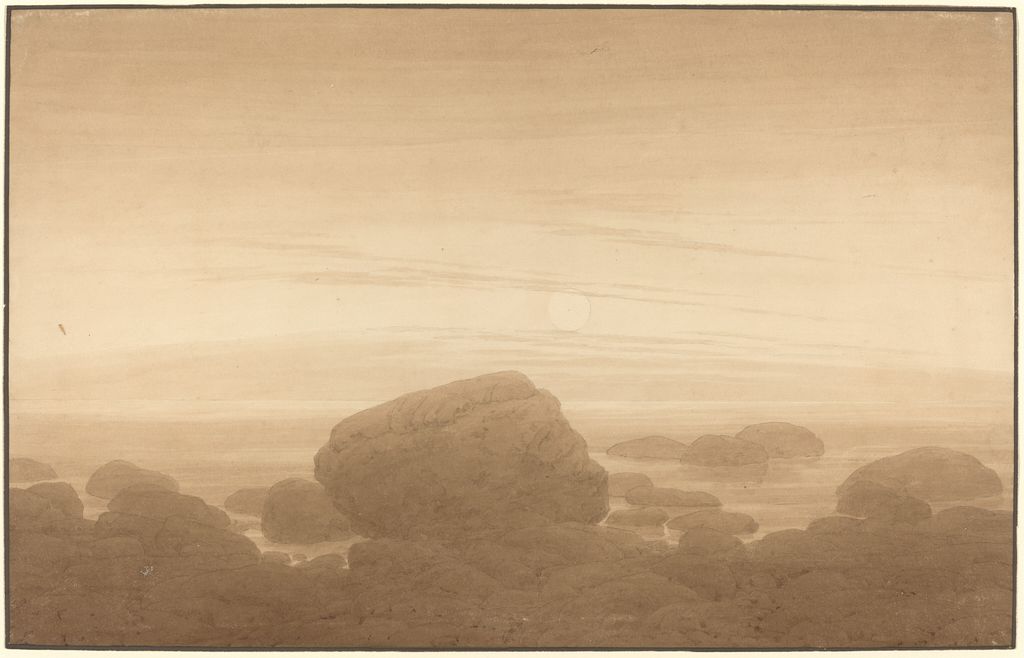
Moonrise on an Empty Shore, a separate late drawing by Friedrich. National Gallery of Art, 1992.11.1.
Frequently Asked Questions
Discussion
Reader insights are welcome, especially close-looking observations about how the three figures, ships, moon and paired-work context shape the painting's mood.
Reader Insights
How does companionship change the mood of Friedrich's moonlit shore?
Do the ships feel like return, distance, hope, or all three?
What changes when Moonrise is read beside The Solitary Tree?
Does Moonrise over the Sea feel most powerful as a coastal image, a pair with The Solitary Tree, or a meditation on hope?
Join the Conversation
Share a source-grounded close reading of the figures, ships, moon or Wagener pair context.
References
- Alte Nationalgalerie, Staatliche Museen zu Berlin, Mondaufgang am Meer, W.S. 53.
- Birgit Verwiebe, Friedrich anniversary chronicle, Moonrise over the Sea, including the archival reference for Friedrich’s letter of 1 November 1822.
- Alte Nationalgalerie, Staatliche Museen zu Berlin, Der einsame Baum, W.S. 52.
- Kunst Museum Winterthur, Mondaufgang am Meer.
- Alte Nationalgalerie, Caspar David Friedrich: Infinite Landscapes exhibition checklist, 2024, nos. 90–91.
- Kupferstichkabinett, Staatliche Museen zu Berlin, Sitzender Mann, halb vom Rücken gesehen, nach links vorgeneigt, SZ CD.Friedrich 13.
- Nationalgalerie, Staatliche Museen zu Berlin, Acquisition Logs of the Nationalgalerie.
- Birgit Verwiebe, “Bestandskataloge – Galeriekataloge – Sammlungsführer”, in Die Sammlung der Nationalgalerie zum langen 19. Jahrhundert, pp. 23–40, especially pp. 23–27 and 36.
- State Hermitage Museum, Moonrise over the Sea, ГЭ-6396.
- Markus Bertsch, Friedrich anniversary chronicle, Moonrise by the Sea, Hamburger Kunsthalle 1952-131.
- Metropolitan Museum of Art, Johan Christian Dahl, Mother and Child by the Sea, 1830, 2007.164.2.
- Sabine Rewald, Caspar David Friedrich: Moonwatchers, Metropolitan Museum of Art, 2001, p. 50, Dahl's letter and the 1827 figure study.
- Metropolitan Museum of Art, The Soul of Nature exhibition labels, pp. 16–17, Berlin, Dahl and Prague paintings.
- National Gallery Prague, Collection of Modern Art, The North Sea in Moonlight, 1823–24.