by Tom Gurney
Tom Gurney BSc (Hons) is an art history expert with over 20 years experience
Published on June 19, 2020 / Updated on October 14, 2023
Email: tomgurney1@gmail.com / Phone: +44 7429 011000
Neubrandenburg: Introduction
Two travellers stop beside a boulder. Across the fields, the spire of St Mary’s Church rises from a dark town into the light behind it. In Neubrandenburg, Caspar David Friedrich gives that first light of day most of the canvas. He knew the Mecklenburg town through family and repeated visits, and he painted it here beneath a sky that makes a familiar place look suddenly strange. The oil dates to 1816–17 and belongs to the Pommersches Landesmuseum in Greifswald.[1]
At a Glance
- Artist Caspar David Friedrich
- Title Neubrandenburg, also Neubrandenburg in the Morning Mist.[1][2]
- Date 1816–17.[1]
- Medium Oil on canvas.[1]
- Dimensions 92 cm high × 71.5 cm wide, as catalogued by the Pommersches Landesmuseum in its Google Arts & Culture entry.[2]
- Collection Pommersches Landesmuseum, Greifswald.[1][2]
Contents
- Introduction
- A familiar town and an invented landscape
- Two people beside the stone
- The light behind the town
- Friedrich’s later view of the town in flames
- The church in the painting and in the town
- Looking into a town from the outside
- From Stettin to Greifswald and New York
- Annotated Details
- Image Details
A familiar town and an invented landscape
Neubrandenburg lies about sixty kilometres south of Greifswald, where Friedrich was born. His father came from Neubrandenburg, and the painter returned to the town and drew it repeatedly. A graphite sheet now in Dresden records one visit with unusual precision. Friedrich wrote the town’s name and the date 25 April 1809 next to a study of an oak, then dated a second tree study 26 April. As the Met’s Moonwatchers catalogue explains, he later used both trees in an 1811 winter landscape. The sheet documents how he studied the area, and the later painting shows how far an observed detail could travel from its original setting.[1][3]
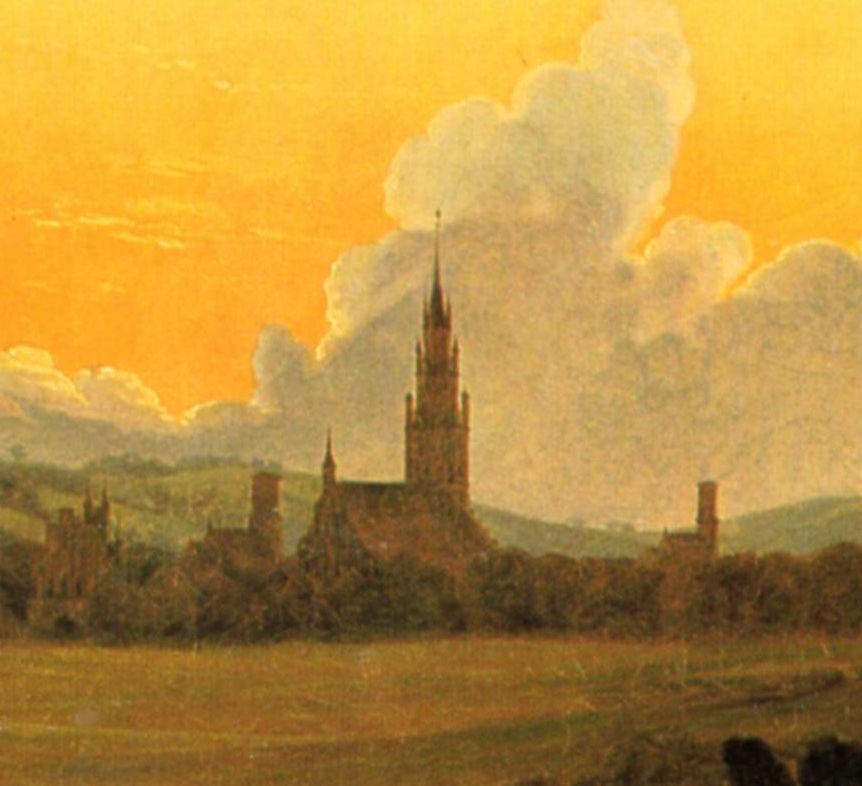
In Neubrandenburg itself, the local detail that fixes the place is the Marienkirche, or St Mary’s Church. Friedrich gives its tower a pointed Gothic termination that makes it conspicuously taller than the surrounding buildings. The roofs and lower towers form a broken horizontal band, partly lost among the trees. The spire rises in stages from that band and ends in a fine point. Against the pale cloud immediately behind it, even that narrow tip remains legible. The alteration gives a single building enough visual weight to hold its own against the sky.[1]
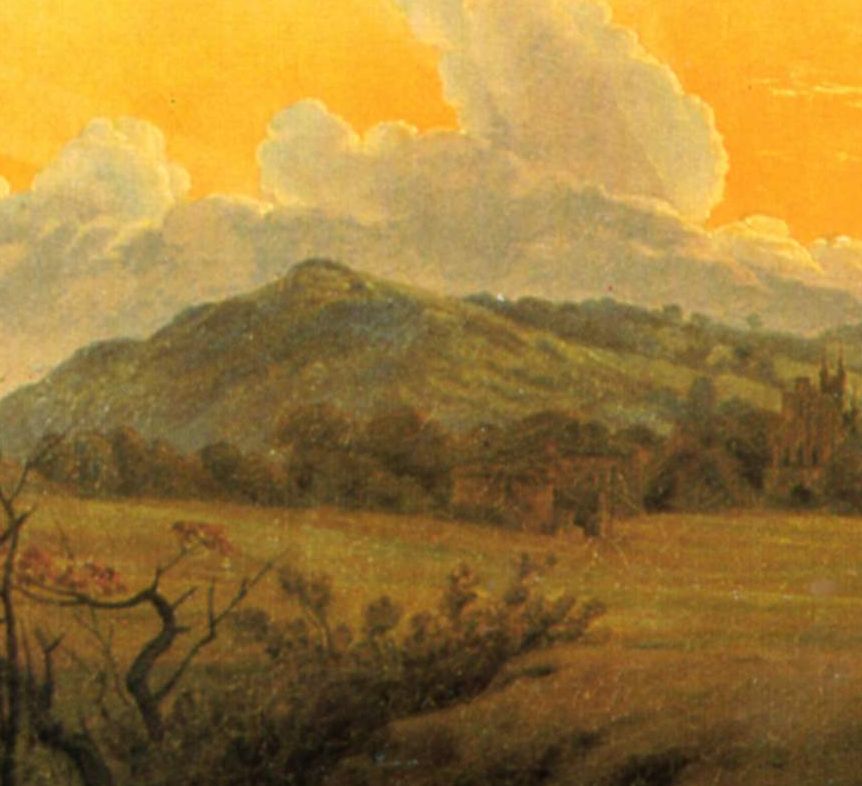
The hills behind the town rise to either side of the church. The broad slope on the left and the smaller rise on the right let the eye distinguish the town from the country beyond, while the foreground field separates it from the travellers. Those layers make for a convincing landscape even though they bring together features that do not fit the local geography. The museum portal points to the mountainous ridge and the light behind the town. Seen from the northeast, the skyline would not have the sunrise directly behind it as painted here. Bringing the light to that position puts the church in silhouette and gives the travellers a clear point of attention across the field.[1]
Two people beside the stone
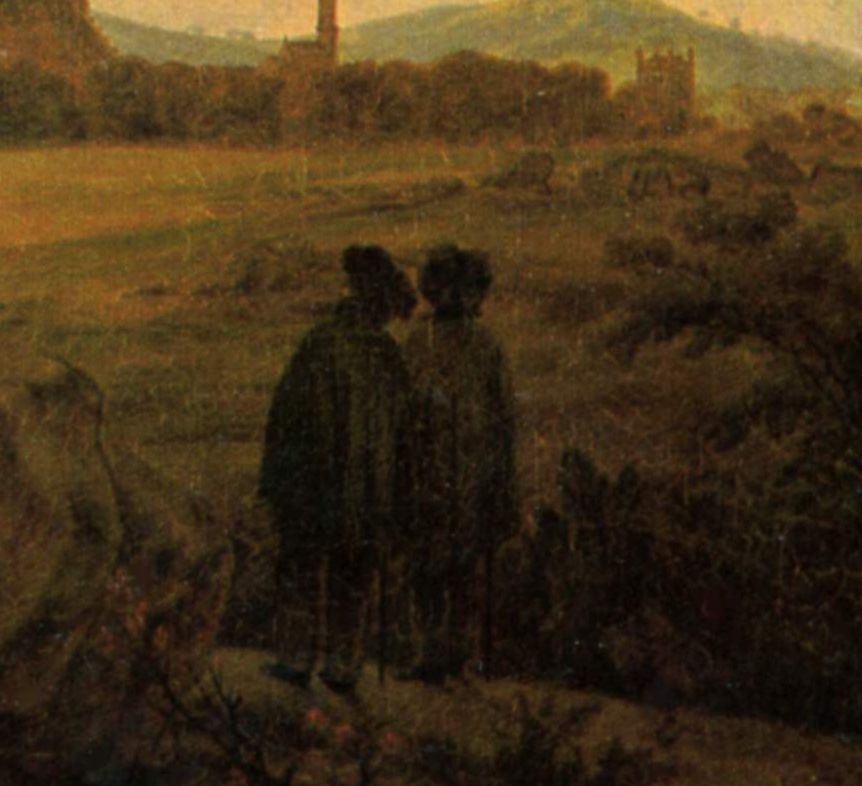
The travellers occupy a small patch of ground low on the right. Their dark coats nearly merge with the scrub, but there is a narrow gap between their heads. They stand close enough to share the view while keeping slightly different postures. The track shows pale beneath them and bends around the boulder. That curve briefly holds the eye close to the ground before the open field carries it on to the town. Friedrich shows their backs, leaving their expressions to the imagination and giving the viewer the same prospect they have stopped to consider.[1][4]
The stone is broad and irregular. Its lit upper surface is easier to make out than its base, which disappears into the shadowed growth. The Mecklenburg-Vorpommern portal identifies a burial mound in the foreground. The Met’s exhibition label describes the boulder as a possible ancient grave marker. The Met also describes the travellers’ dress as medieval in style and notes that such clothing signalled political liberalism in Friedrich’s time. The costume and the church thus give the medieval past a place in the picture at two very different scales. The spire registers from across a room. The shapes of the clothes emerge on closer inspection.[1][4]
The light behind the town
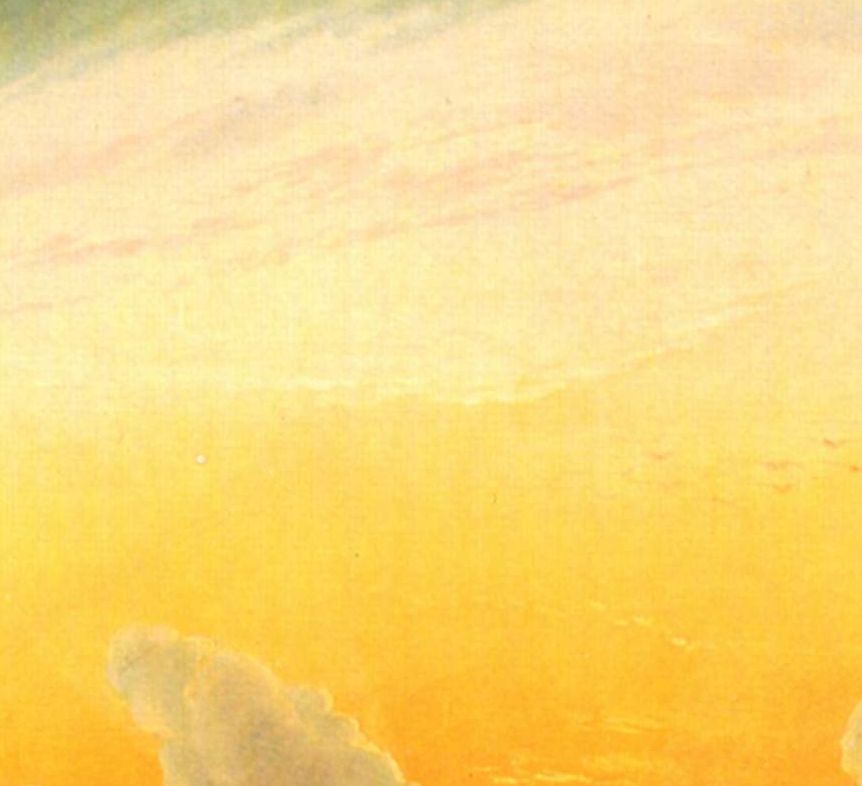
An orange band opens above the horizon, paling into yellow higher up. Low clouds gather across it in rounded masses, some with bright rims and grey interiors. At the top, a broad, darker layer stretches diagonally across the picture. The contours change as the eye travels upward, from the crisp line of the spire and the lit edges of the lower clouds to the softer boundaries of the clouds overhead. Friedrich gives no clear view of the sun’s disc. The changing colour and the light caught on the clouds let us locate the dawn beyond the town.[1][4]
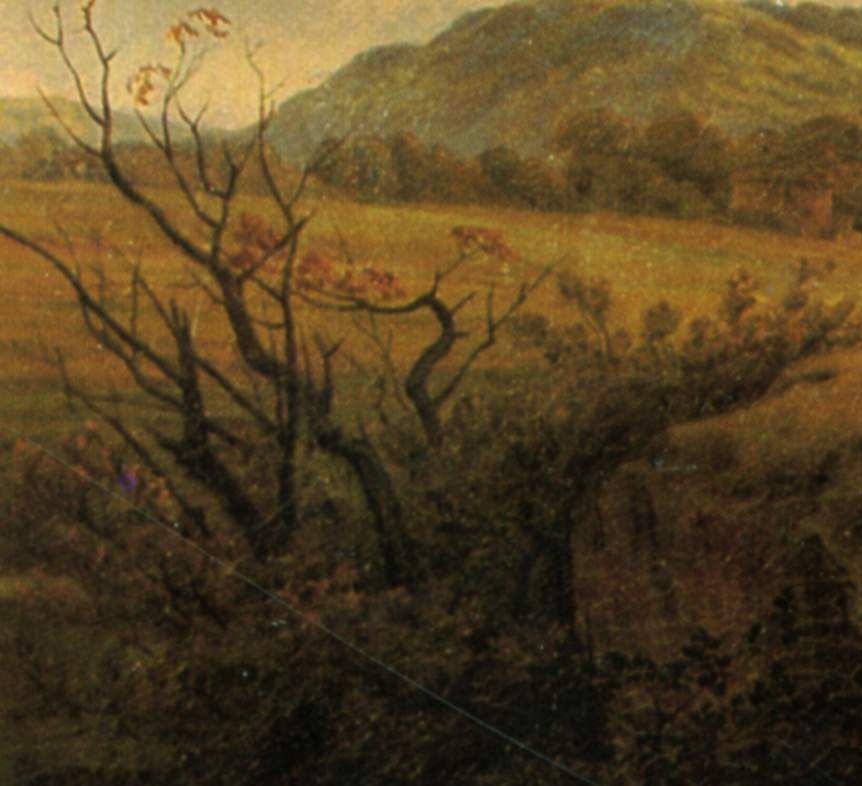
The smaller silhouettes help measure this expanse. On the left a sparsely leafed branch reaches above the ridge line and into the brightness. Well above the spire, a few faint strokes suggest birds crossing the yellow sky. The twig and the spire can both be traced to something solid below. The birds give the eye a momentary point of focus in the stretch of light between the lower clouds and the dark mass above.[1][2]
In the Mecklenburg-Vorpommern museum portal’s religious reading, the travellers have emerged from a valley of death and are looking toward the light of the heavenly Jerusalem. The Met label also sees the town as a possible sacred destination. In that interpretation, the burial feature belongs to the ground the two have crossed, and the opening sky suggests a life beyond the grave. The eye can make that journey in seconds, from the stone to the field to the spire, while the travellers remain where Friedrich placed them. He gives the dark foreground enough detail to feel near and tangible, and keeps the town distant even at its brightest.[1][4]
Friedrich’s later view of the town in flames
Friedrich returned to the same skyline around 1834 in Neubrandenburg in Flames, an unfinished oil in the Hamburger Kunsthalle. The later canvas is horizontal, with a road leading past harvested fields toward the Friedländer Tor, part of the town’s medieval fortifications. Smoke rises from St Mary’s Church. Above it, sunlight fans out behind a long bank of cloud. Markus Bertsch’s essay for the Friedrich anniversary exhibition notes that Friedrich based the road and adjoining ground on an 1824 drawing, probably of terrain near Dresden, and put Neubrandenburg where the drawing had mountains.[5]
St Mary’s altered spire remains recognisable in both paintings, but the light makes the church do different work. In the earlier canvas, a bright patch behind the tower singles it out as the travellers’ distant landmark. In the later picture, smoke partially absorbs the building into the disaster, even as the sky continues to brighten. Bertsch points out that no town fire is known from Friedrich’s lifetime. He discusses earlier documented fires as possible points of reference, leaving the occasion of the painted blaze open.[1][5]
The church in the painting and in the town
The Marienkirche that gave Friedrich his principal landmark was already centuries old. Neubrandenburg's account of the building dates its consecration to 1298 and singles out the elaborate Brick Gothic east gable. It also records repeated damage from fires and a restoration by Friedrich Wilhelm Buttel between 1832 and 1841. That campaign came after the morning picture. The church's appearance has changed again since the destruction of 1945 and its reconstruction as a concert hall. The painted outline belongs to one stage in a much longer history of how the building has been seen and rebuilt.[1][11][12]
Friedrich concentrated on what a viewer could recognise from outside the town. There is too little light on the church to study its brickwork or the details of its gable. Instead, each change in the width of its tower makes the silhouette easier to distinguish from the lower roofs. Its narrow point reaches into a part of the sky where there is little else of comparable sharpness. The church takes its place in the picture through the contrast between that clean outline and the soft cloud immediately behind it. A building known locally for the richness of its masonry becomes a landmark made of a few decisive changes in contour.[1][2][11]
The position of the travellers helps hold that landmark at a distance. Friedrich puts them off to the right, leaving the centre available for the open ground and the lit sky over the town. Their view runs diagonally from a patch of rough ground to the church. A viewer standing before the canvas can take a second route, down from the brightest cloud to the tip of the spire and then to the travellers. The town can therefore be read as a destination even though the path near their feet is too short to follow all the way to a gate.[1][2][4]
Looking into a town from the outside
The wider Meadows near Greifswald helps show how much Friedrich changed the role of the skyline here. Clara Blomeyer describes how he preserved the relative positions and proportions of Greifswald's buildings from a squared drawing, even while changing the animals in the foreground. The churches stand among mills and smaller roofs, and the town stretches laterally across the pasture. In Neubrandenburg, a single pointed tower takes on more of the work of identifying the place. The hills rise behind it and the tall canvas gives the bank of cloud room to gather above it.[1][4][13]

The foregrounds offer equally different accounts of the land outside the walls. The Greifswald field can be read as pasture through the presence and movement of its animals. In Neubrandenburg the two travellers and the possible grave marker give a small stretch of ground more weight than its area on the canvas would suggest. The view from one place to the other remains open. The field and the intervening light give the travellers something to look across, and the uncertainty of the stone's purpose leaves their pause open to several readings. The picture can be approached through what a familiar tower looks like at daybreak, as well as through what that tower might promise to someone standing beyond the town.[1][4][13]
From Stettin to Greifswald and New York
A published reproduction records that the municipal museum in Stettin, now Szczecin, had acquired Neubrandenburg before 1930. The Pommersches Landesmuseum’s history traces the broader Stettin collection through its wartime evacuation to Coburg, its move to Kiel at the end of 1970 under the care of the Stiftung Pommern, and its eventual arrival in Greifswald. That collection history puts Friedrich’s painting of a Mecklenburg town within a regional museum collection formed on both sides of the present German–Polish border.[6][7]
The Metropolitan Museum of Art borrowed Neubrandenburg for Caspar David Friedrich: The Soul of Nature, which ran in New York from 8 February to 11 May 2025. In the exhibition, it appeared alongside cityscapes and seascapes concerned with the view toward a distant horizon. Among them was Meadows near Greifswald, where the buildings take on the cool tones of the surrounding air above green fields. Seen in that company, Neubrandenburg shows how sharply Friedrich could pick out a skyline when he wanted light to draw the eye to a particular building. After the loan, the Pommersches Landesmuseum marked the painting’s return with a talk on 21 June 2025, the Day of Brick Gothic.[4][8][9][10]
Annotated Details from Neubrandenburg
Use the numbered details to trace the forms and light in this work.
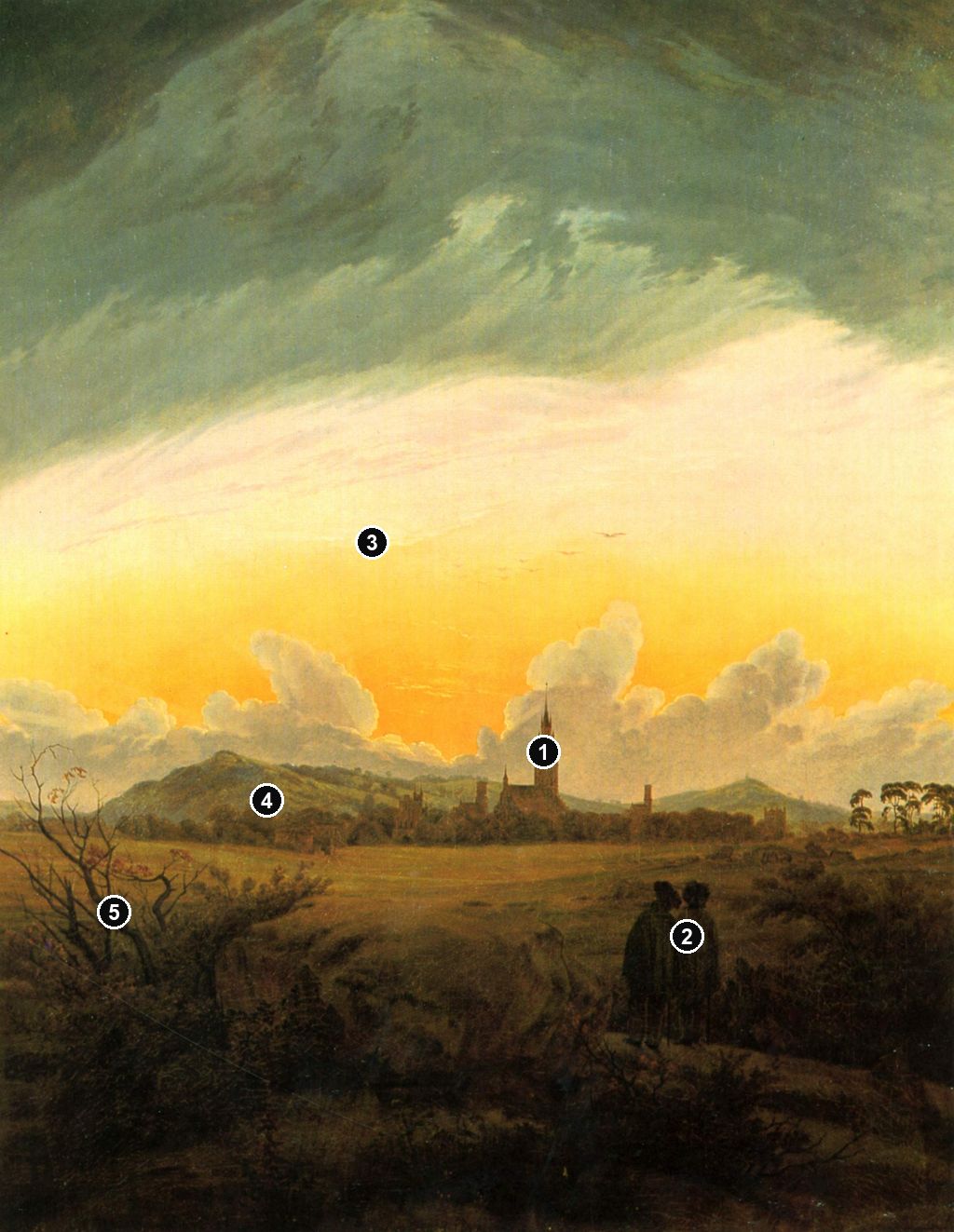
Details from NEUBRANDENBURG
The detail crops show parts of the work at a larger scale.
St Mary’s spire
The tall pointed spire rises above the darker silhouette of the town.
Two figures in the foreground
Two people seen from behind look across the open ground towards the town.
The break in the clouds
The sky opens into a broad area of yellow light below the darker clouds.
The distant ridges
The land rises behind the town in low contours distinct from the nearer, uneven ground.
The branches at the edge
Bare foreground branches cross the light above the lower ground.
Frequently Asked Questions
Discussion
Reader insights are welcome, especially source-grounded observations about how Friedrich turns a family city into a symbolic landscape of distance, memory and dawn.
Reader Insights
How do the two back-turned figures guide your eye toward the town and sky?
Where does Neubrandenburg feel topographical, and where does it become symbolic?
How does the glowing sky change the meaning of the distant town?
In Neubrandenburg, does the town feel more like a real place, a remembered family landscape, or a spiritual destination?
Join the Conversation
Share a source-grounded close reading of the figures, St Mary's steeple, the burial mound, the dawn light or the relationship to Neubrandenburg in Flames.
References
- Caspar David Friedrich: Neubrandenburg, Virtuelles Landesmuseum Mecklenburg-Vorpommern, English object entry.
- Neubrandenburg in the morning mist, Pommersches Landesmuseum collection entry on Google Arts & Culture.
- Caspar David Friedrich: Moonwatchers, The Metropolitan Museum of Art, 2001, cat. 4, Study of Two Trees.
- Caspar David Friedrich: The Soul of Nature, exhibition labels, The Metropolitan Museum of Art, 2025, p. 15.
- Neubrandenburg in Flames, Markus Bertsch, Caspar David Friedrich anniversary chronicle, from the Hamburger Kunsthalle exhibition catalogue, 2023, p. 276.
- Index to the Neubrandenburg reproduction caption, Mitteilungen aus dem Genealogischen Archiv Kreplin, no. 21, index to Pommern: Zeitschrift für Kultur und Geschichte, Jg. 45, H. 1, 2007, back cover.
- Geschichte der Sammlungen, Pommersches Landesmuseum, institutional collection history.
- Caspar David Friedrich: The Soul of Nature, The Metropolitan Museum of Art, exhibition overview and dates.
- Inside the Exhibition, The Metropolitan Museum of Art, installation and artwork list.
- Heimkehr aus New York – Caspar David Friedrichs Gemälde Neubrandenburg, Pommersches Landesmuseum, 21 June 2025.
- City of Neubrandenburg, Marienkirche/Konzertkirche, architectural and restoration history.
- City of Neubrandenburg, Geschichte der Stadt Neubrandenburg, historical chronology.
- Clara Blomeyer, Meadows near Greifswald, Hamburg exhibition catalogue, 2023, pp. 268–71.