by Tom Gurney
Tom Gurney BSc (Hons) is an art history expert with over 20 years experience
Published on June 19, 2020 / Updated on October 14, 2023
Email: tomgurney1@gmail.com / Phone: +44 7429 011000
Greifswald Harbor: Introduction
In Caspar David Friedrich’s Greifswald Harbor, a sailing ship with its sails gathered in rises above the roofs and church towers of the artist’s hometown. A rowing boat lies close to its hull, while smaller craft cross the water under sail and three figures occupy the bank at our feet. Above the tallest mast, there is still a stretch of open sky. The Alte Nationalgalerie in Berlin catalogues the painting as Der Greifswalder Hafen, about 1818–20, oil on canvas, 90 cm high by 70 cm wide, inventory A II 356. It is also known in English as The Port of Greifswald. [1]
At a Glance
- Date · ca. 1818–20
- Medium · Oil on canvas
- Collection · Alte Nationalgalerie, Staatliche Museen zu Berlin
- Dimensions · 90 cm high × 70 cm wide
- Accession · A II 356
Contents
- Introduction
- Ships moving at different speeds
- A familiar skyline rebuilt around the ships
- The bank and the underdrawing
- Evening light and the idea of return
- Greifswald from land and from a deck
- From the river mouth to the town quays
- A different harbor at evening
- From Greifswald to the Nationalgalerie
- Annotated Details
- Image Details
Ships moving at different speeds
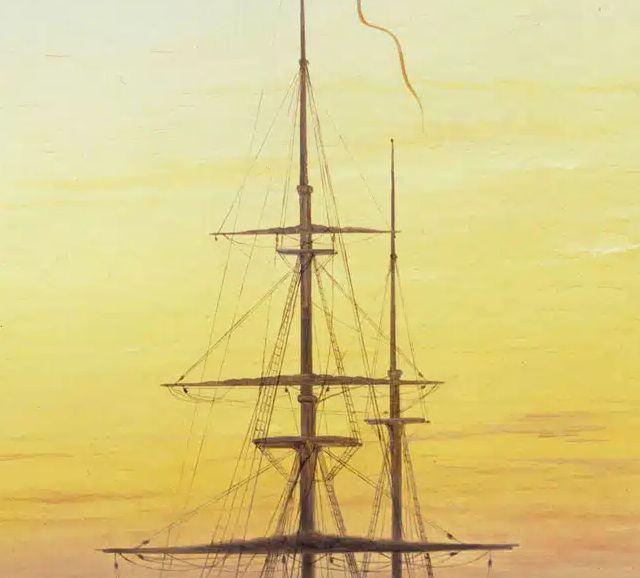
The broad hull in the middle of the painting looks almost stationary. High above it, a long, narrow pennant bends in several places as it trails to the right. Trace the mast down from the pennant and the crosspieces become wider, with slender lines running out to their ends and back down to the deck. Two ladder-like sets of rigging give the tall structure its sense of weight and height. The light makes the ropes legible even where they cross one another. With the sails furled, the shape of the ship depends on lines that would be partly hidden under canvas in a picture of the same vessel at sea. [1]
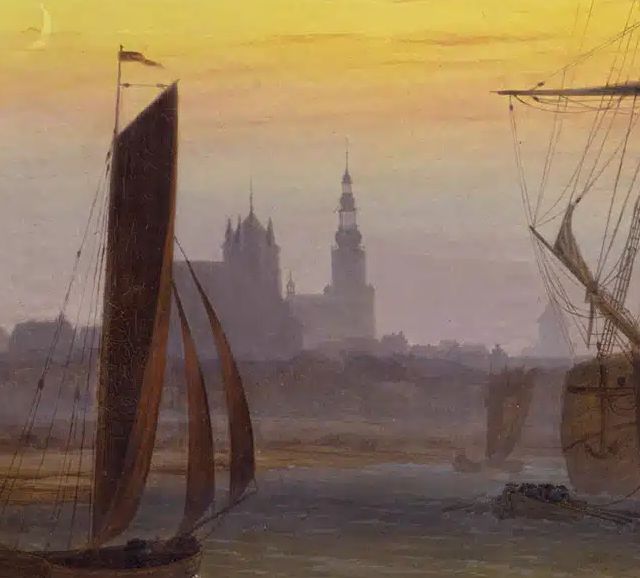
There is canvas aplenty elsewhere. At left a small boat shows one tall, dark sail and two slender curved shapes of cloth, each separated from the next by a sliver of light. It is close enough to pick out a figure at the stern. To the right of the large ship another small craft carries a narrow brown sail, and behind it a taller vessel is softened by haze. Near the far right bank, a patch of light shows beneath the square shape of another sail. The boats occupy distinct layers of water and present different profiles. There is room to see across the harbor between them, even though the cluster of masts makes the farther shore look crowded. [1]
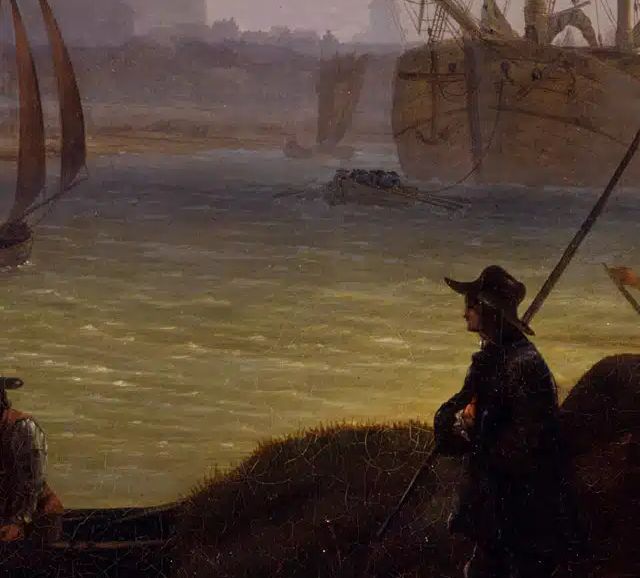
In the Nationalgalerie’s account, the rowing boat beside the big vessel is bringing it to its anchorage. That boat is easy to overlook because it is low in the water and almost disappears against the dark base of the hull. Once seen, it changes the apparent action. The largest vessel is capable of long voyages, but at this point in the picture the small boat is doing the immediate work of moving it into place. The motion implied by the pennant, the boat under oars and the sails farther out can coexist with the almost fixed position of the main ship. The harbor is busy on the scale of a crew’s tasks and slow on the scale of a voyage. [1]
A familiar skyline rebuilt around the ships
Greifswald was Friedrich’s birthplace. He returned to visit family and draw along the Baltic coast, as Birgit Verwiebe describes in the anniversary chronicle. Its account identifies the outlines of St. Mary’s, St. Nicholas’s and St. Jacob’s in the painting. On the left, the wider church profile and the narrow, tiered tower beside it are easy to pick out even through the blue-grey air. The buildings below merge into a band along the low horizon. A viewer who knows the town can identify it by those tall structures, even where the intervening roofs and waterfront recede into indistinct paint. [2]
The city’s maritime history helps explain what Friedrich had to draw on. The old harbor occupies the Ryck, the river that leads out by Wieck into the Greifswalder Bodden. This was a waterway used for shipping as well as fishing, with vessels of different sizes and purposes sharing the approaches to the town. The painting draws on that real setting while arranging the traffic and the townscape to work within the upright canvas. The central mast overtops the church towers by a wide margin. Its crosspieces extend into the pale air above the city, while the diagonals of the rigging return the eye to the hull. From there one can follow the narrow runs of water either side of the vessel into the haze. The churches supply the bearings of a known place. The position and scale of the ship govern the view of it. [1] [3]
One of Friedrich’s drawings offers a way to see how the main ship was made to fit this scene. Werner Sumowski drew attention to a similar two-masted vessel in a drawing now in Berlin’s Kupferstichkabinett. In her study of Friedrich’s ships, Sabine Cibura describes some differences. The drawing shows a slender vessel secured at a quay, its anchors stowed. The painting gives the vessel a heavier hull and an anchor hanging over the side, ready to drop. There are also differences in the spacing of the masts and the angle of the bowsprit. Scholars disagree over whether the drawing served as a model. The comparison helps clarify the choice the painting makes visible. It gives the ship the posture and equipment of a vessel still being brought into position. [4]
The bank and the underdrawing
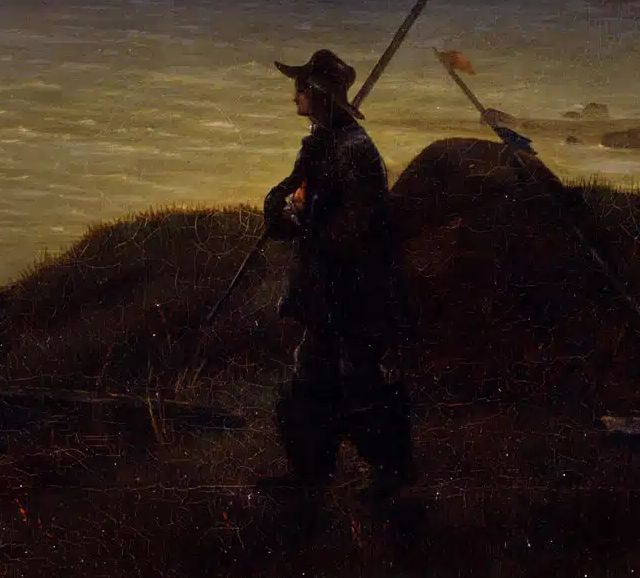
At the lower left, two men lean close to a small boat at the water’s edge. A third stands in profile nearer the middle, a long pole slanting up beside his shoulder. The shore rises in a low mound behind him, and to the right a net hangs from upright branches. These forms are dark enough to be hard to read at first. The brightest strokes of the water come right up to their edges, making the men’s hats and the rim of the boat stand out as silhouettes. The slant of the pole carries the eye from the standing figure toward the large hull. The net’s uprights pick up the much taller lines of the rigging while keeping the viewer’s feet, as it were, on the shore. [1]
Art historians have questioned the attribution of the painting, in part because the figures in the foreground are unusually anecdotal for Friedrich. The Nationalgalerie catalogues the painting under his name and discusses a narrower question about the authorship of the three figures and their nearby boat. [1] [4]
The Alte Nationalgalerie cites Kristina Mösl’s technical study, which used infrared reflectography to reveal Friedrich’s preparatory drawing beneath the painted middle distance and background. The examination detected no underdrawing in the foreground. The museum notes that the difference lends some support to the suggestion that the figures and boat could be by another hand. The finding concerns what the examination was able to detect beneath the paint. It leaves the identity of the painter of those details unresolved. On the surface visible today, the figures still provide the closest measure of how large the ship and how distant the skyline are. [1]
Evening light and the idea of return
A thin crescent low in the yellow light at left is easy to miss. The air changes from blue-grey at the town, through pink and orange above it, into an extended area of pale colour. The vessels farther back seem to be losing their edges, while the mast nearest the middle remains fine and dark well above the horizon. In the Nationalgalerie’s interpretation, the ships entering or lying at anchor evoke a journey through life, with its risks and eventual end. The large ship makes that reading tangible. Its size suggests the distance it could cover, while its gathered sails and the presence of the rowing boat make the present moment one of approach and slowing down. The city is a place to come back to, visibly waiting in the evening light. [1] [2]
Greifswald from land and from a deck
In Meadows near Greifswald, painted in 1821/22 and now in the Hamburger Kunsthalle, Friedrich sets the city beyond low, wet ground. The horizontal canvas makes the eye travel along the horizon. In the harbor the rigs divide that horizon into glimpses, and the tall canvas allows the eye to climb far above it. The Pomeranian State Museum exhibited the two works together in Hometown in 2024, bringing both loans to Greifswald. Seen together, the pictures give very different accounts of how a person might recognise the same place from a distance. [5] [6]
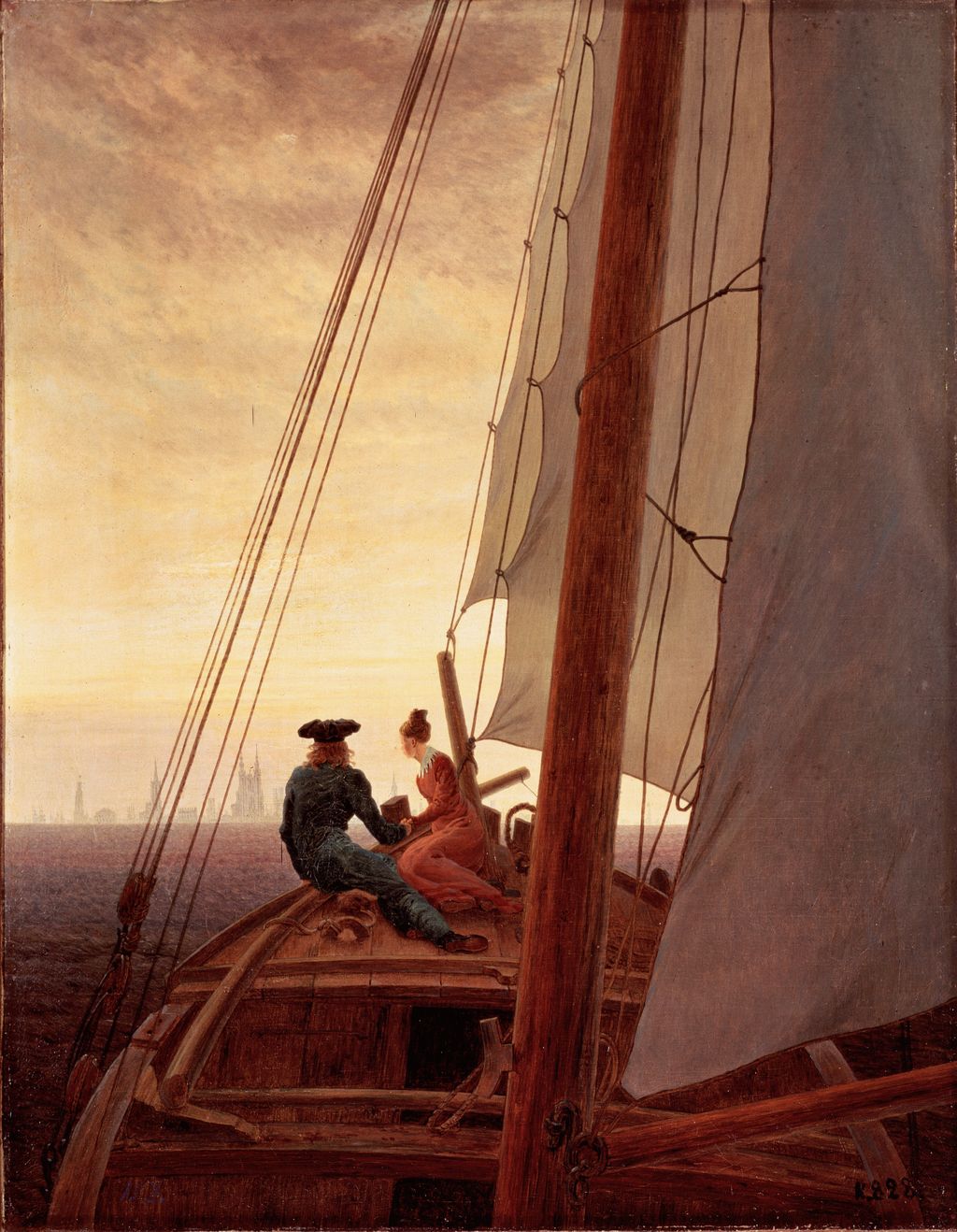
On Board a Sailing Ship, the Hermitage painting, makes the viewer share the deck with a couple sitting hand in hand at the bow. The mast and sail loom close and the skyline lies ahead of them across the water. The Metropolitan Museum of Art’s exhibition catalogue discusses that distant city as a poetic combination of features associated with several places, including Greifswald. In the Berlin painting, the viewer stands back from the vessel and can see it within a working harbor. One picture gives the anticipation of those looking ahead from the bow. The other shows the labor and slowing movement of coming in. [7]
From the river mouth to the town quays
The route from the Bodden to Greifswald helps explain why the small craft in the painting deserve as much attention as the largest ship. The city archive records that shallow water on the Ryck could oblige larger sailing vessels to transfer cargo at Wieck into lighter craft for the trip upriver. Prevailing westerlies could also make the approach to the town difficult. The picture gives no clear account of a particular cargo, but it gives the small boats room to work alongside the big vessel. Oars, sails and a ready anchor belong to different stages of moving through these waters. The scale of the ship makes those small operations easy to miss, even though they help establish where it is and what it is doing.[1][3]
Greifswald's historical interpretation of the waterfront places some of Friedrich's drawing positions on the north bank, near the salt works or farther east along the river. On the opposite side, the city wall stood close to the water, with openings where streets approached the river. The two sides of the Ryck could therefore present very different kinds of activity within one view. Shipbuilding and the salt works occupied parts of the north bank, while the gates, church gables and roofs identified the town across the water. The Berlin oil makes the contrast easier to grasp by letting the waterfront roofs subside into haze and giving the dark near bank and upright rigging much greater definition.[1][8]
Friedrich's drawings also show how freely he could move between these kinds of subject. On a narrow pencil sheet dated 1815, now in Oslo, he recorded fishing boats on the Greifswalder Bodden, a stretch of shore at Wieck and the west front of the Eldena ruins seen from the side. The museum catalogues the sheet as both a landscape and a boat study. It gives an example of the close attention Friedrich paid to the several elements that could enter a harbor composition. In the Berlin canvas the large ship and low foreground craft are much closer to us than the churches. We can read the rigging as a construction in its own right while the distant stone buildings identify the place.[1][9]
A different harbor at evening
The Prussian Palaces and Gardens Foundation owns a separate oil called Hafen, painted in 1815–16 after Friedrich's 1815 trip to Greifswald. Jessica Korschanowski describes two substantial sailing ships on either side of that composition, one seen from the bow and the other from the stern. Their hulls and masts leave a passage in the middle, towards which a rowing boat carries a man and woman into the evening light. Friedrich Wilhelm III acquired the painting in 1816 and gave it to the crown prince for his twenty-first birthday.[10]
The Berlin Greifswald Harbor gives almost exactly that central position to the hull and mast of one large vessel. Its rowing boat keeps close to the ship's side, and we see the open water in strips around it. In the earlier oil, the illuminated passage makes the outward motion of the rowers legible at once. Here, the arrangement lets us discover the movement after taking in the dominant ship. Korschanowski interprets the earlier scene as a possible image of passage from earthly life. The Nationalgalerie's reading of the later work also takes the voyage as a figure for life, but the approach to anchorage and the outlines of a known town give return a more prominent place in the image.[1][2][10]
From Greifswald to the Nationalgalerie
The Berlin museum lists Gustav Ludwig Kirchhoff and Johanna Luise Kirchhoff, both of Greifswald, in the painting’s provenance. It records a purchase in 1919 from retired rear admiral Gustav Kirchhoff of Warnemünde. Writing about the work in 1921, the Nationalgalerie’s director Ludwig Justi found a sense of inward life and longing in the central vessel’s carefully rendered form. His response is particularly apt to the exposed rigging. With the big sails gathered, a viewer can linger over individual lengths of rope and still feel how much space the mast opens above a town Friedrich knew well. [1] [2]
Annotated Details from Greifswald Harbor
Use the numbered details to trace the forms and light in this work.
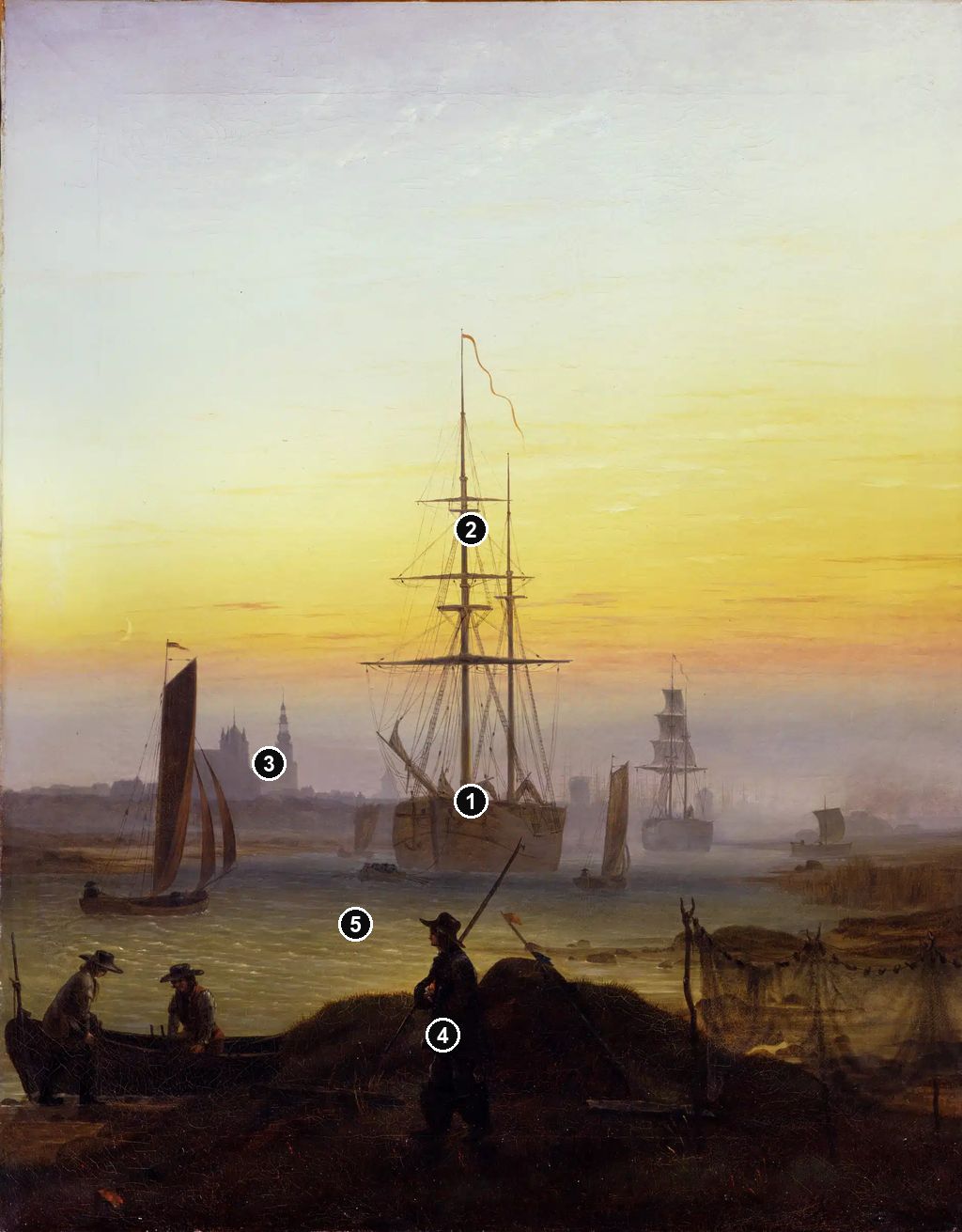
Details from GREIFSWALD HARBOR
The detail crops show parts of the work at a larger scale.
The central sailing ship
The large vessel sits near the middle of the harbor with its sails furled.
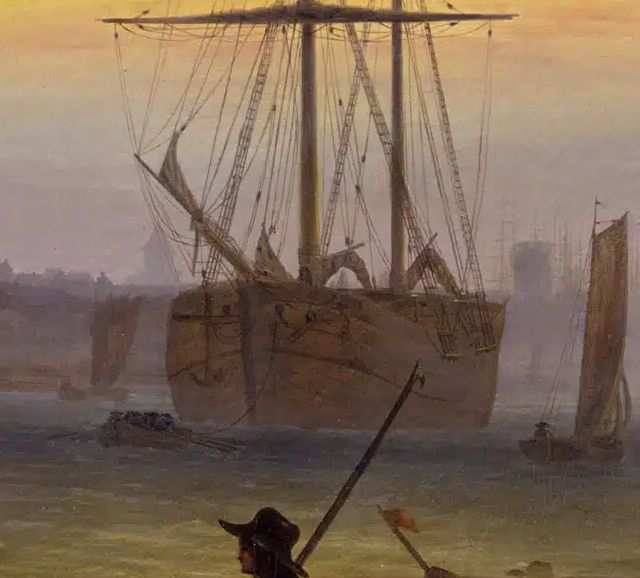
Masts and rigging
The rigging appears as a network of fine lines against the bright sky.
The distant town
The church towers rise above the town behind the nearer boats.
Figures at the water’s edge
Several people appear in silhouette among boats and gear in the dark foreground.
The illuminated water
Light breaks into short marks on the water between the shore and the moored vessels.
Frequently Asked Questions
Discussion
Reader insights are welcome, especially close-looking observations about how the ships, harbor activity, Greifswald skyline and evening sky shape the painting's sense of return.
Reader Insights
How does the large vessel change the scale of the harbor scene?
Where do work, return and departure meet in the lower half of the painting?
How do the Greifswald church towers keep the scene tied to native place?
Does Greifswald Harbor feel most powerful as a hometown image, a maritime scene, or a meditation on life's journey?
Join the Conversation
Share a source-grounded close reading of the harbor, central ship, church skyline, title mapping or relationship to Meadows near Greifswald.
References
- Staatliche Museen zu Berlin, Alte Nationalgalerie, Der Greifswalder Hafen, A II 356, with object essay by Birgit Verwiebe.
- Caspar David Friedrich anniversary chronicle, Der Greifswalder Hafen, essay by Birgit Verwiebe.
- City of Greifswald and Stadtarchiv, Greifswalder Schifffahrts- und Hafengeschichte.
- Sabine Cibura, Die Schiffe und Boote im Werk von Caspar David Friedrich, Bonn, 2019, pp. 303–305.
- Hamburger Kunsthalle via the Caspar David Friedrich anniversary chronicle, Meadows near Greifswald, HK-1047.
- Pomeranian State Museum, Caspar David Friedrich. Hometown.
- The Metropolitan Museum of Art, The Romantic Vision of Caspar David Friedrich, On the Sailboat, pp. 48–49.
- Caspar-David-Friedrich-Gesellschaft, Bürgerschilder, historical interpretation of the harbor and Friedrich's drawing positions.
- Nasjonalmuseet, Fishing boats on the Greifswalder Bodden, the shore at Wieck and the west front of the Eldena ruins, NG.K&H.1962.0045-021.
- Jessica Korschanowski and Stiftung Preußische Schlösser und Gärten Berlin-Brandenburg, Hafen, GK I 6180.