



 by Tom Gurney
Tom Gurney BSc (Hons) is an art history expert with over 20 years experience
Published on June 19, 2020 / Updated on October 30, 2026
Email: tomgurney1@gmail.com / Phone: +44 7429 011000
Argenteuil by Édouard Manet: Introduction
Two people sit close together before a river crowded with boats. The man turns towards his companion; she looks out at us. Their striped clothes fill the foreground, while the Seine flashes an unusually strong blue behind them. Above the water, pale buildings and trees mark the opposite shore beneath a broad summer sky.
Édouard Manet painted Argenteuil in 1874. The canvas now belongs to the Musée des Beaux-Arts de Tournai in Belgium.[1] Its cheerful colours can make the subject seem immediately familiar: a couple taking their ease beside the water. Yet the picture leaves their relationship open, and its most inviting feature, the blue river, became a particular source of dispute when Manet exhibited it the following year.[2][3]
At a Glance
- ArtistÉdouard Manet
- TitleArgenteuil
- Date1874
- MediumOil on canvas
- Dimensions148.5 cm high × 114.5 cm wide
- CollectionMusée des Beaux-Arts de Tournai, Belgium
- Inventory number438
- InscriptionPainted signature “Manet” and date “1874”[4]
- ExhibitionManet’s sole submission to the Salon of 1875[2]
This work across Édouard Manet’s career
Contents
- Manet at Argenteuil in 1874
- The Woman Looking Out and the Man Turning In
- Stripes That Follow Different Bodies
- Masts, Ropes and the Crowded Space
- Why the River’s Blue Matters
- Leisure Beside a Working Shore
- The Blue Water at the Salon of 1875
- Argenteuil and Boating
- A Painting Kept, Then Collected
- Annotated details
Manet at Argenteuil in 1874
The painting belongs to a summer of contact between Manet and the younger painters associated with Impressionism. Claude Monet was working at Argenteuil; Manet stayed at family property across the Seine at Gennevilliers.[5] The river offered them light, boats and the changing appearance of a place shaped by both recreation and industry.[2]
The Tournai museum connects Argenteuil with Monet’s invitation to paint together beside the water.[1] That exchange helps explain the picture’s place in Manet’s career, although its large figures and elaborate arrangement retain a strong character of their own. The scene gives as much importance to people and their clothes as to the weather around them.
Its upright format makes that balance possible. The seated pair occupy much of the lower part; above their heads, the river and the farther shore extend across the canvas. A narrow portrait shape accommodates an extensive setting without reducing the people to small incidents within a landscape.
Summer light also has a social setting here. The figures have dressed for an outing. Boats are gathered closely around them, and the visible bank carries buildings as well as vegetation. Manet gives the river a place within contemporary life, where leisure takes place among the structures and activities of a growing suburb.
The Woman Looking Out and the Man Turning In
The woman’s outward gaze forms a point of contact with the viewer. Her head is almost frontal, and the dark band of her hat sets off the pale fabric piled above it. Beneath the brim, small changes of light and shadow establish the eyes, nose and mouth without a strongly outlined face.
Her companion turns towards her. The brim of his straw hat projects over his forehead, while a moustache gives weight to the profile. His head directs attention across the small interval between them. Her face carries it out of the picture again.
The museum identifies the man as Rudolf Leenhoff, Suzanne Manet’s brother and the painter’s brother-in-law. The woman remains unidentified.[1] The painting supplies more definite information about their poses than about their relationship. His attention appears directed towards her, but her outward look offers no clear response.
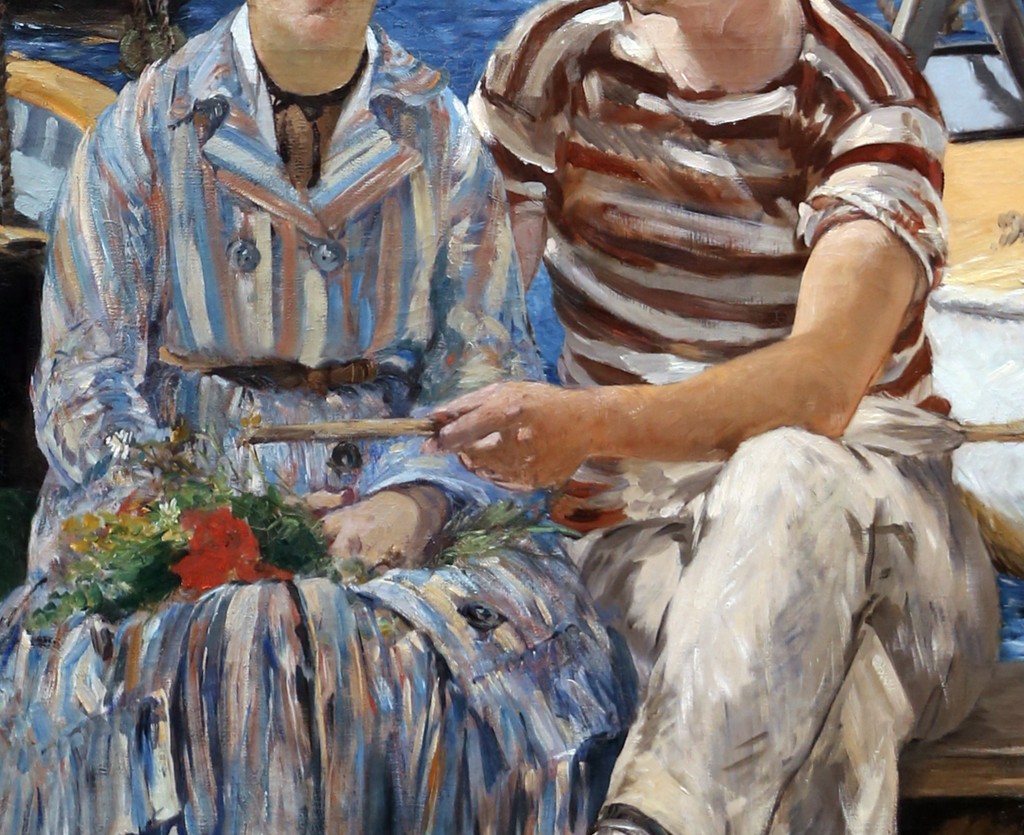
One of his forearms reaches across the foreground; his other arm is partly concealed. She holds flowers in her lap, including a strong red bloom amid green leaves and stems. These details invite a story, but the picture gives no secure answer to who brought the bouquet or what passed between the two people.
Their closeness is nevertheless a matter of visible arrangement. Shoulders almost meet, fabrics overlap, and the man’s extended arm connects their separate areas of the canvas. He sits with one leg crossed, bringing a pale shoe with red lacing close to the lower edge. The pose expands sideways as well as towards us, occupying the space beside the woman’s broad skirt.
Stripes That Follow Different Bodies
The two outfits create one of the painting’s strongest connections. The man wears broad cream and reddish-brown bands; the woman’s dress gathers finer blue, pale and warm-coloured lines. Each figure becomes conspicuous through a pattern that changes as it follows the body.
Across the man’s chest, the stripes provide a strong horizontal movement. They curve around his torso and break at the rolled sleeves, where exposed skin interrupts the repeated bands. The pattern makes the turn of the upper body easy to follow. A dark stripe can describe both a piece of cloth and the change of angle beneath it.
The woman’s dress offers a more intricate passage. Lines descend through the bodice, bend around the waist and spread through the gathered skirt. Near the neckline, pale and blue strokes meet at sharp angles. Lower down, the folds divide the fabric into irregular strips of light and shade.
The paint changes character within these patterns. Some marks remain separate enough to read as stripes; others join into broader patches. At the bottom of the dress, the eye moves between an impression of cloth and a succession of coloured strokes. Manet allows that movement to remain active without making every seam or fold equally explicit.
A narrow dark belt gives the dress a firm division at the waist. Above it, the dark ribbon at the neck provides another small point of concentration. These accents help organise a figure whose surface is otherwise full of competing lines.
The hats introduce a different kind of resemblance. Both rise prominently against the blue, but the woman’s contrasts a dark rim with pale folds, while the man’s straw carries a red band. That red connects loosely with the flowers and the lacing of his shoe. Small warm accents travel through the foreground, keeping its many pale and blue passages from becoming uniform.
Masts, Ropes and the Crowded Space
A thick mast rises near the left edge and continues beyond the top of the canvas. Thin ropes hang beside it, dividing the river and sky into narrow intervals. At the other side, an oblique rope descends towards the boats behind the man. The scene is full of lines that seem to belong to quite different distances.
The mast is especially forceful because it stands so close to the border. Its brown surface interrupts the lighter setting almost from top to bottom. The woman sits beside this strong upright, while the descending rope at the right gives her companion a more sloping surrounding shape.
Behind the pair, pale sailcloth and dark hulls overlap. A cream-coloured sail stretches across the blue near the man’s hat; farther down, the side of a boat presents light paint, warm wood and dark edging. Such shapes establish a boat basin, yet their proximity to the heads and shoulders also brings them into the foreground design.
The slim object extending across the figures’ laps is a closed parasol, identified in Paul Hayes Tucker’s discussion of the picture.[2] Its near-horizontal direction cuts across the woman’s descending stripes and the man’s reaching arm. Even an accessory that might pass unnoticed in an account of the outing becomes significant in the arrangement of lines.
The precise seating arrangement has also been described differently. Tucker places the pair on a dock, while Théodore Duret’s later account describes a bench in a boat.[2][6] In the painting, the lower wooden support and the overlapping craft do little to separate the figures clearly from their surroundings. That compressed space contributes to the closeness of the scene.
Why the River’s Blue Matters
The water supplies the most emphatic colour behind the figures. A large strip of blue runs across the painting at head level, interrupted by boats, rigging and the pale sail. Smaller dark and light touches disturb its surface. Some cluster into short horizontal movements; others break against the edges of objects.
The colour has different effects beside the two figures. It stands apart from the man’s warmer stripes and bare arm. The woman’s dress shares more of its blue, although her many pale strokes keep the fabric distinct. The same river can therefore separate one figure sharply from the setting while drawing the other into a closer colour relationship.
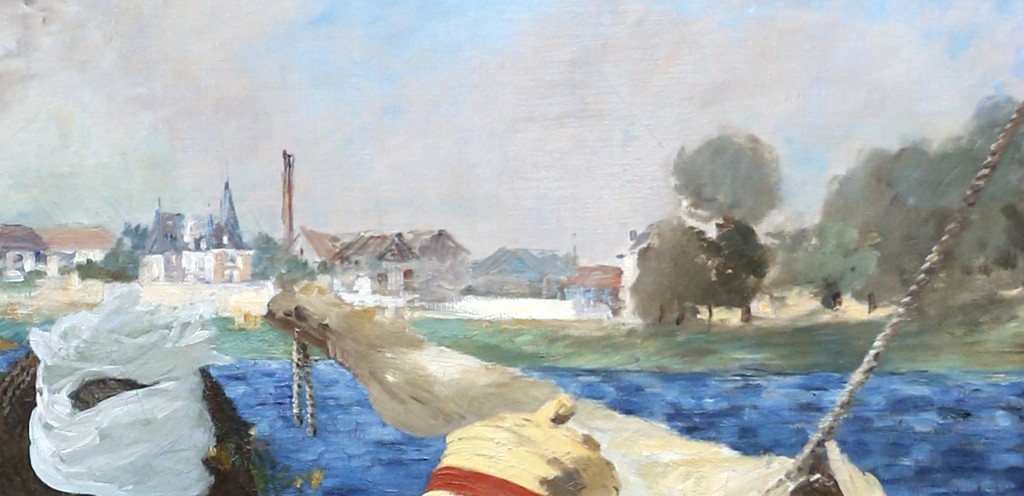
The water also lies between two different scales of description. In front, faces, flowers and striped clothes take up substantial areas of the canvas. Beyond it, buildings and trees become small patches along the bank. The blue provides an interval across which the eye moves from the near pair to that distant world.
Manet does not continue its intensity evenly through the sky. Above the bank, pale blue mingles with grey and warmer cloud-like passages. The lighter air gives the upper part of the picture room to expand, while the deeper water holds attention close to the people and boats.
This distribution helps explain why the river can seem so assertive. Its colour occupies a relatively narrow stretch of the view, but its saturation gives it a force comparable to the much larger figures. It is both a represented surface and a conspicuous band within the painting.
Leisure Beside a Working Shore
The farther bank complicates any idea of an untouched rural escape. Small roofs, buildings and thin industrial stacks appear among the trees. Their presence places the outing within a landscape used for several purposes at once.
Manet gives these distant elements much less definition than the people. A light building may be little more than a compact pale shape; a roof changes the colour immediately above it. Trees gather into larger, softer masses. The difference in handling allows the bank to remain legible without competing with the detailed patterns below.
The sky, shore and water also divide the setting into broad horizontal zones. These run behind the foreground’s mast, rigging and striped clothes, whose lines turn in several directions. The apparent ease of the outing rests within a composition that is continually crossing one system of marks with another.
The result includes both the attractions of a summer resort and evidence of the place’s everyday use. Pleasure boats and industrial structures can occupy the same view. The two people remain its largest forms, but the world behind them helps give their leisure a particular location.
The Blue Water at the Salon of 1875
Manet selected Argenteuil as his only submission to the Salon of 1875.[2] The large, brightly coloured river scene entered the official exhibition a year after it was painted.
Émile Zola’s June 1875 account records how strongly attention settled on its colour. He reports that the water was considered excessively blue and became the subject of repeated jokes. In his view, a more subdued version would have pleased the public, but Manet had painted a colour he had actually seen.[3]
Zola’s defence was also an argument about the figures. He admired their convincing presence and singled out the striped dress, the man’s shirt and the straw hat. He believed the dispute over the water distracted people from the force with which the pair had been painted.[3]
That response draws together two things which can become separated in an account of Impressionism: the observation of outdoor colour and the importance of the human figure. In Argenteuil, the river’s blue matters partly because it surrounds large, conspicuously dressed people. The question of how to paint light is inseparable from how to make those people occupy the scene.
Writing in 1906, Duret recalled hostility towards both the colour and the sitters. He described viewers objecting to their ordinary appearance and to the lack of a clearly stated action. They seemed simply to be sitting there, without the explanatory gestures that could make a scene easy to summarise.[6]
Duret wrote as an advocate looking back over Manet’s career. His account stresses rejection with a sweep that Zola’s contemporary support helps qualify. Together, the two writers reveal a disagreement about what deserved attention: conventional expectations about colour and subject, or the particular appearance of these people in this setting.
Argenteuil and Boating
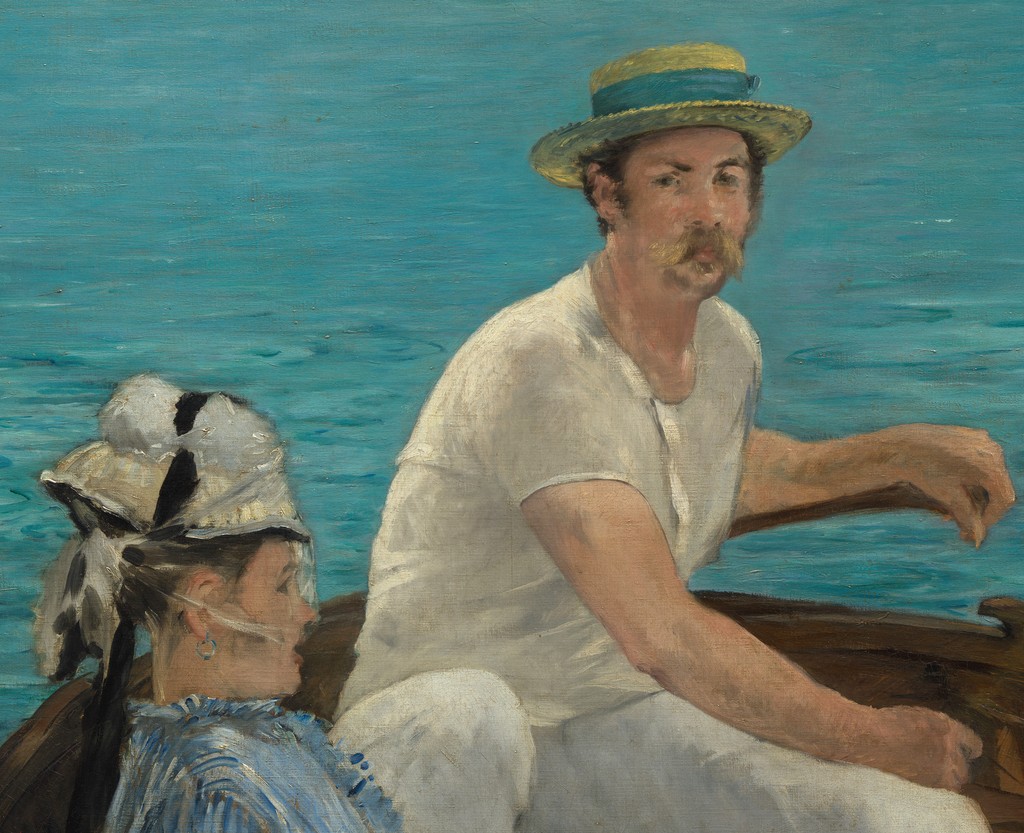
Manet’s Boating, also dated 1874 and now at the Metropolitan Museum of Art, offers a useful comparison.[7] It brings a man and woman close to the viewer in a horizontal canvas, with water filling the background and no visible distant shore.
The contrast begins with their clothes. A large white outfit sets off the blue striped dress in Boating. Here, both figures wear stripes, and their patterns meet across the lower part of the composition. In the Met painting the man looks out while the woman turns into profile; in Argenteuil, their directions are reversed.
The surrounding space changes just as markedly. Boating gives us a cropped craft, a fragment of sail and an extensive field of water. Argenteuil makes room for rigging, neighbouring vessels, the bank and the sky. Its tall format lets the setting rise behind the people in several stages.
The titles can also conceal differences between other works from the same summer. Museum Wales holds Argenteuil, Boat (study), a smaller landscape of moored craft under overcast skies. Its museum describes it as preparation for a wider sunny composition including a woman and child. It should therefore be distinguished from the seated pair in the Tournai painting.[8] The several pictures show how much could change within a shared river setting.
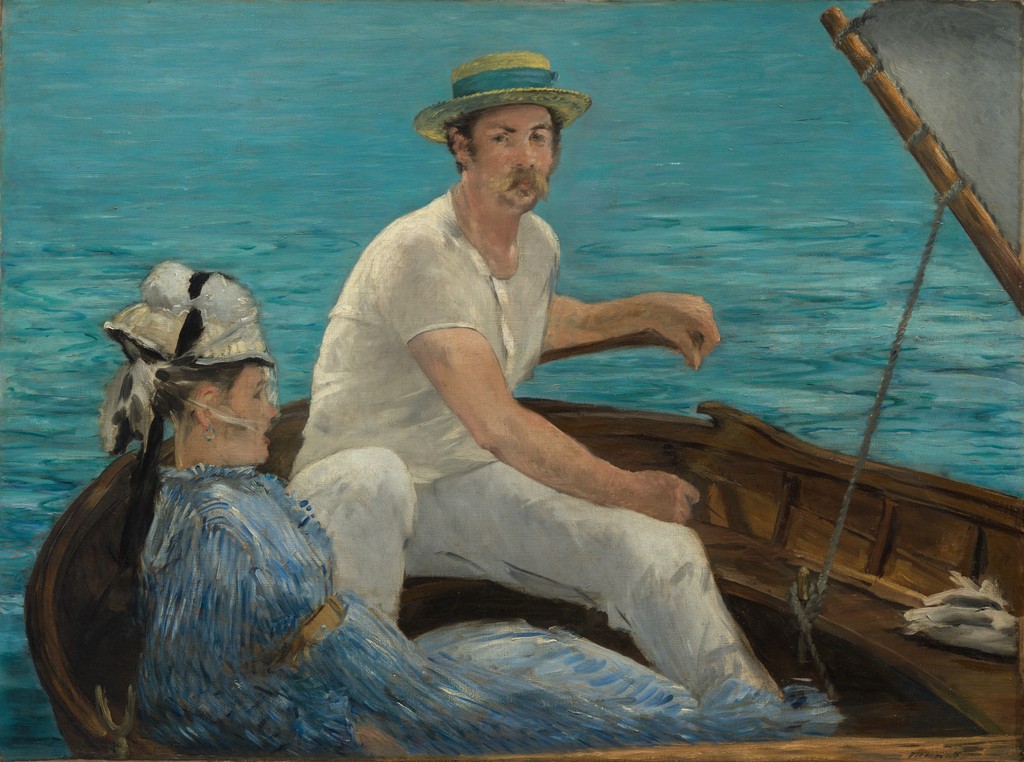
Édouard Manet, Boating, 1874. The Metropolitan Museum of Art, New York, 29.100.115. The Metropolitan Museum of Art, H. O. Havemeyer Collection, Bequest of Mrs. H. O. Havemeyer, 1929. Image source. CC0 / Public domain. Rectangular crop within the supplied painting edges removes the surrounding black field and narrow frame/edge bands; no rotation, warping or enlargement.
Annotated Details from Argenteuil and Boating: Figures beside the Water
The numbered points identify visible features discussed in this article. Return from each detail to the whole composition. Each caption identifies the work shown.
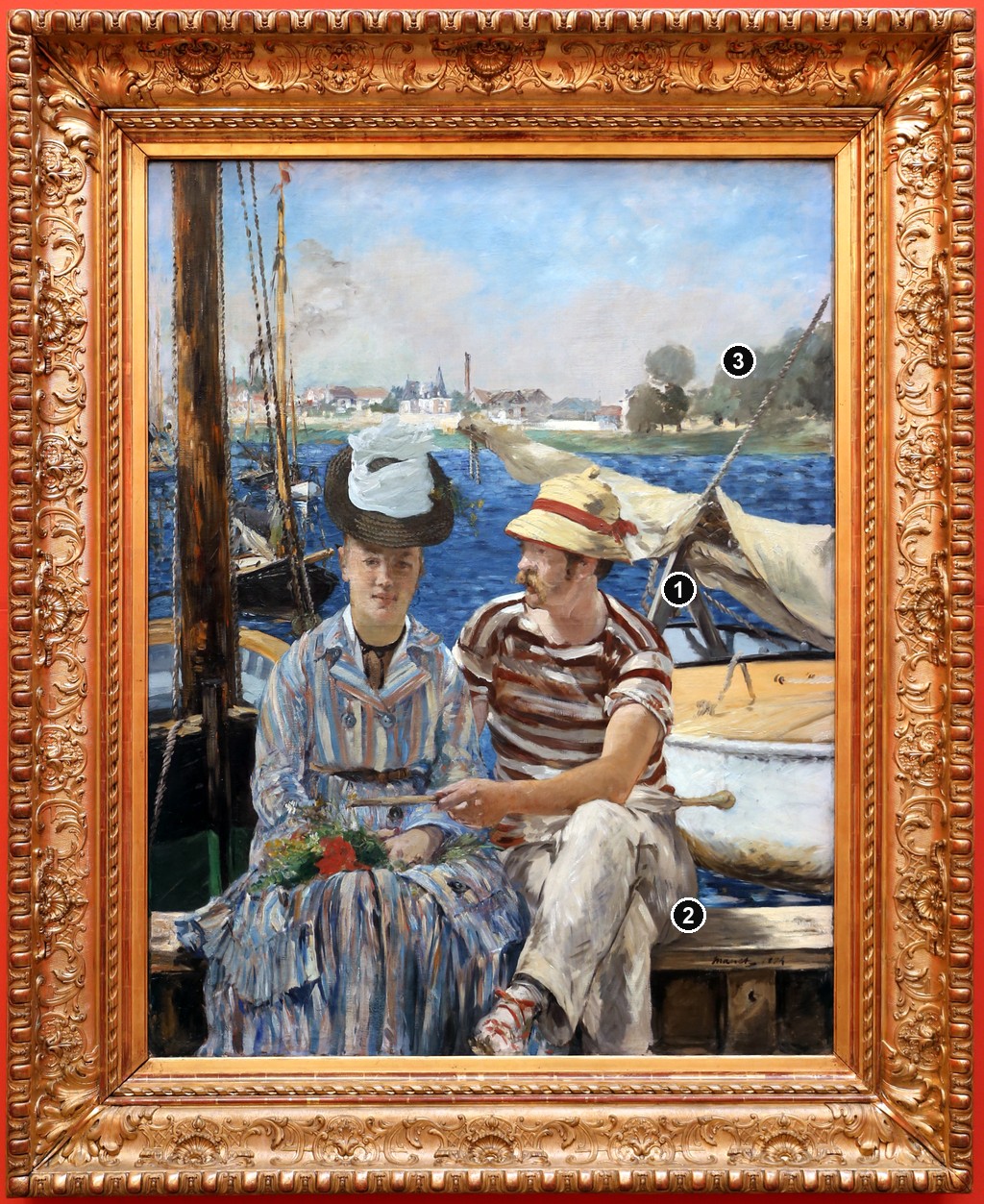
Argenteuil — Framed Photograph
Édouard Manet, Argenteuil, 1874. Musée des Beaux-Arts, Tournai, inventory 438. Photograph: Sailko / Wikimedia Commons. Image source. CC BY 3.0. Photograph by Sailko, CC BY 3.0. Numbers added to a separate resized overview retaining the supplied decorative frame. Detail crops from the original photograph; no enlargement, retouching or perspective alteration.
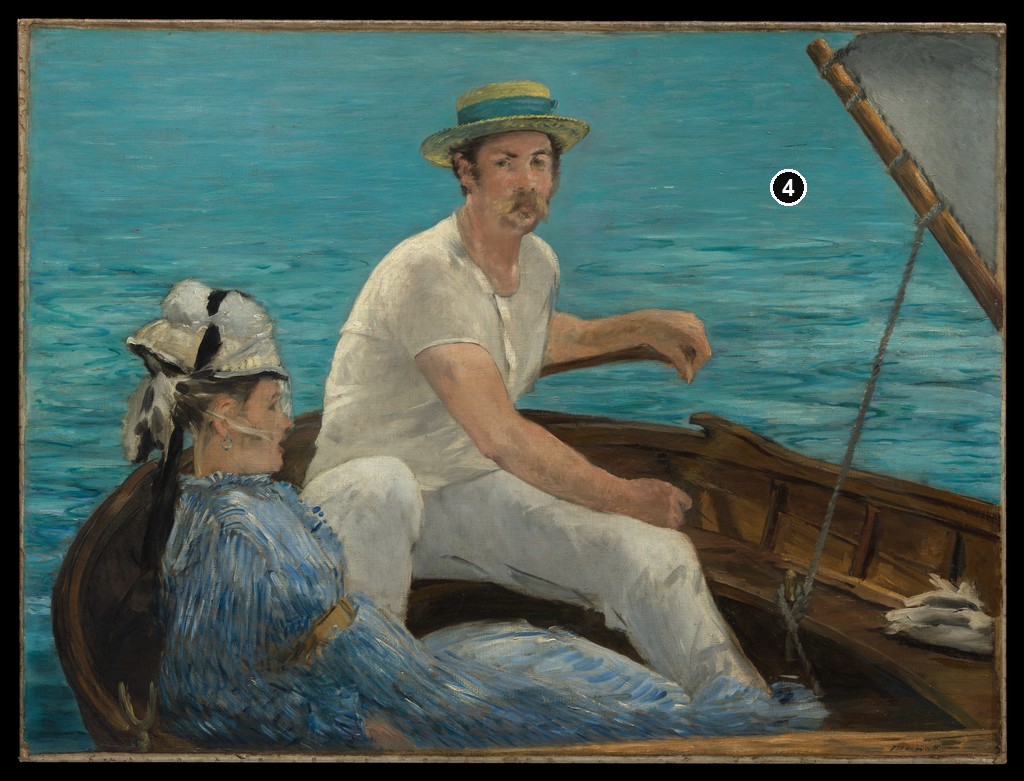
Boating — New York
Édouard Manet, Boating, 1874. The Metropolitan Museum of Art, New York, 29.100.115. The Metropolitan Museum of Art, H. O. Havemeyer Collection, Bequest of Mrs. H. O. Havemeyer, 1929. Image source. CC0 / Public domain. Numbers added to a separate resized overview retaining the complete supplied view and existing margins. Detail crops from the immutable original; no enlargement or retouching.
Details from ARGENTEUIL AND BOATING: FIGURES BESIDE THE WATER
Compare the faces, patterned clothes and crossing hand in Argenteuil, then follow the river to the distant bank. Boating gives the two faces a different set of directions.
Argenteuil — Framed Photograph
Two Faces beneath Different Hats
The woman faces out beneath her dark brim and pale hat. The man turns towards her under a straw hat with a red band.
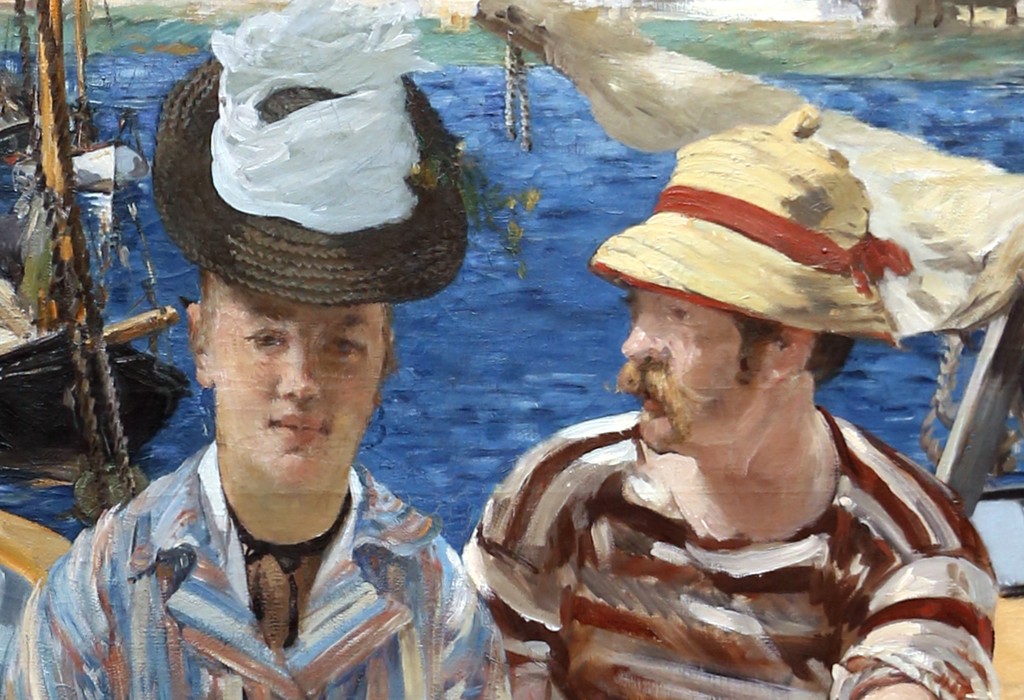
Stripes, Flowers and the Extended Hand
Fine lines spread through the woman’s dress beside the man’s broader stripes. His hand crosses above the flowers and the closed parasol.
Blue Water and the Distant Bank
A strong blue band of water separates the nearby boats from the small pale buildings and trees across the river.
Boating — New York
The Reversed Directions of the Faces
In Boating, the man turns out towards us while the woman appears in profile. Their directions differ from those of the Argenteuil pair.
A Painting Kept, Then Collected
According to the Tournai museum, Manet retained Argenteuil during his lifetime. In 1889 Henri Van Cutsem bought it from Suzanne Manet, the artist’s widow. It subsequently became part of the collection bequeathed to Tournai.[1]
That history gives the picture a different course from the sale of Boating at the 1879 Salon.[7] The two river scenes could share a date and related subjects while moving through different exhibitions and collections.
The 1875 dispute also gives Argenteuil a particular place among Manet’s public appearances. A modern outing, familiar clothes and a recognisable river setting could still disturb expectations about painting. Zola’s response shows how a critic could treat the same features as grounds for confidence in the artist’s future. The work now preserved in Tournai carries both the summer subject and the history of that disagreement.
Artworks directory
Explore selected paintings, drawings and prints by Édouard Manet. Search by title or another recorded name.
Frequently Asked Questions
It belongs to the Musée des Beaux-Arts de Tournai in Belgium.[1]
The museum identifies the man as Rudolf Leenhoff, Manet’s brother-in-law. The woman’s identity is unknown.[1]
Zola’s 1875 account reports that viewers considered the colour excessive. He defended it as a colour Manet had observed.[3]
Discussion
Look again at the images and ideas explored in Argenteuil by Édouard Manet. These editorial prompts invite your observations.
Reader Insights
Compare the broad stripes crossing the man’s chest with the fine lines spreading through the woman’s skirt.
Trace the mast and ropes upwards, then look across the river to the smaller buildings.
Which of these changes your sense of distance most strongly: the overlapping boats, the colour, or the difference in scale?
Join the Conversation
Share a detail, comparison or question about Argenteuil by Édouard Manet below.
References
- Musée des Beaux-Arts de Tournai. “Édouard Manet — Argenteuil,” 1874. Object record, sitter identification and collection history. View source. (in French).
- Paul Hayes Tucker. The Impressionists at Argenteuil. National Gallery of Art, Washington, 2000, pp.25–28, especially p.27, fig.19. Summer 1874 context, the Salon submission and interpretation of the composition. View source.
- Émile Zola. “Lettres de Paris, juin 1875,” published in Le Messager de l’Europe. The Argenteuil passage; French text presented by Les Cahiers naturalistes. View source. (in French).
- KIK-IRPA, BALaT. “Argenteuil,” object 10137026, Musée des Beaux-Arts de Tournai, inventory 438. Dimensions, medium, date and inscriptions. View source.
- The Metropolitan Museum of Art. “The Monet Family in Their Garden at Argenteuil,” 1874, 1976.201.14. Manet’s summer stay at his family’s house in Gennevilliers. View source.
- Théodore Duret. Histoire d’Édouard Manet et de son œuvre, 1906, pp.165–170. Retrospective account of Argenteuil, its sitters and its reception. View source. (in French).
- The Metropolitan Museum of Art; Jane R. Becker. “Boating,” 1874, 29.100.115. Object record and 2017 catalogue entry; exhibition and provenance history. View source.
- Amgueddfa Cymru — Museum Wales. “Argenteuil, Boat (study),” 1874, NMW A 2467. Description of the separate boat study and its relation to a wider composition. View source.
- Splash image, Édouard Manet, Argenteuil, 1874. Musée des Beaux-Arts, Tournai, inventory 438. Photograph: Sailko / Wikimedia Commons. Image source. CC BY 3.0. Photograph by Sailko, CC BY 3.0. Cropped to the inner painting and resized.


