



 by Tom Gurney
Tom Gurney BSc (Hons) is an art history expert with over 20 years experience
Published on June 19, 2020 / Updated on October 30, 2026
Email: tomgurney1@gmail.com / Phone: +44 7429 011000
At the Café by Édouard Manet: Introduction
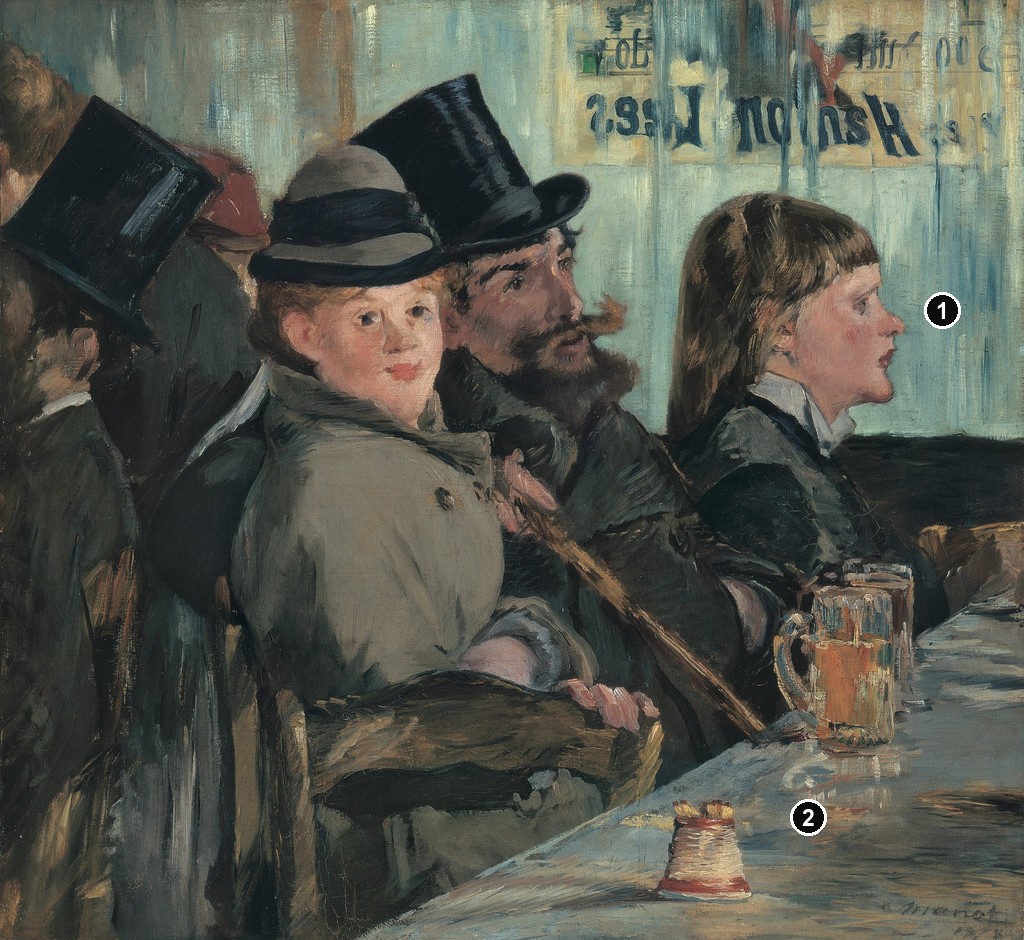
Black hats overlap, a pale face turns towards us and a mug of amber beer catches the light. The customers in Édouard Manet's At the Café sit so close that their shoulders and clothing seem to merge. Their attention moves in different directions. We have a good view of their faces, but little sense of what passes between them.
Signed and dated 1878, the painting belongs to the Oskar Reinhart Collection «Am Römerholz» in Winterthur, Switzerland. It is also known by its French title, Au café, and the German Im Café.[1] Its crowded arrangement has an unusual history: these customers once occupied the left side of a larger café interior. Manet divided that canvas, then developed the surviving sections into separate paintings.
At a Glance
- ArtistÉdouard Manet
- TitleAu café, also known as At the Café and Im Café
- Date1878, signed and dated
- MediumOil on canvas
- Dimensions78 × 84 cm, height × width
- CollectionSammlung Oskar Reinhart «Am Römerholz», Winterthur
- Inventory numberSOR1953.3.[1]
This work across Édouard Manet’s career
Olympia
1863The Fifer
1866The Balcony
1868–69The Railway
1873At the Café by Édouard Manet (current article)
1878, signed and datedAsparagus
1880Contents
- Close Together, Looking Apart
- Hats, Beer and a Pot of Matches
- A Window onto the Entertainment
- The Fingertips in the Other Painting
- A Cut That Was Made Twice
- Repainting the Two Interiors
- An Independent Life in Winterthur
- Annotated details
Close Together, Looking Apart
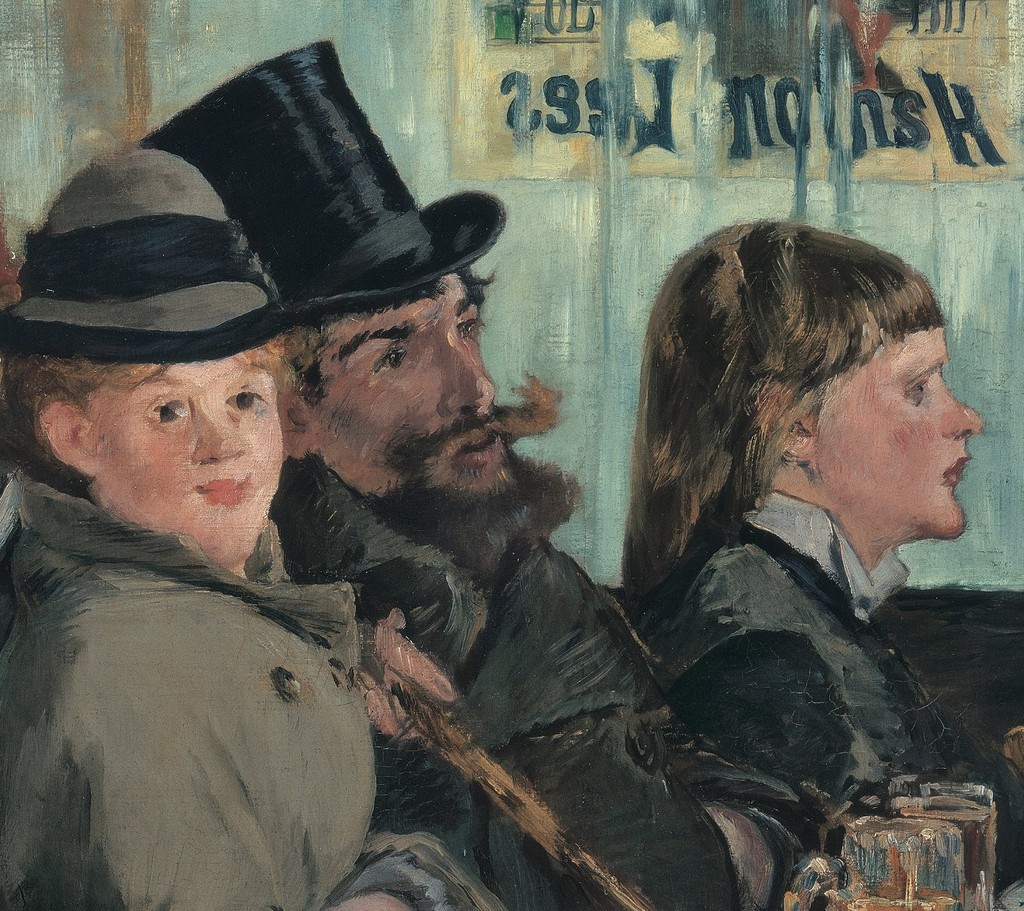
Three figures dominate the group. At the front, a woman wears a grey-brown coat and a rounded hat encircled by a dark band. Her face turns out towards the viewer, giving her a directness that the other principal customers lack. The coat spreads into a broad, relatively quiet area beneath the small, brightly painted face.
Behind her, a bearded man wears a much taller black top hat. His head turns towards the right, and the curling outline of his moustache carries that movement beyond his face. Farther right, a younger woman appears in profile, her brown hair falling behind a pale collar. Her face points out towards something beyond the picture's edge.
Their positions suggest proximity without explaining a relationship. The man and the woman at the front overlap closely, yet their eyes do not meet. The younger woman's profile continues the movement towards the right, while the front woman's gaze brings us back out of the group. Looking from one face to another sets up a circuit that never becomes a conversation we can follow.
The owning collection describes this as a staging of the anonymity of metropolitan life: people share a public space while remaining strangely distant.[1] The painting makes that reading possible through very concrete choices. Manet brings the heads together, turns them at different angles and gives us no shared gesture that would explain the gathering.
Other customers are caught at the left edge. A black hat tilts into the foreground; behind it, part of another head and a warmer patch of clothing remain visible. These cut-off figures make the room seem to continue beyond the rectangle. We are close enough to notice individual faces, yet our view includes only a small portion of the company.
Hats, Beer and a Pot of Matches
The dark clothes occupy much of the lower and middle picture. Within them, black shifts towards green, grey and brown. Long marks run down the coat at the left; shorter strokes break across the bearded man's clothing. The hats have firmer outlines and sharper flashes of light, giving the clustered heads a rhythm of curves, brims and rising cylinders.
Against this group, the pale tabletop cuts diagonally through the foreground. It widens towards us and leads the eye back to the glasses at the right. Its blue-grey surface contains scattered warmer reflections and streaks of light. The broad strokes keep it connected to the loose handling of the clothes, even as its colour separates it from them.
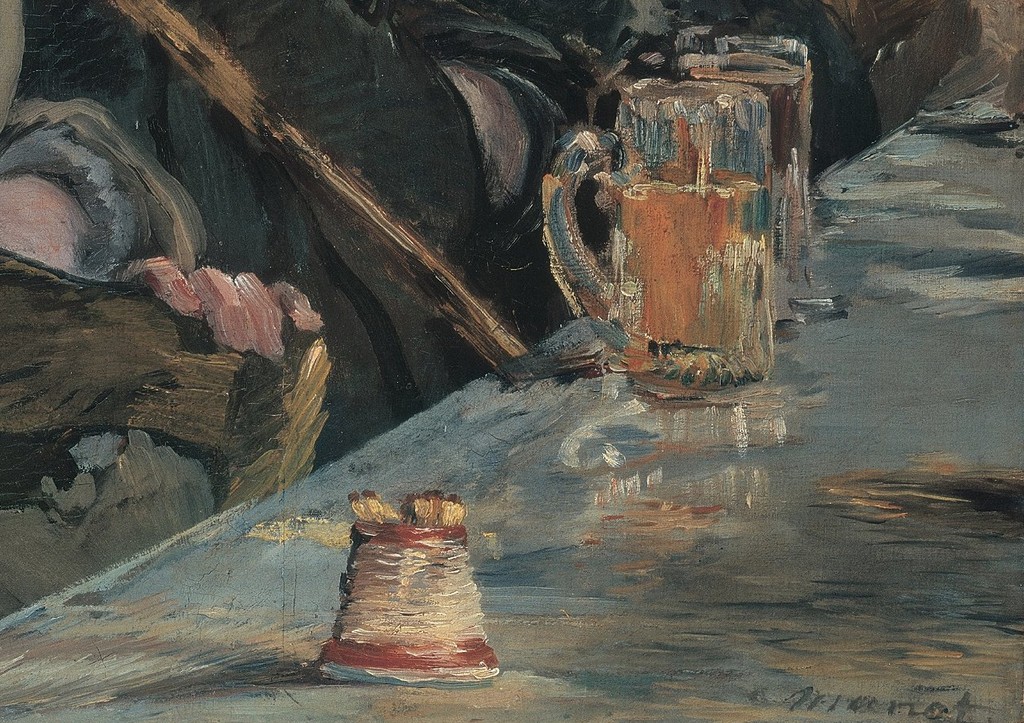
The nearer beer mug is a small concentration of warmth. Amber and brown fill its body, while pale marks catch the rim, base and handle. The glass behind it adds another set of bright verticals. Seen against the nearly black clothing, these touches are enough to suggest transparent vessels with liquid inside.
Near the bottom stands a small cylindrical match container, striped in cream and reddish brown. It is set apart from the people and glasses, with a little open table around it. This modest object helps us judge the depth of the foreground: the table reaches towards us before the seated group begins.
A Window onto the Entertainment
Behind the customers, a pale blue-green window and curtain make the darker silhouettes stand out. Vertical folds pass between the heads. Around the hats, the light background makes even a small turn of a brim conspicuous; elsewhere, the curtains and clothes meet in less sharply defined passages.
Fragments of a poster appear high on the window. The Courtauld's account identifies the advertisement as one for a troupe of trapeze artists performing at the Folies-Bergère.[2] It places another kind of spectacle within this view of seated customers. The performers themselves are absent; lettering and patches of colour announce their activity above the stillness of the group.
The setting was the Café-concert de Reichshoffen in Paris. A café-concert combined the company and drinking of a café with live entertainment. Such establishments became popular subjects for Manet, who painted the customers and workers of Parisian cafés as well as the performances they attended.[3]
In this picture, the attraction lies outside our immediate view. The rightward faces may encourage us to imagine something happening beyond the frame, but Manet leaves the object of their attention open. The poster and the café setting give us a social world; the faces retain their individual uncertainty.
The Fingertips in the Other Painting
The original larger canvas also included the figures now seen in Corner of a Café-Concert at the National Gallery in London. That painting, dated probably 1878–80 by its owner, shows a waitress carrying beer beside customers at a table. A man in a blue blouse fills much of its foreground.[3]
At first, the two works look awkward companions. Winterthur's picture is a little wider than it is high; London's is distinctly upright. One has a pale window behind the customers, while the other contains a stage, a performer and musicians. Their present shapes and backgrounds record changes made as Manet worked towards two independent compositions.
The connection becomes easier to follow at table level. The table and shadows at the right of the Winterthur painting continue into the left side of the London one. Most strikingly, the fingertips of the young woman in Winterthur remain visible at London's left edge.[3] Part of a single person's gesture is distributed between two pictures in different collections.
David Bomford's technical examination, published in 1983, brought several kinds of evidence together. An earlier painted edge of the table could be traced in both pictures. A glass shadow and the space between the tables matched. In the London painting's X-radiograph, a painted-out window also corresponded with the window that remains visible at Winterthur.[4]
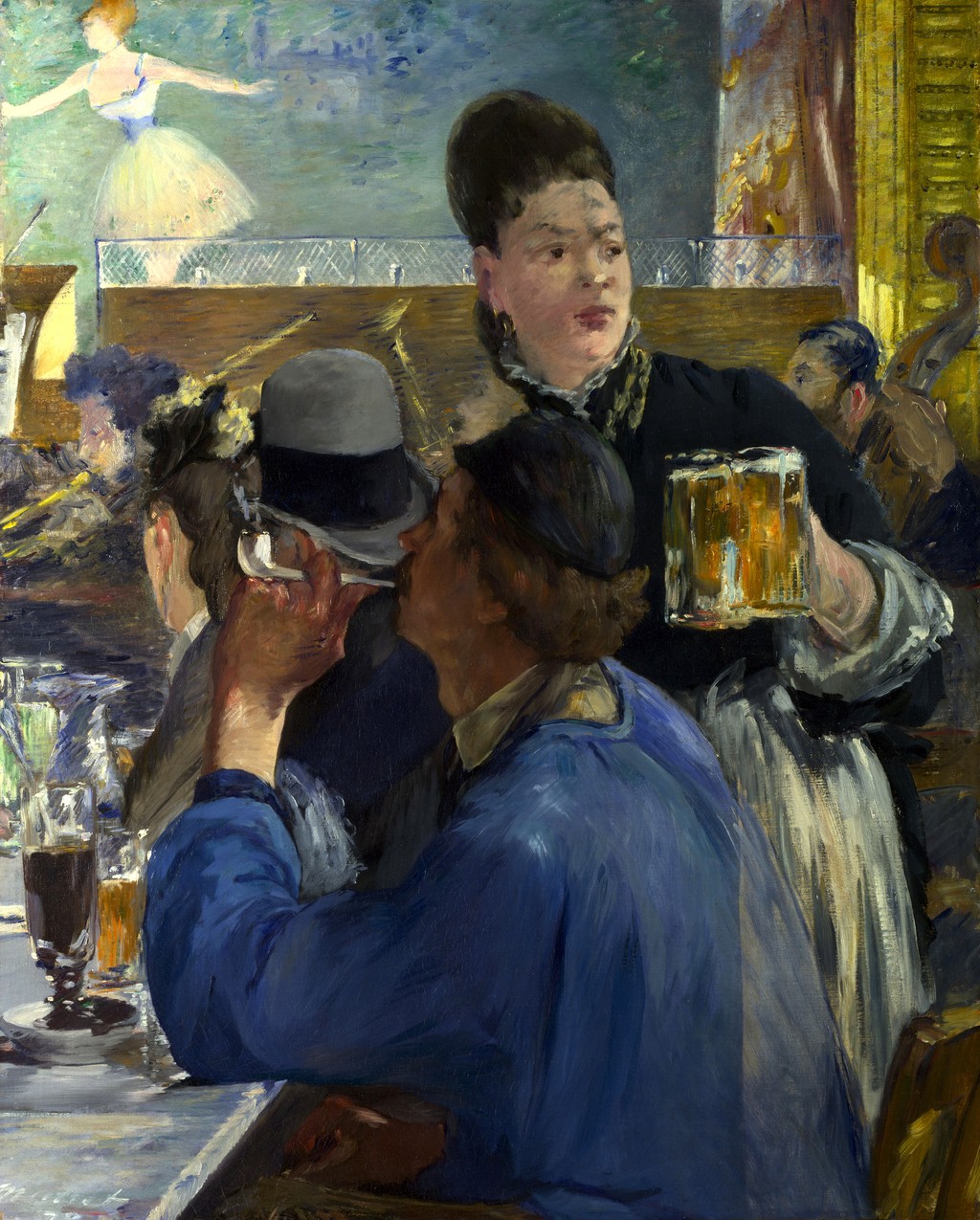
Édouard Manet, Corner of a Café-Concert, probably 1878–80. The National Gallery, London, NG3858. The National Gallery, London; reproduction via Wikimedia Commons. Image source. Public domain. Whole supplied reproduction resized within native dimensions; no enlargement or retouching.
Annotated Details from At the Café and Its London Companion
The numbered points identify visible features discussed in this article. Return from each detail to the whole composition. Each caption identifies the work shown.
At the Café — Winterthur
Édouard Manet, At the Café (Au café / Im Café), 1878. Sammlung Oskar Reinhart «Am Römerholz», Winterthur, SOR1953.3. Sammlung Oskar Reinhart «Am Römerholz»; reproduction via Wikimedia Commons. Image source. Public domain. Numbers added to a separate resized overview of the complete supplied reproduction, retaining its existing edges. Detail crops from the immutable original; no enlargement or retouching.
Corner of a Café-Concert — London
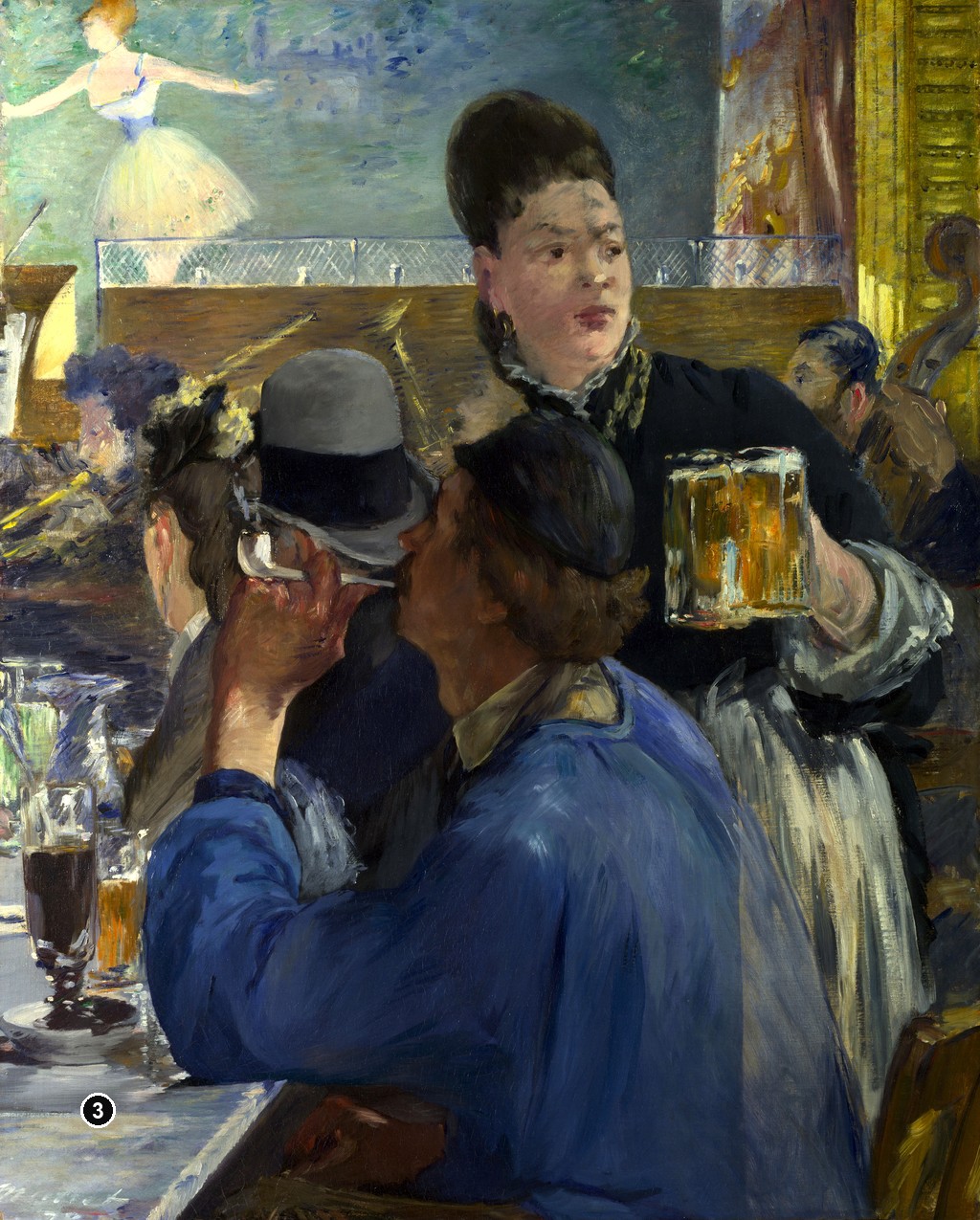
Édouard Manet, Corner of a Café-Concert, probably 1878–80. The National Gallery, London, NG3858. The National Gallery, London; reproduction via Wikimedia Commons. Image source. Public domain. Numbers added to a separate resized overview of the complete supplied reproduction, retaining its existing edges. Detail crops from the immutable original; no enlargement or retouching.
Details from AT THE CAFÉ AND ITS LONDON COMPANION
Compare the three faces beneath the hats with the bright beer glasses on the diagonal table. Then look at the glass vessels along the left edge of the related London painting.
At the Café — Winterthur
Three Faces below the Hats
The three principal faces turn in different directions beneath the dark hats and the pale window.
Beer Glasses and the Diagonal Table
Bright rims and amber beer stand near the diagonal tabletop, beside the man’s resting hand and the long pipe.
Corner of a Café-Concert — London
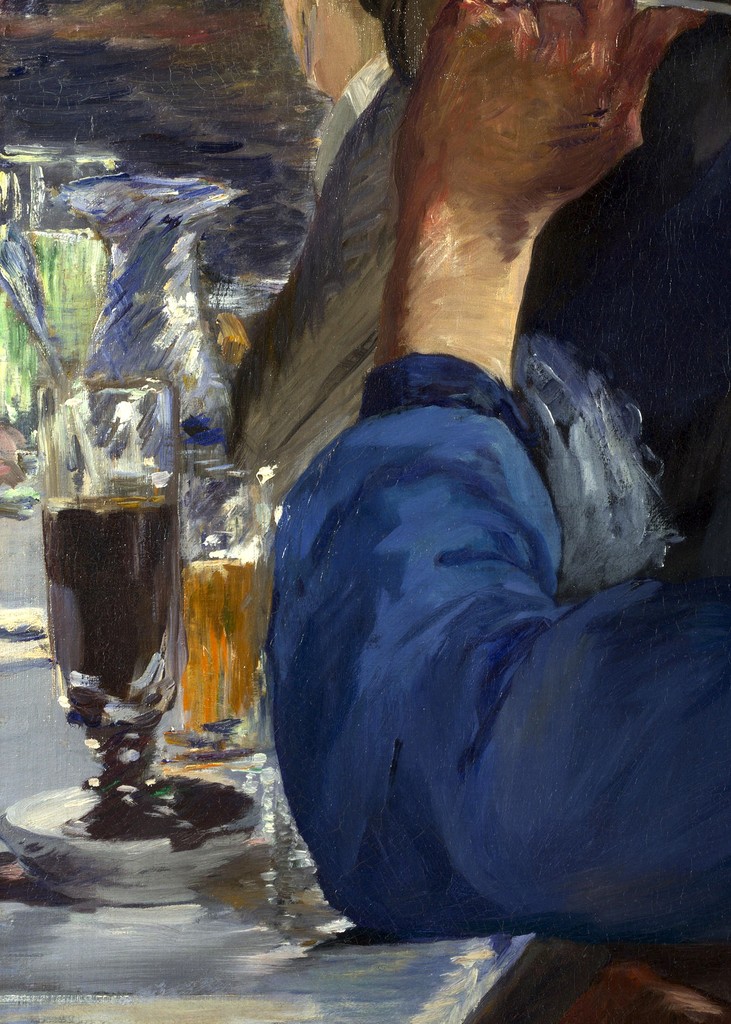
Glasses at London’s Left Edge
Glass rims, pale reflections and dark and amber contents crowd the table near the painting’s left edge.
A Cut That Was Made Twice
The Winterthur picture has a further complication: it contains a vertical join within its own canvas. Bomford described a line running just to the left of the younger woman's head, where a curtain fold helps disguise it, and continuing down through the lower composition. His examination concluded that this was a cut which had subsequently been rejoined.[4]
That distinction changes the story of the larger painting. It suggests that Manet tried a division before settling on the boundary that now separates the two works. In Bomford's reconstruction, the first cut left the younger woman attached to the group on the right. A later cut through the tables separated her from that group, and her section was reunited with the people to the left.[4]
The process would have allowed Manet to reconsider which figures belonged together. A young woman who had briefly occupied the left edge of one composition became the right-hand figure of another. The physical division of the canvas was also a way of changing the relationships within the crowd.
The evidence supports a sequence of cutting, joining and repainting, but it cannot restore every part of the original interior. Material was trimmed from the Winterthur section, including at the top and bottom. Bomford left the full original dimensions uncertain.[4] The two surviving paintings therefore preserve a substantial part of the earlier design without providing a complete picture of its first state.
Even the current edges need to be read with that history in mind. Bringing reproductions together can help us notice the continuing table or the young woman's fingertips. It cannot automatically recover the lost canvas or remove the alterations to the backgrounds.
Repainting the Two Interiors
Both paintings were lined, meaning that another canvas was attached behind the painted support. In the Winterthur work, this helped hold the separated pieces together. Bomford found that Manet had also painted across the paper edging used to finish the lined canvas. The relationship between paint and edging supplied evidence that work continued after the canvas had been reassembled.[4]
The curtain was important to this revision. Heavy strokes were worked around the profiles of the man and the younger woman, and vertical folds helped absorb the join into the window setting.[4]
London's picture developed differently. Manet added a new strip of canvas along its right side, giving the waitress a more central position. He replaced the earlier window background with the stage and orchestra now visible behind her. The join can still be followed through the blue blouse of the seated man.[3]
These changes help explain why the two backgrounds no longer match. They were adjusted to serve the people retained in each picture. At Winterthur, the pale window gathers the dark hats and coats into a close group; in London, the waitress and her customers are brought into relation with the performance behind them.
The visible breadth of Manet's brushwork can make the scene feel immediate. Its material history shows how much reconsideration could lie behind that effect. The impression of a passing encounter emerged through decisions about where to cut, which figures to keep together and how to repaint the space around them.
An Independent Life in Winterthur
Oskar Reinhart acquired At the Café in 1953 through the intermediary Fritz Nathan, according to the collection's published provenance.[5] It entered a collection in which the canvas could be encountered as a complete picture, with its own balance of faces, dark clothing, pale background and foreground objects.
In 2005, an exhibition at «Am Römerholz» brought the Winterthur and London paintings together. The exhibition examined their common origin and the revisions that had given each its separate form.[6] Seeing them in company made it possible to compare the surviving connections while also recognising how far Manet had developed each section.
Artworks directory
Explore selected paintings, drawings and prints by Édouard Manet. Search by title or another recorded name.
Frequently Asked Questions
The signed and dated 1878 painting belongs to the Oskar Reinhart Collection «Am Römerholz» in Winterthur, inventory SOR1953.3.[1]
Their surviving connections help explain the division, but trimming and repainting leave the full original dimensions uncertain.[4]
Discussion
Look again at the images and ideas explored in At the Café by Édouard Manet. These editorial prompts invite your observations.
Reader Insights
Compare the directions of the three principal faces. Notice how their closeness differs from the separate places towards which they look.
Follow the diagonal tabletop towards the beer glasses. Compare the small warm reflections with the larger dark areas of clothing.
Compare the table at Winterthur’s right edge with the table at London’s left. Look for the continuing gesture described in the article, while keeping the present paintings’ different shapes in view.
Join the Conversation
Share a detail, comparison or question about At the Café by Édouard Manet below.
References
- Federal Office of Culture, Im Café, 1878, inventory SOR1953.3; current German object record, description and collection details (in German). View source.
- The Courtauld Gallery, Au café, virtual-tour label for From Goya to Impressionism, 2025. View source.
- The National Gallery, London, Corner of a Café-Concert, probably 1878–80, NG3858; overview, in-depth commentary and object details. View source.
- David Bomford and Ashok Roy, “Manet's ‘The Waitress’: An Investigation into its Origin and Development,” National Gallery Technical Bulletin 7, 1983, pp.3–19; David Bomford's examination and reconstruction, pp.3–13. View source.
- The Courtauld Institute of Art, From Goya to Impressionism: Masterpieces from the Oskar Reinhart Collection, 2025 lender and provenance list, Au café entry, PDF pp.18–19. View source.
- Sammlung Oskar Reinhart «Am Römerholz», Manet trifft Manet. Geteilt, wiedervereint, account of the 2005–06 exhibition; original German text (in German). View source.
- Splash image, Édouard Manet, At the Café (Au café / Im Café), 1878. Sammlung Oskar Reinhart «Am Römerholz», Winterthur, SOR1953.3. Sammlung Oskar Reinhart «Am Römerholz»; reproduction via Wikimedia Commons. Image source. Public domain. Complete supplied reproduction, resized without further cropping; its outer canvas border was already cropped in the supplied image.


