



 by Tom Gurney
Tom Gurney BSc (Hons) is an art history expert with over 20 years experience
Published on June 19, 2020 / Updated on October 30, 2026
Email: tomgurney1@gmail.com / Phone: +44 7429 011000
Beggar with Oysters by Édouard Manet: Introduction
A bearded man stands beneath a broad green hat, his body wrapped in a deep blue cloak. Pale oyster shells lie among scattered straw at his feet. Édouard Manet’s Beggar with Oysters gives this solitary figure almost the entire height of a tall canvas, with little surrounding detail to distract from his presence.
The Art Institute of Chicago dates the painting to 1865–67 and includes Philosopher in its title. An oil on canvas measuring 188 × 111 cm, it belongs to the Arthur Jerome Eddy Memorial Collection.[1] The double title connects an anonymous contemporary man with an older tradition of representing philosophers in humble clothes.
At a Glance
- ArtistÉdouard Manet
- Collection titleBeggar with Oysters (Philosopher)
- Date1865–67
- MediumOil on canvas
- Dimensions188 × 111 cm
- CollectionArt Institute of Chicago
- CreditArthur Jerome Eddy Memorial Collection
- Accession number1931.504.[1]
This work across Édouard Manet’s career
Contents
- A Face beneath the Green Hat
- The Blue Cloak and Concealed Hands
- Trousers, Shoes and Cast Shadows
- Oyster Shells at the Feet
- Why the Title Includes Philosopher
- Comparing Velázquez’s Menippus
- Related Figures and Two Titles
- Exhibition and the Eddy Collection
- Annotated details
A Face beneath the Green Hat
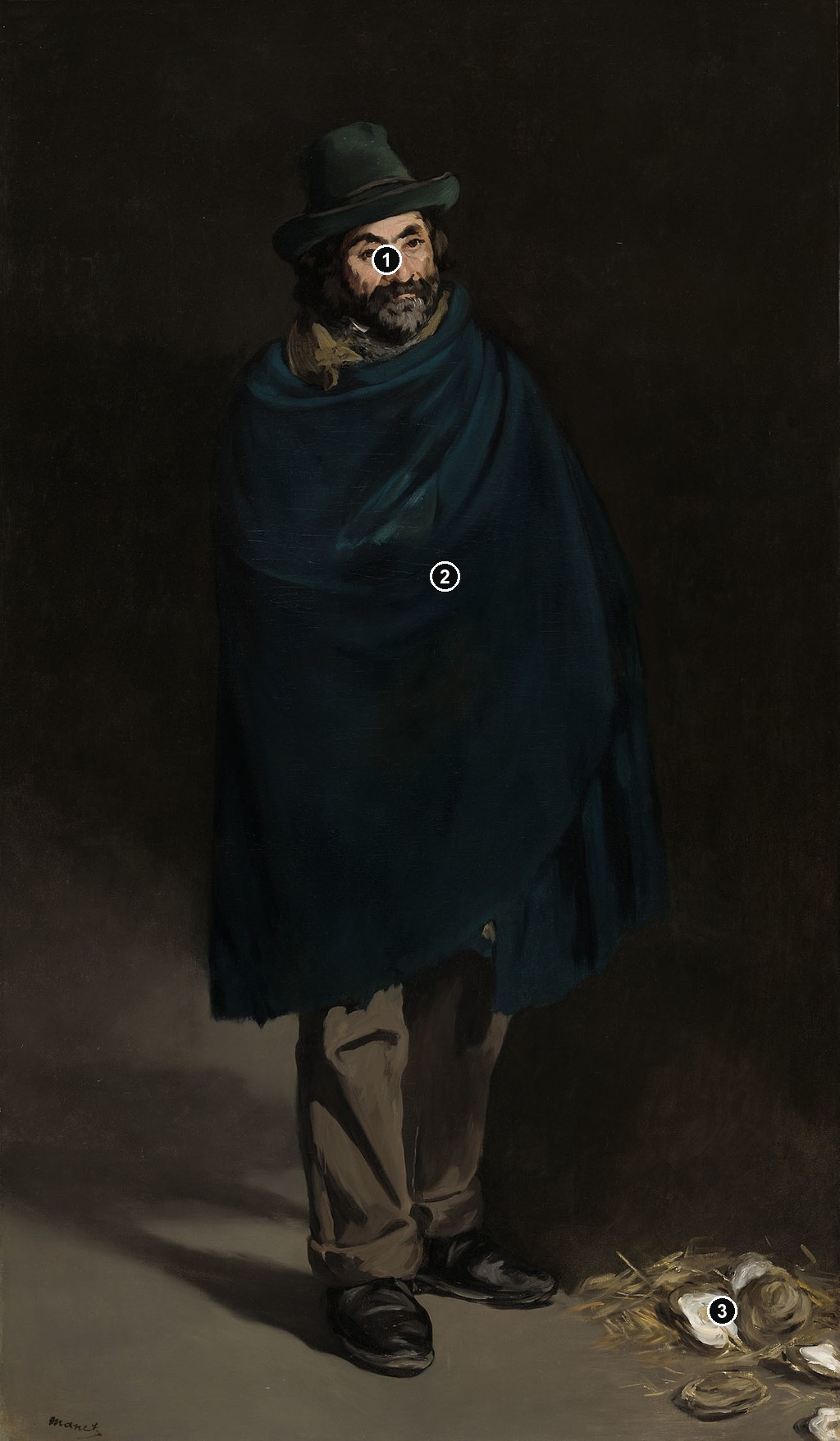
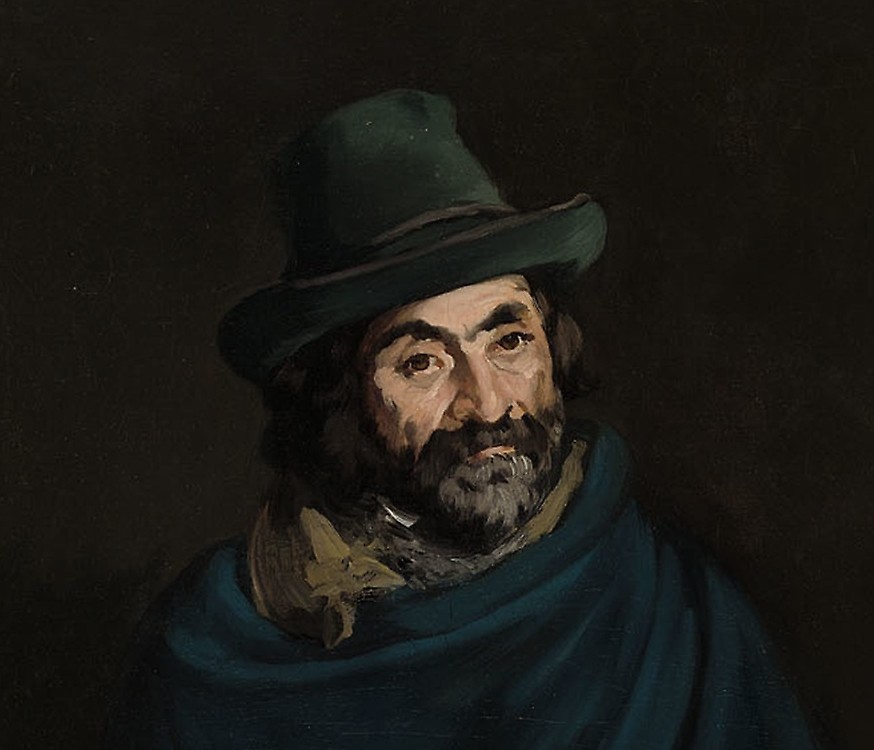
The hat rises in an uneven crown, with a narrow band crossing it above the brim. Its dark green surface separates gently from the brown-black background. The projecting brim forms a much sharper boundary against the pale forehead, drawing attention towards the face below.
Cream, ochre and pink passages establish the cheeks and nose. Dark eyebrows interrupt the light forehead, while smaller dark touches locate the eyes. The face is angled slightly beneath the sloping hat, and the two cheeks receive unequal areas of light. These differences keep it from appearing as a symmetrical mask.
A thick beard encloses the lower face. Grey marks break across its darker brown and black areas, particularly beneath the mouth. The hair at either side of the head is less sharply separated from the setting. Manet varies the firmness of these boundaries, allowing the illuminated features to remain more distinct than the outer edge of the hair.
The Blue Cloak and Concealed Hands
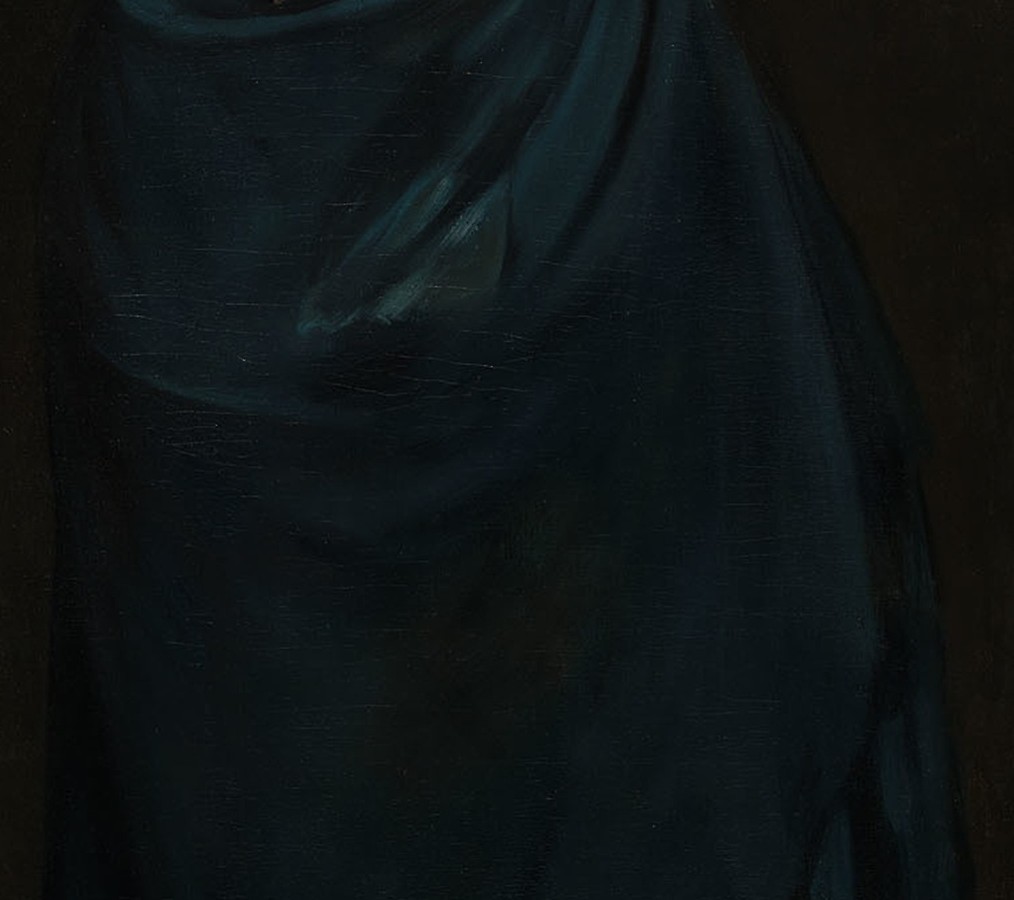
The cloak spreads across both shoulders and wraps around the front of the body. Curved folds gather near the neck, where a warmer ochre-brown collar remains visible. Below, longer blue passages sweep diagonally across the torso and continue down the viewer’s right side.
The arms and hands are concealed within this wrapping. The pose therefore has none of the explanatory gestures that might show the man asking for money, carrying an object or performing a particular task. His standing body and visible face carry the encounter.
Manet gives the garment considerable variety within its restricted colour. Some folds emerge through brighter blue edges; others appear as broad changes between darker and lighter areas. The lower cloak receives less internal description than its upper folds. Its irregular hem breaks against the trousers rather than forming a neat horizontal edge.
The resulting silhouette is substantial but uneven. It widens around the shoulders, narrows towards the legs and projects farther on one side. Small shifts in outline give the wrapped figure a particular stance without requiring the viewer to see the position of every limb beneath the cloth.
Trousers, Shoes and Cast Shadows
Brown-grey trousers emerge from under the blue hem. Strong changes of tone establish their creases: a pale area beside the knee meets a dark diagonal, while narrower strokes descend towards the cuffs. These relatively angular passages differ from the broader curves of the cloak above.
The shoes occupy separate positions. The nearer one extends towards the lower left, its rounded dark toe catching a narrow highlight. The other turns farther across the picture, exposing more of its side. Their unequal angles give the figure a stable footing without making the stance rigidly balanced.
Long shadows stretch leftwards across the lighter floor. They connect the feet with an area of space that otherwise contains very little. The ground becomes darker behind the figure and merges into the extensive background, leaving the setting difficult to locate.
No doorway, pavement or neighbouring person identifies a particular street episode. The dark surroundings concentrate attention on the man, but they do not establish a time of day.
Oyster Shells at the Feet
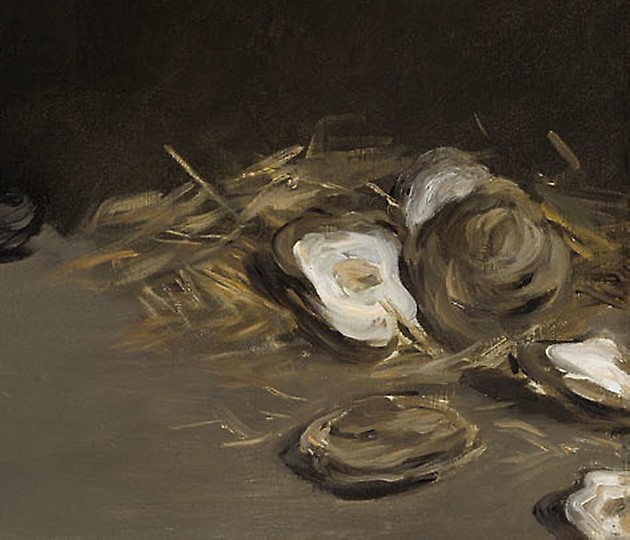
At the lower right, opened shells introduce some of the painting’s brightest passages. Cream and white strokes describe their interiors, while brown and grey rings suggest their rougher outer surfaces. Thin yellow marks spread between them like loose straw.
This small group changes the balance of the foreground. The figure stands nearer the left side, and his cast shadows extend farther left. The shells answer that weight with a cluster of light on the right, separated from his shoes by a narrow area of floor.
Their handling also invites a change of viewing distance. Seen within the whole painting, they form a bright irregular patch. Closer looking distinguishes overlapping shells and the strokes that describe their rims. The foreground contains a small still-life subject within the larger image of a standing man.
The oysters identify this particular philosopher picture. Their presence gives the title a concrete, ordinary object beside its more elevated suggestion of philosophical wisdom.
Why the Title Includes Philosopher
The Chicago museum interprets the painting’s large scale and sparse setting as giving an overlooked social type the presence normally associated with more prestigious subjects. Its account connects the philosopher title with a tradition in which poverty could accompany wisdom.[1] This is a way of understanding the represented role, rather than identifying the man as a known historical thinker.
Manet’s interest in that tradition drew on Spanish painting. The Norton Simon Museum identifies Velázquez’s Aesop and Menippus as important models for his philosopher figures. Manet saw those works during his journey to Spain in 1865, while his own related pictures developed around the period before and after that visit.[2]
The connection joins an earlier pictorial format to a contemporary subject. Manet’s man wears recognisable everyday clothes and stands beside discarded shells, yet the full-length presentation asks for the sustained attention given to a portrait. The lack of a named identity leaves the relationship between individual appearance and general social role unusually prominent.
Comparing Velázquez’s Menippus
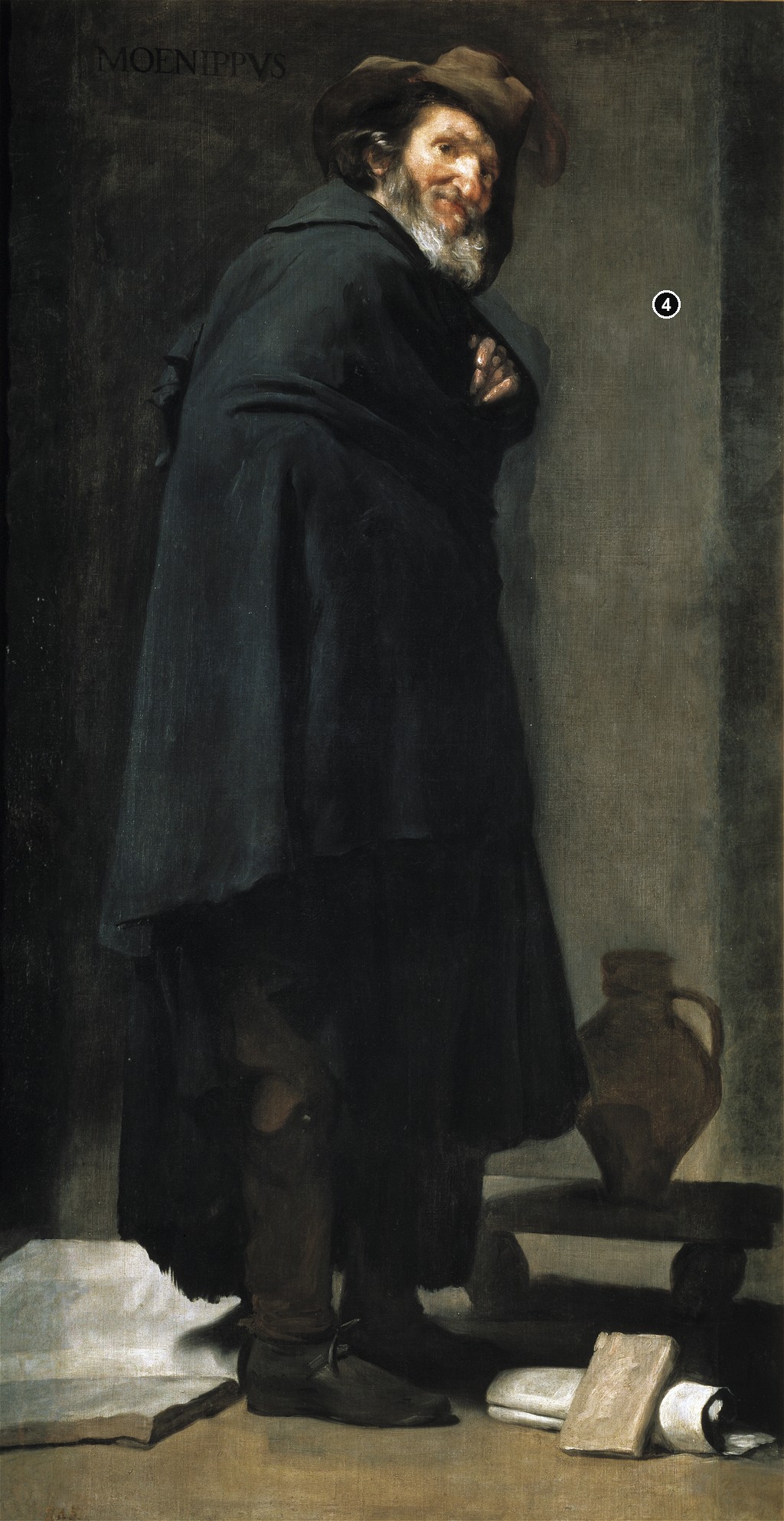
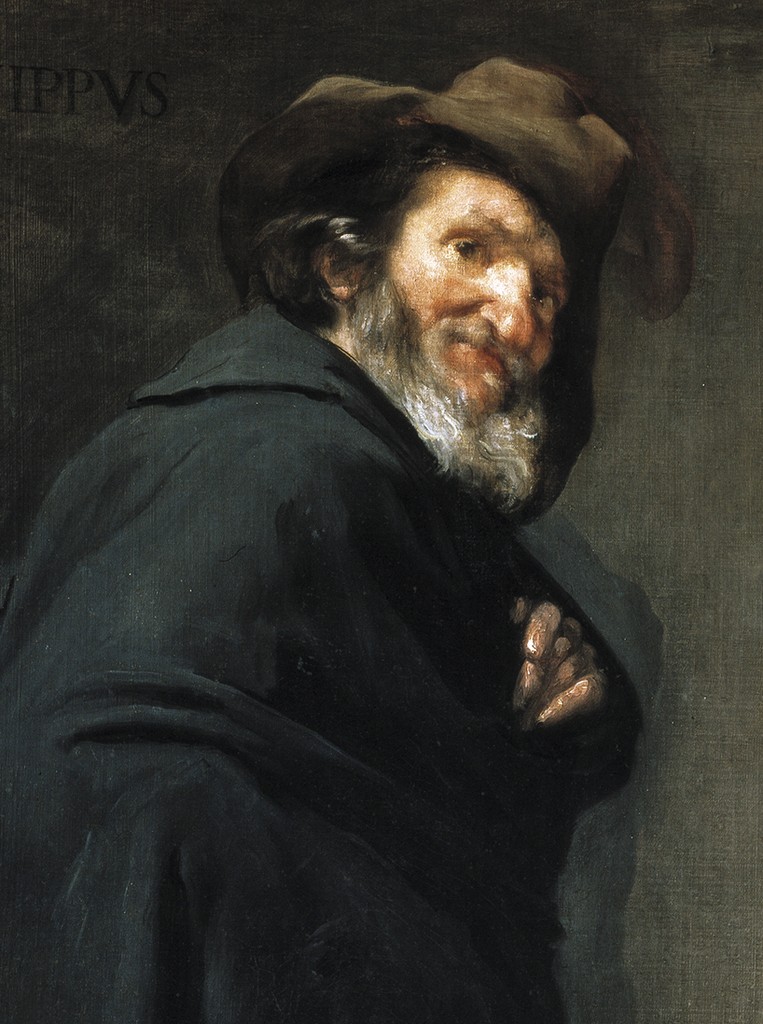
Velázquez painted Menippus in about 1638. Now in the Museo Nacional del Prado, the oil measures 179 × 94 cm.[3] A dark cloak and broad hat again dominate the figure, but the body turns away while the head looks back towards the viewer. One hand remains visible against the wrapping.
Manet brings his figure into a more frontal stance and conceals both hands. His cloak spreads across the chest, whereas Velázquez’s turns with the shoulder and back. The head consequently has a different relation to the body in each picture: Manet’s rises above the broad front, while the earlier philosopher looks around from within his cloak.
The surrounding objects make another distinction. Velázquez names Menippus at the upper left and places books, papers and a brown vessel around the feet. Architectural forms help define the setting. Manet offers shells and straw against a much less particular background, exchanging the named ancient character and his objects for an anonymous modern figure.
The Prado’s Spanish commentary stresses how Velázquez’s philosophers combine ordinary clothing and convincingly individual faces with the uncertain territory between portrait and fiction.[3] That tension provides a useful context for Manet. His man can appear closely observed without the painting becoming a documented account of a particular person’s life.
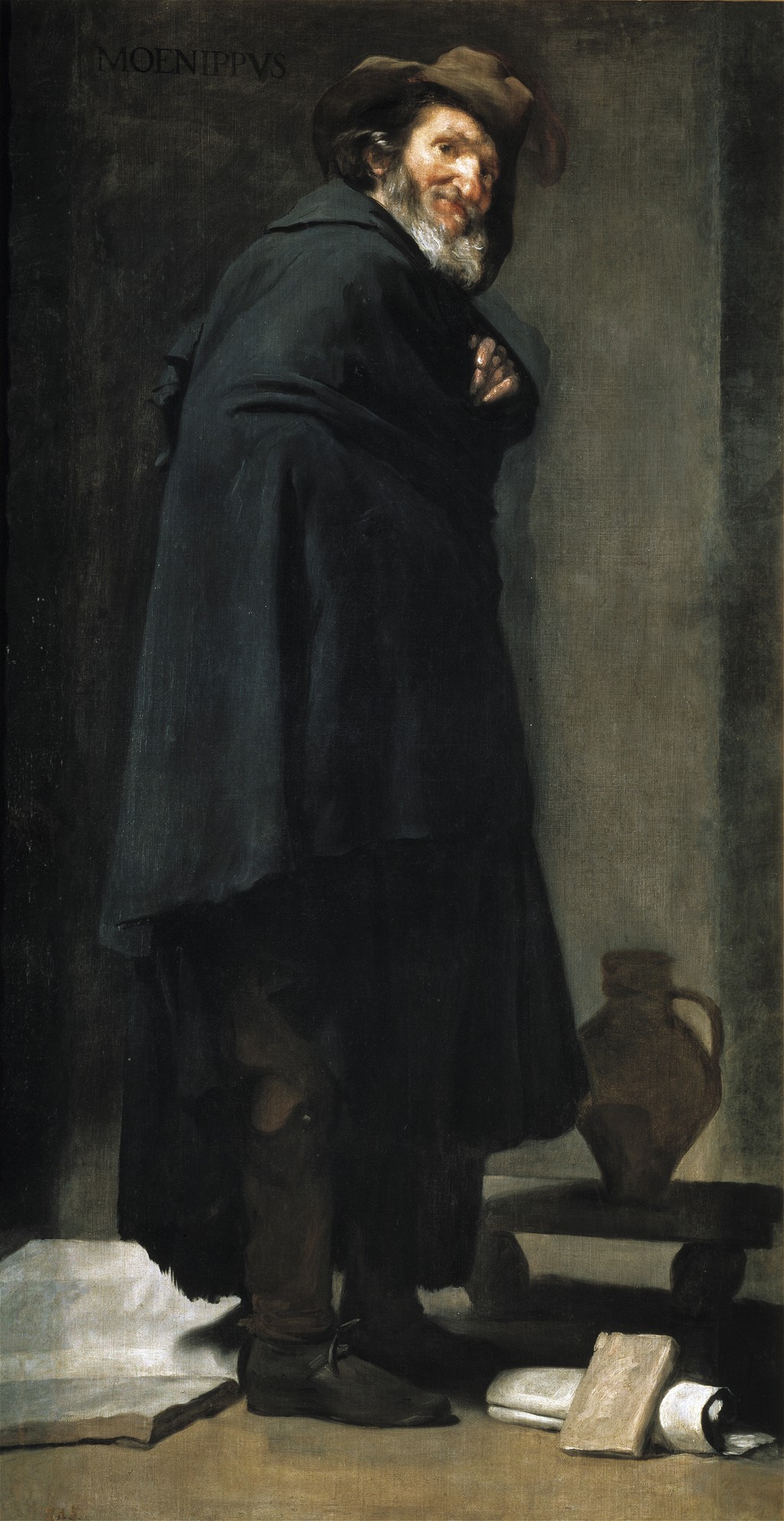
Diego Velázquez, Menippus, about 1638. Oil on canvas, 179 × 94 cm. Museo Nacional del Prado, Madrid, P001207. Museo Nacional del Prado, Madrid; faithful reproduction via The Yorck Project/Wikimedia Commons. Image source. Public domain.
Related Figures and Two Titles
Beggar with Oysters belongs beside Beggar with a Duffle Coat and The Ragpicker in Manet’s treatment of solitary male figures. With the earlier Absinthe Drinker, they were loosely brought together as four philosophers when the artist sold works to Paul Durand-Ruel in 1872.[2] This later grouping embraces pictures made at different moments.
The two ways of naming the Chicago painting also appear in French. The Musée d’Orsay catalogues a Godet photographic reproduction as Mendiant aux huitres ou Philosophe d’Edouard Manet: beggar with oysters or philosopher.[4] The photograph records the painting; it is a separate collection object with its own dimensions and history.
Exhibition and the Eddy Collection
The Art Institute records the canvas in Manet’s independent exhibition on the avenue de l’Alma in 1867 under the title Philosophe. It also lists its appearance at the Cercle de l’Union Artistique in Paris in 1870.[1] The painting therefore had an exhibition life before the dealer sale that grouped the philosopher pictures together.
After Durand-Ruel acquired it in 1872, it passed through the collection of the singer Jean-Baptiste Faure. Arthur Jerome Eddy bought the painting from Durand-Ruel in 1894. Following descent through Eddy’s family, it entered the Art Institute by bequest in 1931.[1]
Annotated Details from Beggar with Oysters
The numbered points identify visible features discussed in this article. Return from each detail to the whole composition. Each caption identifies the work shown.
Beggar with Oysters
Édouard Manet, Beggar with Oysters (Philosopher), 1865–67. Oil on canvas, 188 × 111 cm. Art Institute of Chicago, 1931.504. Arthur Jerome Eddy Memorial Collection. The Art Institute of Chicago; Arthur Jerome Eddy Memorial Collection; CC0 reproduction via Wikimedia Commons. Image source. CC0 / Public domain.
Menippus — Velázquez
Diego Velázquez, Menippus, about 1638. Oil on canvas, 179 × 94 cm. Museo Nacional del Prado, Madrid, P001207. Museo Nacional del Prado, Madrid; faithful reproduction via The Yorck Project/Wikimedia Commons. Image source. Public domain. Numbers added to a separate resized whole supplied overview. Detail crops from the unchanged original; no enlargement, retouching or colour alteration.
Details from BEGGAR WITH OYSTERS
Follow the numbered details back to the complete images above. Each caption identifies the work shown.
Beggar with Oysters
The hat and the face
The dark green brim cuts across the lighter forehead. Cream, ochre and pink marks build the face above a beard interrupted by grey touches.
Folds across the blue cloak
Broad blue passages sweep across the wrapped body. Curved folds near the shoulders lead into longer descending marks while the hands remain concealed.
Shells and straw at the edge
Pale interiors and darker rounded shells sit among narrow yellow strokes. This small bright group lies beside the shoes at the lower right edge of the composition.
Menippus — Velázquez
Turned Head and Hand in the Cloak
The bearded face looks outward beneath a brown hat while one hand emerges from the dark clothing.
Artworks directory
Explore selected paintings, drawings and prints by Édouard Manet. Search by title or another recorded name.
Frequently Asked Questions
The Art Institute describes the philosopher figures as anonymous men representing recognisable contemporary urban types. Its current account does not identify this sitter by name.[1]
It belongs to the Art Institute of Chicago, accession 1931.504, in the Arthur Jerome Eddy Memorial Collection.[1]
Discussion
Look again at the images and ideas explored in Beggar with Oysters by Édouard Manet. These editorial prompts invite your observations.
Reader Insights
Compare the dark brim with the light shapes of the forehead, nose and cheeks. Which boundaries appear most firmly defined?
Follow the cloak’s folds down to the trouser cuffs and shoes. How does the change in direction and handling establish the standing body?
Compare Manet’s shells with the books and vessel in Menippus. How do these small foreground groups affect your reading of the figures?
Join the Conversation
Share a detail, comparison or question about Beggar with Oysters by Édouard Manet below.
References
- Art Institute of Chicago, Beggar with Oysters (Philosopher), 1865–67, 1931.504; current collection commentary, facts, exhibition history and provenance (in English). View source.
- Norton Simon Museum, Manet’s Philosophers from the Art Institute of Chicago, 10 August 2021; exhibition announcement and historical account of the related pictures (in English). View source.
- Museo Nacional del Prado, Menipo, about 1638, P001207; collection facts and expanded Spanish commentary, from Fábulas de Velázquez, edited by Javier Portús Pérez, 2007, p. 327 (in Spanish). View source.
- Musée d’Orsay, Mendiant aux huitres ou Philosophe d’Edouard Manet, RF MO ODO 2023 1 22; Godet photographic reproduction record, distinct from the Chicago canvas (in French). View source.
- Splash image, Édouard Manet, Beggar with Oysters (Philosopher), 1865–67. Oil on canvas, 188 × 111 cm. Art Institute of Chicago, 1931.504. Arthur Jerome Eddy Memorial Collection. The Art Institute of Chicago; Arthur Jerome Eddy Memorial Collection; CC0 reproduction via Wikimedia Commons. Image source. CC0 / Public domain.


