



 by Tom Gurney
Tom Gurney BSc (Hons) is an art history expert with over 20 years experience
Published on June 19, 2020 / Updated on October 30, 2026
Email: tomgurney1@gmail.com / Phone: +44 7429 011000
The Bench by Édouard Manet: Introduction
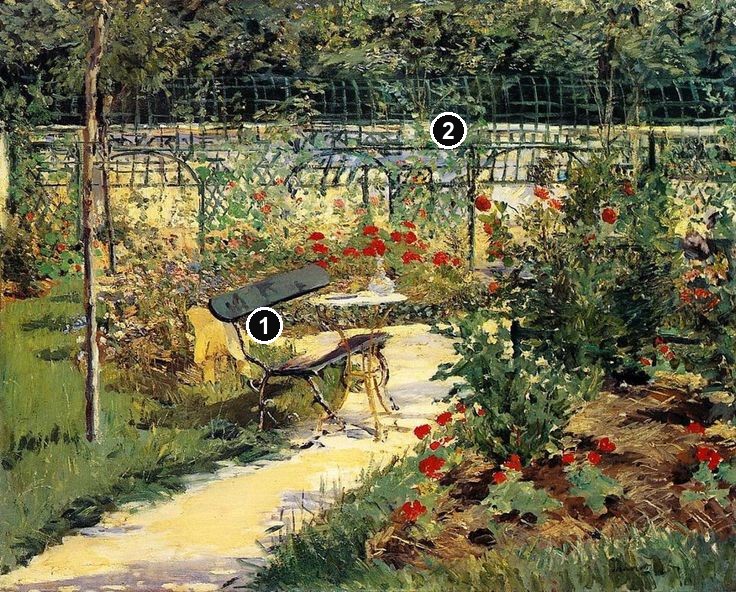
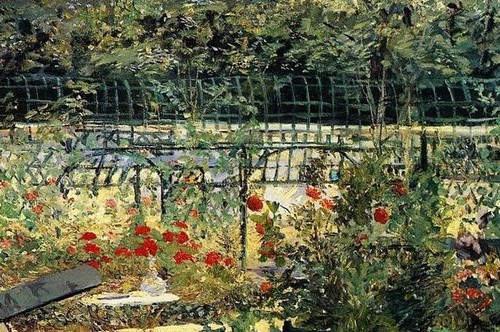
An empty bench stands beside a small round table in a garden thick with flowers. A pale path approaches from the lower left, carrying the eye towards this place for sitting before turning into the plants beyond. In Édouard Manet’s The Bench, furniture gives an unoccupied garden a human scale.
The Getty’s Manet and Modern Beauty exhibition identified the picture as My Garden (The Bench), dated 1881. This oil on canvas measures 65.1 × 81.3 cm and was lent from a private collection.[1] Its alternative title brings the garden as a whole into view beside the particular seat that helps organise it.
At a Glance
- ArtistÉdouard Manet
- TitleMy Garden (The Bench)
- Date1881
- MediumOil on canvas
- Dimensions65.1 × 81.3 cm
- CollectionPrivate collection, as recorded in the Getty’s 2019 exhibition checklist.[1]
This work across Édouard Manet’s career
Contents
- An Empty Seat and a Round Table
- Following the Pale Path
- Red Flowers among Many Greens
- Framework behind the Flowers
- The Versailles Garden in 1881
- The Bench as a Figure
- An Earlier Garden with People
- My Garden in Manet and Modern Beauty
- Annotated details
An Empty Seat and a Round Table
The bench occupies the middle-left of the composition. Its dark green back forms a broad diagonal above the lighter path. A darker edge describes the seat below, while thin curved supports establish its position on the ground. The furniture is small within the whole garden, but its more continuous shapes distinguish it from the surrounding broken patches of foliage.
Yellow and ochre passages interrupt the seat and its left end. Their brightness links this part of the bench with the sunlit ground behind it. Across the green back, darker marks create an uneven surface, keeping the object from becoming a uniformly coloured strip.
The table stands just in front, slightly to the right. Its pale oval top catches the light, and narrow warm-coloured legs descend through darker curves towards the path. A small light form rises from the tabletop. It suggests a vessel, although the abbreviated description leaves its exact shape and contents uncertain.
Bench and table establish a place that could be used. Their closeness makes it easy to imagine someone sitting within reach of the small surface, yet no person occupies the scene.
Following the Pale Path
The path begins as a broad yellow-white strip at the lower left. Its edges are irregular, meeting dark grass and the brown-green boundary of the flowerbed. As it approaches the bench, the light area narrows and changes direction. This movement draws attention through the garden rather than towards a distant horizon.
Small grey-blue and darker passages interrupt the pale ground. Some cross it diagonally; others gather close to the furniture and the plants. They break up the long light shape, allowing the path to register as a surface with changing tones rather than a flat band.
The nearer flowerbed projects into the composition from the right. Its uneven edge partly conceals the continuation of the walk, while the table’s narrow supports leave glimpses of light between them. Manet lets the route emerge in sections, with objects and foliage repeatedly interrupting it.
The left side is more open. A slender trunk stands on a green strip beside the path, providing an upright against the sloping bench and receding walk. The eye can move between this vertical line and the broader, less regular mass of plants on the opposite side.
Red Flowers among Many Greens
Red touches are distributed across the middle distance and the foreground at the right. Some collect into compact clusters; others remain separated by green and yellow marks. Their repeated colour links areas at different depths without turning them into one continuous flowerbed.
Near the front, red strokes sit beside broad leaves, brown earth and thin yellow-green blades. Farther back, smaller bright patches appear around and beyond the furniture. The change in their scale helps distinguish the nearer plants from the flowering growth behind the bench.
The greens are equally varied. Deep almost-black areas lie beside pale yellow-green passages, with cooler blue-green marks elsewhere. These differences give the foliage internal movement and keep the dense planting from becoming a single undivided mass.
Individual strokes remain prominent. A broad leaf may be established by one substantial green shape, while a flower receives a few concentrated marks. Differences of shape and colour suggest abundant growth without outlining every plant.
Framework behind the Flowers
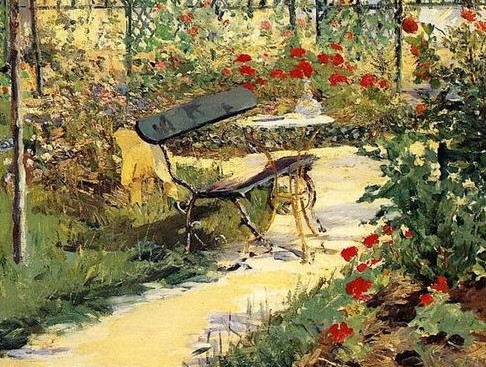
Behind the bench, curved arches and slender uprights establish a more regular pattern. Horizontal and vertical lines cross the background foliage, creating a grid that remains visible through the plants. These repeated divisions give the upper part of the picture a structure quite different from the irregular flowerbed below.
A pale blue-grey strip runs beyond the nearer framework. Above it, darker foliage gathers towards the top of the canvas. The shifts between pale horizontal passages, dark vegetation and thin crossing lines make the garden feel enclosed, even where its precise boundary is difficult to follow.
The framework also changes how the flowers are seen. Red and yellow marks appear between its uprights, while stems and leaves overlap its curves. Regular divisions remain visible beneath the spreading growth.
The Versailles Garden in 1881
The picture belongs to Manet’s late garden painting. The Getty’s exhibition account places him at Versailles in the summer of 1881 and at Rueil the following year, painting the gardens of the houses he rented.[2] The title My Garden therefore refers to a place he occupied during a stay, rather than establishing that he owned the property.
This setting brings a familiar domestic environment into the landscape. A bench, table, path and planted borders provide the principal subjects. The picture does not require a grand view or a notable building to give the garden its particular character.
Garden painting belonged alongside the portraits and flower pictures of Manet’s final years. The attention given to this small outdoor space forms part of that continuing variety of subjects.
The Bench as a Figure
Writing in 1906, Théodore Duret described this Versailles garden as empty of people and suggested that the bench itself became the figure within it. He also praised the picture’s colour and intensity of light.[3] His interpretation gives a clear account of why the seat matters despite occupying a relatively small share of the canvas.
The bench offers a recognisable object around which the surrounding growth can be organised. Its back has a continuous direction, its legs establish contact with the path, and the table gives it a nearby companion shape. These objects create a centre of attention through ordinary use and scale, even though they remain entirely unoccupied.
An Earlier Garden with People
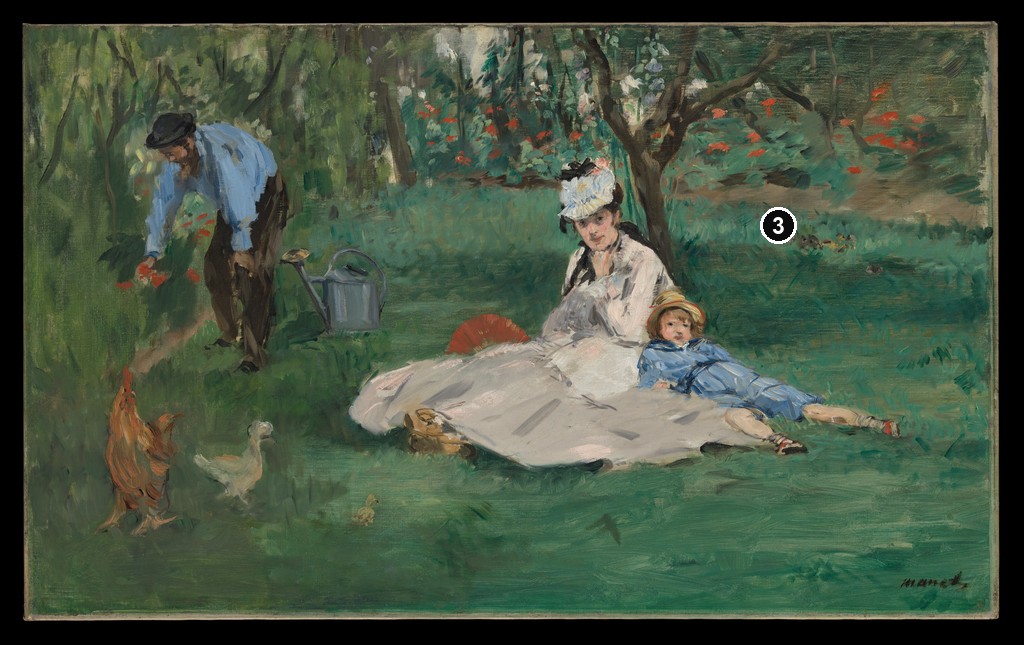
Manet had already made a garden the setting for The Monet Family in Their Garden at Argenteuil in 1874. The Metropolitan Museum of Art identifies the figures as Monet, his wife Camille and their son Jean. Its oil on canvas measures 61 × 99.7 cm.[4]
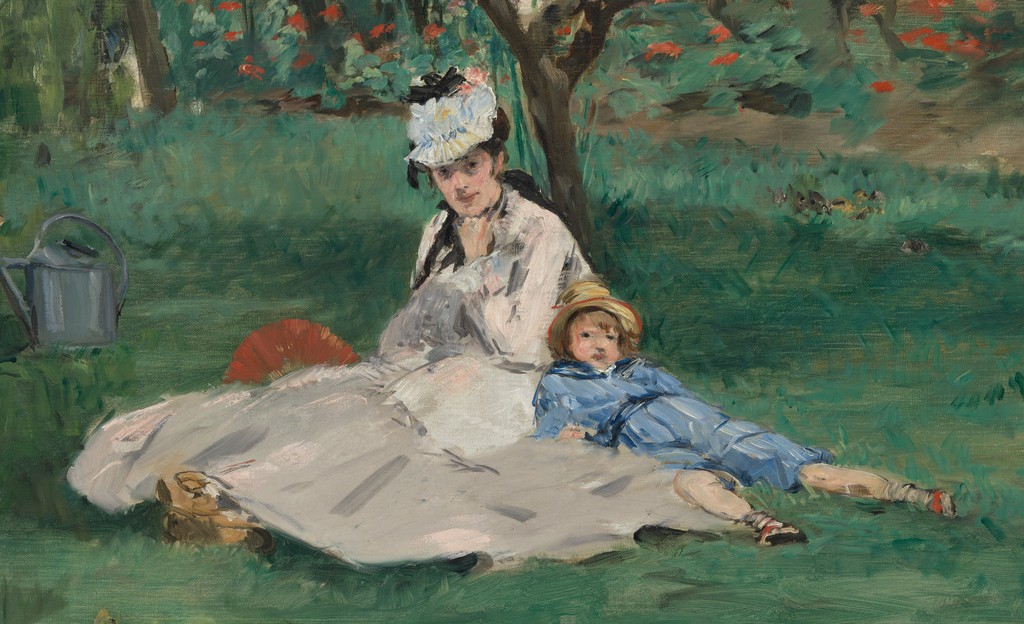
That earlier picture has a wider format and a broad lawn. Monet bends towards the plants at the left, beside a watering can, while Camille and Jean sit beneath a tree. Red flowers interrupt the greenery farther back, and birds occupy the foreground. The people and their activities establish different points of interest across the space.
In The Bench, a path replaces the extensive lawn as the main way into the image. Flowerbeds press closer to the furniture, and a framework divides the background. The absence of figures allows the relationships between seat, table, route and planting to become more prominent.
The two pictures show how a garden can support different kinds of composition. One spreads the family group across an open grassy area; the other concentrates on a smaller place for sitting within dense growth.
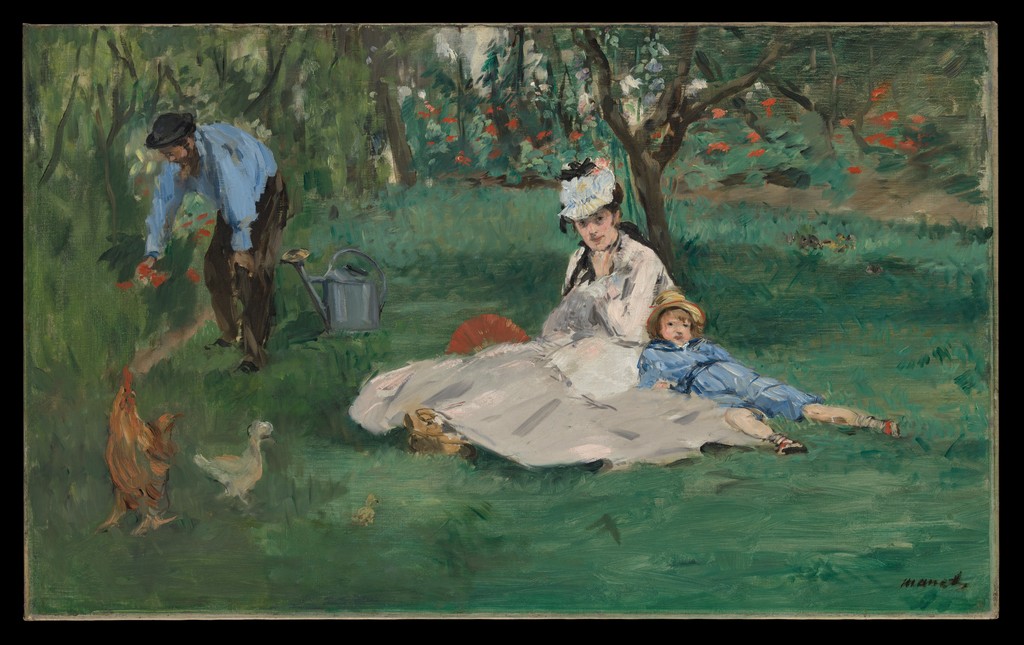
Édouard Manet, The Monet Family in Their Garden at Argenteuil, 1874. Oil on canvas, 61 × 99.7 cm. The Metropolitan Museum of Art, 1976.201.14. Bequest of Joan Whitney Payson, 1975. The Metropolitan Museum of Art, Bequest of Joan Whitney Payson, 1975. Image source. CC0 / Public domain.
My Garden in Manet and Modern Beauty
The Getty included My Garden (The Bench) in its 2019 exhibition Manet and Modern Beauty, devoted to the artist’s late career. The checklist placed it among works that also encompassed floral still lifes, portraits and illustrated letters.[1][2]
The privately held canvas joined a public survey of paintings and works on paper that explored Manet’s continuing artistic activity near the end of his life.[1][2]
Annotated Details from The Bench
The numbered points identify visible features discussed in this article. Return from each detail to the whole composition. Each caption identifies the work shown.
The Bench
Édouard Manet, My Garden (The Bench), 1881. Oil on canvas, 65.1 × 81.3 cm. Private collection; exhibited in Manet and Modern Beauty, 2019. Private collection; faithful reproduction via Wikimedia Commons, Artbook source. Image source. Public domain.
The Monet Family in Their Garden
Édouard Manet, The Monet Family in Their Garden at Argenteuil, 1874. Oil on canvas, 61 × 99.7 cm. The Metropolitan Museum of Art, 1976.201.14. Bequest of Joan Whitney Payson, 1975. The Metropolitan Museum of Art, Bequest of Joan Whitney Payson, 1975. Image source. CC0 / Public domain. Numbers added to a separate resized overview retaining the complete supplied view and existing margins. Detail crops from the immutable original; no enlargement or retouching.
Details from THE BENCH
Follow the numbered details back to the complete images above. Each caption identifies the work shown.
The Bench
The bench, table and path
The sloping green back and pale round tabletop form clear shapes within the broken patches of planting. Their thin supports leave glimpses of the light path between them.
Framework behind the flowers
Curved arches and crossing lines divide the plants behind the seat. Small red touches appear between the uprights while foliage overlaps the framework.
The Monet Family in Their Garden
Camille and Jean on the Lawn
Camille’s broad pale skirt meets Jean’s blue clothes. Her upright head contrasts with his reclining body and outward-reaching legs.
Artworks directory
Explore selected paintings, drawings and prints by Édouard Manet. Search by title or another recorded name.
Frequently Asked Questions
The Getty’s 2019 exhibition checklist dates My Garden (The Bench) to 1881.[1]
No person is painted in the scene. The furniture suggests a place for sitting, but the arrangement does not identify a visitor or establish a story about someone leaving.
Discussion
Look again at the images and ideas explored in The Bench by Édouard Manet. These editorial prompts invite your observations.
Reader Insights
Compare the bench’s sloping back with the pale tabletop. How do these relatively continuous shapes stand out among the plants?
Follow the light path from the lower left. Where do the furniture and flowerbeds interrupt your view of its route?
Compare this empty seat with the people in the Monet-family picture. How does each arrangement direct attention through its garden?
Join the Conversation
Share a detail, comparison or question about The Bench by Édouard Manet below.
References
- J. Paul Getty Museum, Manet and Modern Beauty, 2019, exhibition checklist, no. 71, p. 13; illustrated record for My Garden (The Bench) (in English). View source.
- J. Paul Getty Museum, Manet and Modern Beauty, 2019, “Flowers, Fruit, and Gardens”; the Versailles and Rueil rental gardens and late work (in English). View source.
- Théodore Duret, Histoire d’Édouard Manet et de son œuvre, 1906, pp. 243–244; the bounded Versailles garden passage in his account of Manet’s later work (in French). View source.
- The Metropolitan Museum of Art, The Monet Family in Their Garden at Argenteuil, 1874, 1976.201.14; current short collection commentary and object facts (in English). View source.
- Splash image, Édouard Manet, My Garden (The Bench), 1881. Oil on canvas, 65.1 × 81.3 cm. Private collection; exhibited in Manet and Modern Beauty, 2019. Private collection; faithful reproduction via Wikimedia Commons, Artbook source. Image source. Public domain.


