


 by Tom Gurney
Tom Gurney BSc (Hons) is an art history expert with over 20 years experience
Published on June 19, 2020 / Updated on October 30, 2026
Email: tomgurney1@gmail.com / Phone: +44 7429 011000
Boating by Édouard Manet: Introduction
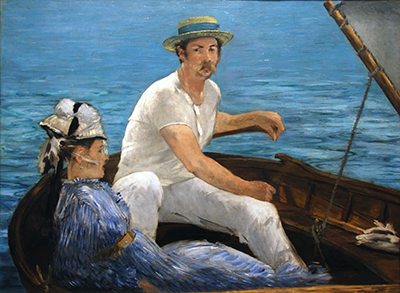
A man in white turns towards us from the stern of a sailboat. Beside him, a woman looks away, her striped dress spreading across the foreground. Blue water fills the space behind their heads, with no distant bank to tell us how far the view extends. The boat feels close enough to touch, yet its position is difficult to settle.
Édouard Manet’s Boating, dated 1874, belongs to the Metropolitan Museum of Art in New York.[1] Its bright colours and summer subject offer an inviting first impression. Closer looking reveals a tightly organised picture in which large shapes, cropped objects and small changes of direction continually redirect our attention.
At a Glance
- ArtistÉdouard Manet
- Date1874
- MediumOil on canvas
- Dimensions97.2 × 130.2 cm
- French exhibition titleEn bateau
- CollectionThe Metropolitan Museum of Art, New York
- Accession number29.100.115
- SignatureLower right, “Manet”
- AcquisitionH. O. Havemeyer Collection, bequest of Mrs. H. O. Havemeyer, 1929[1]
This work across Édouard Manet’s career
Contents
- A Modern Outing on the Seine
- Two Figures, Two Directions
- White Clothes and a Blue Dress
- Water without a Horizon
- The Cropped Boat and the Diagonal Rope
- Freshness Worked towards through Revision
- A Japanese-Print Comparison
- Beside Argenteuil
- Blue Water at the Salon
- From the Salon to the Metropolitan Museum
A Modern Outing on the Seine
Manet worked near Argenteuil in the summer of 1874.[2] The river brought painting into contact with a world of recreation, fashionable clothes and excursions from Paris.
The Getty’s account of Boating places its figures within the expanding popularity of leisure boating among the Parisian bourgeoisie. Their clothes help establish that setting. The man’s white outfit and blue-banded straw hat are associated with the Cercle nautique, an exclusive boating club based in Asnières.[1] The woman’s striped dress, elaborate hat and veil give her appearance a similarly fashionable character.[3]
These details give a social setting to the light and colour. A day on the river involved how people presented themselves as well as where they went. The white shirt and trousers announce the man against the water; the woman’s hat remains conspicuous even within the close framing. Both figures bring carefully chosen forms of dress into an apparently casual outdoor scene.
The image offers few other clues about the outing. We cannot follow a route along a shore or identify a landing place. Our attention stays with the boat and its occupants, whose appearance supplies much of the information that a wider landscape might otherwise provide.
Two Figures, Two Directions
The man occupies the centre of the painting, his head rising above his companion’s. His torso twists as one arm extends towards the tiller and the other bends across his raised leg. The pose has several competing directions: his shoulders turn, his knees spread, and his face comes back towards the viewer.
The Metropolitan Museum tentatively identifies him as Rodolphe Leenhoff, Manet’s brother-in-law. The woman remains unidentified.[1] Their names are less secure than their painted roles: he steers, while she sits back within the curve of the stern. The clothing’s association with a boating club does not by itself establish the sitter’s membership.
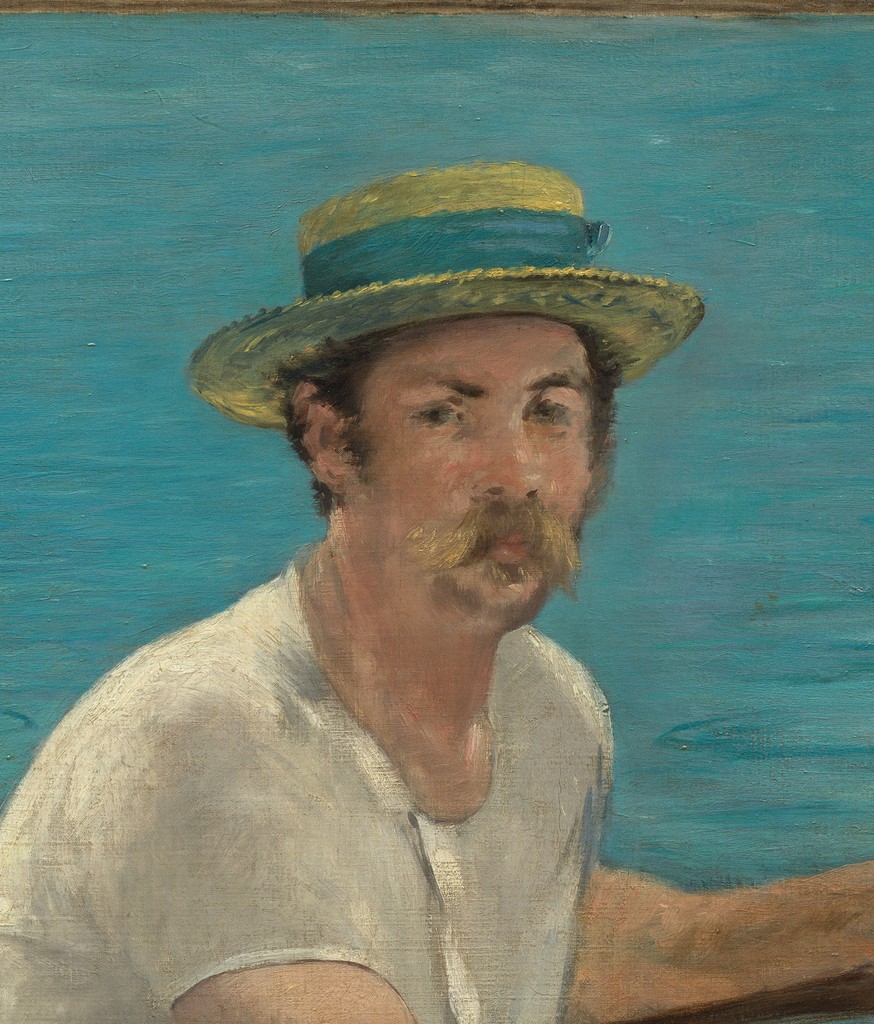
His features receive concentrated attention. A moustache crosses the upper lip; the eyebrows and the shadow beneath the hat give weight to his direct look. The face feels more closely resolved than some of the surrounding passages, including the broad white cloth below it.
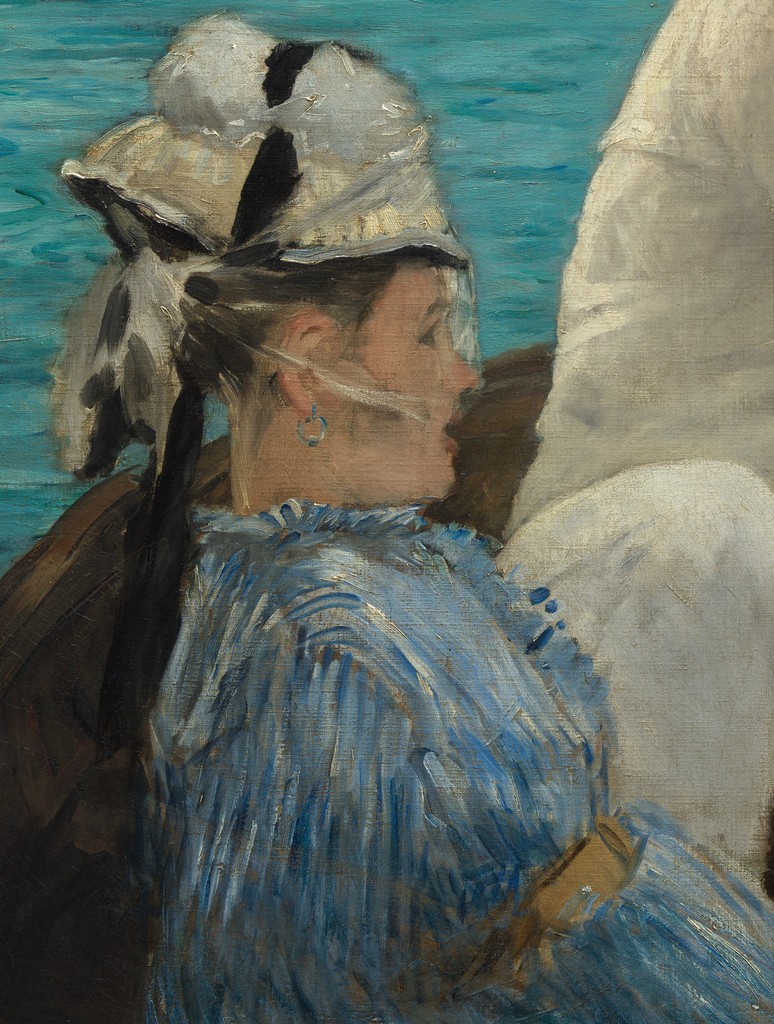
The woman’s profile takes attention towards the right. Her nose, mouth and chin form a clear contour against the water. A fine veil passes across her face, adding a delicate surface between skin and the surrounding light. Dark ribbons descend behind her neck and meet the striped fabric of the dress.
Paul Hayes Tucker reads the figures’ opposed directions and the picture’s close framing as sources of unease, complicating the promise of an easy summer outing.[4] The painting certainly leaves their relationship unexplained. The difference between his outward look and her profile creates a visual interval that remains available to interpretation.
White Clothes and a Blue Dress
The man’s outfit forms the largest area of light. Shirt and trousers join across his seated body, with grey and warmer touches marking folds, shade and the turn of a sleeve. Brown arms interrupt this pale expanse, making the pose legible within a relatively limited range of tones.
The white is especially effective beside the woman’s dress. Her fabric breaks into many blue and pale lines, which change direction as they pass over shoulder, bodice and skirt. Some remain narrow and distinct; others broaden into short, irregular strokes. The dress grows less clearly bounded near the bottom of the canvas, where its marks begin to spread beyond an easily followed contour.
A warm belt introduces a small, firm accent at the waist. Its shape helps hold the figure together amid the changing stripes. Above, the hat gathers lighter folds around dark ribbons; below, the skirt expands into a more restless arrangement of paint.
The figures also exchange colours. The man’s hat carries a band close to the blue-green of the water, while the woman’s pale hat relates to his clothes. Warm straw and wood make another connection across the scene. Such correspondences let the composition remain strongly divided into people, boat and water while small echoes draw those parts together.
Looking from the man’s shirt to the lower edge of the dress reveals how much Manet varies his touch within one picture. Broad modelling and broken marks coexist, each giving the eye a different amount of information.
Water without a Horizon
The upper part of Boating is dominated by water. With the shore and sky outside the frame, blue spreads behind the figures as an almost continuous field. Its extent is difficult to measure: there is no distant object against which to judge scale.
The surface is more varied than it first appears. Around the left side of the boat, small darker marks interrupt the blue and suggest disturbances in the water. Farther up, the paint becomes quieter, with finer changes of tone and direction. The transition reduces the amount of visual activity behind the heads without supplying a conventional distant view.
The boat still gives the scene depth. Its curved stern encloses the woman, the inner side recedes towards the right, and wooden ribs divide the darker surface. The figures sit within a recognisable space, even as the water presses close behind them.
This tension gives the blue unusual importance. It describes the river and also occupies a large area of the canvas in its own right. The white shirt stands against it with striking clarity; the blue dress approaches it more closely in colour. The two figures meet the same background in different ways.
The Cropped Boat and the Diagonal Rope
The framing cuts through the craft at several points. The near side disappears below the canvas; the sail enters from the upper right as a sharply truncated form. These interruptions make a small group of objects feel like parts of a larger activity taking place around us.
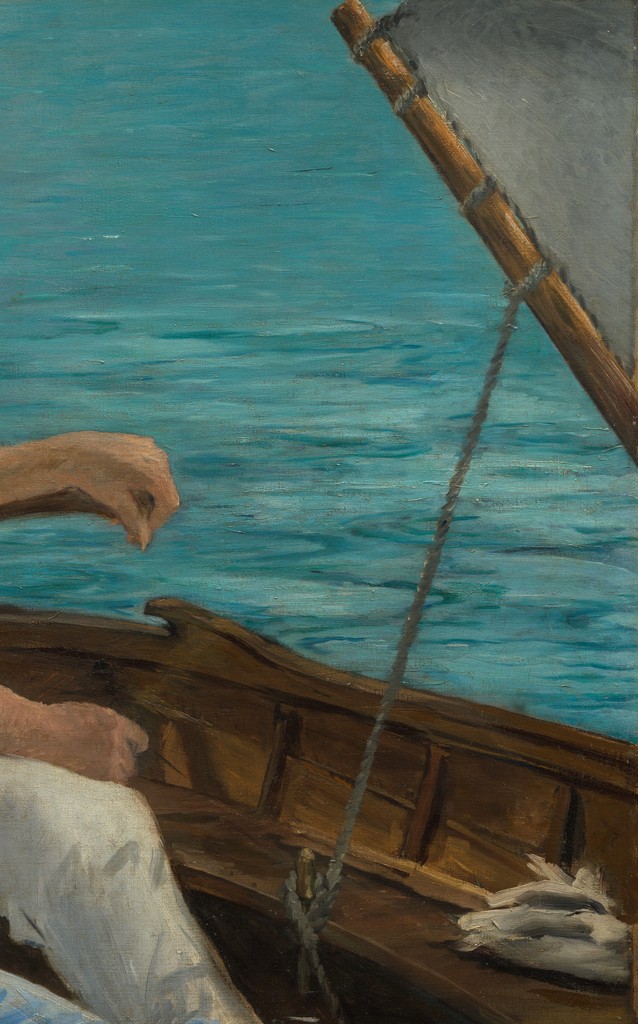
The rope crossing the water is particularly conspicuous. It travels diagonally from the sail’s edge towards a fastening near the lower right. Against the relatively even blue, this thin line acquires an emphasis much greater than its width suggests.
The man’s left hand rests on the tiller. His other hand comes towards the knee, leaving an open interval above the leg. Below the rope, a folded parasol introduces another long object into the boat, its pale fabric contrasting with the darker wood. An oarlock at the lower left gives a further small indication of the craft’s construction.[4]
These objects establish different kinds of direction. The tiller reaches across the boat, the rope cuts over the water, and the sail points into the picture from beyond its boundary. The curved stern gathers the woman into a more enclosing shape. Straight lines and curves repeatedly meet without settling into a simple grid.
Their effect becomes easier to notice if attention moves away from the faces for a moment. The boat is full of information about how it is built and handled, yet those practical details also organise the painted surface. A fastening becomes a stopping point for a diagonal; a wooden edge becomes the boundary of a field of colour.
Freshness Worked towards through Revision
The apparent immediacy of Boating emerged through changes. Heather Lemonedes Brown’s account for the Cleveland Museum of Art describes work on the composition extending from 1874 to 1876. She reports technical examination showing that the woman entered during its development and that the sail and rope were revised. The rope was initially held by the boatman before being tied in its present position.[2]
That change alters the relationship between a practical action and a conspicuous line. The hand now appears relatively self-contained near the knee, while the rope has its own long passage across the blue.
The revisions encourage a slower understanding of the picture’s freshness. The scene can feel abruptly encountered because the composition brings objects close and cuts them off. Those effects are compatible with a process of reconsideration, in which a figure or a diagonal was adjusted until its relation to the whole became convincing.
The handling also supports different speeds of looking. The face asks for close attention to small changes; the white clothes can be understood in broad masses; the dress repeatedly dissolves into separate strokes. The painting lets these different degrees of resolution remain visible together.
A Japanese-Print Comparison
Becker connects Boating with compositional devices found in Japanese prints, naming Utagawa Kuniyoshi’s Water Scene as one comparison.[1] The relationship becomes more useful when an actual print is placed beside the canvas.
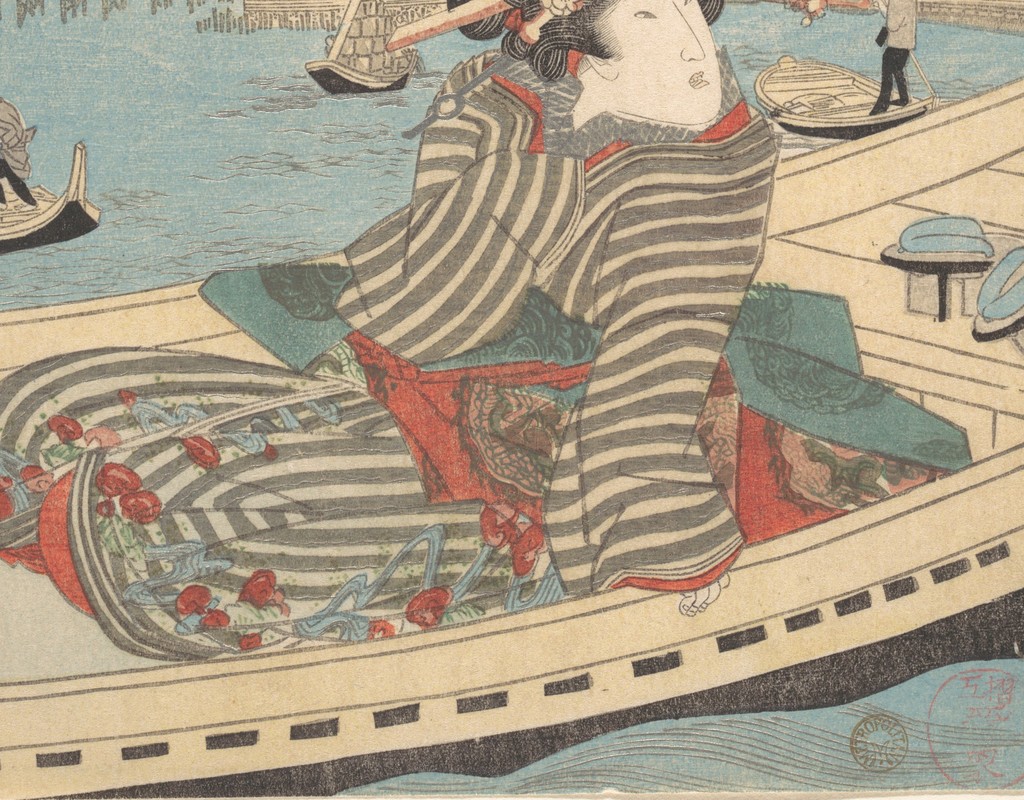
Kuniyoshi’s 1840 colour woodblock shows a large woman within a boat that cuts across the foreground. Smaller craft, a distant shore and a broad expanse of sky extend behind her. The Met explains the figure as a playful transformation of a male hero from the Chinese Suikoden story, and notes the landscape’s use of Western perspectival devices.[5]
The foreground boat makes a strong diagonal, and the woman’s patterned robe occupies much of its interior. Alternating pale and grey bands turn around her seated body. Red and green details interrupt the stripes, giving colour small areas of particular force. At the bottom, the boat passes out of the image rather than presenting itself as a complete object.
The comparison with Manet lies partly in that close placement of figure and craft. Both pictures let a boat reach beyond the frame and make clothing an active part of the design. Yet Kuniyoshi provides a distant shore and layered scenery, while Manet concentrates his background into water.
It also gives the French painting’s cropped sail another context. A picture need not include an entire object to make its presence felt. A fragment can suggest continuation beyond the boundary while retaining a definite shape within the image. In Boating, the small triangle of sail brings the larger vessel into view through a tightly limited piece of it.
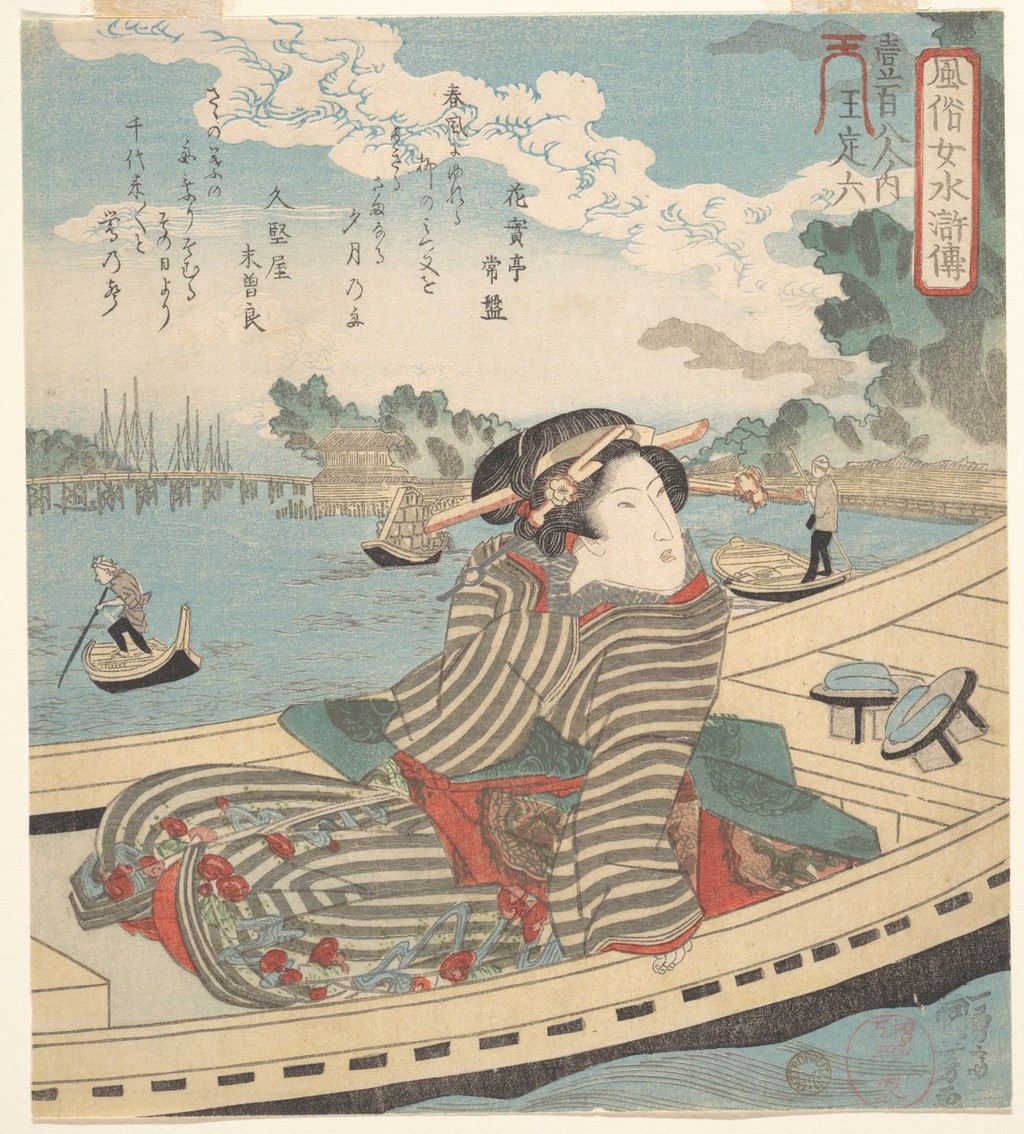
Utagawa Kuniyoshi, Water Scene, 1840. Colour woodblock print. The Metropolitan Museum of Art, New York, JP1252. The Metropolitan Museum of Art, Rogers Fund, 1921. Image source. CC0 / Public domain. Whole supplied print sheet resized. No enlargement or retouching.
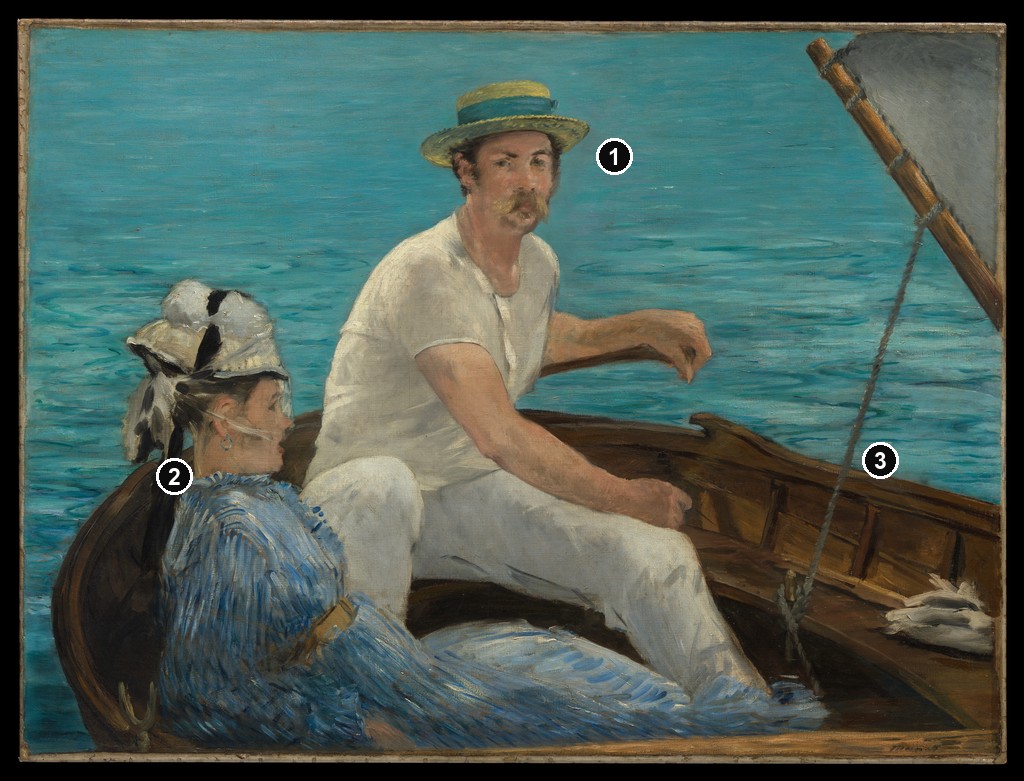
Annotated Details from Boating and Kuniyoshi’s Water Scene
The numbered points identify visible features discussed in this article. Return from each detail to the whole composition. Each caption identifies the work shown.
Boating
Édouard Manet, Boating, 1874. The Metropolitan Museum of Art, New York, 29.100.115. The Metropolitan Museum of Art, H. O. Havemeyer Collection, Bequest of Mrs. H. O. Havemeyer, 1929. Image source. CC0 / Public domain. Numbers added to a separate resized whole overview retaining the supplied painting edges and surrounding border. Detail crops from the museum original; no enlargement or retouching.
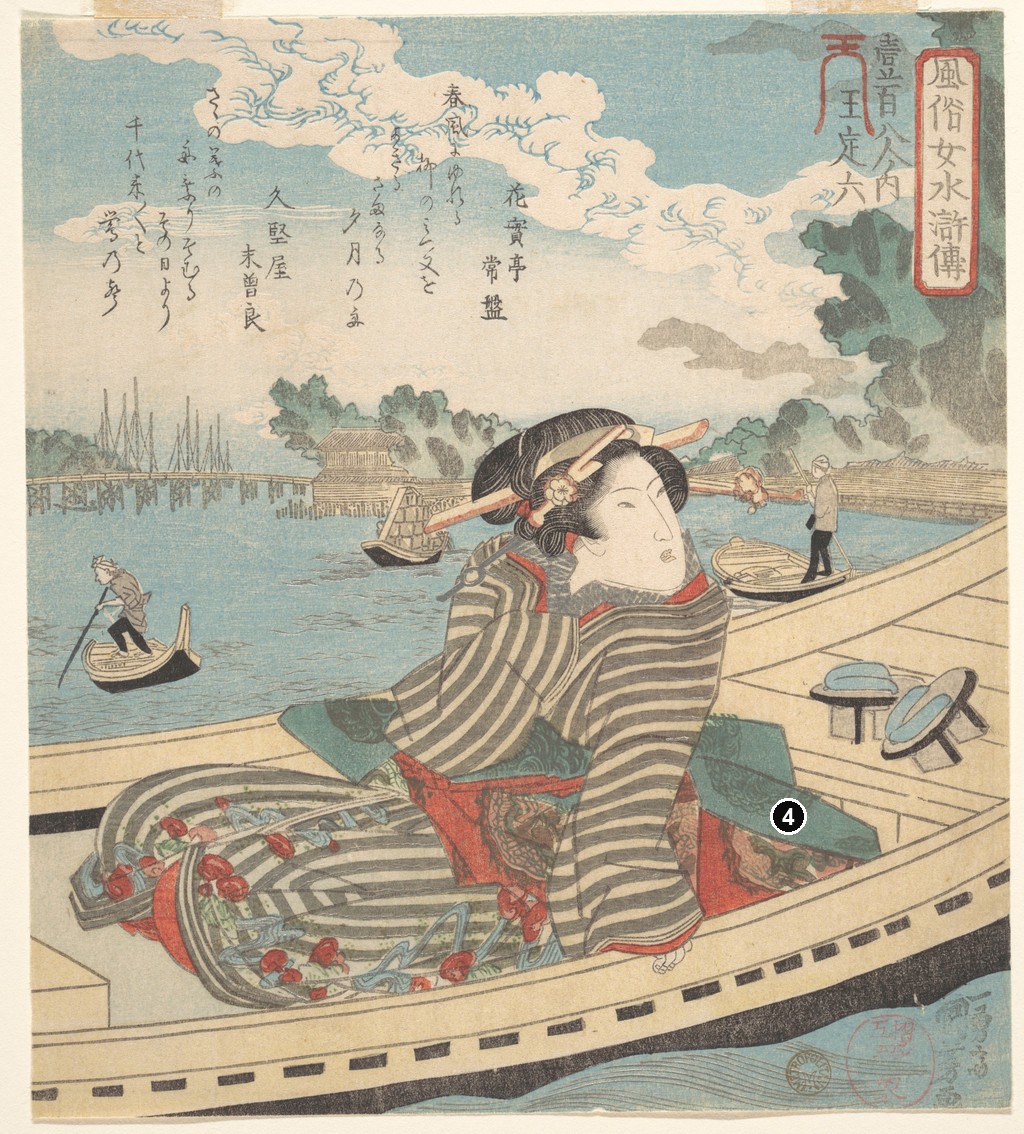
Kuniyoshi’s Water Scene
Utagawa Kuniyoshi, Water Scene, 1840. Colour woodblock print. The Metropolitan Museum of Art, New York, JP1252. The Metropolitan Museum of Art, Rogers Fund, 1921. Image source. CC0 / Public domain. Number added to a separate resized whole-sheet overview. One detail cropped from the print; no enlargement or retouching.
Details from BOATING AND KUNIYOSHI’S WATER SCENE
Compare the boatman’s turned face with the woman’s veiled profile, then follow the rope across the blue water. Kuniyoshi’s print offers a separate arrangement of patterned clothing and a foreground boat.
Boating
The Boatman’s Hat and Turned Face
The blue-banded hat and small dark facial marks stand against the broad blue water above the white shirt.
The Veil, Profile and Striped Dress
A fine veil crosses the woman’s profile. Pale and blue stripes change direction across her shoulder and bodice.
The Tiller, Rope and Cropped Sail
The tiller reaches beside the man’s hand, while a rope descends from the small fragment of sail at the upper right.
Kuniyoshi’s Water Scene
The Patterned Robe and Diagonal Boat
Broad robe stripes and smaller coloured patterns bend across the seated figure inside the large foreground boat.
Beside Argenteuil
Manet explored a related subject in Argenteuil, also dated 1874 and now in the Musée des Beaux-Arts de Tournai.[6] Its taller format gives the figures a more extensive setting: boats, rigging, the opposite shore and sky all take their places behind them.
The woman faces the viewer while the man turns towards her. Both wear striped clothes, producing a busier meeting of patterns than the contrast between a blue dress and white outfit in Boating. A mast rises strongly at the left, and ropes pull attention towards the upper part of the composition.
The comparison clarifies what Manet leaves out of Boating. Buildings and distant land provide bearings in Argenteuil. Here, the water keeps the background open and the sail survives as a corner fragment. A change of format and framing changes the balance between a social scene and its surroundings.
The wider exchange with Berthe Morisot provides another context for Manet’s developing touch.[2] Their relationship as painters, including a comparison with her later Summer’s Day, is explored in Manet and Berthe Morisot.
Blue Water at the Salon
Boating was shown in Manet’s studio in 1876 and at the Salon in 1879.[2] Huysmans discussed it there as En bateau, alongside In the Conservatory.[7] A scene associated with the summer of 1874 thus reached the official exhibition several years later.
Joris-Karl Huysmans defended its blue water in his account of the 1879 Salon, later collected in L’Art moderne. He argued that water could indeed take on such a colour, depending on its surroundings, the light and the season. The mistake, in his view, lay with painters who approached a river with a fixed formula for how it ought to look.[7]
Huysmans also admired Manet’s abbreviated treatment and recognised a connection between the cropped boat and Japanese prints. His defence joined observation to invention: the strong colour and abrupt framing were ways of making a modern picture convincing.[7]
Writing retrospectively in 1906, Théodore Duret compared Boating with Argenteuil. He considered its colour less violent and its reception less hostile, although he did not describe a general welcome.[8] The difference between Huysmans’s active defence and Duret’s later assessment gives two perspectives on the picture’s entry into public view.
The blue continues to make its case through the painting itself. It sets off the white clothes, receives the long rope and approaches the colour of the dress. What could trouble a critic as an improbable river also holds together some of the picture’s strongest visual relationships.
From the Salon to the Metropolitan Museum
Victor Desfossés bought the painting at the 1879 Salon. It passed through Durand-Ruel in 1895 to H. O. and Louisine Havemeyer. Mary Cassatt encouraged their purchase; her praise of it as “the last word in painting” is recalled through Louisine’s memoir. The canvas entered the Met through her 1929 bequest.[1]
Its setting remains remarkably spare. A strip of wood, a piece of sail and a few diagonal lines are enough to establish the boat. Clothing supplies broader masses and a multitude of smaller marks. Around them, the blue keeps opening out, carrying the close encounter with the figures into a space whose limits we never quite discover.
Artworks directory
Explore selected paintings, drawings and prints by Édouard Manet. Search by title or another recorded name.
Frequently Asked Questions
Water fills it without a visible shore or horizon, giving the figures a broad field of blue behind them.
His left hand rests on the tiller used to steer the boat.
The revisions described by Brown point to a developing composition, with changes to the figures and rigging.[2]
Discussion
Look again at the images and ideas explored in Boating by Édouard Manet. These editorial prompts invite your observations.
Reader Insights
Follow the rope across the blue water before returning to the man’s right hand.
Compare the broad white clothes with the lower edge of the striped dress.
Then look at the framed fragments of boat and sail: each suggests more of the vessel than the painting actually shows.
Join the Conversation
Share a detail, comparison or question about Boating by Édouard Manet below.
References
- The Metropolitan Museum of Art; Jane R. Becker. “Boating,” 1874, 29.100.115. Current object record, provenance and exhibition history; catalogue entry by Becker, 2017. View source.
- Heather Lemonedes Brown. “Manet & Morisot: An Artistic Friendship.” Cleveland Museum of Art, 11 February 2026. Making history, revisions and the 1876 and 1879 exhibitions. View source.
- J. Paul Getty Museum. Manet and Modern Beauty, GettyGuide stop 1002, “Boating.” Transcript with Scott Allan and Gloria Groom; leisure, clothing and framing. View source.
- Paul Hayes Tucker. The Impressionists at Argenteuil. National Gallery of Art, Washington, 2000, catalogue no.40, p.142. Interpretation of the figures, composition and painted touch. View source.
- The Metropolitan Museum of Art. “Water Scene,” Utagawa Kuniyoshi, 1840, JP1252. The print’s medium, subject and use of perspective. View source.
- Musée des Beaux-Arts de Tournai. “Édouard Manet — Argenteuil,” 1874. The related painting and its collection. View source. (in French).
- Joris-Karl Huysmans. “Le Salon de 1879,” in L’Art moderne, 1883. The Manet passage, including the defence of blue water and Japanese-print cropping; French transcription. View source. (in French).
- Théodore Duret. Histoire d’Édouard Manet et de son œuvre, 1906 edition, p.185. The retrospective comparison with Argenteuil and account of reception. View source. (in French).
- Splash image, Édouard Manet, Boating, 1874. The Metropolitan Museum of Art, New York, 29.100.115. The Metropolitan Museum of Art, H. O. Havemeyer Collection, Bequest of Mrs. H. O. Havemeyer, 1929. Image source. CC0 / Public domain. Surrounding frame and narrow edge bands cropped from the museum reproduction before resizing. No enlargement or retouching.


