



 by Tom Gurney
Tom Gurney BSc (Hons) is an art history expert with over 20 years experience
Published on June 19, 2020 / Updated on October 30, 2026
Email: tomgurney1@gmail.com / Phone: +44 7429 011000
Boy with Cherries by Édouard Manet: Introduction
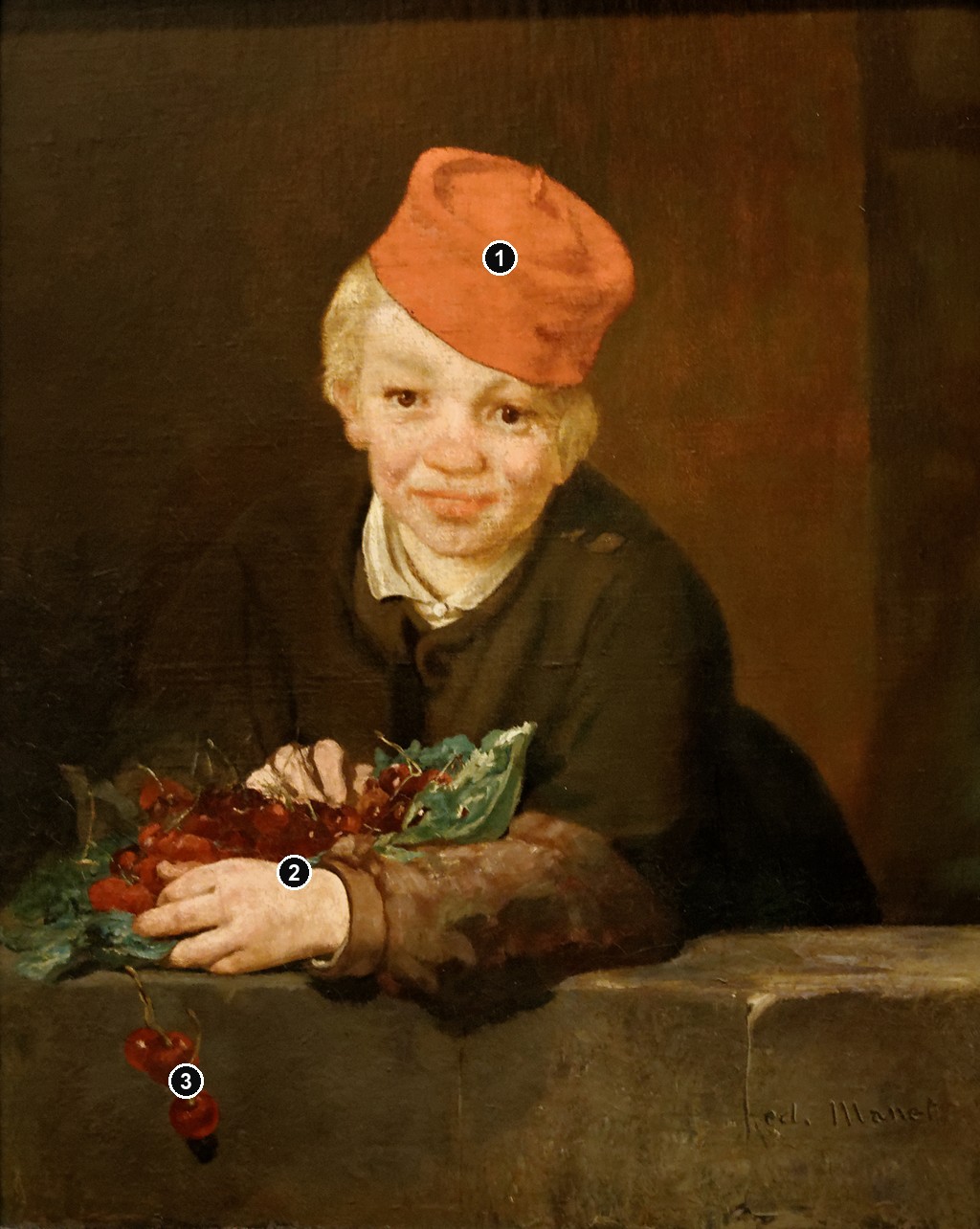
A tilted red cap catches the eye above a light face and dark jacket. Below, red cherries gather among green leaves beside the boy’s hands, with two fruits hanging in front of a stone ledge. In Édouard Manet’s Boy with Cherries, a portrait meets a small still life at the edge of the painted space.
The Museu Calouste Gulbenkian in Lisbon dates the work to about 1858. Its Portuguese title is O Rapaz das Cerejas. Painted in oil on canvas, it measures 65.5 × 54.5 cm and is recorded as inventory 395.[1] The boy occupies most of the upper field, while the fruit, sleeve and parapet establish a substantial foreground below him.
At a Glance
- ArtistÉdouard Manet
- TitleBoy with Cherries / O Rapaz das Cerejas
- DateAbout 1858
- MediumOil on canvas
- Dimensions65.5 × 54.5 cm
- CollectionMuseu Calouste Gulbenkian, Lisbon, 395; purchased 19 April 1910.[1]
This work across Édouard Manet’s career
Contents
- The Red Cap and Light Face
- Hands, Cherries and the Projecting Sleeve
- A Signed Stone Parapet
- A Comparison with Titian
- Portrait and Still Life
- Alexandre and La Corde
- From the Manet Family to Lisbon
- Annotated details
The Red Cap and Light Face
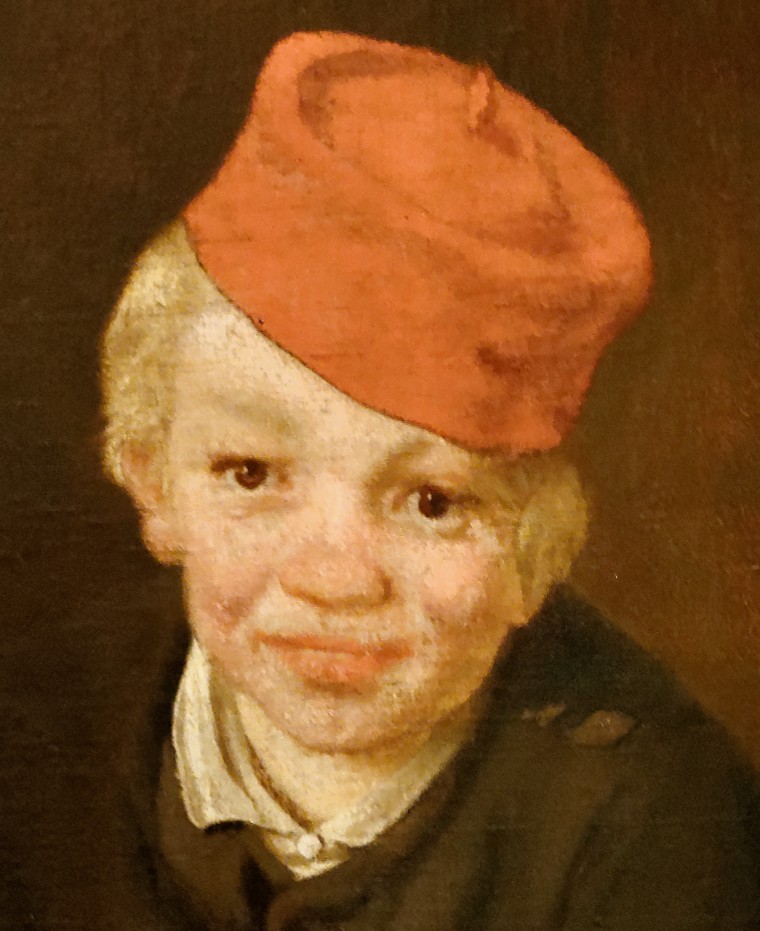
The cap tilts across the top of the head, rising towards the left before curving down on the right. Its red shape has an uneven outline and broad variations in tone. Set against the darker surroundings, it gives the upper part of the portrait a strong area of colour that can be recognised before the smaller facial features.
Light hair appears beneath it, especially beside the forehead and ears. The face turns towards the viewer, with a slight inclination that follows the cap’s asymmetry. Dark eyes sit within pale surrounding passages, and warm pink and ochre tones distinguish the cheeks, nose and mouth.
The mouth has a gentle upward turn. Small changes around it contribute to the expression, while the boy’s direct gaze gives the portrait an immediate connection with the viewer.
A pale collar makes another light shape below the chin. Its folds and small central fastening interrupt the dark jacket, keeping the head visually connected to the body. The collar is much smaller than the red cap, but together they mark the upper and lower boundaries of the light face and hair.
Hands, Cherries and the Projecting Sleeve
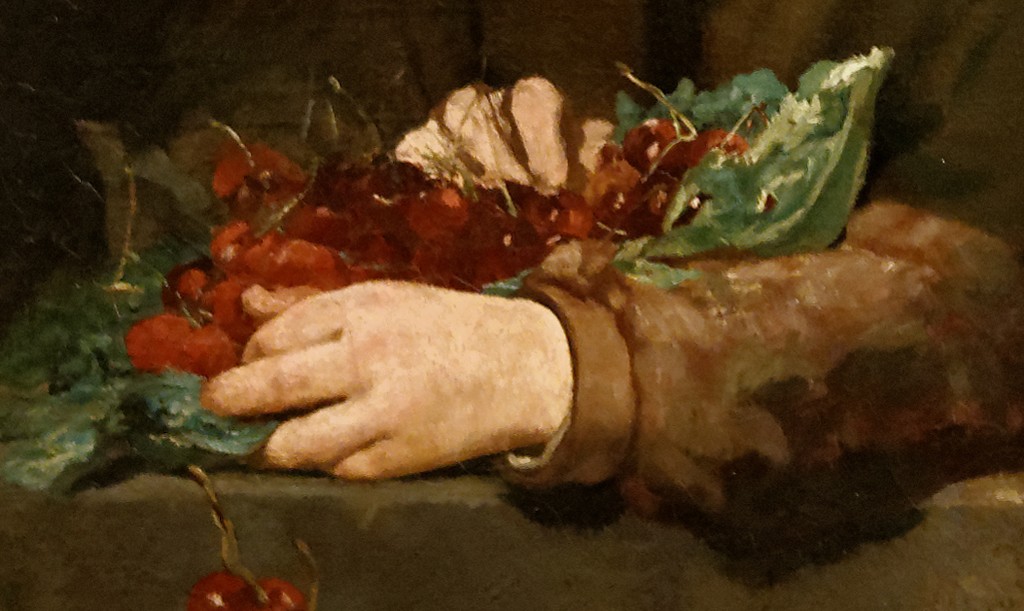
The hands bring the portrait into contact with the fruit. One extends towards the left across the foreground, its fingers lying beside the cherries and leaves. The other appears farther back, with several fingers rising among the stems. Their different positions create an interval of fruit between the nearer hand and the body.
Red cherries collect into a dense group. Some are described as rounded forms with small bright touches, while others merge into darker red passages. Thin stems and green leaves interrupt the cluster. The differences between these marks make the fruit feel abundant without separating every cherry into an equally distinct outline.
The nearer sleeve crosses the ledge in a broad diagonal. Warmer brown passages distinguish it from the darker jacket above, while a narrow pale cuff appears beside the hand. Its rounded volume gives the lower foreground a substantial form, connecting the arm to the horizontal surface beneath it.
The cap’s red returns in the cherries. These separated areas of colour link the head with the foreground, while the green leaves create a cooler contrast around the hands.
A Signed Stone Parapet
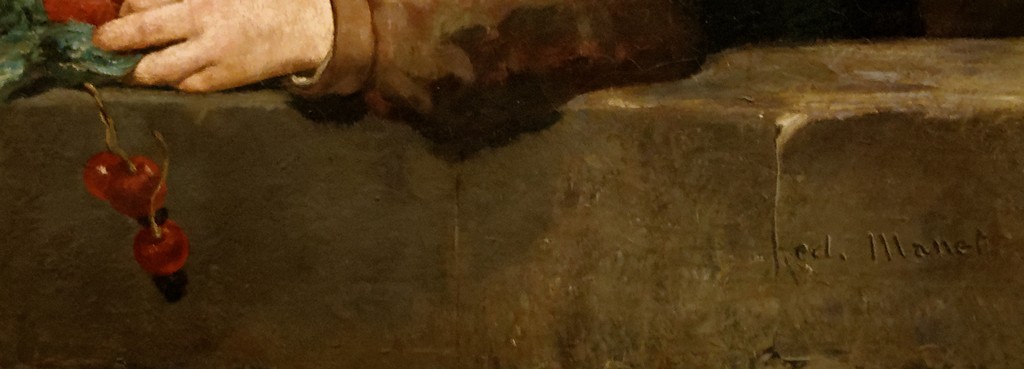
The ledge extends across the lower field. Its upper surface catches more light than its front, and a vertical division near the right helps establish the impression of separate stone blocks. The boy’s sleeve and the fruit overlap its top, making the barrier part of the figure’s immediate surroundings.
Two cherries hang down in front of it on a thin stem. Their bright red forms and small dark shadow interrupt the broad stone-coloured area. This hanging pair carries the still life beyond the ledge’s upper surface and makes the foreground seem to approach the viewer.
At the lower right, Manet’s painted signature resembles an inscription in the stone. The letters belong to the depicted parapet as well as to the surface of the painting. Together with the projecting sleeve and fruit, they encourage attention to the place where the represented scene meets its edge.
The parapet also controls the framing. It conceals the lower body and provides a firm horizontal division beneath the boy. Above it, the dark background offers little description of a surrounding room. The ledge therefore supplies a more definite spatial boundary than anything behind the figure.
A Comparison with Titian
Art historian Rolf Læssøe proposed a probable allusion to Titian in the relationship between the parapet, signature and projecting forms. He compared Boy with Cherries with the portrait often called the man with a quilted sleeve, drawing attention to its similarly inscribed ledge and the sleeve’s movement towards the viewer.[2]
The National Gallery in London now titles that painting Portrait of Gerolamo (?) Barbarigo, retaining uncertainty about the sitter’s identity. It dates the oil on canvas to about 1510 and records its size as 81.2 × 66.3 cm, inventory NG1944.[3]
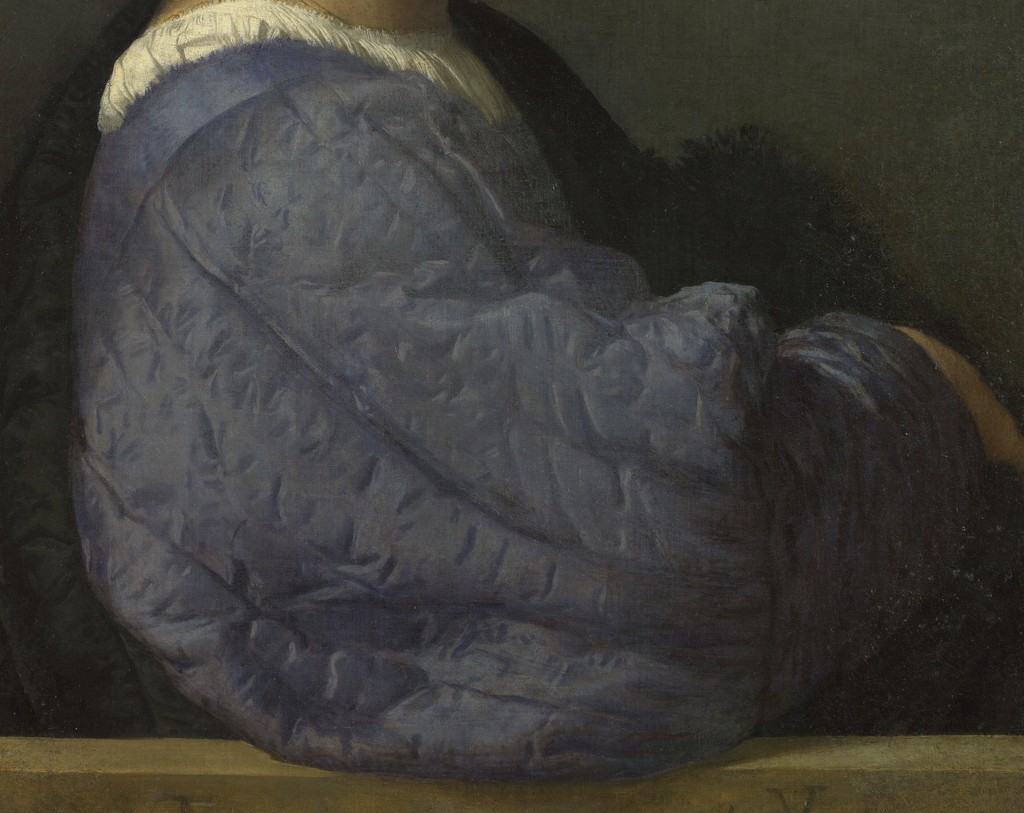
In Titian’s portrait, a man turns his head over his shoulder while a large blue sleeve occupies much of the lower foreground. A pale collar separates his neck from the dark clothing. The elbow meets a parapet, and the painted initials T.V. appear on its front. The National Gallery’s commentary emphasises how the sleeve projects into the viewer’s space.[3]
Manet’s boy has a more frontal face, while fruit and leaves share the space around the arm. The parapet supports several forms: the sleeve, hands, clustered cherries and the pair below.
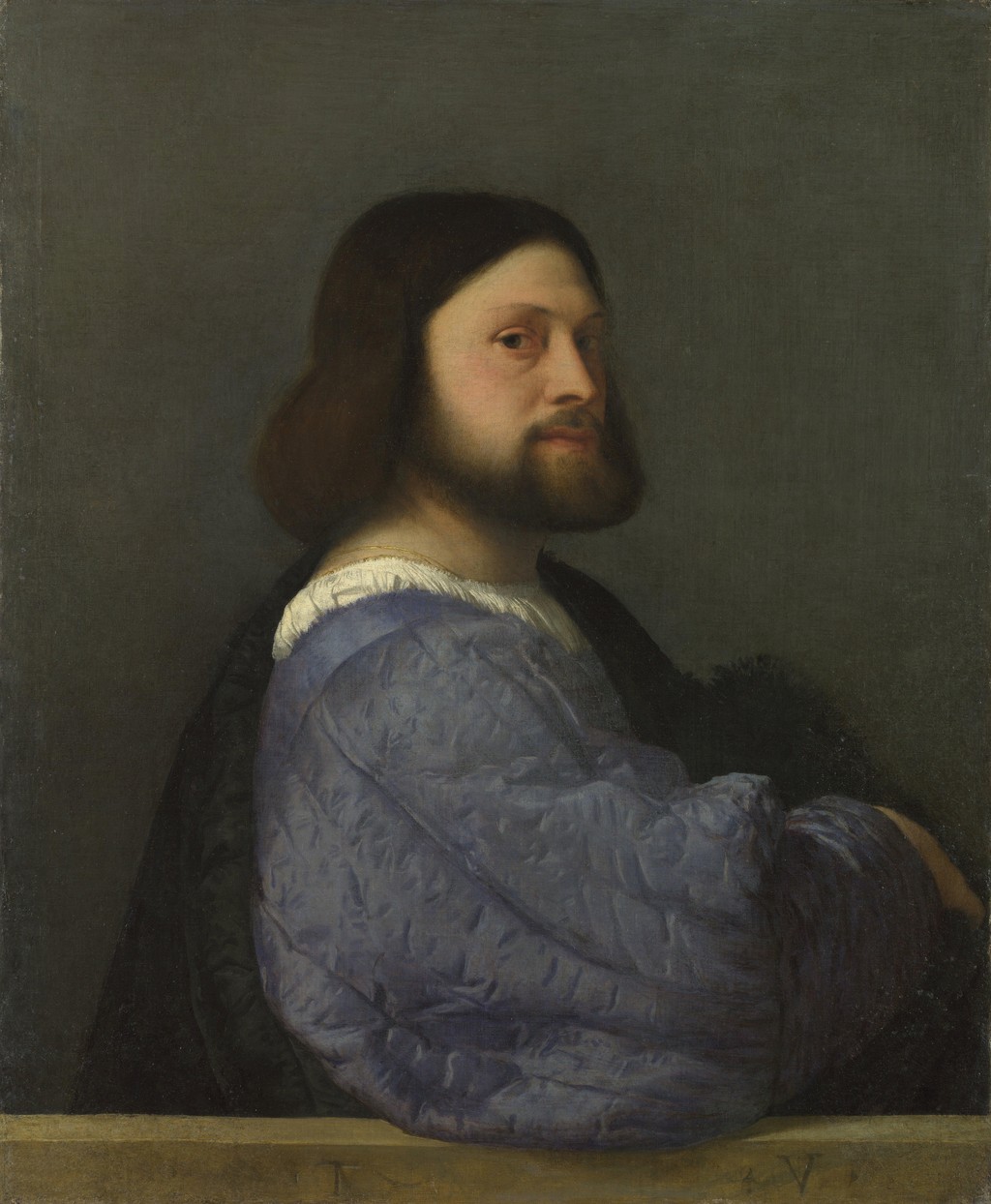
Titian, Portrait of Gerolamo (?) Barbarigo, about 1510. Oil on canvas, 81.2 × 66.3 cm. The National Gallery, London, NG1944; bought 1904. The National Gallery, London, via Wikimedia Commons; faithful public-domain reproduction. Image source. Public domain.
Portrait and Still Life
The Gulbenkian’s collection account places the work within a realist tradition associated with Caravaggio and seventeenth-century Dutch genre painting. It also reads the cherries as an allegory of the senses, evoking Ribera.[1] These connections locate the portrait among older approaches to ordinary people, objects and sensory experience.
The fruit has enough prominence to sustain attention beside the face. Its colour, leaves and position on the ledge give it a distinct place within the composition, while the hands make it part of the sitter’s pose.
The museum also identifies later reworking in the hands. In her 2009 essay, Gulbenkian curator Luísa Sampaio associated their handling with Manet’s later work.[1][4] This assessment draws attention to a particularly active part of the image: the fingers connect the figure to the fruit and help establish the nearer and farther planes of the foreground.
Alexandre and La Corde
The museum identifies the boy as Alexandre, an assistant who cleaned Manet’s brushes and posed for him. It reports that he later died by suicide at 15, and connects the episode with Charles Baudelaire’s short prose tale La Corde, first published in 1864.[1][4]
Baudelaire dedicated the work to Manet. In the French text, a narrator introduces a painter’s account of a young assistant; the story develops through that speaker’s expectations and discoveries.[5] Its literary form matters: the painter’s voice belongs to a constructed narrative rather than an autograph statement by Manet.
The dedication provides a clear connection between writer and artist, while the museum supplies the identification with Alexandre. The portrait’s expression can be described in its own visual terms, without making its smile a prediction of the later event or a diagnosis of the sitter’s private feelings.
From the Manet Family to Lisbon
The Gulbenkian’s provenance records the painting with Eugène Manet, then with the dealer Durand-Ruel and the collector Maurice Leclanché. Sampaio’s published account likewise traces its passage through the artist’s family and subsequent collections.[1][4]
Calouste Gulbenkian purchased it in Paris on 19 April 1910, from Leclanché through Bernheim Jeune.[1][4] That transaction brought this early portrait into the collection now housed in Lisbon, where its Portuguese title preserves the cherries as the work’s identifying subject.
Annotated Details from Boy with Cherries
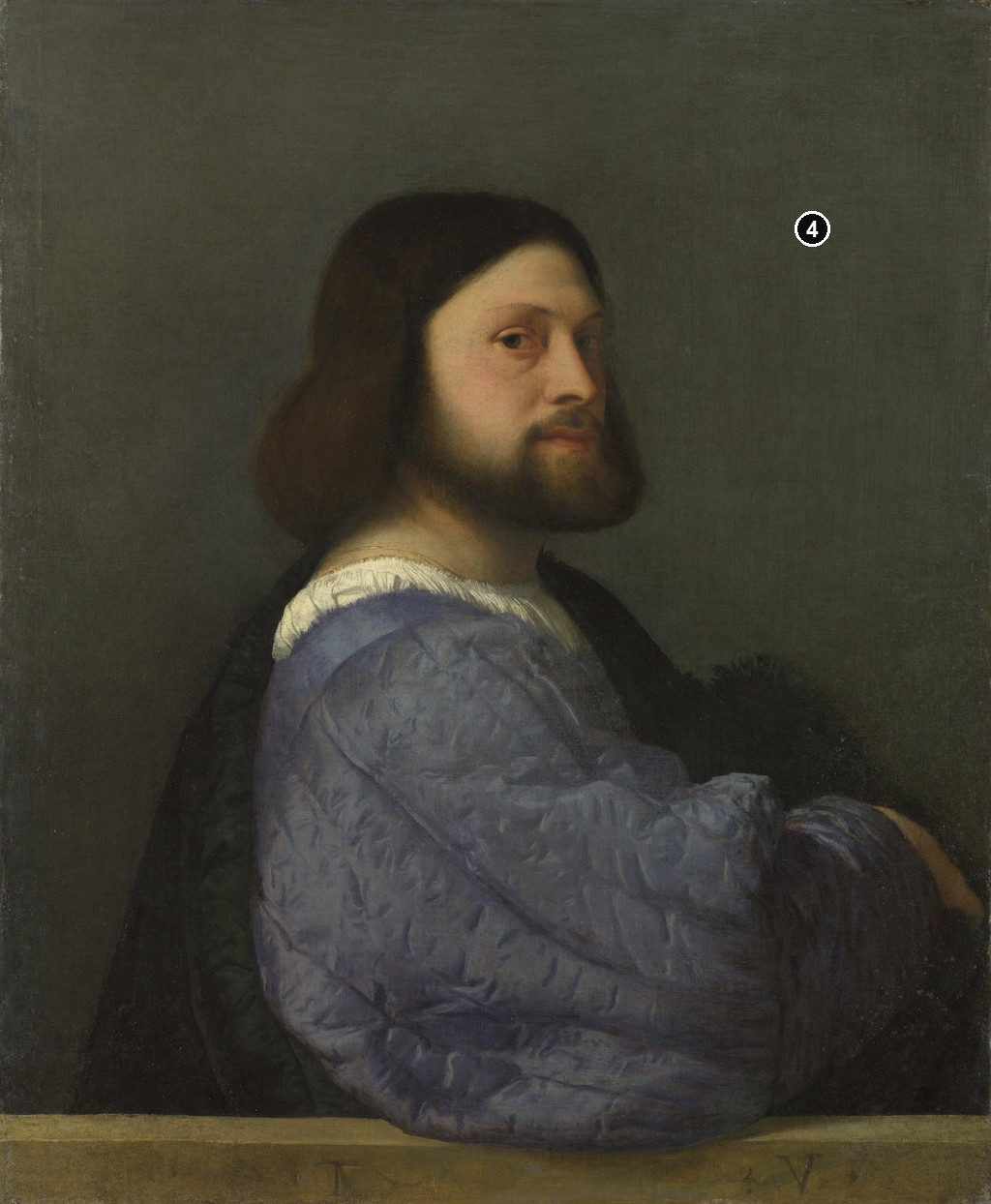
The numbered points identify visible features discussed in this article. Return from each detail to the whole composition. Each caption identifies the work shown.
Boy with Cherries
Édouard Manet, Boy with Cherries (O Rapaz das Cerejas), about 1858. Oil on canvas, 65.5 × 54.5 cm. Museu Calouste Gulbenkian, Lisbon, 395. Yelkrokoyade (photograph), via Wikimedia Commons, CC BY-SA 4.0; Museu Calouste Gulbenkian, Lisbon, 395. Image source. CC BY-SA 4.0. Numbered overview resized and annotated from Yelkrokoyade’s photograph; detail crops made from the same photograph. Overview and crop image derivatives: CC BY-SA 4.0.
Portrait of a Man with a Blue Sleeve — Titian
Titian, Portrait of Gerolamo (?) Barbarigo, about 1510. Oil on canvas, 81.2 × 66.3 cm. The National Gallery, London, NG1944; bought 1904. The National Gallery, London, via Wikimedia Commons; faithful public-domain reproduction. Image source. Public domain. Numbers added to a separate resized whole supplied overview. Detail crops from the unchanged original; no enlargement, retouching or colour alteration.
Details from BOY WITH CHERRIES
Follow the numbered details back to the complete images above. Each caption identifies the work shown.
Boy with Cherries
Cap, face and collar
The tilted red cap frames light hair and a pale face. Below the chin, the light collar meets the dark jacket, marking another boundary around the head.
Hands among the cherries
The nearer hand reaches across the ledge while the other fingers rise among the fruit and stems. Green leaves and red cherries fill the interval between them.
Hanging fruit and signature
Two cherries hang below the ledge’s upper surface. Farther right, the painted signature resembles an inscription in the stone; both features draw attention to the front of the parapet.
Portrait of a Man with a Blue Sleeve — Titian
Blue Sleeve above the Ledge
Broad folds carry the blue sleeve across the foreground above the narrow ledge.
Artworks directory
Explore selected paintings, drawings and prints by Édouard Manet. Search by title or another recorded name.
Frequently Asked Questions
The museum dates the painting to about 1858. It also identifies later reworking in the hands.[1]
It belongs to the Museu Calouste Gulbenkian in Lisbon, inventory 395. Gulbenkian purchased it in Paris on 19 April 1910.[1]
Discussion
Look again at the images and ideas explored in Boy with Cherries by Édouard Manet. These editorial prompts invite your observations.
Reader Insights
Compare the red cap with the cherries below. How does the repeated colour connect the head and foreground?
Follow the nearer sleeve across the parapet to the hand, then look at the hanging cherries. Which forms seem to come closest to the viewer?
Compare Manet’s arm, fruit and signature with Titian’s sleeve and initials. How does each painting use its stone barrier?
Join the Conversation
Share a detail, comparison or question about Boy with Cherries by Édouard Manet below.
References
- Museu Calouste Gulbenkian, O Rapaz das Cerejas, 395; current object facts, curatorial account, provenance and acquisition details, cross-checked with the museum’s English record (in Portuguese). View source.
- Rolf Læssøe, “Édouard Manet’s Le Déjeuner sur l’herbe as a Veiled Allegory of Painting,” Artibus et Historiae 26, no. 51 (2005), pp. 195–220; the bounded comparison on p. 207, figures 16–17 and note 34 (in English). View source.
- National Gallery, London, Portrait of Gerolamo (?) Barbarigo, Titian, NG1944; current collection commentary and object facts (in English). View source.
- Luísa Sampaio, “Édouard Manet: O Rapaz das Cerejas,” Gulbenkian Newsletter 99, January 2009, p. 31; complete short essay and caption (in Portuguese). View source.
- Charles Baudelaire, La Corde, dedicated to Édouard Manet, Petits Poèmes en prose, 1869, pp. 92–97; complete Wikisource transcription of the literary text (in French). View source.
- Splash image, Édouard Manet, Boy with Cherries (O Rapaz das Cerejas), about 1858. Oil on canvas, 65.5 × 54.5 cm. Museu Calouste Gulbenkian, Lisbon, 395. Yelkrokoyade (photograph), via Wikimedia Commons, CC BY-SA 4.0; Museu Calouste Gulbenkian, Lisbon, 395. Image source. CC BY-SA 4.0. Resized from Yelkrokoyade’s photograph; image derivative under CC BY-SA 4.0.


