



 by Tom Gurney
Tom Gurney BSc (Hons) is an art history expert with over 20 years experience
Published on June 19, 2020 / Updated on October 30, 2026
Email: tomgurney1@gmail.com / Phone: +44 7429 011000
Carnations and Clematis in a Crystal Vase by Édouard Manet: Introduction
A large dark clematis opens above a tall transparent vase, while pink-red carnations rise on thin stems towards the upper left. Broad green leaves spread sideways, giving the bouquet a wider middle beneath its more delicate upper flowers. Édouard Manet’s Carnations and Clematis in a Crystal Vase brings these different shapes together against a grey background.
The Musée d’Orsay dates the oil painting to about 1882 and gives its dimensions as 56 × 35.5 cm. The work, numbered MNR 631, is entrusted to the museum and has been on deposit at Musée Fabre in Montpellier since 2023.[1] Its upright format gives substantial space to the clear vessel and the stems below the flowers, as well as to the bouquet itself.
At a Glance
- ArtistÉdouard Manet
- TitleCarnations and Clematis in a Crystal Vase; Œillets et clématite dans un vase de cristal
- DateAbout 1882.[1]
- MediumOil on canvas
- Dimensions56 × 35.5 cm.[1]
- LocationEntrusted to Musée d’Orsay; on deposit at Musée Fabre, Montpellier, since 2023, MNR 631.[1]
This work across Édouard Manet’s career
Contents
- The Central Clematis
- Carnations above the Bouquet
- Leaves and Sideways Movement
- Stems inside the Crystal Vase
- The Base and Grey Setting
- A Late Flower Painting
- Another Crystal Bouquet
- Recovery and Museum Custody
- Annotated details
The Central Clematis
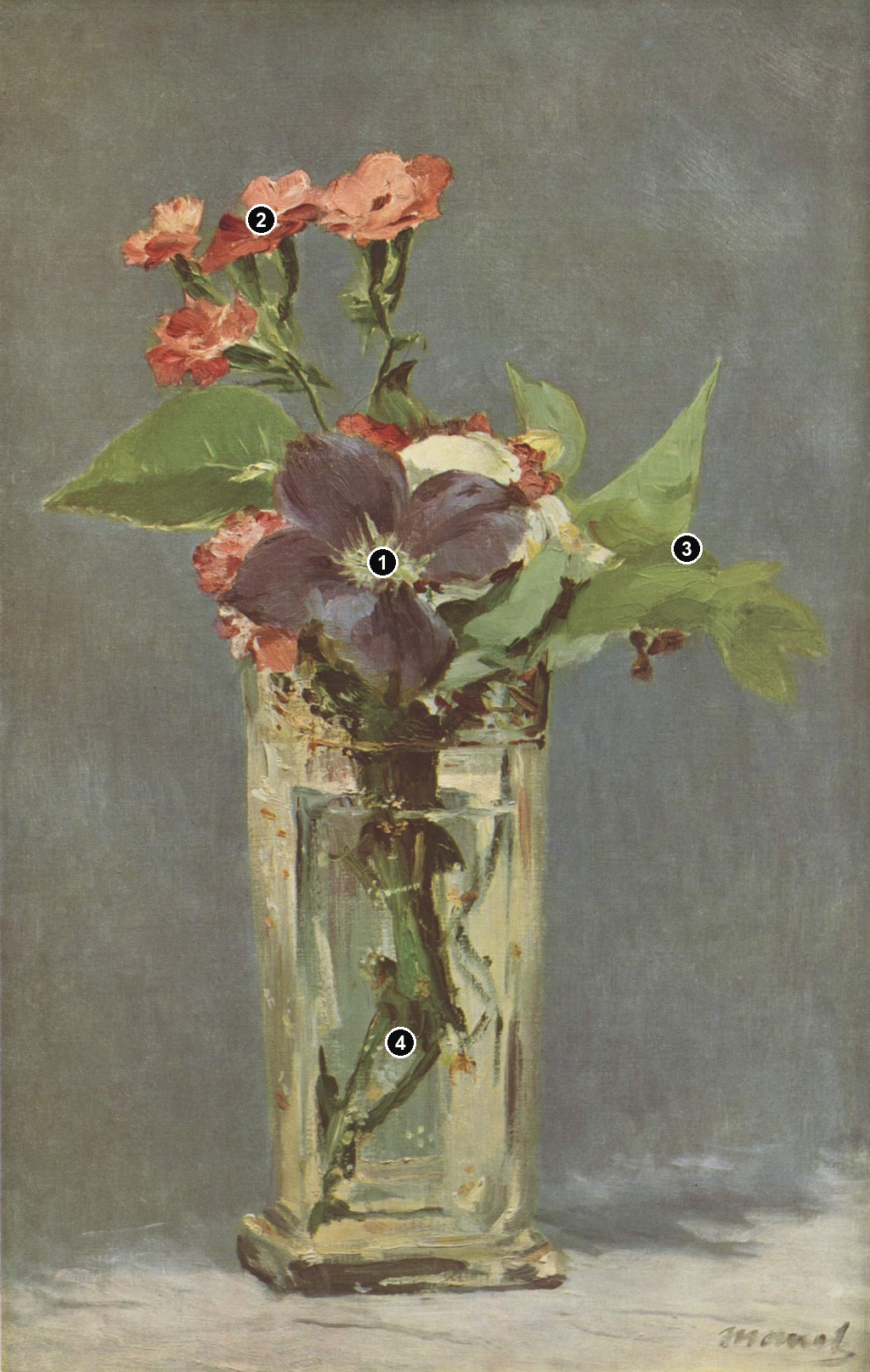
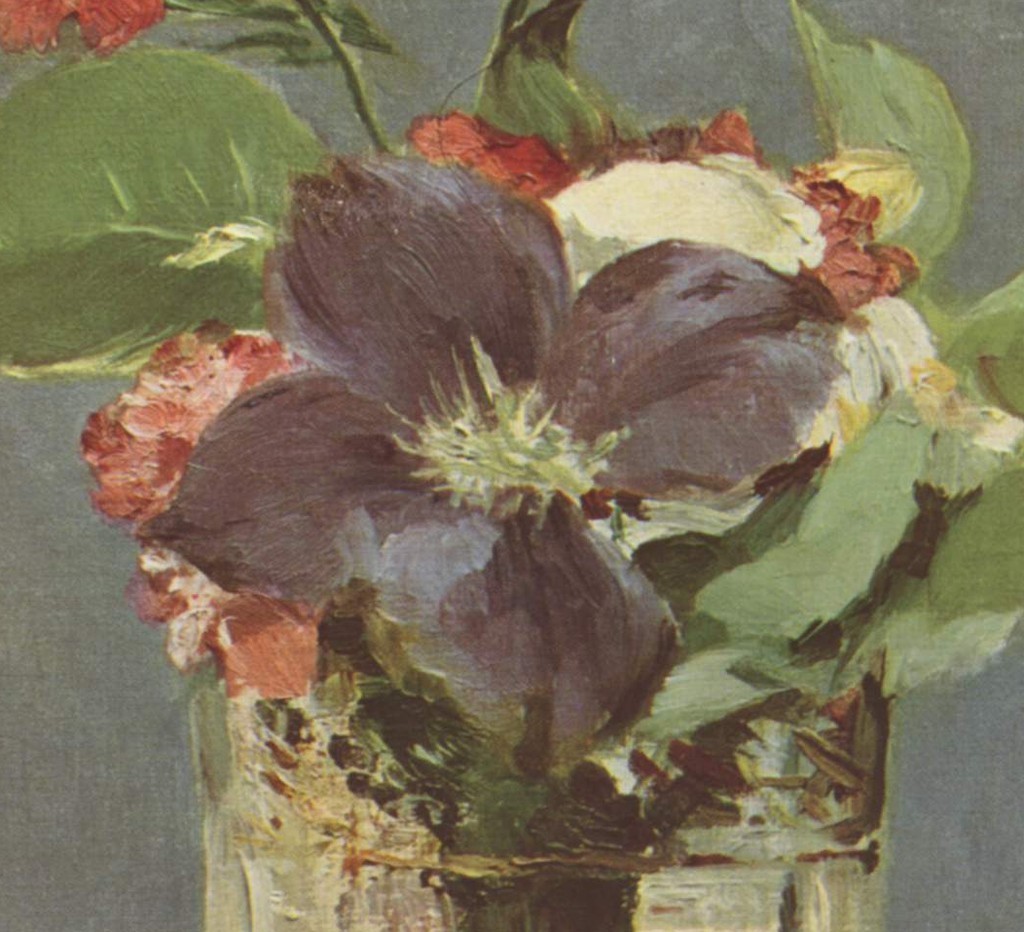
The clematis faces outwards near the middle of the composition. Its broad, dark blue-violet petals spread around a small pale centre, making a strong contrast within the bouquet. The centre contains short, narrow yellow-green touches which radiate into the surrounding darker shapes.
Each petal has a different outline and direction. One extends towards the left, another opens broadly to the right, and a lower petal descends towards the vase mouth. Lighter passages cross their surfaces, varying the darker shapes.
A pale bloom is partly hidden behind the upper right of the clematis. Warm-coloured petals appear at its left and around the top of the vase. These glimpses suggest overlapping flowers, some turned towards the viewer and others obscured within the arrangement.
Carnations above the Bouquet
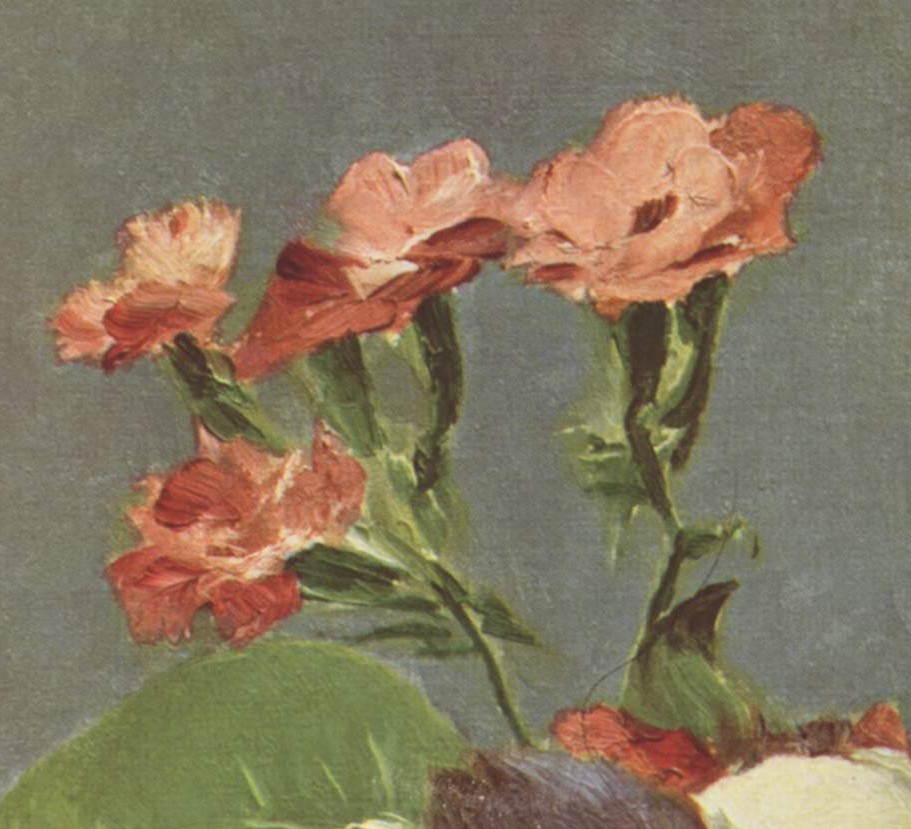
The tallest carnations occupy the upper left of the picture. Their thin stems lift the warm flower heads into the grey space, away from the broad clematis. Pink, red and pale touches describe irregularly folded petals, with darker shapes beneath the lighter upper edges.
The flowers differ in height and inclination. Some open more widely, while others offer a smaller profile. Their stems are also uneven: short leaves and changes of direction interrupt the lines as they rise. One lower carnation turns out from the left side, introducing a warm accent between the upper group and the larger leaves beneath it.
This more open part of the bouquet gives the upper picture a different rhythm. The stems can be followed individually, and the grey background shows through the spaces between them.
Leaves and Sideways Movement
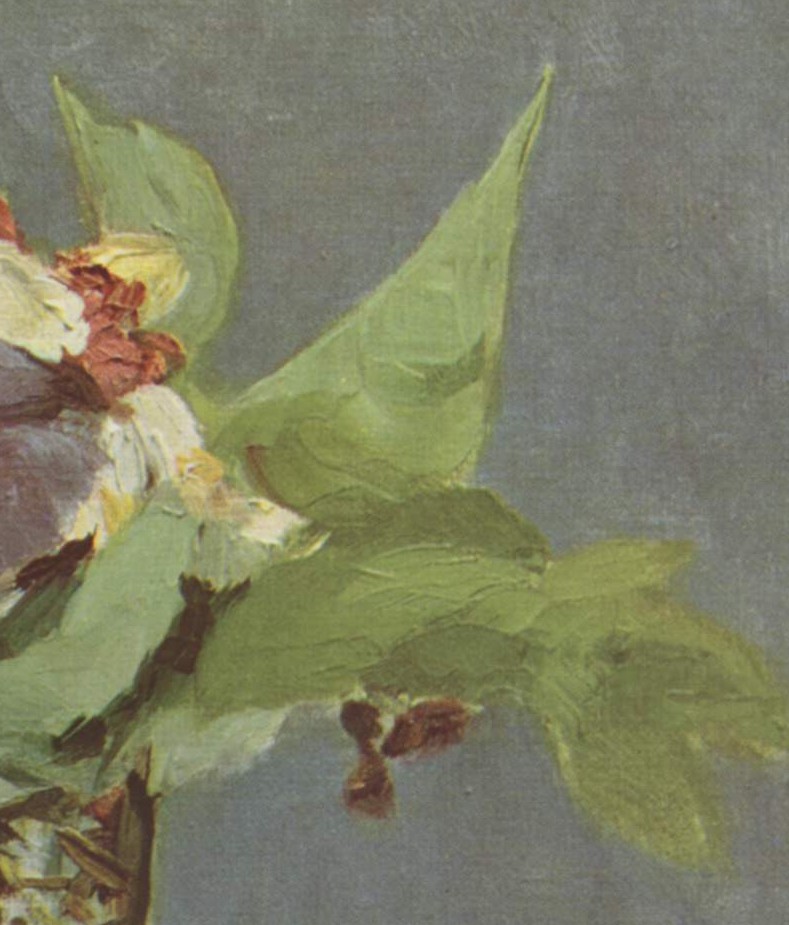
A broad leaf projects towards the left edge below the carnations. Its pointed end and sloping lower outline carry the bouquet sideways, balancing the upward movement of the stems. Pale marks cross its green surface, while darker touches gather near its attachment to the flowers.
The right side contains several overlapping leaves. One rises to a narrow point; others extend more horizontally or bend downwards. Their changing angles keep the bouquet from forming a symmetrical fan. Small dark shapes appear beneath the outer right leaves, where the plant forms become less clearly separated.
The leaves also connect the different levels of the arrangement. Their stems converge near the vase opening, while their broader surfaces stretch between the central flower and the surrounding grey. Following their edges reveals alternating passages of open background and dense plant forms.
Stems inside the Crystal Vase
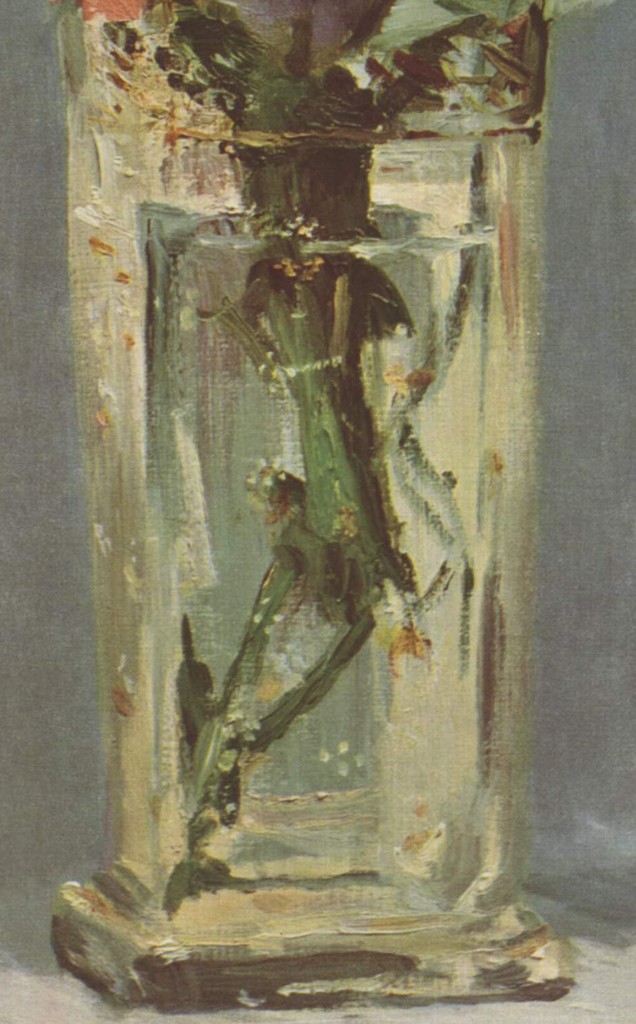
The clear vessel occupies much of the lower half of the painting. Its long upright sides provide a firm structure beneath the uneven flowers. Pale vertical passages mark the glass edges, while shorter horizontal touches describe the opening and changes across its body.
Green stems remain visible through the vase. They cross, bend and descend, creating a second arrangement within the transparent container. Some are dark and narrow; others become broader or lighter as they pass through the painted glass. A curved stem leads towards the lower left, while a straighter dark line gives the centre a more upright direction.
Manet makes the glass legible through the things seen inside it and the light touches around them. The vessel can appear almost colourless in one area and much brighter in another. Its transparency allows the grey of the setting, the pale surface and the green stems to meet within the same narrow space.
The Base and Grey Setting
The vase ends in an angular base close to the bottom of the canvas. Dark horizontal marks run along its lower edge, with lighter passages above. This comparatively solid shape gives the vessel a clear footing beneath the longer, more transparent body.
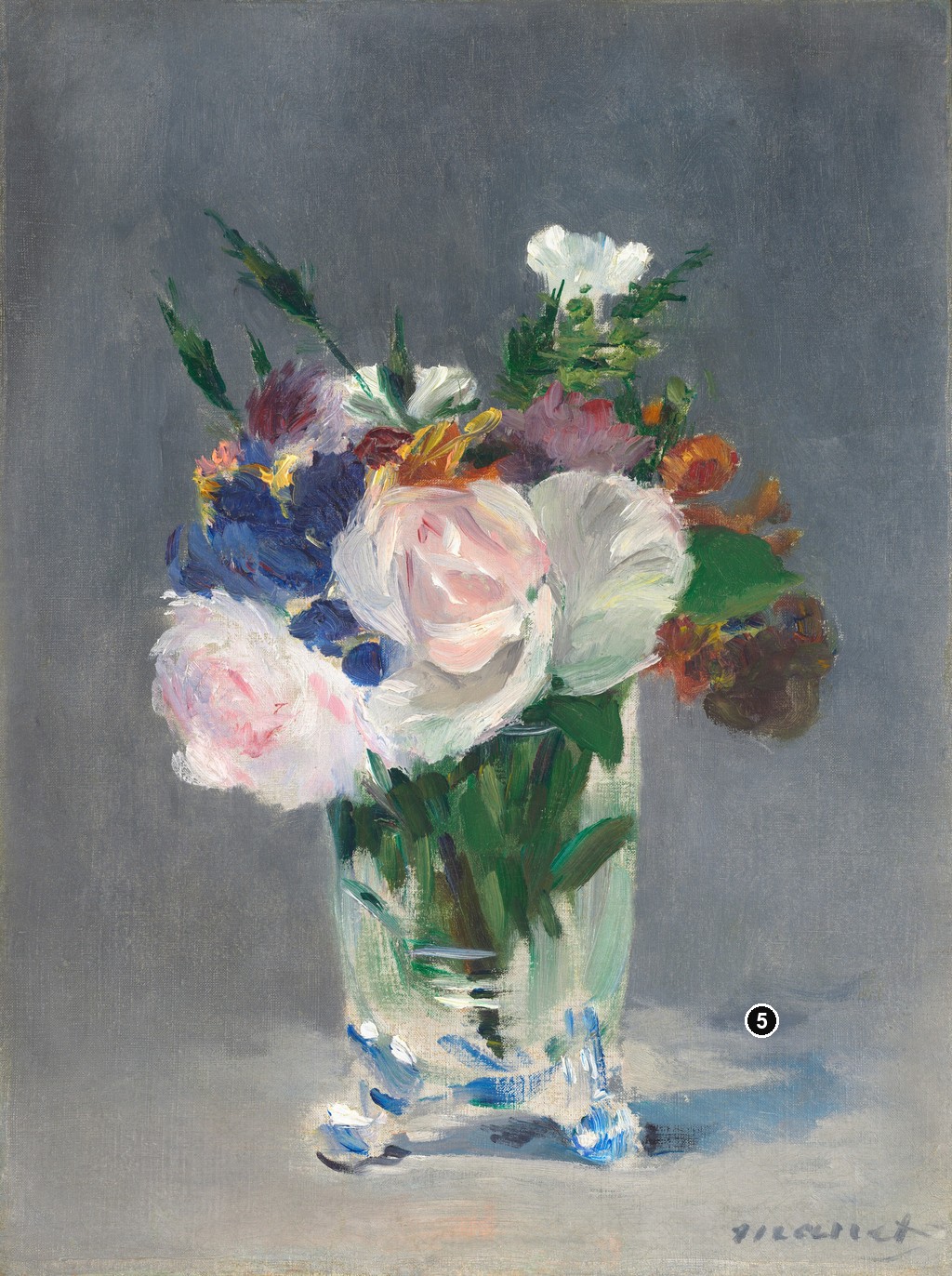
A darker shadow extends to the right across the pale support. Its edges soften into surrounding strokes, and the surface changes gradually into the grey background. The setting remains spare enough for the shapes of the flowers and glass to stand out.
Above the bouquet, the grey field occupies a generous amount of space. Its variations are quieter than the concentrated colours of the flowers. The open area makes the small gaps around the carnations particularly visible, while the signature at the lower right adds a brief dark mark beyond the vase.
A Late Flower Painting
The Musée d’Orsay suggests that the picture may have been painted at Rueil, probably in July 1882.[1]
The museum’s account of its 2000–2001 still-life exhibition describes a later tendency to isolate a few flowers, fruits or vegetables against simple settings. It also draws attention to crystal vases which reveal the interlacing stems beneath bouquets.[2] Those two concerns meet here: a restrained setting surrounds the flowers, while the transparent container gives their stems a substantial role in the composition.
Another Crystal Bouquet
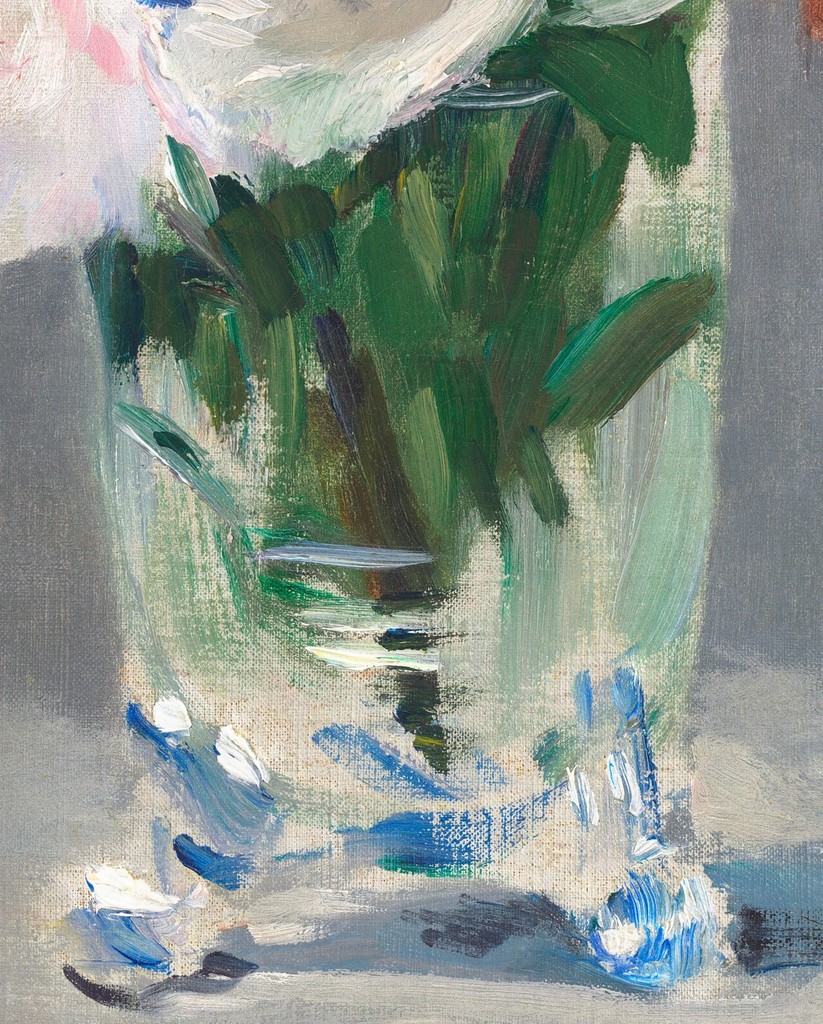
Manet’s Flowers in a Crystal Vase at the National Gallery of Art in Washington offers a related arrangement from about 1882. The smaller oil painting measures 32.7 × 24.5 cm and belongs to the Ailsa Mellon Bruce Collection, accession 1970.17.37.[3]
Its bouquet is fuller, with large pale flowers gathered close together and blue, orange and green touches appearing between them. The clear vase is shorter in relation to the flowers and rests on small rounded feet. Here, by contrast, the tall glass body and the spaces between the upper carnations contribute strongly to the picture’s vertical shape. The comparison brings out how differently Manet could distribute flowers, stems and empty space within the same general subject.
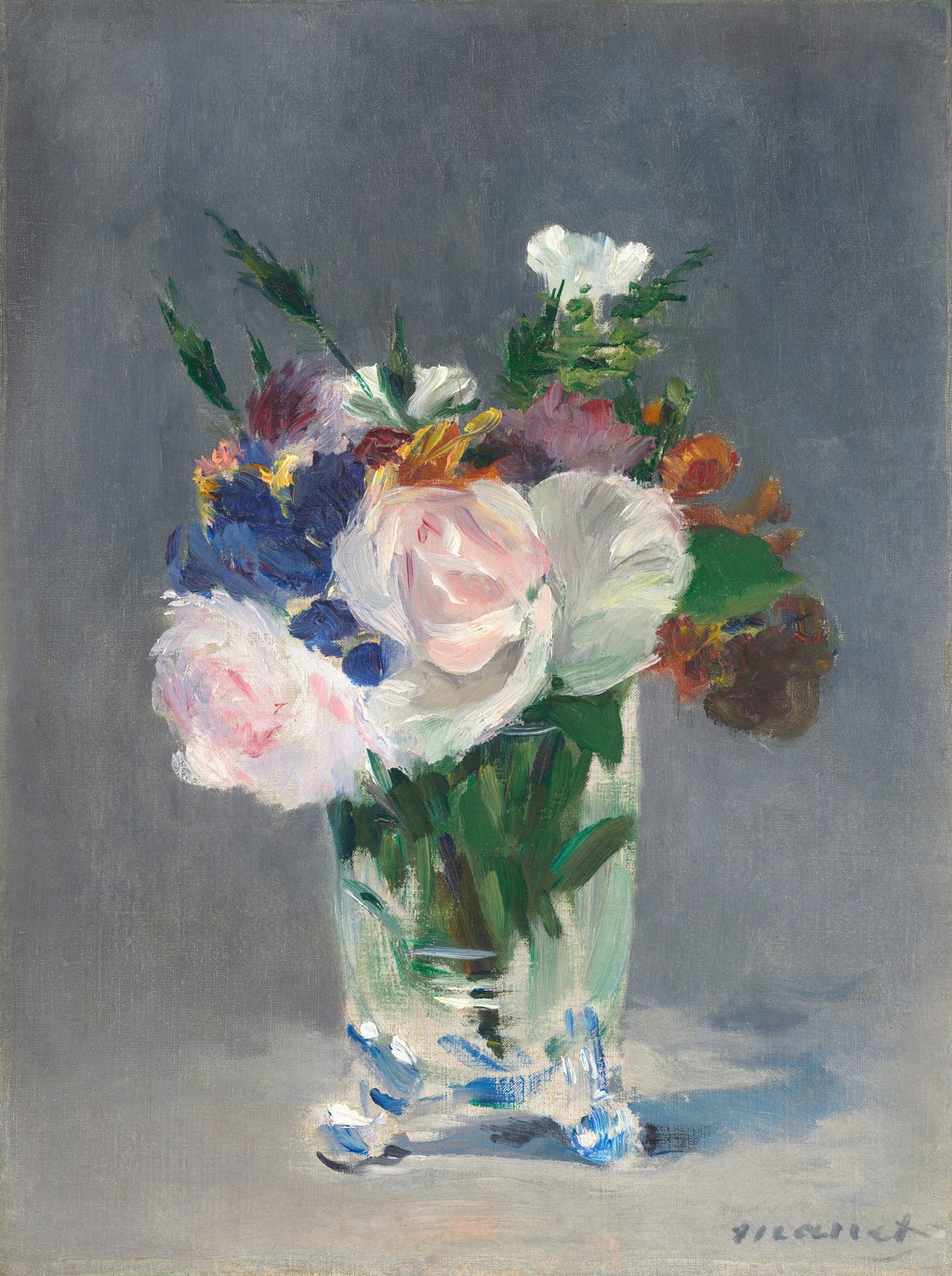
Édouard Manet, Flowers in a Crystal Vase, about 1882. Oil on canvas, 32.7 × 24.5 cm. National Gallery of Art, Washington, Ailsa Mellon Bruce Collection, 1970.17.37. Courtesy National Gallery of Art, Washington, Ailsa Mellon Bruce Collection. Image source. CC0 / Public domain.
Recovery and Museum Custody
The painting’s later history includes its recovery after the Second World War. According to the French Ministry of Culture’s Rose-Valland record, Adolf Wüster bought it from Georges Renand for Joachim von Ribbentrop in 1941. Found in a Hamburg storage depot, it was repatriated to France on 22 October 1948.[4]
It was entrusted to the national museums in 1951, later placed in the care of Musée d’Orsay in 1986, and deposited at Musée Fabre in 2023.[1][4] The Ministry currently categorises it as probably not looted in the present state of research, while warning that its database does not constitute proof of past or present ownership.[4]
Annotated Details from Carnations and Clematis in a Crystal Vase
The numbered points identify visible features discussed in this article. Return from each detail to the whole composition. Each caption identifies the work shown.
Carnations and Clematis in a Crystal Vase
Édouard Manet, Carnations and Clematis in a Crystal Vase, about 1882. Oil on canvas, 56 × 35.5 cm. MNR 631, entrusted to Musée d’Orsay; on deposit at Musée Fabre, Montpellier, since 2023. Reproduction: The Yorck Project (2002), via Wikimedia Commons. Image source. Public domain.
Flowers in a Crystal Vase
Édouard Manet, Flowers in a Crystal Vase, about 1882. Oil on canvas, 32.7 × 24.5 cm. National Gallery of Art, Washington, Ailsa Mellon Bruce Collection, 1970.17.37. Courtesy National Gallery of Art, Washington, Ailsa Mellon Bruce Collection. Image source. CC0 / Public domain. Numbers added to a separate resized whole supplied overview. Detail crops from the unchanged original; no enlargement, retouching or colour alteration.
Details from CARNATIONS AND CLEMATIS IN A CRYSTAL VASE
Follow the numbered details back to the complete images above. Each caption identifies the work shown.
Carnations and Clematis in a Crystal Vase
The central clematis
Broad dark petals surround a small pale centre. A partly hidden light bloom and smaller warm flowers reveal how the forms overlap above the vase opening.
Carnations and their stems
Warm flower heads rise on slender stems with small leaves. Grey spaces separate the upper flowers and make their different heights and inclinations visible.
Leaves on the right
Pointed leaves rise, extend sideways and bend downwards. Their changing angles widen the bouquet beyond the vase and interrupt the grey background.
Glass, stems and base
Crossing green stems remain visible inside the clear vessel. Pale vertical touches describe its sides, while a darker angular base rests on the light surface.
Flowers in a Crystal Vase
Stems, Water and the Glass Foot
Long green stems cross inside the pale glass above the bright curved foot and its shadow.
Artworks directory
Explore selected paintings, drawings and prints by Édouard Manet. Search by title or another recorded name.
Frequently Asked Questions
The Musée d’Orsay dates it to about 1882. It suggests Rueil as a possible place of execution and July 1882 as the probable month.[1]
The painting is entrusted to Musée d’Orsay and has been on deposit at Musée Fabre, Montpellier, since 2023. Its inventory number is MNR 631.[1]
Carnations rise on slender stems above a large open clematis. Smaller blooms and broad green leaves gather around the central flower and the vase opening.
Discussion
Look again at the images and ideas explored in Carnations and Clematis in a Crystal Vase by Édouard Manet. These editorial prompts invite your observations.
Reader Insights
Compare the tall carnations with the large clematis near the vase mouth. How do their different heights and shapes affect the balance of the bouquet?
Follow the lines inside the glass. Where do they cross or change direction, and how do the pale marks around them suggest the vessel?
Look at the grey spaces around the upper flowers and side leaves. Which gaps most clearly separate individual plant forms?
Join the Conversation
Share a detail, comparison or question about Carnations and Clematis in a Crystal Vase by Édouard Manet below.
References
- Musée d’Orsay, Oeillets et clématite dans un vase de cristal, MNR 631, object 1138; current facts, qualified date note, custody and deposit history (in French). View source.
- Musée d’Orsay, Manet. Les natures mortes, exhibition presentation, 11 October 2000–7 January 2001; discussion of later still lifes and crystal vases (in French). View source.
- National Gallery of Art, Flowers in a Crystal Vase, c. 1882, 1970.17.37; current object facts and illustration (in English). View source.
- Ministère de la Culture, Rose-Valland database, Œillets et clématite dans un vase de cristal, MNR00631; provenance, recovery, custody, qualified category and database warning (in French). View source.
- Splash image, Édouard Manet, Carnations and Clematis in a Crystal Vase, about 1882. Oil on canvas, 56 × 35.5 cm. MNR 631, entrusted to Musée d’Orsay; on deposit at Musée Fabre, Montpellier, since 2023. Reproduction: The Yorck Project (2002), via Wikimedia Commons. Image source. Public domain.


