



 by Tom Gurney
Tom Gurney BSc (Hons) is an art history expert with over 20 years experience
Published on June 19, 2020 / Updated on October 30, 2026
Email: tomgurney1@gmail.com / Phone: +44 7429 011000
A Good Glass of Beer by Édouard Manet: Introduction
A bearded man faces us with a pipe at his mouth and a glass of beer beside him. His pale collar and hands stand out against a dark coat, while smoke drifts into the shadow behind his head. Édouard Manet painted A Good Glass of Beer, usually known by its French title Le Bon Bock, in 1873. The picture belongs to the Philadelphia Museum of Art.[1]
At a Glance
- ArtistÉdouard Manet
- TitleLe Bon Bock; A Good Glass of Beer
- Date1873.[1]
- MediumOil on canvas
- Dimensions94.6 × 83.3 cm.[1]
- CollectionPhiladelphia Museum of Art, 1963-116-9.[1]
This work across Édouard Manet’s career
Contents
- A Face Turned towards the Viewer
- The Pipe and the Two Hands
- The Glass and Its Reflection
- Pale Fabric and Dark Clothing
- Bellot and the Work of Posing
- The Salon and the Connection with Hals
- Comparing Two Drinkers
- From Faure to Philadelphia
- Annotated details
A Face Turned towards the Viewer
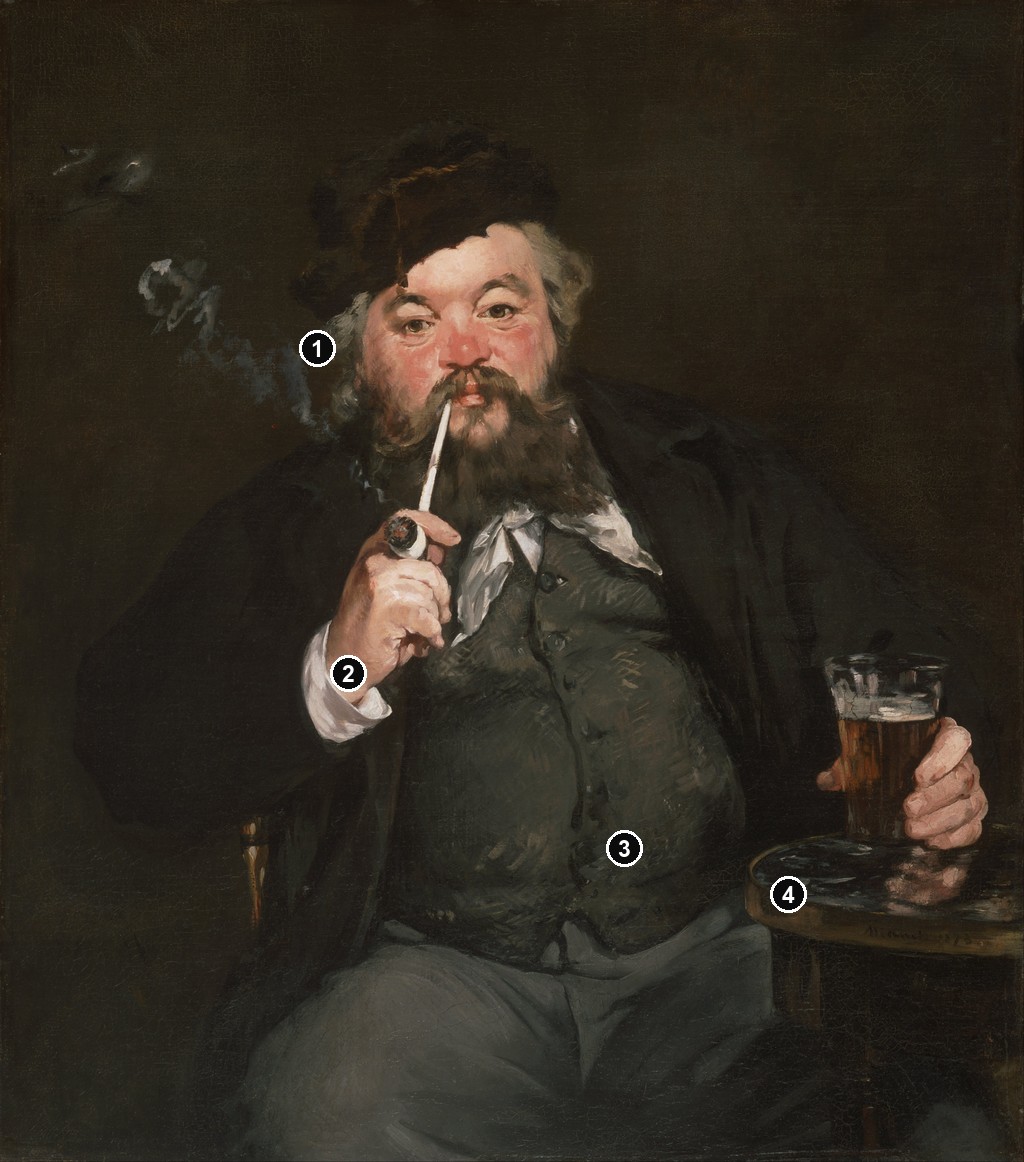
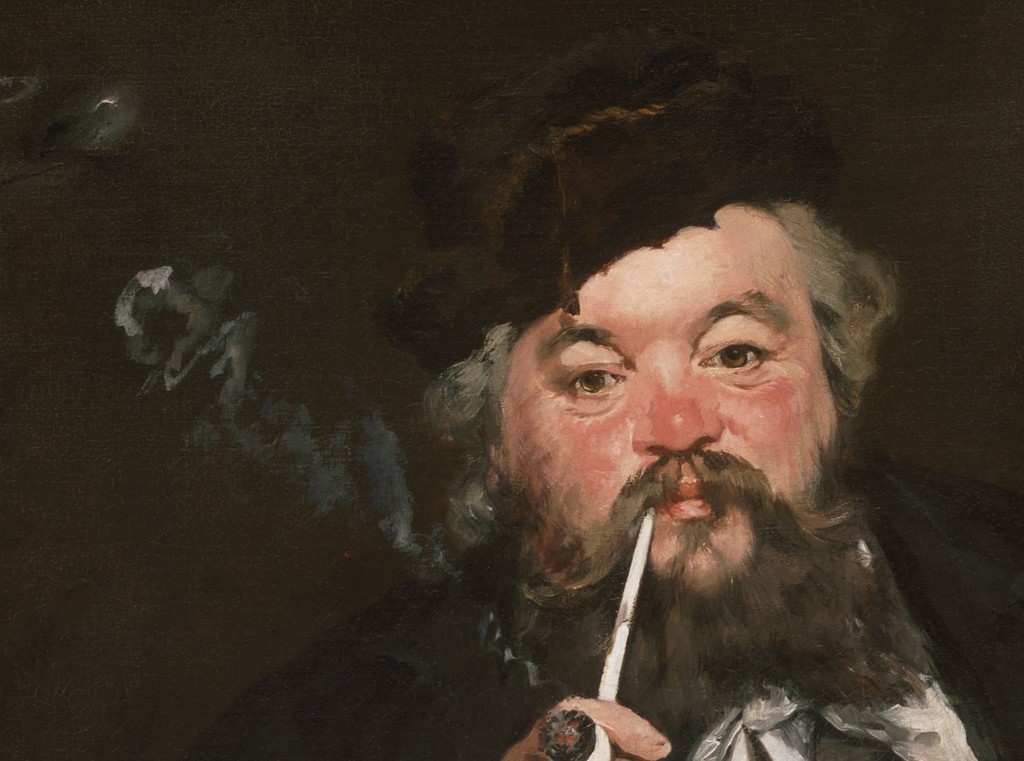
The sitter’s head occupies the upper centre of the canvas, with a dark cap tilted across his forehead. Grey curls spread at the sides, and a full beard surrounds the mouth. Pink and reddish passages bring warmth to the cheeks and nose. Small darker touches describe the eyes, whose direction establishes a close encounter with the viewer.
This direct gaze gives the face a different role from the objects below. The man appears to have paused while looking out from the picture. His mouth remains partly hidden by the pipe stem and moustache, so the expression depends particularly on the eyes and the coloured planes around them.
The cap is less sharply separated from the background than the face. Warm brown touches mark its upper edge, while its darker areas merge with the surrounding shadow.
The Pipe and the Two Hands
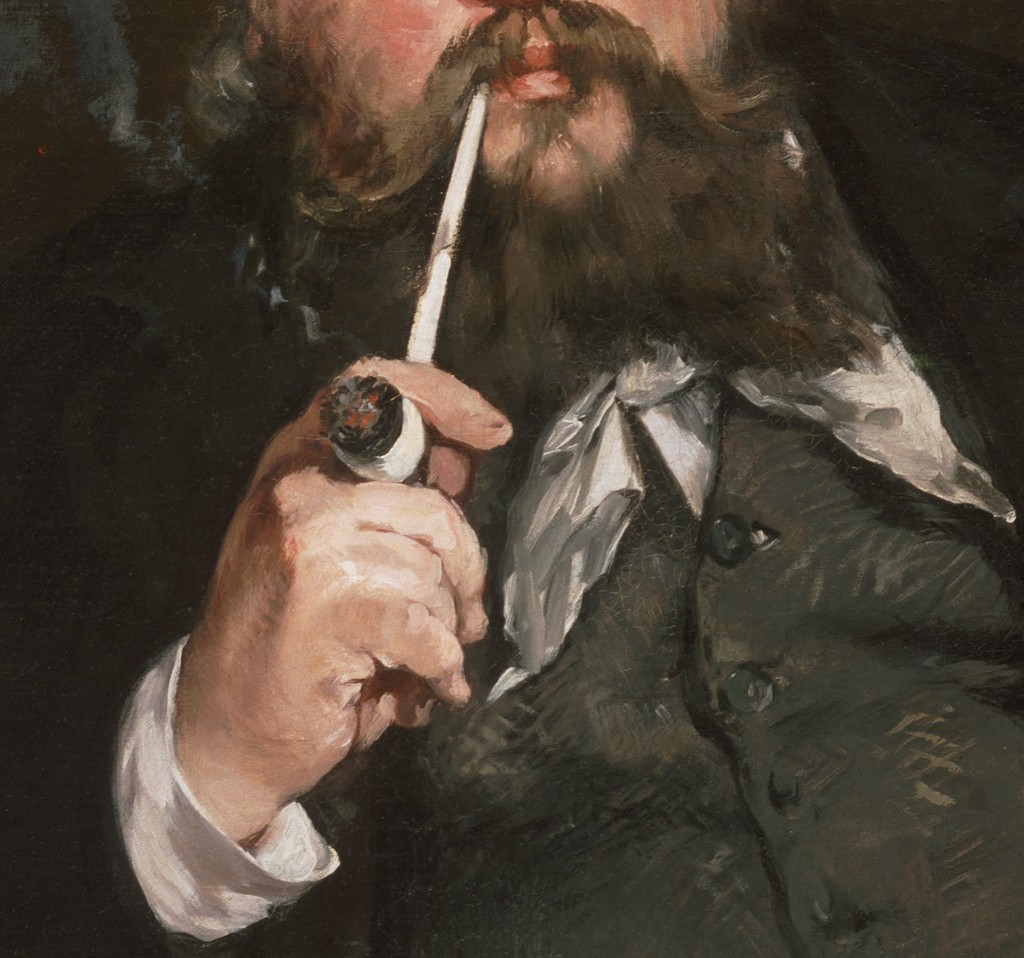
On the left side of the image, a raised hand supports the pipe bowl. The long, narrow stem runs diagonally towards the mouth, making an unusually clear pale line through the darker beard. The thumb and curved fingers gather around the bowl, where a small reddish mark interrupts the dark centre.
The other hand is lower and farther out, wrapped around the glass at the right. Its fingers make a broad light shape against the brown drink and dark sleeve. The two hands give the pose an asymmetrical structure: one rises towards the face, while the other extends towards the table. Between them, the waistcoat fills the middle of the canvas.
Above the pipe, a thin blue-grey trail of smoke curls to the left of the head. Its broken, soft-edged marks contrast with the firmer stem. The smoke spreads into the background rather than forming a sharply bounded object, introducing a lighter movement beside the still, frontal face.
The Glass and Its Reflection
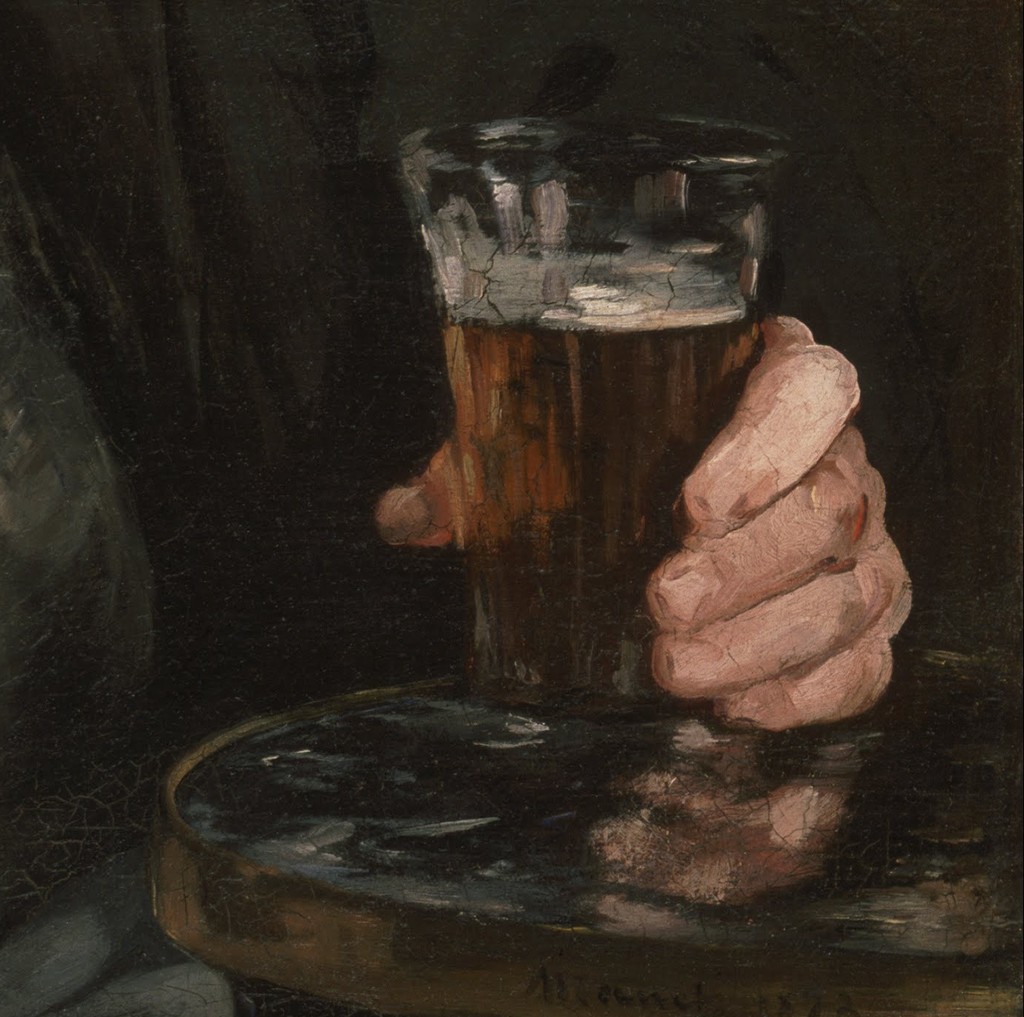
The beer glass sits close to the right edge, where it overlaps the small table. A bright rim and short pale reflections identify its transparent surface. The amber-brown drink gives this corner a warmer colour, while darker vertical marks remain visible within the glass. Near the top of the liquid, a narrow pale band runs across it.
Below, the tabletop repeats the glass and hand in a blurred reflection. These marks are less definite than the objects above: pale touches and brown areas spread across the dark surface without describing a second complete hand or vessel.
A curved brown-gold rim separates the table from the surrounding coat and ground. Only part of this piece of furniture appears, but its rounded edge provides a firm support for the glass. Together, glass, fingers, reflection and rim form a compact group near the margin, balancing the larger pale area of the pipe hand.
Pale Fabric and Dark Clothing
The collar and cuff supply some of the lightest passages in the painting. At the neck, folded fabric spreads out below the beard in irregular points. Long grey marks divide these pale shapes, making the collar look crumpled rather than smoothly pressed. At the wrist, the cuff bends around the raised hand and disappears beneath the sleeve.
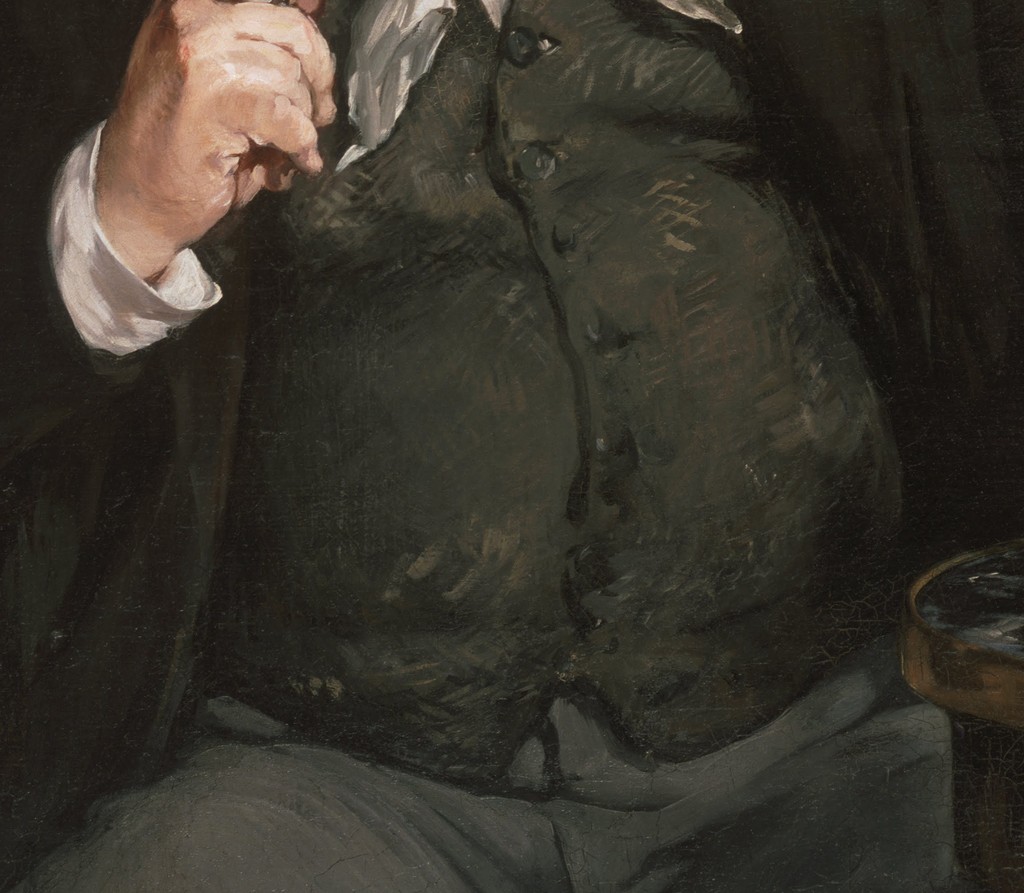
The waistcoat is built from broader olive-grey and brown passages, crossed by shorter, slanting strokes. Buttons interrupt its front. Its lighter colour distinguishes the torso from the nearly black coat, whose outer edges sometimes dissolve into the background. Lower down, the trousers form a broad grey shape, carrying the figure towards the bottom edge.
These differences in handling keep the clothing varied. The pipe stem is narrow and distinct; the collar contains abrupt light-dark folds; the waistcoat spreads into broader marks. The figure’s volume emerges through those changes, with the hands and pale fabric acting as the clearest points of contact between separate garments.
Bellot and the Work of Posing
The Philadelphia museum’s handbook identifies the model as Bellot, a neighbour of Manet. It reports that he posed more than sixty times.[2] That account gives a useful counterpoint to the picture’s informal appearance. An apparently easy pause, with pipe and glass already in place, could emerge from repeated work with a sitter.
Writing in 1906, Théodore Duret described Bellot as an engraver who had frequented the Café Guerbois.[3] The portrait therefore connects an individual known within Manet’s social surroundings with the familiar figure of a drinker. The props are prominent, yet the face and its direct gaze keep the picture centred on a particular person.
The Salon and the Connection with Hals
Manet exhibited Le Bon Bock at the Paris Salon of 1873, where it received a favourable response. Christopher Riopelle’s museum handbook entry connects its warm tones and lively handling with the Dutch painting Manet had admired during a visit to Holland in 1872, particularly the work of Frans Hals.[2]
Duret later recalled that viewers found the picture’s restrained colours more agreeable than some of Manet’s earlier work. He also reported the image’s popularity in reproductions and a dinner named after it. While discussing the resemblance to Hals, Duret defended the handling as recognisably Manet’s own.[3] His account records how the painting’s old-master associations became part of its reception.
Comparing Two Drinkers
Hals’s The Merry Drinker, painted about 1628–30 and now in the Rijksmuseum, offers a useful comparison.[4] Both pictures bring a single man with a drink close to the viewer. Hats, facial hair, pale collars and conspicuous hands help organise each figure, but the gestures differ considerably.
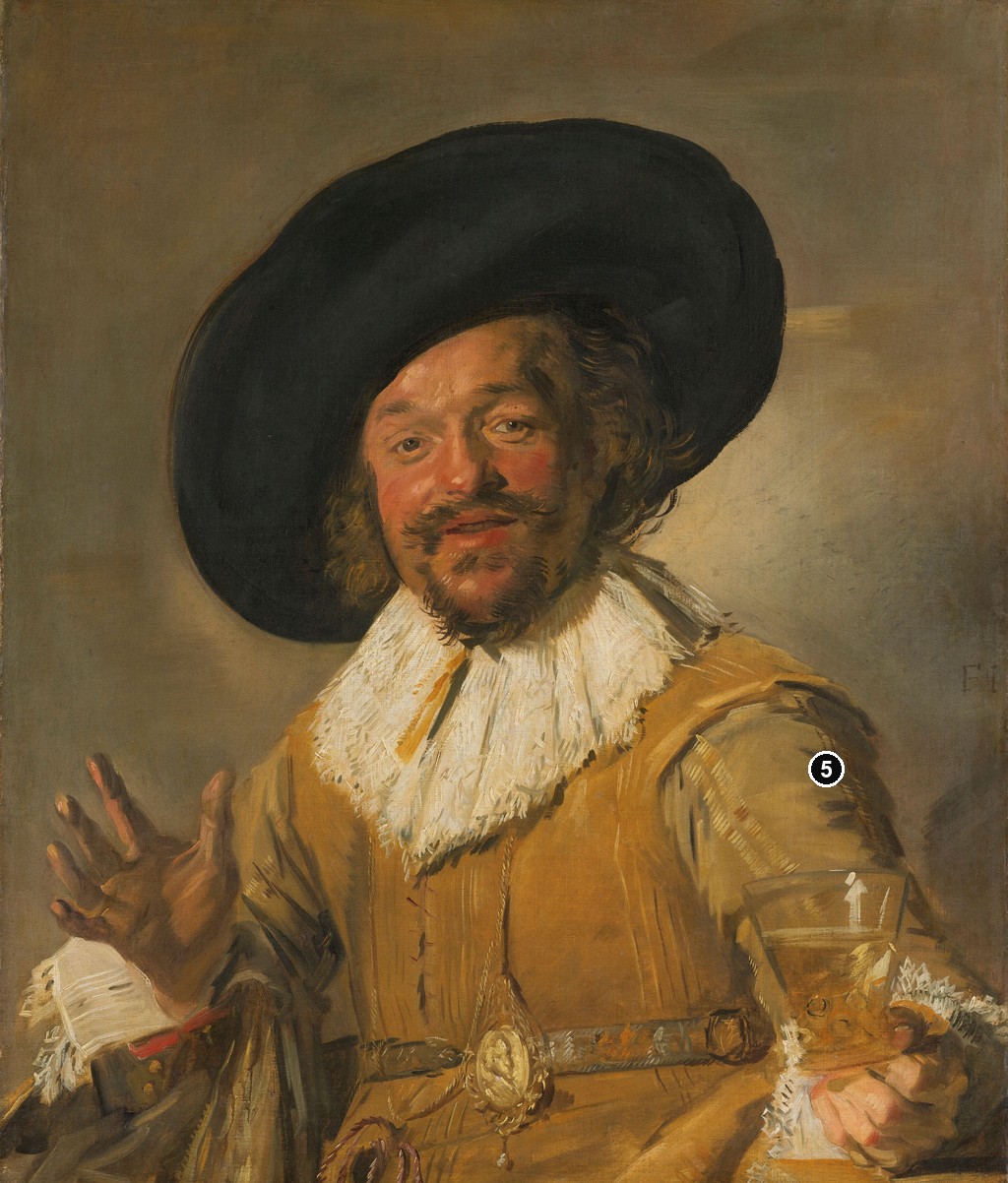
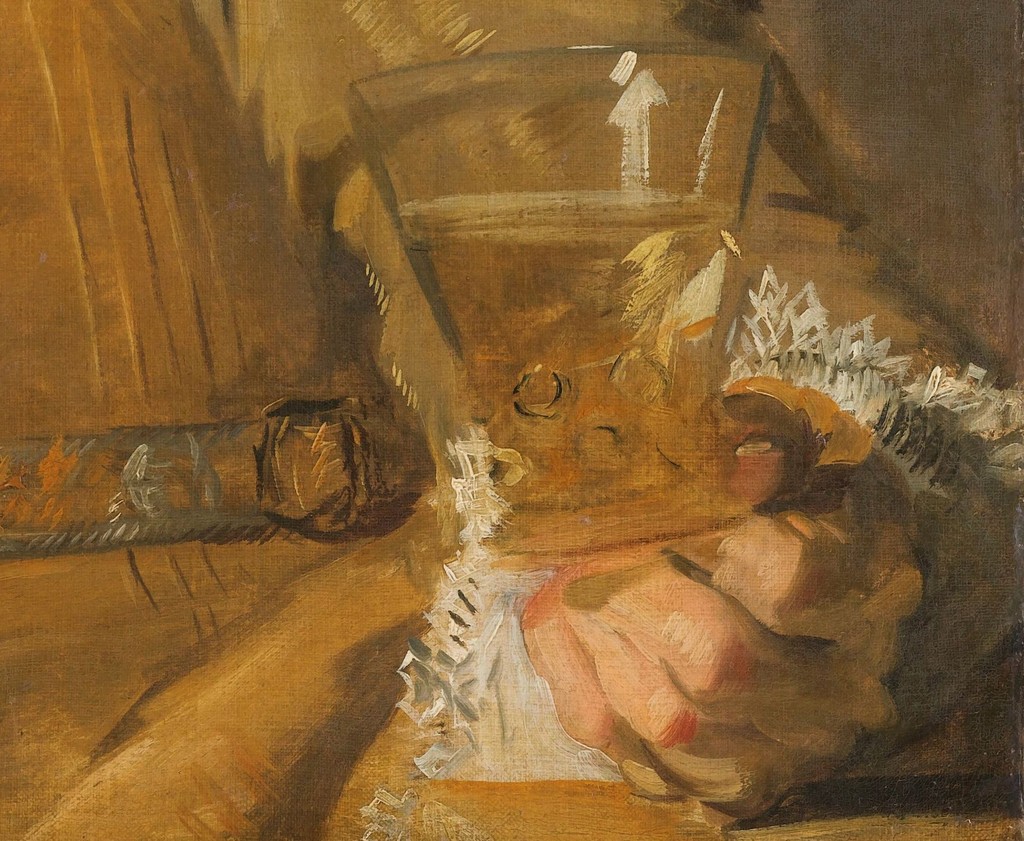
Hals’s man wears a broad-brimmed black hat and a large pale ruff above yellow-brown clothing. One hand opens towards us while the other holds a glass. The spread fingers and open mouth make the address seem expansive. Manet’s smaller cap, pipe stem and hand resting around the beer glass produce a more contained arrangement. The tabletop anchors one side of his figure, whereas Hals lets the raised hands play across the lower part of the portrait.
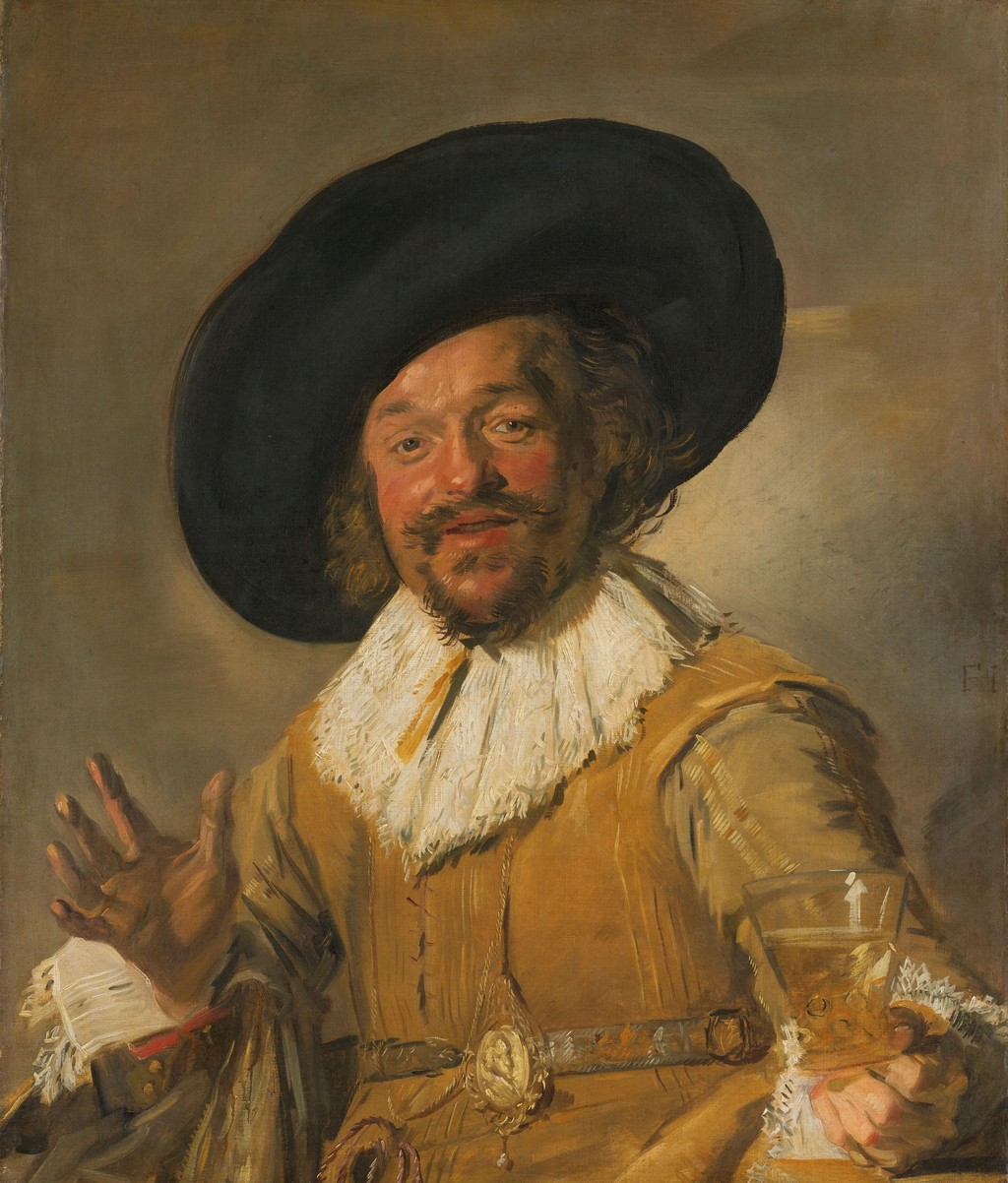
Frans Hals, The Merry Drinker, about 1628–30. Oil on canvas, 81 × 66.5 cm. Rijksmuseum, Amsterdam, SK-A-135. Rijksmuseum; reproduction via Wikimedia Commons. Image source. CC0 / Public domain. Resized without cropping from the supplied reproduction.
From Faure to Philadelphia
Manet sold the painting to the singer and collector Jean-Baptiste Faure in November 1873. After passing through other collections and dealers, it was bought by Carroll S. Tyson, Jr., in October 1923. His bequest brought it to the Philadelphia Museum of Art in 1963, where it is recorded as part of the Mr. and Mrs. Carroll S. Tyson, Jr., Collection.[1]
Annotated Details from A Good Glass of Beer
The numbered points identify visible features discussed in this article. Return from each detail to the whole composition. Each caption identifies the work shown.
A Good Glass of Beer
Édouard Manet, Le Bon Bock (A Good Glass of Beer), 1873. Oil on canvas, 94.6 × 83.3 cm. Philadelphia Museum of Art, The Mr. and Mrs. Carroll S. Tyson, Jr., Collection, 1963, 1963-116-9. Philadelphia Museum of Art; reproduction via Google Art Project / Wikimedia Commons. Image source. Public domain. Resized without cropping from the supplied reproduction.
The Merry Drinker — Hals
Frans Hals, The Merry Drinker, about 1628–30. Oil on canvas, 81 × 66.5 cm. Rijksmuseum, Amsterdam, SK-A-135. Rijksmuseum; reproduction via Wikimedia Commons. Image source. CC0 / Public domain. Numbers added to a separate resized whole supplied overview. Detail crops from the unchanged original; no enlargement, retouching or colour alteration.
Details from A GOOD GLASS OF BEER
Follow the numbered details back to the complete images above. Each caption identifies the work shown.
A Good Glass of Beer
Face, cap and smoke
Warm pink-red passages describe the face beneath the small dark cap. Grey curls and a thin blue-grey trail of smoke interrupt the surrounding shadow.
The pipe hand and pale fabric
The raised hand encloses the pipe bowl. A long pale stem leads towards the mouth, while the crumpled collar and cuff break across the darker clothing.
The waistcoat and clothing
Broad olive-grey and brown passages describe the waistcoat. Buttons and shorter slanting touches interrupt its front above the grey trousers.
The beer glass and reflection
Pale reflections mark the rim and surface of the glass beside the fingers. A blurred reflection of the glass and hand spreads across the dark tabletop.
The Merry Drinker — Hals
Raised Glass and Holding Hand
A thin rim and bright marks separate the glass from the coat above the holding hand.
Artworks directory
Explore selected paintings, drawings and prints by Édouard Manet. Search by title or another recorded name.
Frequently Asked Questions
The museum handbook identifies him as Bellot, a neighbour of Manet who posed for the painting.[2]
It belongs to the Philadelphia Museum of Art, accession 1963-116-9.[1]
Discussion
Look again at the images and ideas explored in A Good Glass of Beer by Édouard Manet. These editorial prompts invite your observations.
Reader Insights
Follow the pipe stem from hand to mouth, then compare the lower hand around the glass. How do the two positions balance the figure?
Look at the marks below the beer. Which parts of the glass and hand survive in the tabletop’s blurred reflection?
Compare Manet’s sitter with Hals’s drinker. How do the hat, mouth and open or closed hands change each figure’s address to the viewer?
Join the Conversation
Share a detail, comparison or question about A Good Glass of Beer by Édouard Manet below.
References
- Philadelphia Museum of Art, Le Bon Bock, 1873, 1963-116-9, current object details and provenance. View source.
- Christopher Riopelle, Philadelphia Museum of Art: Handbook of the Collections, 1995, p.194, complete entry republished as “About the Artwork: Le Bon Bock” on the museum-linked Custom Prints site. View source.
- Théodore Duret, Histoire d’Édouard Manet et de son œuvre, 1906, pp.133–137, selected discussion of Le Bon Bock, its reception and Hals. Digitised French text, Project Gutenberg. French. View source.
- Rijksmuseum, The Merry Drinker, Frans Hals, about 1628–30, SK-A-135, current object record. View source.
- Splash image, Édouard Manet, Le Bon Bock (A Good Glass of Beer), 1873. Oil on canvas, 94.6 × 83.3 cm. Philadelphia Museum of Art, The Mr. and Mrs. Carroll S. Tyson, Jr., Collection, 1963, 1963-116-9. Philadelphia Museum of Art; reproduction via Google Art Project / Wikimedia Commons. Image source. Public domain. Resized without cropping from the supplied reproduction.


