



 by Tom Gurney
Tom Gurney BSc (Hons) is an art history expert with over 20 years experience
Published on June 19, 2020 / Updated on October 30, 2026
Email: tomgurney1@gmail.com / Phone: +44 7429 011000
Head of a Dog by Édouard Manet: Introduction
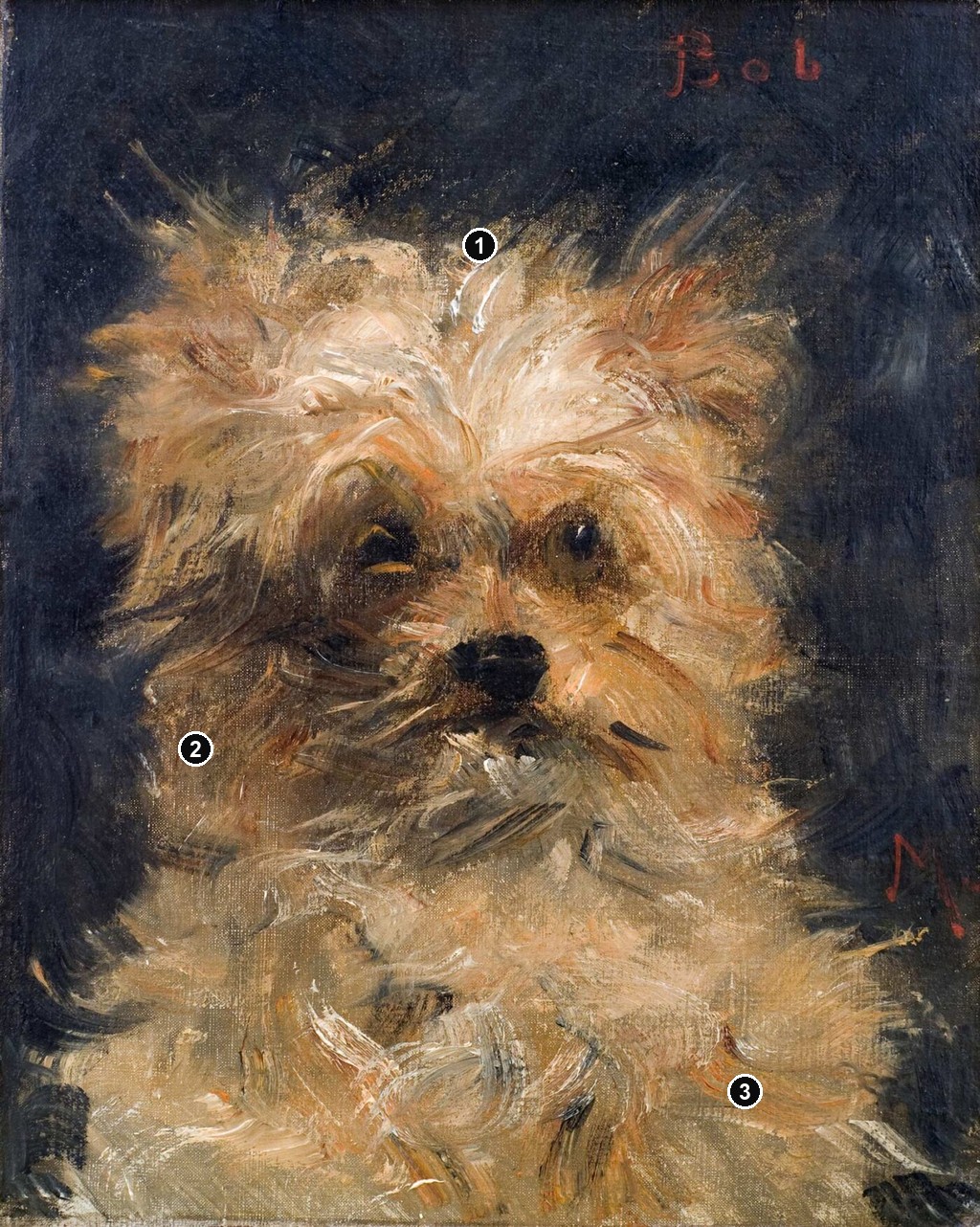
A shaggy dog looks out from a dark background, its cream and brown fur spreading in uneven tufts around the face. The red name at the upper right identifies it as Bob. Édouard Manet brings the head and chest close, leaving almost no setting around this small animal portrait. The work is also known by the French title Tête du chien «Bob» and is dated about 1876.[1]
At a Glance
- ArtistÉdouard Manet
- TitleHead of a Dog; Tête du chien «Bob»
- DateAbout 1876.[1]
- MediumOil on canvas
- Dimensions27.5 × 21.5 cm, as measured in Christie’s catalogue.[1]
- 2019 exhibition lenderThe Ann and Gordon Getty Collection.[2]
This work across Édouard Manet’s career
Contents
- Fur That Breaks the Outline
- The Eyes and Dark Nose
- Muzzle and Chest
- A Dark Setting
- The Red Name and Monogram
- A Pet in Manet’s Circle
- Bob and Tama
- A Recorded Collecting History
- Annotated details
Fur That Breaks the Outline
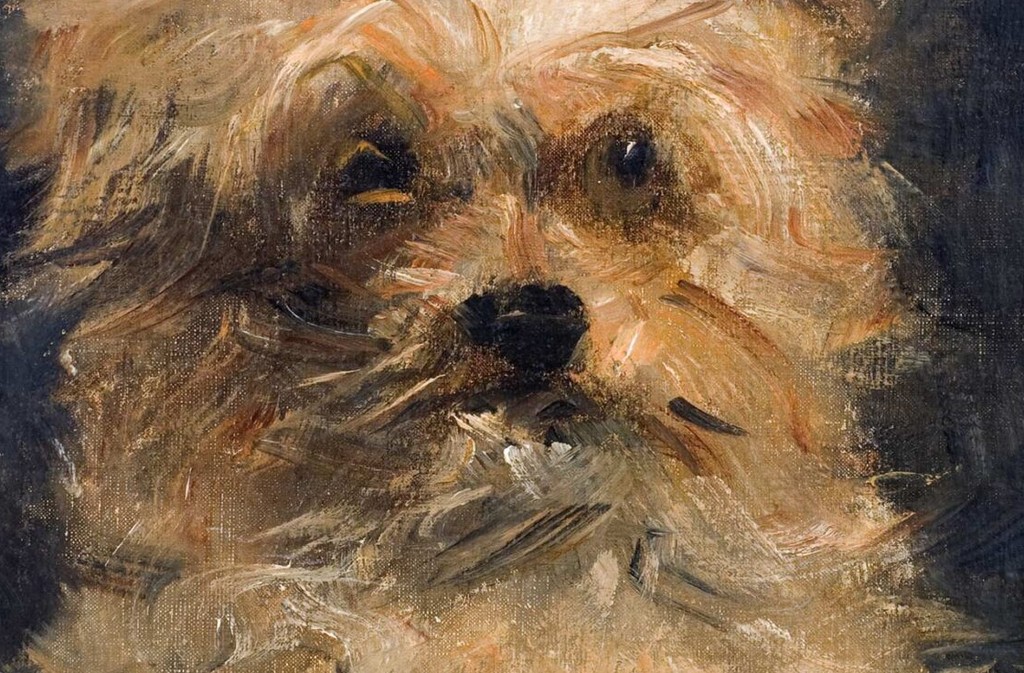
The fur does much of the work of defining Bob’s head. Across the top, pale strokes rise from the forehead before turning outwards towards the sides. Cream, tan and reddish brown overlap in different directions. A few narrow white marks stand apart from the warmer colours, making the tufts appear unevenly lit.
At the left of the image, longer strands descend beside the eye and sweep across the cheek. On the right, the outline is rounder and more compact. Short strokes project into the dark space, so the edge alternates between a clear boundary and scattered marks. The background remains visible between some of these strands.
This variation prevents the head from becoming a simple oval. Its upper outline flares widely, then narrows towards the cheeks before opening into the chest below. The longer forehead hair differs from the smaller marks describing the face.
The Eyes and Dark Nose
Two dark eye shapes sit beneath the pale tufts. The eye on the image’s left is more deeply surrounded by brown shadow, while the opposite eye stands within a lighter passage. Their unequal visibility gives the face a slight asymmetry, even though the nose is placed close to the centre.
Small pale marks interrupt the dark areas around the eyes. Above them, the forehead hair bends away from a central division, opening enough space for both eyes to remain recognisable. The dog’s glance appears directed towards the viewer, with the hair partly enclosing it on either side.
The black nose is broader and more solid than either eye. It interrupts a light brown passage running down the middle of the face. Its rounded upper edge and darker underside give the muzzle a firm centre among the many loose strands. Beneath it, a small darker opening is surrounded by paler hair.
Muzzle and Chest
The hair around the muzzle spreads sideways and downwards. Long cream strokes cross brown and grey passages on the left, while shorter dark marks interrupt the lighter area on the right. Some of these marks run almost horizontally, suggesting the direction of the whisker-like hair without tracing every strand.
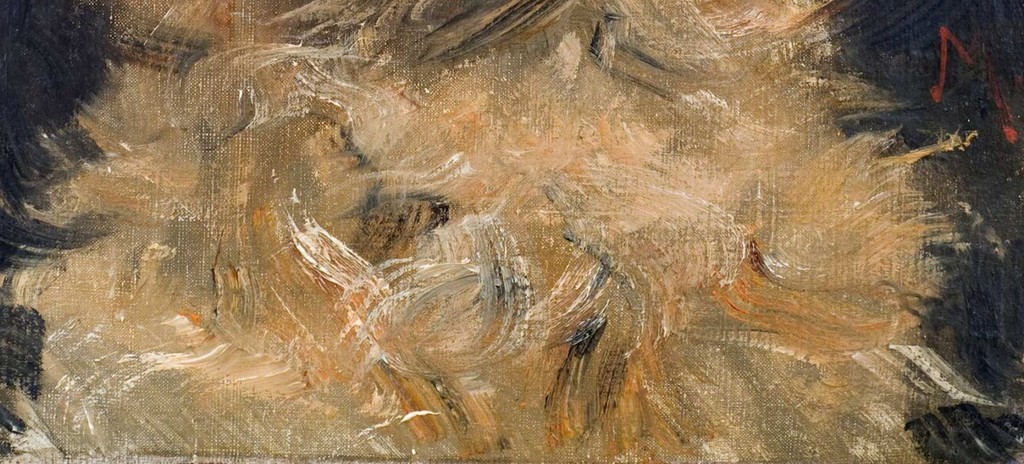
Below the mouth, broader pale strokes turn into the chest. Here the shapes become larger and less tightly grouped than around the eyes. Grey-brown gaps separate the lighter areas, and curved marks suggest overlapping locks of fur. The chest continues to the bottom of the canvas, where several strokes meet the edge.
The transition from face to chest is gradual. There is no strong collar line dividing them, and the longer hair conceals much of the neck. The viewer recognises the animal through the concentration of eyes, nose and muzzle above this less precisely bounded lower area.
A Dark Setting
The surrounding dark field occupies much of the upper part of the picture. Its blue-grey and nearly black passages provide a cool contrast to the warmer fur. Above the head, a broad opening remains around the red name; at the sides, the dark areas narrow as the hair reaches outwards.
There is little in this setting to suggest a particular room. No floor or piece of furniture establishes the dog’s position through distance. Instead, the uneven outline of the fur and the open space above it determine how close the animal appears.
The Red Name and Monogram
The name Bob sits high on the right, separate from the brightest forehead tufts. Its red letters are small enough to leave plenty of dark space around them. Their thin, irregular forms differ from the broader strokes describing the hair.
A red M appears farther down the same side. It stands beside the chest rather than directly beneath the name. The two inscriptions create separate points of colour at different heights, linking the otherwise open upper background with the denser lower area.
Denis Rouart and Daniel Wildenstein included the painting as Tête du chien «Bob» in their 1975 catalogue, identifying the monogram at the right.[3]
A Pet in Manet’s Circle
Christie’s identifies the portrait as a commission from Jean-Baptiste Faure, the opera singer and collector of Manet’s work.[1] Getty’s 2019 account describes Bob as most likely belonging to Faure and places Manet’s pet portraits within his circle of friends and acquaintances.[2]
The animal’s precise breed remains uncertain. Getty notes the historical identification as a chien griffon, while also acknowledging disagreement. Nor is it clear how Manet arranged the sitting: the account identifies no preparatory drawing specifically for this painting.[2] The tousled appearance gives the portrait a sense of immediacy, but does not by itself establish how long Bob remained in front of the painter.
Bob and Tama
Manet’s Tama, the Japanese Dog, about 1875, offers a useful comparison. Now in the National Gallery of Art, Washington, it is a larger oil painting, measuring 61 × 50 cm.[4] It shows the whole animal standing in an interior.
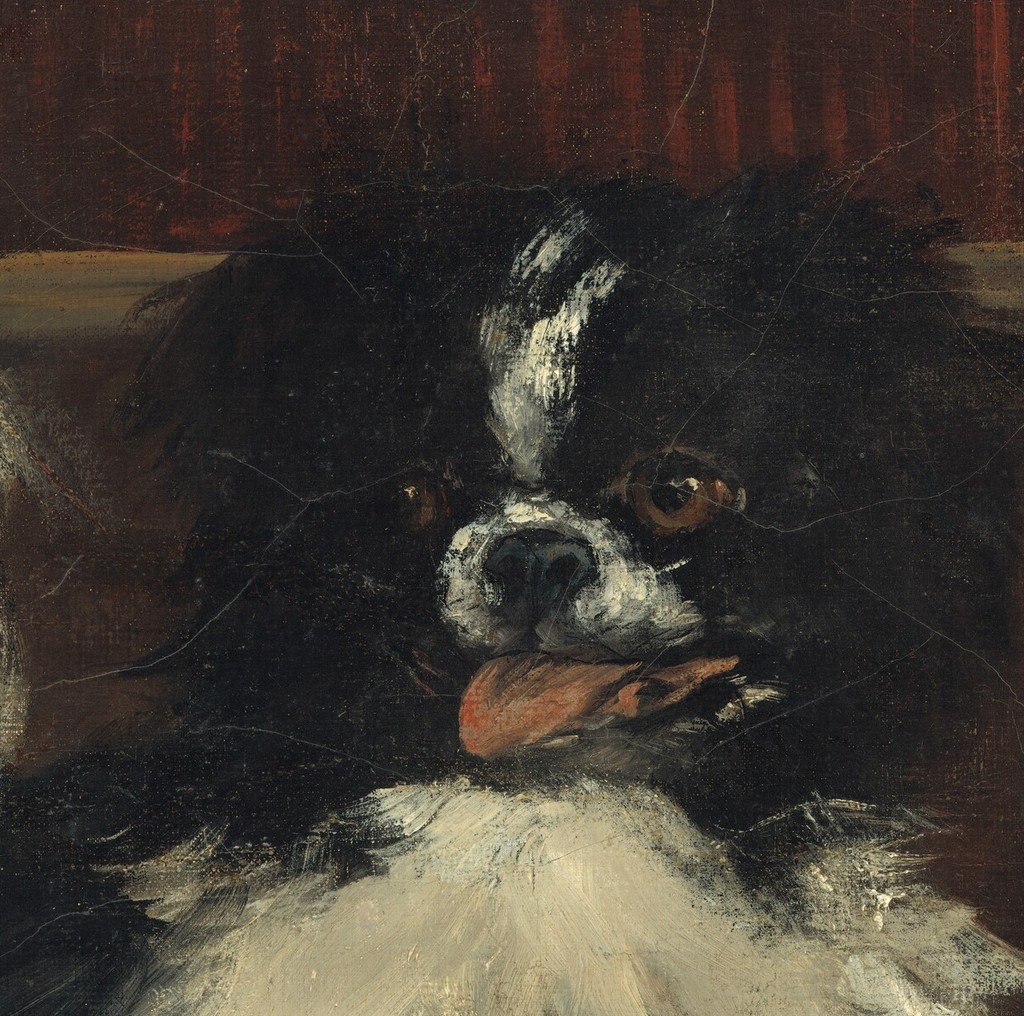
Tama’s white chest and legs contrast with its black flanks. Its curled tail rises on the left, balancing the head turned towards the viewer. A stick leans against the panelled background, and a figure-like toy lies on the floor below. These surrounding objects establish a room and give the dog space in which to stand.
The gold capitals spelling TAMA occupy the upper left. Bob’s red name is smaller and placed on the opposite side. In the close portrait, head, chest and surrounding darkness dominate; in Tama, paws, tail, floor and accessories share the task of describing the animal’s presence. Both paintings give a named dog an individual place within Manet’s portrait work.
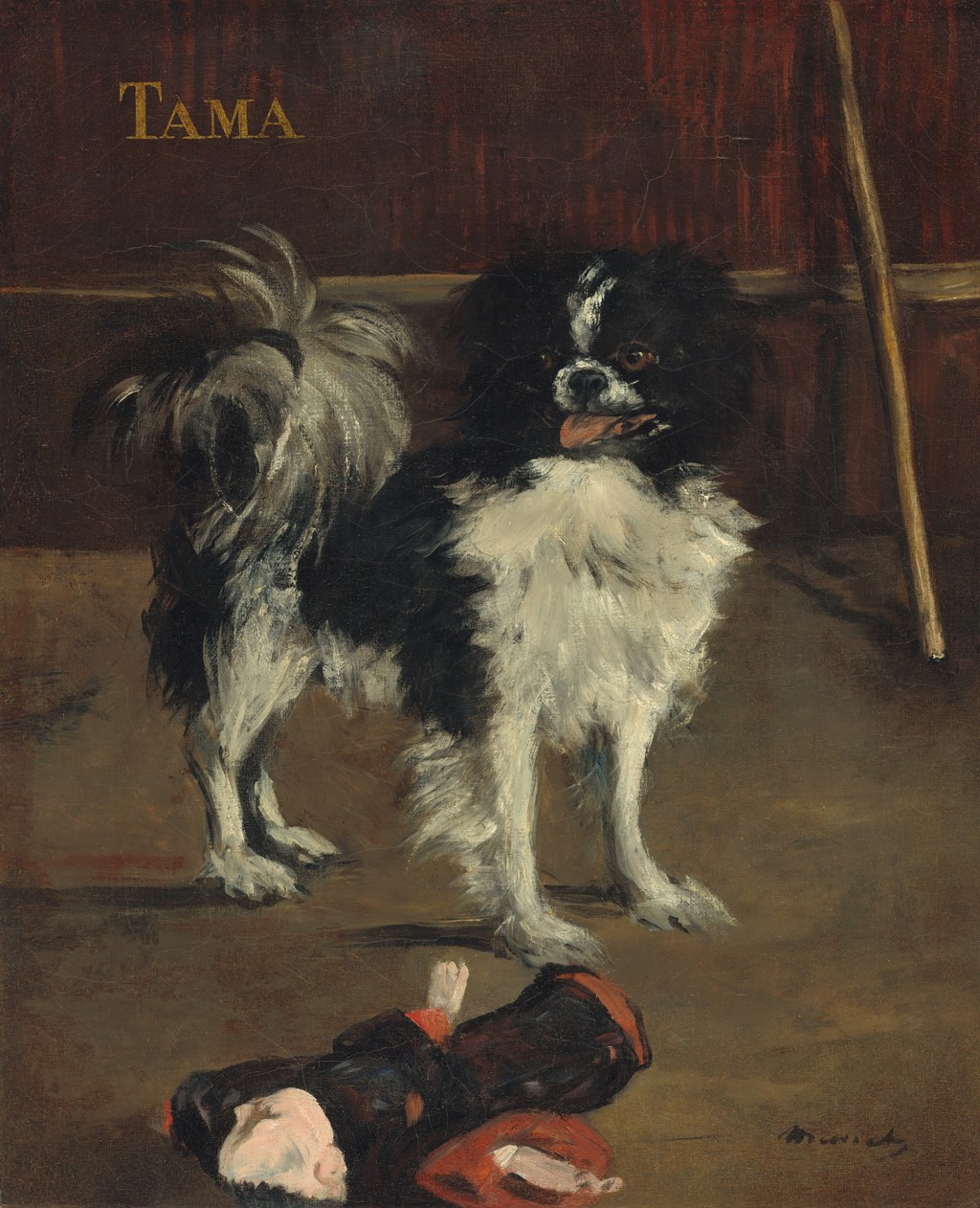
Édouard Manet, Tama, the Japanese Dog, about 1875. Oil on canvas, 61 × 50 cm. National Gallery of Art, Washington, Collection of Mr. and Mrs. Paul Mellon, 1995.47.12. Image source. CC0 / Public domain. Resized without cropping or enlargement from the supplied reproduction.
A Recorded Collecting History
Rouart and Wildenstein listed Bob’s portrait in exhibitions in Berlin in 1928, Zürich in 1933 and Philadelphia and Chicago in 1966–67.[3] It later appeared in Manet and Modern Beauty at the Getty in 2019, on loan from the Ann and Gordon Getty Collection.[2]
Christie’s provenance records earlier ownership by Ludwig and Estella Katzenellenbogen, followed by Estella, and the Gettys’ acquisition at auction in 1982. The later Getty collection sale catalogue stated that the work was offered under a settlement agreement between the owner and Estella Katzenellenbogen’s heirs concerning ownership and transfer of title.[1]
Annotated Details from Head of a Dog
The numbered points identify visible features discussed in this article. Return from each detail to the whole composition. Each caption identifies the work shown.
Head of a Dog
Édouard Manet, Head of a Dog (Bob), about 1876. Oil on canvas, 27.5 × 21.5 cm according to Christie’s. The Ann and Gordon Getty Collection, exhibition lender in 2019. Édouard Manet / The Ann and Gordon Getty Collection (2019 photograph), via Getty and Wikimedia Commons. Image source. Public domain. Numbers added to a separate overview. Three broad detail crops from the supplied reproduction; no enlargement, recolouring or retouching.
Tama, the Japanese Dog
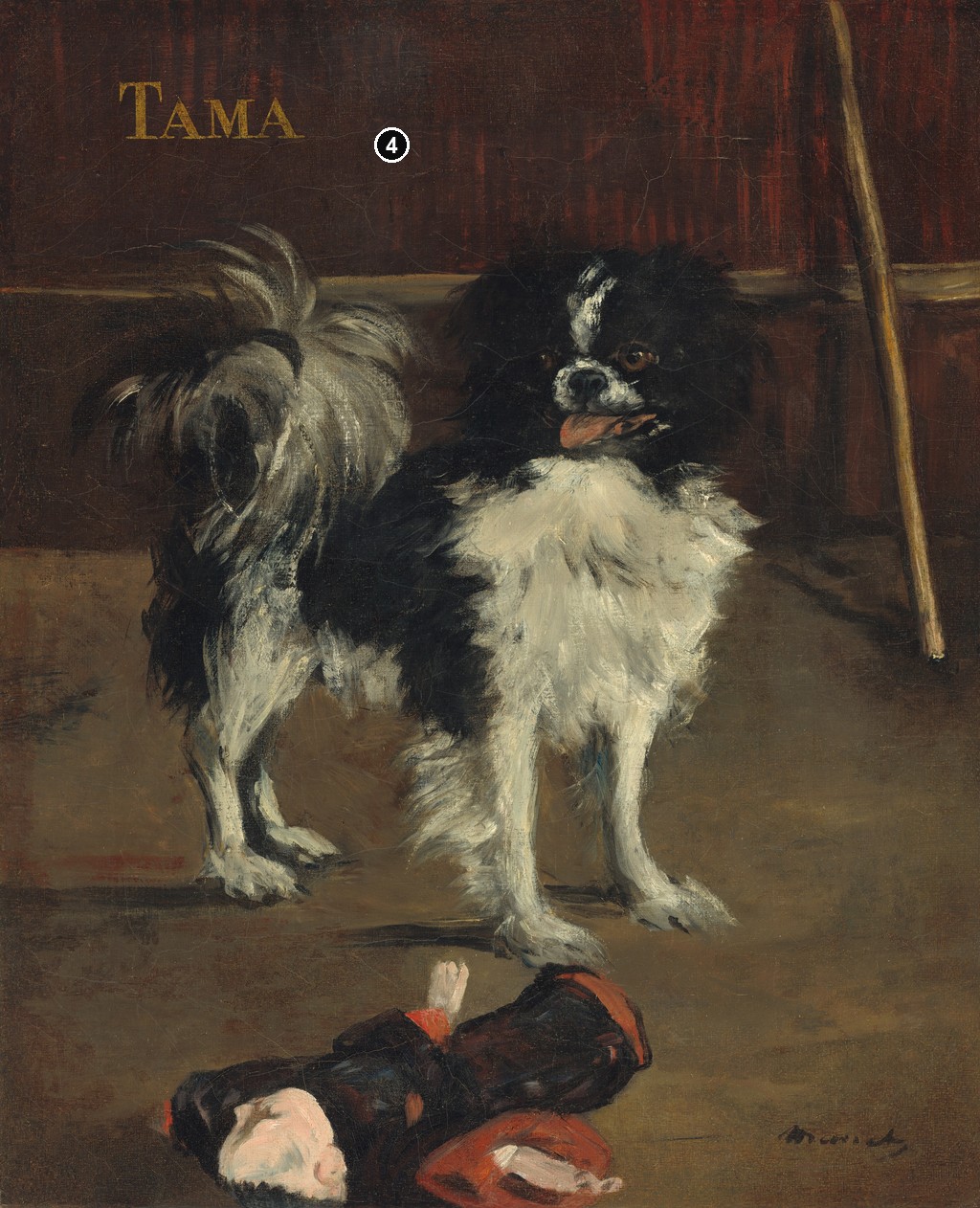
Édouard Manet, Tama, the Japanese Dog, about 1875. Oil on canvas, 61 × 50 cm. National Gallery of Art, Washington, Collection of Mr. and Mrs. Paul Mellon, 1995.47.12. Image source. CC0 / Public domain. Numbers added to a separate resized whole supplied overview. Detail crops from the unchanged original; no enlargement, retouching or colour alteration.
Details from HEAD OF A DOG
Follow the numbered details back to the complete images above. Each caption identifies the work shown.
Head of a Dog
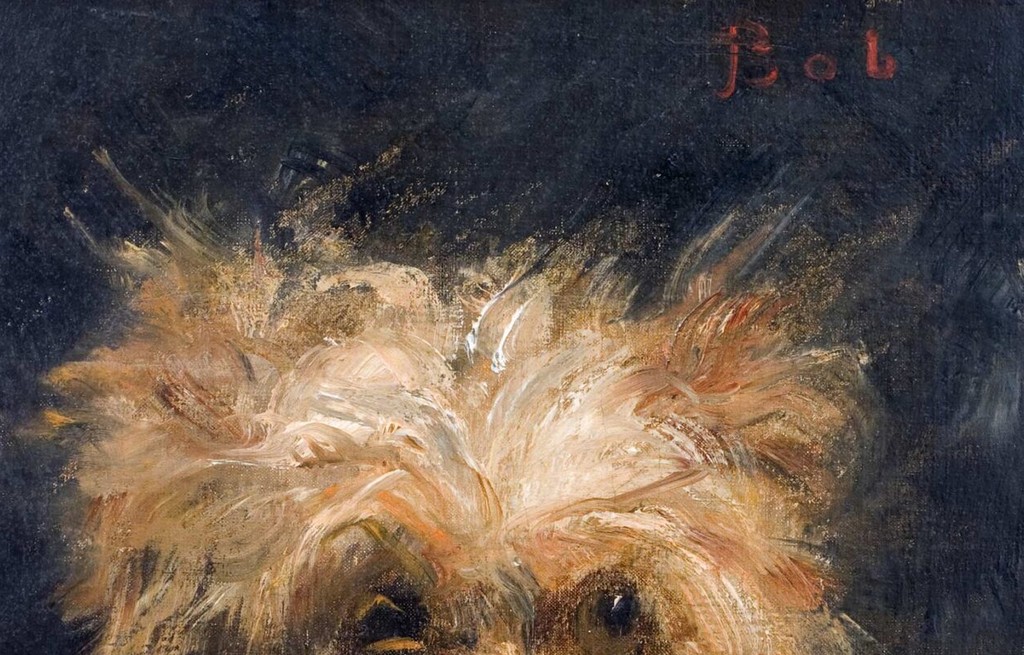
The forehead and red name
Pale tufts spread outwards beneath the small red name. Dark space separates the letters from the highest strands of hair.
Eyes, nose and muzzle
Unequal dark eye shapes sit above the central black nose. Pale muzzle strands spread to either side and are crossed by shorter dark marks.
Chest and red monogram
Broader cream and brown marks spread across the lower chest. The red M stands to the right, beside the fur and below the name.
Tama, the Japanese Dog
Dark Head, White Blaze and Muzzle
A white blaze and pale muzzle interrupt the dark head beside the small eye and projecting tongue.
Artworks directory
Explore selected paintings, drawings and prints by Édouard Manet. Search by title or another recorded name.
Frequently Asked Questions
The red inscription identifies the dog as Bob.[1]
The breed is uncertain. Scholars have called him a chien griffon, but the identification is not settled.[2]
Discussion
Look again at the images and ideas explored in Head of a Dog by Édouard Manet. These editorial prompts invite your observations.
Reader Insights
Follow the fur around the top and sides of the head. Where do separate strands interrupt the dark background?
Compare the name above the head with the M beside the chest. How do their positions divide the open and crowded areas?
Compare Bob with Tama. How do paws, a tail and surrounding objects change the space of a pet portrait?
Join the Conversation
Share a detail, comparison or question about Head of a Dog by Édouard Manet below.
References
- Christie’s, Tête du chien “Bob”, Édouard Manet, Getty collection sale, lot 1, details, provenance and lot essay. View source.
- Caitlin Shamberg, “Who Is Bob the Dog and Why Did Manet Paint His Portrait?”, Getty News, 6 December 2019, with comments by Scott Allan and Emily Beeny. View source.
- Denis Rouart and Daniel Wildenstein, Édouard Manet: Catalogue raisonné, tome I, 1975, no. 253, pp. 206–207, Tête du chien «Bob». Digitised catalogue, Wildenstein Plattner Institute. French. View source.
- National Gallery of Art, Washington, Tama, the Japanese Dog, about 1875, 1995.47.12, collection record. View source.
- Splash image, Édouard Manet, Head of a Dog (Bob), about 1876. Oil on canvas, 27.5 × 21.5 cm according to Christie’s. The Ann and Gordon Getty Collection, exhibition lender in 2019. Édouard Manet / The Ann and Gordon Getty Collection (2019 photograph), via Getty and Wikimedia Commons. Image source. Public domain. Resized without cropping or enlargement from the supplied reproduction.


