



 by Tom Gurney
Tom Gurney BSc (Hons) is an art history expert with over 20 years experience
Published on June 19, 2020 / Updated on October 30, 2026
Email: tomgurney1@gmail.com / Phone: +44 7429 011000
In the Conservatory by Édouard Manet: Introduction
A small gap between two hands gives this large double portrait a quiet suspense. A woman sits at one end of a green bench, her bare left hand hanging over its back. Behind her, a man leans forward with a cigar between his fingers. Their hands approach near the centre of the canvas, while their faces turn in different directions.
Édouard Manet’s In the Conservatory belongs to the Alte Nationalgalerie in Berlin, which dates it to 1878/79.[1] The painting brings fashionable clothes, dense plants and an apparently casual encounter into a closely organised space. Its people seem familiar with one another, yet the picture leaves us to judge the character of their conversation from poses, glances and that narrow interval between their hands.
At a Glance
- ArtistÉdouard Manet
- Date1878/79
- MediumOil on canvas
- Dimensions115 cm high × 150 cm wide
- CollectionAlte Nationalgalerie, Staatliche Museen zu Berlin
- Inventory numberA I 550
- German titleIm Wintergarten
- French exhibition titleDans la serre
- InscriptionLower left, “Manet 1879”[1]
- Salon exhibition1879[2]
This work across Édouard Manet’s career
Contents
- A Winter Garden for Modern Life
- Monsieur and Madame Guillemet
- The Hands, the Cigar and the Bench
- Grey Cloth and Yellow Accessories
- A Garden Painted in Many Greens
- Faces and the Movement of Paint
- Huysmans at the Salon of 1879
- Suzanne in a Related Conservatory Portrait
- From Paris to Berlin
- Annotated details
A Winter Garden for Modern Life
The conservatory is a cultivated indoor setting. Plants grow in pots around the bench, bringing large leaves and flowers close to the seated woman. The blue-and-white container at the left and the paler pots behind the wooden spindles make the arrangement visible as something tended and assembled.
Berlin’s museum places the scene in a conservatory attached to a studio Manet was using in Paris.[1] Such a setting allowed him to bring a substantial human subject together with an extensive study of foliage, colour and light. The plants form a sheltered environment around the figures, with little opportunity for the eye to escape into a distant view.
The effect is abundant but closely contained. A broad leaf can take up as much space as part of a face, and a flowering stem can appear close to a hat or shoulder. The conservatory brings the scale of a garden into intimate contact with the people inside it.
This proximity matters to the painting’s subject. Fashionable dress, furniture and carefully cultivated plants belong within the same arrangement. The woman’s yellow accessories emerge against the leaves, while the man’s dark coat makes a compact mass beside their spreading forms. The garden is an active part of how the couple appears.
Monsieur and Madame Guillemet
The sitters are the Guillemets, married friends of Manet who ran a fashion business in the Rue Saint-Honoré.[1] Their connection with clothing gives particular interest to the attention lavished on the woman’s appearance.
Madame Guillemet occupies the left half of the composition. Her upright upper body rises from a skirt that spreads widely across the foreground. One arm follows the bench back, opening her pose towards the centre; the other descends to her lap. Her head turns towards the right, although her eyes do not meet her husband’s.
He bends over the back of the bench, directing his face towards hers. His shoulders form a dark arch around the warm colours of his forehead, cheek and beard. The upper edge comes close to his hair, making his forward movement feel compressed within the picture.
The two poses establish different kinds of presence. Her figure has room to expand through the skirt and along the bench. His is gathered into the upper right, with the pale trousers visible in separate strips below the rail. He seems to enter a space already largely occupied by her.
These differences can encourage a reading of emotional distance, or of a private exchange caught in passing. The painting supplies no definite account of what they are saying or feeling. Its most reliable information lies in the way they are placed: one seated, one leaning, their bodies separated by the bench while their hands come close together.
The Hands, the Cigar and the Bench
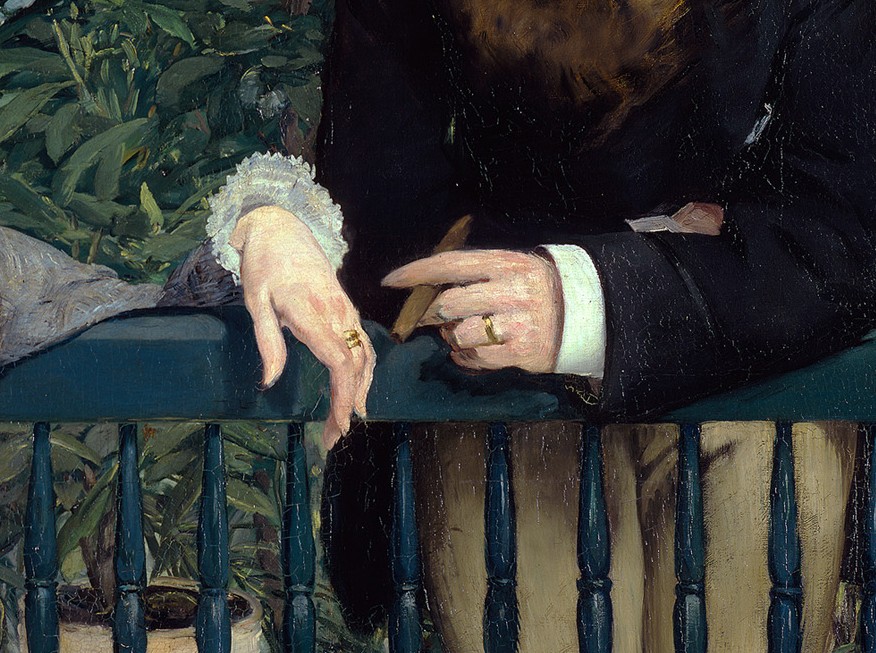
Madame Guillemet’s bare hand hangs loosely from a wrist surrounded by pale lace. The fingers descend across the dark upper rail, making their shapes unusually clear. A gold ring supplies a small warm accent near the knuckles.
Her husband’s hand approaches from the right. White cuff and dark sleeve set it apart from the surrounding coat. His extended finger points across the space, while the brown cigar introduces another short, firm shape beside it. A ring is visible on his hand too.
The hands attract attention partly because so much of the painting leads towards them. Her raised forearm comes in from the left; his bent body descends from above. The long bench rail carries the eye across the whole group. At their meeting point, a small open interval interrupts the possibility of contact.
Manet gives that interval a setting of considerable weight. The bench back is broad and dark, with a blue-green surface that changes where light strikes it. Its repeated vertical spindles create a measured rhythm below the hands. Through the openings, pale cloth, pots and foliage remain visible.
The structure consequently performs two tasks. It places a substantial piece of furniture between the figures and also gives their arms a shared support. The open spindles prevent it becoming a solid wall, while the upper rail remains strong enough to divide the canvas into distinct areas.
Near the lower right, the empty seat continues beyond Madame Guillemet’s skirt. That unoccupied strip extends the bench into the surrounding garden. The furniture gives the couple a common place, although each person uses it differently.
Grey Cloth and Yellow Accessories
Madame Guillemet’s outfit offers a remarkable variety within a limited range of colours. The grey dress carries a fine linear pattern across its surface. Dark buttons descend through the bodice, and a black belt makes a firm division at the waist. Above, a large dark bow gathers the neckline into a conspicuous shape.
The fabric changes direction across the body. Shorter, closer marks describe the fitted bodice; longer passages open through the skirt. At the right, the folds fan out into a broad grey expanse, with dark divisions marking their turns. The dress supplies a large area in which the eye can follow both the shape of clothing and the direction of the brush.
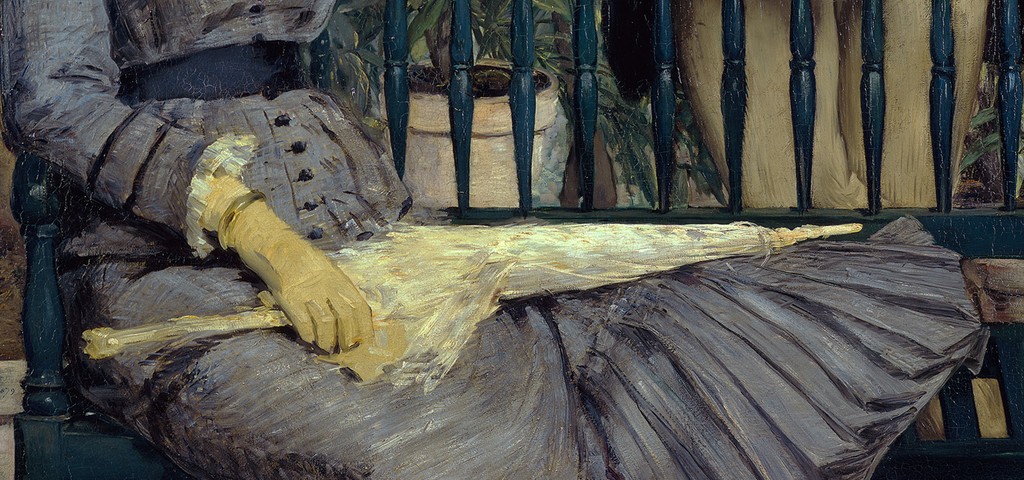
Yellow provides a second route through the figure. It begins with the hat, passes through the ties beside the face and reappears in the gloved right hand and closed parasol across her lap. Each area has a different texture. The hat gathers curling, irregular marks; the glove forms a smoother length around hand and wrist; the parasol spreads into lighter folds over the grey.
The yellow glove also gives the lower hand a different character from the bare one above. Its fingers rest over the parasol with a compact, carefully shaped weight. The bare hand is more exposed and loosely suspended. Two hands belonging to the same figure thus produce quite different effects within the composition.
Writing in 1906, Théodore Duret recalled Madame Guillemet’s reputation for elegant clothes and hats, which he said she made herself. He particularly admired Manet’s care with the hat and the dress’s orderly folds.[3] His recollection gives a personal context to the painting’s sustained interest in how clothes are made to appear.
A Garden Painted in Many Greens
The foliage offers an equally varied surface. Large leaves at the right spread outward in pointed sections. Their pale edges and long strokes create a fan behind the man, echoing the spreading folds of the skirt below while moving in another direction.
At the left, slender blades cross behind the woman’s shoulder and hat. Smaller leaves gather into darker clusters between the two heads. The background changes density as the eye moves across it: open, emphatic shapes give way to a more closely interwoven passage of stems and leaves.
The greens range from deep, almost black recesses to lighter blue-green and yellow-green touches. Their differences help separate one plant from another. Some leaves appear to advance towards the figures; others disappear into a darker space behind them.
Pink blossoms near Madame Guillemet’s head introduce a warmer note. Their broken shapes contrast with the long blades nearby. They also make a loose colour connection with the rosy passages of her face, bringing small areas of warmth into a large green field.
The pots give the planting a base. At the far left, white and blue decoration creates another kind of pattern beside the dress. Near the centre, simpler pale containers can be glimpsed through the bench. These interruptions keep the plants attached to a recognisable interior, even where the foliage itself becomes difficult to disentangle.
Faces and the Movement of Paint
The faces require a different pace of looking from the leaves and clothes. Madame Guillemet’s features emerge through small changes of tone. Warm pink crosses the cheek, a shadow gathers beneath the hat, and a few concentrated marks establish the eyes. The pale face is particularly clear beside the dark bow and nearby foliage.
Her husband’s forehead receives a stronger light. Below it, the beard spreads into a warmer, darker mass, with separate touches describing its changing surface. His features remain readable within the large dark shape of the coat, but they do not receive exactly the same treatment as hers.
Elsewhere, Manet lets the brushwork become more conspicuous. The skirt can be followed in long passages of grey; a leaf may be established by a few broad strokes; lace breaks into small pale touches around the wrist. Different kinds of material call for different arrangements of marks.
The picture’s polish therefore depends on variation. A crisply placed button can coexist with a rapidly brushed fold, just as the central fingers can remain distinct against the broad painted bench.
Huysmans at the Salon of 1879
Manet exhibited the painting at the Salon of 1879 as Dans la serre, alongside Boating, shown as En bateau.[2] Joris-Karl Huysmans admired both works, and his response to the conservatory picture moves readily between its subject and its handling.
He describes the woman sitting on a green bench and the man leaning over its back. He notices the large plants, red flowers and the rapid-looking execution of her dress. The man’s forehead, hands and cigar receive particular attention as passages in which touches of light give life to the figure.[2]
Huysmans reads the encounter as an easy conversation with a flirtatious vitality. He also admires the air around the figures and their separation from the surrounding green. To him, the convincing light is a success over conventional ways of painting sunlight.[2]
His enthusiasm makes a useful historical companion to the picture. A viewer today might attend first to the gap between the hands or to the difference between the two gazes. Huysmans responds to an animated human presence and to the freedom of the painting. The same arrangement can support attention to reserve, ease or the energy of its execution.
Duret later remembered objections to the brilliance of the green plants and the picture’s varied colour.[3] He wrote as a defender looking back over Manet’s career. Huysmans’s contemporary praise gives a more immediate example of a critic who found the painting persuasive. Their accounts preserve differing responses to colour and finish, rather than a single verdict from the Salon public.
Suzanne in a Related Conservatory Portrait
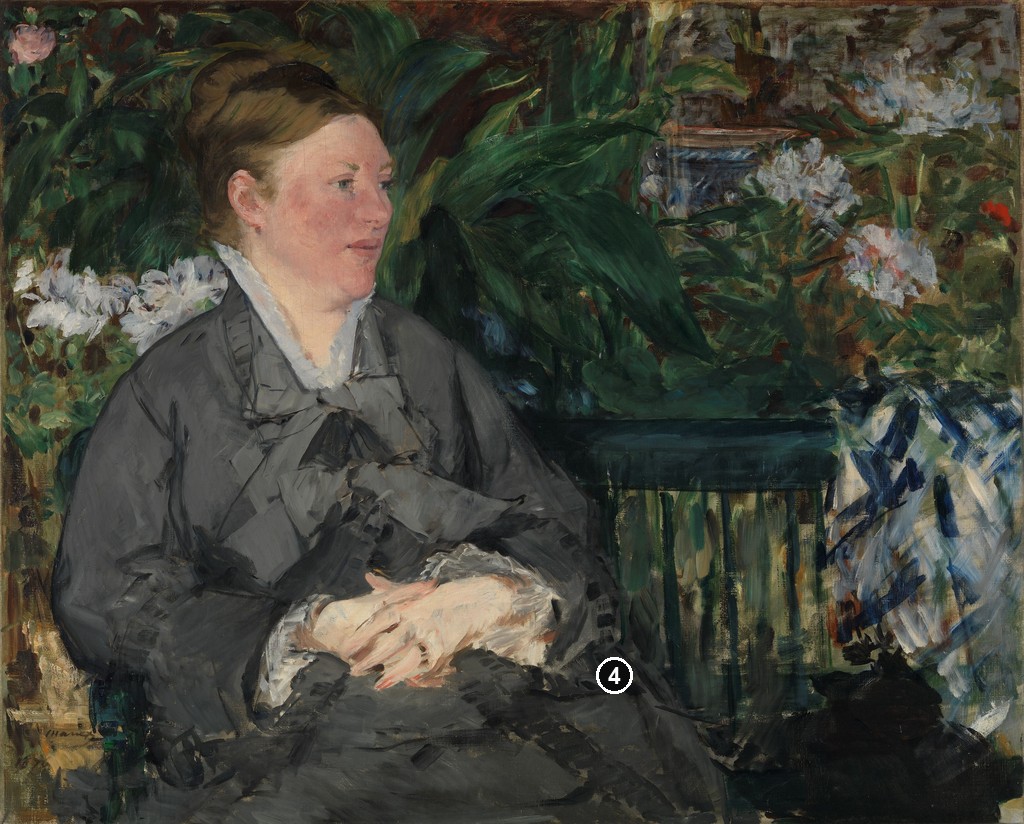
Manet explored a related setting in Madame Manet in the Conservatory, now in Norway’s Nasjonalmuseet and catalogued there as 1879. It depicts his wife, Suzanne, seated in grey before plants and a green bench.[4]
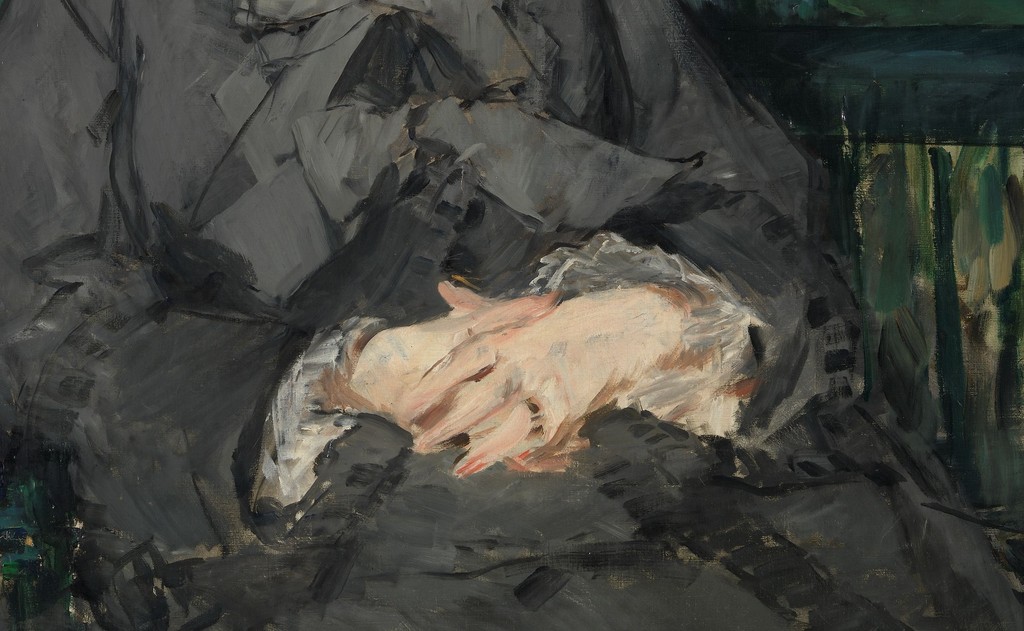
Her hands rest together in her lap. The bench extends into open space at the right, where its spindles remain visible beneath the rail. Behind her, broad leaves and pale flowers fill the canvas. A blue-and-white pot introduces a decorative pattern among the plants.
The comparison changes the function of several familiar elements. In the Berlin picture, the bench holds the two figures in a carefully divided relationship. In Suzanne’s portrait, it provides a setting around a single person. Her clasped hands are gathered low, leaving the face to become the principal point of concentration.
The clothes also have a different degree of resolution. Broad grey strokes describe Suzanne’s dress, while the hands remain comparatively open and loosely indicated. Her face receives more sustained attention. The GettyGuide presents it as a private, unfinished work. Emily Beeny discusses the attention to Suzanne’s face, while Gloria Groom traces the relationship between lace and flowers.[5]
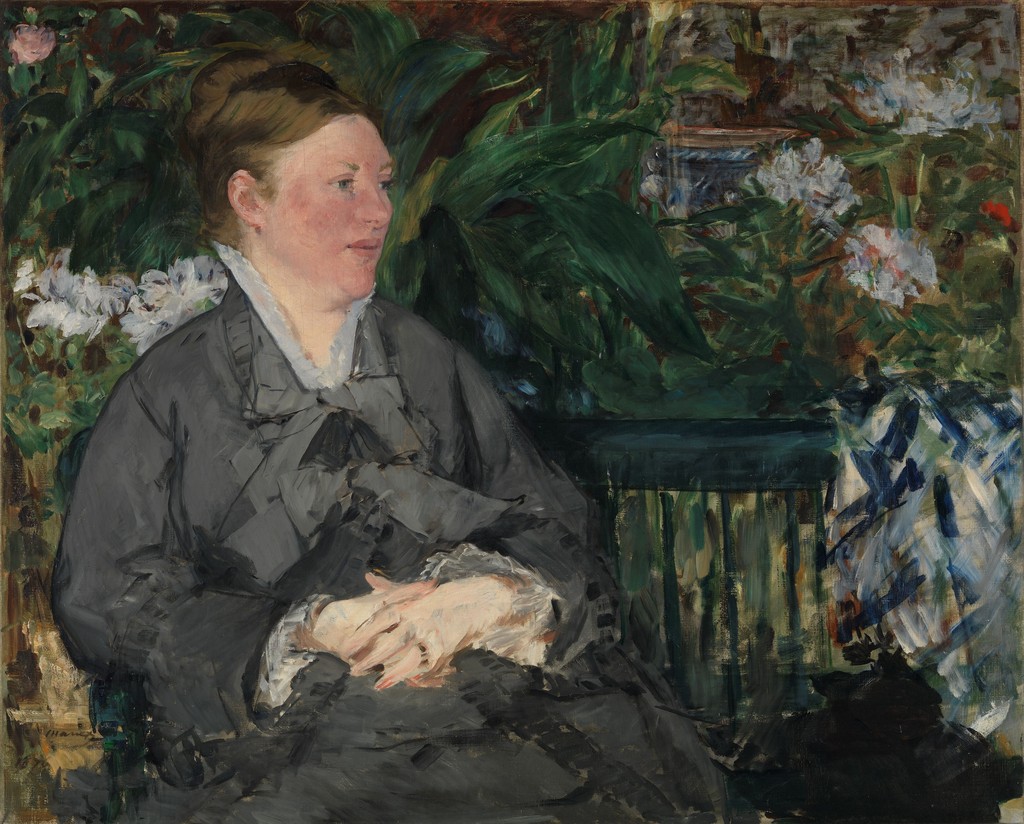
Édouard Manet, Madame Manet in the Conservatory, 1879. Nasjonalmuseet, Oslo, NG.M.01286. Nasjonalmuseet / Børre Høstland. Image source. CC BY 4.0. Resized and re-encoded from the museum photograph.
Annotated Details from In the Conservatory: Faces, Hands and Yellow Accessories
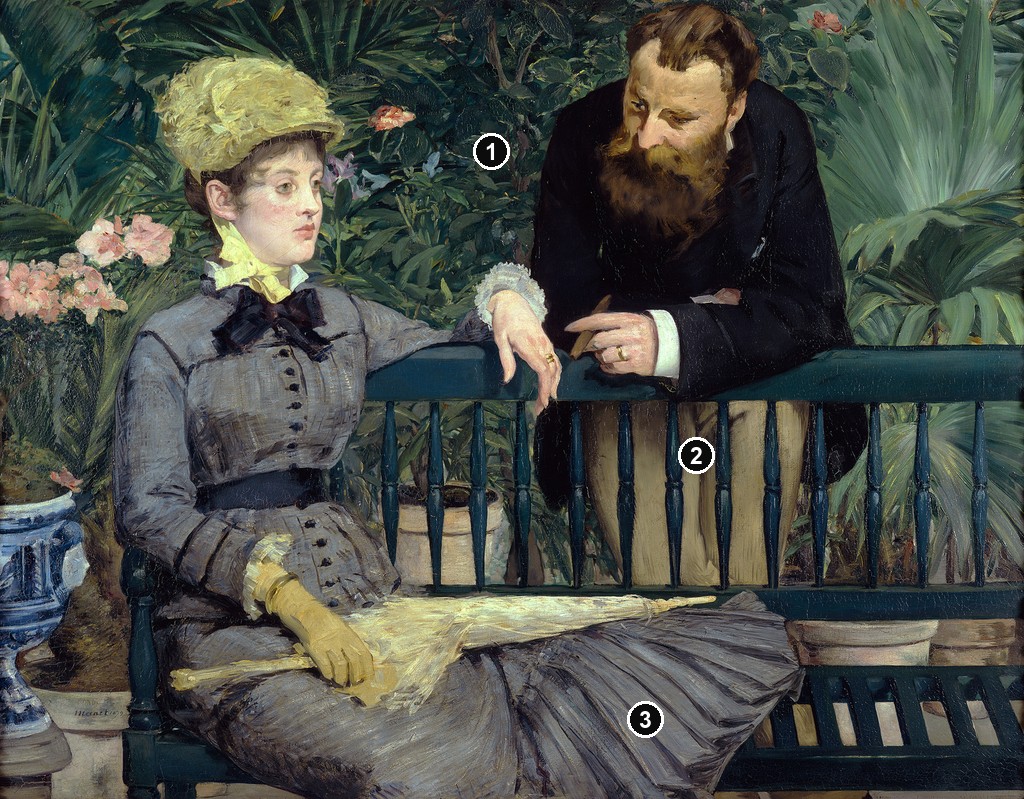
The numbered points identify visible features discussed in this article. Return from each detail to the whole composition. Each caption identifies the work shown.
In the Conservatory — Berlin
Édouard Manet, In the Conservatory (Im Wintergarten), 1878/79. Alte Nationalgalerie, Berlin, A I 550. Staatliche Museen zu Berlin, Alte Nationalgalerie / Jörg P. Anders. Image source. Public domain. Numbers added to a separate resized whole overview retaining the supplied edges and margins. Detail crops from the immutable original; no enlargement or retouching.
Madame Manet in the Conservatory — Oslo
Édouard Manet, Madame Manet in the Conservatory, 1879. Nasjonalmuseet, Oslo, NG.M.01286. Nasjonalmuseet / Børre Høstland. Image source. CC BY 4.0. Nasjonalmuseet / Børre Høstland, CC BY 4.0. Number added to a separate resized whole overview; one detail crop from the museum photograph. No enlargement, retouching or colour alteration.
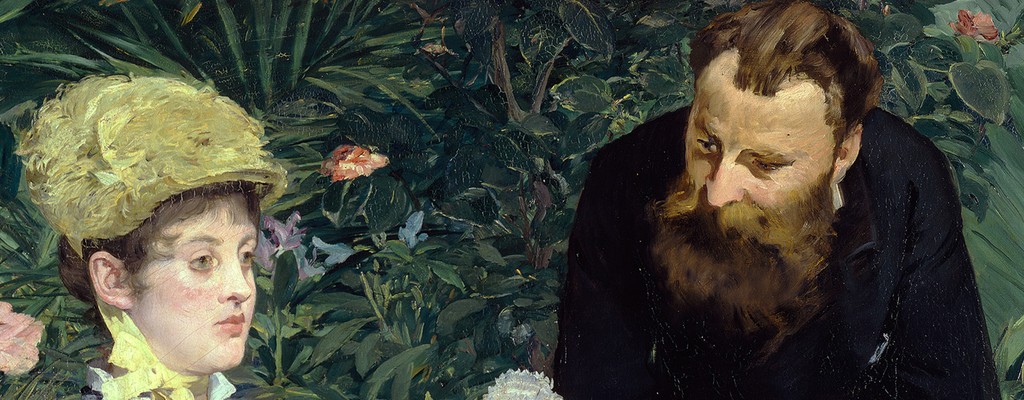
Details from IN THE CONSERVATORY: FACES, HANDS AND YELLOW ACCESSORIES
Compare the two faces and the near hands above the bench, then follow the yellow glove and parasol across the grey skirt. Suzanne’s folded hands offer a different gesture in the Oslo portrait.
In the Conservatory — Berlin
Two Faces among Leaves
The woman’s upright head and the man’s leaning face turn in different directions among the dense leaves.
Hands across the Bench Rail
The two bare hands approach above the broad green rail, leaving a small gap between the fingers.
Yellow Glove, Parasol and Grey Skirt
The yellow glove rests over the closed parasol. Long grey folds spread beneath these smaller warm shapes.
Madame Manet in the Conservatory — Oslo
Hands Folded over the Grey Dress
Suzanne’s hands gather together low on the grey dress, edged by loosely described pale cuffs.
From Paris to Berlin
The painting passed through the collection of Jean-Baptiste Faure and the dealer Durand-Ruel before Hugo von Tschudi acquired it for Berlin’s Nationalgalerie in 1896.[1] Private supporters supplied the funds. As the museum’s collection history explains, Tschudi’s acquisitions of modern French painting faced opposition from the emperor and the acquisition committee.[6]
The work consequently became part of another debate about the place of modern art. A picture shown in Paris in 1879 could acquire a new significance when selected for a major German collection seventeen years later. Its reception now involved what a museum should collect and display, alongside questions of colour, technique and subject.
The Nationalgalerie’s commentary reports that the painting was still attacked as erotically suggestive in the Prussian parliament in 1904.[1] That response gives a later setting to the couple’s ambiguous closeness. The same fully dressed figures whom Huysmans had admired for their living presence could trouble another audience.
Its Berlin history records a change in institutional judgement as well as ownership. Tschudi and the work’s supporters gave the canvas a place in a public collection, making Manet’s modern portrait part of the museum’s account of nineteenth-century painting.
Artworks directory
Explore selected paintings, drawings and prints by Édouard Manet. Search by title or another recorded name.
Frequently Asked Questions
They are Monsieur and Madame Guillemet, married friends of Manet who ran a Paris fashion business.[1]
The setting is a conservatory or winter garden, with plants cultivated in pots around the figures.
A small interval remains between the bare hands near the centre. The man holds a cigar beside his extended fingers.
Discussion
Look again at the images and ideas explored in In the Conservatory by Édouard Manet. These editorial prompts invite your observations.
Reader Insights
Follow the yellow from the hat to the glove and parasol.
Then compare the woman’s bare hand with her gloved one.
The bench gives each a different surrounding shape: one hangs over a dark rail, while the other rests among pale fabric and grey folds.
Join the Conversation
Share a detail, comparison or question about In the Conservatory by Édouard Manet below.
References
- Staatliche Museen zu Berlin; Angelika Wesenberg. “Im Wintergarten,” 1878/1879, A I 550. Current object record, commentary, provenance and museum photograph. View source.
- Joris-Karl Huysmans. “Le Salon de 1879,” in L’Art moderne, 1883. The Manet passage; French transcription. View source. (in French).
- Théodore Duret. Histoire d’Édouard Manet et de son œuvre, 1906, pp.185–187. The Guillemets, dress, related portraits and retrospective reception. View source. (in French).
- Nasjonalmuseet. “Madame Manet in the Conservatory,” (1879), NG.M.01286. Object record and sitter identification. View source.
- J. Paul Getty Museum. Manet and Modern Beauty, GettyGuide stop 1006, “Madame Manet in the Conservatory.” Transcript with Emily Beeny and Gloria Groom. View source.
- Alte Nationalgalerie, Staatliche Museen zu Berlin. “Über die Sammlung in der Alten Nationalgalerie.” Collection history and Tschudi’s acquisition policy. View source. (in German).
- Splash image, Édouard Manet, In the Conservatory (Im Wintergarten), 1878/79. Alte Nationalgalerie, Berlin, A I 550. Staatliche Museen zu Berlin, Alte Nationalgalerie / Jörg P. Anders. Image source. Public domain. Whole supplied reproduction resized within native dimensions; no enlargement or retouching.


