



 by Tom Gurney
Tom Gurney BSc (Hons) is an art history expert with over 20 years experience
Published on June 19, 2020 / Updated on October 30, 2026
Email: tomgurney1@gmail.com / Phone: +44 7429 011000
Isabelle Lemonnier with a Muff: Introduction
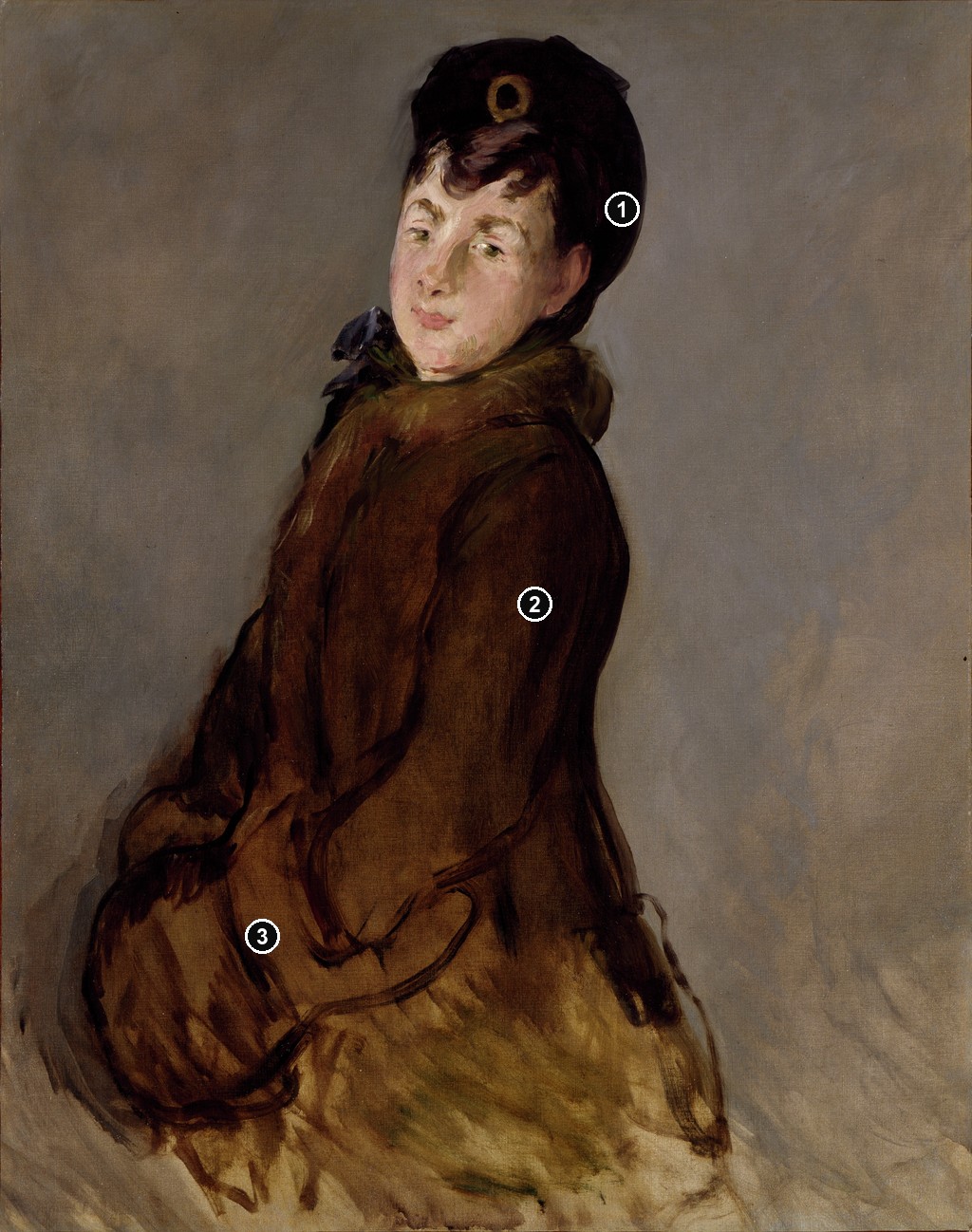
In Isabelle Lemonnier with a Muff, Édouard Manet sets a carefully described face above a body that becomes increasingly loose and sketchy. The young woman turns towards us while her brown coat follows another direction. Her hands disappear into the rounded fur muff near the lower left, where dark outlines remain conspicuous against thinly painted clothing.
The Dallas Museum of Art dates this oil portrait to about 1879–80.[1]
At a Glance
- ArtistÉdouard Manet
- Museum titlePortrait of Isabelle Lemonnier with a Muff
- DateAbout 1879–80.[1]
- MediumOil on canvas
- Dimensions93.03 × 73.66 cm.[1]
- CollectionDallas Museum of Art, 1978.1
- SitterIsabelle Lemonnier
- Collection creditGift of Mr. and Mrs. Algur H. Meadows and the Meadows Foundation, Incorporated.[1]
This work across Édouard Manet’s career
Contents
- Who Was Isabelle Lemonnier
- A Turned Pose
- Face and Hat
- The Coat and Muff
- Different Degrees of Finish
- A Pastel of the Same Sitter
- Illustrated Letters
- The Painting in Dallas
- Annotated details
Who Was Isabelle Lemonnier
Isabelle Lemonnier was the daughter of a successful Parisian jeweller and the younger sister of Marguerite Charpentier, whose portrait with her children was painted by Renoir. Manet portrayed Isabelle repeatedly during his later years; the Dallas museum counts six oil portraits, alongside works in pastel and watercolour.[1][2]
Each portrait treats a familiar person through different choices of dress, scale and pose. A different portrait can isolate another aspect of her appearance without acting as a preliminary stage for this one.
A Turned Pose
The body's broad diagonal begins with the muff at the lower left and rises towards the shoulder at the right. The head introduces a different direction, turning back out of the surrounding clothing. This contrast gives the figure a sense of movement even though the composition contains no clearly described setting or action.
The Dallas museum reads the pose as suggesting a woman moving left and glancing over her shoulder.[1] The impression comes from the painting's arrangement: the torso seems to continue one way while the face briefly addresses the viewer.
Around her, gray space leaves the silhouette exposed. There is no furniture to hold the body in place and no doorway to explain where she might be going. The encounter is carried by the change of direction within the figure itself.
Face and Hat
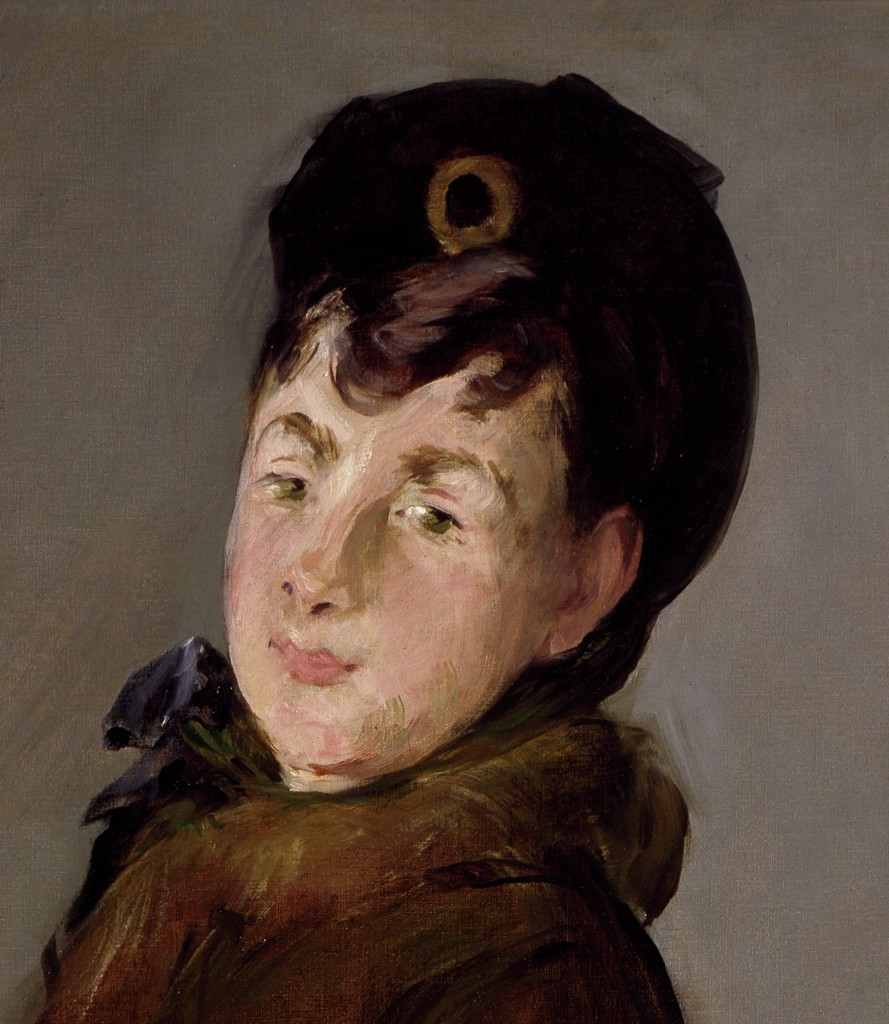
The dark hat rises well above the forehead, giving the head a compact, rounded surround. A small golden-looking ring stands out near its upper centre. Below, the hair breaks into curved locks that cross the forehead, connecting the broad mass of the hat with the smaller divisions of the face.
Manet describes the face through patches that remain visibly separate. Pale touches sit beside warmer pinks and browns, while darker strokes sharpen the eyes and eyebrows. These differences allow the cheeks and nose to appear rounded without making their surface uniformly smooth.
A dark blue-purple bow projects beside the jaw. Against the high brown collar, it marks a small interruption in the warmer clothing. The pale chin sits close to that collar, so that the face appears both exposed to us and closely enclosed by the costume.
The Coat and Muff
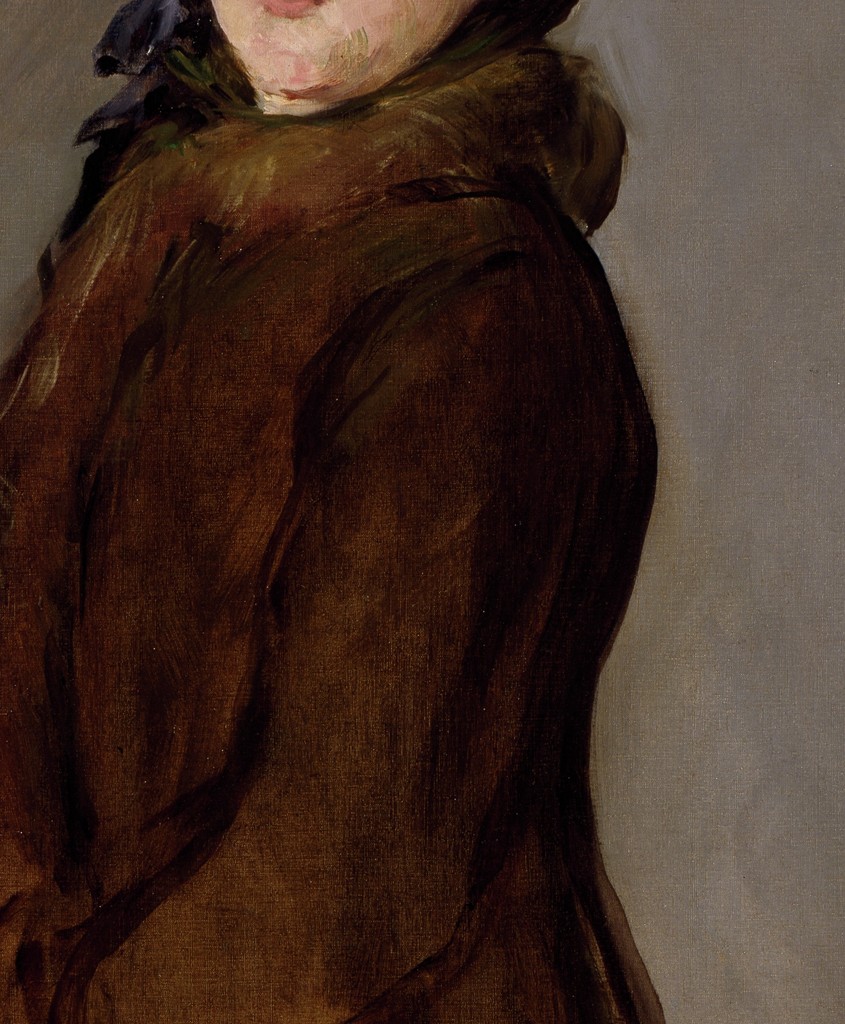
The coat gives the figure most of its weight. Its long brown passages stretch from shoulder to waist, with changes of tone suggesting the sleeve and the turn of the back. Curved dark marks around the near arm help separate that sleeve from the adjoining body, even where both share a similar colour.
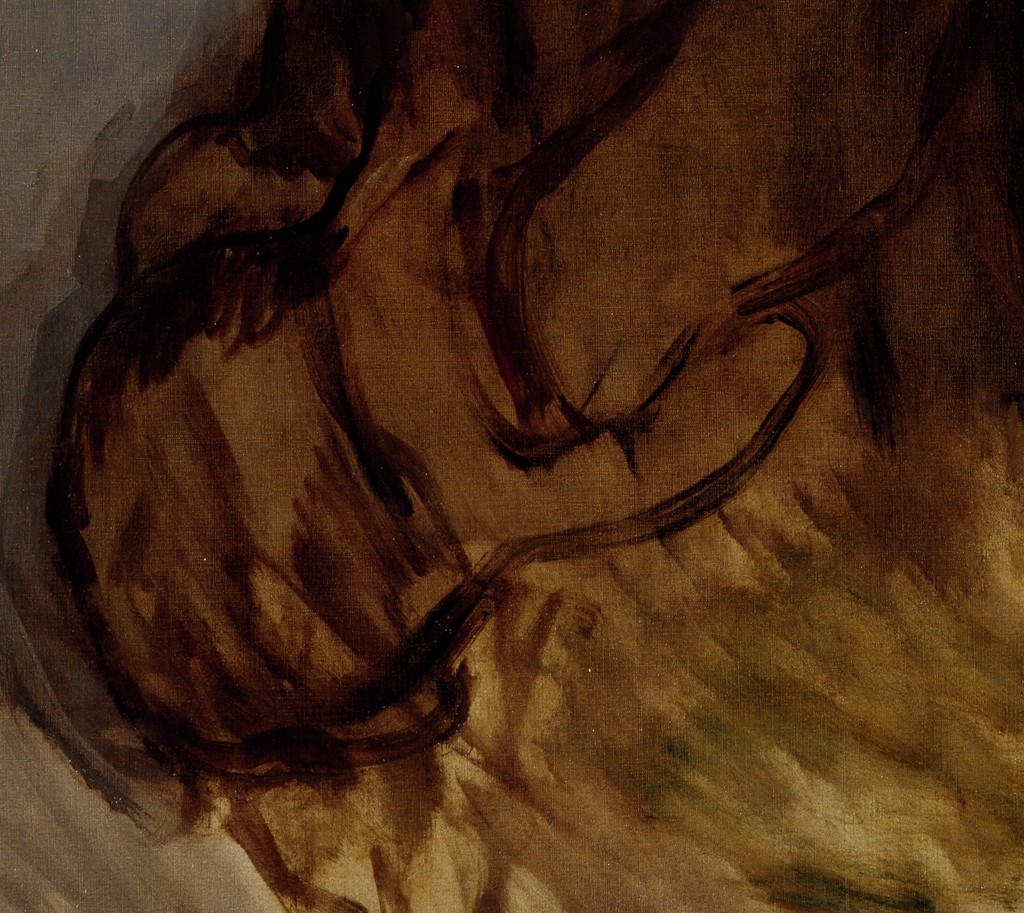
The muff is a fur handwarmer, enclosing the sitter's hands. Here it also becomes a large rounded shape that projects away from the coat. Manet emphasizes its outer curve and the dark opening above it, while leaving its lower surface comparatively thin. The hands are understood through their position inside it rather than through a display of separate fingers.
Several dark arcs repeat and overlap around this area. Lower down, brown strokes become more widely spaced and the pale field shows between them. The rounded accessory remains readable as an object, but its edges also draw attention to the brush moving across the canvas.
Different Degrees of Finish
Art historian Nancy Locke describes the portrait as presenting contrasting levels of finish. In her reading, the rounded head gives way to a flatter treatment of the coat, followed by a lower passage that makes painting's construction unusually apparent.[3]
Locke also compares the blurred gray edge and doubled contours with effects produced by long exposures in nineteenth-century photography.[3] This comparison offers a way of understanding the figure's instability without turning the portrait into a record of one frozen gesture.
The transition can be followed across the whole figure. Near the eyes, small distinctions carry a great deal of descriptive work; around the lower clothing, broader curves and open intervals dominate. Looking shifts between recognizing a woman and following the material marks that hold her image together. For a wider account of these choices, see Manet's style and technique.
A Pastel of the Same Sitter
The Metropolitan Museum of Art holds another portrait of Isabelle, dated 1879–82. It is pastel on canvas, a separate work measuring 55.9 × 46.4 cm.[2] Its narrower view of the sitter offers a useful comparison with the more extensive body and clothing in Dallas.
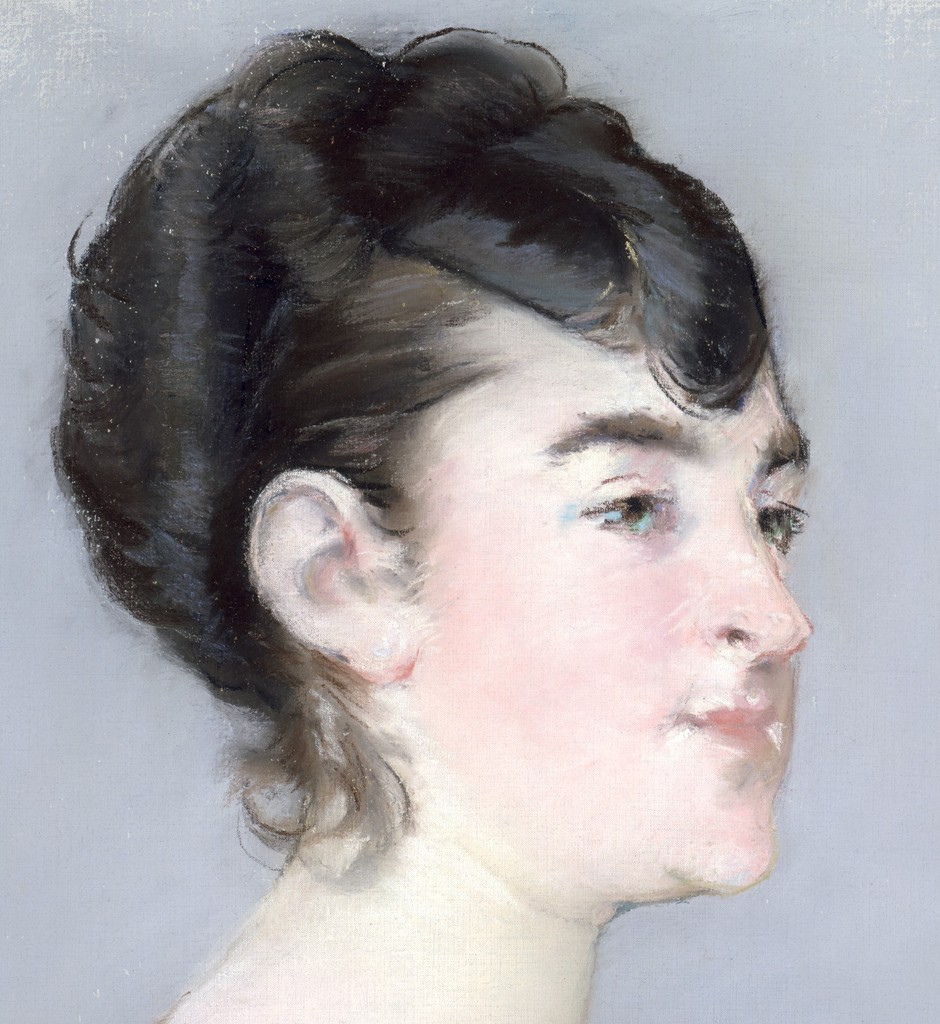
In the pastel, her face turns towards the right. Dark swept-up hair outlines the pale forehead and cheek, while the high light collar leads down into a loosely indicated upper garment. The light blue-gray background continues around the shoulders, whose boundaries are only lightly marked.
A small rose and green leaves occupy the lower right. Their compact shape provides a second point of attention below the head. The Dallas picture distributes its dark clothing over a much larger area; the pastel concentrates the sitter's presence in the head, with pale space extending beneath it. The difference in framing changes how much work the face must do within each composition.
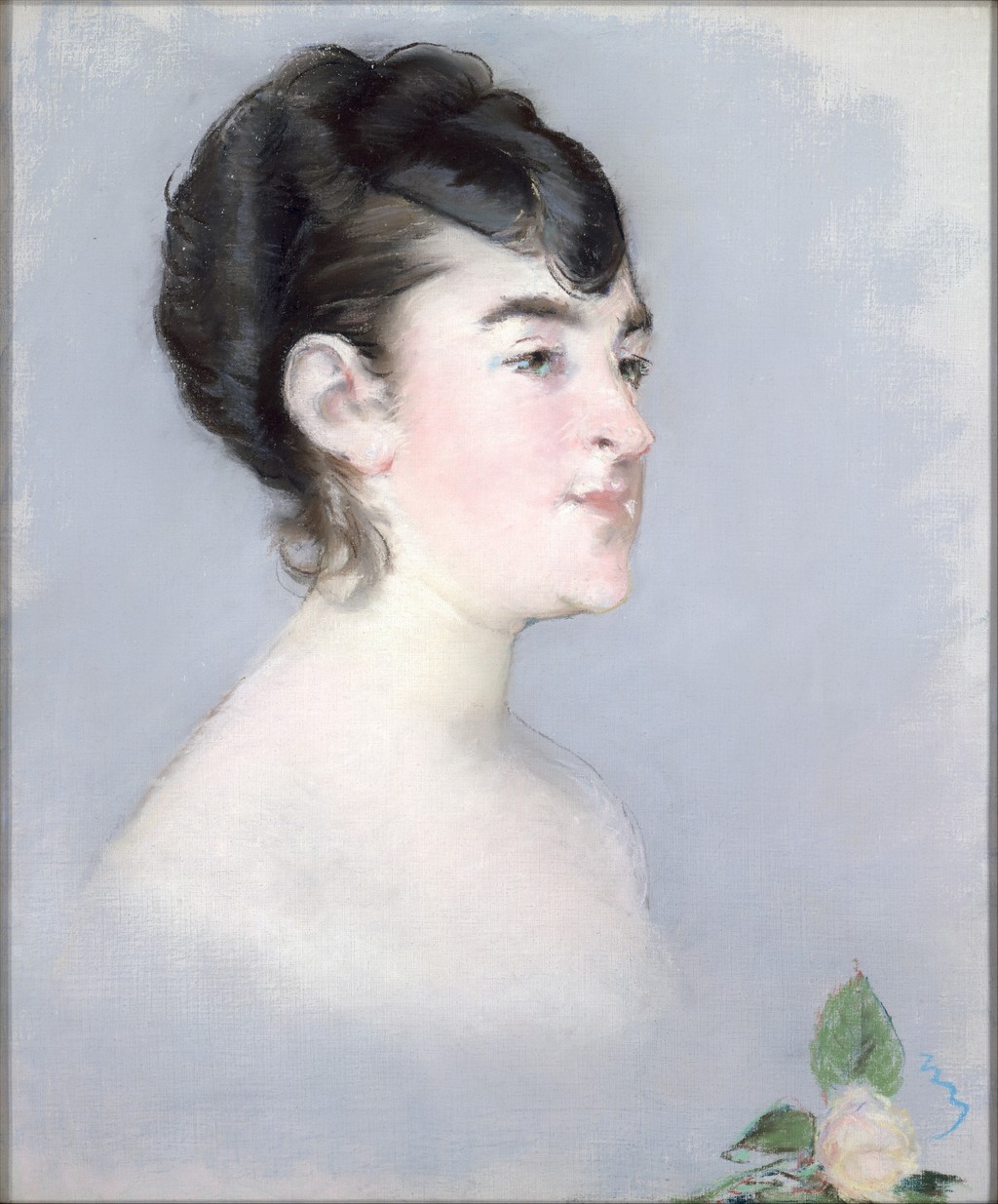
Édouard Manet, Mademoiselle Isabelle Lemonnier (1857–1926), 1879–82. Pastel on canvas, 55.9 × 46.4 cm. The Metropolitan Museum of Art, 29.100.56. H. O. Havemeyer Collection, Bequest of Mrs. H. O. Havemeyer, 1929. Image source. CC0 / Public domain. Whole supplied image resized without cropping or enlargement; no recolouring or retouching.
Illustrated Letters
Manet's portraits of Isabelle belong alongside a personal exchange in words and images. During the summer of 1880, he sent her letters decorated with watercolour sketches.[2] One surviving letter, dated 9 July at Bellevue, is recorded in the Louvre's collections. It asks for news and mentions Léon and a party; the museum describes a seated cat in gray wash on its other side.[4]
Such a letter brings the relationship into the scale of everyday correspondence. A brief message, a drawing and an expectation of a reply accompany the more sustained attention of the portraits. Together they show several ways in which Manet addressed the same person, without making one painted expression a complete account of their friendship.
The Painting in Dallas
Rouart and Wildenstein catalogue the oil as Isabelle Lemonnier au manchon, placing it around 1879 in Manet's rue d'Amsterdam period. Their catalogue also notes that the dates of the six oil portraits had been interpreted differently.[5] The group should therefore be approached as a series of varied treatments rather than a firmly ordered progression.
The Dallas painting entered the museum through the gift of Mr. and Mrs. Algur H. Meadows and the Meadows Foundation.[1] Its title draws attention to an accessory, while its changing treatment of the figure invites looking from the face down to the loose outlines below.
Annotated Details from Isabelle Lemonnier with a Muff
The numbered points identify visible features discussed in this article. Return from each detail to the whole composition. Each caption identifies the work shown.
Isabelle Lemonnier with a Muff
Édouard Manet, Portrait of Isabelle Lemonnier with a Muff, about 1879–80. Oil on canvas, 93.03 × 73.66 cm. Dallas Museum of Art, 1978.1. Gift of Mr. and Mrs. Algur H. Meadows and the Meadows Foundation, Incorporated. Dallas Museum of Art; via Wikimedia Commons. Image source. Public domain. Numbers added to a separate overview. Three detail crops from the existing supplied Commons crop of the museum photograph; no enlargement, recolouring or retouching.
Mademoiselle Isabelle Lemonnier — Pastel
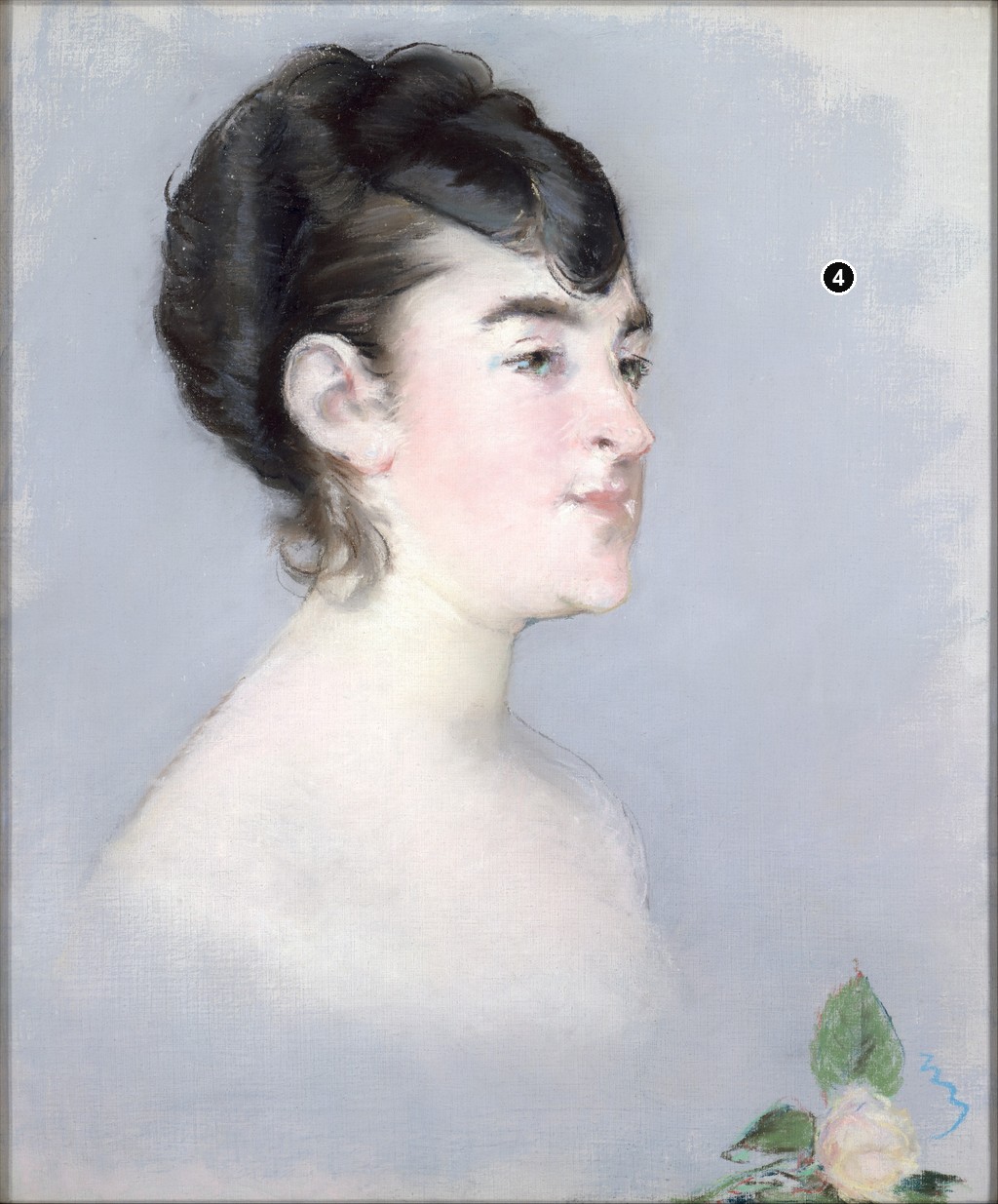
Édouard Manet, Mademoiselle Isabelle Lemonnier (1857–1926), 1879–82. Pastel on canvas, 55.9 × 46.4 cm. The Metropolitan Museum of Art, 29.100.56. H. O. Havemeyer Collection, Bequest of Mrs. H. O. Havemeyer, 1929. Image source. CC0 / Public domain. Numbers added to a separate resized whole supplied overview. Detail crops from the unchanged original; no enlargement, retouching or colour alteration.
Details from ISABELLE LEMONNIER WITH A MUFF
Follow the numbered details back to the complete images above. Each caption identifies the work shown.
Isabelle Lemonnier with a Muff
Face, hat and bow
The pale face is enclosed by the dark hat and high brown collar. A small ring ornament and a blue-purple bow punctuate the surrounding dark shapes.
The collar and curved sleeve
The raised collar opens into long brown passages. Curved dark strokes distinguish the near sleeve from the adjoining coat.
The muff and lower outlines
Overlapping dark arcs describe the rounded muff. Below it, widely spaced brown strokes allow the pale field to show through.
Mademoiselle Isabelle Lemonnier — Pastel
Profile and Coiled Hair
Coiled dark hair frames the pale face, whose outline turns against the blue-grey ground.
Artworks directory
Explore selected paintings, drawings and prints by Édouard Manet. Search by title or another recorded name.
Frequently Asked Questions
She is Isabelle Lemonnier, the daughter of a Parisian jeweller and younger sister of Marguerite Charpentier. Manet made several portraits of her.[2]
It is the fur handwarmer enclosing her hands near the lower left. The Dallas museum identifies both the muff and the fur trimming of her brown coat.[1]
Discussion
Look again at the images and ideas explored in Isabelle Lemonnier with a Muff. These editorial prompts invite your observations.
Reader Insights
Follow the angle of the torso, then the turn of the face. How does their difference affect the sense of an encounter?
Look at the repeated outlines around the muff. Where do they describe its shape, and where do individual strokes become more noticeable?
Compare the whole oil and pastel. How do clothing, head direction and the amount of surrounding space change your attention to the sitter?
Join the Conversation
Share a detail, comparison or question about Isabelle Lemonnier with a Muff below.
References
- Dallas Museum of Art, Portrait of Isabelle Lemonnier with a Muff, about 1879–80, 1978.1, current object details, commentary and collection credit. View source.
- The Metropolitan Museum of Art, Mademoiselle Isabelle Lemonnier (1857–1926), 1879–82, 29.100.56, current object details, commentary and notes. View source.
- Nancy Locke, Manet: Models, Portraits, and La Vie Moderne, Richard R. Brettell Lecture, Dallas Museum of Art, 12 November 2009, especially 40:03–46:07, discussion of finish and photographic comparison. Official transcript access, pp. 16–19. View source.
- Musée du Louvre, 9 juillet (1880), Bellevue, à Isabelle Lemonnier, RF 11176, Verso, current catalogue description. French. View source.
- Denis Rouart and Daniel Wildenstein, Édouard Manet: Catalogue raisonné, tome I, 1975, no. 302 and related sitter/series commentary under no. 299, pp. 236–237. Digitised catalogue. French. View source.
- Splash image, Édouard Manet, Portrait of Isabelle Lemonnier with a Muff, about 1879–80. Oil on canvas, 93.03 × 73.66 cm. Dallas Museum of Art, 1978.1. Gift of Mr. and Mrs. Algur H. Meadows and the Meadows Foundation, Incorporated. Dallas Museum of Art; via Wikimedia Commons. Image source. Public domain. Resized without enlargement from the existing supplied Commons crop of the museum photograph; no recolouring or retouching.


