



 by Tom Gurney
Tom Gurney BSc (Hons) is an art history expert with over 20 years experience
Published on June 19, 2020 / Updated on October 30, 2026
Email: tomgurney1@gmail.com / Phone: +44 7429 011000
Madame Manet at the Piano by Édouard Manet: Introduction
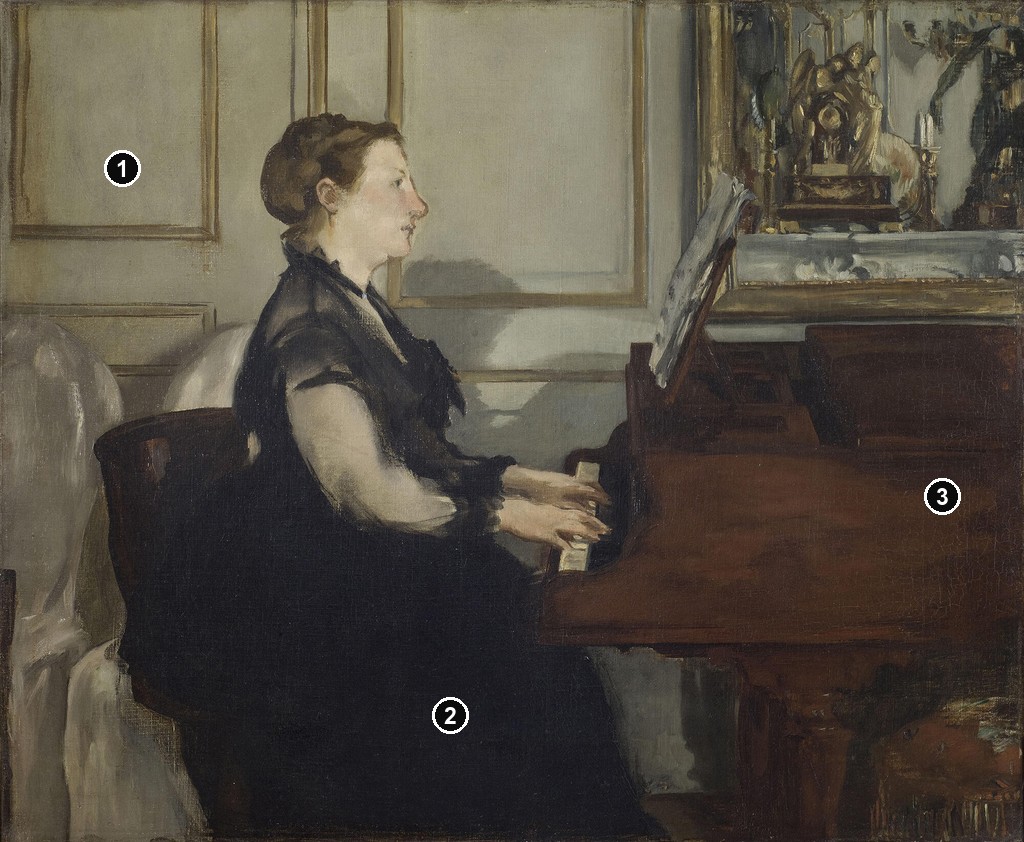
Suzanne Manet sits in profile at a brown piano, her hands resting on the keys and her eyes directed towards the music before her. The dark dress gathers into a broad shape beneath her pale face and forearm. Around her, light wall panels and narrow gold lines give the room a measured order. Manet makes the pianist's presence felt through the relationship between her body, the instrument and the surrounding interior.
The Musée d'Orsay dates Madame Manet at the Piano to 1868. Painted in oil on canvas, it measures 38.5 × 46.5 cm.[1] Its modest size suits the closeness of the view: Suzanne occupies much of the left half, while the piano extends across the right foreground. The painting offers both a likeness of Manet's wife and an image of an activity central to her life.
At a Glance
- ArtistÉdouard Manet
- TitleMadame Manet at the Piano, or Madame Manet au piano
- Date1868
- MediumOil on canvas
- Canvas dimensions38.5 cm high × 46.5 cm wide
- CollectionMusée d'Orsay, Paris
- Inventory numberRF 1994.[1]
This work across Édouard Manet’s career
Contents
- Suzanne as a Pianist
- Profile and Hands
- The Piano and the Room
- Musical Evenings and a Damaged Degas Portrait
- Whistler and Another Piano Picture
- Chabrier and a Dedication to Madame Manet
- From Suzanne's Collection to the Musée d'Orsay
- Annotated details
Suzanne as a Pianist
Born Suzanne Leenhoff, Manet's wife was a Dutch musician who had worked as a piano teacher in his family. They married in 1863. She became a frequent model, appearing in pictures that gave her different settings and roles.[2] Here the instrument connects the portrait with her own skill, making her musical activity part of how we recognise her.
That distinction matters when looking at her hands. They belong to someone accustomed to the keyboard, rather than serving simply as accessories to a costume. The face, arms and fingers all turn towards the same task. The painting's concentration emerges from that arrangement; it does not require an invented account of the tune she plays or the thoughts passing through her mind.
Music was also a social practice. Georges Liébert places the portrait within a nineteenth-century culture in which playing the piano and performing arrangements helped people encounter works they could not hear through recordings. He describes Suzanne as an accomplished interpreter, particularly of Schumann, and recalls her playing for friends.[3] A domestic instrument could bring music into a household and connect its occupants with a much wider cultural life.
The portrait gives that activity an individual focus. Suzanne appears without a visible audience, her attention directed across the instrument. Her place within Manet's family and career is relevant, but the keyboard establishes something more particular than the general role of an artist's wife. It is the object through which her own accomplishment enters the painting.
Profile and Hands
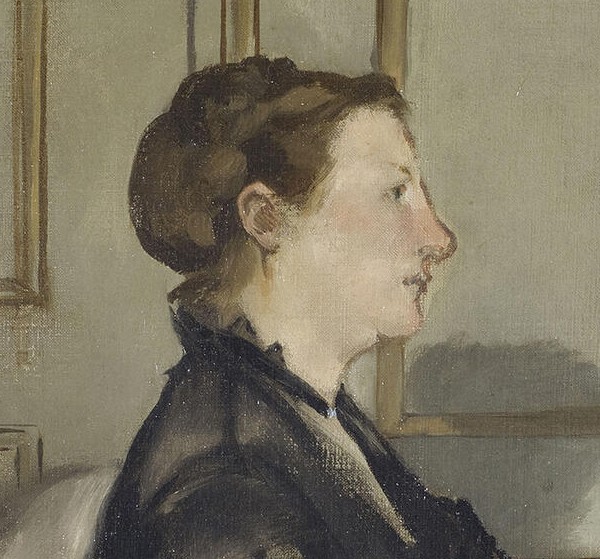
Suzanne's head is placed against an unusually quiet part of the room. The pale wall makes the outline of her forehead, nose, lips and chin easy to follow. Her hair is drawn back into a bun, leaving the profile open. Small shifts of pink and grey model the cheek and jaw without breaking the larger light shape of the face.
The dark collar supplies a firm base for the neck. Below it, the dress is less precisely described. Black and brownish passages join across the torso and skirt, with a few lighter strokes indicating folds and changes of surface. The short sleeve allows the arm to become visible through and beneath the fabric. Its curved contour carries the eye down from the shoulder towards the hands.
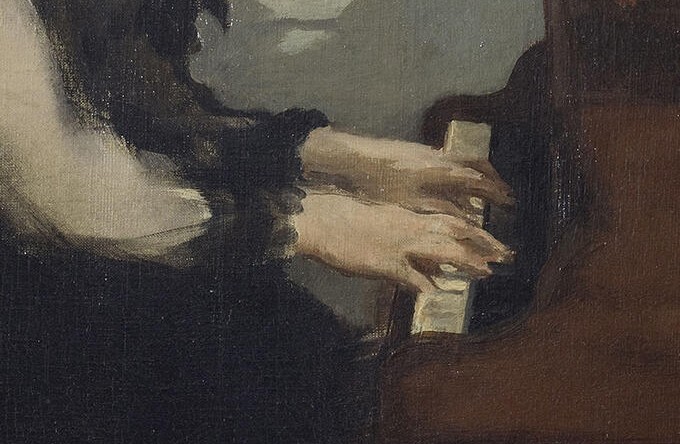
Manet gives the two hands a different kind of definition. Light touches separate fingers from the narrow keys, while darker accents mark the spaces around them. They are small in relation to the skirt and piano, yet their position makes them a centre of activity. The keyboard is the point at which the large dark shape of Suzanne's dress meets the warm brown instrument.
Her forearm forms a soft, rounded diagonal. The score on its stand provides another diagonal, rising steeply towards the upper right. Between them, the pianist's face remains comparatively upright. These different directions connect looking, reading and playing across the canvas.
The picture therefore makes a musical action visible without spelling out its duration. We can follow the relationship between eyes, score and fingers, but the abbreviated marks do not identify a particular passage of music. Her pose could be held for a portrait; the composition gives it the coherence of playing. The musician's practical activity and the painter's arrangement of forms remain closely connected.
The contrast between face and dress is equally important. The head attracts attention through its lightness and carefully maintained outline. The skirt contributes weight and breadth, spreading towards the bottom edge. Suzanne's likeness is neither isolated from her body nor lost within a display of clothing: the simpler dark passages make the smaller pale areas more distinct.
The Piano and the Room
The piano takes up a substantial part of the foreground. Its curved brown side approaches the right edge, and its horizontal surfaces give the composition a strong lower boundary. The instrument has a physical weight that balances Suzanne's figure. It also brings the viewer close to the action, as though standing beside the keyboard rather than watching from across a large room.
Behind her, wall panels offer a different order. Their vertical and horizontal lines surround the organic shapes of head, arm and dress. Thin gold borders warm the otherwise restrained cream and grey tones. A shadow falls across the panelling behind Suzanne, giving the wall a relationship with her body rather than leaving it as a flat decorative screen.
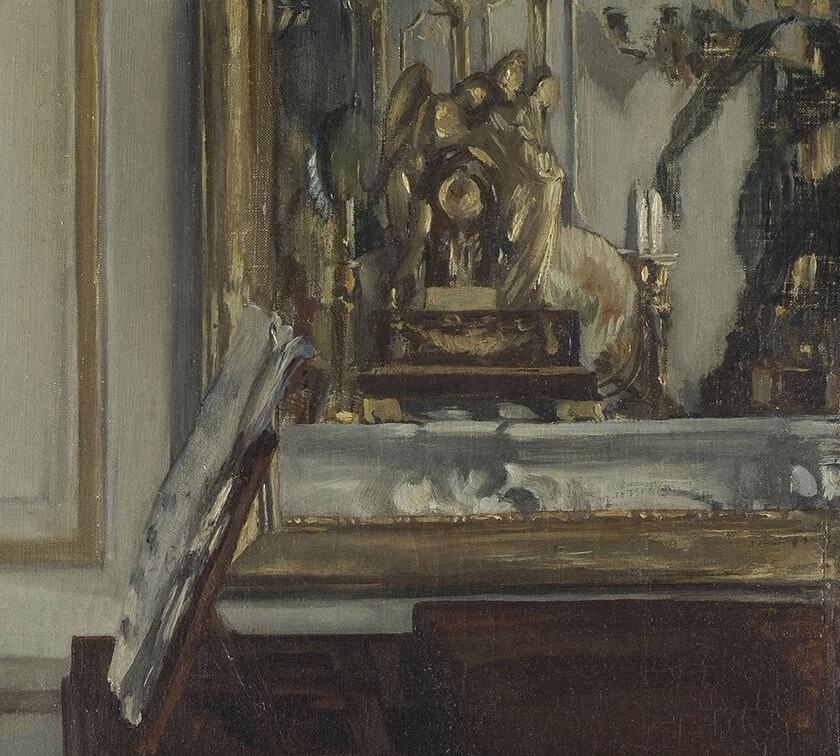
At the left, pale fabric covers a sofa. The dark wooden back of Suzanne's chair passes in front of it, making an overlap between furniture and figure. At the upper right, an ornate clock, a mantel and a framed mirror introduce a denser area of objects and reflections. The score stands between these small decorative forms and the broad surface of the piano.
Curator Isolde Pludermacher draws attention to the white panelling, gold borders and covered sofa when discussing the room's appearance in both Manet's painting and a portrait by Degas.[4] These details identify a shared interior while also showing how differently an artist can arrange it. In Manet's picture, the panels establish a framework around Suzanne's profile and the instrument before her.
The room's different surfaces sustain much of the painting's interest. Pale fabric falls in loose folds; the panelling forms regular rectangles; the piano offers a broad brown curve. The dark dress moves between these areas, holding Suzanne together as a substantial figure. Small objects and furniture give her activity a setting without overwhelming the head and hands.
Musical Evenings and a Damaged Degas Portrait
Suzanne's apparently solitary pose belongs to a household in which music could gather listeners. The Metropolitan Museum's Manet/Degas exhibition text locates this room in the Manet apartment on the rue de Saint-Pétersbourg, where the couple received friends, including Degas, on Thursdays.[5] That setting gives a social dimension to the instrument, even when the audience is outside Manet's composition.
Degas included a listener in Monsieur and Madame Édouard Manet, painted in 1868–69 and now in the Kitakyushu Municipal Museum of Art. Édouard reclines on a sofa at the left, while Suzanne sits at the piano towards the right. Manet cut the canvas through his wife's profile; Degas reclaimed the damaged gift.[5]
The surviving composition makes the loss conspicuous. Suzanne's pale dress and dark waist ribbon remain, along with part of her head, but her face disappears at the painted edge. A broad strip of blank canvas occupies the right side. Its plainness differs sharply from the lightly described room and the figures beside it. The division interrupts a scene originally organised around the relationship between a musician and a listener.
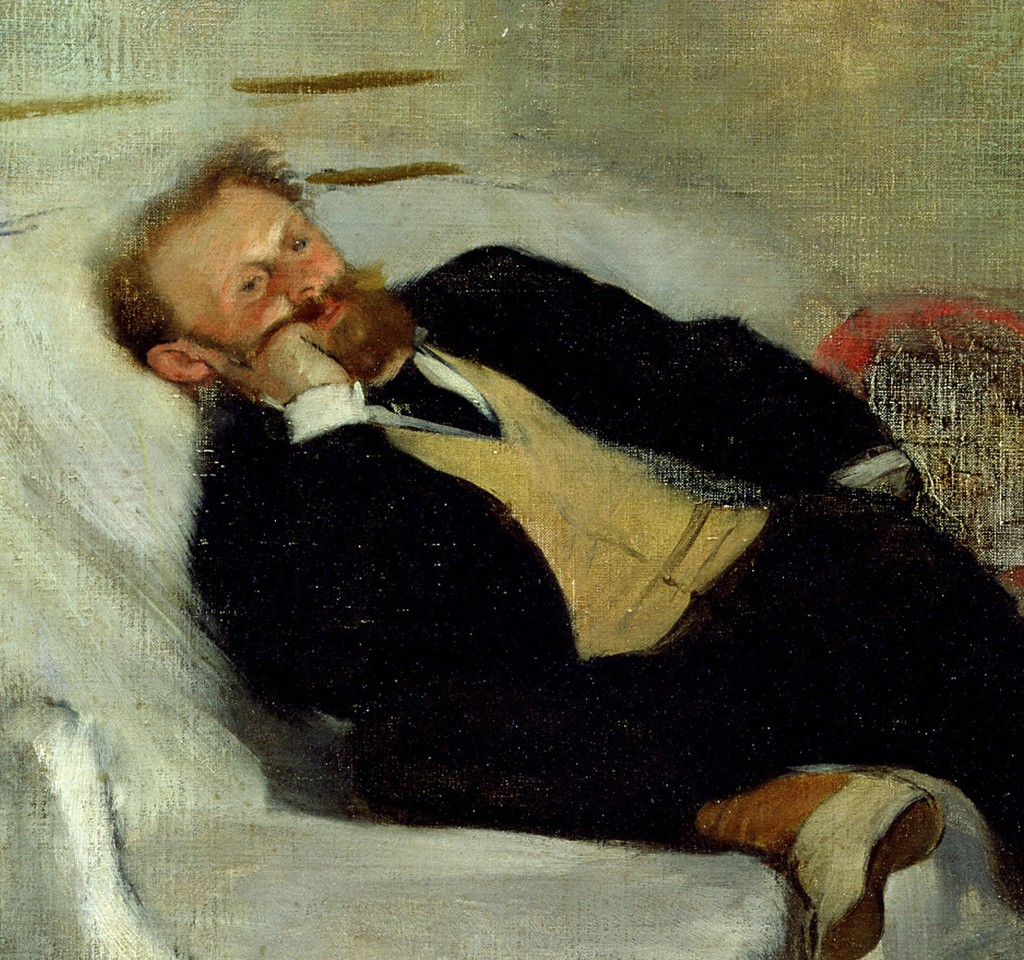
Manet's reclining body supplies a diagonal across Degas's painting. His dark coat stands out against the white sofa cover, and one hand supports his head. Suzanne, by contrast, sits more upright. Her dress descends towards the floor in long folds. Their two poses give the remaining painted area different rhythms, even though the damaged edge prevents a complete view of the musical activity.
The Met's account leaves the reason for the cutting unresolved and notes uncertainty about when and why the blank strip was added. It proposes that Manet's own piano portrait may have been a response to Degas's work.[5] That possibility makes the comparison compelling, but the pictures' overlapping dates do not establish a precise sequence separated by a year.
In Manet's canvas, Suzanne's profile is intact and prominent. The room is concentrated around her, with no reclining listener to share the foreground. The comparison shifts attention from the story of a damaged gift to the different ways of portraying her: Degas places her within an encounter between two people, while Manet makes her musical activity the centre of the image.
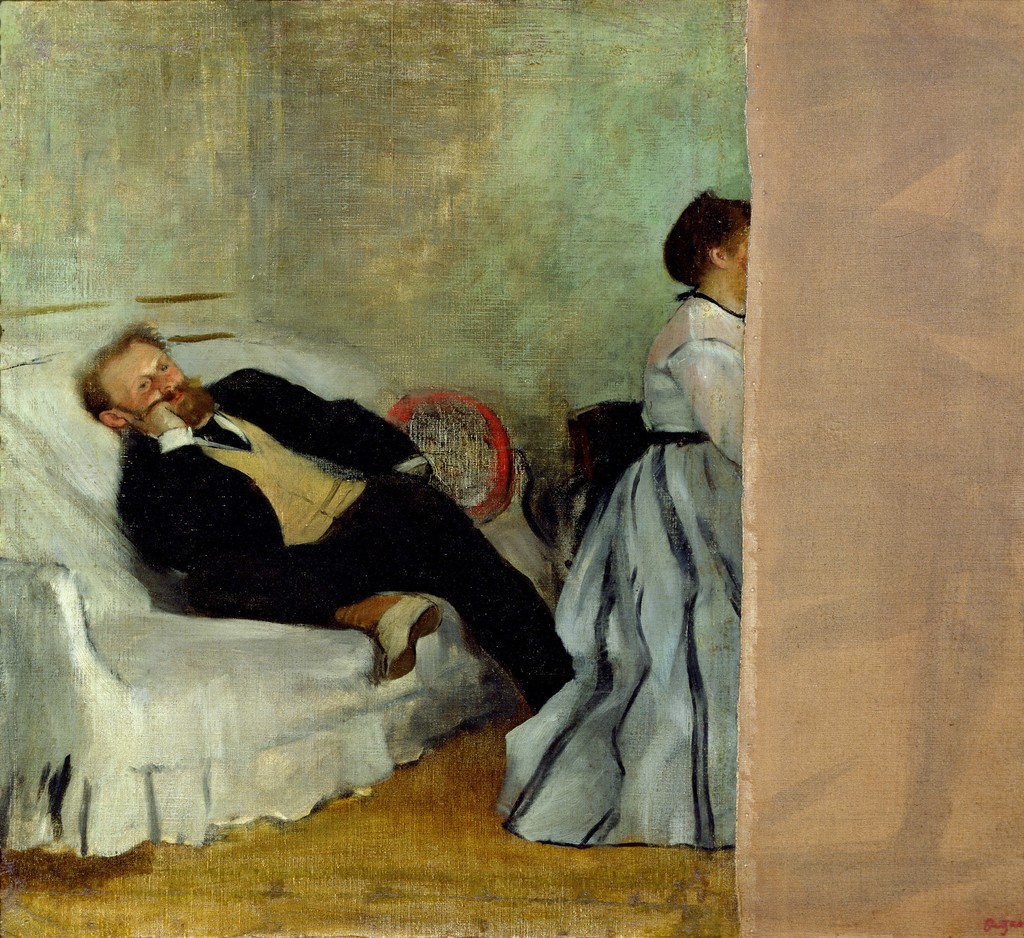
Edgar Degas, Monsieur and Madame Édouard Manet, 1868–69. Kitakyushu Municipal Museum of Art. The surviving blank canvas strip at the right is retained. Kitakyushu Municipal Museum of Art; faithful public-domain reproduction via Wikimedia Commons. Image source. Public domain. Resized from the complete supplied view, including the blank strip; no cropping or reconstruction.
Whistler and Another Piano Picture
Manet also knew Whistler's At the Piano. Diana Seave Greenwald discusses a letter from the spring of 1867 in which the critic and collector Théophile Thoré-Burger asked Manet to help him enquire about buying it. Thoré-Burger had seen the painting at the Paris Salon and hoped to place it alongside his Dutch Old Masters. The proposed acquisition did not succeed.[6]
Whistler painted At the Piano in 1858–59. Now in the Taft Museum of Art, it shows his sister Deborah Haden at the instrument and his niece Annie listening nearby.[7] The adult wears a long black dress, while the child stands in white at the other side of the piano.
Both compositions build a striking relationship between a darkly dressed player and a light interior. In Whistler's picture, the child's white dress supplies a second figure of comparable importance. The piano stands between them, and framed pictures extend across the wall behind. Its broader arrangement lets the eye move between performer and listener.
Manet brings the player closer and gives the instrument a larger share of the foreground. Suzanne's pale face and forearm provide the main light accents within her dark figure. The wall panels establish a quieter background than Whistler's hanging pictures, while the mirror and clock concentrate detail towards one corner. The likenesses between the works are useful precisely because their arrangements differ.
Greenwald also considers possible connections with Vermeer's scenes of keyboard playing, including The Concert, once owned by Thoré-Burger. She leaves Manet's direct acquaintance with those particular works as a question.[6] The documented contact around Whistler's painting offers a firmer link than a definite claim that Suzanne's portrait copies a Vermeer.
The two contemporary piano pictures show how an interior can organise the experience of music for a viewer. Whistler gives the listener a visible body and a contrasting white dress. Manet leaves the listener's place open, allowing our attention to settle on Suzanne's profile, hands and the space immediately around the keyboard.
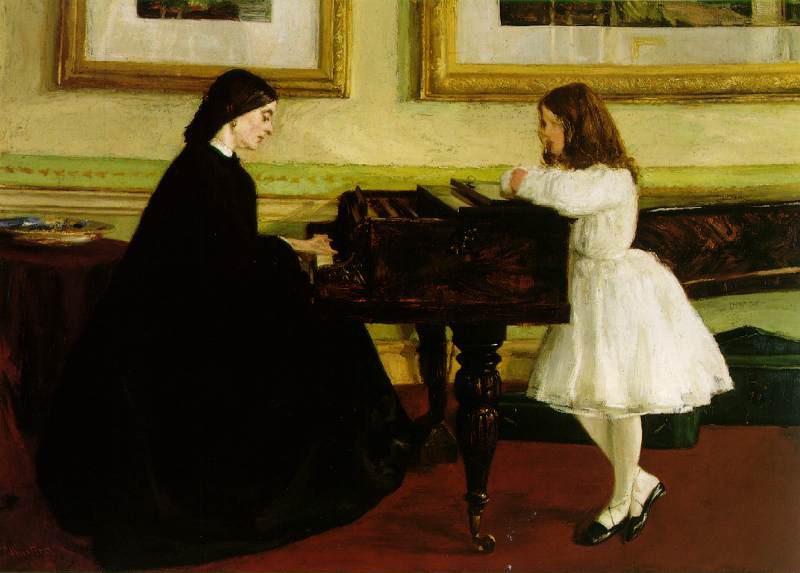
James McNeill Whistler, At the Piano, 1858–59. Taft Museum of Art, Cincinnati, 1962.7. Taft Museum of Art; faithful public-domain reproduction via Wikimedia Commons. Image source. Public domain. Whole supplied reproduction resized within native dimensions; no enlargement, retouching or colour alteration.
Annotated Details from Madame Manet: Profile, Piano and a Degas Comparison
The numbered points identify visible features discussed in this article. Return from each detail to the whole composition. Each caption identifies the work shown.
Madame Manet at the Piano — Manet
Édouard Manet, Madame Manet at the Piano, 1868. Musée d’Orsay, Paris, RF 1994. Musée d’Orsay; faithful public-domain reproduction via Wikimedia Commons. Image source. Public domain. Numbers added to a separate resized whole supplied overview. Detail crops from the unchanged original; no enlargement, retouching or colour alteration.
Monsieur and Madame Édouard Manet — Degas
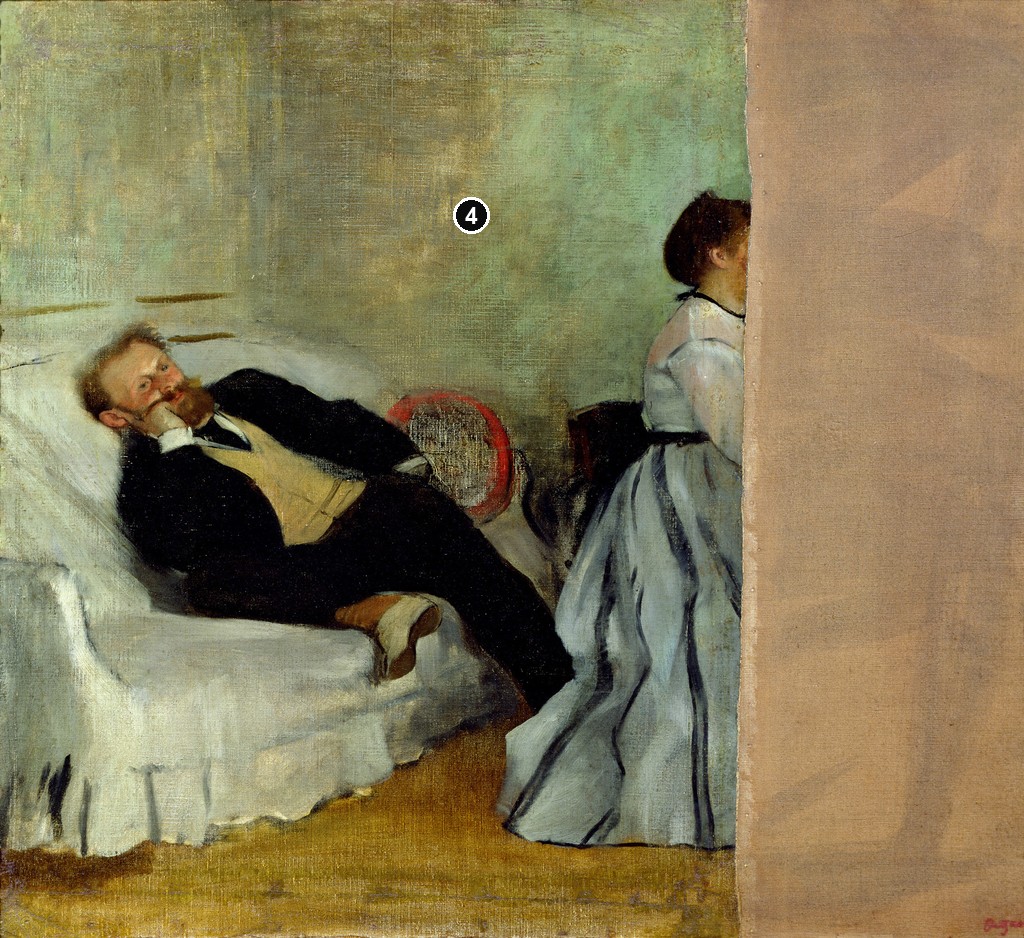
Edgar Degas, Monsieur and Madame Édouard Manet, 1868–69. Kitakyushu Municipal Museum of Art. The surviving blank canvas strip at the right is retained. Kitakyushu Municipal Museum of Art; faithful public-domain reproduction via Wikimedia Commons. Image source. Public domain. Numbers added to a separate resized whole supplied overview of Degas’s painting, retaining the blank right strip and the cut edge of the female figure. Detail crop from the unchanged original; no reconstruction, enlargement, retouching or colour alteration.
Details from MADAME MANET: PROFILE, PIANO AND A DEGAS COMPARISON
Look at Suzanne’s profile, two hands and the piano-room setting, then compare Manet’s reclining figure in Degas’s separate painting.
Madame Manet at the Piano — Manet
Profile and Dark Hair
Suzanne’s profile turns towards the piano above the dark collar and gathered hair.
Two Hands at the Keyboard
The two hands extend from dark cuffs towards the pale keys.
Slanting Pages and Mirror
The slanting pages rise above the keys beneath the mirror and reflected ornaments.
Monsieur and Madame Édouard Manet — Degas
Face, Supporting Hand and Waistcoat
In Degas’s separate painting, Manet rests his head on one hand above a pale waistcoat.
Chabrier and a Dedication to Madame Manet
Suzanne's musical circle also included Emmanuel Chabrier. His Impromptu in C major, dedicated to Madame Édouard Manet, gives a specific musical work a place beside her painted likeness. The Bibliothèque nationale de France dates its composition to 1865 and its first publication, by Hartmann, to 1873. Camille Saint-Saëns gave its first public performance at the Société nationale de musique on 27 January 1877.[8]
Those different dates describe the life of a composition, from its creation to publication and performance. The dedication recognises Suzanne within that musical world. It offers a more concrete indication of her connections than an imagined identification of the pages on the painted stand.
Nothing legible in the portrait establishes that she is playing Chabrier's Impromptu. The connection lies in the pianist herself. Manet's picture shows the bodily work of reading and playing; the dedication identifies her as a recipient of music written by a composer in her circle. Together they allow Suzanne's musicianship to remain part of her identity beyond her appearances as a model.
From Suzanne's Collection to the Musée d'Orsay
The portrait remained with Suzanne until 1894, when Maurice Joyant acquired it. It entered Isaac de Camondo's collection in 1895 and passed to the French national collection through his bequest in 1911. It was first displayed at the Louvre in 1914, later housed at the Jeu de Paume, and assigned to the Musée d'Orsay in 1986.[1]
Its passage into a public collection changed the audience for a picture rooted in a private musical setting. The room's objects remain close to Suzanne, but her profile and hands can now be considered alongside other painted musicians, portraits and interiors. Its small scale continues to reward the kind of attention that an intimate portrait invites.
Artworks directory
Explore selected paintings, drawings and prints by Édouard Manet. Search by title or another recorded name.
Frequently Asked Questions
The Musée d’Orsay dates the painting to 1868.[1]
It belongs to the Musée d’Orsay in Paris, inventory RF 1994.[1]
Discussion
Look again at the images and ideas explored in Madame Manet at the Piano by Édouard Manet. These editorial prompts invite your observations.
Reader Insights
Follow Suzanne’s profile down towards her forearm and hands. Compare the small light areas with the broad dark shape of the dress.
Look from the keyboard to the wall panels, mirror and clock. Notice how the instrument and the room organise the space around the pianist.
Compare Manet’s portrait with the Degas and Whistler piano pictures. How does a visible listener change the arrangement, and what does the blank strip interrupt in Degas’s work?
Join the Conversation
Share a detail, comparison or question about Madame Manet at the Piano by Édouard Manet below.
References
- Musée d'Orsay, Madame Manet au piano, 1868, RF 1994; current object details and provenance (in French). View source.
- Isabella Stewart Gardner Museum, Manet: A Model Family, large-print exhibition labels, 2024, PDF pp.4–5, 11 and 15–16; Suzanne's musicianship and marriage. View source.
- Georges Liébert, “Madame Manet au piano,” L'Histoire par l'image, March 2016; domestic piano playing and Suzanne's musical activity (in French). View source.
- Isolde Pludermacher, Manet/Degas, Musée d'Orsay curator-interview transcript, 2023, PDF pp.3–4; the shared room and the two portraits (in French). View source.
- The Metropolitan Museum of Art, Manet/Degas, large-print exhibition text, 2023, PDF pp.13–15; Suzanne's profile, the piano portrait and Degas's double portrait. View source.
- Diana Seave Greenwald, “Édouard Manet, James McNeill Whistler, and a Stolen Vermeer: Unexpected Connections at the Gardner Museum,” Isabella Stewart Gardner Museum, 26 November 2024. View source.
- Taft Museum of Art, James McNeill Whistler, At the Piano, 1858–59, 1962.7; collection details and sitters. View source.
- Bibliothèque nationale de France, Emmanuel Chabrier, Impromptus. Piano. No 1. D 11. Do majeur, musical authority record 13910404t; composition, dedication, publication and first performance (in French). View source.
- Splash image, Édouard Manet, Madame Manet at the Piano, 1868. Musée d’Orsay, Paris, RF 1994. Musée d’Orsay; faithful public-domain reproduction via Wikimedia Commons. Image source. Public domain. Whole supplied reproduction resized within native dimensions; no enlargement, retouching or colour alteration.


