



 by Tom Gurney
Tom Gurney BSc (Hons) is an art history expert with over 20 years experience
Published on June 19, 2020 / Updated on October 30, 2026
Email: tomgurney1@gmail.com / Phone: +44 7429 011000
Marguerite de Conflans Wearing a Hood by Édouard Manet: Introduction
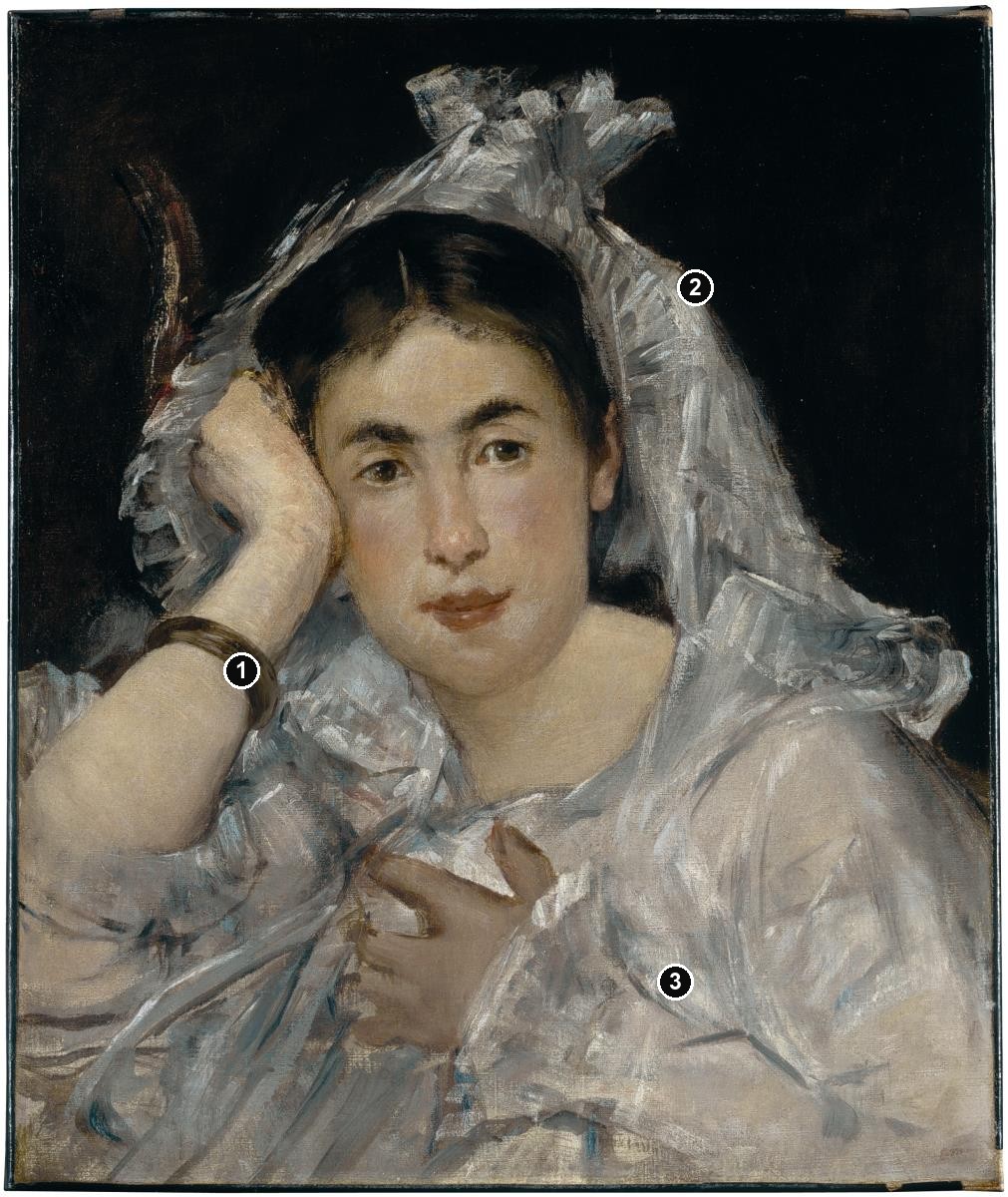
A pale covering rises above Marguerite de Conflans's dark hair and spreads across her shoulders. One hand supports her tilted head; the other gathers the fabric against her chest. Édouard Manet painted this portrait in 1873. It belongs to the Oskar Reinhart Collection ‘Am Römerholz’ in Winterthur, where the hood is identified as probably a Spanish mantilla.[1] Warm skin and cool clothing stand out against the dark background.
At a Glance
- ArtistÉdouard Manet
- TitleMarguerite de Conflans Wearing a Hood
- Alternative titlePortrait of Marguerite de Conflans wearing a Mantilla
- French catalogue titlePortrait de Marguerite de Conflans; also La Jeune Fille en Blanc
- Date1873
- MediumOil on canvas
- Dimensions55.5 × 46.5 cm
- CollectionOskar Reinhart Collection ‘Am Römerholz’, Winterthur
- Inventory numberSOR1947.1.[1][2]
This work across Édouard Manet’s career
Contents
- The Hand Supporting the Head
- Warm Features and Dark Hair
- The Pale Covering
- A Second Hand Gathering Fabric
- A Dark Ground and Varied Marks
- A Probable Mantilla
- A Note on the Face's Appearance
- Comparing the Oval Portrait in Toulouse
- From the Studio to Winterthur
- Annotated details
The Hand Supporting the Head
The raised arm enters from the lower left and rises towards the head. Its pale, comparatively broad surface is interrupted at the wrist by a dark bracelet. Above that band, the hand bends inward and meets the side of the face, partly disappearing among hair and light fabric.
This gesture gives the portrait an uneven framework. The forearm occupies a large area at the left, while the opposite shoulder spreads towards the right edge. Between them, the head tilts slightly into the hand. The body does not form a rigid upright beneath the face; its different angles give the figure a more varied outline.
Following the arm upwards also reveals several boundaries. Skin meets the dark bracelet, then the hand approaches dark hair and pale folds. These neighbouring areas clarify the wrist and temple, even where finger contours become less distinct.
Warm Features and Dark Hair
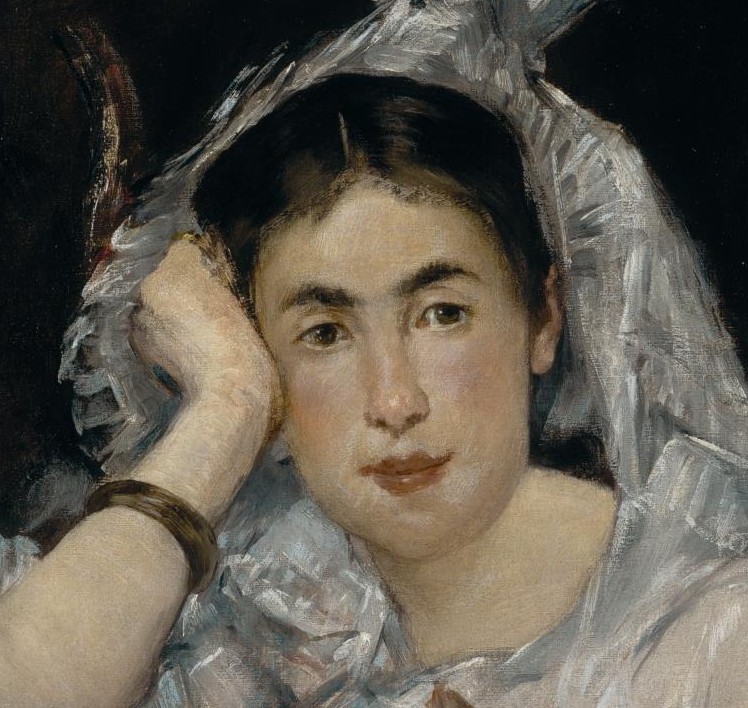
Marguerite's hair parts near the middle and curves around the forehead. Its dark mass provides a firm setting for the lighter skin below. Small warm passages appear within the brown, but the hair remains much less varied in tone than the forehead, cheeks and nose.
The face is described through compact changes of colour. Pale cream shifts towards warmer pink around the cheeks, while darker marks establish the eyebrows and eyes. A small reddish area defines the mouth. The chin and neck carry the light down towards the neckline, linking the face with the broader passages of clothing.
The eyes sit within this arrangement rather than dominating it in isolation. Their dark centres repeat the stronger darks of the hair and background on a smaller scale. The face can therefore be read both as an individual likeness and as a concentration of warm, relatively continuous forms among more broken marks.
The Pale Covering
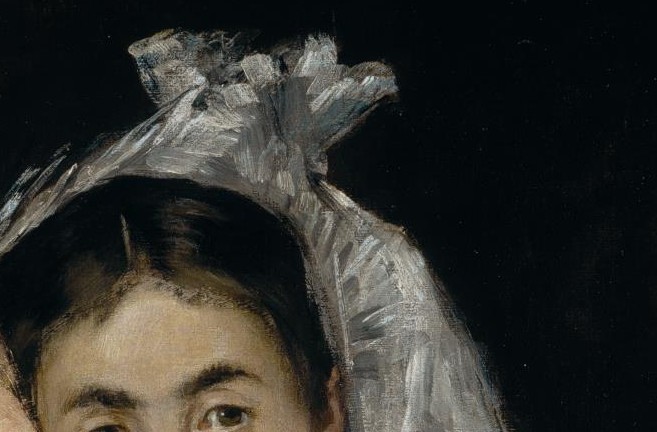
Above the head, the fabric gathers into an irregular cluster of pointed and rounded shapes. White strokes cross blue-gray passages, with darker gaps between them. Some marks run along the folds; others cut across them, making the upper edge appear restless against the background.
At the right of the face, the covering descends in a longer band. Repeated pale strokes suggest changes in direction as it moves towards the shoulder. Here the shape is easier to follow than each separate fold. Individual marks remain visible within a continuous fall of fabric.
The left side is more compressed. Cloth gathers around the supporting hand and meets the sleeve below. Its pale edges appear and disappear against the dark hair and ground, producing small interruptions around the head. These uneven boundaries keep the covering from becoming a simple, smooth arch.
A Second Hand Gathering Fabric
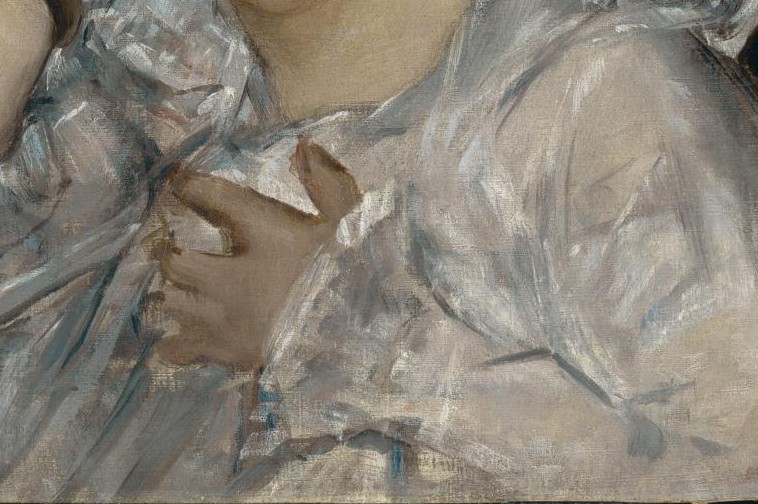
The other hand rests near the centre of the chest. Its warmer colour distinguishes it from the surrounding gray and white. Bent fingers close around a fold, drawing attention to the point where several diagonal passages come together.
This hand has a different function from the raised one. One supports the head; the other holds the garment. The arrangement connects distant parts of the figure without making the two gestures symmetrical. A diagonal runs from the lower-left folds towards the gathering hand, then continues through the neckline and shoulder.
Below, broad light strokes change direction across the clothing. Thin dark lines separate some folds, while elsewhere neighbouring pale areas merge. The sleeve at the right becomes a large, rounded mass, contrasting with the tighter gathering of material around the hand.
A Dark Ground and Varied Marks
The background supplies few clues to a room. It forms a dark field around the upper body, broken mainly by the outline of the hair, covering and arm. Without surrounding furniture or a detailed interior, the small changes along those edges acquire greater importance.
The dark ground also changes the apparent strength of the pale marks. A short white stroke at the top of the hood stands out more sharply than a similar stroke buried within the shoulder. The same range of colours produces both conspicuous edges and quieter transitions, depending on what surrounds it.
Close looking brings these differences into focus. The cheek appears more continuously described than parts of the lower garment, where the direction of a stroke remains conspicuous. Recognizability and visible brushwork coexist in different proportions.
A Probable Mantilla
The collection's record identifies Marguerite as the daughter of a schoolfriend of Manet. It suggests that the covering was probably a traditional Spanish lace veil, or mantilla, and relates the dark background to the Goya paintings Manet admired.[1] These connections place the portrait within both a circle of acquaintances and the artist's continuing interest in Spanish art.
The word “hood” describes the covering's position around the head. The proposed mantilla identification adds a cultural context, while remaining qualified. The painted folds themselves provide no secure basis for identifying a particular textile maker or material.
A Note on the Face's Appearance
Denis Rouart and Daniel Wildenstein catalogued this painting in 1975 as Portrait de Marguerite de Conflans, also known as La Jeune Fille en Blanc. Comparing it with a photograph by Lochard, they noted repainting of the face.[2] Their short entry gives no date or responsible hand. This qualification matters when considering the contrast between the facial features and the surrounding, more loosely described fabric.
Comparing the Oval Portrait in Toulouse
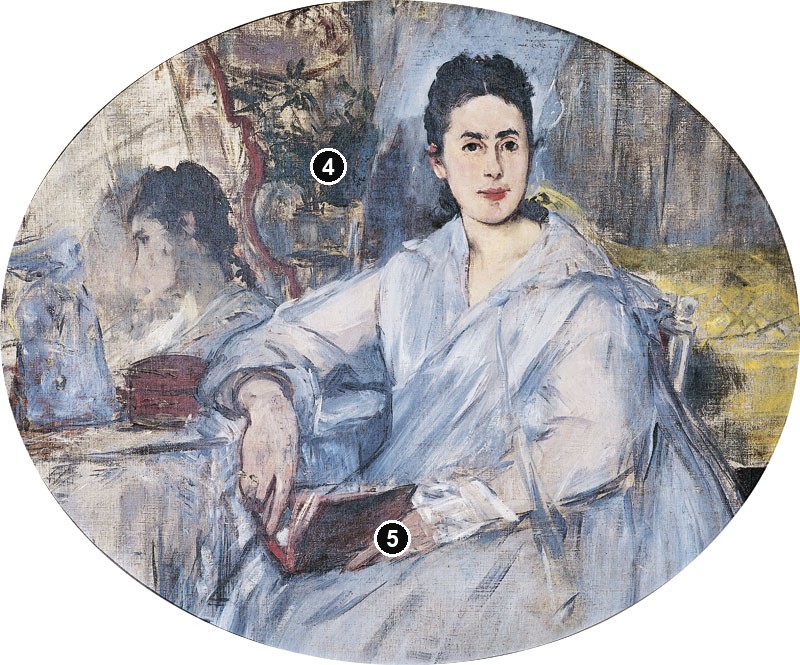
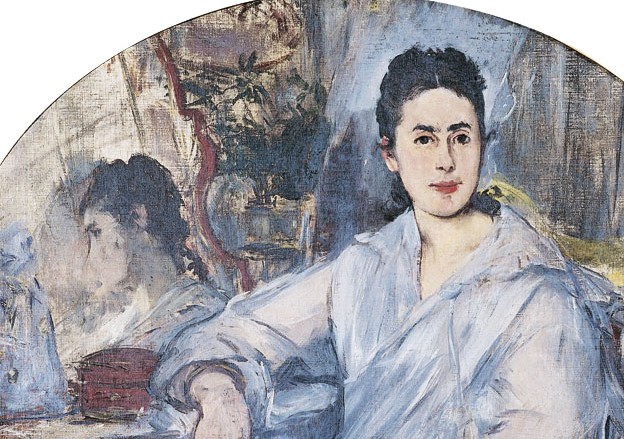
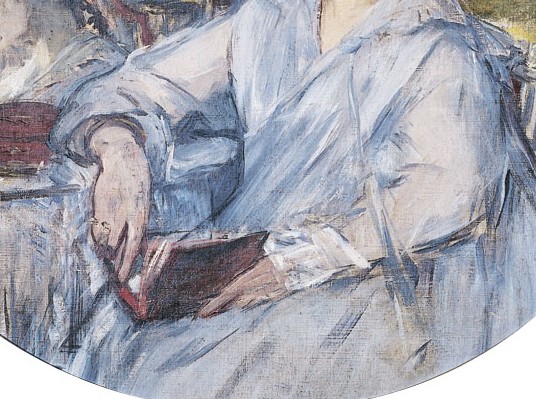
Manet also painted Marguerite in a wider, oval composition now deposited by the Musée d'Orsay at the Musée des Augustins in Toulouse. Orsay dates that separate work to about 1876.[3] There, the sitter wears pale blue clothing, rests beside a table and holds an open reddish book. A mirror introduces another view of the figure into the surrounding interior.
The two paintings organize attention differently. In the hooded portrait, the raised hand helps frame the face, while the other hand gathers cloth close to the body. In Toulouse, the hands lead down towards the book and across to the tabletop. They connect the sitter with objects around her rather than concentrating the gestures around her head and chest.
The oval boundary also gives the Toulouse portrait a different setting. Its curved edge contains a much wider arrangement of body, table, mirror and background. The hooded painting brings the figure close to a rectangular frame, leaving little room for such an interior. Comparing them shows how Manet could vary the relationship between a familiar sitter and the space around her.
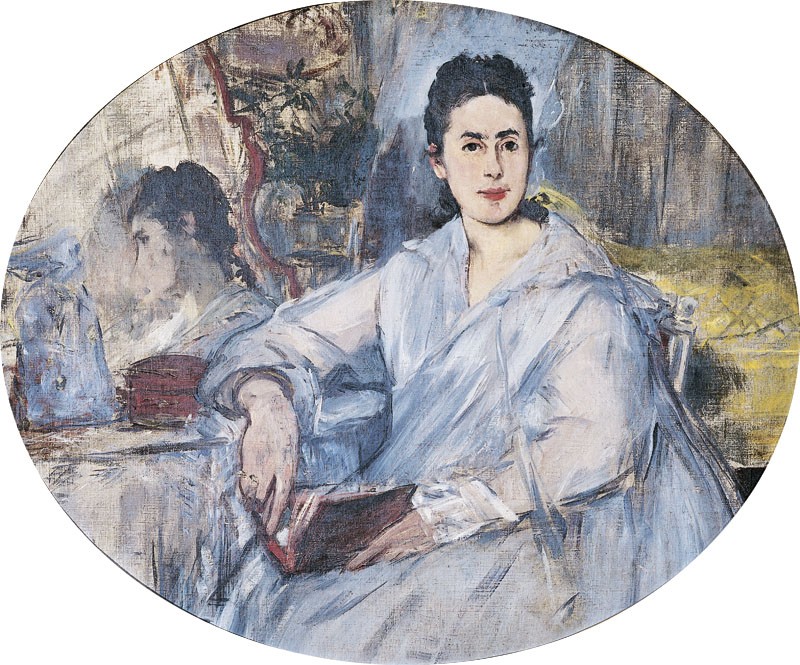
Édouard Manet, Marguerite de Conflans, about 1876. Oil on canvas, 53 × 64 cm according to Musée d’Orsay, RF 1945 4; deposited at the Musée des Augustins, Toulouse, D 1986 1. Photothèque Musée des Augustins, Toulouse / Daniel Martin; deposit of Musée d’Orsay. Image source. Public domain. Whole oval composition retained at source size without enlargement; no recolouring or retouching.
Annotated Details from Marguerite de Conflans Wearing a Hood
The numbered points identify visible features discussed in this article. Return from each detail to the whole composition. Each caption identifies the work shown.
Marguerite de Conflans Wearing a Hood
Édouard Manet, Marguerite de Conflans Wearing a Hood, 1873. Oil on canvas, 55.5 × 46.5 cm. Oskar Reinhart Collection ‘Am Römerholz’, Winterthur, SOR1947.1. Sammlung Oskar Reinhart «Am Römerholz», Winterthur. Image source. Public domain. Numbers added to a separate overview. Detail crops from the museum source image; no enlargement, recolouring or retouching.
Marguerite de Conflans Toulouse Oval Portrait
Édouard Manet, Marguerite de Conflans, about 1876. Oil on canvas, 53 × 64 cm according to Musée d’Orsay, RF 1945 4; deposited at the Musée des Augustins, Toulouse, D 1986 1. Photothèque Musée des Augustins, Toulouse / Daniel Martin; deposit of Musée d’Orsay. Image source. Public domain. Numbers added to a separate overview. Detail crops from the museum source image; no enlargement, recolouring or retouching.
Details from MARGUERITE DE CONFLANS WEARING A HOOD
Compare the two hand gestures and pale covering in Winterthur, then follow the mirror and book in the Toulouse portrait.
Marguerite de Conflans Wearing a Hood
Face Hand and Bracelet
The tilted head meets the supporting hand beside dark hair. A dark bracelet interrupts the pale forearm near the wrist.
Upper Folds of the Covering
Pale pointed and rounded folds gather above the hair. Short white and blue-gray marks create an irregular edge against the dark ground.
Gathering Hand and Diagonal Fabric
Bent fingers gather cloth at the chest. Broad diagonal strokes spread below and beside the warmer hand.
Marguerite de Conflans Toulouse Oval Portrait
Face Mirror and Table
The oval portrait sets the sitter beside a mirror and table. The reflected view adds another angle within the wider interior.
Hands and Open Book
The hands lead attention towards an open reddish book. Blue clothing and the tabletop surround this separate concentration of detail.
From the Studio to Winterthur
The hooded portrait was recorded in Manet's estate and appeared as lot 33 in the 1884 sale. It passed through the dealer Portier and the collection of Alexander Cassatt, later appearing with the French Art Gallery in New York.[2] Oskar Reinhart acquired it in 1947.[1]
In 2025, the painting travelled to London's Courtauld Gallery for Goya to Impressionism, an exhibition of works from Reinhart's collection.[4]
Artworks directory
Explore selected paintings, drawings and prints by Édouard Manet. Search by title or another recorded name.
Frequently Asked Questions
It belongs to the Oskar Reinhart Collection ‘Am Römerholz’ in Winterthur, Switzerland, inventory SOR1947.1.[1]
The familiar title calls it a hood. The collection suggests it was probably a Spanish mantilla, a traditional lace veil.[1]
No. The oval portrait with a book and mirror is a separate painting, held by Orsay and deposited in Toulouse.[3]
Discussion
Look again at the images and ideas explored in Marguerite de Conflans Wearing a Hood by Édouard Manet. These editorial prompts invite your observations.
Reader Insights
Compare the supporting hand with the hand gathering cloth. How does each gesture direct attention through the figure?
Follow the covering against the dark background. Where does its outline become sharp, and where do individual strokes remain visible?
Compare the Winterthur and Toulouse portraits. How do the rectangular and oval formats change the relationship between sitter and surroundings?
Join the Conversation
Share a detail, comparison or question about Marguerite de Conflans Wearing a Hood by Édouard Manet below.
References
- Swiss Federal Office of Culture, Bildnis Marguerite de Conflans mit Kapuze, 1873, SOR1947.1, Oskar Reinhart Collection ‘Am Römerholz’, collection record, commentary and provenance. German. View source.
- Denis Rouart and Daniel Wildenstein, Édouard Manet: Catalogue raisonné, tome I, 1975, no.204, p.174 and illustration p.175. French. View source.
- Musée d'Orsay, Marguerite de Conflans, about 1876, RF 1945 4, collection record; deposited at the Musée des Augustins, Toulouse. View source.
- Oskar Reinhart Collection ‘Am Römerholz’, Goya to Impressionism: Masterpieces from the Oskar Reinhart Collection, 2025 press release, pp.1–2 and 5. View source.
- Splash image, Édouard Manet, Marguerite de Conflans Wearing a Hood, 1873. Oil on canvas, 55.5 × 46.5 cm. Oskar Reinhart Collection ‘Am Römerholz’, Winterthur, SOR1947.1. Sammlung Oskar Reinhart «Am Römerholz», Winterthur. Image source. Public domain. Whole supplied museum view retained at source size; no enlargement, recolouring or retouching.


