



 by Tom Gurney
Tom Gurney BSc (Hons) is an art history expert with over 20 years experience
Published on June 19, 2020 / Updated on October 30, 2026
Email: tomgurney1@gmail.com / Phone: +44 7429 011000
A Matador by Édouard Manet: Introduction
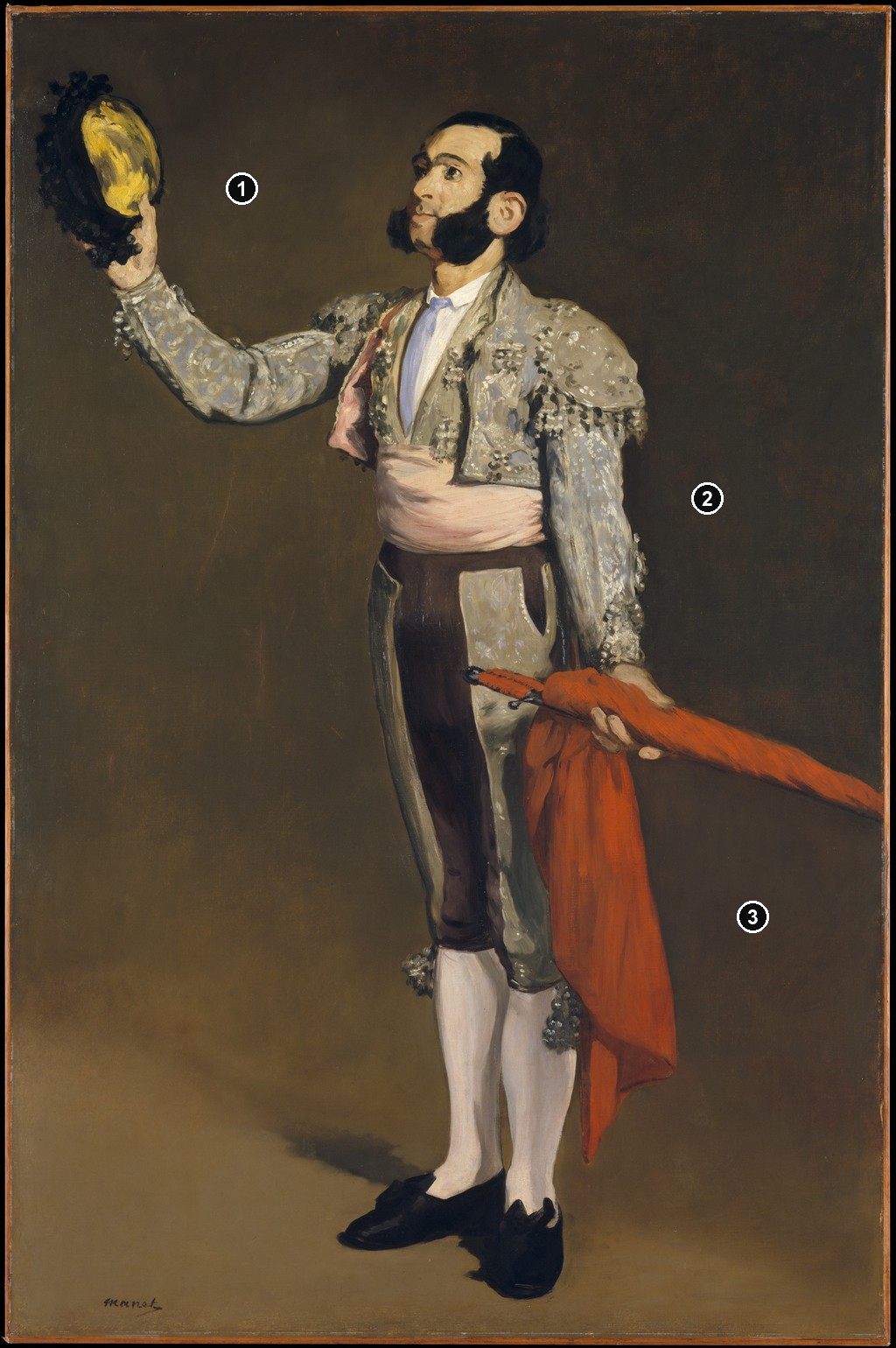
A man raises a dark hat towards the upper left, turning his face in the same direction. His other hand holds a sword and red cloth that reaches across to the opposite edge. Édouard Manet painted A Matador in 1866–67, after visiting Spain. The full-length figure belongs to the Metropolitan Museum of Art in New York.[1] Its elaborate costume stands out against a spare brown setting.
At a Glance
- ArtistÉdouard Manet
- TitleA Matador
- Alternative titleThe Saluting Torero
- French catalogue titleLe Matador saluant.[2]
- Date1866–67
- MediumOil on canvas
- Dimensions171.1 × 113 cm
- CollectionThe Metropolitan Museum of Art, New York
- Accession number29.100.52
- CreditH. O. Havemeyer Collection, Bequest of Mrs. H. O. Havemeyer, 1929.[1]
This work across Édouard Manet’s career
Contents
- The Raised Hat and Upward Gaze
- A Jacket Made of Small Marks
- Pink Sash and Red Muleta
- Stockings, Shoes and Shadow
- The Brown Space Around the Figure
- The Figure and the Model
- What Does the Salute Mean?
- After the Visit to Spain
- Comparing Victorine in the Costume of an Espada
- From Duret to the Met
The Raised Hat and Upward Gaze
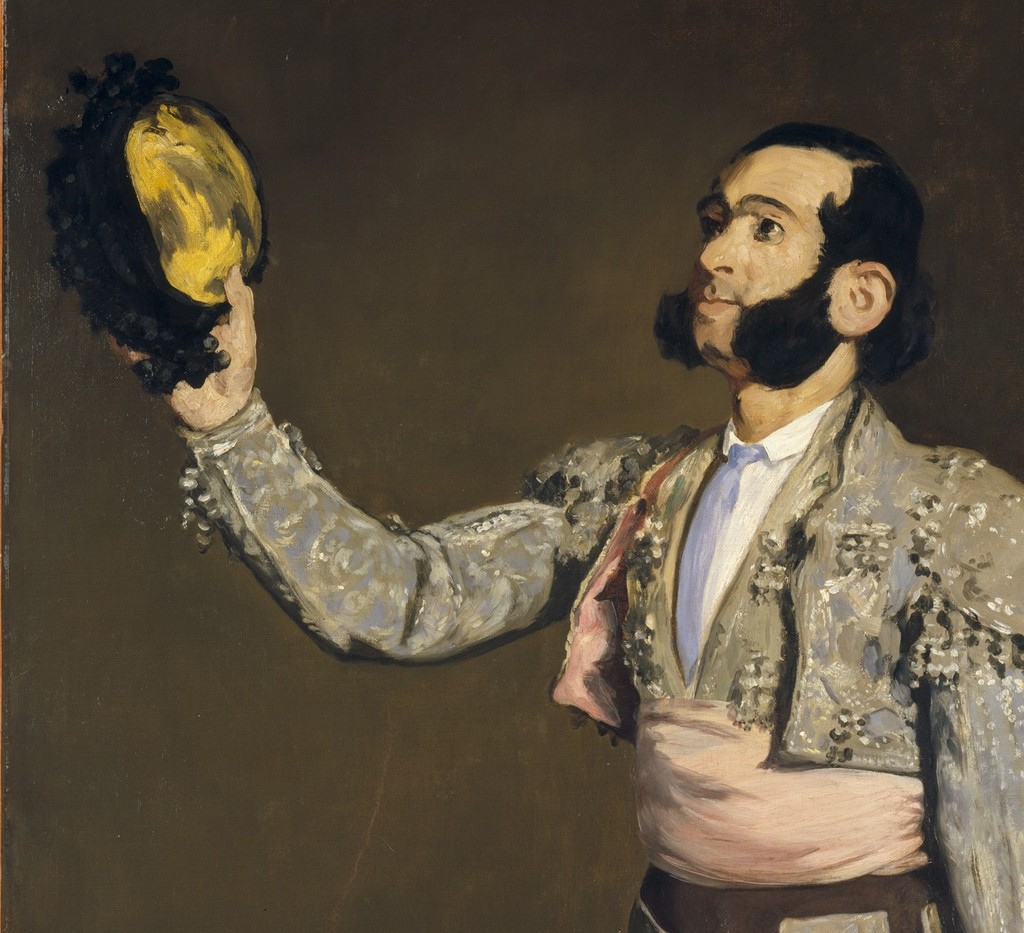
The raised arm opens a large space beside the upper body. From the shoulder, the sleeve extends outwards and then bends upwards at the elbow. The hand continues that movement towards the dark hat, whose warm yellow interior catches the eye near the left edge of the canvas.
The hat is held away from the head. Dark hair and broad sideburns frame the face; the forehead, nose and cheek form a much lighter passage between them. The eyes look upwards, following the direction established by the arm, while the chin remains closer to horizontal.
There is room between the hat and the face for the background to show through. This opening keeps the raised hand distinct from the head and reveals the contour of the bent sleeve.
A Jacket Made of Small Marks
The short jacket appears silver-gray, with scattered pale, dark and yellowish touches across its surface. Around the shoulder, compact spots give way to hanging fringes. Along the sleeve, longer strokes follow the arm, interrupted by smaller marks that suggest decoration. Manet varies these touches rather than describing every ornament with an equally sharp outline.
The jacket's open front reveals a white shirt and pale blue necktie. These comparatively simple shapes provide a quieter area beneath the face. A narrow pink passage inside the jacket adds another warm colour before the broader sash below.
At the outer shoulder, the pale costume stands sharply against the brown ground. Within the jacket, however, light marks meet dark accents in a much busier arrangement. The result is a fabric that looks richly worked from a distance while retaining the visible marks of painting at closer range.
Pink Sash and Red Muleta
A wide pink sash crosses the waist. Its long, nearly horizontal folds interrupt the jacket's intricate pattern and separate the upper body from the dark trousers. Cream and warmer pink strokes overlap across the band, making its surface appear folded and slightly uneven.
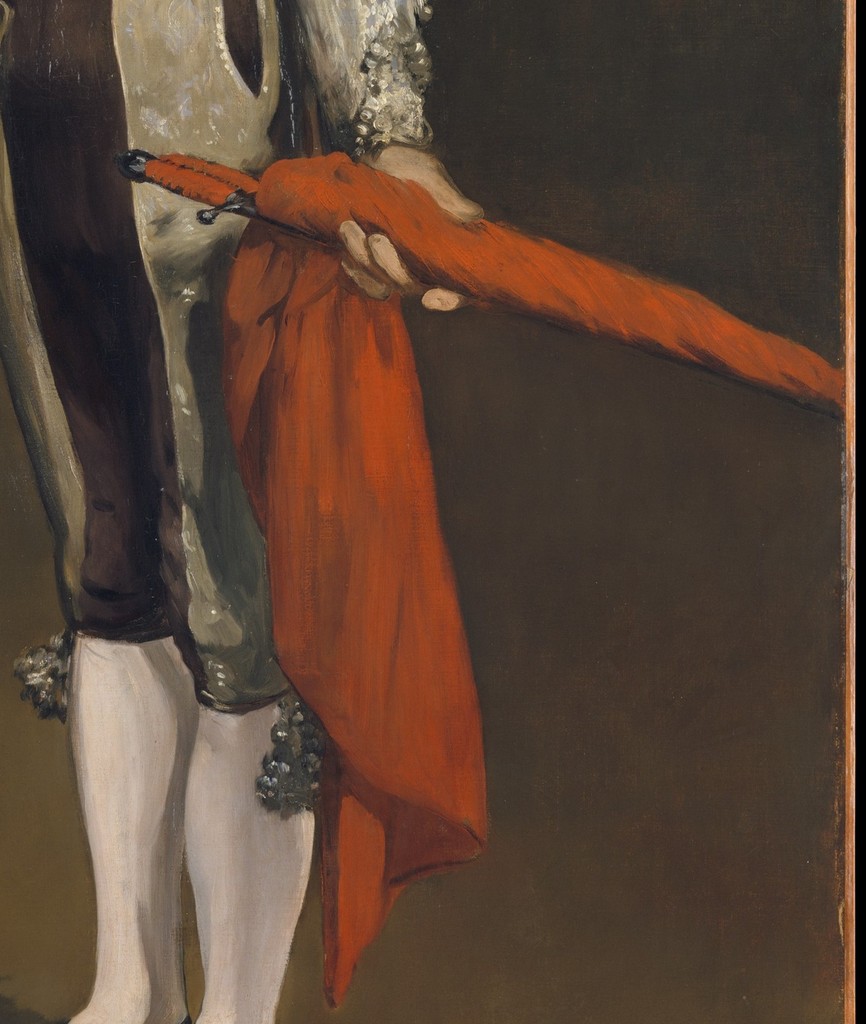
The lowered arm leads to a second concentration of colour. Fingers emerge beneath the red cloth, close to a dark sword hilt. The fabric wraps around the weapon and continues diagonally towards the right edge, where the painted form is cut by the boundary of the canvas. Another length hangs down beside the legs.
The red muleta, the cloth used by a matador, consequently has two distinct directions. One part projects across the picture; the other falls towards the ground. Together they widen the otherwise narrow lower figure. The hand holding them is small, but it connects the straight arm, the extended diagonal and the heavier hanging folds.
Stockings, Shoes and Shadow
Below the sash, dark knee-length trousers carry the figure down towards pale stockings. The change from dark clothing to light legs is abrupt. Small ornaments at the knees interrupt that boundary, echoing the more extensive decoration above.
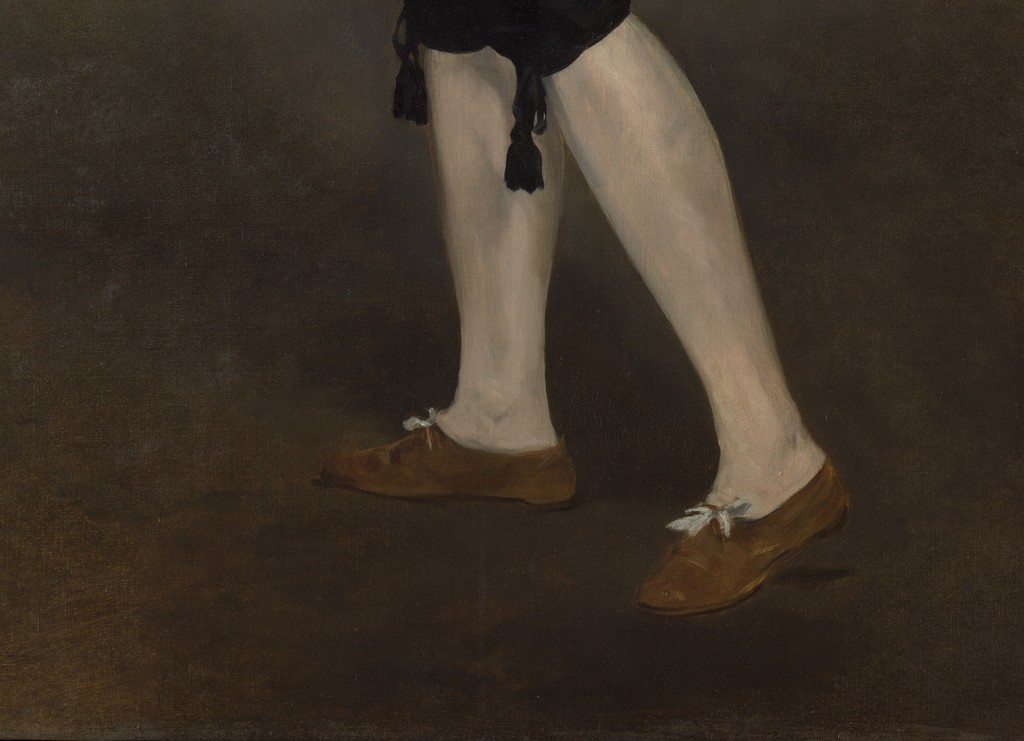
The two shoes point in different directions. One stretches towards the left, while the other presents a broader dark shape nearer the lower centre. The feet remain close together, but their differing angles keep the stance from looking like two parallel vertical lines. Above them, the pale stockings narrow towards the ankles.
A dark shadow spreads leftwards from the feet. Its irregular edge becomes softer as it extends across the ground, giving the shoes a place to stand. Near the lower left, Manet's signature forms a small dark group of marks apart from the figure.
The Brown Space Around the Figure
The background changes gradually from darker brown around the upper body to a lighter, warmer area below. There is no sharply defined line where a wall meets a floor. The figure occupies a space that can be understood through the feet and shadow without being described as a particular room or arena.
This setting also changes how the costume is seen. The dark trousers approach the background in tone, while the pale stockings and jacket stand further apart from it. The extended red cloth creates a strong interruption at the right.
The Figure and the Model
The Met identifies the matador as Cayetano Sanz y Pozas, whom Manet saw perform during his 1865 visit to Spain.[1] The painting's construction is less certain than that identification might suggest.
Juliet Wilson-Bareau has proposed that Manet's brother Eugène, or another model, could have assumed the pose in the matador's costume, while a photographic portrait supplied the distinctive head.[3] This would combine a remembered public figure with the practical resources of the studio. It remains a proposal, rather than evidence that Sanz sat for Manet or that a particular surviving photograph was used.
What Does the Salute Mean?
The raised hat is often understood as a ceremonial salute. Wilson-Bareau suggests that the figure may be addressing the president who presides over the bullfight, or dedicating the bull to a lady.[3] Both readings place the gesture within the formal actions surrounding the fight.
Manet leaves its recipient outside the picture. The viewer sees the upward gaze and extended arm, but no answering figure, crowd or bull. The gesture can look expansive without establishing that a victory has occurred. Its purpose is suggested by the costume and equipment; its precise occasion remains open.
After the Visit to Spain
Manet travelled to Spain in 1865 and studied Velázquez's paintings in Madrid. A Matador belongs among the early full-length figures he painted after that encounter.[1][3] The isolated body and restrained setting give the elaborate costume unusual prominence.
His Spanish interests had already produced paintings before the journey. The later canvas continues that engagement, while giving the standing figure a different presentation. In 1867, Manet included it in his own exhibition pavilion near the Exposition Universelle in Paris.[1] The French catalogue records it as number 16, under the title Un matador de taureaux.[2]
Comparing Victorine in the Costume of an Espada
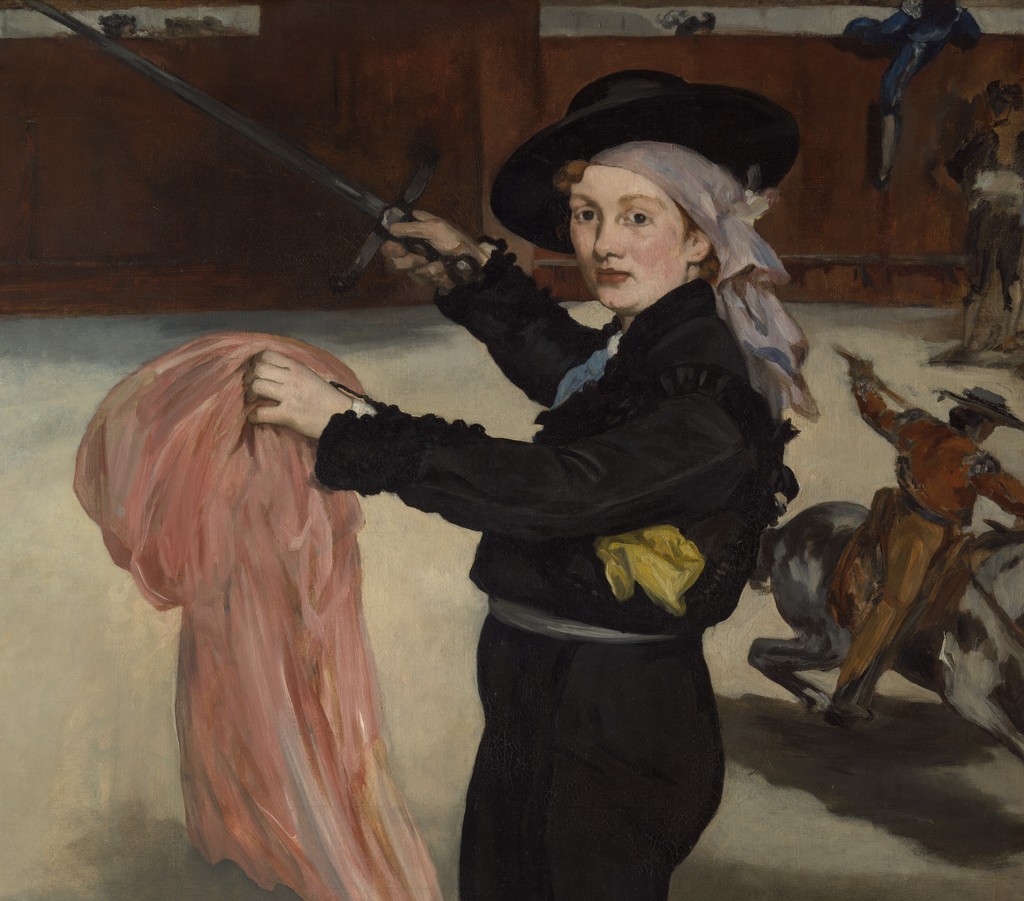
An earlier painting, Mademoiselle V. . . in the Costume of an Espada, shows the model Victorine Meurent dressed as a male bullfighter. Manet painted it in 1862, before his Spanish visit. A bullfighting scene derived from Goya appears behind her.[4]
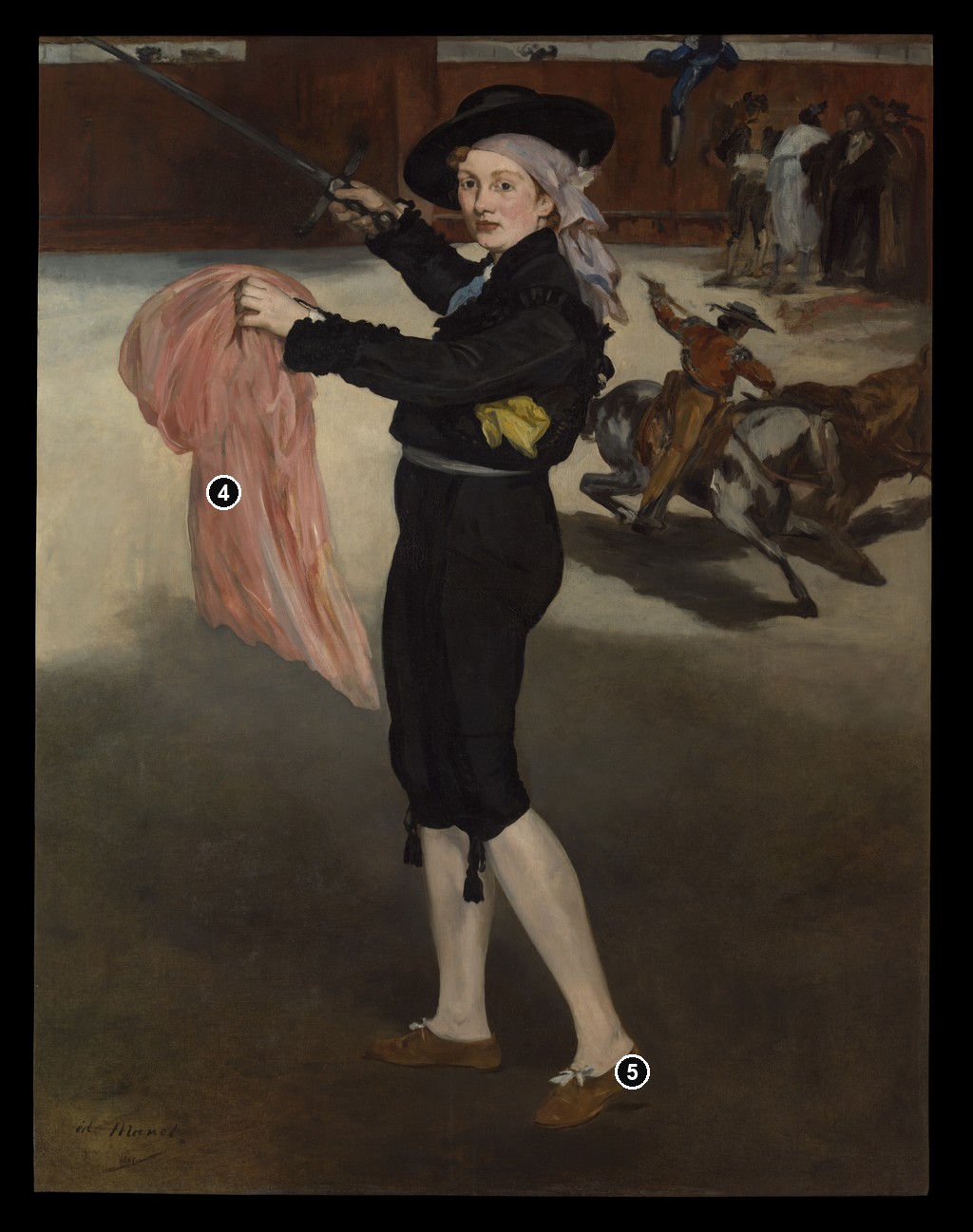
The differences become clear in the hands and face. Victorine extends a sword across the upper left and spreads a pink cape with her other hand. Her body turns away while her face looks back towards the viewer. In A Matador, the raised hand holds a hat, and the head turns upwards with the gesture. Red fabric gathers in the lowered hand and projects towards the opposite edge.
Their surroundings also organize attention differently. Behind Victorine, the barrier and mounted figures introduce a smaller scene of activity. Around the saluting matador, the brown field offers little to interrupt the standing silhouette. One painting places a costumed figure before an arena backdrop; the other concentrates the action into the raised arm, turning head and equipment held at the waist.
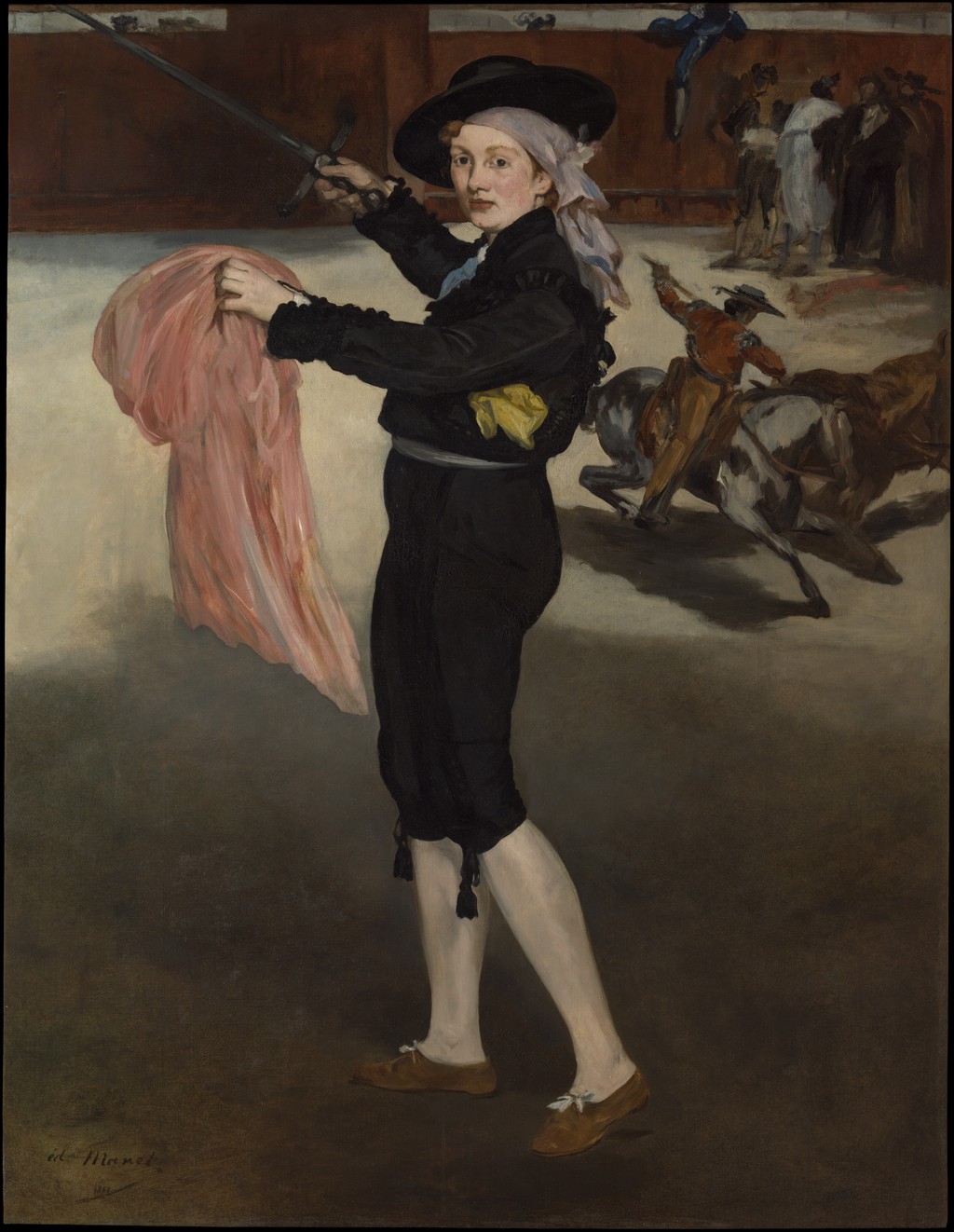
Édouard Manet, Mademoiselle V. . . in the Costume of an Espada, 1862. Oil on canvas, 165.1 × 127.6 cm. The Metropolitan Museum of Art, New York, 29.100.53. The Metropolitan Museum of Art, H. O. Havemeyer Collection, Bequest of Mrs. H. O. Havemeyer, 1929. Image source. CC0 / Public domain. Outside photographic margins reduced; no enlargement, recolouring or retouching.
Annotated Details from A Matador
The numbered points identify visible features discussed in this article. Return from each detail to the whole composition. Each caption identifies the work shown.
A Matador
Édouard Manet, A Matador, 1866–67. Oil on canvas, 171.1 × 113 cm. The Metropolitan Museum of Art, New York, 29.100.52. The Metropolitan Museum of Art, H. O. Havemeyer Collection, Bequest of Mrs. H. O. Havemeyer, 1929. Image source. CC0 / Public domain. Numbers added to a separate overview. Detail crops from the museum source image; no enlargement, recolouring or retouching.
Victorine in the Costume of an Espada
Édouard Manet, Mademoiselle V. . . in the Costume of an Espada, 1862. Oil on canvas, 165.1 × 127.6 cm. The Metropolitan Museum of Art, New York, 29.100.53. The Metropolitan Museum of Art, H. O. Havemeyer Collection, Bequest of Mrs. H. O. Havemeyer, 1929. Image source. CC0 / Public domain. Numbers added to a separate overview. Detail crops from the museum source image; no enlargement, recolouring or retouching.
Details from A MATADOR
Follow the raised hat, decorated jacket and red cloth, then compare Victorine’s earlier pose and footwear.
A Matador
Raised Hat and Turned Head
The raised hand lifts a dark hat with a yellow interior. The face turns upwards across the open space between the head and hat.
Jacket Ornament and Pink Sash
Small pale and dark touches describe the decorated jacket. Longer pink strokes cross the sash beneath its open front.
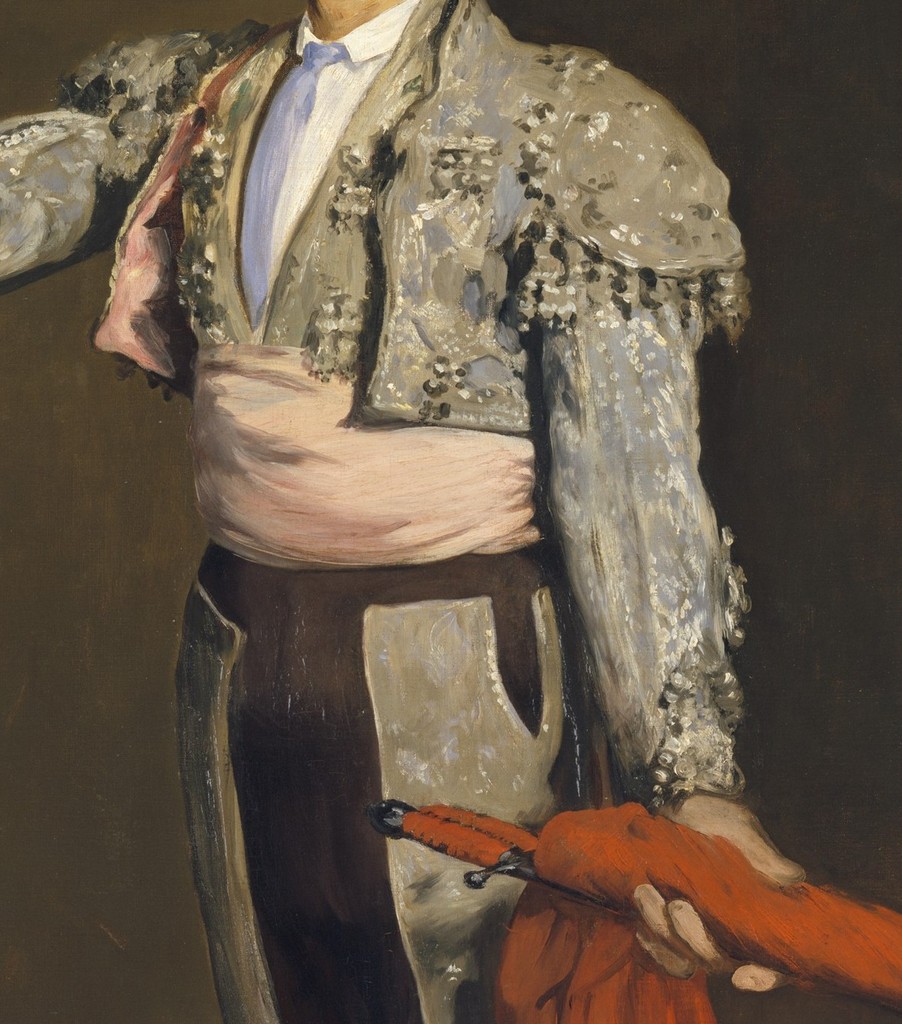
Hand Sword and Red Muleta
Fingers hold the sword and red cloth together. The cloth projects to the right painted edge and hangs down beside the legs.
Victorine in the Costume of an Espada
Victorine Face and Two Hand Gestures
Victorine looks towards the viewer while one hand extends a sword and the other spreads a pink cape. The barrier supplies a setting behind the gesture.
Victorine Stockings and Bow Shoes
Pale stockings lead down to brown shoes with bows. Their angles and surrounding ground differ from the saluting matador’s dark shoes and compact stance.
From Duret to the Met
Théodore Duret bought A Matador from Manet in 1870. Following Duret's 1894 sale, it passed through the dealings of Paul Durand-Ruel and the collector Jean-Baptiste Faure. The Havemeyers acquired it in 1898, and it entered the Met through Mrs. H. O. Havemeyer's bequest in 1929.[1]
Artworks directory
Explore selected paintings, drawings and prints by Édouard Manet. Search by title or another recorded name.
Frequently Asked Questions
It belongs to the Metropolitan Museum of Art in New York, accession 29.100.52.[1]
The painting does not establish that a victory has occurred. The salute may address the presiding official or dedicate the bull to a lady.[3]
Discussion
Look again at the images and ideas explored in A Matador by Édouard Manet. These editorial prompts invite your observations.
Reader Insights
Follow the raised hand towards the hat, then the lowered hand towards the red cloth. How do their different directions shape the figure?
Compare Victorine's arena backdrop with the brown field around the saluting matador. Where does each picture ask you to look next?
Compare the jacket's scattered touches with the long folds across the sash. How does the handling change between the two areas?
Join the Conversation
Share a detail, comparison or question about A Matador by Édouard Manet below.
References
- The Metropolitan Museum of Art, A Matador, 1866–67, 29.100.52, collection record, commentary, signature, provenance and notes. View source.
- Denis Rouart and Daniel Wildenstein, Édouard Manet: Catalogue raisonné, tome I, 1975, no.111, p.108 and illustration p.109. French. View source.
- Juliet Wilson-Bareau, in Gary Tinterow and Geneviève Lacambre, Manet/Velázquez: The French Taste for Spanish Painting, 2003, no.149, p.496; related discussion p.236 and illustration p.233. View source.
- The Metropolitan Museum of Art, Mademoiselle V. . . in the Costume of an Espada, 1862, 29.100.53, collection record and commentary. View source.
- Splash image, Édouard Manet, A Matador, 1866–67. Oil on canvas, 171.1 × 113 cm. The Metropolitan Museum of Art, New York, 29.100.52. The Metropolitan Museum of Art, H. O. Havemeyer Collection, Bequest of Mrs. H. O. Havemeyer, 1929. Image source. CC0 / Public domain. Whole supplied view retained, including the full hat, red cloth, shoes and signature; no enlargement, recolouring or retouching.


