



 by Tom Gurney
Tom Gurney BSc (Hons) is an art history expert with over 20 years experience
Published on June 19, 2020 / Updated on October 30, 2026
Email: tomgurney1@gmail.com / Phone: +44 7429 011000
The Milliner by Édouard Manet: Introduction
A woman turns in profile while holding a dark hat close to her body. Her pale shoulder and neck emerge above a black wrap, against a background crowded with floral marks. Édouard Manet painted At the Milliner’s, also known as The Milliner, around 1881. The oil belongs to the Fine Arts Museums of San Francisco, at the Legion of Honor.[1] Hats establish the subject, but the woman’s precise activity is less easily settled.
At a Glance
- ArtistÉdouard Manet
- TitleAt the Milliner’s
- Also known asThe Milliner; La Modiste; Chez la modiste
- Date1881, also dated about 1881
- MediumOil on canvas
- Dimensions85.1 × 73.7 cm
- CollectionFine Arts Museums of San Francisco, Legion of Honor
- Accession number1957.3
- CreditMuseum purchase, Mildred Anna Williams Collection.[1]
This work across Édouard Manet’s career
Contents
- The Face in Profile
- The Shoulder and Black Wrap
- The Hat in Her Hands
- Pattern and Loose Brushwork
- A Shop or a Dressing Room
- Comparing Degas’s Millinery Shop
- The Painting after Manet
- Annotated details
The Face in Profile
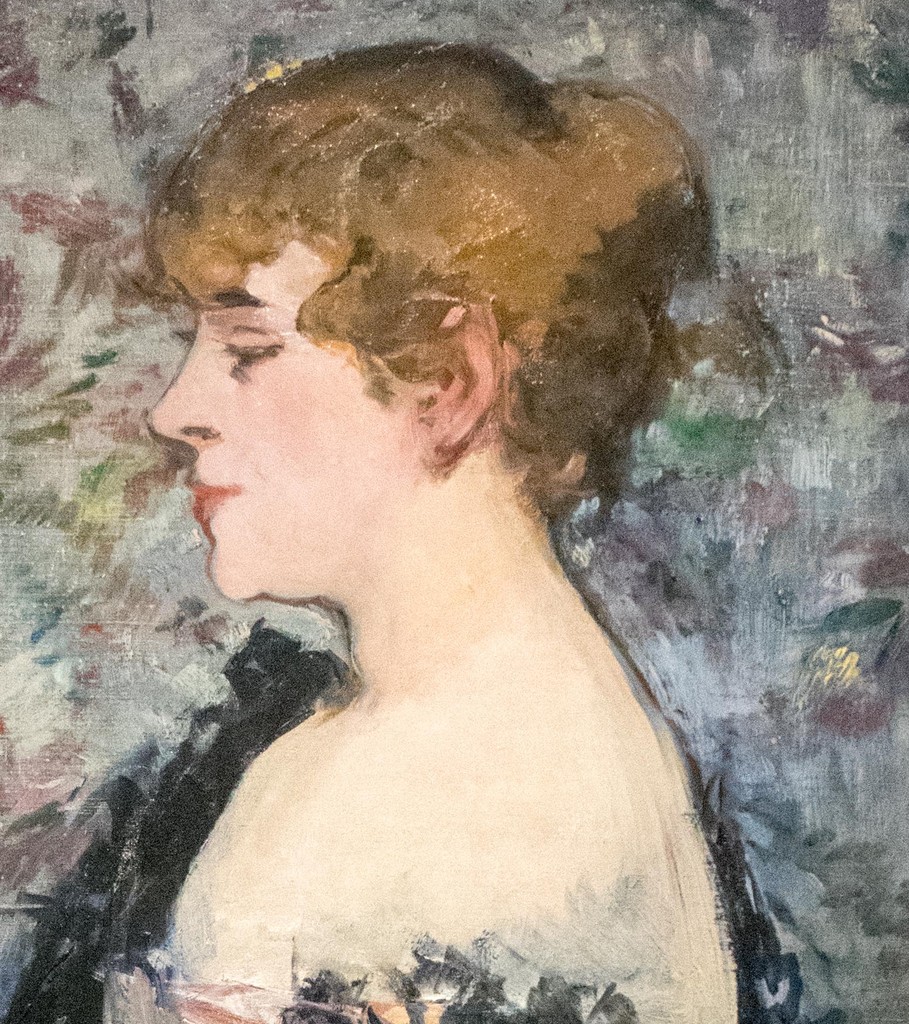
The face turns towards the left, bringing the forehead, nose, lips and chin into a continuous pale outline. The eye looks downwards, beneath a dark eyebrow. Hair rises in a rounded mass above the forehead and gathers behind the head, where a dark ribbon or ornament meets the patterned background.
The face differs from the broad surface of the shoulder. One is seen almost edge-on; the other opens towards the viewer. Between them, the neck forms a long, comparatively quiet passage, giving the upper body volume.
The pale profile is especially clear against darker patches in the background. Elsewhere, similar light tones approach one another and the edge becomes less emphatic. Manet varies the contour’s strength, allowing the head to stand apart from the pattern without an equally dark line around every part.
The Shoulder and Black Wrap
A broad expanse of light skin extends from the neck across the shoulder. Below it, pale pink and cream touches suggest the upper part of the dress. These narrow passages are interrupted by a black wrap whose uneven edge rises and falls across the body.
The black area is substantial, but it does not form a single featureless shape. Short light strokes, warmer patches and dark folds break up its surface. Near the shoulder, small upright touches make the boundary particularly irregular. Lower down, longer marks follow the fall of the clothing.
The wrap also connects the woman’s upper body with the hat she holds. Both are dark, yet the pale hands and lining provide interruptions between them. The eye can follow the shoulder down towards the wrist and then move left into the accessory. Light skin, dark fabric and the hat’s opening form an interlocking arrangement across the middle of the picture.
The Hat in Her Hands
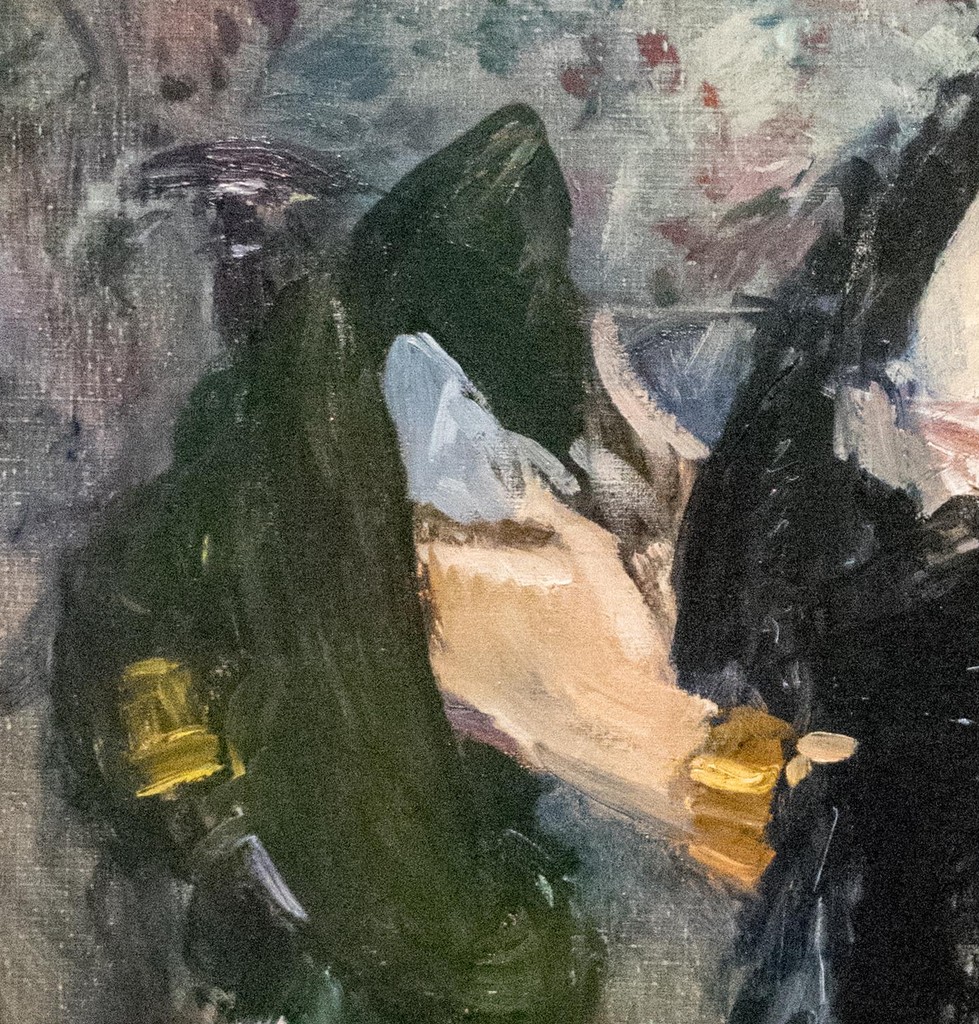
The held hat has a dark exterior and a much lighter interior. Its upper edge slopes diagonally, giving the opening a direction distinct from the woman’s upright neck. The pale lining catches the light close to the fingers, where several shapes overlap in a small area.
At the wrist, a yellow-gold bracelet makes a bright horizontal accent. Its compact shape contrasts with the softer passages around the hand. Pale fingers, warm touches and the bracelet make this small junction conspicuous.
Other hats and their supports appear at the left edge. A strong red ribbon descends beside yellow accents, while a narrow dark upright carries scattered pale touches. These objects are partly cut by the picture’s boundary. Their incomplete forms suggest a display continuing beyond the view, rather than a separate still life neatly contained beside the woman.
The colours of these accessories recur elsewhere. Yellow appears again at the bracelet; pale marks answer the lining and skin. These repetitions join the cropped display to the central figure.
Pattern and Loose Brushwork
Behind the woman, violet, green, blue and brown marks spread across the field. Some resemble petals or leaves, while others are looser patches. The pattern continues around the head and shoulder, with no clearly drawn corner or piece of furniture to fix the room’s dimensions.
This busy surface changes how the figure is seen. Beside the neck, small scattered marks make the broad pale shape appear particularly calm. Near the hair and black wrap, darker passages approach the figure’s own tones. The background sometimes separates the body sharply and sometimes draws close to it.
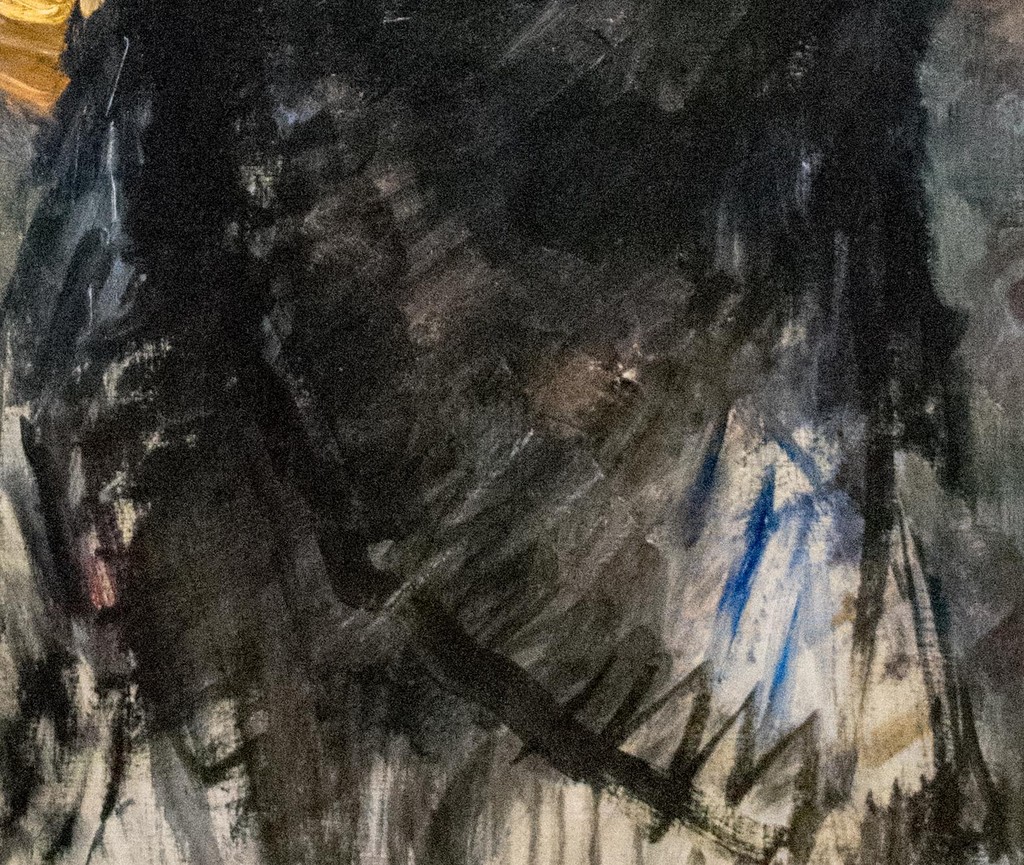
The lower clothing has a different character from the face. Dark diagonals cross pale areas, and strokes remain easy to distinguish from one another. A few broad marks carry much of the suggestion of folds. Looking down the canvas, the viewer moves from a relatively continuous profile to a more open arrangement of painted strokes.
The Metropolitan Museum’s 2023 Manet/Degas label suggests that the sparse brushwork in the lower dress may indicate that the picture is unfinished.[2] That possibility helps explain the difference in treatment, while leaving open how Manet intended the painting to develop. The visible contrast can be appreciated without assigning every loose passage to a particular moment of execution.
A Shop or a Dressing Room
The woman’s handling of a hat and the display beside her suggest a millinery shop. She might be making or arranging an accessory, but she might also be examining it as a customer. The Met’s exhibition label presents both possibilities and notes that the loosely slung shawl and exposed shoulder could point towards a dressing area at home.[2]
The San Francisco museums’ exhibition account likewise allows a domestic setting used for millinery work. Its discussion of a later photograph by Eugène Atget explains that a shop and living quarters could share a space.[3] A room’s private character therefore need not remove it from the world of work.
Manet gives the viewer enough information to recognize hats as the subject, while leaving the social exchange incomplete. No second person receives the hat, and no transaction is shown. The woman’s attention is directed away from us, towards an activity whose full circumstances remain outside the frame.
Comparing Degas’s Millinery Shop
Edgar Degas’s The Millinery Shop, painted in 1879–86 and now in the Art Institute of Chicago, spreads hats across a much wider field. The museum describes uncertainty in the woman’s social role here too: her fashionable green dress and long gloves could belong to an employee or a customer.[4]
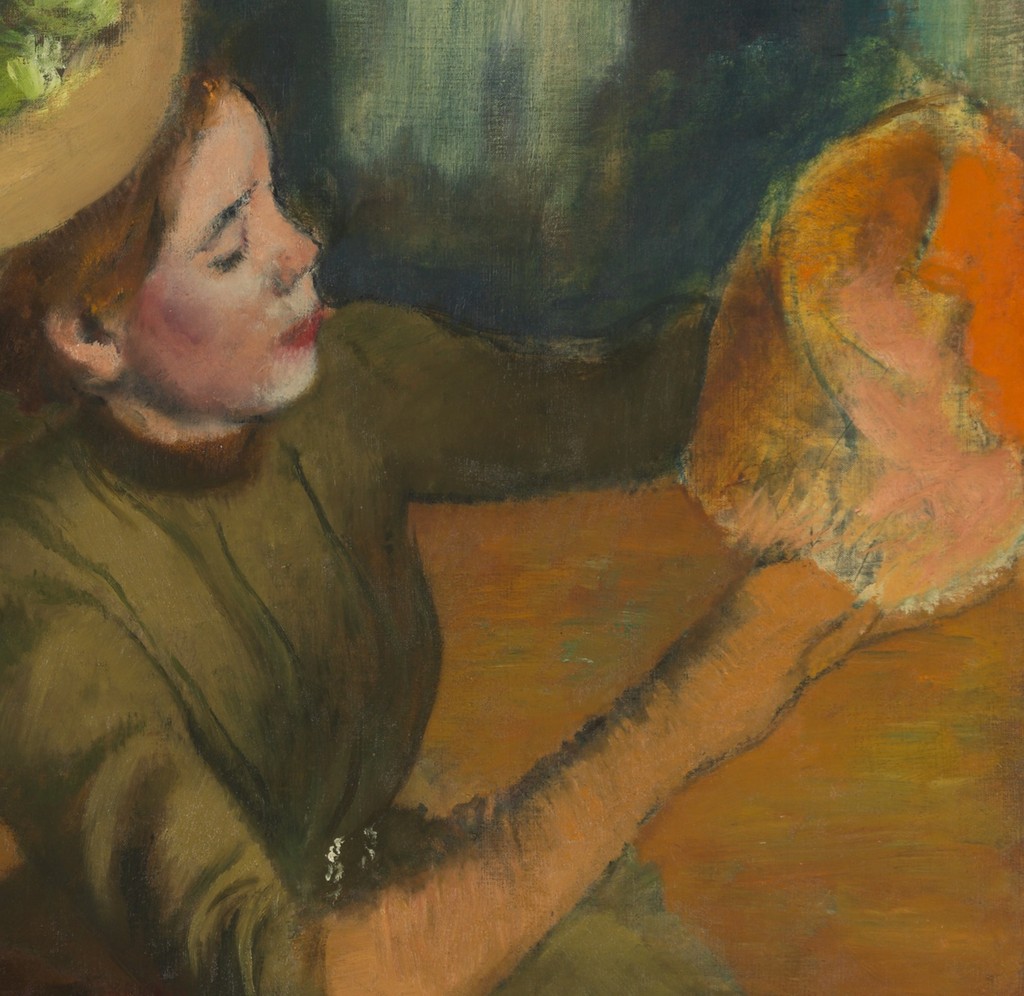
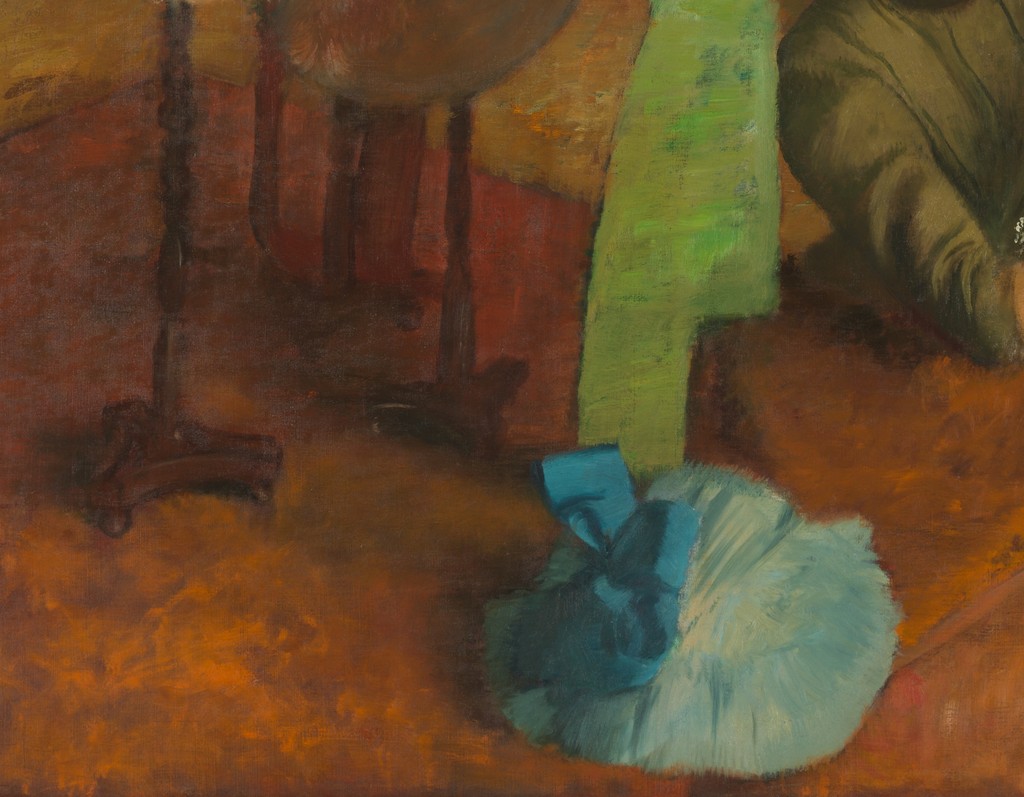
Degas places the woman on the right, reaching towards an orange-toned hat. A diagonal table edge leads across the picture, while hats on thin stands occupy much of the left side. Near the lower edge, a pale hat with a blue bow projects into the foreground. The elevated viewpoint lets the viewer look across these objects towards the seated figure.
Manet brings the woman closer and gives the display less room. Her shoulder occupies an area that Degas fills with hats and tabletop. In Degas, the green-trimmed hat overlapping the head complicates the figure’s outline; in Manet, the pale profile remains comparatively distinct against the floral field.
Both artists make the accessories important to the composition. Degas uses their overlapping volumes to measure depth across a shop interior. Manet gathers hat, hands, bracelet and wrap into a tighter group below the face. The shared subject produces different arrangements of looking, reaching and handling.
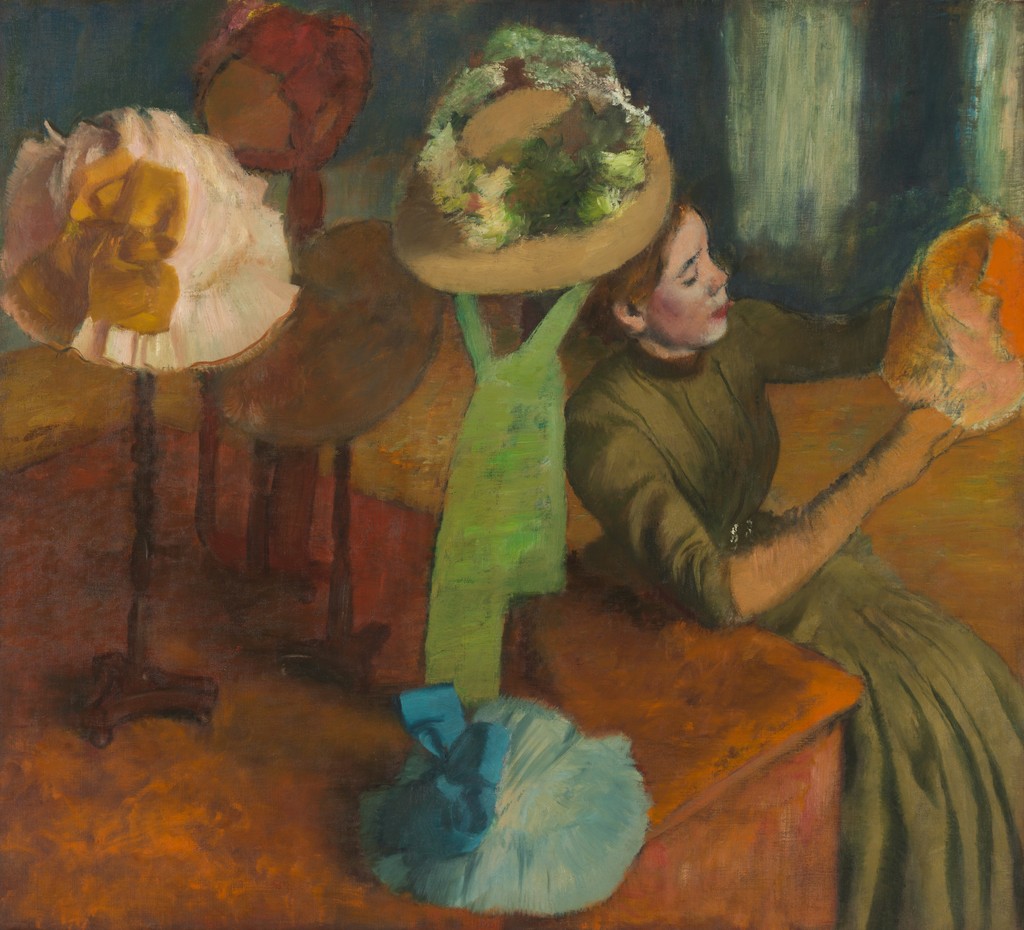
Edgar Degas, The Millinery Shop, 1879–86. Oil on canvas, 100 × 110.7 cm. The Art Institute of Chicago, 1933.428. Mr. and Mrs. Lewis Larned Coburn Memorial Collection. Image source. CC0 / Public domain. Museum image resized; whole supplied view retained. CC0; no enlargement, recolouring or retouching.
Annotated Details from The Milliner
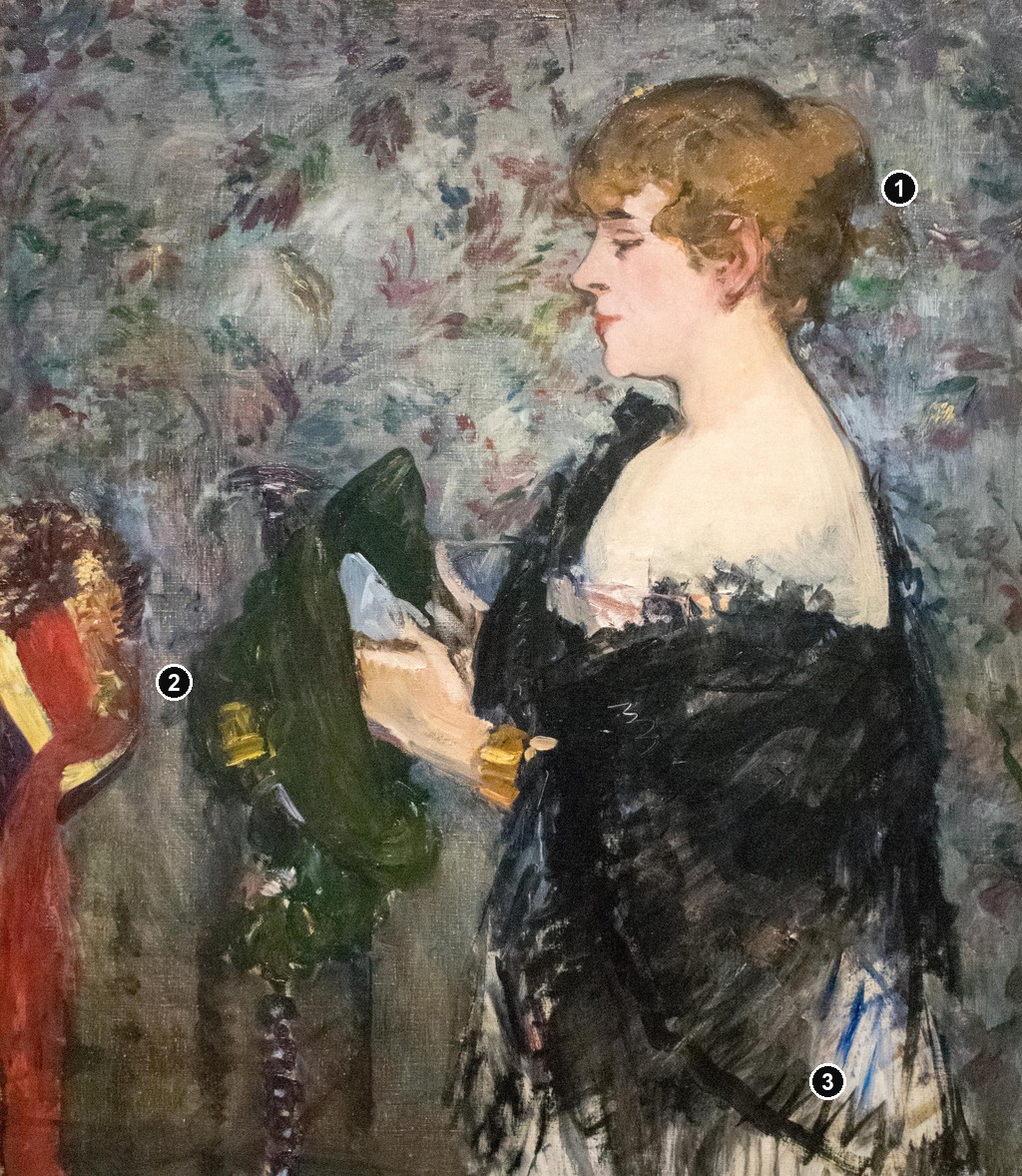
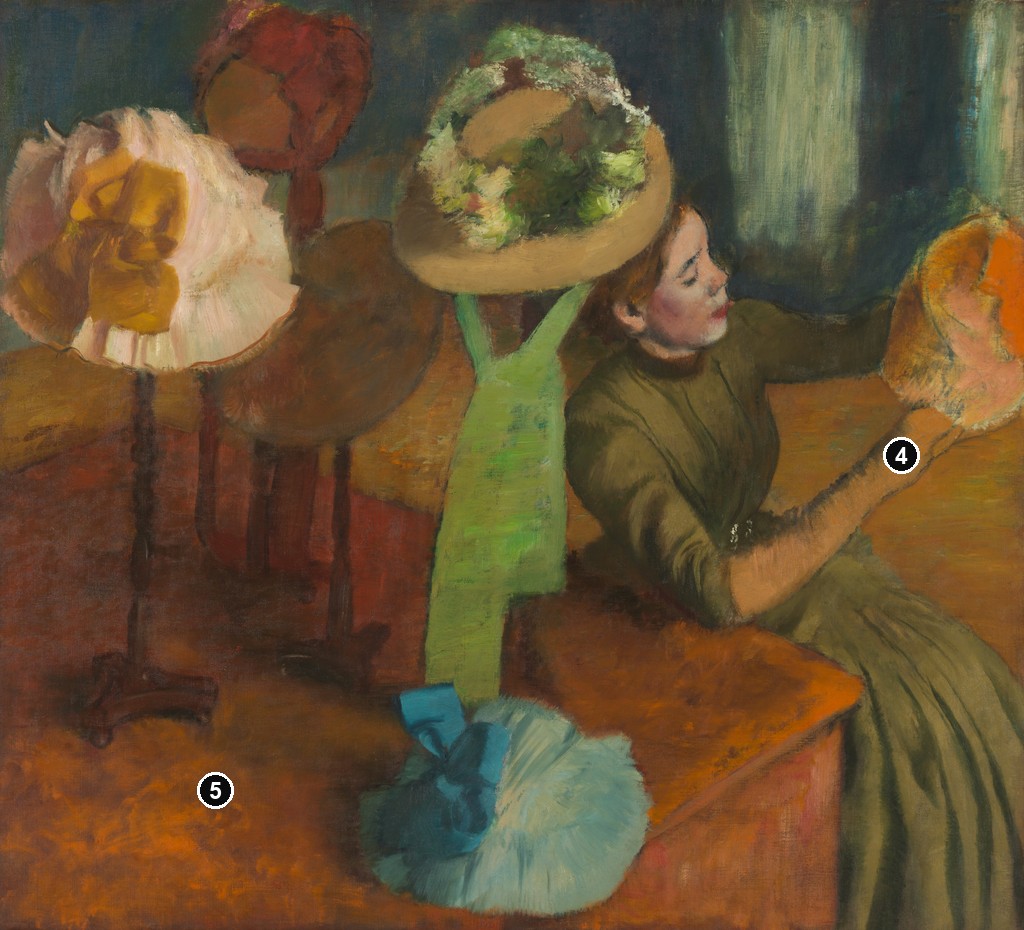
The numbered points identify visible features discussed in this article. Return from each detail to the whole composition. Each caption identifies the work shown.
At the Milliner’s
Édouard Manet, At the Milliner’s (The Milliner), 1881. Oil on canvas, 85.1 × 73.7 cm. Fine Arts Museums of San Francisco, Legion of Honor, 1957.3. Photograph: DragPrime / Wikimedia Commons. Museum purchase, Mildred Anna Williams Collection. Image source. CC BY-SA 4.0. Numbers added to a separate resized overview. Detail crops from the photograph by DragPrime / Wikimedia Commons. Adapted overview and crops: CC BY-SA 4.0; no enlargement, recolouring or retouching.
Degas The Millinery Shop
Edgar Degas, The Millinery Shop, 1879–86. Oil on canvas, 100 × 110.7 cm. The Art Institute of Chicago, 1933.428. Mr. and Mrs. Lewis Larned Coburn Memorial Collection. Image source. CC0 / Public domain. Numbers added to a separate resized overview. Detail crops from the Art Institute of Chicago image. CC0; no enlargement, recolouring or retouching.
Details from THE MILLINER
Compare Manet’s profile, held hat and loose lower clothing with Degas’s reaching figure and foreground display.
At the Milliner’s
Profile and Pale Shoulder
The head turns left above the broad pale shoulder. Dark hair and scattered background marks make different parts of the outline more distinct.
Held Hat Hand and Bracelet
Pale lining and fingers interrupt the dark hat and wrap. A yellow-gold bracelet makes a compact accent at the wrist.
Loose Strokes in the Lower Dress
Dark diagonal strokes cross pale areas below the wrap. Their open arrangement differs from the more continuous treatment of the face.
Degas The Millinery Shop
Degas Reaching Figure and Hat
The seated woman reaches towards an orange-toned hat. Her green dress and extended gloves place the gesture on the right side of the composition.
Foreground Hat and Table Edge
A pale hat with a blue bow lies near the foreground. The diagonal table edge leads past the hats and their narrow supports.
The Painting after Manet
Rouart and Wildenstein’s French catalogue records La Modiste in Manet’s estate in 1883 and at the 1884 sale, where Vayson bought it. It subsequently passed through collections including those of Auguste Pellerin and Oskar Schmitz, before its acquisition for San Francisco in 1957.[5]
The same 1975 catalogue reports some retouching and a signature at the lower left added by another hand.[5] That account adds a qualification to the painting’s later history; it does not identify who made the changes or establish their extent. The distinctive arrangement of profile, shoulder and held hat remains the starting point for looking at the work.
Artworks directory
Explore selected paintings, drawings and prints by Édouard Manet. Search by title or another recorded name.
Frequently Asked Questions
It belongs to the Fine Arts Museums of San Francisco, at the Legion of Honor, accession 1957.3.[1]
Her role is uncertain. She may be a worker handling a hat or a customer examining one, and the setting may be a shop or a domestic dressing area.[2]
The Met’s 2023 exhibition label suggests that the sparse brushwork in the lower dress may indicate an unfinished work.[2]
Discussion
Look again at the images and ideas explored in The Milliner by Édouard Manet. These editorial prompts invite your observations.
Reader Insights
Look at the pale lining, fingers and yellow-gold bracelet. How do these small light passages separate the hat from the black wrap?
Follow the outline from forehead to shoulder. Where does the background sharpen the edge, and where do similar tones bring the figure and pattern closer?
Compare the space occupied by hats in Degas’s painting with the cropped display beside Manet’s figure. How does each arrangement direct your attention?
Join the Conversation
Share a detail, comparison or question about The Milliner by Édouard Manet below.
References
- J. Paul Getty Museum, Manet and Modern Beauty: The Artist’s Last Years, exhibition checklist, 2019, no.64, p.11. View source.
- The Metropolitan Museum of Art, Manet/Degas, large-print exhibition text, 2023, PDF pp.147–148, labels for At the Milliner’s and The Millinery Shop. View source.
- Fine Arts Museums of San Francisco, Degas, Impressionism, and the Paris Millinery Trade, 2017, sections discussing Manet’s At the Milliner’s and Atget’s photograph of a milliner’s home. View source.
- Art Institute of Chicago, The Millinery Shop, Edgar Degas, 1879–86, 1933.428, collection record and commentary. View source.
- Denis Rouart and Daniel Wildenstein, Édouard Manet: Catalogue raisonné, tome I, 1975, no.373, p.276 and illustration p.277. French. View source.
- Splash image, Édouard Manet, At the Milliner’s (The Milliner), 1881. Oil on canvas, 85.1 × 73.7 cm. Fine Arts Museums of San Francisco, Legion of Honor, 1957.3. Photograph: DragPrime / Wikimedia Commons. Museum purchase, Mildred Anna Williams Collection. Image source. CC BY-SA 4.0. Photograph resized; whole supplied view retained. Adapted image: CC BY-SA 4.0. No enlargement, recolouring or retouching.


