


 by Tom Gurney
Tom Gurney BSc (Hons) is an art history expert with over 20 years experience
Published on June 19, 2020 / Updated on May 18, 2026
Email: tomgurney1@gmail.com / Phone: +44 7429 011000
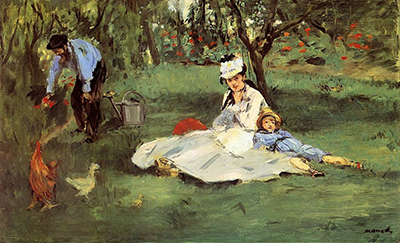
The painting features Monet's wife and family while Monet tended to the garden nearby.
Description of the Painting
On the left of the painting we can see a *ck, a hen and a chick perhaps symbolising the fairy tale nature of the subject family. In fact in the same sitting, Monet made a portrait of Manet at his easel, the whereabouts of this painting is currently unknown.
Also Auguste Renoir, another French Impressionist artist had joined his two fellow artists and was painting a portrait of Monet at his easel. (Monet Painting in His Garden at Argenteuil, 1873). Manet had become interested in Claude Monet and his Impressionist style of painting.
Monet believed in using the outdoors to infuse his work with the spirit of nature. In 1874 the two families had moved close to one another, Manet at the family house in Gennevilliers and Monet in Argeteuil.
It must have been an industrious afternoon with all three artists painting, conversing, borrowing paints and looking for vantage points. Renoir painted a close up of Camille Monet and Her Son Jean in the Garden at Argenteuil 1874 complete with the Rooster.
It is believed that Manet had lost patience with Renoir's intrusion and said, "He has no talent, that boy. Since he's your friend, you should tell him to give up painting!". His most famous works include A Bar at the Folies-Bergère (1882) and Olympia. (1863) Manet had close friends within the Impressionist movement including Berthe Morisot, a key figure in this vibrant collection of new artists.
Manet Visits Monet at Argenteuil
The Monet Family in Their Garden at Argenteuil was painted in 1874, during one of the most important periods in the development of Impressionism. At the time, Claude Monet was living at Argenteuil, a growing suburban town beside the Seine northwest of Paris.
Argenteuil became one of the central locations of early Impressionism. Monet painted its riverbanks, bridges, gardens, regattas and suburban streets repeatedly during the 1870s. The town also attracted fellow artists, including Édouard Manet, Pierre-Auguste Renoir, Alfred Sisley and Gustave Caillebotte.
Manet's visit to Monet's garden therefore represents more than a simple social call. It captures a moment when several of the leading French painters of the age were exchanging ideas directly beside the Seine.
Who Appears in the Painting?
The seated woman is Camille Monet, Claude Monet's first wife and one of the most recognisable figures in early Impressionism. Beside her is the couple's young son Jean Monet.
Camille appears in many of Monet's paintings from the 1860s and 1870s, including Woman with a Parasol, Springtime (The Reader) and Camille on Her Deathbed.
Unlike formal academic portraiture, Manet presents the family in a relaxed outdoor setting surrounded by flowers, sunlight and garden foliage. This modern domestic atmosphere was central to the Impressionist movement.
The Garden at Argenteuil
The garden itself plays a major role in the composition. Monet had developed the property into a colourful domestic painting space filled with flowers and carefully arranged planting.
Gardens became increasingly important throughout Monet's career. The experiments with light, flowers and outdoor atmosphere at Argenteuil helped prepare the way for his later gardens at Vétheuil and eventually the famous lily pond at Giverny.
Manet's painting therefore records an early stage in Monet's lifelong fascination with cultivated nature and outdoor painting.
Manet and Impressionism
Although Édouard Manet never officially exhibited with the Impressionists, he was closely connected to many members of the movement. Younger artists such as Monet and Renoir admired his bold handling of modern life and contemporary subjects.
By the 1870s Manet had become increasingly interested in lighter colours, outdoor settings and more spontaneous brushwork. His visits to Monet at Argenteuil helped encourage this transition.
The Monet Family in Their Garden at Argenteuil therefore occupies an important place between Realism and Impressionism. It combines Manet's strong compositional structure with the lighter atmosphere associated with Monet and Renoir.
Renoir's Companion Painting
During the same gathering at Argenteuil, Pierre-Auguste Renoir painted Camille Monet and Jean in the Garden at Argenteuil. The two paintings are often discussed together because they depict the same family, location and afternoon.
Comparing the two works reveals important differences between Manet and Renoir. Manet's version is more structured and observational, while Renoir's painting dissolves more fully into colour, light and decorative atmosphere.
Together, the paintings provide one of the best surviving visual records of the Impressionist circle during the 1870s.
Analysis of the Painting
The composition is built around contrasts between dark clothing, bright flowers and sunlit foliage. Camille Monet's dress and bonnet stand out against the greenery, while Jean introduces movement and informality into the scene.
Manet avoids the rigid finish associated with Salon painting. Instead, areas of foliage and flowers are painted with freer brushwork that helps create a sense of outdoor immediacy.
The painting also demonstrates the growing importance of modern leisure in French art. Rather than depicting mythology or history, Manet presents ordinary family life as a subject worthy of serious painting.
Why This Painting Matters
The Monet Family in Their Garden at Argenteuil matters because it documents the relationships at the centre of Impressionism. It is not simply a portrait of Monet's family, but a visual record of artistic friendship and collaboration.
The painting connects Manet, Monet and Renoir at a crucial moment in modern art history. It also preserves one of the earliest surviving images of the garden culture that would later define Monet's career.
Today the work is valued not only for its artistic qualities, but also for the insight it provides into the social world of the Impressionists during the 1870s.
Related Monet Paintings from Argenteuil
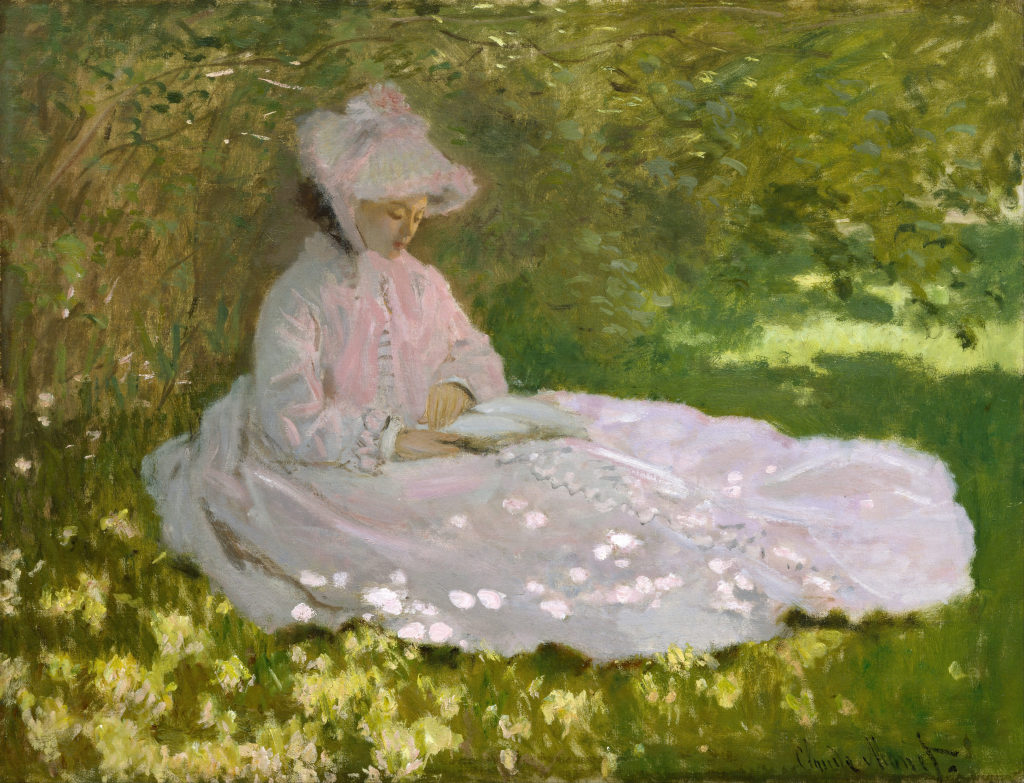
Springtime (The Reader)
Monet's intimate portrait of Camille Monet beneath lilacs in the family garden at Argenteuil.
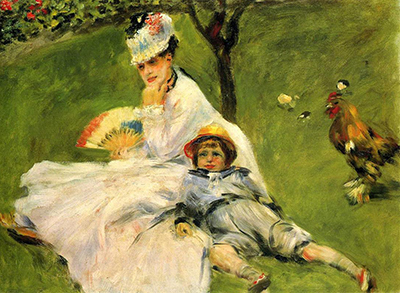
Renoir's Version of the Scene
Renoir painted the Monet family during the same famous gathering at Argenteuil in 1874.