



 by Tom Gurney
Tom Gurney BSc (Hons) is an art history expert with over 20 years experience
Published on June 19, 2020 / Updated on October 30, 2026
Email: tomgurney1@gmail.com / Phone: +44 7429 011000
Moonlight Harbor at Boulogne by Édouard Manet: Introduction
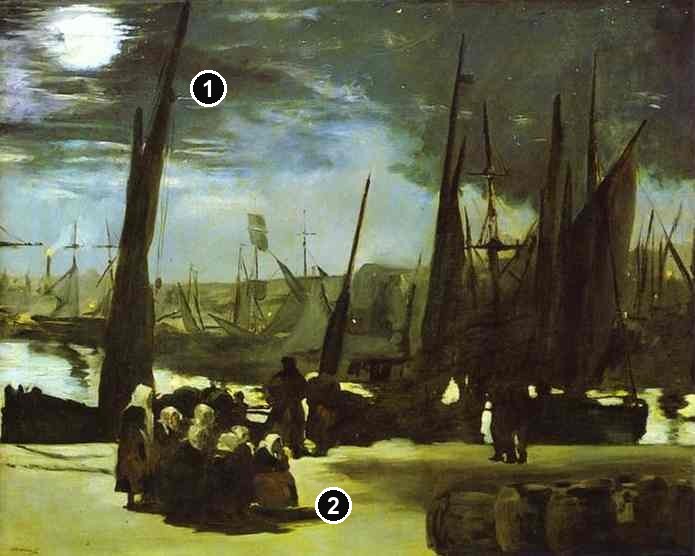
A bright moon hangs above a harbour crowded with masts and dark sails. Below, women in pale head coverings gather on a light quay, their clothing merging into a compact dark group. Édouard Manet brings these small figures and the larger boats together through sharp contrasts of light and shadow. Moonlight Harbor at Boulogne, known in French as Clair de lune sur le port de Boulogne, belongs to the Musée d’Orsay in Paris. The museum currently dates it to 1869.[1]
At a Glance
- ArtistÉdouard Manet
- TitleClair de lune sur le port de Boulogne
- Also known asMoonlight, Harbor at Boulogne; The Port of Boulogne by Moonlight
- Date1869 in the Musée d’Orsay catalogue; also dated 1868
- MediumOil on canvas
- Dimensions81.5 × 101 cm
- CollectionMusée d’Orsay, Paris
- Accession numberRF 1993
- CreditBequest of Comte Isaac de Camondo, 1911.[1]
This work across Édouard Manet’s career
Contents
- The Moon and Broken Clouds
- Masts, Sails and Reflections
- Women and Barrels on the Quay
- A Harbour Seen from a Hotel
- Comparing Van der Neer’s Moonlit Landscape
- From Brussels to the Musée d’Orsay
- Annotated details
The Moon and Broken Clouds
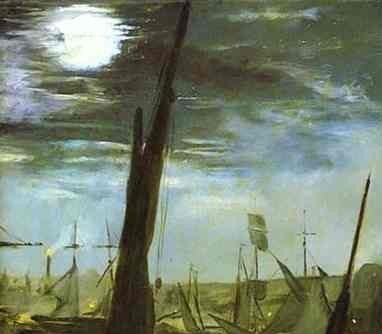
The moon occupies the upper left corner, close to the edge of the composition. Its pale disc is surrounded by streaks of cloud, which cross the sky in uneven horizontal bands. The light spreads beyond the circular shape, making this corner appear more open than the darker sky to the right.
Across the centre, pale blue-grey passages alternate with darker cloud shapes. Some marks are thin and almost horizontal; others spread into broader patches. Their changing edges prevent the sky from becoming a flat background to the boats.
Small light points appear towards the upper right. They are much less prominent than the moon, and the eye has to adjust to the surrounding darkness to notice them. Together with the broken clouds, they give the sky an extent that reaches beyond the strongly marked objects below.
The moon is separated from the water by a large area of sky and a dense line of boats. Its effect returns in the narrow, bright passages between the hulls. These fragments of light make the water visible without exposing every part of the harbour equally.
Masts, Sails and Reflections
A tall, dark mast rises near the left side and continues beyond the top edge. It cuts across the cloud bands, making an especially strong connection between the boats and the sky. Its width and closeness distinguish it from the finer uprights farther away.
To the right, masts, ropes and sloping sail shapes crowd together. Some remain separate lines against the lighter sky; others disappear into a larger dark mass. This alternation makes the harbour seem dense while preserving a few clear directions through it.
The sails provide broader shapes among the narrow uprights. Their slanting edges interrupt the horizontal spread of the water and quay. Below them, the hulls form a low, connected band, with small openings through which pale water can be seen.
Reflections appear as irregular light patches, broken by the boats and their shadows. Near the left, a larger stretch of water catches the light. Towards the right, smaller bright openings punctuate the darkness beneath the sails. The arrangement moves the eye across the harbour rather than leading it along one straight reflection from the moon.
These contrasts also establish distance. The nearer hulls and mast have considerable dark weight; the farther boats are more lightly indicated against the sky. A few slender lines can suggest a distant vessel.
Women and Barrels on the Quay
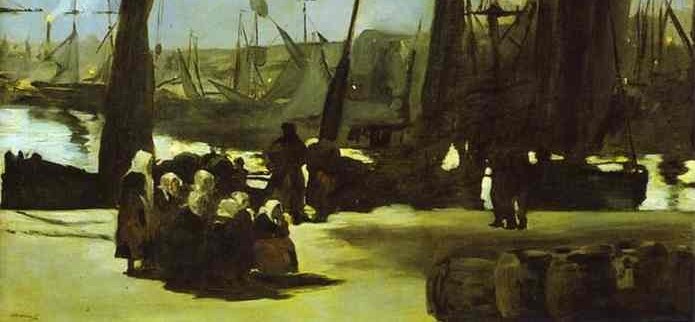
The foreground women are gathered slightly left of centre. Their pale head coverings stand out above dark shoulders and clothing. The overlapping bodies form an irregular mound, with a standing figure at the left and lower, seated forms beside her.
The group’s position matters as much as its small scale. It lies against the brightest part of the quay, below the tall mast, and has enough open ground around it to remain distinct from the boats. Dark shadows extend sideways from the figures, joining their separate forms into a larger shape.
Published interpretations connect the women with the fishing trade. The Grand Palais’s 2019 exhibition guide describes them as preparing the catch for the following day’s market.[2] An RMN–Grand Palais account instead interprets them as sailors’ wives waiting for fishermen to return.[3] Both readings place the figures within the working life of the port, although their individual identities and relationships remain uncertain.
Other standing figures appear closer to the boats. Small pale passages distinguish them from the dark hulls, but Manet gives them little facial detail. Their presence keeps the waterfront inhabited even where its objects merge into shadow.
At the lower right, a cluster of barrels occupies another substantial area of the quay. Rounded ends and dark bands give these objects a different rhythm from the upright figures. Their overlapping forms balance the women on the left, while the pale ground between the two groups leaves a broad opening in the foreground.
A Harbour Seen from a Hotel
Writing in 1906, Théodore Duret identified the viewpoint of this moonlit harbour scene as a window of the Hôtel de Folkestone on the Boulogne quay.[4] His account helps explain the wide view across boats, water and foreground activity. The picture takes in several layers of the port within a single horizontal canvas.
Manet returned to harbour subjects in different conditions and with different kinds of movement. In The Folkestone Boat, Boulogne, the ferry and the people around its departure offer another view of the town’s waterfront. Here the scattered light and continuous dark silhouettes hold the scene together more strongly than any single action.
The painting’s date has been treated differently by museums and scholars. While the Musée d’Orsay retains 1869, the Musée du Luxembourg’s exhibition account dates it to 1868 and connects it with Manet’s summer stay that year.[5] Louis van Tilborgh’s study of the Boulogne paintings likewise places the group in the documented 1868 visit, discussing how Manet developed harbour scenes with the help of drawings.[6]
Van Tilborgh includes the moonlit harbour among these composed views. His account allows for a picture developed through drawings as well as direct observation. The strongly placed mast, overlapping sails and separated foreground groups give the scene an order that remains visible through its darkness.
Comparing Van der Neer’s Moonlit Landscape
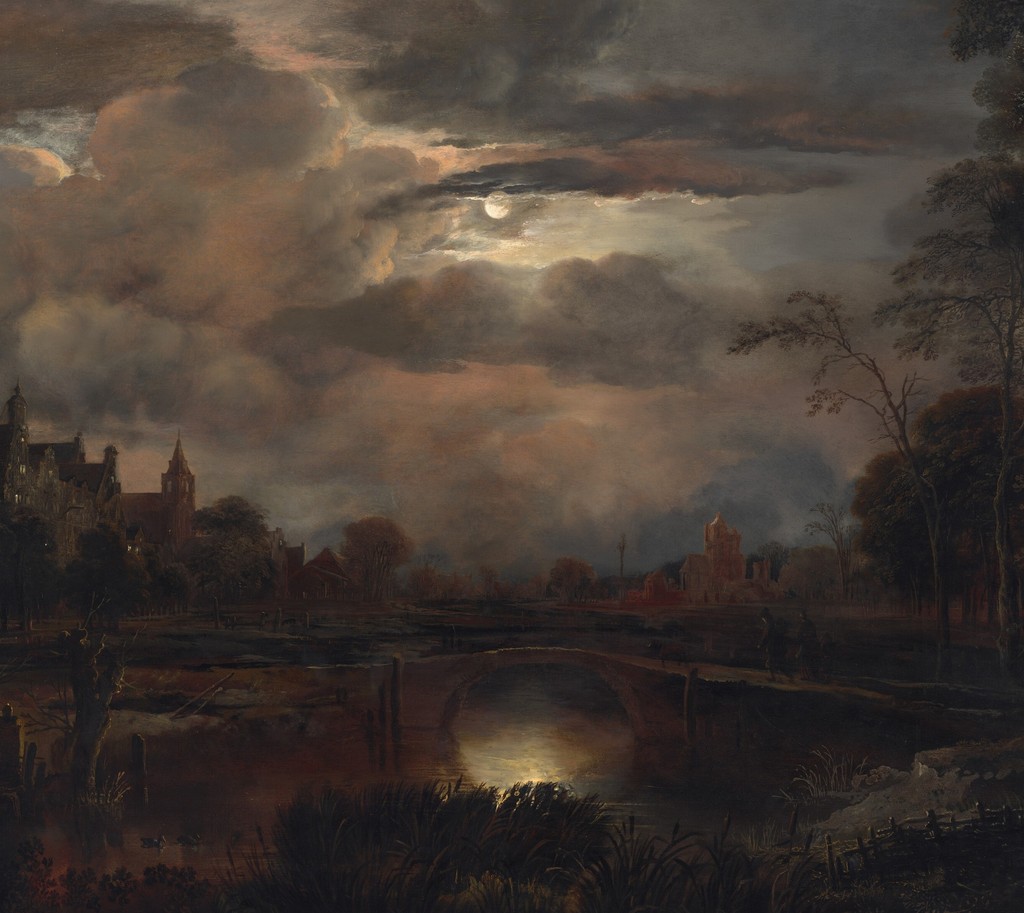
The Grand Palais guide connects Manet’s picture with the night landscapes of the seventeenth-century Dutch painter Aert van der Neer.[2] A useful comparison is Van der Neer’s Moonlit Landscape with Bridge, probably painted in 1648–50 and now in the National Gallery of Art, Washington.[7]
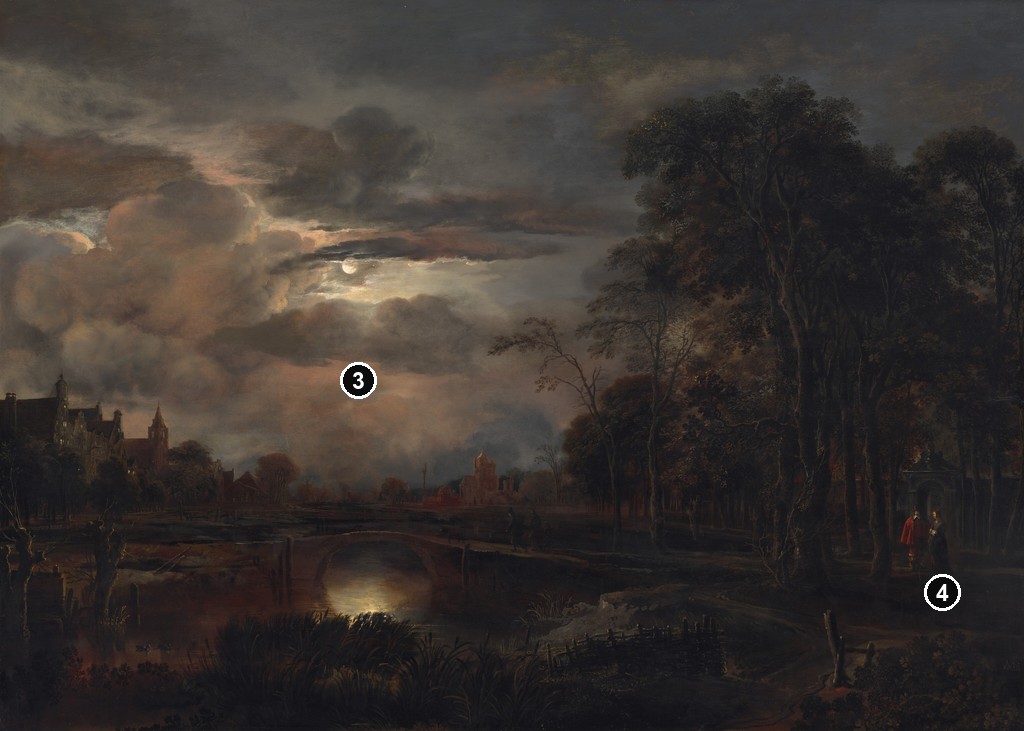
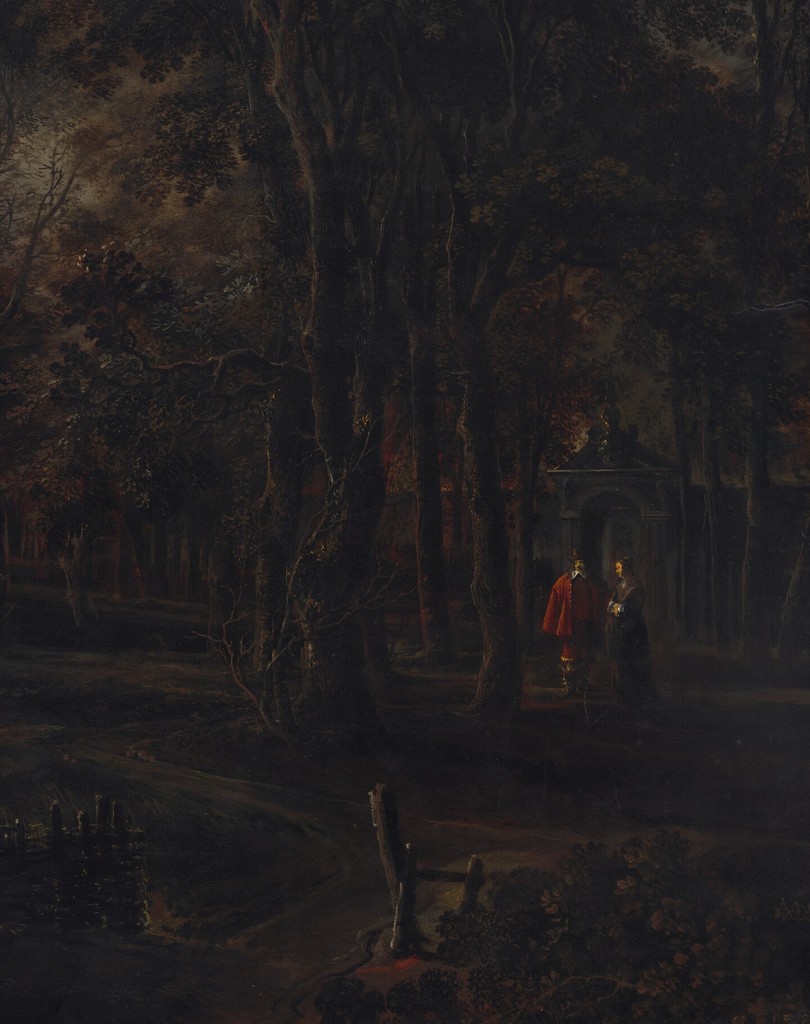
In that painting, a small moon appears among large clouds above a river. Its light returns on the water beneath an arched stone bridge. Buildings occupy the left bank, while a dense group of trees rises on the right. Tiny figures crossing the bridge and a couple beside a gateway become visible through selective highlights.
Manet uses a similar contrast between a luminous sky and a darker inhabited foreground. His pale head coverings help distinguish the women just as small lights pick out Van der Neer’s figures. In both works, much of the setting remains in shadow, and the viewer connects the scattered bright passages.
The distribution of forms is different. Van der Neer’s trees and buildings create a broad enclosure around the river, with many fine branches and architectural details. Manet fills the middle distance with a sharper pattern of masts and sails. His quay is a wide pale strip, bringing the figures and barrels forward against the darker boats.
Arthur K. Wheelock Jr. describes Van der Neer’s setting as a combination of urban and rural motifs rather than a record of one exact place.[8] The comparison shows how both painters construct a night landscape and direct attention through darkness.
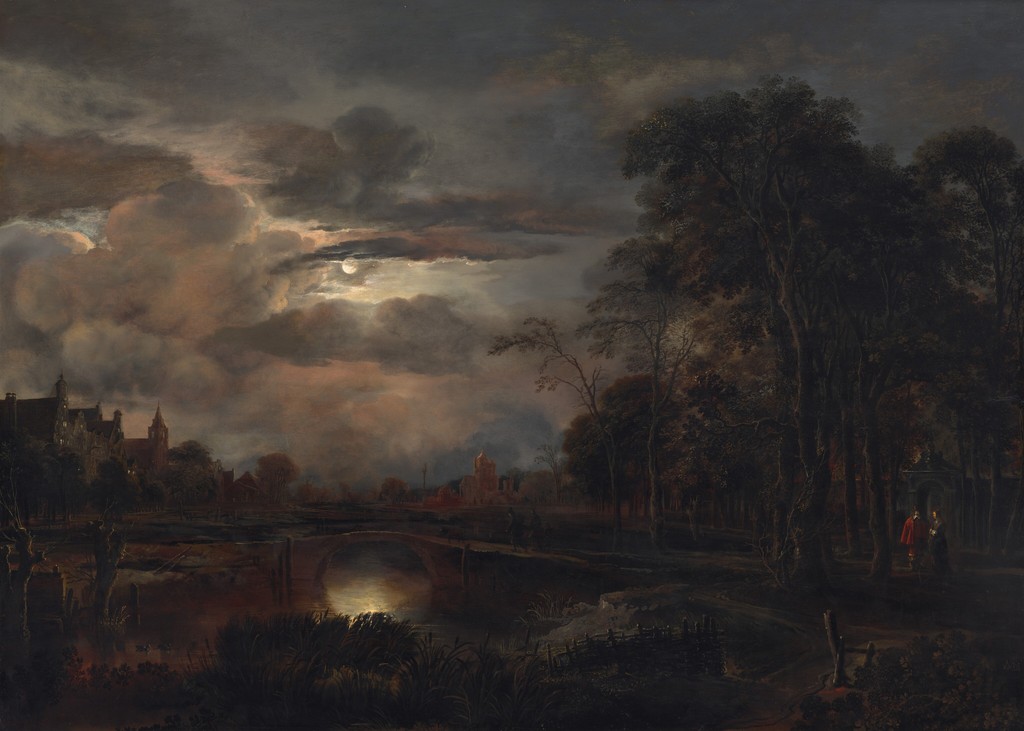
Aert van der Neer, Moonlit Landscape with Bridge, probably 1648–50. Oil on panel, 78.4 × 110.2 cm. National Gallery of Art, Washington, 1990.6.1. Courtesy National Gallery of Art, Washington. Patrons’ Permanent Fund, 1990.6.1. CC0. Image source. CC0 / Public domain. Museum image resized; whole supplied view retained. CC0; no enlargement, recolouring or retouching.
Annotated Details from Moonlight Harbor at Boulogne
The numbered points identify visible features discussed in this article. Return from each detail to the whole composition. Each caption identifies the work shown.
Moonlight Harbor at Boulogne
Édouard Manet, Clair de lune sur le port de Boulogne, 1869 in the Musée d’Orsay catalogue; also dated 1868. Oil on canvas, 81.5 × 101 cm. Musée d’Orsay, Paris, RF 1993. Musée d’Orsay, bequest of Comte Isaac de Camondo, 1911. Reproduction via Wikimedia Commons, Public Domain Mark 1.0. Image source. Public domain. Numbers added to a separate overview. Broad detail crops from the Wikimedia Commons reproduction; no enlargement, recolouring or retouching.
Van der Neer Moonlit Landscape with Bridge
Aert van der Neer, Moonlit Landscape with Bridge, probably 1648–50. Oil on panel, 78.4 × 110.2 cm. National Gallery of Art, Washington, 1990.6.1. Courtesy National Gallery of Art, Washington. Patrons’ Permanent Fund, 1990.6.1. CC0. Image source. CC0 / Public domain. Numbers added to a separate resized overview. Detail crops from the National Gallery of Art image. CC0; no enlargement, recolouring or retouching.
Details from MOONLIGHT HARBOR AT BOULOGNE
Compare the moon, reflections and foreground groups in Manet’s harbour with the river, bridge and gateway in Van der Neer’s night landscape.
Moonlight Harbor at Boulogne
Moon Clouds and Mast
The bright moon and broken cloud bands meet the tall dark mast at the left. The crop retains a broad part of the sky and harbour.
Figures Boats and Quay
The overlapping women and pale head coverings stand against the light quay. Boats and barrels give the group its wider foreground setting.
Van der Neer Moonlit Landscape with Bridge
Moon River and Bridge
The small moon appears among clouds above the river. Its reflection returns beneath the arched bridge, linking sky and water.
Trees Gateway and Couple
Dark trees surround the gateway and the two small figures. Light catches the red garment and pale details against the surrounding shadows.
From Brussels to the Musée d’Orsay
The Musée d’Orsay records the painting’s appearance in Brussels in 1869 and in the posthumous Manet exhibition in Paris in 1884.[1] Its early collecting history also links it with Alfred Stevens and the dealer Paul Durand-Ruel.
The Musée du Luxembourg’s account describes Durand-Ruel acquiring the picture in 1872 through Stevens, while noting differences between the dealer’s later recollection and Manet’s recorded price. It then traces a brief sale and return before Jean-Baptiste Faure acquired the painting in January 1873.[5]
The work later entered the collection of Comte Isaac de Camondo. His 1911 bequest brought it into the French national collections for the Louvre. It was assigned to the Musée d’Orsay in 1986.[1]
Artworks directory
Explore selected paintings, drawings and prints by Édouard Manet. Search by title or another recorded name.
Frequently Asked Questions
The painting belongs to the Musée d’Orsay in Paris, accession RF 1993. It entered the French national collections through the Camondo bequest of 1911.[1]
Discussion
Look again at the images and ideas explored in Moonlight Harbor at Boulogne by Édouard Manet. These editorial prompts invite your observations.
Reader Insights
Follow the brightest passages from the moon to the water and quay. Where do the boats interrupt their connection?
Compare the large mast at the left with the crowded rigging at the right. How do these different dark shapes organize the harbour?
Look between the women and the barrels. What does the open ground contribute to the balance of the foreground?
Join the Conversation
Share a detail, comparison or question about Moonlight Harbor at Boulogne by Édouard Manet below.
References
- Musée d’Orsay, Clair de lune sur le port de Boulogne, RF 1993, current collection record, inscription, provenance and exhibition history. French. View source.
- Réunion des musées nationaux–Grand Palais, La Lune. Du voyage réel aux voyages imaginaires, educational dossier, 2019, p.20, Manet entry. French. View source.
- RMN–Grand Palais, Clair de Lune sur le Port de Boulogne (Moonlight Over the Port of Boulogne), 1869, Google Arts & Culture partner commentary. English. View source.
- Théodore Duret, Histoire d’Édouard Manet et de son œuvre, 1906, pp.162–163, Boulogne and hotel-window passage. French. View source. (in French).
- Musée du Luxembourg, Clair de lune, ou Clair de lune sur le port de Boulogne, Durand-Ruel exhibition commentary and notes. French. View source.
- Louis van Tilborgh, “The jetty of Boulogne-sur-Mer”, Van Gogh Museum Journal 2002, pp.151–153, Boulogne-group discussion and note3. View source.
- National Gallery of Art, Moonlit Landscape with Bridge, Aert van der Neer, probably 1648/1650, 1990.6.1, collection record. View source.
- Arthur K. Wheelock Jr., “Moonlit Landscape with Bridge”, Dutch Paintings of the Seventeenth Century, National Gallery of Art online edition, 2018, Entry. View source.
- Splash image, Édouard Manet, Clair de lune sur le port de Boulogne, 1869 in the Musée d’Orsay catalogue; also dated 1868. Oil on canvas, 81.5 × 101 cm. Musée d’Orsay, Paris, RF 1993. Musée d’Orsay, bequest of Comte Isaac de Camondo, 1911. Reproduction via Wikimedia Commons, Public Domain Mark 1.0. Image source. Public domain. Whole supplied reproduction retained for web display. No enlargement, recolouring or retouching.


