



 by Tom Gurney
Tom Gurney BSc (Hons) is an art history expert with over 20 years experience
Published on June 19, 2020 / Updated on October 30, 2026
Email: tomgurney1@gmail.com / Phone: +44 7429 011000
Music Lesson by Édouard Manet: Introduction
A pale wooden guitar and an open book of music stand out against two darkly dressed figures. One person holds the instrument; the other follows a line on the page. The objects suggest a shared activity, yet the two faces turn outward, leaving their exchange difficult to read. Édouard Manet painted Music Lesson in 1870. The large canvas now belongs to the Museum of Fine Arts, Boston.[1]
At a Glance
- ArtistÉdouard Manet
- TitleMusic Lesson
- French titleLa leçon de musique
- Date1870
- MediumOil on canvas
- Dimensions141 × 173.1 cm
- CollectionMuseum of Fine Arts, Boston
- Accession number69.1123
- CreditAnonymous Centennial gift in memory of Charles Deering, 1969.[1]
This work across Édouard Manet’s career
Contents
- The Guitar and the Open Score
- Astruc and the Unnamed Woman
- A Dark Interior and Spanish Interests
- Astruc beside Manet in Fantin-Latour’s Studio
- Music Lesson at the Salon of 1870
- From Manet’s Studio to Boston
- Annotated details
The Guitar and the Open Score
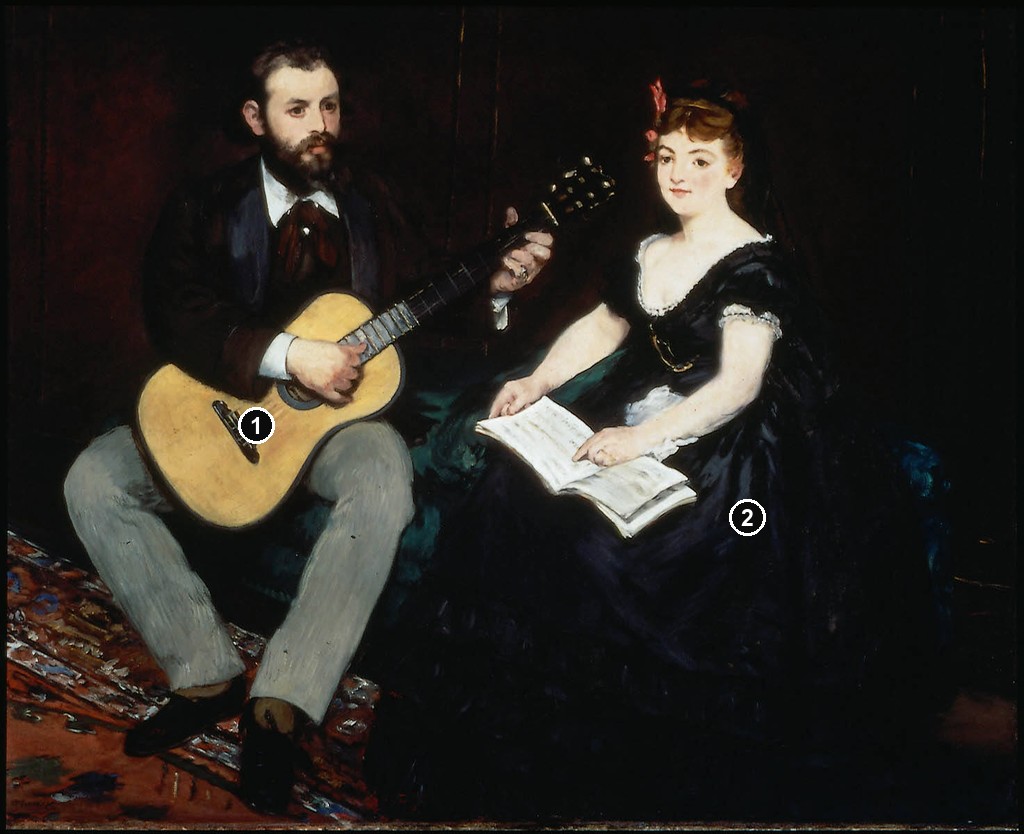
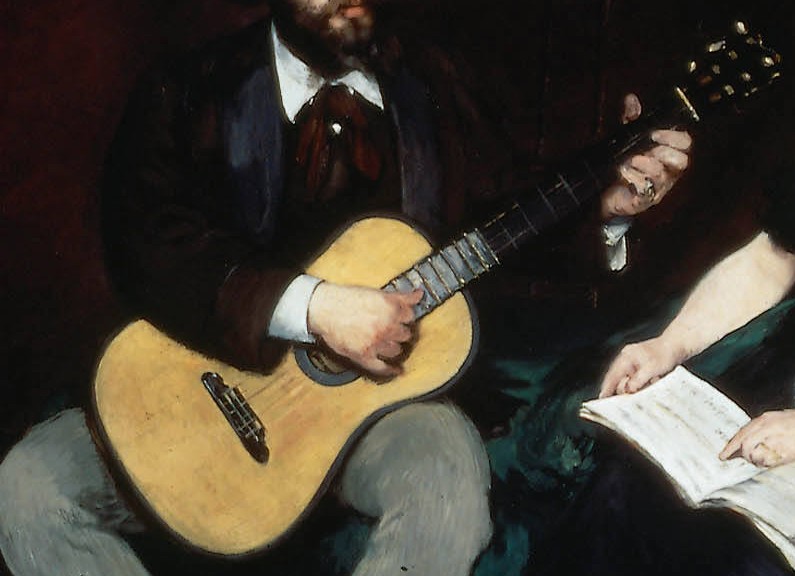
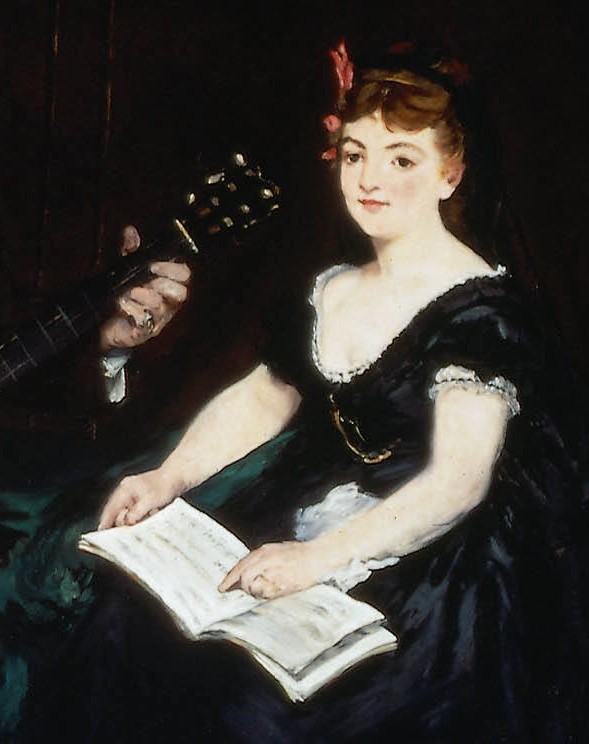
The guitar occupies a broad, bright area on the left. Its rounded body rests across the man’s thighs, while the neck rises diagonally towards the space between the two heads. The curve of the instrument and the long straight neck give the composition two different directions: a spreading shape close to the lap and a narrow line pointing upwards.
The man’s hands connect these parts. His right hand meets the strings near the dark sound hole; his left holds the neck. White at the wrist separates the playing hand from the darker sleeve. Against his jacket, the instrument’s pale wood becomes particularly prominent, drawing attention to the physical action that the pose implies.
At the right, the woman’s exposed arms lead down towards the open score. One hand rests beside the upper pages, while the other points into the book. The paper forms an uneven white shape across her lap, with sloping edges that answer the diagonal of the guitar. These two objects bring a strong light into the lower centre of the picture.
The faces remain separate from that busy arrangement of hands and objects. Neither sitter bends closely over the music. Their relatively upright heads and outward looks make the scene feel held in place, despite the activity suggested by the instrument. The painting allows the viewer to notice this stillness while imagining the sound that might connect the pair.
Astruc and the Unnamed Woman
The guitarist is identified as Zacharie Astruc, Manet’s friend and a figure active in poetry, criticism, music and the visual arts. The catalogue raisonné by Denis Rouart and Daniel Wildenstein places the painting’s execution in Manet’s rue Guyot studio in 1870. It also records a separate study for the female figure, while leaving her identity uncertain.[2]
An exhibition guide published for the 2013 Manet exhibition in Venice identifies the companion as Astruc’s wife.[3] Miranda Wallace’s 2021 museum catalogue essay, however, still describes her as unidentified.[4] The wife identification therefore remains a possibility rather than a secure name for the sitter. The scene’s apparent familiarity does not settle the relationship between these two people.
There is also a difference between identifying a model and identifying a role. Writing in 1906, Théodore Duret described Astruc as a music teacher accompanying a young woman who sings while following the score.[5] This gives the title a plausible explanation, with the guitar supporting the voice. It is Duret’s interpretation of the represented activity, rather than a record of a particular lesson.
The pointing finger draws attention to the music. On its own, it does not tell us who has greater musical experience, whether a correction is being made, or which passage is being played. The woman’s hand can be read as maintaining her place in the score. Manet gives the gesture enough clarity to invite that reading without supplying an elaborate story around it.
A Dark Interior and Spanish Interests
The setting reveals relatively little about the room. Dark vertical divisions appear behind the figures, but there is no wide view into an adjoining space. A strip of patterned rug fills the lower left, while green-blue upholstery appears between and beside the bodies. These limited furnishings keep attention close to the pair.
The man’s light grey trousers form two large shapes below the guitar. Their open angle contrasts with the broad, continuous sweep of the woman’s skirt. Small pale passages at her neckline and sleeves distinguish her upper body from the surrounding dark fabric. The book, arms and face emerge from a much larger mass of dark colour.
Wallace connects the woman’s black lace dress and hair ornament with Spanish fashion, and describes the richly patterned rug through a Moorish association.[4] This reading places the interior within Manet’s wider interest in Spanish subjects. The guitar makes that connection especially visible, although the objects do not establish the woman’s nationality or the room’s location.
Astruc shared Manet’s enthusiasm for Spain. The Kunsthalle Bremen’s account of their friendship explains that he recommended a detailed itinerary for Manet’s 1865 journey, which the painter followed in part.[6] The instrument here suits that shared interest while presenting Astruc as someone involved in making music. For another treatment of the guitar and a posed performer, Manet’s earlier The Spanish Singer offers a useful contrast.
Astruc beside Manet in Fantin-Latour’s Studio
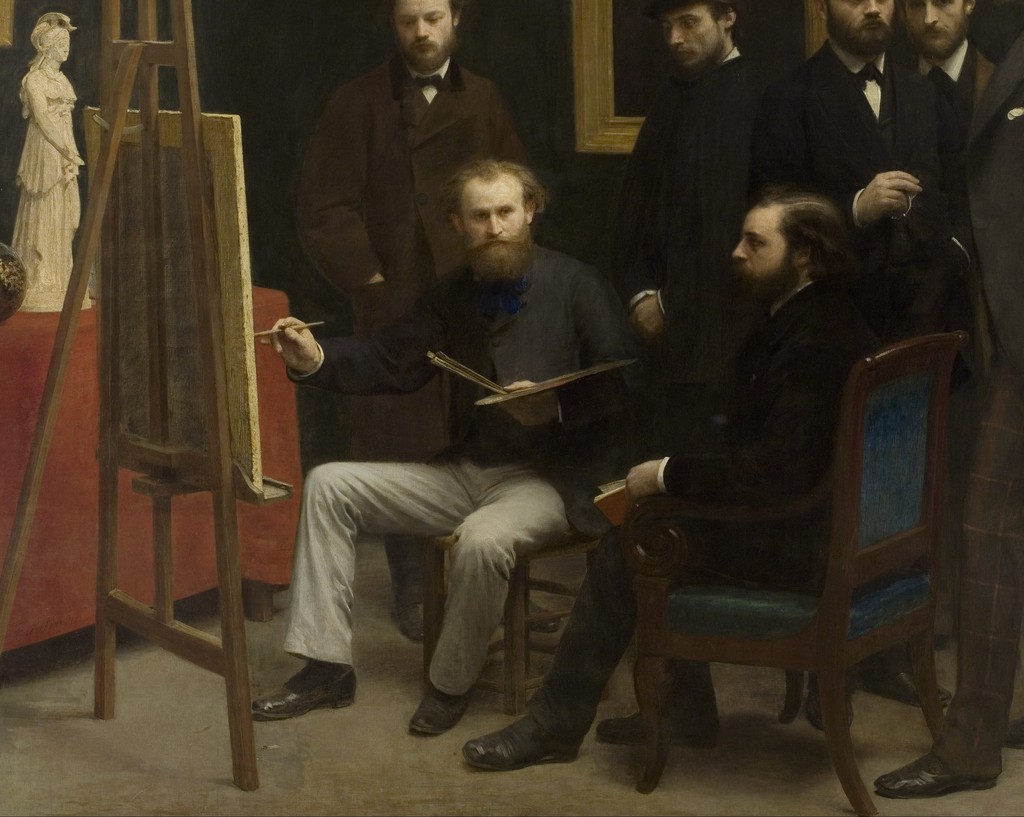
Astruc also appears facing Manet in Henri Fantin-Latour’s A Studio at Les Batignolles, painted in 1870 and now in the Musée d’Orsay. There Manet sits at an easel with palette and brush, while Astruc occupies a chair opposite him. Behind them stand other members of their artistic circle, including Renoir, Zola, Bazille and Monet. The group portrait was exhibited at the same year’s Salon.[7]
The two pictures give Astruc different positions within a shared culture. Manet shows him holding an instrument, his hands engaged in producing music. Fantin-Latour makes him the seated companion of a painter at work. The arrangement brings the critic and artist into close relation through their opposing chairs and the space of the easel.
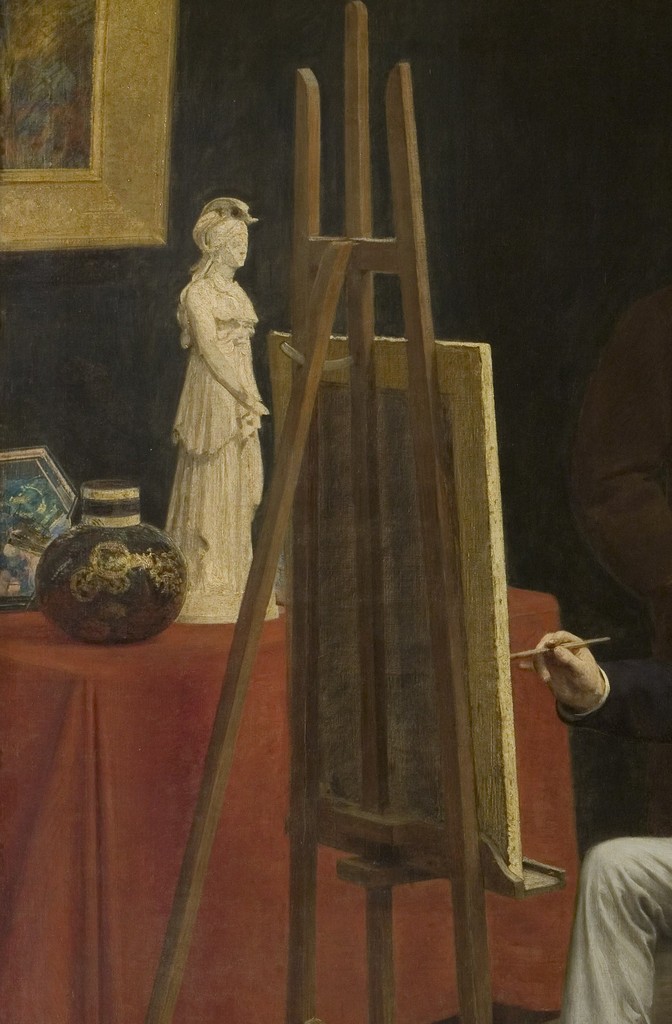
Fantin-Latour gives his group more objects and people than Manet includes in Music Lesson. Easel uprights, a large framed picture and the standing men divide the room into smaller areas. A pale statuette and a decorated vessel sit at the left. The Musée d’Orsay interprets the Minerva figure as a sign of respect for classical tradition, and the vessel as an expression of the group’s interest in Japanese art.[7]
The figures’ restrained dress and sober poses are also central to the museum’s account: Fantin-Latour presents the controversial young artists as serious, respectable people.[7] Looking back at Music Lesson, the simpler arrangement becomes more striking. Its two figures have a greater area of darkness around them, and the guitar and score carry much of the information about their activity. Astruc’s recognisable presence connects the intimate musical pairing with the larger professional gathering.
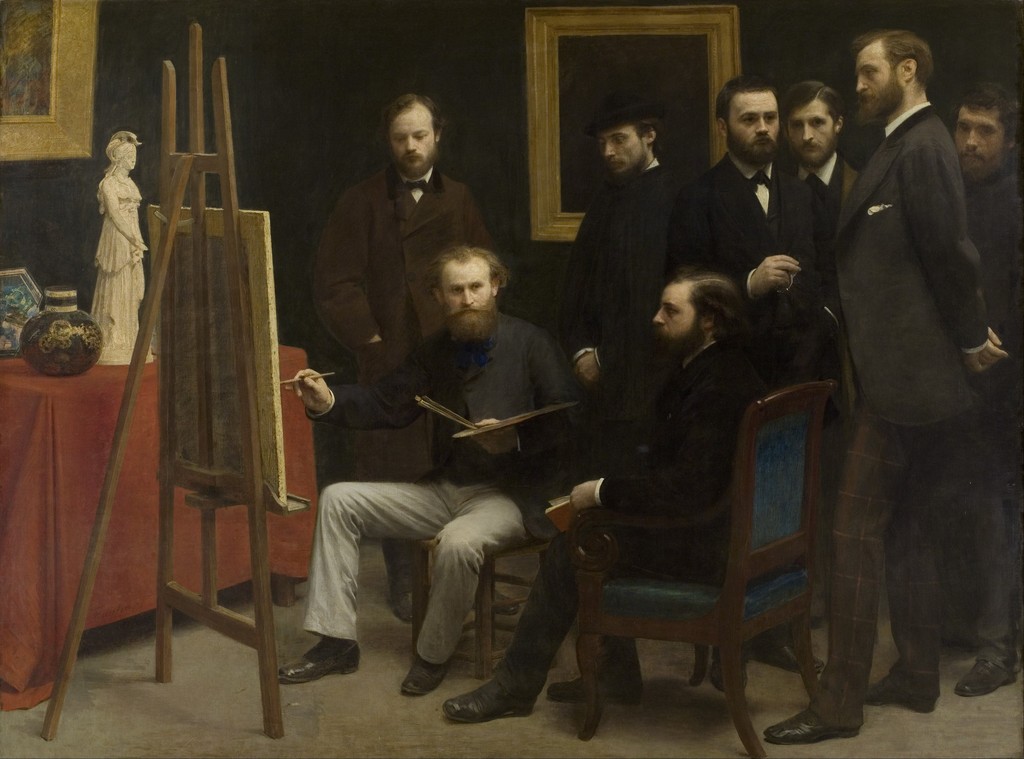
Henri Fantin-Latour, A Studio at Les Batignolles, 1870. Oil on canvas, 204 × 273.5 cm. Musée d’Orsay, Paris, RF 729. Manet sits at his easel with Astruc facing him. Musée d’Orsay, Paris, purchased 1892. Google Art Project reproduction via Wikimedia Commons, Public Domain Mark 1.0. Image source. Public domain. Whole supplied reproduction resized for web display. No enlargement, recolouring or retouching.
Annotated Details from Music Lesson
The numbered points identify visible features discussed in this article. Return from each detail to the whole composition. Each caption identifies the work shown.
Music Lesson
Édouard Manet, Music Lesson, 1870. Oil on canvas, 141 × 173.1 cm. Museum of Fine Arts, Boston, 69.1123. The guitarist is identified as Zacharie Astruc; the woman’s identity remains uncertain. Museum of Fine Arts, Boston. Anonymous Centennial gift in memory of Charles Deering. AMICA Library reproduction via Wikimedia Commons, Public Domain Mark 1.0. Image source. Public domain. Numbers added to a separate resized overview. Broad detail crops from the Wikimedia Commons reproduction; no enlargement, recolouring or retouching.
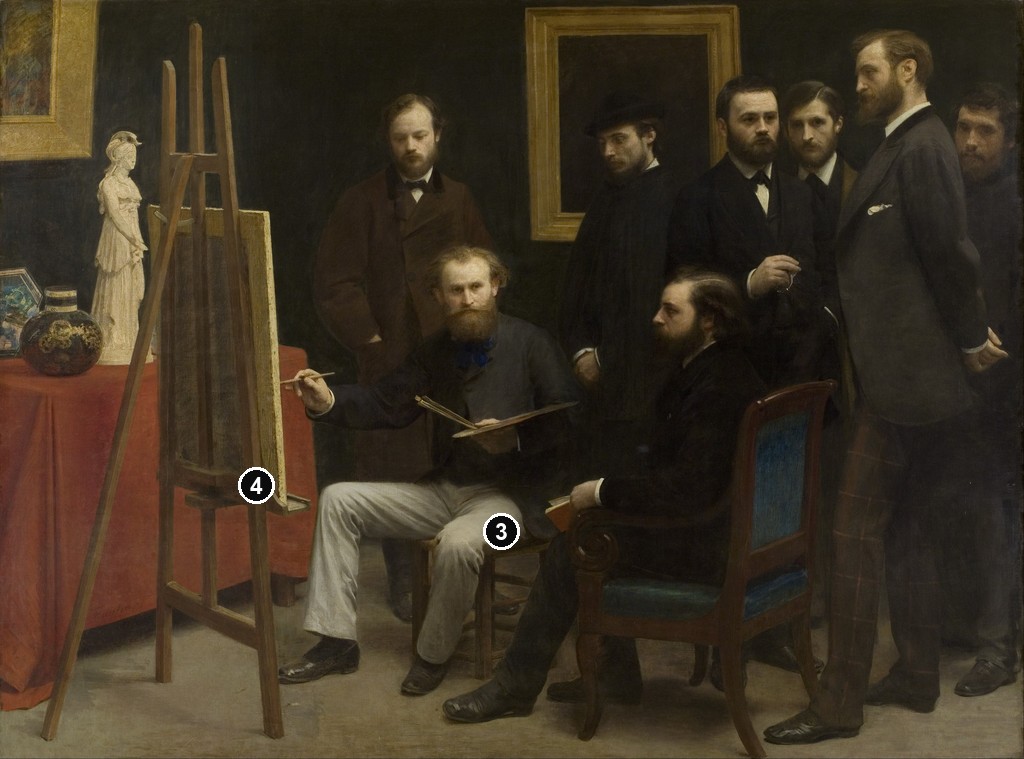
Fantin-Latour A Studio at Les Batignolles
Henri Fantin-Latour, A Studio at Les Batignolles, 1870. Oil on canvas, 204 × 273.5 cm. Musée d’Orsay, Paris, RF 729. Manet sits at his easel with Astruc facing him. Musée d’Orsay, Paris, purchased 1892. Google Art Project reproduction via Wikimedia Commons, Public Domain Mark 1.0. Image source. Public domain. Numbers added to a separate resized overview. Detail crops from the Google Art Project reproduction via Wikimedia Commons; no enlargement, recolouring or retouching.
Details from MUSIC LESSON
Follow the guitar, hands and score in Manet’s musical interior, then compare Manet and Astruc with the objects beside Fantin-Latour’s studio easel.
Music Lesson
Guitar and Playing Hands
The rounded guitar body and rising neck connect the two hands. The white cuff separates the playing hand from the dark sleeve.
Face Arms and Score
The pale face and exposed arms lead down to the open score. The pointing finger concentrates attention within the light pages.
Fantin-Latour A Studio at Les Batignolles
Manet and Astruc
Manet holds palette and brush at the easel, while Astruc faces him from the opposite chair. Their hands and tools organise the space between them.
Minerva Vessel and Easel
A pale Minerva statuette and decorated vessel stand beside the easel. These objects bring different shapes and light accents into the studio.
Music Lesson at the Salon of 1870
Manet exhibited Music Lesson at the 1870 Salon alongside his portrait of Eva Gonzalès.[5] The pairing placed two kinds of artistic activity before the public: music making in one picture and painting in the other. Both compositions depend on a figure holding the tools of an art, with a larger dark or light clothing shape surrounding the action.
Accounts of the response to Music Lesson differ in emphasis. The Venice exhibition guide describes severe ridicule in the press.[3] Duret’s later account instead stresses a cold, contemptuous reception, observing that this picture did not provoke the storm that had greeted The Balcony at the previous Salon. He says the portrait of Gonzalès attracted the greater attention that year.[5]
From Manet’s Studio to Boston
Durand-Ruel bought Music Lesson at Manet’s estate sale in February 1884. The painting later belonged to Henri Rouart before entering the stock of M. Knoedler and Co.[1]
The Museum of Fine Arts records Knoedler selling it to Charles Deering in November 1916. After passing by descent, it entered the museum in 1969 as an anonymous Centennial gift in Deering’s memory.[1]
Artworks directory
Explore selected paintings, drawings and prints by Édouard Manet. Search by title or another recorded name.
Frequently Asked Questions
It belongs to the Museum of Fine Arts, Boston, accession 69.1123. It entered the collection in 1969 as an anonymous Centennial gift in memory of Charles Deering.[1]
Discussion
Look again at the images and ideas explored in Music Lesson by Édouard Manet. These editorial prompts invite your observations.
Reader Insights
Trace the woman’s arms down to the open book. How does the pointing finger focus attention within the pale pages?
Follow the instrument from its rounded body to the end of its neck. How does that line connect the two halves of the composition?
Compare Astruc’s position here with his chair opposite Manet in Fantin-Latour’s studio group. What do the hands and objects tell you about each scene?
Join the Conversation
Share a detail, comparison or question about Music Lesson by Édouard Manet below.
References
- Museum of Fine Arts, Boston, Music Lesson, 69.1123, current object record, inscription, provenance and note. View source.
- Denis Rouart and Daniel Wildenstein, Édouard Manet: Catalogue raisonné, tome I, 1975, p.140, entries151–152; p.141, matching plates. French. View source.
- Fondazione Musei Civici di Venezia, Manet: Ritorno a Venezia, French exhibition guide, 2013, p.21, entry55. French. View source.
- Miranda Wallace, “Seeing and Being Seen: Impressionists and the City”, in French Impressionism from the Museum of Fine Arts, Boston, NGV/MFA, 2021, pp.150–151, Music Lesson discussion. View source.
- Théodore Duret, Histoire d’Édouard Manet et de son œuvre, 1906, pp.105–106, Music Lesson and the 1870 Salon. French. View source. (in French).
- Kunsthalle Bremen, Manet und Astruc: Künstlerfreunde, 2021–2022 exhibition account, shared interests and “Manets Spanienreise” section. German. View source. (in German).
- Musée d’Orsay, Un atelier aux Batignolles, Henri Fantin-Latour, RF729, current object record, commentary and exhibition history. French. View source.
- Splash image, Édouard Manet, Music Lesson, 1870. Oil on canvas, 141 × 173.1 cm. Museum of Fine Arts, Boston, 69.1123. The guitarist is identified as Zacharie Astruc; the woman’s identity remains uncertain. Museum of Fine Arts, Boston. Anonymous Centennial gift in memory of Charles Deering. AMICA Library reproduction via Wikimedia Commons, Public Domain Mark 1.0. Image source. Public domain. Whole supplied reproduction resized for web display. No enlargement, recolouring or retouching.


