



 by Tom Gurney
Tom Gurney BSc (Hons) is an art history expert with over 20 years experience
Published on June 19, 2020 / Updated on October 30, 2026
Email: tomgurney1@gmail.com / Phone: +44 7429 011000
La Parisienne: Study of Ellen Andrée by Édouard Manet: Introduction
A tall black hat, a pale face and a narrow white neck edge rise above a dress that spreads almost across the canvas. Light gloves interrupt the dark outline on either side. In La Parisienne, Édouard Manet gives fashionable clothing a commanding presence while leaving the setting almost empty. The painting, also known as The Parisian, belongs to Nationalmuseum in Stockholm.[1]
At a Glance
- ArtistÉdouard Manet
- TitleLa Parisienne / The Parisian
- Swedish titleParisiska
- ModelEllen Andrée
- Date1875 in the catalogue raisonné; 1883 in the current museum record.[1][2]
- MediumOil on canvas
- Dimensions192 × 125 cm
- CollectionNationalmuseum, Stockholm
- Accession numberNM 2068.[1]
This work across Édouard Manet’s career
Olympia
1863The Fifer
1866The Balcony
1868–69The Railway
1873La Parisienne: Study of Ellen Andrée by Édouard Manet (current article)
1875 (catalogue); 1883 (current museum record)Asparagus
1880Contents
- A Full-Length Figure in Black
- Ellen Andrée and the Parisienne Role
- A Grey Setting and a Dark Hem
- Why the Date Is Disputed
- Renoir’s Blue Parisienne
- From Suzanne Manet to Stockholm
- Annotated details
A Full-Length Figure in Black
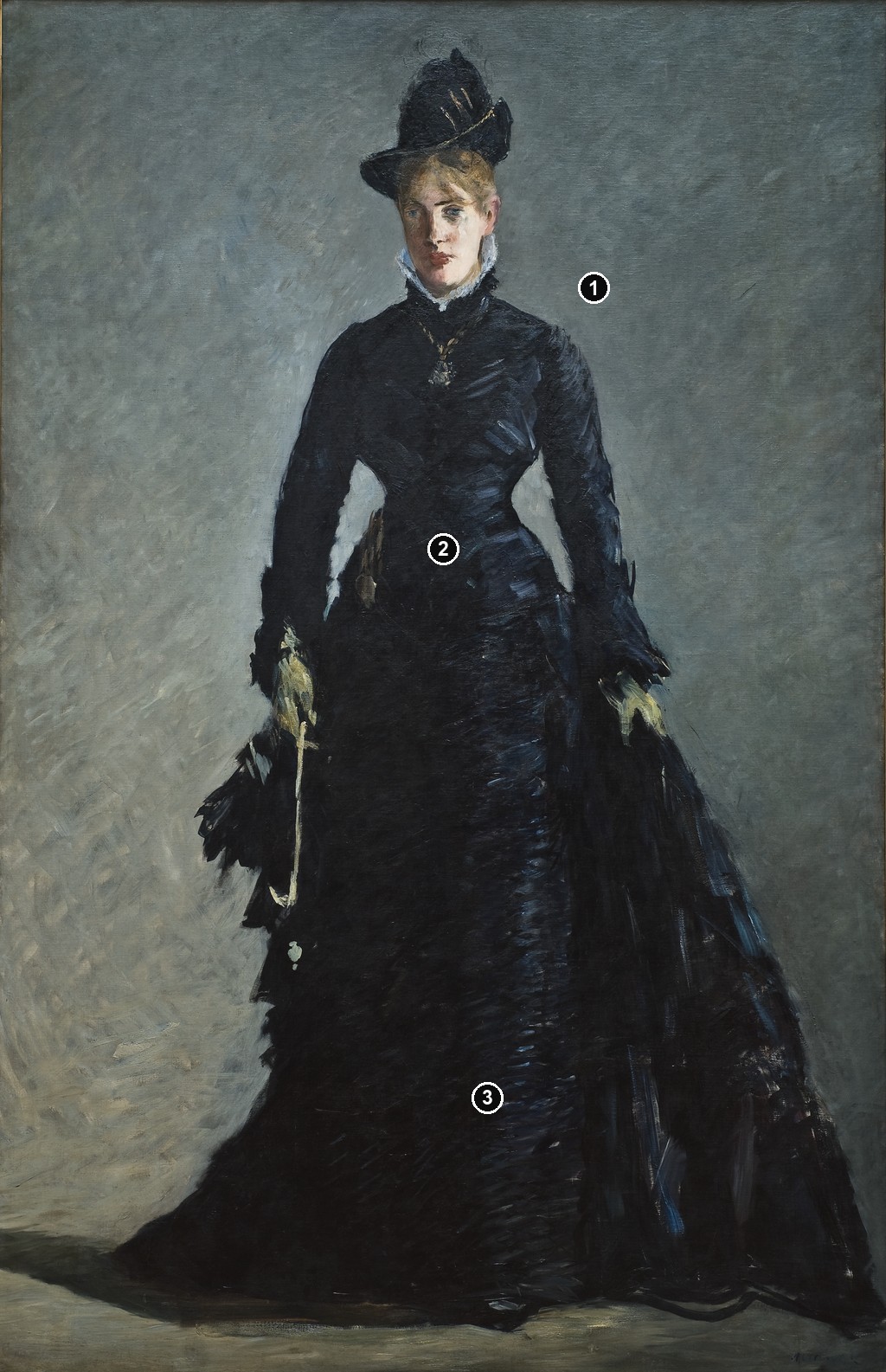
The woman stands with her head upright and her shoulders nearly square to the viewer. Her arms descend beside the fitted bodice, leaving small pale spaces between the waist and sleeves. The skirt broadens below the hips and extends outwards along the floor. This progression makes the figure narrow near the centre and expansive at the bottom, with the hat adding height above the face.
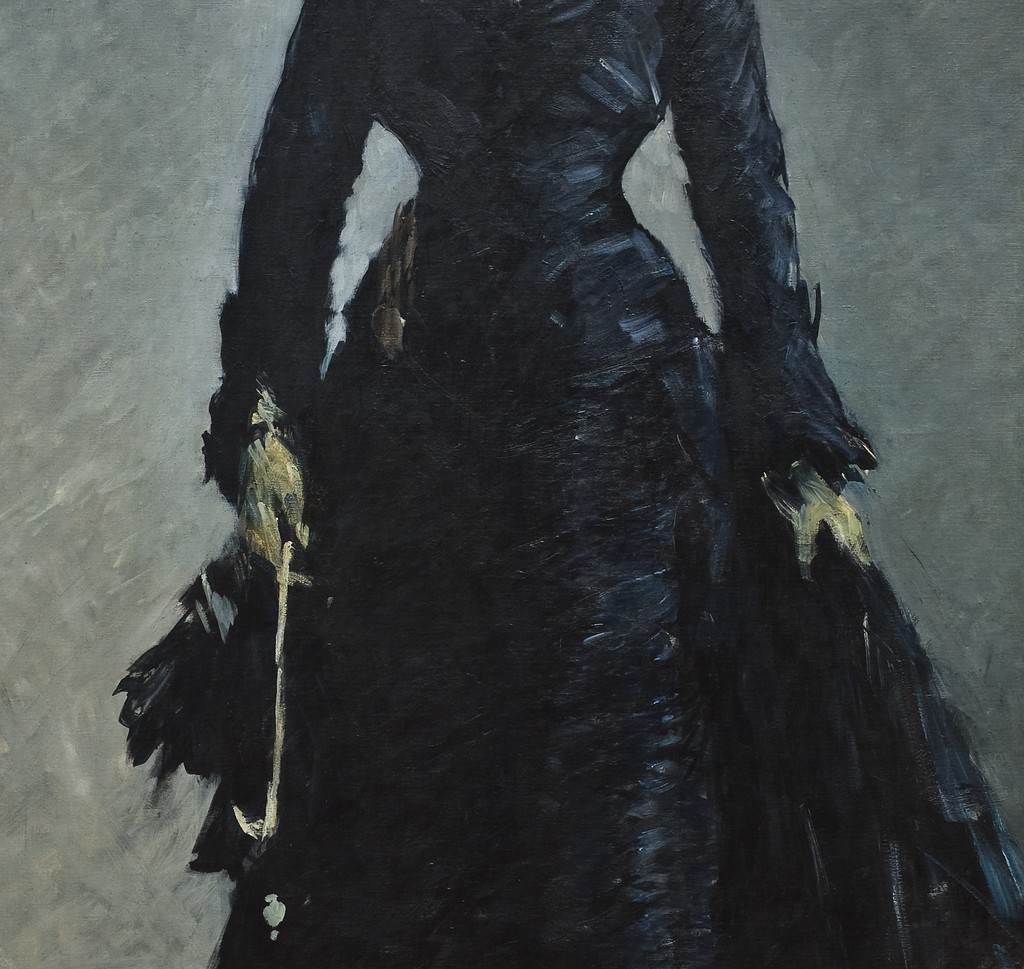
Black clothing occupies most of the painted body, but its surface contains many different degrees of light. Blue-grey strokes cross the bodice and run through the folds of the skirt. Some are short and closely spaced, while others travel further across a turning surface. Their changing directions help distinguish the front of the dress from the material gathered at the side.
The light accents are much smaller. A white frill rises around the neck, separating the face from the dark collar. A pendant hangs below it. The gloves make two pale, irregular shapes near the hips, with one hand beside a dark accessory and a hanging light loop. Each of these details becomes visible partly because so much of the surrounding clothing is dark.
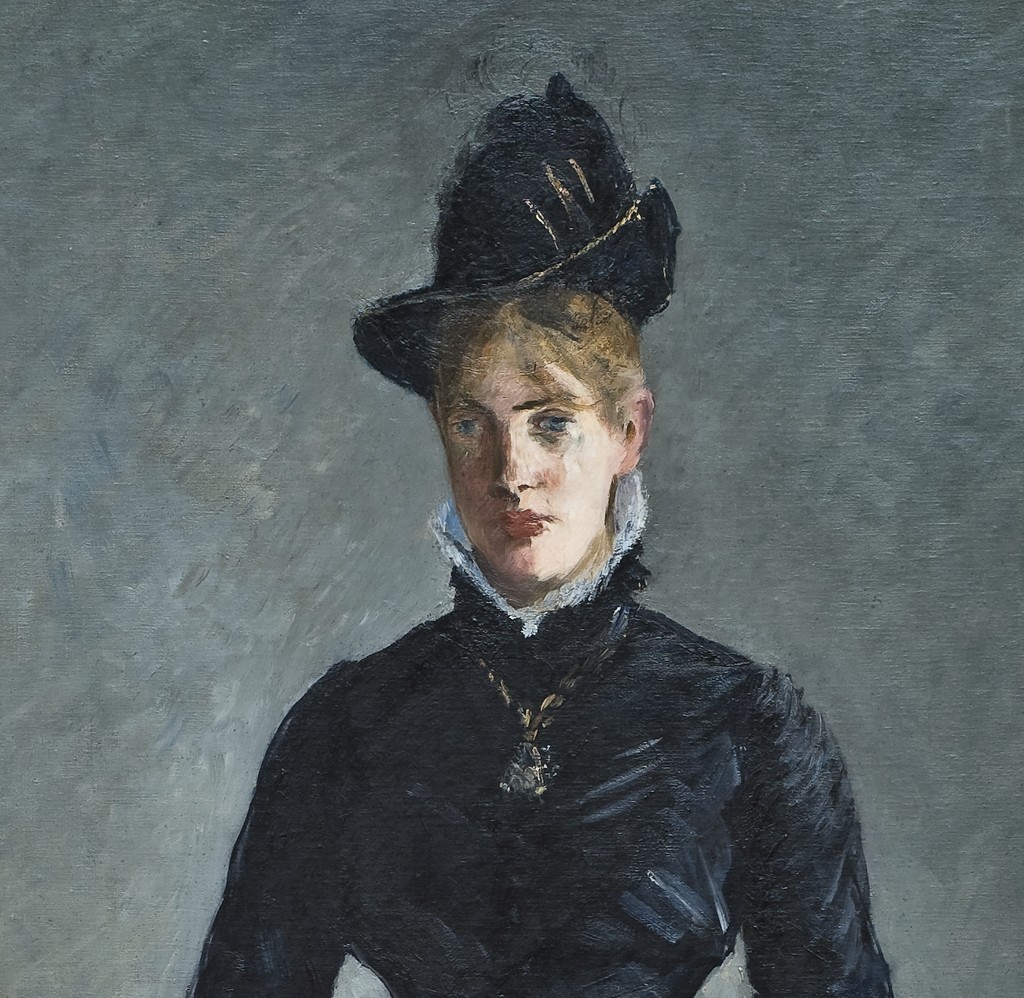
The face occupies a small area within this arrangement. The hat projects beyond it, while the white neck edge frames it from below. Manet gives the features more concentrated definition than much of the background, allowing the viewer to recognise a person while following the larger silhouette of her clothes.
Ellen Andrée and the Parisienne Role
The model is Ellen Andrée, an actress who posed for Manet. Denis Rouart and Daniel Wildenstein’s catalogue identifies her through an entry in Suzanne Manet’s account book concerning the painting’s sale in 1898.[2] The name therefore has documentary support beyond the general title. The canvas is associated with a particular model even though its title presents a broader kind of figure.
Nationalmuseum interprets the work primarily as an image of a modern Parisian woman, with dress and appearance taking an important place in the city’s consumer culture.[1] The title La Parisienne directs attention towards that public role. It invites the viewer to consider the whole presentation, from hat to hem, alongside the individual face.
The Metropolitan Museum of Art included this painting in its 2013 exhibition Impressionism, Fashion, and Modernity. Its discussion of the black dress places Ellen’s appearance among images in which dark fashionable clothing conveyed elegance.[3] Manet’s Lady with Fans, showing Nina de Callias in a different setting, also featured in that discussion.
Here, the clothes give the viewer a great deal to examine. The waist, sleeves, high neck and gathered skirt establish a carefully organised outline. Yet the surroundings supply few clues about an occasion. We cannot see a room prepared for visitors, a street she is crossing or another person whom she might address. The figure is available for close looking without being attached to a detailed sequence of events.
A Grey Setting and a Dark Hem
The background varies across the canvas rather than forming a single flat grey. Lighter passages gather beside parts of the arms and skirt, while darker areas appear towards the upper right. Broad, visible marks run through this surrounding field. They provide enough variation to keep it active without identifying a particular wall or furnishing.
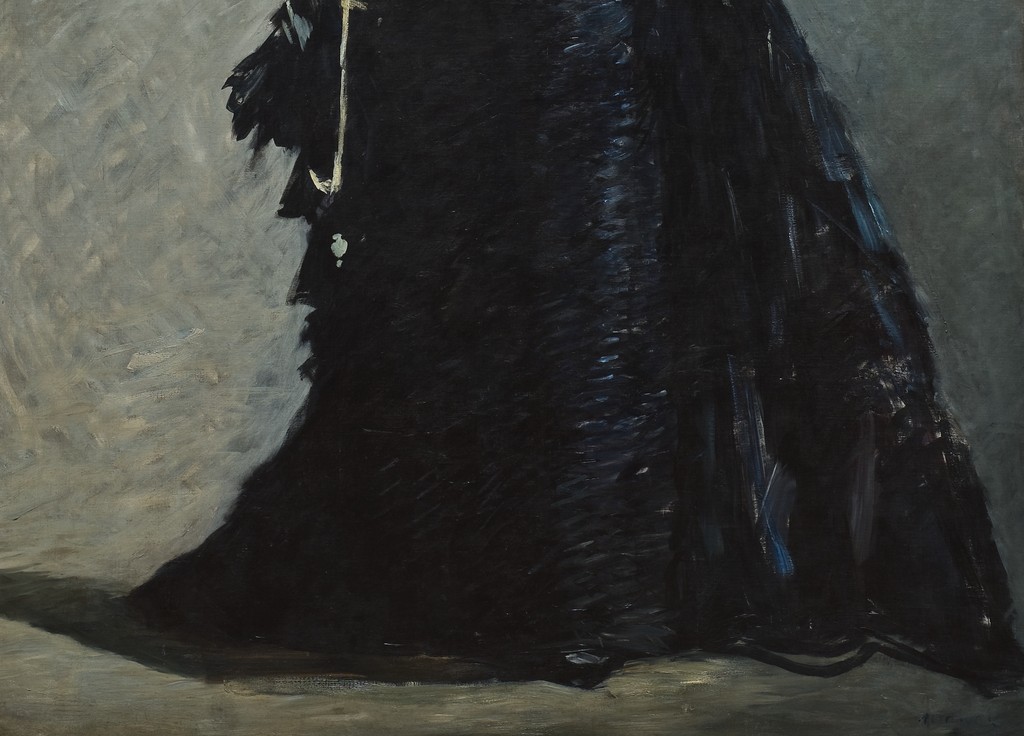
At the bottom, the hem meets a strip of ground. A dark shape extends to the left, while the dress’s broad right edge curves down towards the same level. These low, spreading forms make the figure feel planted on the surface beneath her. They also give the composition a strong horizontal ending after the long vertical movement from hat to skirt.
The difference between the plain surroundings and the detailed clothing sharpens the silhouette. The small openings beside the waist are especially effective: they let the background enter between arm and body, making the fitted middle clear. Looking from these spaces towards the hem reveals how far the dress expands.
Why the Date Is Disputed
Rouart and Wildenstein date the painting to 1875. They explain that their date follows an annotation by Léon Koëlla on a photograph taken by the photographer Lochard.[2] The Met’s 2013 exhibition likewise used an approximate date of 1875.[3]
Nationalmuseum’s current collection record, however, lists 1883.[1] It does not explain the difference from the earlier dating. These records should therefore be kept distinct: 1875 has a published catalogue argument behind it, while 1883 is the date currently supplied by the owning museum. The disagreement does not establish that Manet began the canvas in one year and completed or revised it in the other.
Renoir’s Blue Parisienne
Pierre-Auguste Renoir painted another La Parisienne in 1874. Now in Amgueddfa Cymru–Museum Wales, it shows the actress Henriette Henriot in a blue dress. It was exhibited at the first Impressionist exhibition that year.[4] This is a different model and painting from Manet’s Stockholm canvas, despite the shared title.
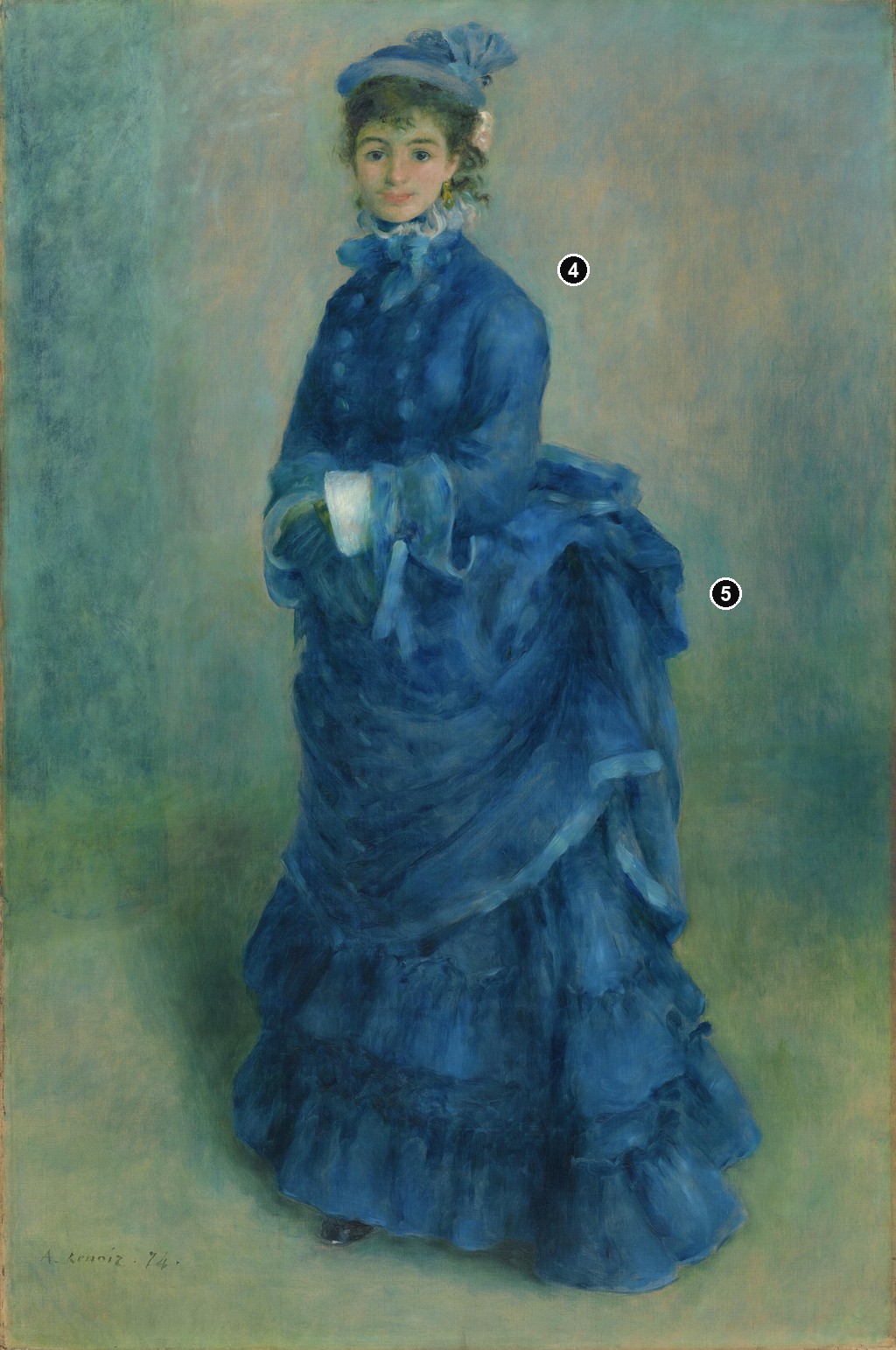
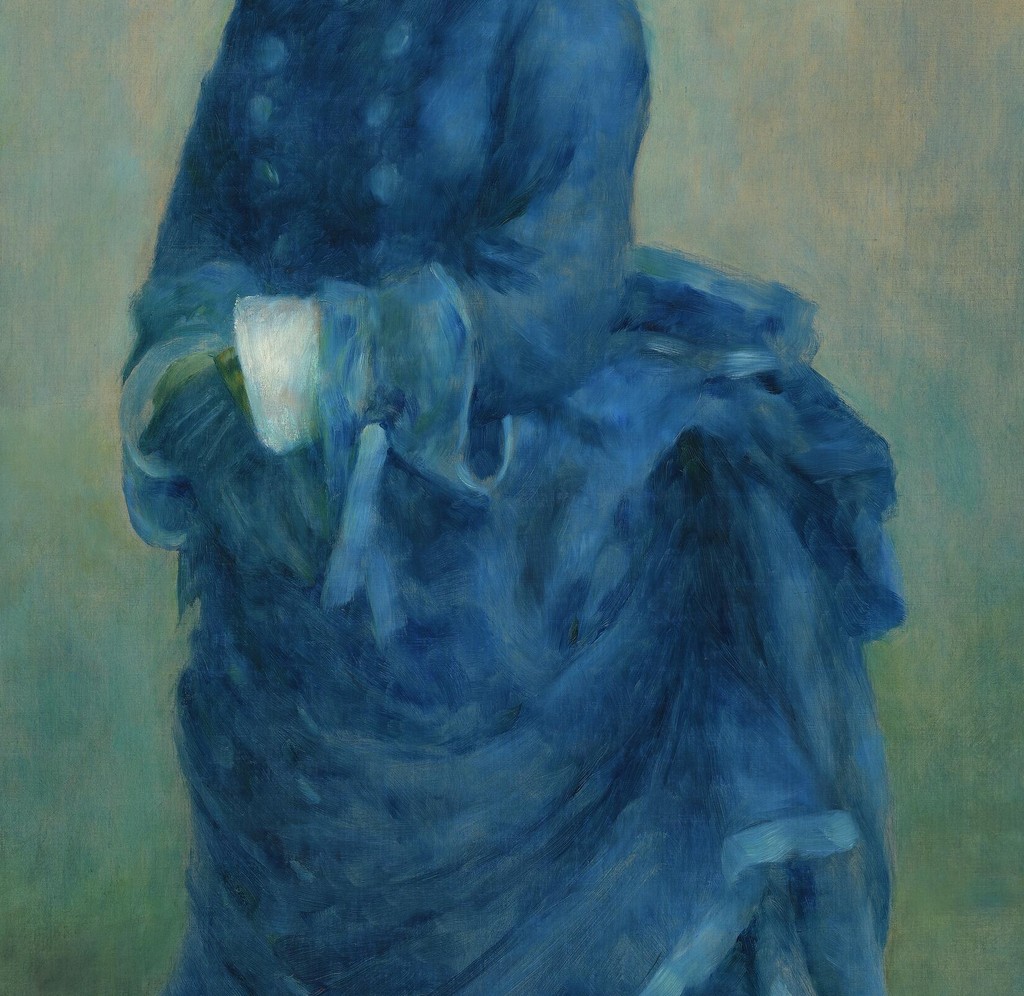
Renoir turns the body more noticeably and brings the hands together near the waist. The blue skirt gathers into large folds, with a prominent mass at the back. Pale collar and cuff accents appear within the stronger colour. Compared with Manet’s lowered arms and more frontal arrangement, the joined hands make a compact centre of activity.
The two pictures also use their surrounding space differently. Manet’s figure extends broadly across the lower edge, while Renoir leaves more room around the dress. Both, however, give relatively little information about a setting. The eye can stay with the clothing’s outline, the position of the hands and the small area occupied by the face.
Museum Wales curator Anne Pritchard connects Renoir’s relatively empty background and turned pose with the presentation of fashion plates. She also distinguishes the known model from the more general Parisian type suggested by the title.[5] That distinction offers a useful way of looking at Manet’s painting too. Ellen remains identifiable, while the tall canvas presents a complete fashionable appearance. In each work, the balance between a particular face and an extensive costume leaves room for both portraiture and a broader image of modern dress.
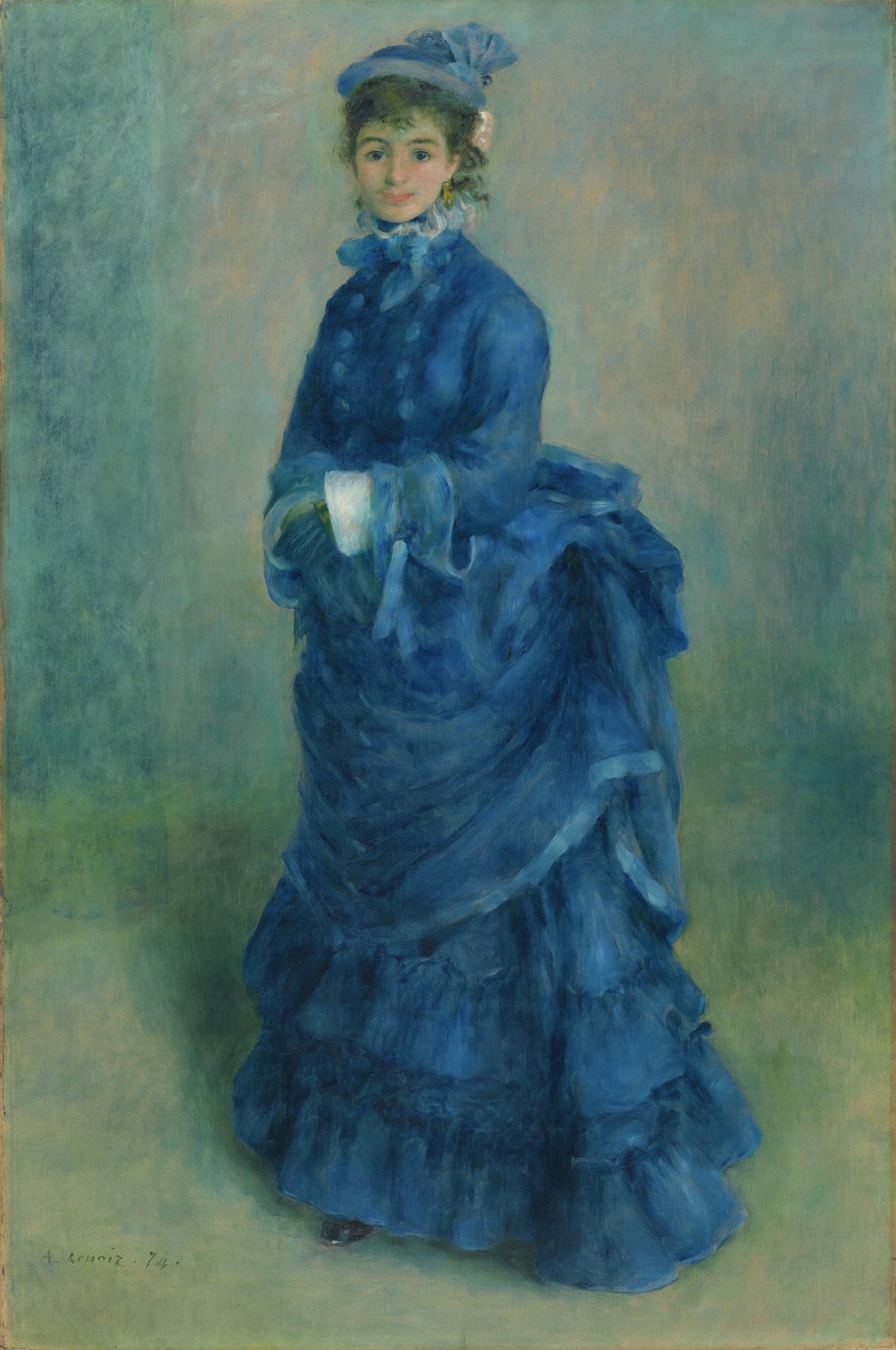
Pierre-Auguste Renoir, La Parisienne, 1874. Oil on canvas, 163.2 × 108.3 cm. Amgueddfa Cymru–Museum Wales, NMW A 2495. Model: Henriette Henriot. Amgueddfa Cymru–Museum Wales; Gwendoline Davies bequest, 1952. Image 197108 via Wikimedia Commons, CC0 1.0. Image source. CC0 / Public domain. Whole supplied reproduction resized for web display. No enlargement,recolouring or retouching.
Annotated Details from La Parisienne (Study of Ellen Andrée)
The numbered points identify visible features discussed in this article. Return from each detail to the whole composition. Each caption identifies the work shown.
La Parisienne Ellen Andree
Édouard Manet, La Parisienne (Study of Ellen Andrée). Date: 1875 in the catalogue raisonné; 1883 in the current museum record. Oil on canvas, 192 × 125 cm. Nationalmuseum, Stockholm, NM 2068. Nationalmuseum, Stockholm; consortium gift, 1917. Photo: Erik Cornelius, Nationalmuseum. Museum-supplied reproduction via Wikimedia Commons, Public Domain Mark 1.0. Image source. Public domain. Numbers added to a separate resized overview. Detail crops from the museum-supplied reproduction via Wikimedia Commons, prepared for web display; no enlargement or retouching.
Renoir La Parisienne
Pierre-Auguste Renoir, La Parisienne, 1874. Oil on canvas, 163.2 × 108.3 cm. Amgueddfa Cymru–Museum Wales, NMW A 2495. Model: Henriette Henriot. Amgueddfa Cymru–Museum Wales; Gwendoline Davies bequest, 1952. Image 197108 via Wikimedia Commons, CC0 1.0. Image source. CC0 / Public domain. Numbers added to a separate resized overview. Detail crops from the Museum Wales reproduction via Wikimedia Commons; no enlargement, recolouring or retouching.
Details from LA PARISIENNE (STUDY OF ELLEN ANDRÉE)
Follow the hat, gloves and spreading skirt in Manet’s painting, then compare the face and gathered hands in Renoir’s blue Parisienne.
La Parisienne Ellen Andree
Hat Face and White Collar
The tall dark hat rises above the pale face. The narrow white neck edge separates the head from the dark collar.
Waist Gloves and Accessory
Pale spaces beside the fitted waist separate arm and body. The light gloves and hanging loop interrupt the dark clothing.
Skirt Hem and Ground
The skirt widens across the lower canvas. Short light marks break up the dark fabric, while the hem meets a narrow strip of ground.
Renoir La Parisienne
Henriette Hat and Collar
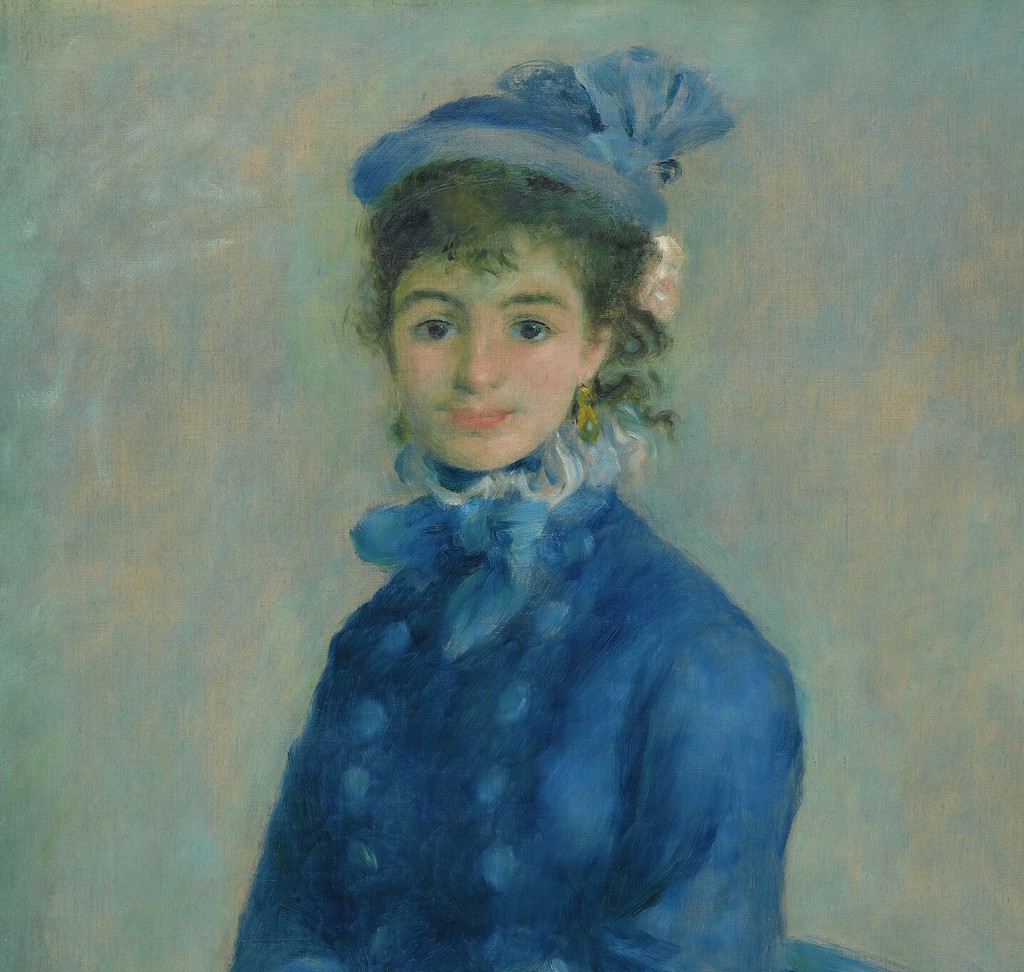
Renoir’s model, Henriette Henriot, wears a blue hat and pale collar. The face is a small focus within the surrounding blue clothing.
Gathered Hands and Blue Folds
The hands gather near the waist, beside the large folds at the back of the dress. Their compact arrangement contrasts with Ellen’s lowered arms.
From Suzanne Manet to Stockholm
The catalogue raisonné records Suzanne Manet selling La Parisienne to Paechter in Berlin on 13 June 1898. The painting subsequently belonged to Linde in Lübeck and Marczell de Nemes before reaching Stockholm in 1917.[2]
Nationalmuseum records its acquisition as a gift from a consortium comprising S. Hult, Kristoffer Hult, Ernest Thiel, Arthur Thiel and Casper Tamm.[1] Its substantial size gives the fashionable figure an imposing presence in the collection.
Artworks directory
Explore selected paintings, drawings and prints by Édouard Manet. Search by title or another recorded name.
Frequently Asked Questions
The model is Ellen Andrée. The catalogue raisonné supports the identification through a reported entry in Suzanne Manet’s account book concerning the painting’s 1898 sale.[2]
Manet’s painting belongs to Nationalmuseum, Stockholm, accession NM 2068. It entered the collection as a consortium gift in 1917.[1]
Discussion
Look again at the images and ideas explored in La Parisienne: Study of Ellen Andrée by Édouard Manet. These editorial prompts invite your observations.
Reader Insights
Follow the blue-grey marks through the bodice and skirt. Where do they suggest a change in the direction of a fold?
Look at the spaces beside the arms and around the hem. How does the surrounding grey help make the silhouette clear?
Compare the lowered arms in Manet’s painting with the gathered hands in Renoir’s. How do those different poses organise the dress and body?
Join the Conversation
Share a detail, comparison or question about La Parisienne: Study of Ellen Andrée by Édouard Manet below.
References
- Nationalmuseum, Stockholm, Parisiska / The Parisian, NM2068, current object record and expanded description, including its 1883 date and 1917 gift. Swedish. View source.
- Denis Rouart and Daniel Wildenstein, Édouard Manet: Catalogue raisonné, tome I, 1975, p.196, entry236; p.197, corresponding plate. French. View source.
- The Metropolitan Museum of Art, “Galleries Three and Four—The White Dress and the Black Dress”, Impressionism, Fashion, and Modernity, 2013, black-dress discussion and Parisienne caption. View source.
- Amgueddfa Cymru–Museum Wales, La Parisienne, Pierre-Auguste Renoir, NMW A2495, current object record and commentary. View source.
- Anne Pritchard, Pierre-Auguste Renoir, La Parisienne, Open Arts Archive, complete two-page film transcript, especially the empty background, fashion-plate comparison and named model. View source.
- Splash image, Édouard Manet, La Parisienne (Study of Ellen Andrée). Date: 1875 in the catalogue raisonné; 1883 in the current museum record. Oil on canvas, 192 × 125 cm. Nationalmuseum, Stockholm, NM 2068. Nationalmuseum, Stockholm; consortium gift, 1917. Photo: Erik Cornelius, Nationalmuseum. Museum-supplied reproduction via Wikimedia Commons, Public Domain Mark 1.0. Image source. Public domain. Whole supplied reproduction prepared for web display. No enlargement or retouching.


