


 by Tom Gurney
Tom Gurney BSc (Hons) is an art history expert with over 20 years experience
Published on June 19, 2020 / Updated on October 30, 2026
Email: tomgurney1@gmail.com / Phone: +44 7429 011000
Portrait of Antonin Proust by Édouard Manet: Introduction
Antonin Proust stands with one hand on his hip, a top hat above his grey beard and a yellow glove hanging beside his cane. His clothes suggest a man prepared to appear in public, yet the uneven brushwork keeps the encounter lively. Manet’s portrait, dated 1880 by the Toledo Museum of Art, turns a longtime friend into a striking example of modern masculine elegance.[1]
Its apparent ease was difficult to achieve. Proust’s recollections describe discarded attempts, unfinished hands and an artist intensely concerned about the picture’s presentation.
At a Glance
- ArtistÉdouard Manet
- TitleAntonin Proust
- Date1880
- MediumOil on canvas
- Dimensions129.5 × 95.9 cm
- CollectionToledo Museum of Art, Ohio
- Accession1925.108
- CreditGift of Edward Drummond Libbey.[1]
This work across Édouard Manet’s career
Contents
- A Friend in Public Life
- Dark Clothes and Coloured Paint
- Hands and Gloves
- Beginning Again
- The Portrait at the Salon
- A Frame and Space around the Picture
- Another Portrait of Proust
- Annotated details
A Friend in Public Life
Proust was a journalist and politician as well as Manet’s childhood companion and fellow art student.[1] Their friendship gave the portrait a personal basis, but the sitter’s appearance also belongs to the public world in which he worked. The upright figure, formal coat and carefully arranged accessories make an impression before any knowledge of their shared history is required.
In the Getty’s exhibition commentary, curator Scott Allan connects Proust’s presentation with the conventions of political portraiture. He also proposes that the fashionable sitter can be read as a counterpart to Manet himself.[2] That interpretation gives the elegant clothes a particular interest: one friend presents another through a social manner that the painter also understood and cultivated.
The figure nevertheless remains an individual presence. Proust’s eyes look towards the viewer beneath the projecting brim. His moustache stretches across the face, while the beard spreads into a softer, paler mass below. Small changes in the handling of these features prevent the formal costume from becoming the portrait’s only subject.
Dark Clothes and Coloured Paint
The coat occupies much of the canvas, but its darkness is far from uniform. Blue passages mark the sleeves, lapels and front of the garment. Some edges are firm enough to describe tailoring, while others dissolve into neighbouring dark strokes. The painter distinguishes folds and changes of direction without modelling every part to the same degree.
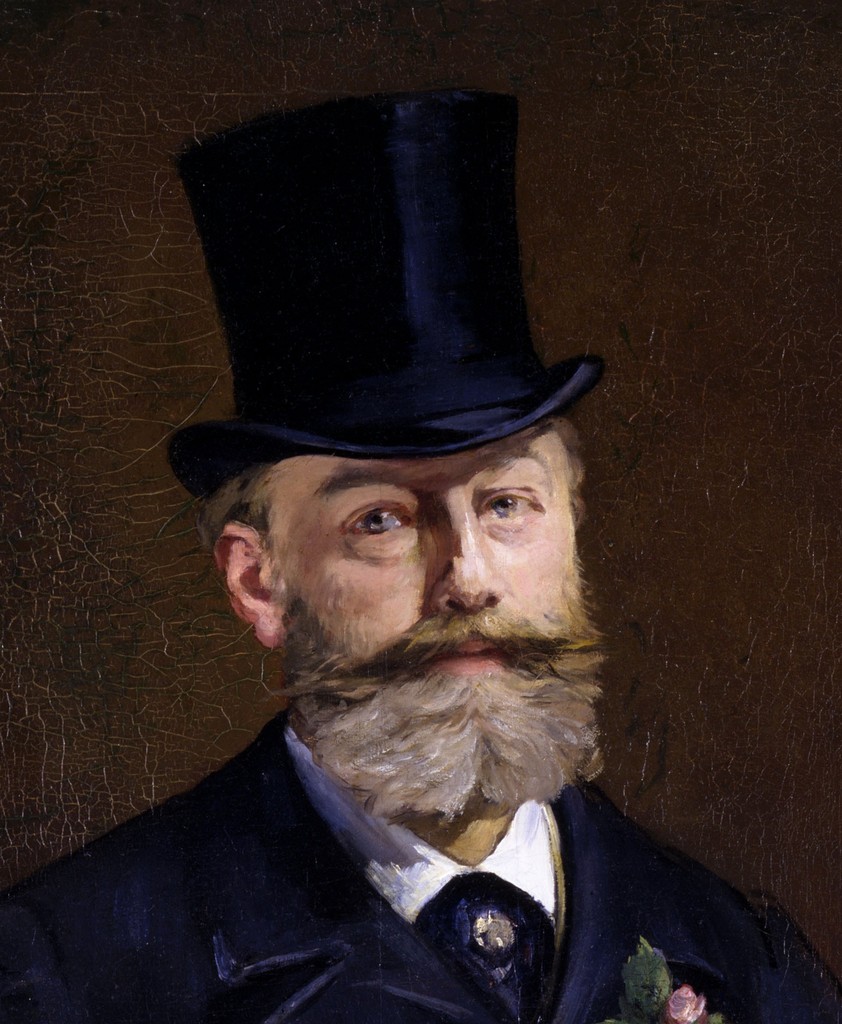
The hat makes these variations particularly conspicuous. Its high crown rises as a dark block against the brown ground, yet a blue band of light gives it a rounded surface. The brim tilts across the forehead. Its projecting curve links the solid shape above with the more closely described eyes beneath.
Smaller accents interrupt the clothes. A white collar catches the light under the beard; a pale handkerchief appears against the chest; a pink flower and green leaves brighten the lapel. These touches have different textures and sizes. Together they keep the broad dark figure from settling into one continuous silhouette.
The background supplies comparatively little information about a room. Brown tones surround the sitter without giving him an elaborate setting. Against that quiet field, the lifted elbow and the outward movement of the other arm become especially clear. Proust’s presence depends on the arrangement of the body and its accessories rather than on a furnished environment explaining his profession.

Édouard Manet, Antonin Proust, 1880. Oil on canvas, 129.5 × 95.9 cm. Toledo Museum of Art, 1925.108. Gift of Edward Drummond Libbey. Toledo Museum of Art / Google Art Project via Wikimedia Commons. Image source. Public domain. Whole supplied reproduction resized within native dimensions; no enlargement, retouching or colour alteration.
Hands and Gloves
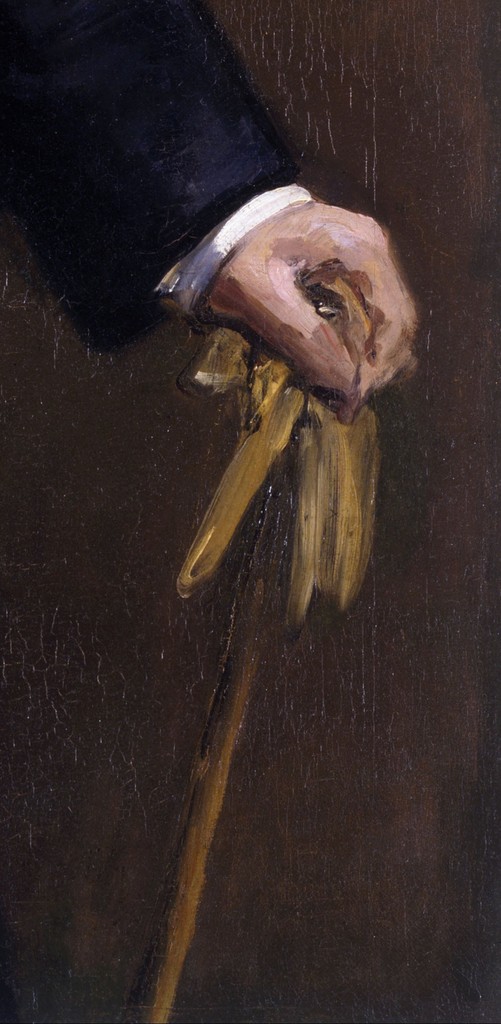
The two hands perform different tasks. The gloved hand at the viewer’s left rests against the hip, its spread fingers making a pale shape across the coat. On the right, the bare hand holds the other glove beside the cane. The hanging fingers of the empty glove extend the gesture downwards, while the cane continues towards the bottom edge.
This contrast gives the pose much of its character. One arm establishes a firm bend; the other opens the figure towards the surrounding space. The repeated yellow of the gloves connects the two sides without making their actions identical. The accessories contribute to the sitter’s bearing as well as to the picture’s distribution of colour.
A letter reproduced by Proust recalls Manet’s quick treatment of the glove held by the bare hand. Proust had asked him, in a new English translation, “Please, not a stroke more.” Manet describes their agreement as a moment of affection between them.[3] A seemingly minor passage of paint thus becomes part of the friendship represented in the larger portrait.
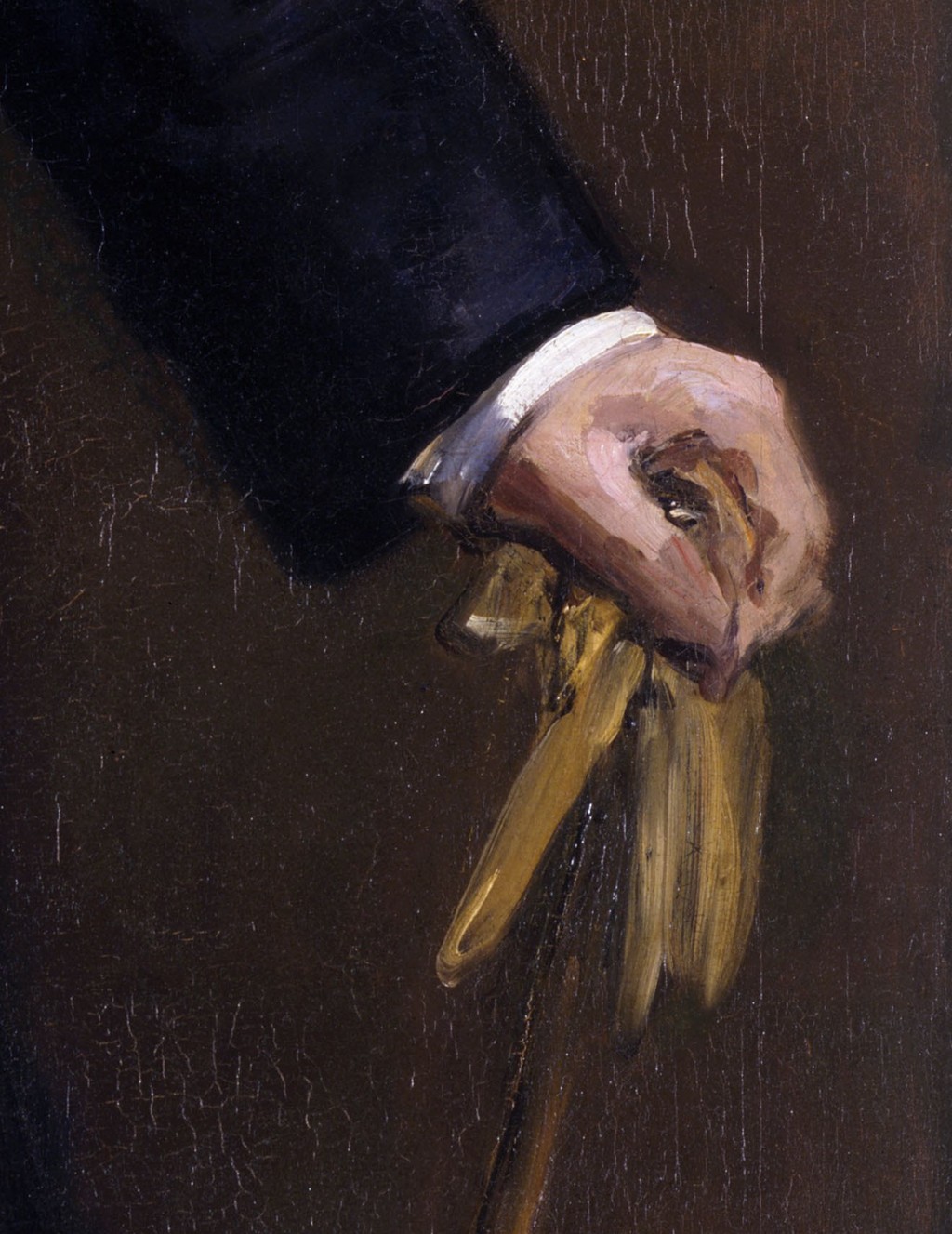
Detail of Édouard Manet’s Antonin Proust, 1880: the bare hand, hanging glove and cane. Toledo Museum of Art, 1925.108. Toledo Museum of Art / Google Art Project via Wikimedia Commons. Image source. Public domain. Detail cropped from the native reproduction; no retouching or colour alteration.
Beginning Again
Proust’s account places the portrait beside Manet’s work on Chez le Père Lathuille. He remembers the painter wanting to achieve a portrait in a single sitting, but also says that seven or eight canvases were used before the successful attempt. Even then, the hands and parts of the background remained to be completed.[3]
The two parts of that recollection belong together. A desired effect of directness could follow several unsuccessful starts, and a decisive passage could still leave other areas unresolved. Proust’s description makes the achievement of the figure an event within a longer process, rather than a guarantee that the whole painting was finished without interruption.
Sarah Herring’s National Gallery catalogue discussion also cites these repeated attempts when considering Manet’s pursuit of spontaneity.[4] The appearance of a first response was something he worked to obtain. It need not tell the viewer how many sittings, rejected canvases or later adjustments lay behind a finished portrait.
Proust’s phrase about an unprepared white canvas belongs to his remembered description of Manet’s intention.[3] It is distinct from a material examination of the surviving painting. The useful point here is the ambition for a fresh beginning: an image that would retain the energy of encountering the sitter, however demanding the effort to arrive at it.
The Portrait at the Salon
The painting appeared at the Salon of 1880. Toledo’s account describes a divided response, with some viewers objecting to its casual handling and others admiring the strength of the paintwork.[1] Its polished costume and conspicuous brush marks offered different kinds of finish within the same image.
Proust’s memoir preserves a similarly uneven experience of recognition. A letter from Manet complains that the portrait had been placed awkwardly near a door and judged unfairly. He then turns from its public reception to the difficulty of concentrating a painting’s interest on a single figure while keeping that figure alive and substantial.[3]
The complaint identifies a practical problem visible in the canvas. Proust has no companion with whom to exchange a glance or gesture. His head, stance, clothing and hands must sustain the encounter by themselves. The space around him is therefore active even though it contains few objects: it allows each outward movement of his body to register.
Proust also reproduces encouraging messages from Antoine Guillemet and Théodore Duret. Duret praises the pose and the combination of firmness with supple handling.[3] These responses show that Manet’s disappointment did not mean an absence of admiration. The same portrait could attract support from friends while leaving the painter dissatisfied with its official presentation.
A Frame and Space around the Picture
Framing mattered strongly in Proust’s recollection of the studio. After the portrait had taken shape, Manet turned it away and wanted it framed before showing it. Proust recalls him insisting on the frame’s effect while acknowledging that a gloved hand still needed a few touches.[3]
That episode connects completion with presentation. The painting was more than an isolated surface awaiting its last mark. Its boundary and setting would affect how the sitter emerged from the background and how the portrait met another viewer.
The letter printed in the memoir extends this concern to museum display. Manet objects to pictures being crowded together without space between their frames.[3] Read beside his complaint about the Salon hanging, the remark expresses a wish for the portrait to be encountered with room around it. It gives the figure’s painted independence a counterpart in the conditions under which the canvas might be seen.
Another Portrait of Proust
Manet also painted a different, larger portrait of Proust, dated 1881 in the Musée Fabre’s record. It measures 183 × 110.5 cm and is recorded there as a French State deposit, inventory D52.2.1, MNR 135.[5] It should be distinguished from Toledo’s 1880 canvas.
In the Montpellier picture, Proust stands at full length with his hat lowered beside him. Pale trousers occupy a substantial part of the composition, and the head is uncovered. These changes alter the balance between dark clothing and light areas. The comparison shows how the same sitter could support another arrangement, rather than making every image of Proust a version of the same pose.
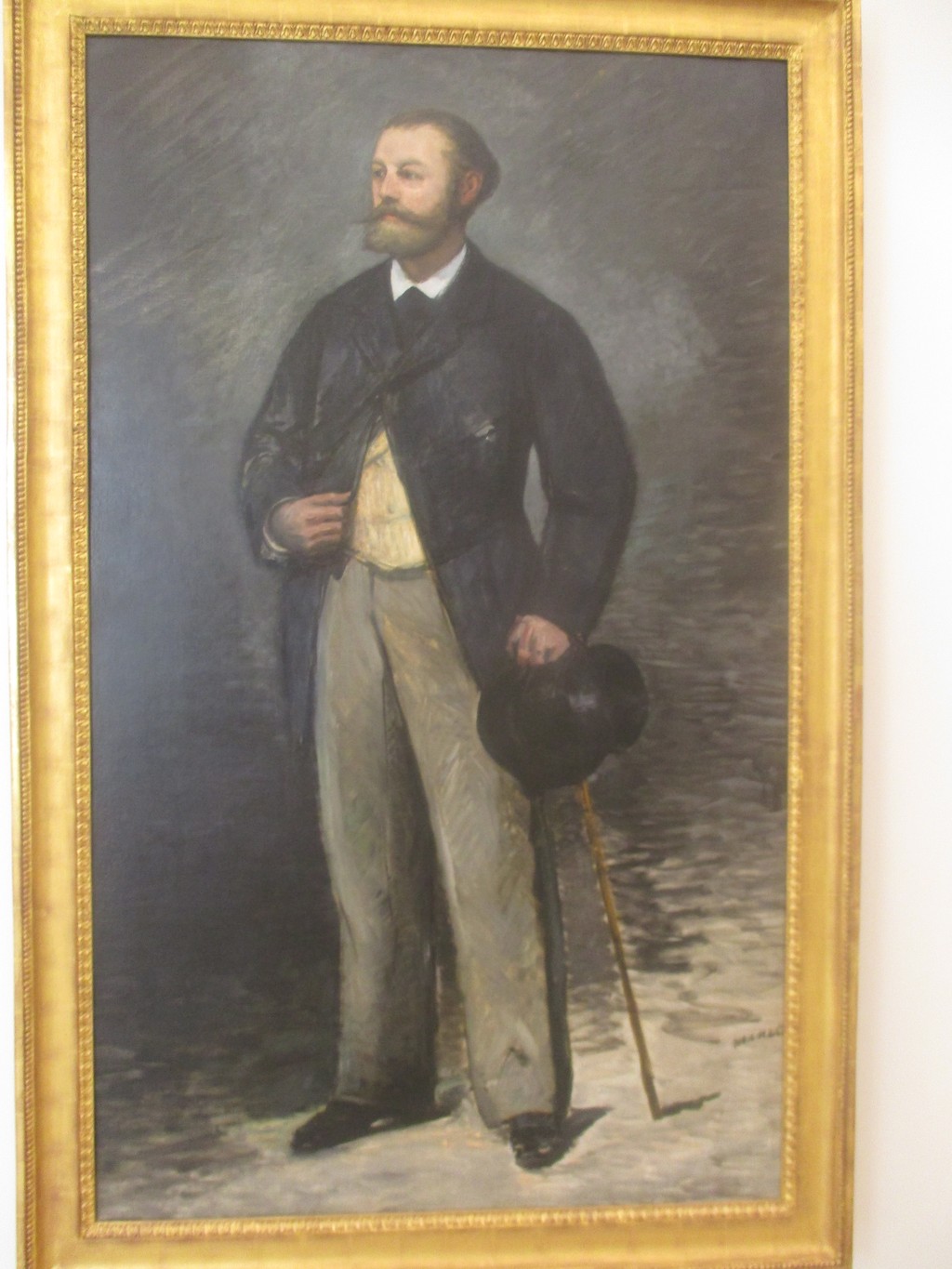
Édouard Manet, Portrait of Antonin Proust, 1881. Musée Fabre, Montpellier, D52.2.1, MNR 135; French State deposit. Framed photographic view of this separate painting. Photograph by Thomon, 9 June 2017 / Wikimedia Commons, CC BY-SA 4.0. Image source. CC BY-SA 4.0. Photograph resized; full provided framed view retained.
Annotated Details from Antonin Proust: Hat, Hands and Cane
The numbered points identify visible features discussed in this article. Return from each detail to the whole composition. Édouard Manet, Antonin Proust, 1880. Oil on canvas, 129.5 × 95.9 cm. Toledo Museum of Art, 1925.108. Gift of Edward Drummond Libbey. Toledo Museum of Art / Google Art Project via Wikimedia Commons. Image source. Public domain. Numbers added to a separate resized whole supplied overview. Detail crops from the unchanged original; no enlargement, retouching or colour alteration.
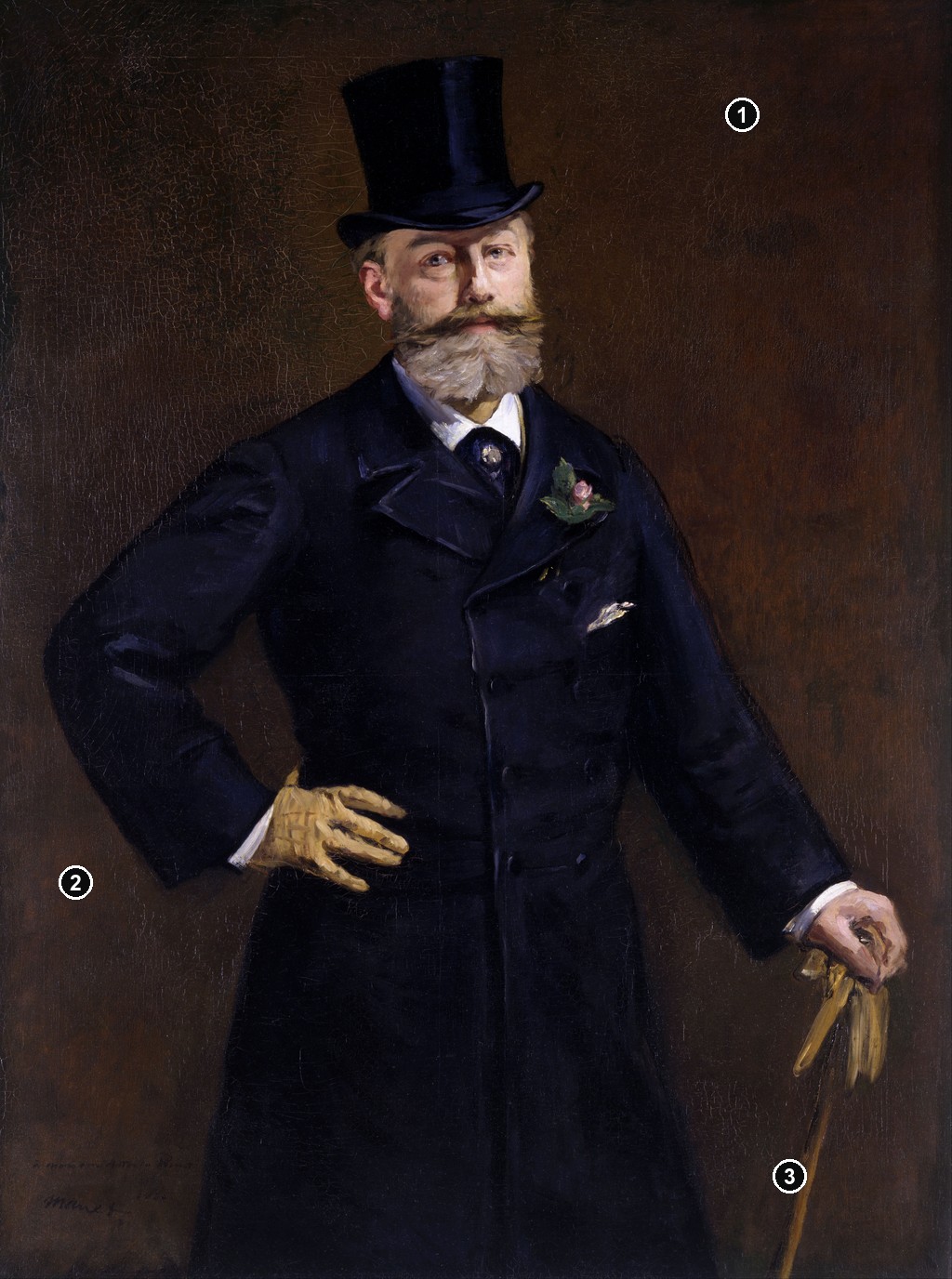
Details from ANTONIN PROUST: HAT, HANDS AND CANE
Move from the hat and face to the gloved hand and the bare hand holding a glove beside the cane.
Top Hat, Face and Beard
The tall black hat sits above the outward-looking face and spreading beard.
Gloved Hand and Dark Coat
The gloved hand presses against the dark coat, giving the elbow a sharp outward angle.
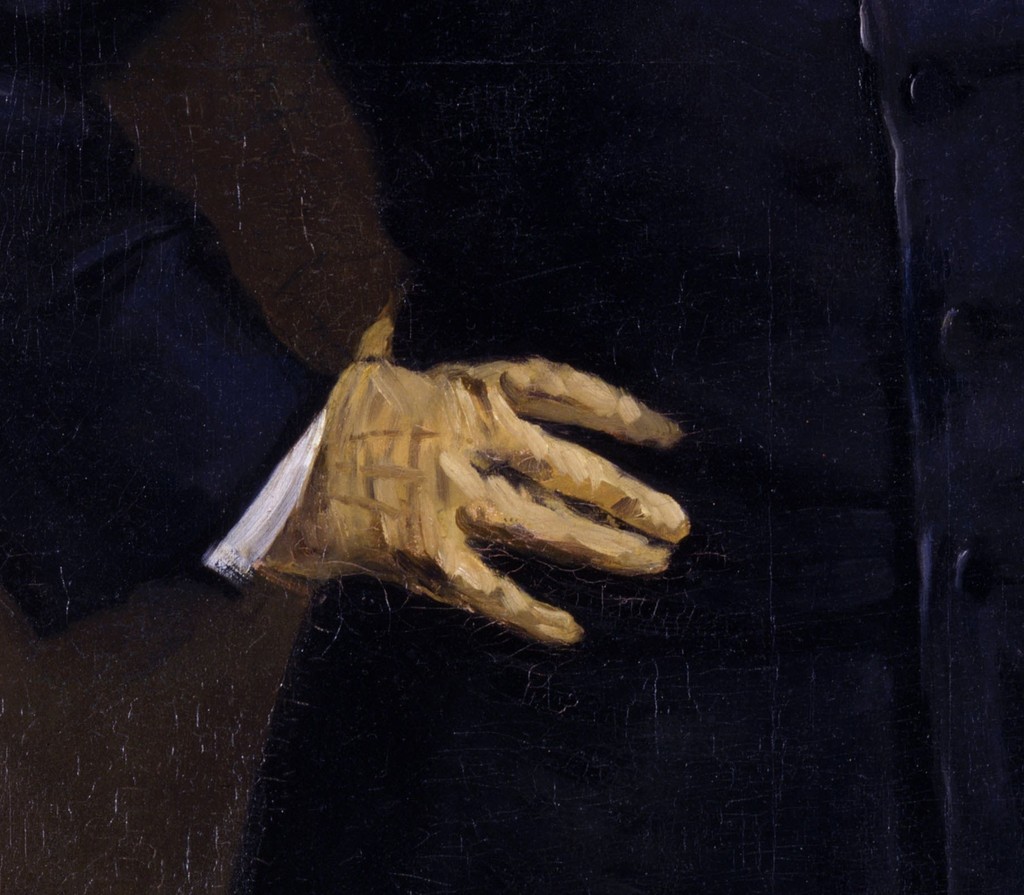
Bare Hand, Hanging Glove and Cane
The bare hand holds the hanging glove beside the cane, whose lower end meets the original picture edge.
Artworks directory
Explore selected paintings, drawings and prints by Édouard Manet. Search by title or another recorded name.
Frequently Asked Questions
Proust remembers that ambition, but also describes seven or eight canvases before a successful attempt and further work on the hands and background.[3]
Discussion
Look again at the images and ideas explored in Portrait of Antonin Proust by Édouard Manet. These editorial prompts invite your observations.
Reader Insights
Compare the gloved hand on the hip with the bare hand holding the other glove. How does each contribute to the pose?
Follow the blue passages through the hat and coat. Where do they give a dark shape volume or separate one part from another?
Consider Manet’s concern with the frame and the Salon hanging. How might the space around a portrait change its effect?
Join the Conversation
Share a detail, comparison or question about Portrait of Antonin Proust by Édouard Manet below.
References
- Toledo Museum of Art, Antonin Proust, 1880, accession 1925.108; collection details and label text (in English). View source.
- J. Paul Getty Museum, Manet and Modern Beauty, GettyGuide stop 1005, Antonin Proust; transcript with curator Scott Allan and narrator (in English). View source.
- Antonin Proust, Édouard Manet, Souvenirs, 1913 edition, pp. 100–103 and plate 26, PDF pp. 160–163 and 166; recollections and reproduced letters (in French). View source.
- Sarah Herring, with technical contributions by Hayley Tomlinson, Catherine Higgitt and Marika Spring, Eva Gonzalès, National Gallery catalogue entry, 2024, Process section and note 21; Proust’s repeated portrait attempts (in English). View source.
- Musée Fabre, Portrait d’Antonin Proust, 1881, D52.2.1, MNR 135; dimensions, deposit status and commentary (in French). View source.
- Splash image, Édouard Manet, Antonin Proust, 1880. Oil on canvas, 129.5 × 95.9 cm. Toledo Museum of Art, 1925.108. Gift of Edward Drummond Libbey. Toledo Museum of Art / Google Art Project via Wikimedia Commons. Image source. Public domain. Whole supplied reproduction resized within native dimensions; no enlargement, retouching or colour alteration.


