



 by Tom Gurney
Tom Gurney BSc (Hons) is an art history expert with over 20 years experience
Published on June 19, 2020 / Updated on October 30, 2026
Email: tomgurney1@gmail.com / Phone: +44 7429 011000
Portrait of Jeanne Duval by Édouard Manet: Introduction
A white dress spreads across almost the entire width of the sofa. Above it, a woman’s dark-haired head rises near the right side of the canvas. One hand extends towards a lace curtain; a small black shoe projects from the pale fabric below. Manet gives these separated details room to register against the extraordinary breadth of the skirt.
Painted in 1862, the work is known as Lady with a Fan and traditionally identified as a portrait of Jeanne Duval, the actress and long-term companion of Charles Baudelaire. It belongs to the Museum of Fine Arts in Budapest.[1] The painting offers a striking encounter with a particular figure, while the name attached to it opens a more complicated history of poetry, portraiture and identification.
At a Glance
- ArtistÉdouard Manet
- Date1862
- Other titlesLady with a Fan; Baudelaire’s Mistress, Reclining.[2]
- SitterTraditionally identified as Jeanne Duval
- MediumOil on canvas
- Dimensions89.5 × 113 cm, height × width
- CollectionMuseum of Fine Arts, Budapest
- Inventory number368.B.[1]
This work across Édouard Manet’s career
Contents
- The Dress across the Sofa
- A Head, an Extended Hand and a Fan
- Green Upholstery and Translucent Lace
- Jeanne Duval beyond the Poet’s Description
- What Recent Photographic Research Adds
- Pose and Biographical Interpretation
- The Separate Watercolour in Bremen
- Annotated details
The Dress across the Sofa
The skirt supplies the painting’s largest shape. It rises near the waist at our right, then expands across the centre and falls in broad curves towards the left. Its lower edge reaches almost to the bottom of the canvas. The woman’s body is largely concealed within that spreading volume, whose contours establish the reclining pose.
The fabric is much more varied than the word white suggests. Pale blue streaks run down the bodice and across the skirt. Grey shadows deepen along folds, while warmer cream and yellowish touches interrupt the cooler passages. Some strokes follow the apparent direction of the cloth; others sit conspicuously on its surface.
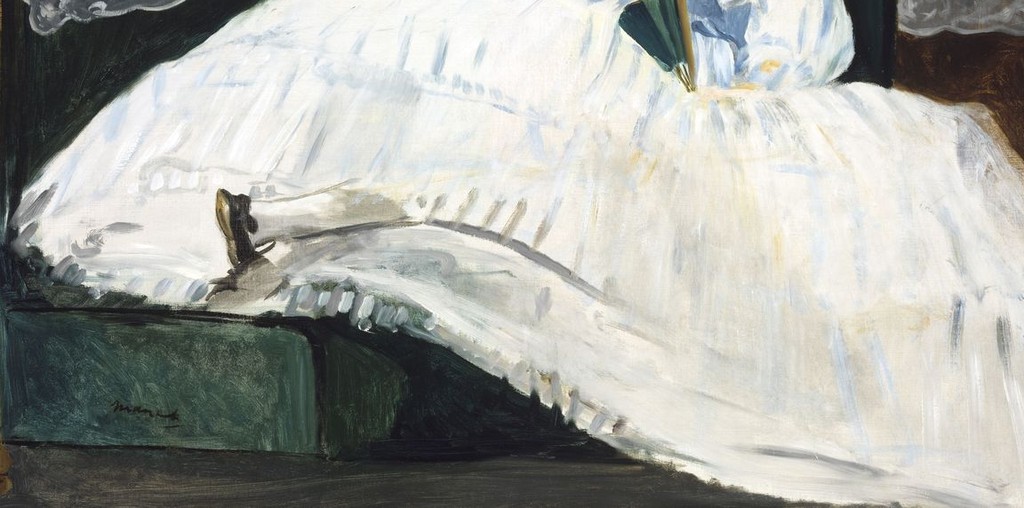
Near the lower left, the hem bends over a darker underlayer. Short pale marks pick out an irregular edge, with a deeper grey area above and behind the projecting shoe. The combination gives the skirt weight. It seems to rest and gather across the furniture, even where its broadest light areas have been described with remarkable economy.
At the right, the sleeve swells outward before narrowing towards the wrist. Blue-grey strokes separate it from the main body of the dress. The dark-edged neckline and small warm ornament below the throat help distinguish the bodice from the much larger skirt.
The museum describes the garment as a crinoline, emphasising its enormous extent.[1] Fashion supplies Manet with an unusually expansive surface to paint. The clothing establishes the figure’s appearance, but it also determines how the viewer moves across the canvas: along stripes, over the rounded skirt and down to the small interruption of the shoe.
A Head, an Extended Hand and a Fan
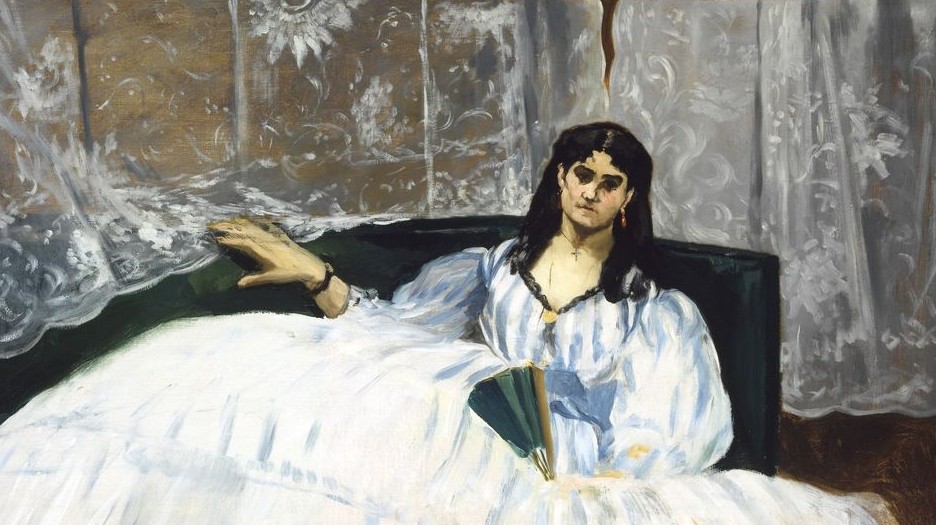
The head occupies a dark opening between hair, sofa and curtain. Long strands fall towards the shoulders, while shorter shapes cross the forehead. Shadow gathers around the eyes and beneath the cheekbones. The mouth is closed, and the head tilts slightly away from the more upright lines behind it.
Manet’s handling gives the face a firm presence without describing every feature equally. A few warm and dark touches establish the nose, mouth and eyes. The lighter skin is framed by hair, while the dark neckline leads down towards the pale bodice. Small earrings and a fine cross at the upper chest add concentrated details near the head.
Her right arm stretches along the sofa towards our left. The hand lies close to the curtain’s lower edge, its long fingers extending almost horizontally. A dark band at the wrist separates hand from sleeve. This gesture lengthens the figure beyond the compact grouping of head and torso.
The other hand is near the fan at her waist. Its dark green-blue leaves spread into a small, partly opened wedge, with narrow golden-brown sticks visible along the edge. Set against the pale dress, the fan gives the eye a sharply bounded object to examine among the broader fabric strokes.
The shoe makes another compact dark accent. Its small size is striking beside the skirt that surrounds it, and its position helps us understand that the reclining body continues towards the left. Head, hand, fan and shoe punctuate the great light area at different heights and distances.
These details can be observed closely without settling the woman’s state of mind. Her expression has often drawn strongly emotional readings, but the painting offers no action or exchange that would make one private feeling certain. Its force rests partly in the contrast between the figure’s stillness and the restless movement of the surfaces around her.
Green Upholstery and Translucent Lace
The sofa is deep green, with darker passages beneath the skirt and behind the shoulders. A curved upper edge runs towards the extended hand. Below, a rectangular section of its front remains visible at our left, carrying Manet’s signature low on the upholstery.
The green provides an essential boundary for the white clothing. It follows the skirt around the left side, then reappears in smaller areas near the torso. These interruptions make the pale fabric easier to read as a substantial form occupying a piece of furniture.
Above it, the lace curtain offers a second way of painting white. Its pale patterns are broken by darker areas through which the window and warmer background remain visible. Long vertical folds descend from the top, while the scalloped lower edge curves across the sofa.
The distinction between curtain and dress is particularly revealing. The skirt gathers into large, comparatively opaque masses; the curtain spreads light marks over a darker field. In one, pale paint establishes the bulk of fabric. In the other, it suggests a patterned material that lets light and colour through.
The curtain also connects several parts of the composition. Its descending folds frame the head, its lower curve approaches the outstretched hand, and its repeated ornament carries the eye towards the left border. Small curls and flowers keep that broad background active without introducing another figure or a separate narrative.
Warm brown and ochre behind the lace prevent the painting from becoming only an opposition of black and white. Those subdued colours sit beside the sofa’s green and the dress’s blue-grey shadows. The apparent simplicity of the palette depends on many such differences within its large areas.
Annotated Details from Lady with a Fan: Dress, Hand and Green Sofa
The numbered points identify visible features discussed in this article. Return from each detail to the whole composition. Édouard Manet, Lady with a Fan, traditionally identified as Portrait of Jeanne Duval, 1862. Museum of Fine Arts, Budapest, 368.B. Museum of Fine Arts, Budapest; reproduction via Wikimedia Commons. Image source. Public domain. Numbers added to a separate resized whole provided overview. Detail crops from the immutable original; no enlargement, retouching or colour alteration.
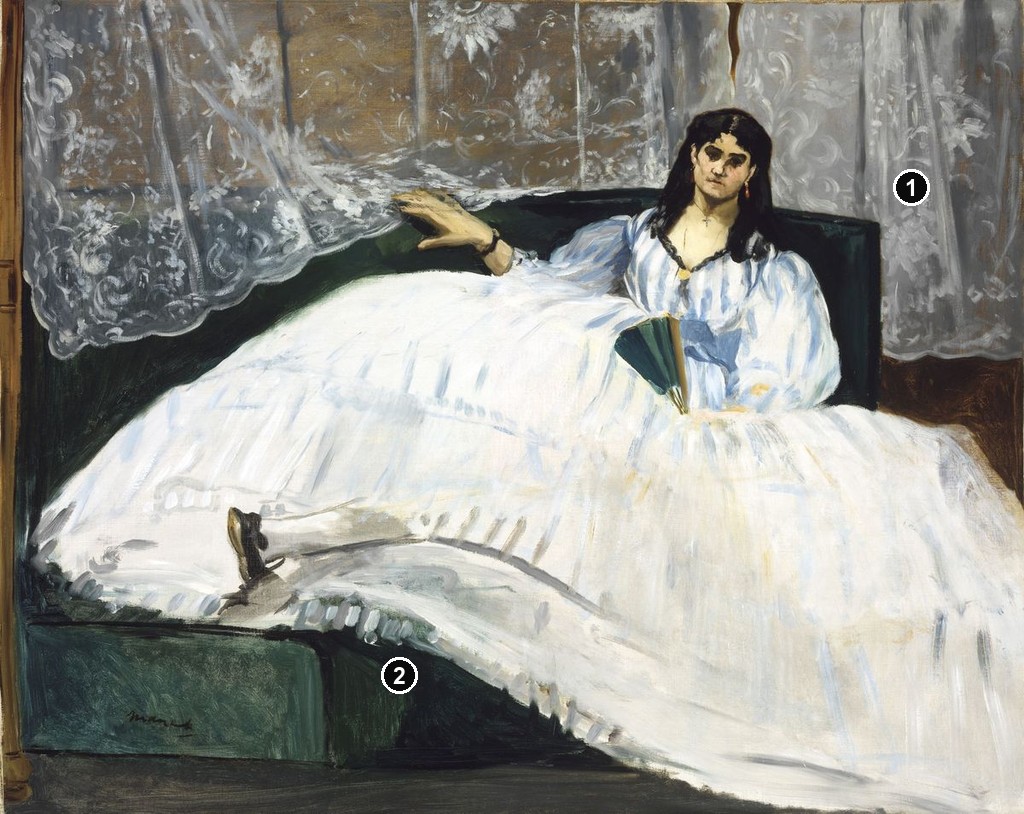
Details from LADY WITH A FAN: DRESS, HAND AND GREEN SOFA
Compare the head, extended hand and fan with the spreading white skirt, small black shoe and dark green sofa. The sitter is traditionally identified as Jeanne Duval.
Head, Extended Hand and Fan
The dark-haired head and extended hand sit above the spreading dress, with the fan opening against the pale fabric.
White Skirt, Black Shoe and Green Sofa
A small black shoe interrupts the broad pale skirt, whose lower folds lie across the dark green sofa.
Jeanne Duval beyond the Poet’s Description
The identification with Jeanne Duval connects the portrait to Baudelaire’s circle. Duval was an actress before becoming the poet’s long-term companion; the Budapest museum dates their meeting to 1842.[1] Her association with his poetry has often dominated accounts of her life.
Denise Murrell places Duval within the history of Black Paris and Manet’s artistic surroundings. Her study emphasises that Duval had a theatrical career of her own, while much of the surviving commentary describes her through her relationship with Baudelaire.[3] Recovering the person involves reading those accounts with attention to the interests and prejudices of their authors.
Baudelaire’s poems helped make Duval a compelling literary figure. They also encouraged later writers to approach her through images of desire, distance and supposed exoticism. Murrell discusses the racialising language that accompanied admiration and hostility alike.[3] Such language belongs to the history of her reception; it offers an unreliable guide to the thoughts of the woman in Manet’s painting.
The titles reveal some of that history. Lady with a Fan directs us towards a visible person and accessory. Baudelaire’s Mistress, Reclining identifies her through a relationship and pose. Portrait of Jeanne Duval gives the figure a name. Each encourages a slightly different beginning for looking at the same canvas.
The name should also retain its degree of certainty. The museum identifies the sitter as Duval, but the scholarly literature includes challenges to that identification. Murrell summarises both the conventional view and the objections, as well as the suggestion that Manet may have used a photograph.[3] The portrait’s history therefore includes an argument about who is represented and how the likeness was made.
What Recent Photographic Research Adds
Photographs have brought fresh evidence into that discussion. A University of Exeter report published in February 2026 describes Maria Scott’s investigation of two nineteenth-century photographic cards bearing the name “Jeanne” and the stamp of the Atelier Nadar. Scott located the second after encountering the earlier discovery online.[2]
According to the report, she compared the photographs at high resolution, considered the archive’s legal-deposit information and examined their relationship to Manet’s portrait. Similarities included facial features and the crucifix. Scott argues that the photographs strengthen the identification with Duval and that Manet probably worked from the standing portrait.[2]
This is a recent scholarly argument, reported with its supporting comparisons. It offers a more concrete possibility than an imagined likeness, while leaving questions about the circumstances of making the painting. Photographic assistance would still allow decisions about pose, scale, clothing and setting.
Pose and Biographical Interpretation
Duval’s reported illness has influenced readings of the reclining body. In the museum’s commentary, Judit Geskó suggests that the conspicuously placed foot may allude to that history.[1] The qualification is significant: it is a proposed connection between biography and pictorial arrangement.
Within the image, the foot also performs a clear compositional task. It breaks the pale expanse at the left, balances the dark fan nearer the waist and helps locate the body beneath the enormous dress. The extended hand gives another bodily point of reference above it. These relationships remain visible regardless of how much biography a viewer brings to them.
Murrell makes a further comparison, observing that Manet used related reclining poses for women within his close social circle, including Suzanne Manet and Berthe Morisot. She reads those similarities as evidence of the pictorial importance accorded to women of different social positions.[3]
That comparison broadens the portrait’s context. Reclining on a sofa, holding a fan and wearing a substantial dress can belong to several kinds of portrait. The arrangement need not carry only one biographical meaning. It also belongs to Manet’s sustained interest in how clothing, furniture and a posed body can occupy a canvas together.
The Separate Watercolour in Bremen
A small watercolour in the Kunsthalle Bremen offers a close comparison with the oil. Dated about 1862 and measuring 167 × 238 mm, it is described by the museum as a study for the Budapest painting.[4] Its dimensions and paper surface give the reclining figure a very different physical scale.
The woman again sits towards the right, with an arm extended and a fan near her waist. Pale fabric spreads across the lower part of the sheet, and the small black shoe appears at the left. Green-blue touches establish the sofa, while the background remains much less elaborate than the oil’s patterned curtain.
The medium changes the effect of the dress. In the watercolour, the pale paper contributes to its lightness, with coloured strokes suggesting folds across the broad reserved area.[4] In the oil, the whites, blues and greys have a more continuous painted presence, and the lace curtain adds another richly worked surface above them.
Looking between the two brings the painting’s decisions into sharper focus. The same wide skirt, small head and separated hand and foot can sustain a rapid, open arrangement on paper or a denser encounter with fabric and pattern on canvas. The Budapest portrait gives the figure’s surroundings particular weight: a curve of green upholstery, a pale hand beneath lace, and a dark fan held against the dress.
Artworks directory
Explore selected paintings, drawings and prints by Édouard Manet. Search by title or another recorded name.
Frequently Asked Questions
Discussion
Look again at the images and ideas explored in Portrait of Jeanne Duval by Édouard Manet. These editorial prompts invite your observations.
Reader Insights
Follow the pale dress across the sofa before returning to the smaller head. How does their difference in scale shape the encounter?
Trace the extended hand towards the lace curtain. Compare the light marks in the fabric with the more solid-looking hand.
Move between the dark fan and the projecting black shoe. Notice how these separated accents help locate the body beneath the dress.
Join the Conversation
Share a detail, comparison or question about Portrait of Jeanne Duval by Édouard Manet below.
References
- Judit Geskó, Lady with a Fan, Édouard Manet, 1862, 368.B. Museum of Fine Arts, Budapest, collection record and commentary supplied to Google Arts & Culture. View source.
- Andrew Merrington, “Photographic find leads to new insights into ‘Baudelaire’s mistress’,” University of Exeter, 6 February 2026. Report on Maria Scott’s research. View source.
- Denise M. Murrell, Seeing Laure: Race and Modernity from Manet’s Olympia to Matisse, Bearden and Beyond, Columbia University, PhD dissertation, 2014, pp. 52–59, especially pp. 53–56. View source.
- Kunsthalle Bremen, Jeanne Duval: La Maîtresse de Baudelaire (Baudelaire’s Mistress), Édouard Manet, about 1862, watercolour. Museum record and commentary supplied to Google Arts & Culture. View source.
- Splash image, Édouard Manet, Lady with a Fan, traditionally identified as Portrait of Jeanne Duval, 1862. Museum of Fine Arts, Budapest, 368.B. Museum of Fine Arts, Budapest; reproduction via Wikimedia Commons. Image source. Public domain. Whole supplied reproduction resized within native dimensions; no enlargement, retouching or colour alteration.


