



 by Tom Gurney
Tom Gurney BSc (Hons) is an art history expert with over 20 years experience
Published on June 19, 2020 / Updated on October 30, 2026
Email: tomgurney1@gmail.com / Phone: +44 7429 011000
Portrait of Madame Brunet by Édouard Manet: Introduction
A pale face, a narrow white collar and two differently placed hands interrupt a broad expanse of black clothing. In Portrait of Madame Brunet, Édouard Manet gives these small light areas unusual force. Getty dates the portrait to about 1861–1863, reworked by 1867.[1]
At a Glance
- ArtistÉdouard Manet
- TitlePortrait of Madame Brunet
- DateAbout 1861–1863, reworked by 1867
- MediumOil on canvas
- Dimensions132.4 × 100 cm
- CollectionJ. Paul Getty Museum, Los Angeles
- Accession number2011.53.[1]
This work across Édouard Manet’s career
Portrait of Madame Brunet by Édouard Manet (current article)
About 1861–63; reworked by 1867Olympia
1863The Fifer
1866The Balcony
1868–69The Railway
1873Asparagus
1880Contents
- Light Within the Dark Coat
- Who Was Madame Brunet?
- A Figure Against Landscape
- How the Canvas Changed
- Tissot’s Marquise de Miramon
- From the Studio to the Getty
- Annotated details
Light Within the Dark Coat
The coat spreads from the shoulders towards the lower corners, creating a large, roughly triangular shape. At first it can seem almost continuous with the hat and dark hair. Closer looking reveals changes throughout it. Blue-grey patches describe the shoulders and sleeves; narrower dark folds descend from the chest; rounded buttons mark a line near the centre. Black provides the portrait with its largest area of colour while accommodating many smaller differences.
The face is comparatively small. Its pale outline is enclosed by dark hair, and a light collar makes a second, narrower shape immediately below it. The bow at the throat joins the hair and coat, interrupting that pale band. Above, the hat widens beyond the head, with a grey plume and a small green accent near its upper edge. These details change the outline without competing with the face for attention.
The eyes look out towards the viewer. The mouth is closed, and the nose and brows are described with distinct, economical marks. The head turns slightly in relation to the broad front of the body. Their different directions keep the figure from becoming rigidly symmetrical. Her expression remains difficult to name, and the surrounding dark paint supplies no reliable account of what she was feeling.
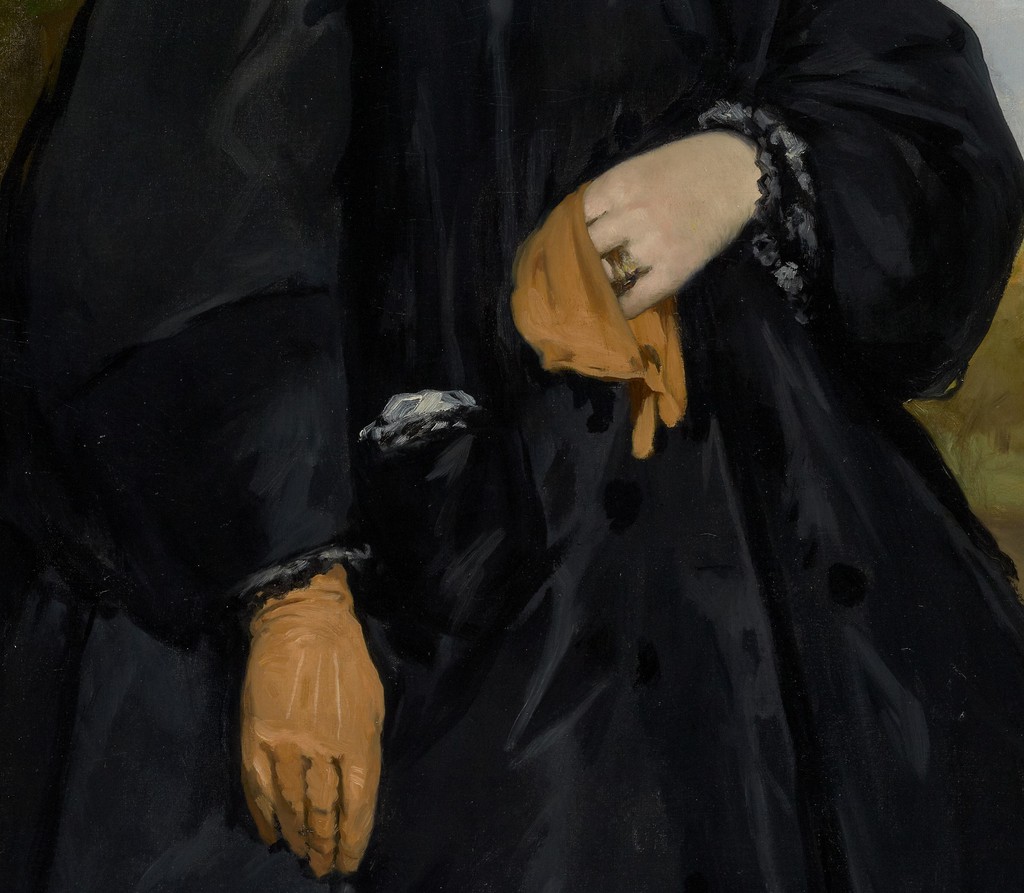
The two hands organise the lower part of the pose. On the viewer’s left, a tan glove hangs beside the coat, its fingers pointing down. The other hand bends across the waist, its pale skin visible against another tan glove. This higher cluster breaks into the dark centre of the figure. The lower glove is more isolated, standing out against the sleeve and skirt of the coat.
Their different heights make the posture easier to follow. One arm descends; the other bends towards the body. Light touches at the cuffs connect the hands with the collar, while the warmer gloves introduce a colour distinct from both skin and clothing. The eye moves from face to hand to glove without tracing every intervening fold.
At the bottom, the white skirt and its dark patterned bands interrupt the coat’s spreading outline. Only a relatively narrow portion of this lighter clothing remains visible. Its repeated dark marks have a different rhythm from the long folds above, bringing the figure to the canvas edge through a change of pattern as well as colour.
Who Was Madame Brunet?
Scott Allan’s 2021 research identifies the sitter as Caroline de Pène, wife of sculptor Eugène Cyrille Brunet, drawing together annotated photographs and marriage records.[2] Getty’s vocabulary record retains a qualification about the identification.[3]
A name supplies a historical connection, but the painted figure also holds attention through the way she occupies the canvas. She faces us without being surrounded by an interior full of personal possessions. Her hat, coat and gloves give the pose a particular character, while the broad landscape places relatively little additional information close to her. The hands are occupied with clothing, and no separate object establishes a profession or activity.
The familiar story that she rejected the portrait comes from Théodore Duret’s later, second-hand account of what Manet told him.[2] It should not determine how every part of the face is read. The arrangement of eyes, mouth, head and clothing can be considered separately from an anecdote about the completed work.
A Figure Against Landscape
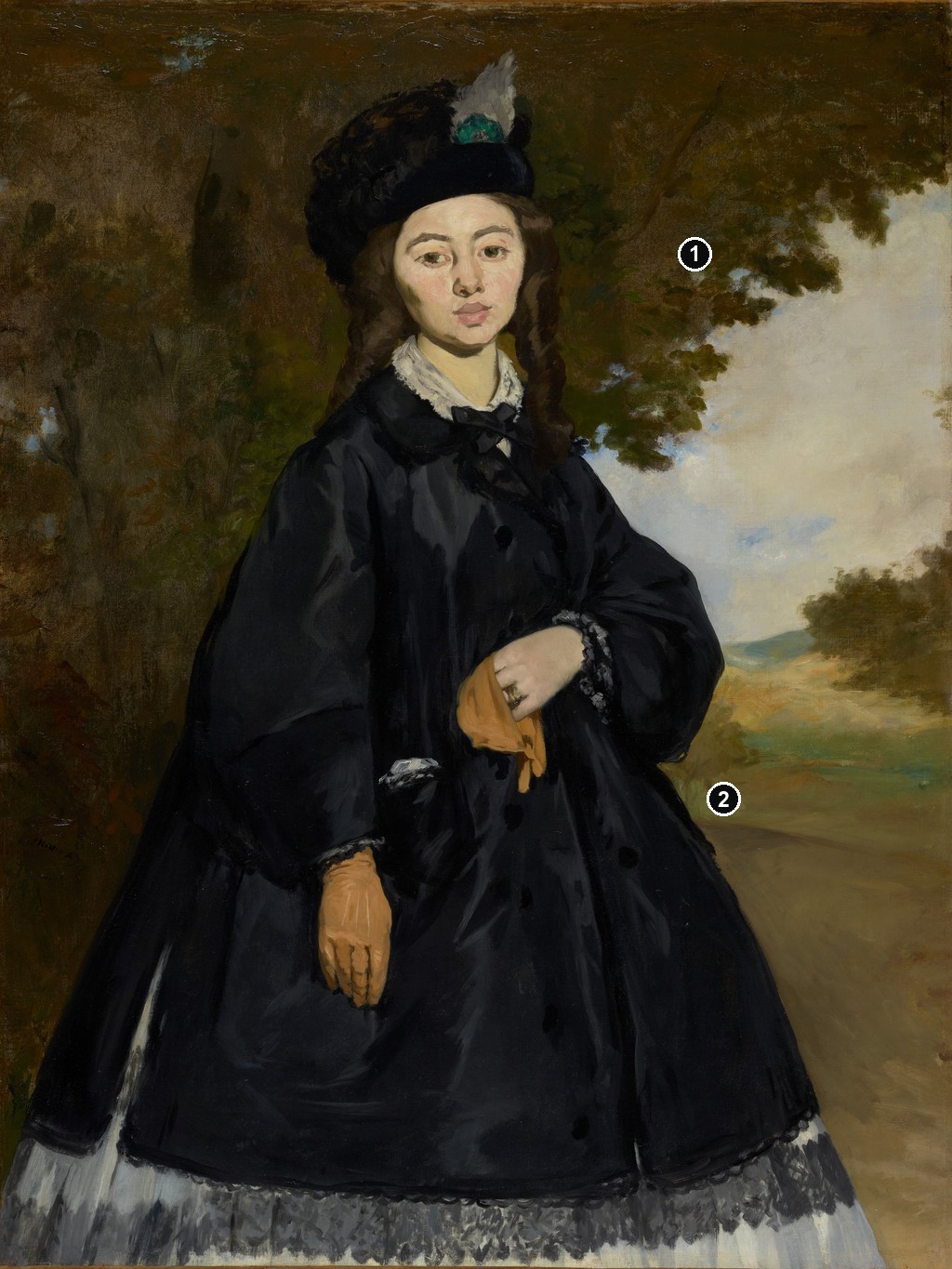
The background changes markedly from left to right. A broad tree trunk rises beside the figure on the left, with dark foliage spreading above and behind her. On the right, a pale opening introduces sky and a more distant landscape. The dark outline of her sleeve becomes particularly clear where it meets this lighter area.
Leaves form an irregular boundary against the sky, while the coat supplies longer, more continuous curves. The tree has its own upright direction, distinct from the tapering body. Looking between these shapes reveals how the landscape helps separate parts of the figure while bringing other passages close in tone.
The small patches of sky among the leaves prevent the upper background from closing into an uninterrupted dark mass. Lower down, the open ground on the right recedes beside the figure. Her clothing remains close to the surface, with the skirt cut by the bottom edge. The portrait holds together a near, strongly outlined person and a background whose lighter spaces suggest greater distance.
Getty connects Manet’s strong light-dark contrasts and broad handling with his interest in Spanish painting.[1] The relationship can also be approached through the visible balance between the figure’s pale accents and its much larger dark shapes. Those accents remain legible across the canvas, while closer looking reveals the changing marks within the coat and foliage.
How the Canvas Changed
Allan reports technical evidence of lower-edge trimming and a reclaimed, repainted upper margin. The examination did not corroborate the older proposal that a plain background had been scraped away before the landscape was added. The exact cutting date and Manet’s motive remain unrecorded.[2]
The present format gives the head, shoulders and hands a substantial share of the available space. Although the body continues beyond the lower edge, the face remains well below the top of the canvas. Foliage spreads above the hat, allowing a surrounding landscape even within the shortened figure arrangement. Its current proportions can be considered without reconstructing an exact missing section.
The surviving skirt is important to this effect. Its pale band makes the lower edge active, setting a light area beneath the coat rather than allowing the entire foreground to end in black. At the same time, the coat’s curved hem remains visible above it. These overlapping edges keep the clothing readable as distinct layers.
Tissot’s Marquise de Miramon
A different approach appears in James Tissot’s Portrait of the Marquise de Miramon, painted in 1866 and also at the Getty. The museum describes her rose-coloured gown as a peignoir and identifies Japanese objects among the fashionable furnishings.[4]
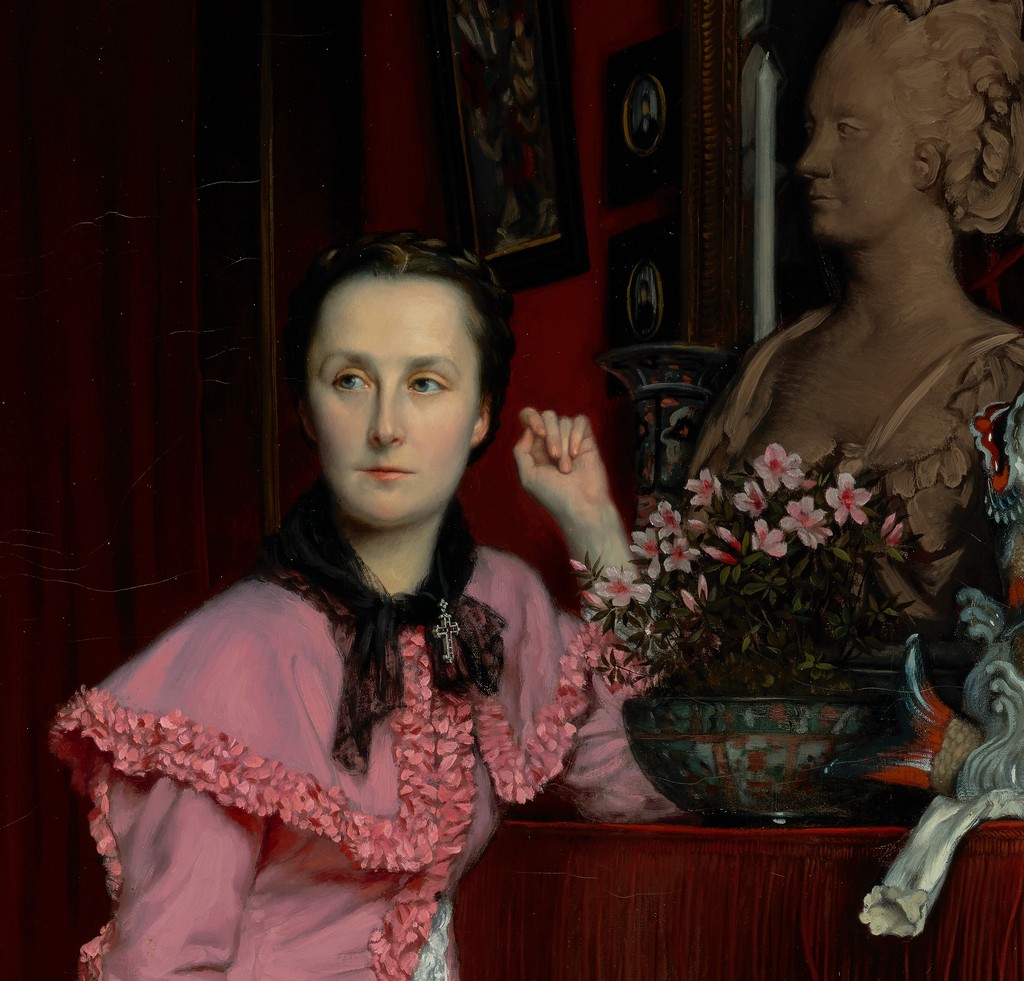
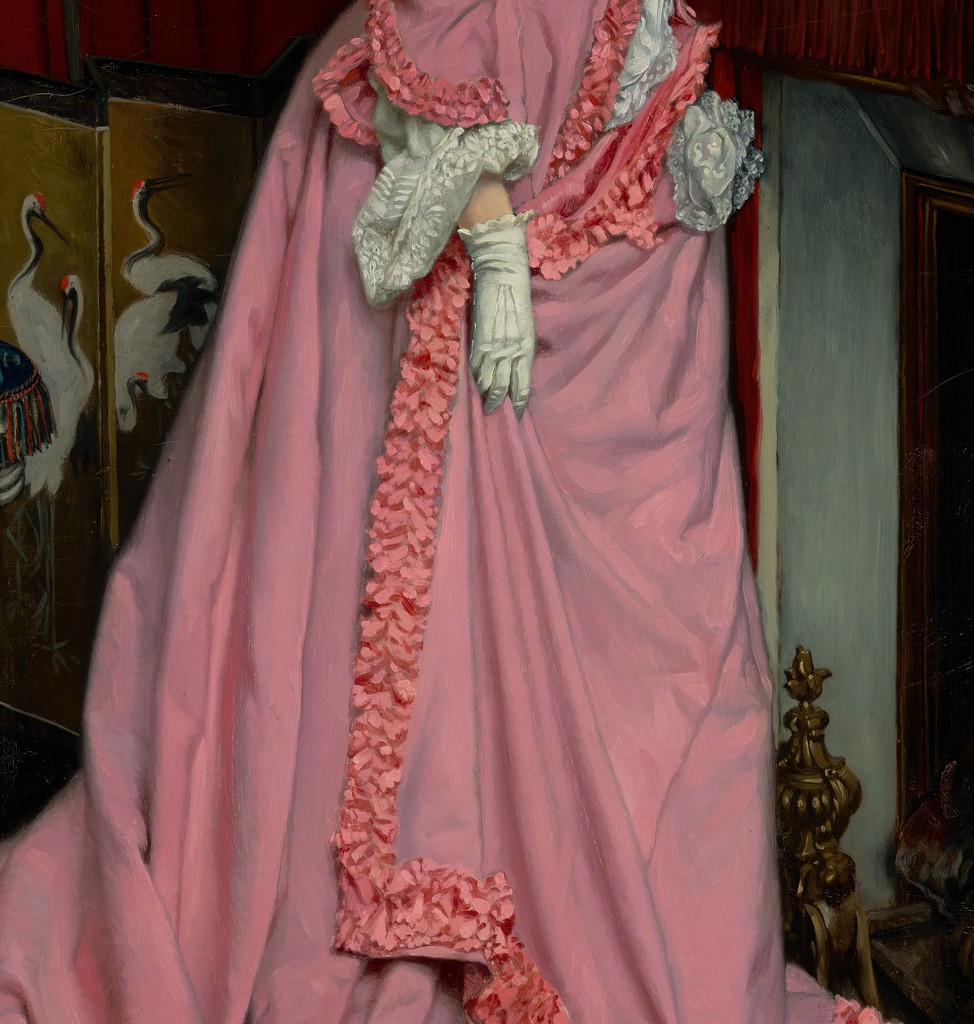
Pink fabric occupies much of Tissot’s narrow canvas. Ruffles run around the neckline, down the front and along the hem, repeatedly breaking the gown’s outline. A pale glove hangs near the waist, while the raised arm brings the other hand close to the head. These light areas are distributed through a body that leans towards the mantelpiece.
Manet’s figure stands more independently against her surroundings. The bent hand remains near the middle of the torso, and the dark coat creates a broad, largely uninterrupted outer shape. Tissot’s ruffles multiply the edges within the dress; Manet’s folds change more quietly across the dark surface. The contrast invites attention to how each painter makes clothing occupy space.
The settings extend that difference. Tissot surrounds the woman with red curtains, a screen, flowers, ceramics and a bust. The mantel establishes a support beside her arm, and the objects gather close to her head. Manet leaves more of the surrounding area to tree, foliage, sky and ground. His figure meets a broad field of changing tones, while Tissot’s is placed among many individually described things.
The two pictures also offer different routes for looking. In Manet, the face, collar and hands stand apart as light accents. In Tissot, the eye can follow the pink dress through an extended series of folds and ruffles before moving into the objects above it. The portraits reward comparison through these particular arrangements, without requiring the women to represent opposing personalities.
Getty reports that Tissot requested the painting’s loan for the 1867 World Fair.[4] Manet’s portrait was shown separately in his independent exhibition that year, following its appearance at Martinet’s gallery in 1863.[5]
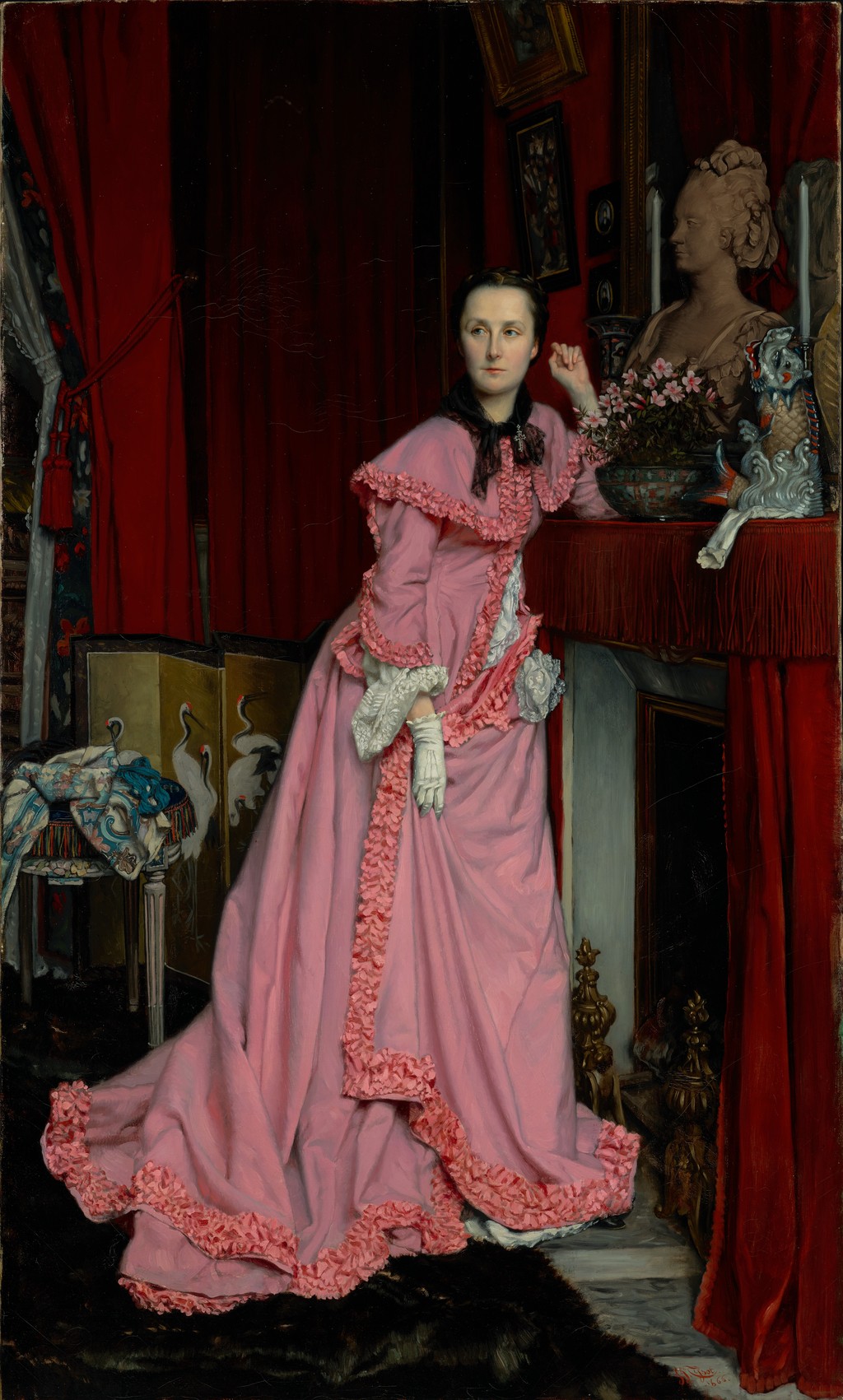
James Tissot, Portrait of the Marquise de Miramon, née Thérèse Feuillant, 1866. J. Paul Getty Museum, 2007.7. Image source. CC0 / Public domain. Whole provided image resized without enlargement or retouching.
Annotated Details from Portrait of Madame Brunet and Tissot’s Marquise de Miramon
The numbered points identify visible features discussed in this article. Return from each detail to the whole composition. Each caption identifies the work shown.
Portrait of Madame Brunet
Édouard Manet, Portrait of Madame Brunet. J. Paul Getty Museum, Los Angeles, 2011.53. Image source. CC0 / Public domain. Numbers added to a separate resized overview; detail crops from the unchanged original. No enlargement or retouching.
Marquise de Miramon — Tissot
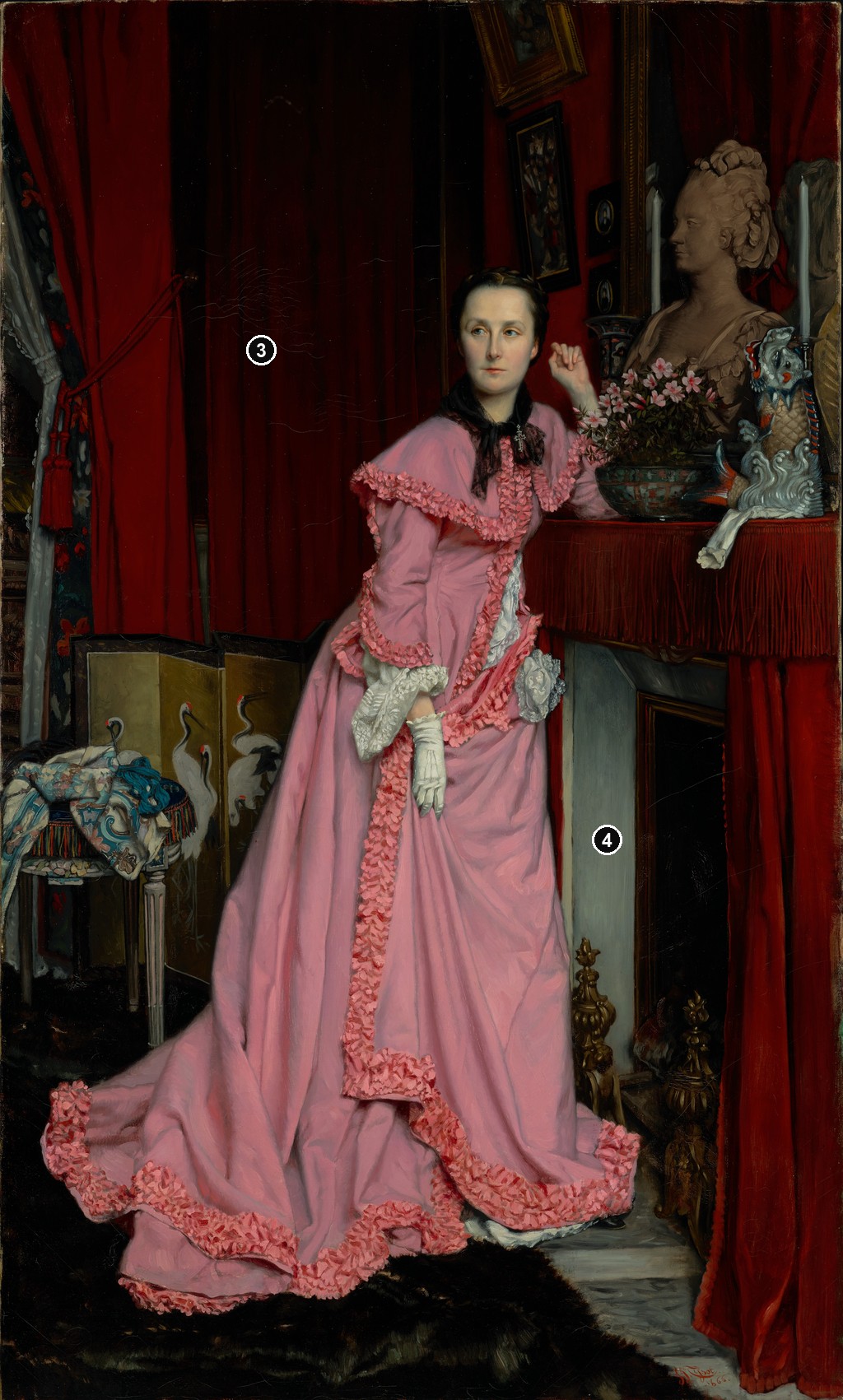
James Tissot, Portrait of the Marquise de Miramon, née Thérèse Feuillant, 1866. J. Paul Getty Museum, 2007.7. Image source. CC0 / Public domain. Numbers added to a separate resized overview; detail crops from the unchanged original. No enlargement or retouching.
Details from PORTRAIT OF MADAME BRUNET AND TISSOT’S MARQUISE DE MIRAMON
Look from the hat, face and collar to the two differently placed hands, then compare the raised hand and pink folds in Tissot’s portrait.
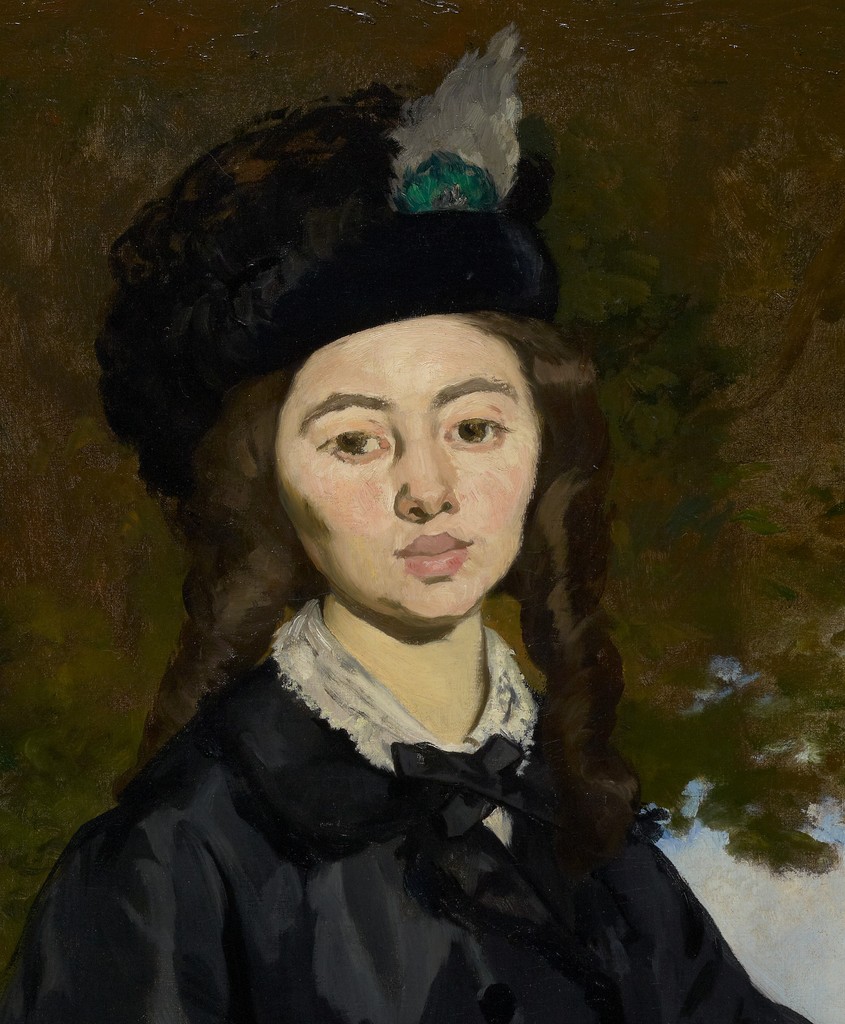
Portrait of Madame Brunet
The Hat, Face and Collar
The pale face and narrow collar sit between the dark hat, hair and coat. The plume and small green accent change the hat’s upper outline.
The Hands and Tan Gloves
The two hands occupy different heights. One glove points down beside the coat, while the bent hand and second glove interrupt the darker centre.
Marquise de Miramon — Tissot
Tissot: The Head, Raised Hand and Mantel
Tissot places the head and raised hand close to flowers, ceramics and the mantelpiece. The nearby objects fill much of the surrounding space.
Tissot: The Glove and Pink Folds
A pale hanging glove contrasts with the pink fabric. Long folds and repeated ruffles give the dress many internal edges.
From the Studio to the Getty
The older Rouart–Wildenstein catalogue records the historical title Young Woman in 1860 and an 1860 date.[5] That title should be distinguished from the Getty’s present dating.[1]
Getty’s provenance records Duret acting for Durand-Ruel at the 1884 estate sale, followed by Blanche.[1] It later entered Joan Whitney Payson’s collection before Getty’s 2011 acquisition.[6]
Seen beside the more crowded portraits among Manet’s paintings, Madame Brunet gives particular prominence to the outline of a single figure. Her face, collar and hands remain small within the broad arrangement, yet they keep drawing the eye back across the dark clothing. The landscape opens around her without loosening that concentrated presence.
Artworks directory
Explore selected paintings, drawings and prints by Édouard Manet. Search by title or another recorded name.
Frequently Asked Questions
Allan identifies her as Caroline de Pène, the sculptor Eugène Brunet’s wife.[2]
Getty dates it to about 1861–1863, reworked by 1867.[1]
It belongs to the J. Paul Getty Museum, Los Angeles, which acquired it in 2011.[1]
Discussion
Look again at the images and ideas explored in Portrait of Madame Brunet by Édouard Manet. These editorial prompts invite your observations.
Reader Insights
Follow the changing tones across the coat, then compare their edges with those around the face and collar.
Trace the downward arm and the bent arm. Notice how the different heights of the gloves organise the pose.
Compare the edges of Manet’s dark coat with Tissot’s pink ruffles, then look at how closely the settings surround each figure.
Join the Conversation
Share a detail, comparison or question about Portrait of Madame Brunet by Édouard Manet below.
References
- J. Paul Getty Museum, Portrait of Madame Brunet, 2011.53, current object description, details and provenance. View source.
- Scott Allan, “Manet’s Portrait of Madame Brunet: Recent Investigations”, Getty Research Journal 14 (2021), pp. 103–122, especially pp. 107–115 and notes 45–50. View source.
- Getty Research Institute, Caroline de Pène Brunet, ULAN 500353537, identity note. View source.
- J. Paul Getty Museum, Portrait of the Marquise de Miramon, née Thérèse Feuillant, 2007.7, collection record and commentary. View source.
- Denis Rouart and Daniel Wildenstein, Édouard Manet: Catalogue raisonné, vol. I (1975), no. 31, pp. 50–51. View source.
- J. Paul Getty Museum, “Getty Announces Acquisition of Rare, Early Portrait by Édouard Manet”, 1 December 2011. View source.
- Splash image, Édouard Manet, Portrait of Madame Brunet. J. Paul Getty Museum, Los Angeles, 2011.53. Image source. CC0 / Public domain. Whole provided image resized without enlargement or retouching.


