



 by Tom Gurney
Tom Gurney BSc (Hons) is an art history expert with over 20 years experience
Published on June 19, 2020 / Updated on October 30, 2026
Email: tomgurney1@gmail.com / Phone: +44 7429 011000
Portrait of Zacharie Astruc by Édouard Manet: Introduction
A pale face and two hands emerge from the dark clothing of a seated man. Beside him, books crowd a red-covered table, while a woman appears in a brighter interior above them. In Portrait of Zacharie Astruc, Édouard Manet brings these distinct areas together within a broad canvas. The painting dates from 1866 and belongs to Kunsthalle Bremen.[1]
At a Glance
- ArtistÉdouard Manet
- TitlePortrait of Zacharie Astruc / Portrait of the Poet Zacharie Astruc
- German titleBildnis des Dichters Zacharie Astruc
- Date1866
- MediumOil on canvas
- Dimensions90.5 × 116 cm
- CollectionKunsthalle Bremen – Der Kunstverein in Bremen
- Accession number88-1909/1.[1]
This work across Édouard Manet’s career
Contents
- A Dark Figure and a Crowded Table
- A Portrait of a Friend
- The Light Scene at the Left
- Another Literary Supporter in Émile Zola
- From the Alma Exhibition to Bremen
- Annotated details
A Dark Figure and a Crowded Table
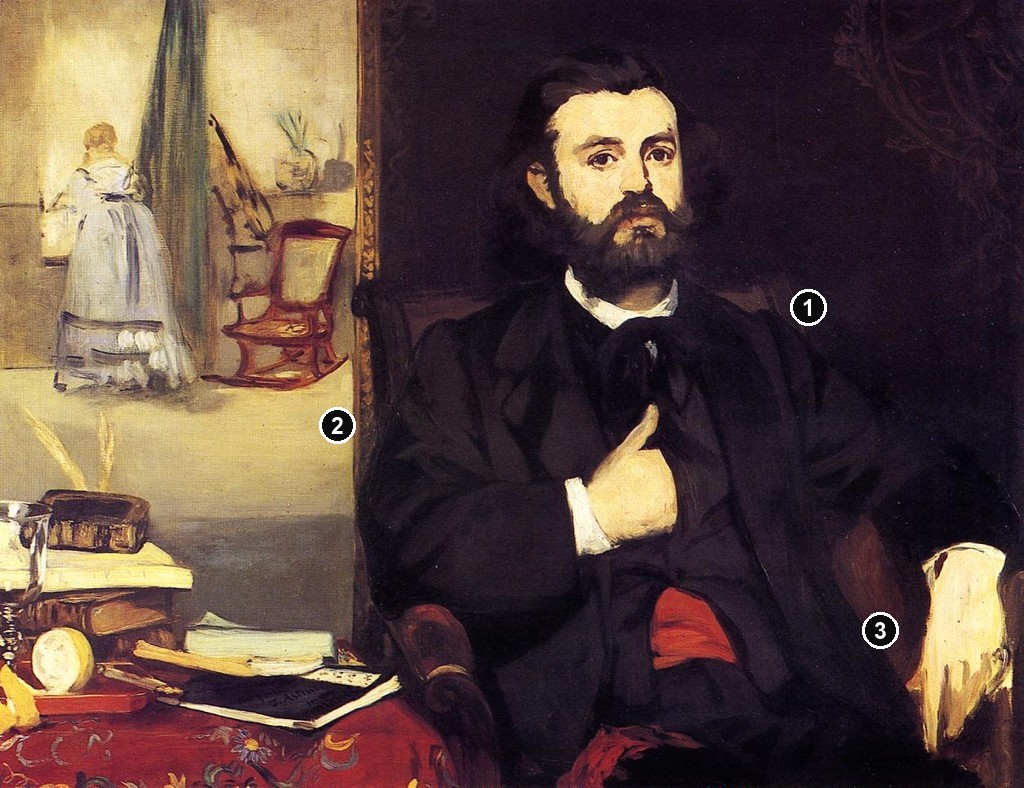
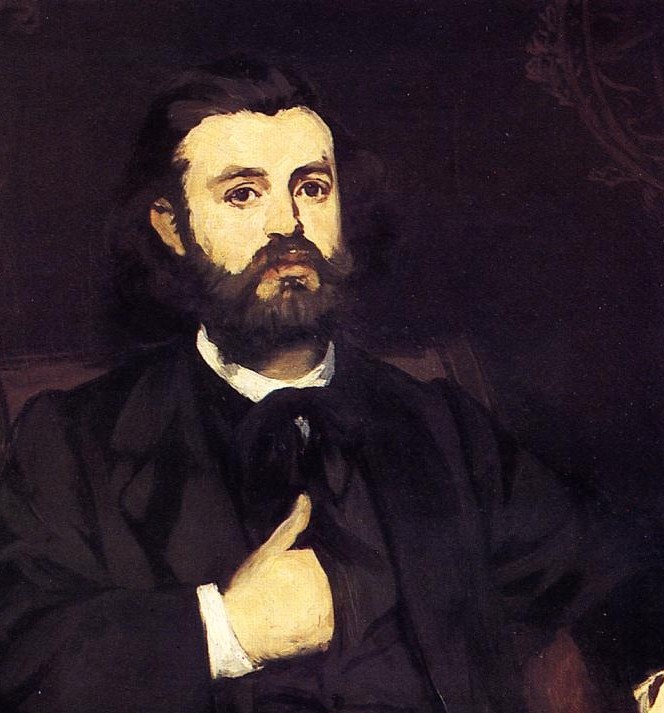
Astruc occupies the right side of the picture. His body faces towards us, with one arm crossing his chest and the other descending towards the chair. The dark coat connects his shoulders with the lower edge. Behind his head, an almost black background makes the illuminated face particularly prominent. Hair, beard and clothing join into a large dark shape interrupted by the forehead, cheeks and white collar.
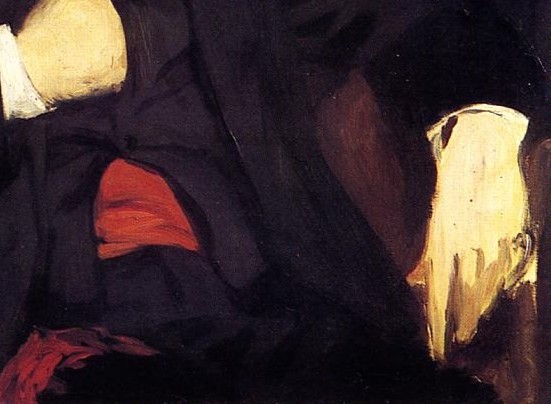
The hands give the pose its variety. One is tucked into the waistcoat, with the thumb pointing upwards near the chest. Its pale cuff marks the turn of the forearm. The other hangs more loosely beside the chair arm, its long fingers extending downwards. These two positions set up different directions across the clothing: a diagonal towards the chest and a downward movement near the outer edge.
Red fabric appears at the waist and again near the bottom of the canvas. It echoes the reddish chair and the patterned tablecloth, carrying colour across the dark figure into the busier left side. The repeats help distinguish the armchair, clothing and foreground table within the composition.
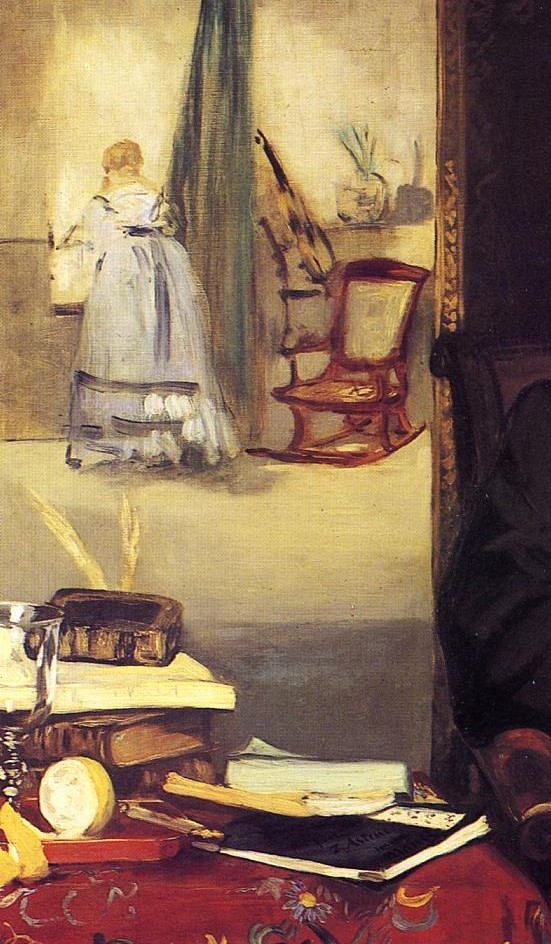
The books create a lower, more horizontal arrangement. Pale page edges stand out against brown and dark covers, while the projecting corners overlap the cloth. Above them, quills rise beside a reflective vessel. A cut lemon introduces a small rounded shape among the rectangles. The objects vary in height and angle, giving the eye several routes through the still life before returning to the sitter.
Kunsthalle Bremen relates the books and writing equipment to Astruc’s literary activity, identifies a Japanese print album with his collecting, and connects the folded fan and red cummerbund with his interest in Spain. The stringed instrument in the light scene adds a musical association.[1] The objects also contribute through their colours, edges and placement.
A Portrait of a Friend
Astruc was more than the subject of a likeness. Dorothee Hansen places his friendship with Manet around 1860 and describes exchanges of books, watercolours and music. The portrait’s dedication addresses him as a poet and friend. He also supported Manet in print, and his verses accompanied Olympia at the 1865 Salon, after that painting had already been made.[2]
His activities extended across criticism, poetry, painting, sculpture and music. Angélique Saadoun’s INHA study also documents his involvement with Japanese art and collecting.[3] The range of interests helps explain the portrait’s unusually varied surroundings. Astruc appears beside things associated with reading and art, yet he holds no book open for us. His outward gaze and the two differently positioned hands keep the person visually distinct from the collection of objects.
Spain was another shared interest. The Bremen exhibition account describes Astruc’s advice for Manet’s 1865 journey; the detailed itinerary was only partly followed.[4] This gives the Spanish associations a place within an ongoing friendship. Manet’s choices remained his own, just as the portrait brings together several interests without illustrating a single episode from Astruc’s life.
The scale of the table is striking. Its contents occupy a substantial portion of the canvas, but they do not obscure the sitter. A dark vertical interval separates the books from his torso. At the same time, the red cloth and waist fabric connect the two sides. The portrait can present Astruc through his surroundings while allowing his face to remain its strongest point of attention.
The Light Scene at the Left
The woman at the left is seen from behind. Her pale skirt widens towards the floor, and her smaller figure introduces a different scale from the seated man. A tall curtain, a chair and a stringed instrument surround her. Along the right of this scene, a narrow gold-coloured edge separates its light space from the dark area behind Astruc.
That boundary makes the arrangement difficult to read as a continuous room. The foreground table appears close to us, while the woman seems further away; the vertical edge can also make her setting look like an image within the image. The eye moves between these possibilities because the bright area is both an apparent interior and a distinct rectangle in the composition.
The museum leaves open whether this is a neighbouring room, a reflection or a painted picture.[1] Each possibility changes the spatial relationship. A room would extend the setting beyond Astruc; a mirror would show space behind the viewer; a painting would introduce another represented scene. The woman’s identity and activity remain uncertain.
The contrast works even while the space stays unresolved. Her light clothing and upright figure counterbalance Astruc’s broad dark body. The chair within her setting repeats a furnishing associated with him, but on a smaller scale. The books below form another layer between the two figures, so the left side rewards looking separately at foreground objects, the dividing edge and the bright scene beyond it.
Another Literary Supporter in Émile Zola
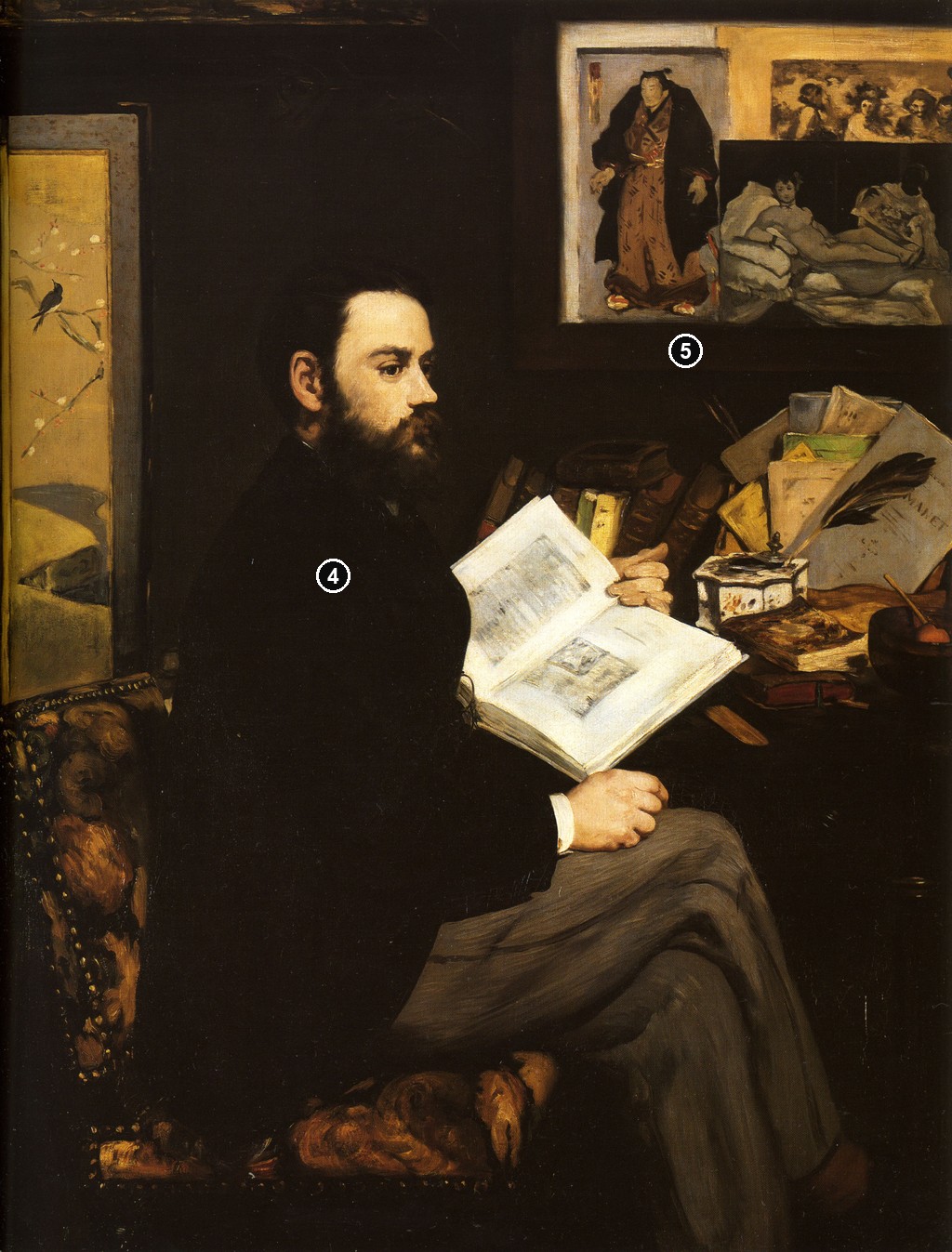
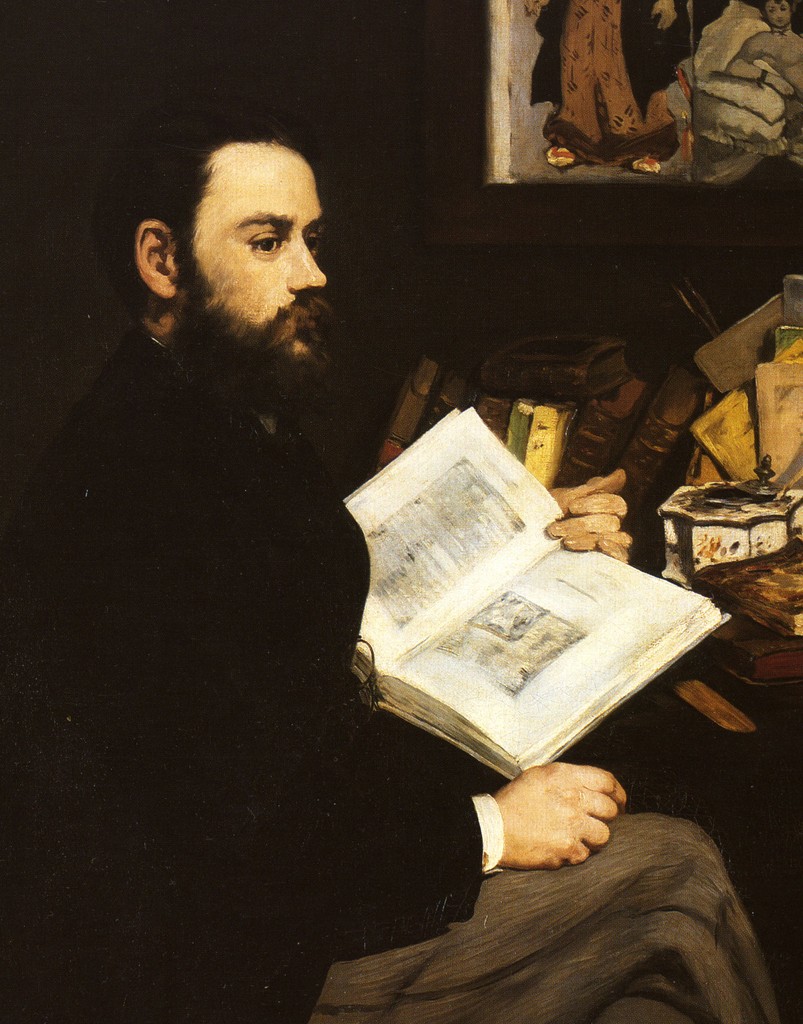
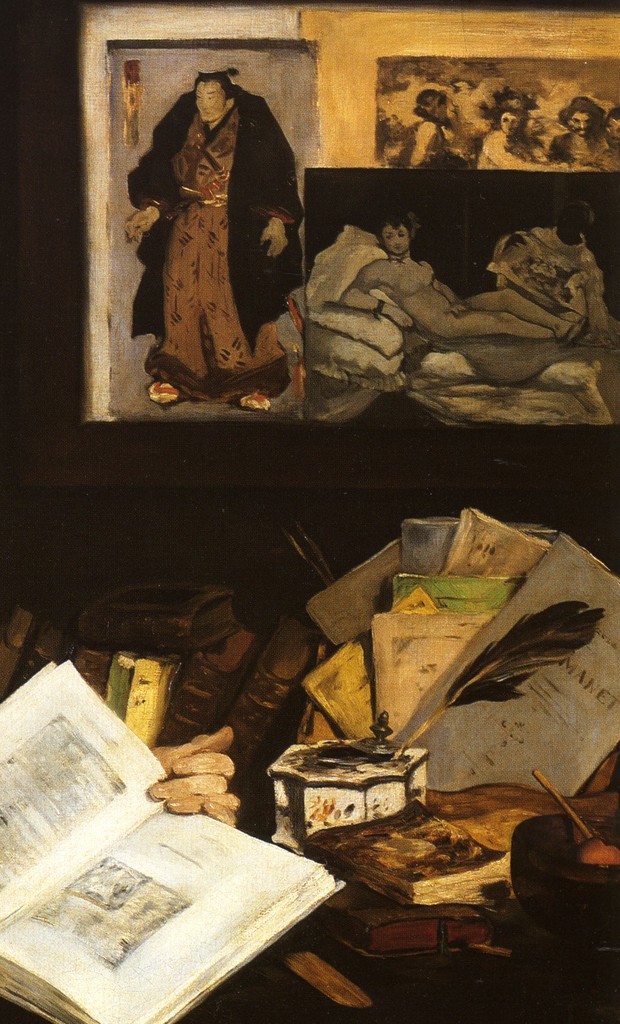
Manet’s Émile Zola, painted in 1868 and now at the Musée d’Orsay, offers a useful comparison. Orsay identifies the blue brochure as Zola’s 1867 defence of Manet and describes the surrounding images of Olympia, Velázquez’s Bacchus and a Japanese print by Utagawa Kuniaki II. The open volume is probably by Charles Blanc.[5]
Zola sits within a tall canvas, with his head turned into profile. His open book occupies the space between his torso and the crowded desk. Astruc faces outwards within a wider format, and his books remain on the table beside him. Both paintings give printed and painted images a substantial presence, but their arrangements produce different routes around the sitter.
The hands make this difference especially clear. Zola supports the volume above his lap, bringing reading material into direct contact with the body. Astruc’s raised hand disappears into his clothing, while the lower one rests beside the chair. The still life therefore stands more independently beside Astruc, with its stacked volumes forming a separate group.
The backgrounds differ too. Zola’s wall displays several recognisable images above the desk, and a Japanese screen rises beside his shoulder. Astruc’s face is surrounded by darkness, while the light scene is displaced to the other side. In Zola, much of the detail collects above and around the open book. In Astruc, attention travels laterally between the face, the table and the uncertain interior. Their shared subject of a writer among cultural objects allows Manet to explore quite different distributions of light and space.
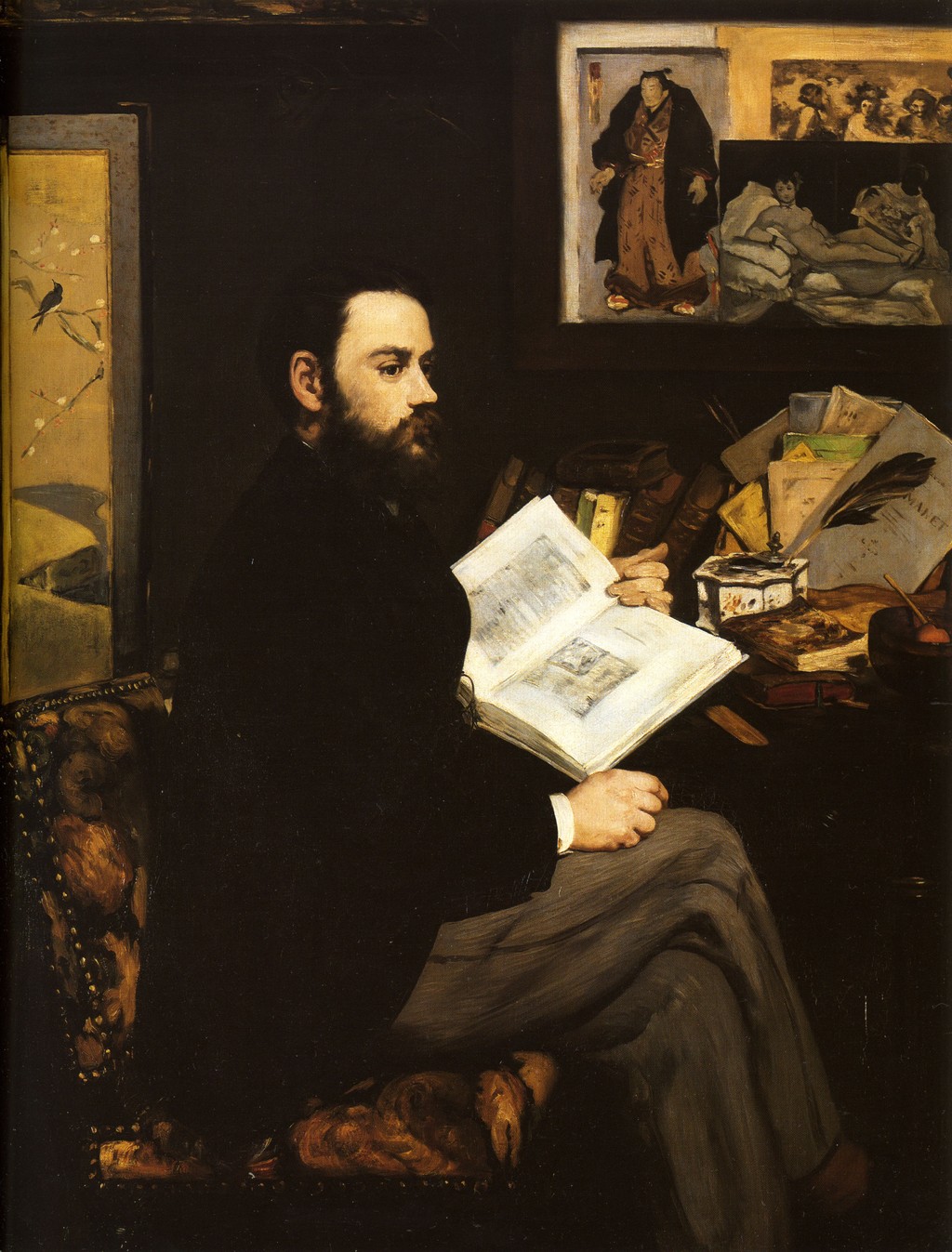
Édouard Manet, Émile Zola, 1868. Oil on canvas, 146 × 114 cm. Musée d’Orsay, RF 2205. Musée d’Orsay; reproduction via Wikimedia Commons, Public Domain Mark 1.0. Image source. Public domain. Whole supplied reproduction resized for web display. No enlargement or retouching.
Annotated Details from Portrait of Zacharie Astruc
The numbered points identify visible features discussed in this article. Return from each detail to the whole composition. Each caption identifies the work shown.
Portrait of Zacharie Astruc
Édouard Manet, Portrait of Zacharie Astruc, 1866. Oil on canvas, 90.5 × 116 cm. Kunsthalle Bremen – Der Kunstverein in Bremen, 88-1909/1. Kunsthalle Bremen – Der Kunstverein in Bremen; reproduction via Wikimedia Commons, Public Domain Mark 1.0. Image source. Public domain. Numbers added to a separate resized overview. Detail crops from the supplied reproduction via Wikimedia Commons; no enlargement or retouching.
Emile Zola Comparison
Édouard Manet, Émile Zola, 1868. Oil on canvas, 146 × 114 cm. Musée d’Orsay, RF 2205. Musée d’Orsay; reproduction via Wikimedia Commons, Public Domain Mark 1.0. Image source. Public domain. Numbers added to a separate resized overview. Detail crops from the Musée d’Orsay reproduction via Wikimedia Commons; no enlargement or retouching.
Details from PORTRAIT OF ZACHARIE ASTRUC
Follow Astruc’s face, hands and the light scene beside him, then compare the open book and wall images in Manet’s portrait of Zola.
Portrait of Zacharie Astruc
Face Collar and Raised Hand
The pale face, white collar and raised hand stand against the large dark area of hair and clothing.
Books and Light Scene
Books overlap the patterned red cloth below the small light scene. The gold-coloured edge divides that scene from Astruc’s dark surroundings.
Waist Lower Hand and Chair
The lowered hand follows the outer edge of the chair. Red fabric at the waist interrupts the dark clothing and echoes the tablecloth.
Emile Zola Comparison
Profile Book and Hands
Zola turns his head into profile and holds an open book above his lap. The hands connect the pale pages with his seated body.
Wall Images and Desk
Several images gather on the wall above the crowded desk. Their placement differs from the single light scene beside Astruc.
From the Alma Exhibition to Bremen
The current museum and the 2021 catalogue date the portrait to 1866. The older Rouart–Wildenstein catalogue read the dedication date as 1864; this accounts for an earlier date in the literature.[1][2][6]
Manet displayed the portrait in his independent 1867 exhibition near the avenue de l’Alma, as Portrait de Z. A. Hansen identifies this as its only public showing during his lifetime. It remained unframed in his studio at his death in 1883. In early 1909, art lovers and the Galerieverein helped finance its acquisition for Bremen in honour of Kunstverein president Carl Schütte, encouraged by Gustav Pauli.[2]
The broad format gives the still life and light scene substantial space beside Astruc. Across that division, the red cloth, pale hands and light scene keep drawing attention from one side of the canvas to the other.
Artworks directory
Explore selected paintings, drawings and prints by Édouard Manet. Search by title or another recorded name.
Frequently Asked Questions
It shows a woman from behind in a light interior. Kunsthalle Bremen leaves open whether it represents a neighbouring room, a reflection or a painting.[1]
Discussion
Look again at the images and ideas explored in Portrait of Zacharie Astruc by Édouard Manet. These editorial prompts invite your observations.
Reader Insights
Follow the face, collar, cuffs and hands, then notice how much of the figure remains dark.
Look at the gold-coloured dividing edge and consider how each spatial reading changes the relationship between the woman and Astruc.
Compare the placement of books and hands in Astruc and Zola, then follow the different paths through their backgrounds.
Join the Conversation
Share a detail, comparison or question about Portrait of Zacharie Astruc by Édouard Manet below.
References
- Kunsthalle Bremen, Bildnis des Dichters Zacharie Astruc, museum-provided description and object details on Google Arts & Culture. View source.
- Dorothee Hansen, in Manet and Astruc: Friendship and Inspiration (2021), publisher’s sample, offered opening of her essay and p. 13. View source.
- Angélique Saadoun, Zacharie Astruc, INHA, 2022, biographical and collection commentary. View source. (in French).
- Kunsthalle Bremen, Manet and Astruc: Friendship and Inspiration, archived German exhibition account, 2021–22. View source. (in German).
- Musée d’Orsay, Émile Zola, collection record and commentary. View source. (in French).
- Denis Rouart and Daniel Wildenstein, Édouard Manet: Catalogue raisonné, vol. I (1975), no. 92, pp. 96–97. View source. (in French).
- Splash image, Édouard Manet, Portrait of Zacharie Astruc, 1866. Oil on canvas, 90.5 × 116 cm. Kunsthalle Bremen – Der Kunstverein in Bremen, 88-1909/1. Kunsthalle Bremen – Der Kunstverein in Bremen; reproduction via Wikimedia Commons, Public Domain Mark 1.0. Image source. Public domain. Whole supplied reproduction resized for web display. No enlargement or retouching.


