



 by Tom Gurney
Tom Gurney BSc (Hons) is an art history expert with over 20 years experience
Published on June 19, 2020 / Updated on October 30, 2026
Email: tomgurney1@gmail.com / Phone: +44 7429 011000
The Ragpicker by Édouard Manet: Introduction
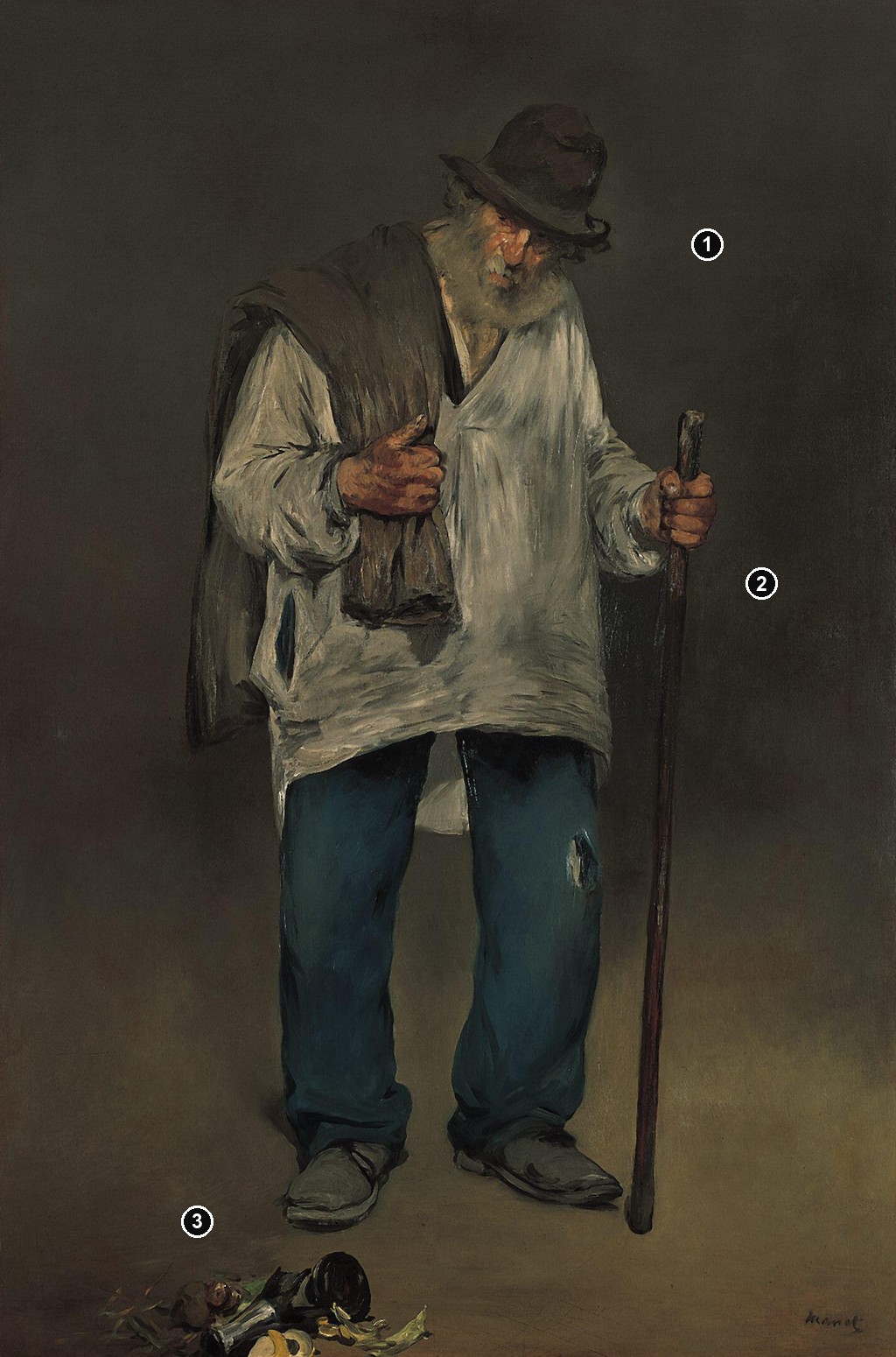
A battered hat casts a shadow over the man's eyes. One hand gathers the load at his shoulder; the other closes around a rough wooden staff. His pale shirt and blue trousers stand out against a brown-grey setting, while a few discarded objects lie near his feet. Manet gives this solitary figure almost the whole height of a large canvas.
The Ragpicker, in the Norton Simon Museum in Pasadena, is dated by its owner to about 1865–1870.[1] Its subject belongs to the working life of nineteenth-century Paris. Its scale, concentrated pose and varied paint surface also invite a slower encounter with the man who occupies it.
At a Glance
- ArtistÉdouard Manet
- DateAbout 1865–1870
- MediumOil on canvas
- Dimensions194.9 × 130.8 cm, height × width
- CollectionThe Norton Simon Foundation, Pasadena
- Accession numberF.1968.09.P.[1]
This work across Édouard Manet’s career
Olympia
1863The Ragpicker by Édouard Manet (current article)
About 1865–1870The Fifer
1866The Balcony
1868–69The Railway
1873Asparagus
1880Contents
- A Standing Figure on a Grand Scale
- What Was a Ragpicker?
- The Shirt, the Hands and the Load
- A Still Life of Discarded Things
- Why Manet Called Such Figures Philosophers
- From The Old Musician to One Isolated Man
- Baudelaire's Ragpicker and the Poet
- Was the Painting Reworked Later?
- Conservation and the Visible Surface
- From the Studio to Pasadena
A Standing Figure on a Grand Scale
At nearly two metres high, the painting establishes a substantial physical presence. The man's hat leaves a stretch of empty space above it, and the small still life approaches the lower edge. Between them, his body makes a long, uneven column. The light shirt broadens the upper half, while the separated legs give the figure a firm base.
The staff makes a second upright beside him. Its lower end reaches slightly below his shoes, and its upper end stops near his bent arm. Because it is narrow and comparatively straight, it makes the changes in the body's outline more noticeable: a shoulder rising under its load, an elbow projecting, a trouser leg bending before the ankle.
His head inclines towards the staff side of the picture. The hat's downward brim deepens the shadow across his eyes, while warmer touches catch his nose and cheek. The beard spreads beneath the face in softer grey and brown strokes. The features are sufficiently distinct to give him individuality, yet his expression remains difficult to read.
The pose gathers attention inwards. Neither arm reaches freely into the surrounding space. One hand holds cloth close to the chest; the other maintains its grip on the stick. These two actions make the body feel occupied even though the man stands still. There is something to carry and something to hold.
Around him, the setting offers few clues to a particular address or occasion. The brown-grey field grows lighter towards the ground, with shadows near the footwear. Manet supplies enough space for standing, but no street corner, building or passer-by competes with the figure. The absence of a detailed setting gives extra weight to each visible object.
What Was a Ragpicker?
Ragpickers recovered materials from the waste of the city. The Norton Simon Museum describes a regulated occupation that included collecting cloth for paper manufacturers and salvaging other household castoffs.[1] The work belonged to an economy of sorting and reuse, with discarded goods passing into new hands or new forms.
This context helps explain the distinction between the man's worn appearance and the useful activity named in the title. His clothes, load and staff introduce a worker whose occupation might have been familiar to a Parisian viewer. The painting gives that occupation a conspicuous place, on a scale that demands sustained attention.
The art historian Theodore Reff connects Manet's street figures with a city being transformed by rebuilding and displacement. Ragpickers also occupied an established place in popular writing and imagery.[2] That wider history matters here, although the unmarked background keeps the painting from becoming a record of one identifiable neighbourhood.
The title tells us the role represented; the sitter's personal history remains less certain. His name is not established in the museum accounts discussed here. The cloth over his shoulder suggests a load, but its contents cannot be counted. The picture offers no reliable account of his income, family or daily routine. Those gaps leave room to look closely at the individual before turning him into an example of an entire way of life.
The Shirt, the Hands and the Load
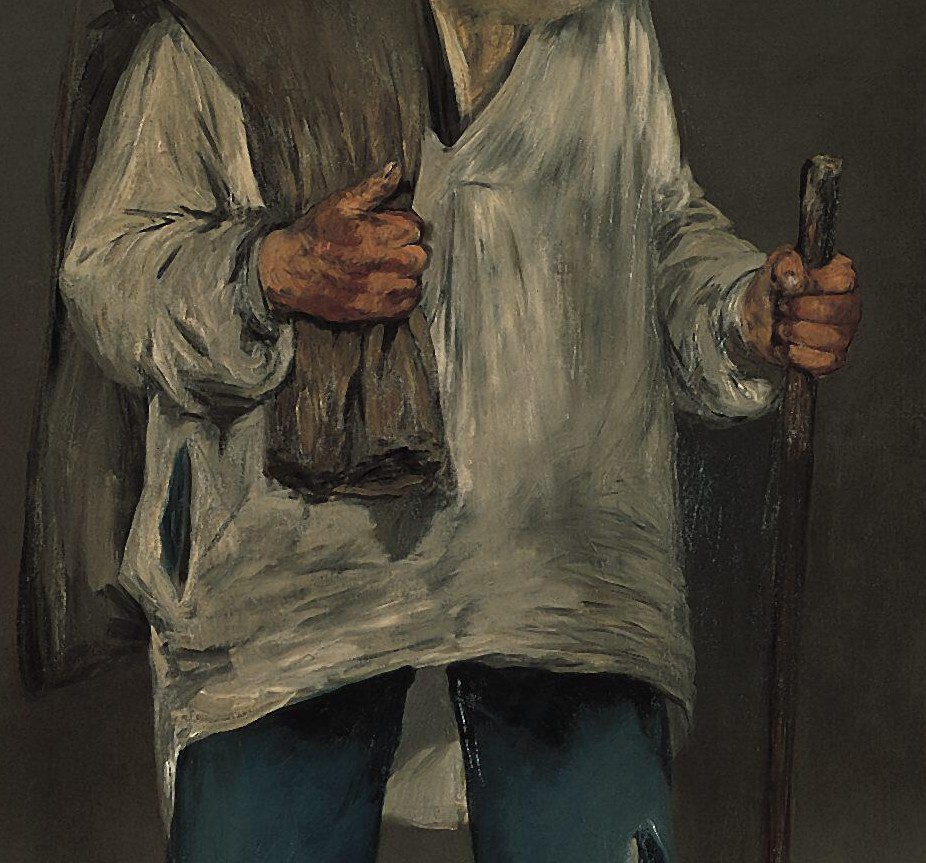
The pale shirt is the painting's largest light shape. At the neck, a dark V cuts sharply into it. Below, grey, cream and muted greenish strokes run down the chest, bending and crossing as they approach the uneven hem. Its surface has weight and movement without every fold being enclosed by a continuous outline.
The sleeves work differently. At the viewer's left, the elbow produces a broad projection, interrupted by a dark crease. Near the wrist, short marks gather around the hand. On the opposite side, the sleeve narrows towards the staff, and its cuff turns in a small curl of light paint. The shirt's general breadth resolves into these more compressed passages at the joints.
Against it, the reddish hands become unusually prominent. The hand beside the chest has an irregular, almost knotted outline, with thumb and fingers pressing around the hanging material. The other wraps around the staff in a more clearly separated grip. Warm colour brings both forward from their pale cuffs.
The load over the shoulder is dark brown and roughly folded. Its upper mass merges with the shoulder's slope, then a long piece hangs down beside the shirt. Where the hand gathers it, the cloth forms a compact hanging end. Elsewhere, its edge is broader and less definite, almost absorbed by the surrounding darkness.
That partial merging changes the balance of the body. The pale shirt is easy to follow, but the darker load makes the shoulder seem heavier and less sharply bounded. Its weight is conveyed through the relationship of hand, fabric and tilted upper body. The viewer can sense the act of carrying without a detailed inventory of what is carried.
Below, the trousers introduce a deep blue that stands apart from the browns and greys. A torn patch interrupts one leg. Near the ankles, the fabric bunches into darker folds above broad grey shoes. Their toes point in slightly different directions, giving the stance a small asymmetry that counters the staff's strong vertical.
A Still Life of Discarded Things
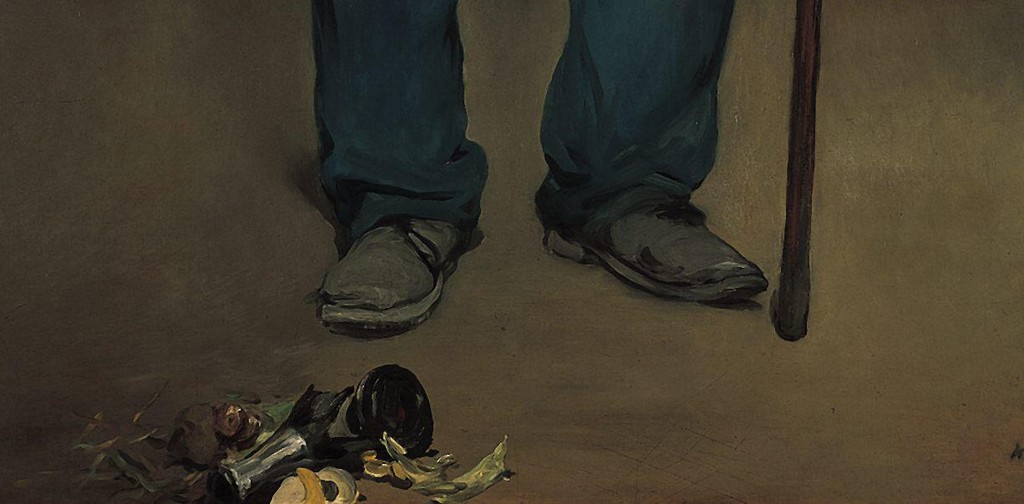
Near the lower left lies a little gathering of broken and used objects. The museum identifies opened oyster shells, a broken champagne bottle and lemon peel.[1] Their scale is modest beside the man, but their edges are among the most varied in the picture: curved glass, irregular pale shells, yellow scraps and dark gaps between them.
The bottle's curved opening makes a particularly deep patch of darkness. Pale strokes beside it catch against the ground, while yellow peel supplies a small, clear colour accent. The shapes can be read as things, but they also form a busy arrangement of lights and darks at the foot of the broad upright figure.
This is a different rhythm from the shirt. Across the chest, the eye travels through a large connected area. In the foreground, it changes direction quickly, following one little fragment and then another. The still life brings a pocket of concentrated visual activity into a setting that is otherwise largely empty.
The objects also give the title a tangible setting. Used things have a place in the man's world, and Manet has made them worth looking at. Glass and peel, shell and cloth each invite a different touch of the brush. Material that has lost its original purpose becomes useful to the painting.
The cluster sits well away from the man's hands. He is not shown sorting or picking up a particular item, and the scene does not unfold as a demonstration of his trade. Instead, the relation between figure and objects remains open. We move between the person and the small things at his feet, noticing how much space each occupies and how differently each is painted.
Why Manet Called Such Figures Philosophers
Manet loosely grouped this canvas with The Absinthe Drinker and the two paintings now known as Beggar with Oysters and Beggar with a Duffle Coat when selling works to Paul Durand-Ruel in 1872. The group became his four philosophers.[3] The name links contemporary street figures with a much older pictorial tradition.
An important precedent was Diego Velázquez. His paintings of Aesop and Menippus, made around 1638, were touchstones for Manet's monumental presentation of an unlikely subject. The Frick's account of The Ragpicker emphasises this connection, including the grand format and the more smoothly described volumes of hat, trousers and still life.[4]
The relationship gives the title “philosopher” a particular force. A man in worn clothes can occupy the kind of commanding space that a large painting makes available. The historical reference supplies an artistic ancestry for that presence, while Manet's staff, cloth and castoffs keep the figure attached to contemporary material life.
The four paintings were a retrospective grouping, rather than a uniform set executed at one moment. The earlier Absinthe Drinker is part of that history.[3] Looking between the two canvases reveals different ways of making a solitary body fill a tall space: the enclosing dark cloak of one figure, the exposed pale shirt and clearly separated legs of the other.
Here, the downward inclination of the head also complicates the grandeur. The man does not make a formal gesture of command or directly solicit our attention. His large presence coexists with absorption in the immediate business of standing, carrying and holding. That combination gives the picture much of its quiet tension.
From The Old Musician to One Isolated Man
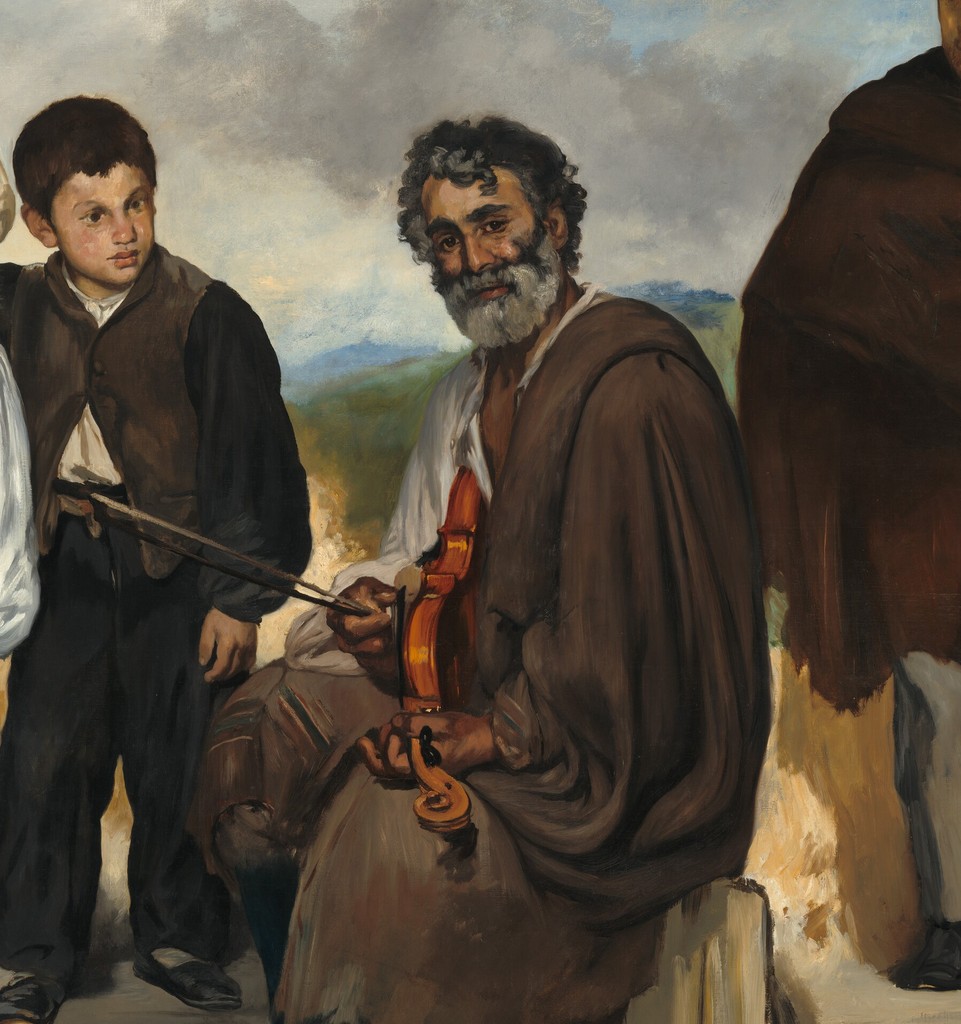
A useful comparison is The Old Musician, another of Manet's paintings of figures associated with life beyond prosperous Parisian interiors.[2] Its broad composition brings several people together beneath an open sky. The seated musician turns towards the viewer, while other figures look in different directions.
The Ragpicker has no equivalent gathering around him. Its vertical format concentrates the space on one body, with the staff close beside it and the refuse below. The empty background makes the intervals between these few elements unusually important. Even the gap between the legs becomes a noticeable light shape.
In The Old Musician, the pale shirt of a boy belongs to an extended sequence of contrasting clothes, faces and poses. Here, the shirt takes command of the whole middle of the canvas. Its brightness no longer has to find its place among several neighbouring figures; it holds the composition almost by itself.
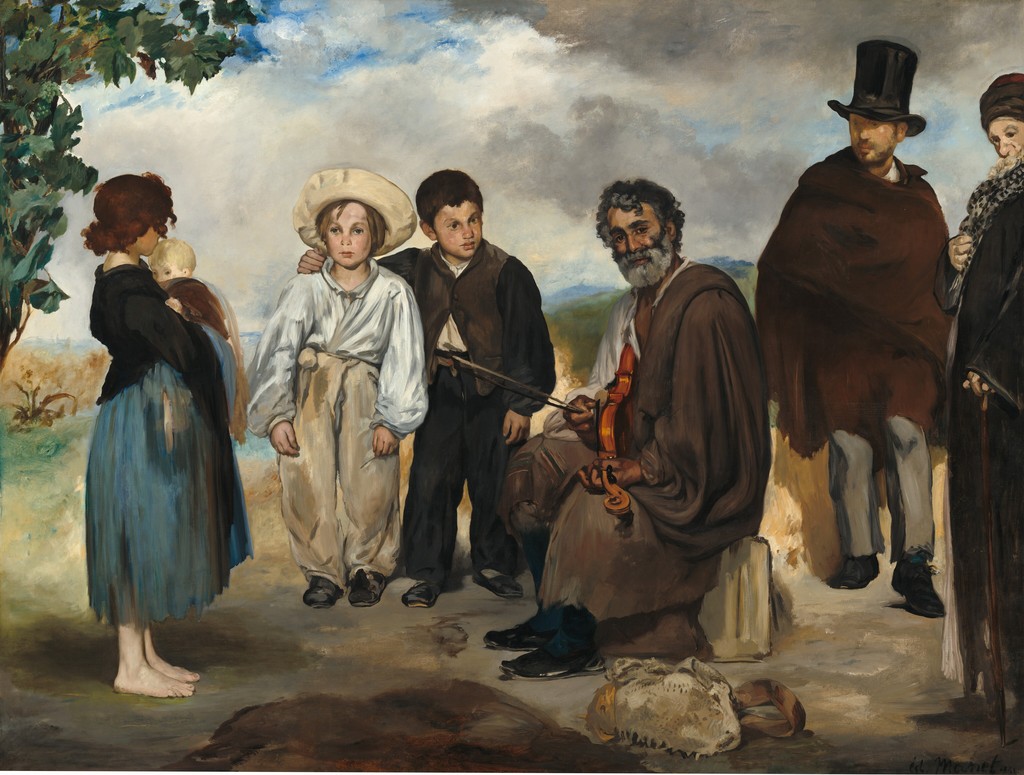
Édouard Manet, The Old Musician, 1862. National Gallery of Art, Washington, 1963.10.162. Chester Dale Collection. Image source. CC0 / Public domain. Whole supplied reproduction resized within native dimensions; no enlargement, retouching or colour alteration.
Annotated Details from The Ragpicker: Hat, Hands and Discarded Things
The numbered points identify visible features discussed in this article. Return from each detail to the whole composition. Each caption identifies the work shown.
The Ragpicker — Before Conservation
Édouard Manet, The Ragpicker, about 1865–1870. The Norton Simon Foundation, Pasadena, F.1968.09.P. This reproduction predates the 2018–19 conservation treatment. The Norton Simon Foundation; faithful reproduction via Wikimedia Commons. Image source. Public domain. Numbers added to a separate resized whole provided overview. These views predate the 2018–19 conservation treatment. Broad detail crops from the immutable original; no enlargement, retouching or colour alteration.
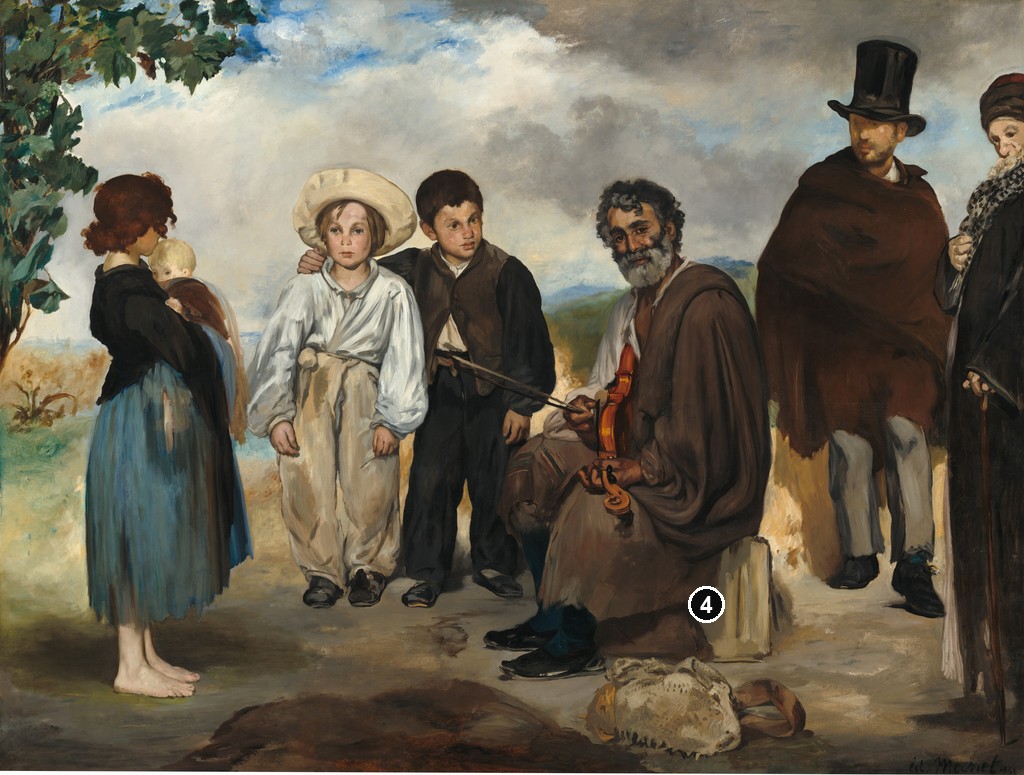
The Old Musician — Group Comparison
Édouard Manet, The Old Musician, 1862. National Gallery of Art, Washington, 1963.10.162. Chester Dale Collection. Image source. CC0 / Public domain. Numbers added to a separate resized whole provided overview. Detail crops from the immutable original; no enlargement, retouching or colour alteration.
Details from THE RAGPICKER: HAT, HANDS AND DISCARDED THINGS
Compare the hat and shoulder load, the two hands and staff, then the shoes and discarded things. This Ragpicker reproduction predates the 2018–19 conservation treatment.
The Ragpicker — Before Conservation
Hat, Face and Shoulder Load
The worn hat shades the face above the gathered dark load at the shoulder. This reproduction predates conservation in 2018–19.
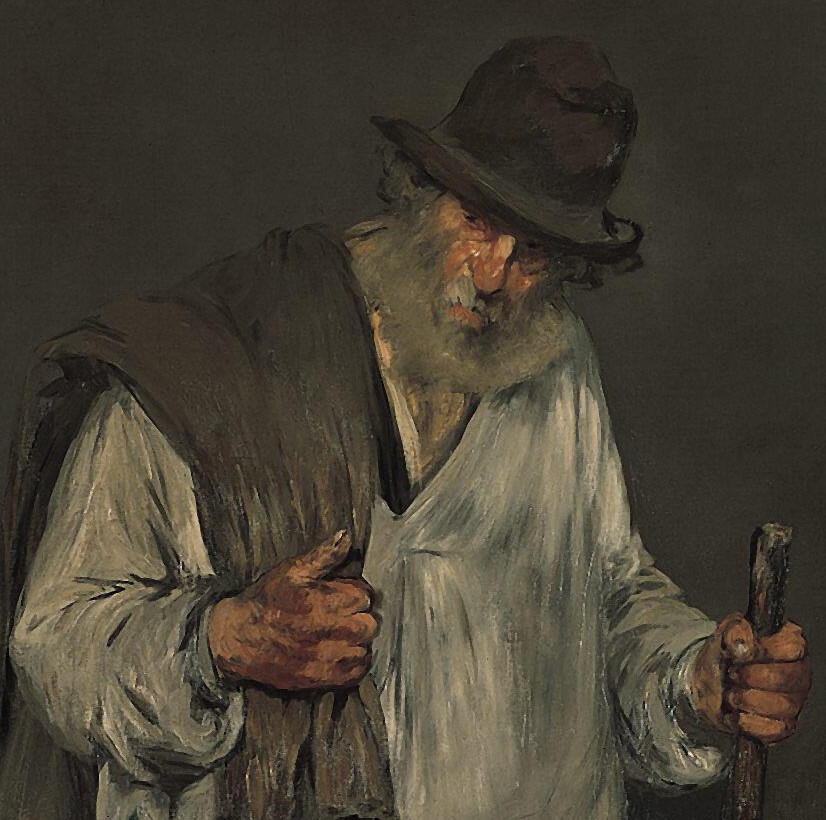
Two Hands and the Wooden Staff
One hand grips the shoulder load while the other closes around the staff beside the pale shirt.
Shoes and Discarded Things
The shoes and lower end of the staff stand above a small group of discarded objects near the original bottom edge.
The Old Musician — Group Comparison
The Musician among the Group
The earlier painting places the seated musician among neighbouring figures, with his violin and hands clearly visible.
Baudelaire's Ragpicker and the Poet
Charles Baudelaire's poem Le Vin des chiffonniers, or “The Ragpickers' Wine,” offers a contemporary literary counterpart. In its French text, a ragpicker moves through an old district and is compared to a poet. Wine transforms exhaustion and hardship into imagined grandeur, public triumph and generous schemes.[5]
The poem shifts between the weight of collected debris and the splendour of an inward vision. Its ragpicker acquires powers far beyond his ordinary circumstances. The comparison with a poet makes the act of transformation central: the person who handles what the city throws away also becomes someone capable of remaking the world in imagination.
That analogy provides a suggestive way into Manet's choice of subject. A painter, too, can discover possibilities in familiar or neglected things. The small still life shows how scraps can become an arrangement of colour and shape. The solitary worker becomes the organising presence of a monumental canvas.
The painting nevertheless creates its own encounter. Baudelaire supplies a moving figure, a night-time district and an expanding imaginative drama. Manet holds his man in a spare, largely undifferentiated space. Reading the poem alongside the picture can enrich their shared interest in the ragpicker while preserving the different means through which each work brings its subject before us.
Was the Painting Reworked Later?
The differences in paint across the figure have prompted a more complicated account of its making. For its 2019 exhibition, the Frick dated the canvas to about 1865–1871 and proposed that Manet probably returned to it in 1876–1877, during the ownership of Ernest Hoschedé.[4] This is a proposed later campaign, alongside the Norton Simon's dating of about 1865–1870.
The Frick's press account points to the vigorous cross-hatching of the face and hands, together with cracks indicating multiple paint layers, as evidence for work after an earlier surface had dried. It connects the possibility with Manet's visits to Hoschedé, although the precise timing remains uncertain.[6]
This proposal changes how we might read the apparent immediacy of the surface. The short, active touches on the hands can look like the product of a sudden decision. They may also belong to a return to a picture whose larger forms were already established. A lively mark can be part of a long history of reconsideration.
The evidence also encourages attention to the painting's unevenness. Hat, shirt, face and hands do not all make their effects in the same way. Their differences can be experienced directly, even while the exact sequence of painting remains a matter for interpretation and technical study. The canvas holds those distinct passages together through the body's continuous pose.
Conservation and the Visible Surface
The picture's later material history adds another layer to the encounter. During a collaboration between the Norton Simon Museum and the Getty's paintings conservation department in 2018–2019, Devi Ormond treated The Ragpicker. The museum's published account explains that analysis of its thick varnish revealed components that prevented complete removal of that layer.[7]
That finding is a useful reminder of what lies between a painted surface and the viewer. The appearance of old paint depends partly on later coatings and on decisions made during treatment. Here, conservation involved recognising a limit to removal, as well as investigating the picture's changing composition.
From the Studio to Pasadena
The museum's provenance records a sale to Durand-Ruel in 1871–1872 and subsequent ownership by Ernest Hoschedé. His 1878 sale listed the work as Le Mendiant, or “The Beggar.”[1] The Norton Simon Foundation acquired it from Wildenstein in 1968.[6]
The sale title is revealing beside Manet's four-philosopher grouping. “Ragpicker,” “beggar” and “philosopher” direct attention towards different aspects of the same figure: an occupation, a social category, an artistic tradition. The painting gives the man a presence that extends beyond any one of those names. His weight rests in the shoes; the cloth presses against his shoulder; his hands remain closed around the things he carries.
Artworks directory
Explore selected paintings, drawings and prints by Édouard Manet. Search by title or another recorded name.
Frequently Asked Questions
The Norton Simon Museum dates it to about 1865–1870.[1]
Ragpickers recovered useful materials from city waste, including cloth for paper manufacturers and other household castoffs.[1]
It belongs to The Norton Simon Foundation in Pasadena, accession F.1968.09.P.[1]
Discussion
Look again at the images and ideas explored in The Ragpicker by Édouard Manet. These editorial prompts invite your observations.
Reader Insights
Compare the pale shirt with the darker load across the shoulder. Notice where the outlines separate clearly and where they merge into the background.
Follow each hand towards the object it holds. How do the gathered cloth and the long staff give the standing body different directions?
Look from the figure’s shoes to the small arrangement of discarded objects near the lower edge. Compare their scale, colours and shadows.
Join the Conversation
Share a detail, comparison or question about The Ragpicker by Édouard Manet below.
References
- Norton Simon Museum, The Ragpicker, F.1968.09.P, collection record, commentary and provenance. View source.
- Theodore Reff, Manet and Modern Paris, National Gallery of Art, 1982, pp. 20 and 182. View source.
- Norton Simon Museum, Manet's Philosophers from the Art Institute of Chicago, exhibition announcement, 10 August 2021. View source.
- The Frick Collection, The Ragpicker, object commentary for Manet: Three Paintings from the Norton Simon Museum, 2019. View source.
- Charles Baudelaire, Le Vin des chiffonniers, Les Fleurs du mal, 1861 text, University of Tübingen. View source. (in French).
- The Frick Collection, Manet: Three Paintings from the Norton Simon Museum, press release, p. 4. View source.
- Norton Simon Museum, Conserving Manet Video Series, 10 February 2021. View source.
- Splash image, Édouard Manet, The Ragpicker, about 1865–1870. The Norton Simon Foundation, Pasadena, F.1968.09.P. This reproduction predates the 2018–19 conservation treatment. The Norton Simon Foundation; faithful reproduction via Wikimedia Commons. Image source. Public domain. Whole supplied reproduction resized within native dimensions; no enlargement, retouching or colour alteration.


