


 by Tom Gurney
Tom Gurney BSc (Hons) is an art history expert with over 20 years experience
Published on June 19, 2020 / Updated on October 30, 2026
Email: tomgurney1@gmail.com / Phone: +44 7429 011000
Self-Portrait with Palette by Édouard Manet: Introduction
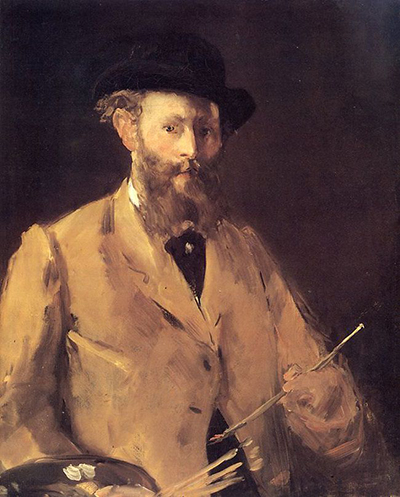
The black bowler and pale jacket announce a man ready to be seen. Then the eye reaches the lower edge: a palette, a handful of brushes and a loosely painted hand holding another brush across the body. Manet presents himself with the tools of his profession, while leaving the work he is making beyond our sight.
Painted about 1878–79, Self-Portrait with Palette brings together a recognisable face, an elegant public appearance and the visible activity of painting.[1] Its most intriguing passage is also its least settled: the hand responsible for making the picture seems to dissolve into the paint.
At a Glance
- ArtistÉdouard Manet
- DateAbout 1878–79.[1]
- MediumOil on canvas
- Dimensions85.5 × 71 cm, height × width, as catalogued by Sotheby's in 2010.[2]
- Alternative titlePortrait de Manet par lui-même, en buste (Manet à la palette)
- CollectionPrivate collection
- Related paintingSelf-Portrait, 1878–79, Artizon Museum, Tokyo.[3]
This work across Édouard Manet’s career
Contents
- A Rare Independent Self-Portrait
- The Face beneath the Bowler
- A Painter Dressed for Society
- Palette, Brushes and the Lower Edge
- Why Is the Brush Hand So Loosely Painted?
- Looking at Himself through a Mirror
- Velázquez and the Painter's Place in a Picture
- The Standing Self-Portrait in Tokyo
- How Many Self-Portraits Did Manet Paint?
- From Suzanne Manet to Later Collectors
A Rare Independent Self-Portrait
Manet painted many other people, but surviving independent oil portraits of himself are rare. The Artizon Museum identifies two: its standing figure in a small cap and this half-length portrait with a palette.[3] They offer different encounters with the same man at roughly the same stage of his life.
The palette picture is often dated 1879. Theodore Reff used that date in his 1982 catalogue, while noting that the canvas is neither signed nor dated. The Metropolitan Museum's 2023 Manet/Degas exhibition list places it about 1878–79.[1][4] That approximate dating allows for the uncertainty of an uninscribed painting.
Published measurements also differ. Reff gives 83 × 67 cm; Sotheby's 2010 catalogue lists 85.5 × 71 cm.[2][4] These are the measurements reported by the respective catalogues, and the later figure is used above with its attribution. The discrepancy does not change the identification of the picture: the bowler, buff jacket and painting tools distinguish it clearly from the Tokyo portrait.
Its half-length format brings us close enough to examine the face and clothing while keeping both hands within the lower part of the composition. The tools sit near the edge of our view. The person is immediately present; his activity emerges as we look down.
The Face beneath the Bowler
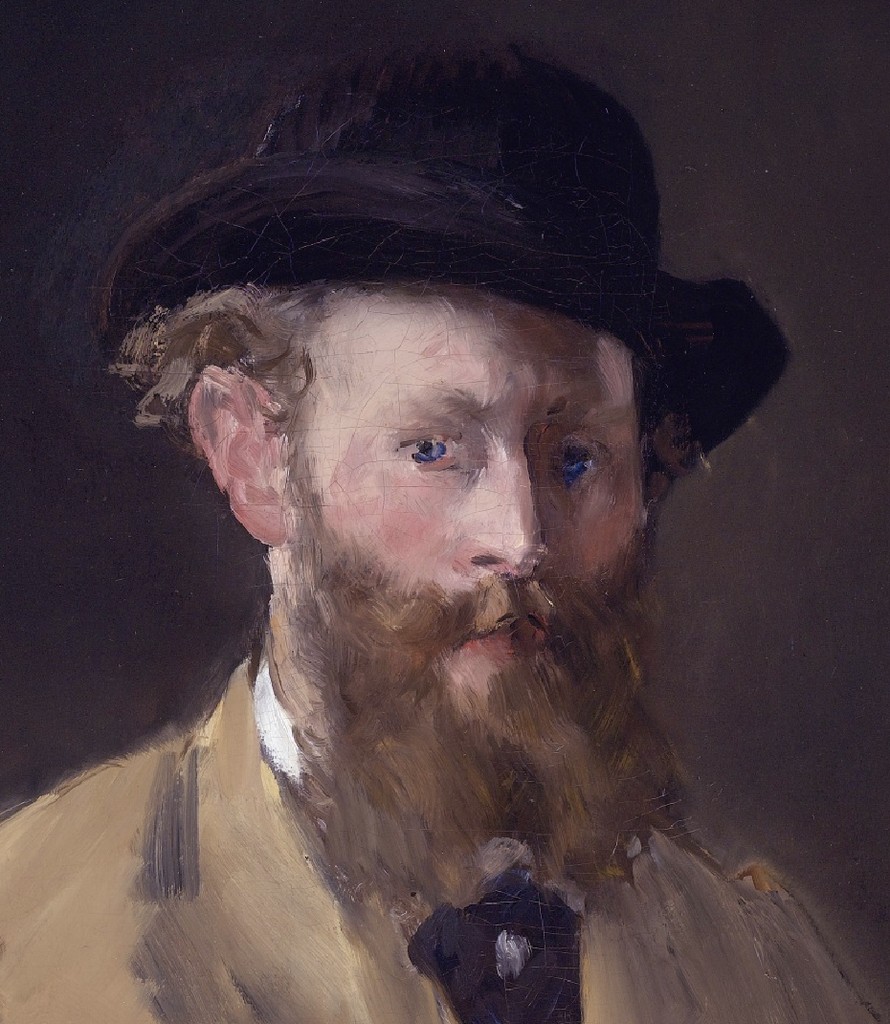
The hat is almost absorbed into the dark background. Its curved brim becomes clearer where it meets the forehead and projects at the right, giving the head a firm upper boundary. Small shifts between black, brown and grey keep it from becoming a single flat shape.
Beneath it, the forehead catches a broad light. Pink warms the ear and cheek on the viewer's left; cooler touches gather around the eyes and the shadowed side of the nose. The face turns slightly, so that the two eyes occupy unequal areas of light and shade. Their small dark and blue accents carry a remarkable amount of attention.
The beard extends the face downwards into the jacket's open neckline. Brown strokes separate and overlap, with lighter passages suggesting individual directions of growth. Around the mouth, small changes of colour make the lips emerge through the surrounding hair. The expression remains alert, although the exact thought behind it stays elusive.
Manet gives the face enough distinction to sustain a personal encounter. Yet the marks that describe it remain visible as marks. A pale stroke can be read as light on skin and, a moment later, as paint laid beside a darker stroke. That double awareness becomes more insistent in the jacket and hand, where the brushwork grows broader.
A Painter Dressed for Society
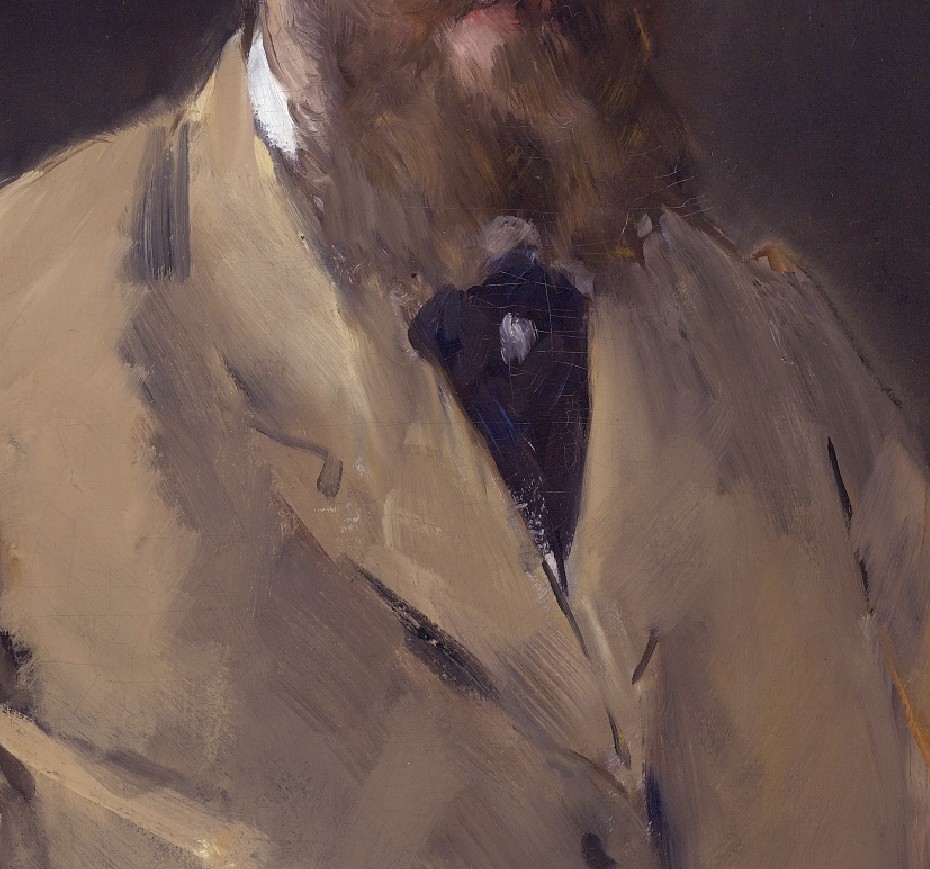
The buff jacket occupies a large proportion of the canvas. Against the dark ground, its shoulders and sleeves establish the body's breadth. The lapels descend towards a deep V, enclosing a black cravat, a narrow white collar and the small bright accent of a stickpin.
Those details matter because they give professional identity a particular social appearance. The brushes establish what Manet does; the clothes show how he chooses to present the person doing it. There is room for care over both the picture and the tie.
Reff describes the portrait as an image of the painter of modern Paris appearing as a fashionable Parisian. He also points out that smart clothing and a working pose occur together in other artist portraits, including Fantin-Latour's 1870 group portrait with Manet at work.[4] The jacket need not make the scene an implausible masquerade. It belongs to a tradition of representing artistic practice through a carefully composed personal appearance.
The clothing is painted with greater freedom than its tidy social message might suggest. Broad strokes travel diagonally across the chest and down the sleeves. Darker interruptions indicate a seam, a pocket opening or a fold, without describing every stitch. Near the waist, the buttons become compact dark touches against the warmer fabric.
Palette, Brushes and the Lower Edge
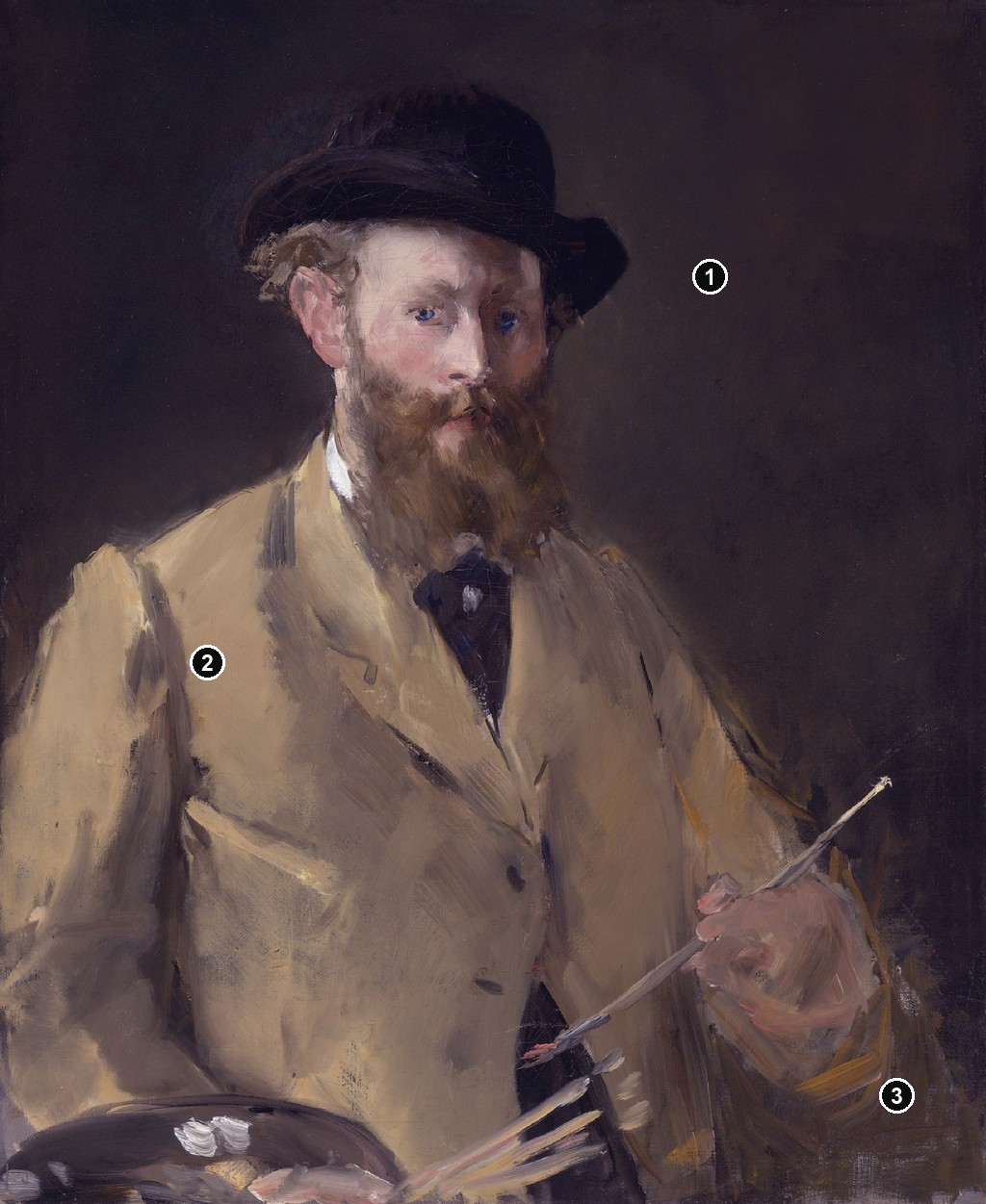
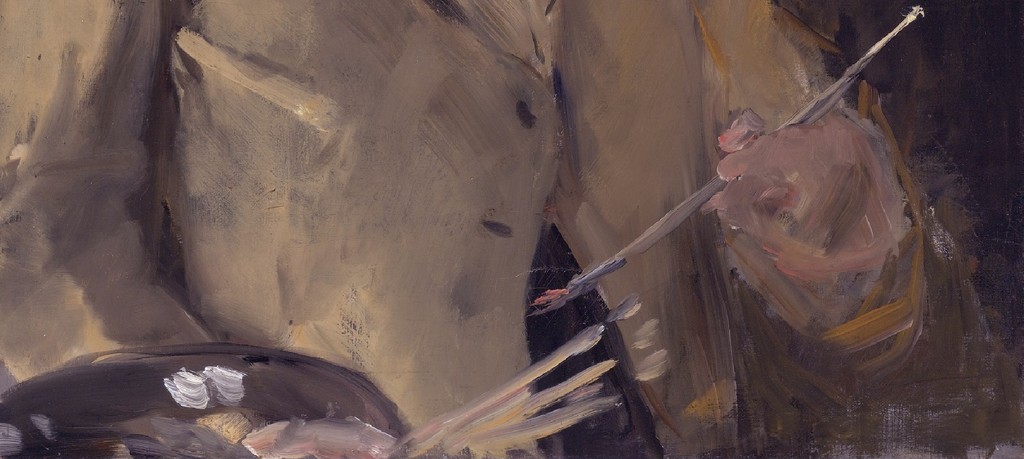
The palette enters at the bottom left as a dark curved shape. Light dabs of colour sit on its surface, and several brushes gather across the lower edge. Part of the supporting hand is cut off by the frame. These objects occupy a shallow foreground, close to where the viewer stands.
Their cropping makes them feel continuous with activity outside the picture. We see enough to understand the equipment without receiving a complete inventory of its arrangement. A brush can disappear beyond the edge while its shaft still directs the eye across the body.
The brush held on the viewer's right provides the strongest diagonal among these tools. It crosses the broad area of the jacket and rises towards the dark ground. Its narrow line differs from the softer boundaries of fingers and fabric around it, making the act of holding something clearer than the exact anatomy of the grip.
The paint dabs on the palette also make a small visual argument. Light colour lies upon a dark support inside a picture where light strokes have been spread over a dark surrounding field. The equipment of painting is itself made out of the same coloured substance that describes the person using it.
No easel or canvas identifies the work in progress. Nothing in the background supplies a studio address, a model's name or a particular subject. The few visible tools carry the professional story, allowing the large, spare area around the figure to remain open.
Annotated Details from Self-Portrait with Palette: Face, Clothes and Tools
The numbered points identify visible features discussed in this article. Return from each detail to the whole composition. Each caption identifies the work shown.
Self-Portrait with Palette
Édouard Manet, Self-Portrait with a Palette, about 1878–79. Private collection in the published records. Faithful reproduction via The Yorck Project / Wikimedia Commons. Image source. Public domain. Numbers added to a separate resized whole supplied overview. Detail crops from the unchanged original; no enlargement, retouching or colour alteration.
Self-Portrait — Artizon Standing Painting
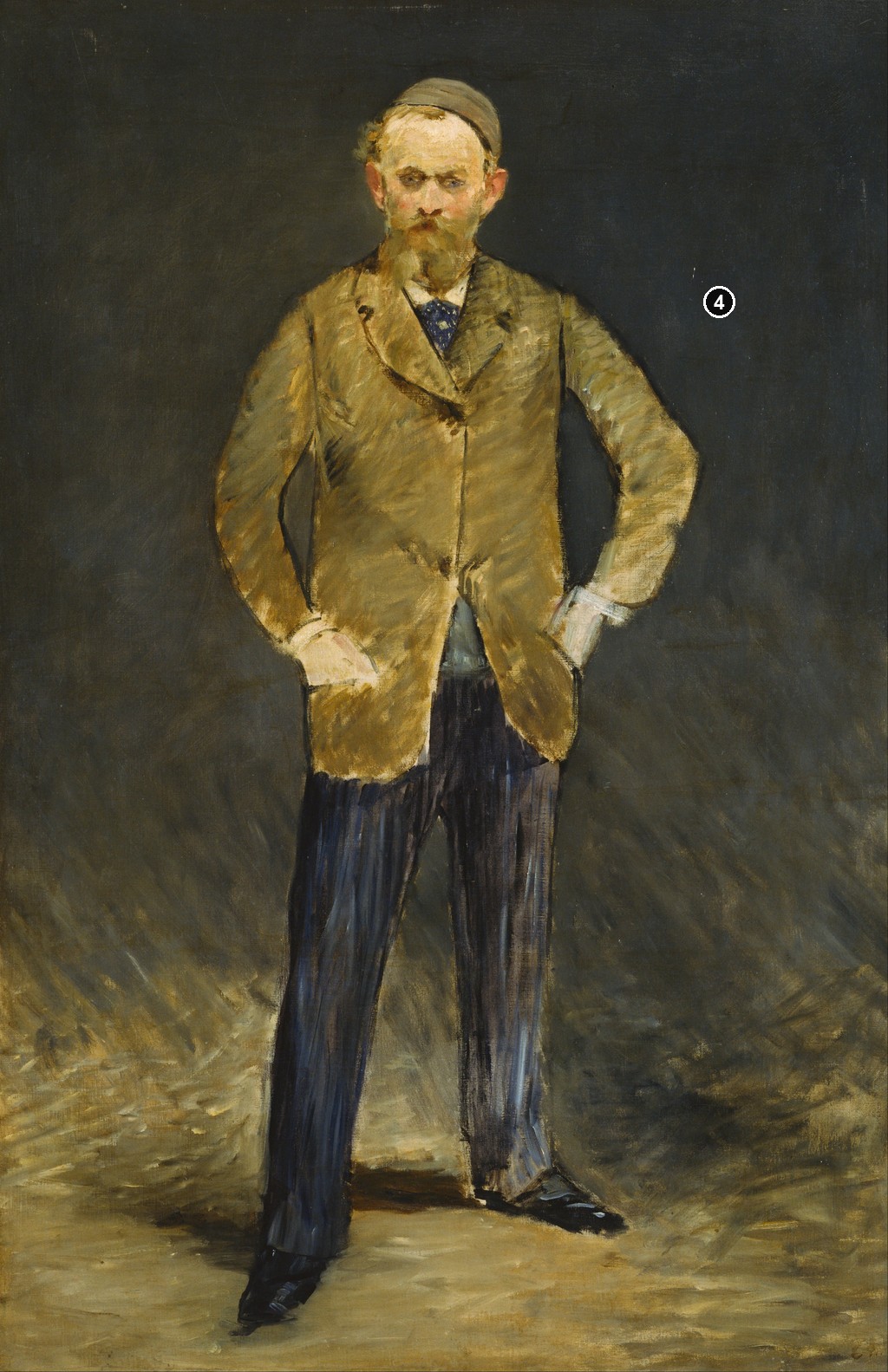
Édouard Manet, Self-Portrait, 1878–79. Artizon Museum, Ishibashi Foundation, Tokyo. A separate standing portrait from the palette painting. Artizon Museum / Google Art Project, via Wikimedia Commons. Image source. Public domain. Numbers added to a separate resized whole supplied overview. Detail crops from the unchanged original; no enlargement, retouching or colour alteration.
Details from SELF-PORTRAIT WITH PALETTE: FACE, CLOTHES AND TOOLS
Move from the bowler and face to the cravat and painting tools, then compare the separate standing self-portrait at Artizon.
Self-Portrait with Palette
Bowler, Face and Beard
The dark bowler surrounds a pale face, with the beard extending towards the open jacket.
Lapel, Cravat and Stickpin
The buff lapels frame a dark cravat and its small pale stickpin.
Brush Hand, Palette and Tools
The loosely painted hand holds a diagonal brush above the palette and other tools cut by the original lower edge.
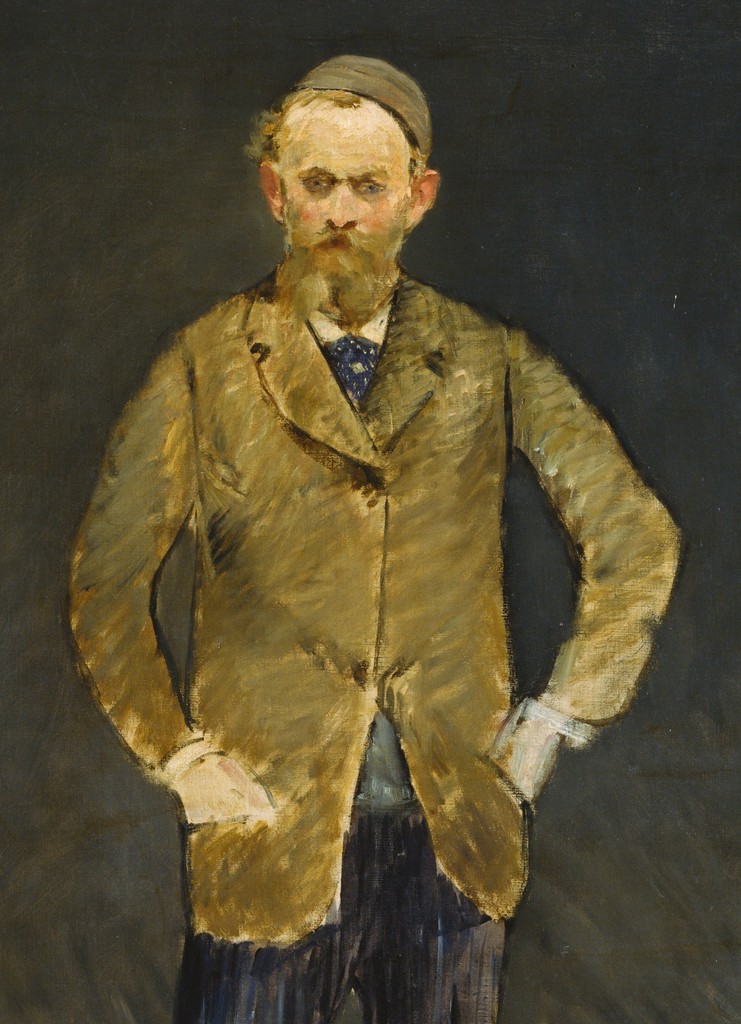
Self-Portrait — Artizon Standing Painting
Cap, Jacket and Hands at the Pockets
In the separate standing self-portrait, the small cap and hands at the pockets give the body a different attitude.
Why Is the Brush Hand So Loosely Painted?
The hand holding the brush is much less fully articulated than the face. Pink and brown passages suggest its bulk, with pale and darker strokes indicating fingers. At some points the form seems to merge with the surrounding sleeve. The brush shaft supplies a more continuous line than the flesh wrapped around it.
That difference invites a longer look. The face, through which we recognise Manet, is relatively settled. The hand, through which he makes himself recognisable, appears still to be taking shape. A portrait of a painter can therefore draw attention to the difficulty of showing the very action that produces it.
The art historian Victor Ieronim Stoichita develops this reading in his discussion of Manet's self-representation. He treats the hand's unfinished appearance as a way of keeping the act of painting in progress: at the point where the artist represents his working hand, the image returns attention to its own making.[5]
That is an interpretation of the picture's effect, rather than a surviving explanation by Manet. The visible looseness establishes a contrast of finish; it cannot by itself tell us whether he intended a philosophical statement, stopped work at a particular moment or wanted to suggest motion. The interest lies in how the contrast operates when we look.
Try following the picture in both directions. From the eyes downwards, the forms gradually loosen into broader strokes. From the tools upwards, those strokes gather into an individual face. The same surface can lead from a person to the means of painting him, or from coloured material to a person.
Looking at Himself through a Mirror
A self-portrait asks the artist to occupy two positions: the person looking and the person being looked at. The arrangement of Manet's tools is consistent with a reversed mirror image. Stoichita makes that reversal central to his account of the painting.[5]
The mirror is not actually shown. Instead, it offers a way to understand how a painter could observe his own face and body while working. We can imagine attention moving between the reflected figure and the painted surface, although the exact arrangement of Manet's working space remains unknown.
This helps explain the portrait's unusual address. The eyes appear to meet ours, but their direction also belongs to the artist's study of himself. Looking at the painting, we enter the line of sight through which the face became an image. The encounter can feel direct even though a reflective surface may have mediated it.
Stoichita also stresses the economy of the setting. Manet leaves out the studio and the other participants that might explain a painter's activity, concentrating on figure, gaze and tools.[5] The viewer supplies the connection between them.
Velázquez and the Painter's Place in a Picture
Reff connects Manet's pose with the figure of Diego Velázquez in Las Meninas.[4] Painted in 1656 and now in the Prado, Velázquez's picture includes its own painter standing at work beside a large canvas within a courtly interior.[6] It gives the artist a visible place among the people and activities he represents.
The comparison concerns more than a shared palette. In both pictures, the painter turns towards a space beyond the painted scene while holding the equipment of his profession. The look and the tools make us aware of an act taking place across the picture's boundary. We see a painter attending to something we cannot fully see.
Manet's treatment is far more concentrated. He removes the surrounding company and architectural setting, bringing the half-length body forward against a dark field. The painting becomes a meeting with one person, with very little depicted space to distract us from his face, clothing and working hand.
Reff reads the relationship as part of Manet's identification with the Spanish master: a modern Parisian painter finding a precedent for his own professional image in the great painter of Madrid.[4] It is a useful account of artistic self-presentation, without requiring every detail of Manet's pose to reproduce Velázquez's.
The difference in setting also changes the role of clothing. Velázquez appears within the world of the Spanish court. Manet's bowler and cravat bring his image into the visual world of contemporary Paris. A familiar painterly role acquires a modern wardrobe, and the spare background lets that wardrobe carry much of the social context.
The Standing Self-Portrait in Tokyo
The Artizon Museum's Self-Portrait, dated 1878–79, extends the figure from cap to shoes. Manet stands with his hands at his pockets, wearing a warm ochre jacket and dark striped trousers. A small cap replaces the broad-brimmed bowler. There are no painting tools.[3]
The longer format gives the body a different presence. We can follow the jacket down to its opening above the trousers, the long vertical stripes and the feet set apart on a broadly brushed ground. Space around the figure allows the stance itself to become a subject of attention.
The palette portrait cuts much of that information away. Its closer view increases the relative importance of the head and chest, while the hands acquire a specific task. In Tokyo, the hands help establish a standing attitude. Here, they make an occupation visible.
The two paintings share a contrast between the more concentrated face and the broader handling of clothing. In the standing portrait, diagonal strokes cross the jacket while the stripes pull the eye down the legs. In the palette portrait, the jacket's broad light area leads towards the tools gathered below it. Similar means support different arrangements of the body.
Artizon interprets its painting in terms of the pride and resolve of an established artist, and explains the reversed jacket fastening through the use of a mirror.[3] That account can enrich the comparison, while the faces themselves remain open to more than one emotional reading. Neither posture supplies a complete private biography.
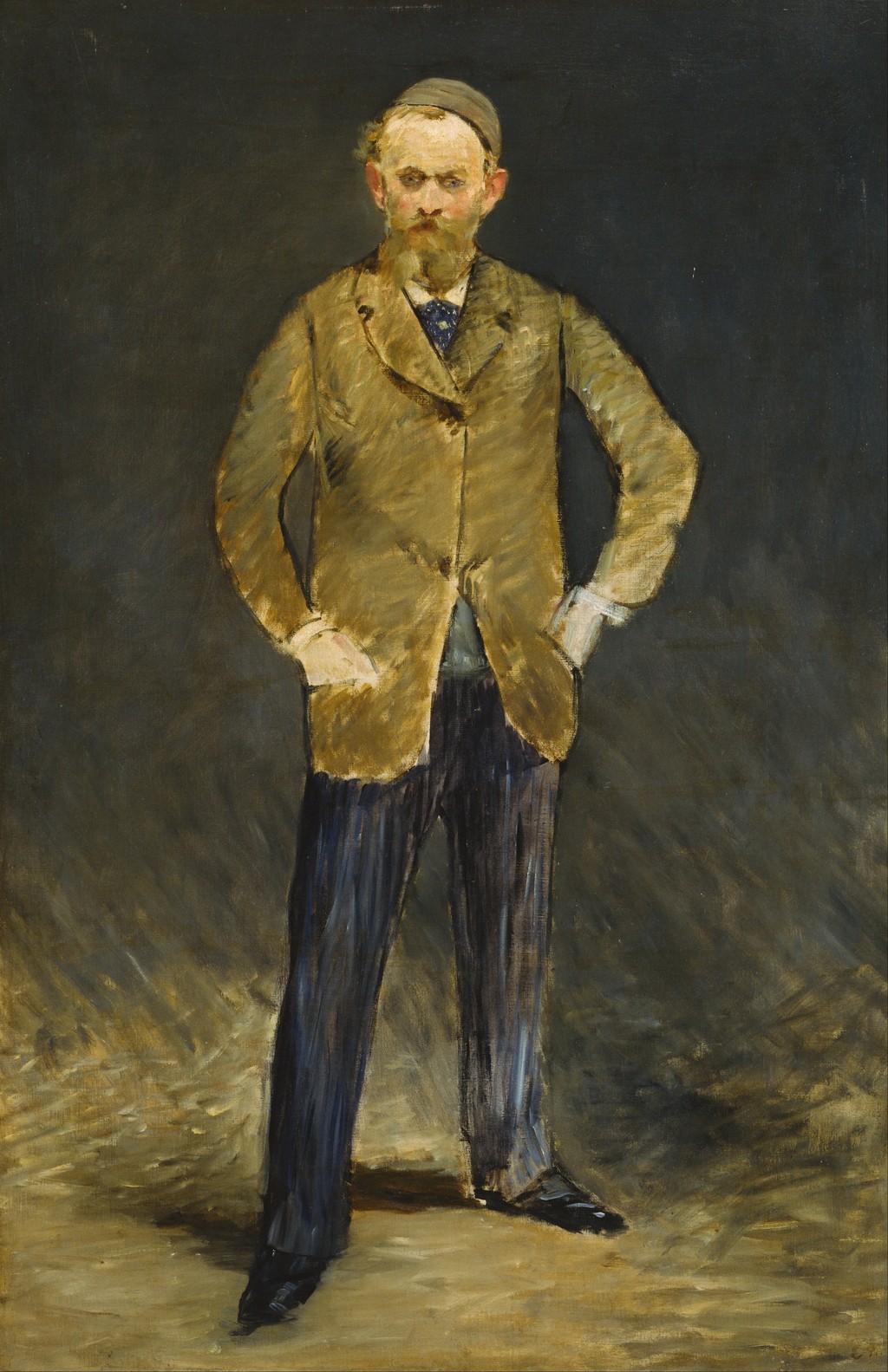
Édouard Manet, Self-Portrait, 1878–79. Artizon Museum, Ishibashi Foundation, Tokyo. A separate standing portrait from the palette painting. Artizon Museum / Google Art Project, via Wikimedia Commons. Image source. Public domain. Whole supplied reproduction resized within native dimensions; no enlargement, retouching or colour alteration.
How Many Self-Portraits Did Manet Paint?
The familiar answer of two refers to the surviving independent oil portraits described by Artizon.[3] A broader history of Manet's self-representation includes appearances within larger compositions, among them the figure discussed by Reff in Music in the Tuileries.[4] The category changes when the artist enters a crowd instead of making himself the independent subject.
Differences of finish can affect the count as well. Stoichita concentrates on the palette picture as the independent self-portrait and explains in a note that he regards the Tokyo canvas as an ébauche, or sketch.[5] His distinction concerns the kind and degree of completion he assigns to the work. Artizon presents the standing painting as a self-portrait in its collection.
These approaches help explain why accounts can sound inconsistent even when they discuss the same paintings. For a reader looking at Manet's image of himself, both oils repay attention. Their different formats, tools and handling show how much can change within the apparently straightforward act of painting one's own likeness.
From Suzanne Manet to Later Collectors
The provenance published by Sotheby's in 2010 begins with Suzanne Manet, who inherited the picture from her husband. It passed to Hermann Paechter in 1899 and was in Auguste Pellerin's collection by 1902. Later owners included the Marquise de Ganay and Jakob Goldschmidt.[2]
The same catalogue records its sale from Goldschmidt's collection in London in 1958 to John and Frances L. Loeb, followed by a New York sale in 1997 and ownership by Stephen A. Wynn. Its final listed transfer is to an unnamed owner before the 2010 auction.[2] That sequence documents a history of private collecting; it does not identify a current owner or a place where the picture can routinely be visited.
The portrait appeared in the Metropolitan Museum's 2023 Manet/Degas exhibition list.[1] Such loans allow an image usually associated with a private collection to enter a wider conversation about the artist. It can be considered alongside the people he painted, the artists who painted him and the larger body of his paintings.
The brush hand remains difficult to separate into finished fingers, yet its task is unmistakable. Manet's likeness holds our attention while the paint keeps reminding us how that likeness was made.
Artworks directory
Explore selected paintings, drawings and prints by Édouard Manet. Search by title or another recorded name.
Frequently Asked Questions
The Met’s Manet/Degas exhibition listing dates it to about 1878–79.[1]
No. Artizon’s 1878–79 Self-Portrait shows Manet standing from cap to shoes without painting tools; it is a separate canvas.[3]
Sotheby’s catalogued it in 2010 as 85.5 × 71 cm, height × width.[2]
Discussion
Look again at the images and ideas explored in Self-Portrait with Palette by Édouard Manet. These editorial prompts invite your observations.
Reader Insights
Compare the concentrated marks around the eyes and beard with the broader strokes across the jacket. Where does the degree of detail change most sharply?
Follow the brushes towards the loosely painted hand and the palette near the lower edge. Notice how the tools remain recognisable through a few bright accents.
Look between this bust portrait and the standing self-portrait in Tokyo. Compare the hats, positions of the hands and amount of surrounding space.
Join the Conversation
Share a detail, comparison or question about Self-Portrait with Palette by Édouard Manet below.
References
- Metropolitan Museum of Art, Manet/Degas: exhibition objects, 2023, entry for Portrait of the Artist (Manet with a Palette), ca. 1878–79. View source.
- Sotheby's, Portrait de Manet par lui-même, en buste (Manet à la palette), Impressionist & Modern Art Evening Sale, London, 2010, lot 9, description and provenance. View source.
- Artizon Museum, Ishibashi Foundation, Édouard Manet, Self-Portrait, collection record and commentary, 1878–79. View source.
- Theodore Reff, Manet and Modern Paris, National Gallery of Art, 1982, pp. 29–30, catalogue entry 1. View source.
- Victor Ieronim Stoichita, “Manet raconté par lui-même”, Annales d'Histoire de l'art et d'Archéologie, no. 13, 1991; republished by Koregos, 2014, section “Autoreprésentation” and note 16. View source. (in French).
- Museo Nacional del Prado, Diego Velázquez, Las meninas, collection record, 1656. View source. (in Spanish).
- Splash image, Édouard Manet, Self-Portrait with a Palette, about 1878–79. Private collection in the published records. Faithful reproduction via The Yorck Project / Wikimedia Commons. Image source. Public domain. Whole supplied reproduction resized within native dimensions; no enlargement, retouching or colour alteration.


