



 by Tom Gurney
Tom Gurney BSc (Hons) is an art history expert with over 20 years experience
Published on June 19, 2020 / Updated on October 30, 2026
Email: tomgurney1@gmail.com / Phone: +44 7429 011000
The Swallows by Édouard Manet: Introduction
Two women sit in a green field while dark birds skim the open space beside them. Their spreading clothes occupy the foreground, but windmills, grazing cattle and a distant village draw the eye beyond the figures. Édouard Manet painted The Swallows in 1873.[1] The scene gives an intimate family group an expansive setting: the women are close together, while the landscape seems to continue far outside their attention.
At a Glance
- ArtistÉdouard Manet
- TitleThe Swallows / Les Hirondelles
- Date1873
- MediumOil on canvas
- Dimensions65 × 81 cm
- CollectionEmil Bührle Collection, on long-term loan at Kunsthaus Zürich
- InventoryBU 0059.[1]
- Catalogue numberRW I190.[1]
This work across Édouard Manet’s career
Contents
- A Family Group in the Grass
- The Field Opens Out
- Why the Birds Matter
- Another View from Berck
- A Question of Finish
- Looking Back to Landscape Painting
- The Painting in Zurich
- Annotated details
A Family Group in the Grass
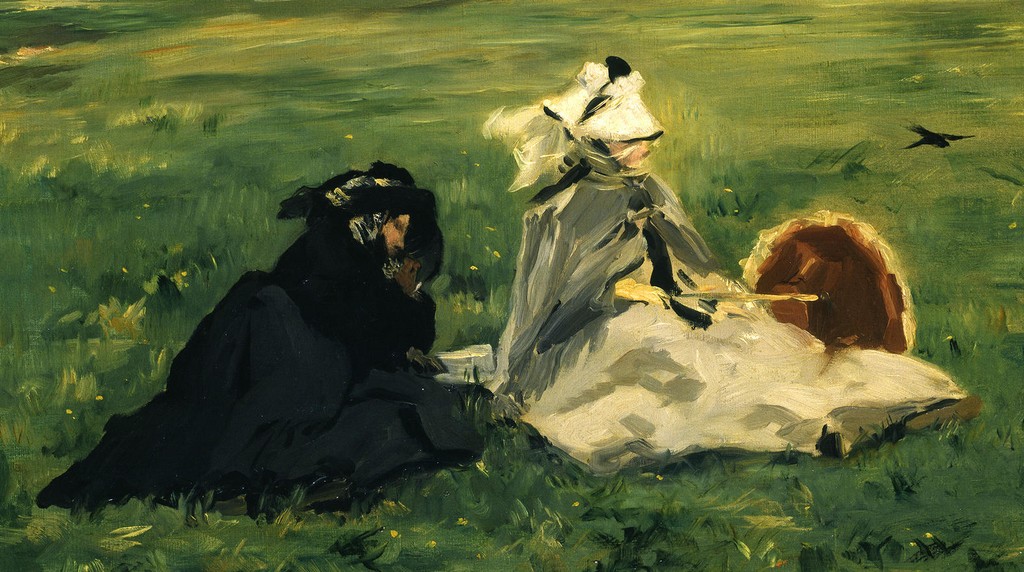
The woman in black sits low at the left, her bent head partly concealed by a broad dark bonnet. A pale rectangular shape near her lap suggests an open book. Beside her, the other woman turns towards the right, with her face screened by a large pale bonnet and its hanging fabric. Their bodies overlap, although their attention appears to move in different directions.
Théodore Duret identified the women as Manet's mother and wife. Writing retrospectively in 1906, he also remarked on their small proportions within what he considered almost a pure landscape.[2] The mother occupies the dark shape at the left; Suzanne Manet is the pale-clothed figure beside her.
Their clothes establish a strong difference of tone without creating two isolated blocks. Small light marks interrupt the mother's bonnet and the edge of her sleeve. Suzanne's apparently white dress contains extensive grey passages, with warmer cream and yellow across its illuminated folds. Both costumes are varied within their broad areas of darkness and light.
Suzanne's skirt spreads to the right and turns back towards the other woman. Long diagonal strokes give some folds a definite direction; neighbouring areas merge into softer patches. The edge alternately stands out against the grass and disappears among its broken marks. This uneven boundary makes the dress feel embedded in its surroundings.
The parasol introduces another kind of shape. Its warm brown interior forms a curved patch beside Suzanne, and the slender handle extends across her lap. Against the dress's irregular folds, its rounded outline looks relatively firm. The parasol brings warm colour into the green field, close to the brightest part of the group.
The women provide a place from which to explore the painting. Their overlapping skirts gather several strong directions near the lower edge. Following those directions outwards, the eye moves into the long strokes of grass and towards the small shapes scattered farther away.
The Field Opens Out
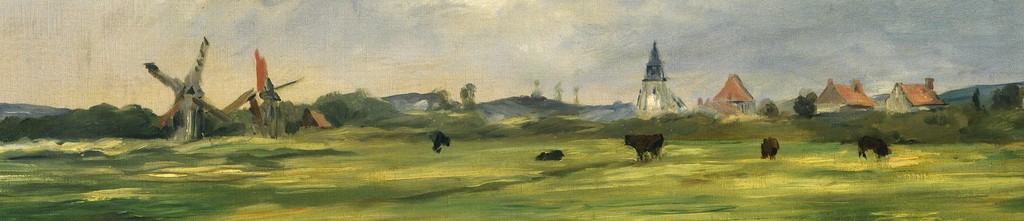
Between the seated women and the village, a broad interval of green gives the landscape much of its spaciousness. Strips of yellow-green cross darker passages, and scattered upright touches break the surface closer to the foreground. The marks vary enough to suggest an uneven field while preserving its broad horizontal sweep.
The cattle occupy this middle distance as separated dark shapes. Some stand more upright; another appears as a low horizontal mass against the grass. They introduce a further scale between the nearby women and the buildings. Their small bodies make the field seem deeper without requiring every contour to be fully described.
At the left, the windmills interrupt the low horizon. Angular sails extend from their narrow structures, making slants that stand apart from the flatter surrounding land. Farther right, a pale church rises to a dark pointed spire. Red roofs and light walls continue the village across the picture, with dark greenery breaking up the spaces between buildings.
These distant forms are compact and economical. A roof can be made legible through its warm triangular patch and the lighter wall beneath it; the church depends on a few strong changes between pale and dark. Their visibility comes partly from the open sky behind them. The horizon remains low enough to leave the buildings surrounded by a large area of atmosphere.
The sky occupies much of the upper picture. Grey-blue clouds spread in loose bands around cream-coloured openings, and the changes between them are often soft. Beneath this expansive movement, the village and cattle look comparatively settled. The painting holds together several kinds of activity: the broad drift of cloud shapes, the broken field, the angular mills and the still seated figures.
Why the Birds Matter
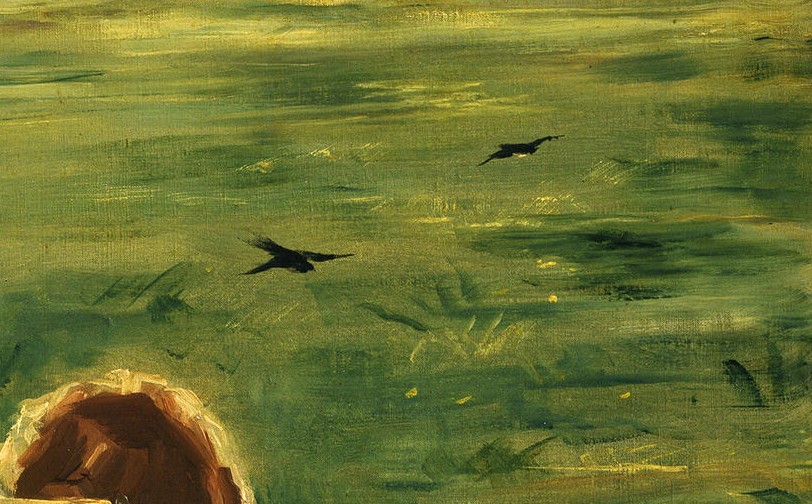
The title directs attention towards some of the smallest forms in the scene. The swallows are dark, sharply angled silhouettes over the grass to the right of the women. Their separation from the cattle matters: the birds appear suspended across the open field, while the heavier animals belong to its surface.
Their wing shapes add quick changes of direction to the longer strokes around them. One dark body cuts across a relatively light area; another spreads its wings above a darker green passage. They are easy to pick out once noticed, yet they occupy very little of the painted surface.
The birds also encourage the eye to move away from the family group. Looking between their scattered silhouettes, we become aware of the amount of open space beside Suzanne. That space would still be present without them, but their small interruptions make it more active. The title gives these passing forms a prominence that their size alone could scarcely command.
Another View from Berck
Rouart and Wildenstein place The Swallows at Berck-sur-Mer during the summer of 1873.[3] Manet also painted On the Beach there that year. In that canvas, now at the Musée d'Orsay, Suzanne sits reading beside the reclining Eugène Manet, the artist's brother.[4]
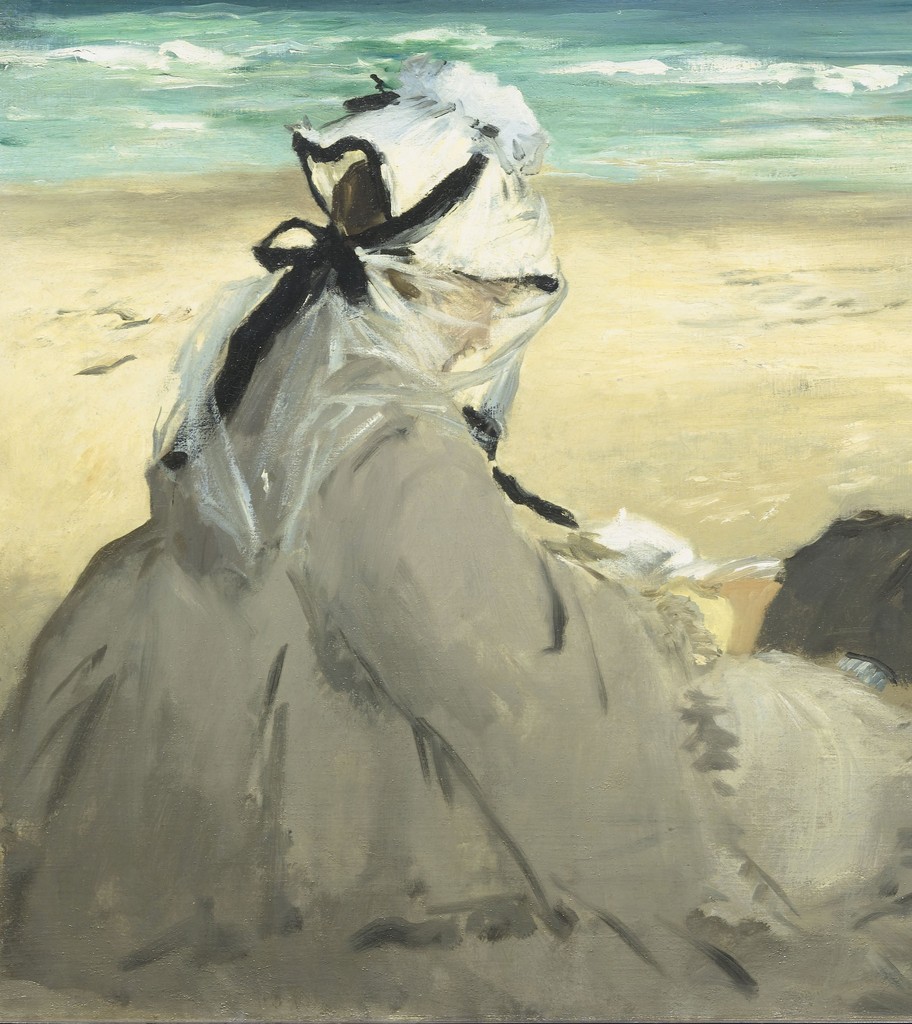
The comparison changes our sense of scale. In On the Beach, Suzanne's pale clothing fills much of the left foreground. Her companion's reclining body extends across the right, leaving a comparatively narrow setting of sand, water and distant boats around them. In The Swallows, the two women gather into a smaller area beneath the broad field and sky.
Both pictures make pale and dark clothes into substantial shapes. Yet those shapes have different relationships with the surroundings. The beach painting brings its figures close, with horizontal bands of water rising behind them. The field opens away from the women through the cattle towards a village. Looking from one canvas to the other makes clear how much a change of proportion can alter the experience of a place.
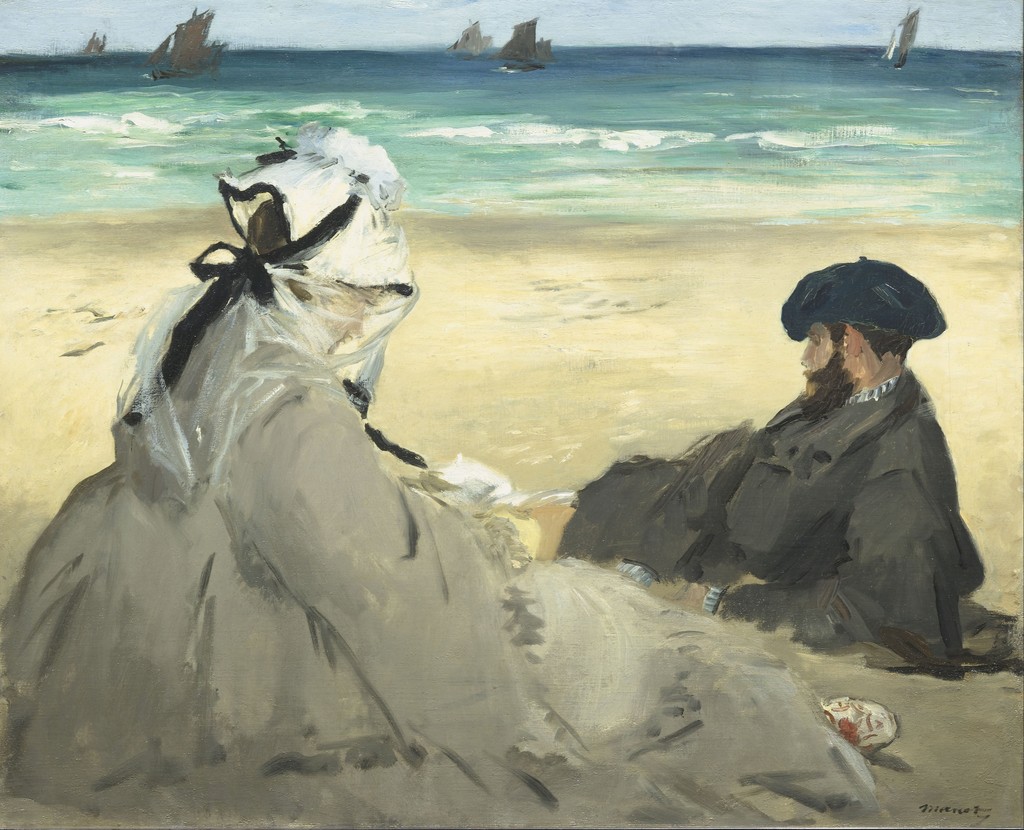
Édouard Manet, On the Beach, 1873. Musée d’Orsay, RF 1953 24. Musée d’Orsay / Google Art Project via Wikimedia Commons; faithful reproduction, PD-Art / Public Domain Mark. Image source. Public domain. Whole supplied reproduction resized for web display. No enlargement or retouching.
Annotated Details from The Swallows
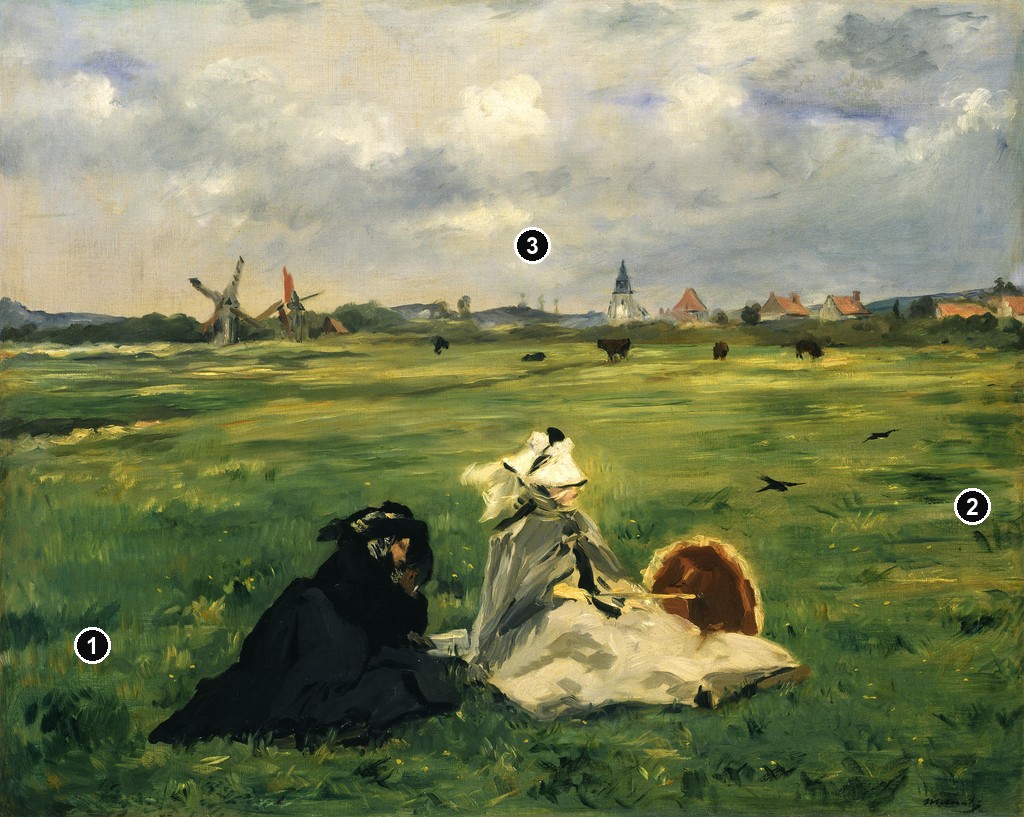
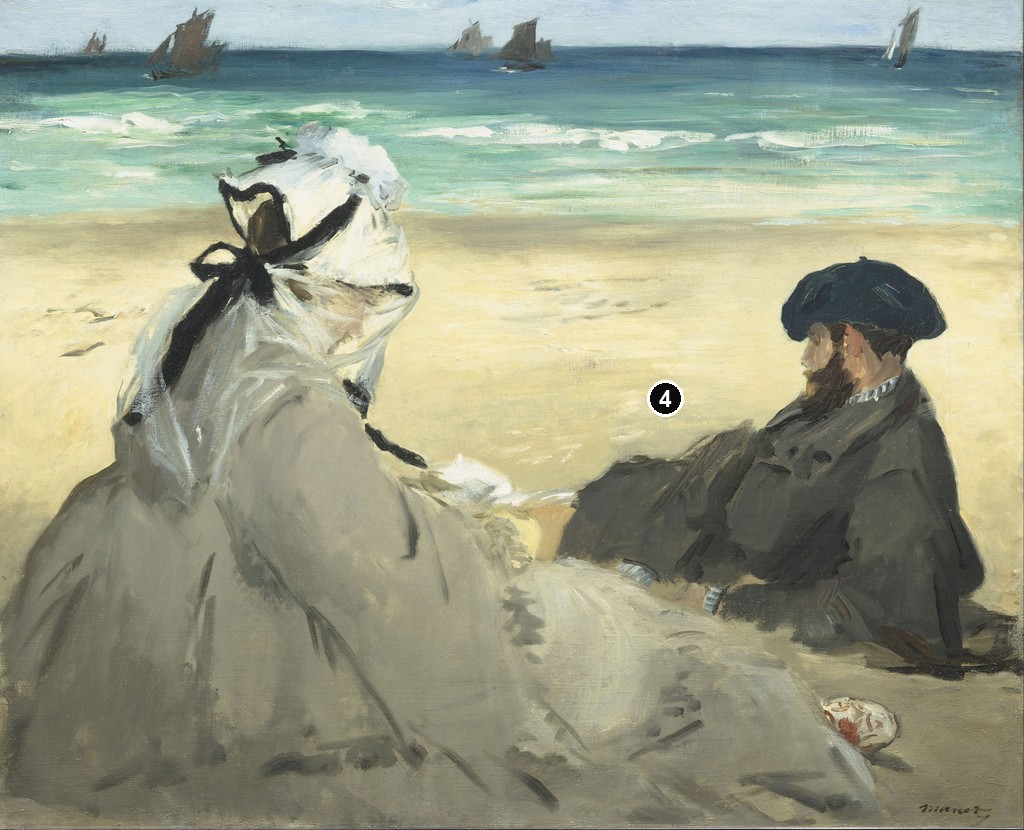
The numbered points identify visible features discussed in this article. Return from each detail to the whole composition. Each caption identifies the work shown.
The Swallows
Édouard Manet, The Swallows, 1873. Emil Bührle Collection, on long-term loan at Kunsthaus Zürich, BU 0059. Faithful public-domain reproduction via Wikimedia Commons; PD-Art / Public Domain Mark. Image source. Public domain. Numbers added to a separate resized overview. Detail crops from the supplied public-domain reproduction; no enlargement or retouching.
On the Beach
Édouard Manet, On the Beach, 1873. Musée d’Orsay, RF 1953 24. Musée d’Orsay / Google Art Project via Wikimedia Commons; faithful reproduction, PD-Art / Public Domain Mark. Image source. Public domain. Numbers added to a separate resized overview. Detail crops from the supplied public-domain reproduction; no enlargement or retouching.
Details from THE SWALLOWS
Look closely at the two women and parasol, the birds over the field, and the distant mills and village. Then compare Suzanne’s larger figure in On the Beach.
The Swallows
Two Women and the Parasol
Manet’s mother sits at the left in dark clothing. Suzanne’s pale dress spreads beside her, with the warm interior of the parasol to the right.
Birds over the Open Field
Dark wing shapes cut across the green field. Their scattered positions make the open space beside the women more active.
Mills Cattle and Village
Angular windmill sails interrupt the low horizon. Cattle occupy the field below, while a pale church and red roofs stand against the sky.
On the Beach
Reading on the Beach
Suzanne’s pale dress fills much of this view. Her book lies near the centre, while bands of sea remain visible behind her bonnet and shoulders.
A Question of Finish
The apparently informal scene became part of a public dispute over painting. The Swallows was rejected by the Salon jury in 1874.[3] Stéphane Mallarmé responded in an article published on 12 April. He discussed it alongside the rejected Masked Ball at the Opera and the accepted Railway, questioning the jury's treatment of Manet's work.[5]
Mallarmé's account begins with the impression of open air. He treats the women as subordinate elements within a much larger space and draws attention to the harmony between their clothes and the afternoon atmosphere. His description helps explain why a picture containing two recognisable family members can nevertheless make the landscape its dominant experience.[5]
He then addresses the objection that the work is insufficiently finished. For Mallarmé, the agreement among its parts already gives the painting coherence; an added touch could damage the balance that makes it compelling. He challenges the assumption that a higher degree of minute description necessarily produces a better picture. His larger argument concerns the public's opportunity to encounter modern painting and judge it for themselves.[5]
The clothes and grass offer a concrete way to consider his defence. Across Suzanne's skirt, a dark stroke can describe a fold without enclosing it completely. Nearby, loose green marks give the ground a restless surface. The two passages use different colours and directions, but they share a visible economy of means. Their relationship matters as much as the information contained in either one.
The same question arises at the horizon. The church and roofs remain recognisable despite their abbreviated forms, and the clouds have room to spread around them. A more insistent outline everywhere would change these relationships, making distant buildings compete more strongly with the foreground. Mallarmé's defence invites us to look at how the existing marks work together across the entire canvas.
Looking Back to Landscape Painting
The windmills, low land and expansive sky also connect the scene with an older landscape tradition. In its 2019 presentation of the Bührle collection, the Musée Maillol paired The Swallows with Aelbert Cuyp's seventeenth-century Storm over Dordrecht. The curators used the comparison to explore connections between Manet and the old masters.[6]
Here, the buildings and cattle establish a broad countryside setting, while the women's enveloping clothes bring a conspicuous human presence into the foreground. The dress and bonnet shapes hold their own against the mills and cloud banks. The result allows small, familiar activities to belong within a much larger view.
The Painting in Zurich
Albert Hecht owned the painting from 1873; Mme Hecht is documented by 1902 and at least until 1936. Kunsthaus records unknown whereabouts before Georges Wildenstein's ownership by 1953. Emil Bührle acquired it on 4 August that year. It entered the foundation in 1960 and has been on loan at Kunsthaus Zürich since 2021. The museum's published provenance, with a research date of 31 December 2021, remains under review.[1]
Artworks directory
Explore selected paintings, drawings and prints by Édouard Manet. Search by title or another recorded name.
Frequently Asked Questions
Manet's mother, in dark clothing at left, and his wife Suzanne, in pale clothing beside her.[2]
In the Emil Bührle Collection, on long-term loan at Kunsthaus Zürich, inventory BU 0059.[1]
The title refers to the small dark birds flying across the field beside the women.[2]
Discussion
Look again at the images and ideas explored in The Swallows by Édouard Manet. These editorial prompts invite your observations.
Reader Insights
Compare the size of the seated women with the field and the large area of sky above them.
Look at the warm curved interior of the parasol beside the angular grey and cream folds of Suzanne's clothing.
Follow a few abbreviated marks from the foreground to the distant village, noticing how much each one contributes to the whole view.
Join the Conversation
Share a detail, comparison or question about The Swallows by Édouard Manet below.
References
- Kunsthaus Zürich, Les Hirondelles, 1873, inventory BU 0059, collection record and provenance; research state 31 December 2021. View source.
- Théodore Duret, Histoire d'Édouard Manet et de son œuvre, Paris, H. Floury, 1906, pp. 163–164. In French. View source.
- Denis Rouart and Daniel Wildenstein, Édouard Manet: Catalogue raisonné, volume I, Peintures, Bibliothèque des Arts, 1975, no. 190, pp. 166–167. In French. View source.
- Musée d'Orsay, Sur la plage, 1873, accession RF 1953 24, collection record. In French. View source.
- Stéphane Mallarmé, Le Jury de peinture pour 1874 et M. Manet, first published in La Renaissance artistique et littéraire, 12 April 1874; reprinted in Œuvres complètes, 1951, pp. 695–700. In French. View source.
- Musée Maillol, La Collection Emil Bührle, 2019 press dossier, section 1, p. 5. In French. View source.
- Splash image, Édouard Manet, The Swallows, 1873. Emil Bührle Collection, on long-term loan at Kunsthaus Zürich, BU 0059. Faithful public-domain reproduction via Wikimedia Commons; PD-Art / Public Domain Mark. Image source. Public domain. Whole supplied reproduction resized for web display. No enlargement or retouching.


