



 by Tom Gurney
Tom Gurney BSc (Hons) is an art history expert with over 20 years experience
Published on June 19, 2020 / Updated on October 30, 2026
Email: tomgurney1@gmail.com / Phone: +44 7429 011000
Vase of Peonies by Édouard Manet: Introduction
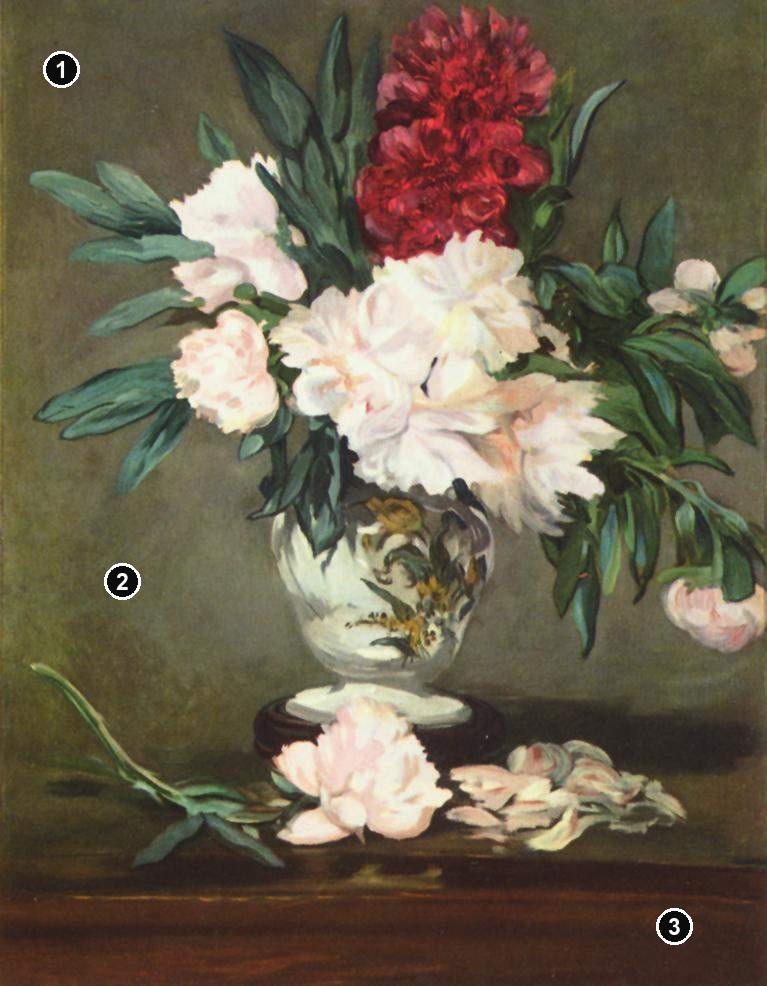
Red peonies rise above a spreading group of pale blossoms in Édouard Manet's Vase of Peonies on a Pedestal. Painted in 1864, the canvas is now at the Musée d'Orsay in Paris.[1] Dark leaves separate the flower heads, while a decorated vase gathers the arrangement into a rounded form below. A detached peony and loose petals lie across the table, introducing a lower, more horizontal group beneath the upright bouquet.
At a Glance
- ArtistÉdouard Manet
- TitleVase of Peonies on a Pedestal / Vase de pivoines sur piédouche
- Date1864
- MediumOil on canvas
- Dimensions93.3 × 70 cm
- CollectionMusée d'Orsay, Paris
- AcquisitionDonation Étienne Moreau-Nélaton, 1906
- Inventory numberRF 1669.[1]
- Catalogue numberRW I86.[2]
This work across Édouard Manet’s career
Contents
- Red above White
- Leaves around the Flowers
- The Decorated Vase
- Flowers across the Table
- Full Blossoms and Loose Petals
- Peony Paintings in the 1860s
- Another Vase of Peonies
- From Manet to the Musée d'Orsay
- Annotated details
Red above White
The strongest red occupies the upper part of the bouquet. It rises behind the paler flowers, making a concentrated vertical shape near the centre. Dark passages divide its rounded forms, while brighter red and pink touches turn along the outer edges. The changing colour gives the group an uneven, lively surface without surrounding each petal with a continuous outline.
The pale blossoms spread more widely. A large white-pink flower opens towards the viewer near the middle, with others overlapping it from above and below. Their edges make a succession of folds, notches and rounded projections. Some petals turn outwards into the darker background; others meet neighbouring flowers, where a narrow dark interval helps separate the forms.
White is varied with cream, pink and warmer touches. A broad light area may establish the face of a blossom, then smaller changes break it into petals. The flowers retain their fullness even where their individual parts are only loosely distinguished. Looking across them, the eye alternates between a large pale mass and the smaller changes within it.
The red and white groups also have different shapes. The red rises in a comparatively narrow column, while the pale flowers extend sideways and downwards. Their meeting near the upper centre joins these directions. The bouquet has height and breadth, with its brightest colours concentrated in overlapping forms rather than evenly distributed across the canvas.
Leaves around the Flowers
The leaves introduce sharper edges among the rounded blossoms. Long pointed shapes rise beside the red flowers, their dark borders separating them from the quieter background. Some stand almost upright; others lean across one another. These narrow forms carry the bouquet towards the top of the picture without simply repeating the outline of the red group.
At the left, broader leaves reach sideways. Their green faces contain darker central divisions and lighter passages along parts of the edges. The changes give them a folded appearance. Between these leaves, pale flowers project forward, making the bouquet's left side alternate between pointed and rounded shapes.
The right side moves differently. A sweep of long leaves bends down beside the vase, ending near a hanging pale flower. Dark green curves connect this lower bloom to the fuller arrangement above. The descent gives that side a loose, extended outline, in contrast with the shorter sideways projections at the left.
These variations make the foliage part of the structure. Leaves separate flower heads, bridge the gaps between them and carry the outer edge of the bouquet in several directions. Their darker colour helps the pale petals stand out, but their changing angles also prevent the flowers from reading as a single undivided cluster.
The Decorated Vase
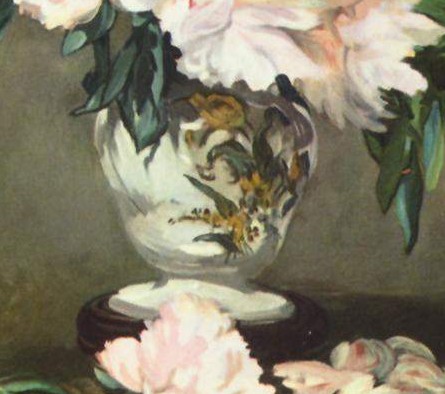
The blossoms partly conceal the mouth of the vase. Beneath them, its light body swells outwards before narrowing towards the foot. The left side catches a broad pale reflection, while the right is more closely connected with the descending leaves. A dark edge marks portions of the vessel's contour, then softens where lighter passages meet the surrounding background.
Its decoration follows the curved surface. Brown, ochre and dark green shapes gather across the front, with curling forms rising towards the flowers. Small lighter openings interrupt this ornament. The pattern makes the vessel an active part of the painting: the eye can follow its surface as well as the larger outline enclosing it.
The pale foot projects on either side of the narrowing body. Below it, a low dark circular support makes another horizontal accent. The change from rounded vase to narrow neck, spreading foot and dark base gives the lower arrangement a clear sequence of shapes.
The vase also occupies a different scale from the foliage. Its broad curves turn gradually, while the leaves make quicker changes of direction. Together, they connect the compact central vessel to the wider, more irregular bouquet. The painted canvas measures almost a metre in height, allowing this ordinary arrangement a substantial presence.[1]
Flowers across the Table
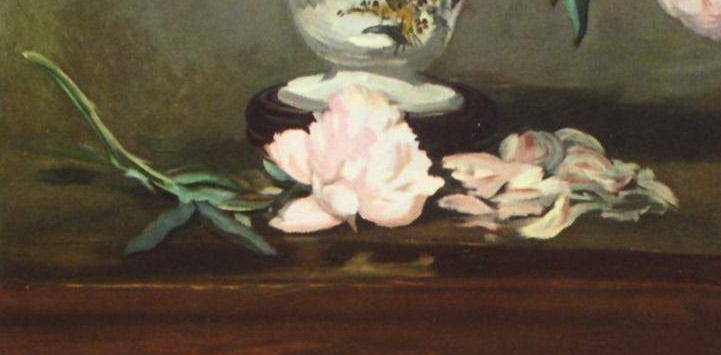
A long green stem enters the foreground from the left and leads towards a detached pale peony. Its leaves spread along the table rather than rising into the bouquet. The flower head opens near the centre, below the vase's foot, where its pale petals interrupt the dark support behind it.
To the right, loose petals and folded flower forms make a lower, more scattered group. Pink, cream and grey-green passages lie close to the tabletop. Some edges are distinct; others merge with the dark surface beneath them. The contrast between the rounded detached flower and these flatter shapes makes the foreground more varied than a simple repetition of the bouquet.
Théodore Duret's 1902 catalogue description identifies the red and white peonies in a decorated white vase, then notes the peony and scattered petals at its foot.[3]
The table extends beneath everything in broad dark bands. A warmer line near its front edge runs across the lower canvas. This horizontal movement gives the scattered petals a stable setting, while the long stem returns the eye towards the vase. The foreground has enough open surface for each small light shape to register separately.
Full Blossoms and Loose Petals
The painting brings together several ways in which flowers can occupy space. Some face outwards, opening broadly towards the viewer. Others turn sideways or hang below the leaves. On the table, the detached head and loose petals spread across a surface rather than remaining part of the upright arrangement.
That contrast can suggest the fragility of cut flowers and the passage of time. The reading comes from the relationship between the full bouquet, the hanging bloom and the scattered forms below. At the same time, the lower flowers continue the picture's colour relationships: their pale pinks and creams answer the blossoms above, while the green stem repeats the foliage's longer lines.
The detached flower therefore participates in the composition as strongly as the flowers in the vase. Its brightness draws attention downwards, and its rounded head gives the low foreground group a centre. Looking back up from it makes the height of the bouquet more apparent.
Peony Paintings in the 1860s
The Metropolitan Museum of Art reports that Manet grew peonies at Gennevilliers and that they were reputedly his favourite flowers.[4] Their broad petals and spreading leaves offered several kinds of shape within one subject. In this painting, the repeated flower heads vary in size, direction and degree of overlap, while the foliage extends their arrangement beyond the central vessel.
The Orsay painting was exhibited at the Galerie Martinet in 1865.[1] It also appeared as number 33 in Manet's own avenue de l'Alma exhibition in 1867.[2] The still life thus belonged to the work he presented publicly during the 1860s. Its large, spreading bouquet provides an early example of the attention he gave to flowers, well before his final years.
Another Vase of Peonies
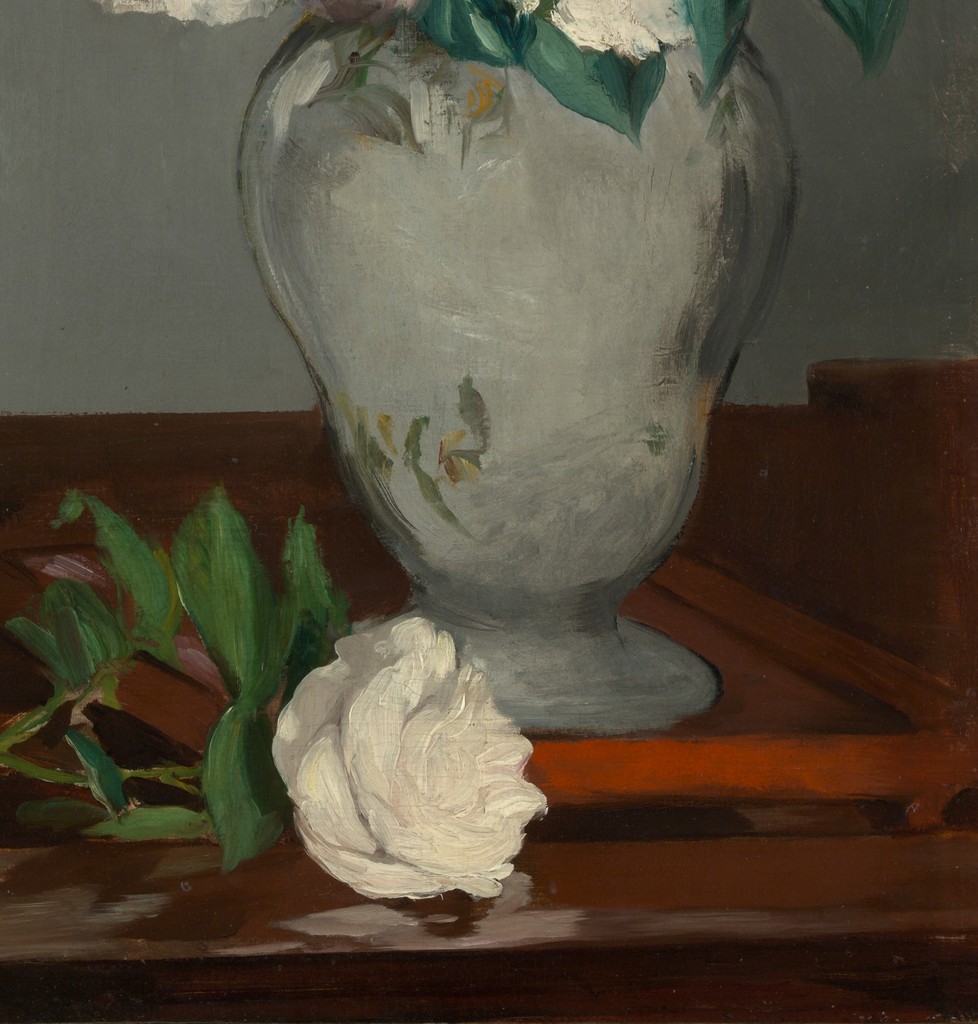
The Met's separate Peonies dates from 1864–65 and measures 59.4 × 35.2 cm. It entered the museum through the bequest of Joan Whitney Payson, 1975, and bears accession number 1976.201.16.[4]
Its narrower arrangement gives more space to a tall pale vase. Pink-purple and white blossoms gather above it, with a detached white flower at the foot. The decoration is less crowded than in the Orsay painting. The red-brown surface underneath also changes the relationship between the vessel and the foreground flower.
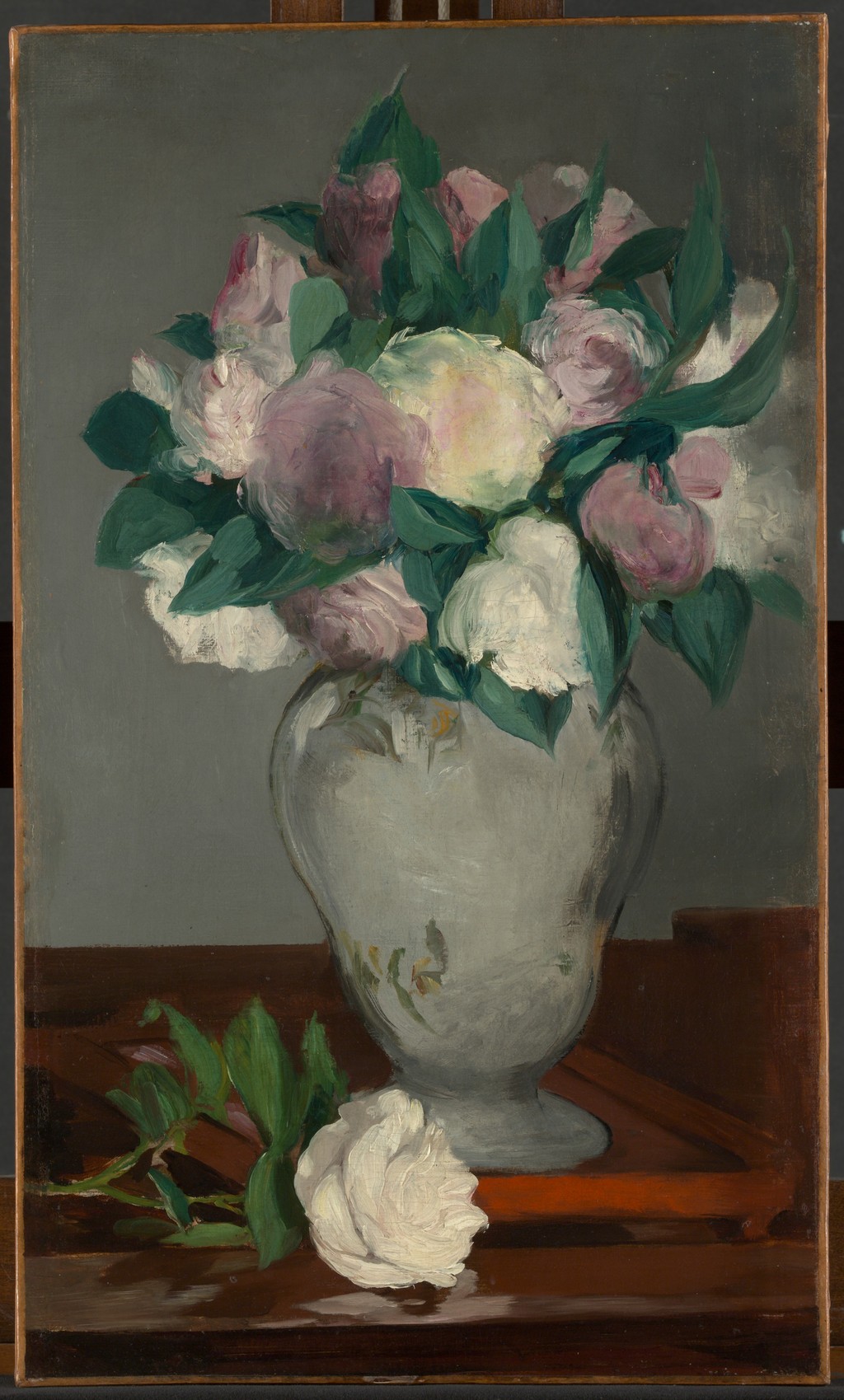
Édouard Manet, Peonies, 1864–65. Met, 1976.201.16. Metropolitan Museum of Art; CC0. Image source. CC0 / Public domain. Unrelated photographic surround cropped conservatively; painted area and physical edges retained. No enlargement or retouching.
Annotated Details from Vase of Peonies
The numbered points identify visible features discussed in this article. Return from each detail to the whole composition. Each caption identifies the work shown.
Vase of Peonies
Édouard Manet, Vase of Peonies, 1864. Musée d’Orsay, RF 1669. Yorck Project via Commons; public domain. Image source. Public domain. Numbers added to a separate resized overview. Detail crops from the supplied public-domain reproduction; no enlargement or retouching.
Peonies Met 1864–65
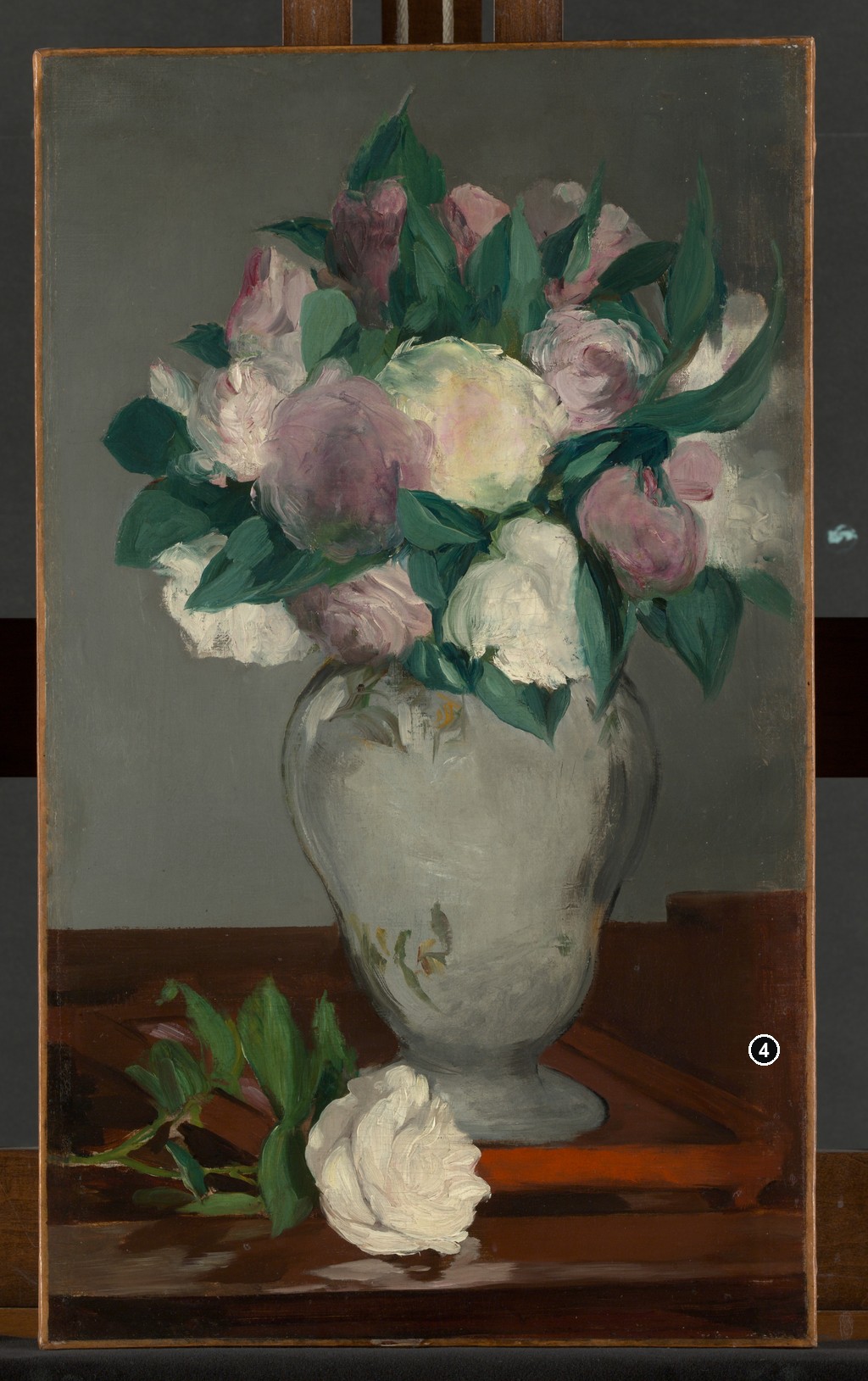
Édouard Manet, Peonies, 1864–65. Met, 1976.201.16. Metropolitan Museum of Art; CC0. Image source. CC0 / Public domain. Numbers added to a separate resized overview. Detail crops from the supplied public-domain reproduction; no enlargement or retouching.
Details from VASE OF PEONIES
Explore the bouquet, vase and foreground, then compare the Met painting.
Vase of Peonies
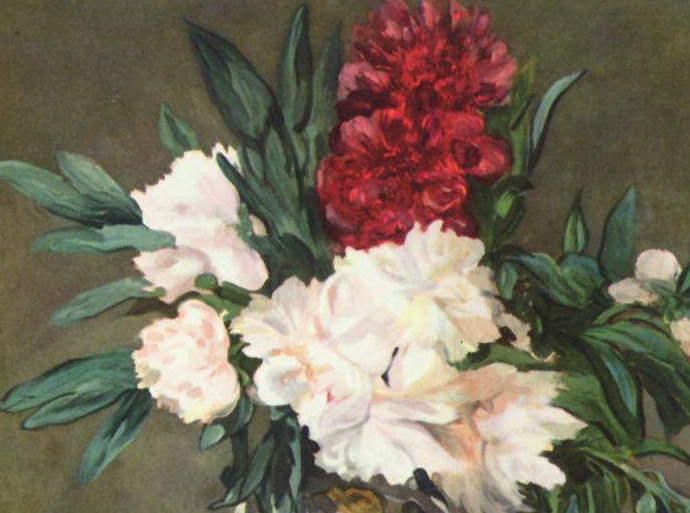
Red and Pale Blossoms
The red flowers rise above the spreading pale group. Pointed leaves separate the rounded flower heads.
The Vase Foot and Dark Support
Curving ornament crosses the pale vase. Its narrow lower body meets a projecting foot and a dark circular support.
The Flower and Petals on the Table
A long stem leads towards the detached pale flower. Loose petals spread to its right across the dark surface.
Peonies Met 1864–65
The Vase and the Foreground Flower
The pale vase occupies a long central shape above the detached white flower.
From Manet to the Musée d'Orsay
Durand-Ruel bought the painting from Manet in 1872. It later belonged to Étienne Moreau-Nélaton, whose donation to the French state in 1906 brought it into the national collections. The work was assigned to the Musée d'Orsay in 1986.[1]
Artworks directory
Explore selected paintings, drawings and prints by Édouard Manet. Search by title or another recorded name.
Frequently Asked Questions
In 1864.[1]
At the Musée d'Orsay in Paris, inventory RF 1669.[1]
No. The Met owns a separate canvas, dated 1864–65, accession 1976.201.16.[4]
Discussion
Look again at the images and ideas explored in Vase of Peonies by Édouard Manet. These editorial prompts invite your observations.
Reader Insights
How do the red flowers change the shape of the bouquet's upper edge?
Where does the pattern make the vase's curved surface most apparent?
How does the detached flower change the balance between the bouquet and foreground?
Join the Conversation
Share a detail, comparison or question about Vase of Peonies by Édouard Manet below.
References
- Musée d'Orsay, Vase de pivoines sur piédouche, RF 1669. In French. View source.
- Denis Rouart and Daniel Wildenstein, Édouard Manet, catalogue raisonné, volume I, 1975, no. 86, pp. 92–93. In French. View source.
- Théodore Duret, Histoire d'Édouard Manet et de son œuvre, 1902, no. 84, p. 213. In French. View source.
- The Metropolitan Museum of Art, Peonies, 1976.201.16. View source.
- Splash image, Édouard Manet, Vase of Peonies, 1864. Musée d’Orsay, RF 1669. Yorck Project via Commons; public domain. Image source. Public domain. Whole supplied public-domain reproduction retained at native size. No enlargement or retouching.


