



 by Tom Gurney
Tom Gurney BSc (Hons) is an art history expert with over 20 years experience
Published on June 19, 2020 / Updated on October 30, 2026
Email: tomgurney1@gmail.com / Phone: +44 7429 011000
A Woman Pouring Water by Édouard Manet: Introduction
A woman lowers her eyes towards a dark jug tilted above a broad basin in Édouard Manet's A Woman Pouring Water. Her pale sleeves spread around the two vessels, while a landscape appears behind her raised arm. The sitter is Suzanne Leenhoff, later the artist's wife. Museum Ordrupgaard calls the painting Kvinde med kande, or Woman with a Jug, and dates it to 1858–1860.[1]
At a Glance
- ArtistÉdouard Manet
- TitleA Woman Pouring Water / Woman with a Jug / Kvinde med kande
- Date1858–1860
- MediumOil on canvas
- Dimensions61 × 54.5 cm
- CollectionMuseum Ordrupgaard, Charlottenlund, Denmark
- Inventory number282 WH
- SignatureEd. Manet, at lower left.[1]
- Catalogue numberRW I20.[2]
This work across Édouard Manet’s career
Contents
- The Hand on the Jug
- The Lowered Head
- Pale Sleeves and Dark Vessels
- A Landscape behind the Figure
- A Reworked Early Painting
- A Later Portrait of Suzanne at the Met
- Annotated details
The Hand on the Jug
Suzanne's raised left hand holds the vessel by its loop handle. Her forearm enters from the right, bending across the pale sleeve before the fingers descend towards the dark jug. A ring supplies a small light accent within this arrangement.
The jug tilts towards the left, with its opening directed towards the basin. Brown and reddish passages describe its rounded body, while lighter marks pick out the ornament across its surface. The handle forms a smaller curve beside the fingers. Its dark outline helps separate the hand from the pale clothing behind it.
Below, the basin spreads almost horizontally across the foreground. Its broad oval contrasts with the more compact jug. Curved bands run around its rim, and a darker interior gives it depth. The supporting hand is less fully described, with warm passages merging into the garment.
Théodore Duret's 1902 catalogue description identifies the basin in the woman's right hand and the small jug or vase in her left.[3] The two vessels establish a practical relationship through their positions: one tips above the other. A distinct stream from the jug is difficult to make out, leaving the tilt and the arrangement of the hands to convey the action.
The Lowered Head
The head inclines towards the vessels, bringing the face into the same downward movement as the raised hand. Blond-brown hair sweeps away from the forehead and gathers at the back. A darker accent near the crown interrupts its softer curves. The outline of the hair remains clear against the large green area immediately behind it.
Light falls across the forehead and nose, with warmer shaded passages along the side of the face. The lowered eyelids are marked more darkly. The mouth is small and lightly described, set above the rounded chin. These closely placed features give the face a different density from the much broader folds around the shoulders.
Several fine necklaces descend over the exposed neck and chest. Their narrow curves contrast with the larger opening of the garment. One line drops farther down towards the bodice, linking the upper body to the area immediately behind the jug. The jewellery supplies delicate linear accents within an otherwise broadly organised figure.
The head and raised hand occupy different sides of the composition. The downward angle of the face brings them into relation across the chest.
Pale Sleeves and Dark Vessels
White and blue-grey clothing surrounds the warm face and arms. On the left, the sleeve descends in a broad, rounded shape, with darker folds bending near the elbow. On the right, the raised forearm emerges from a more sharply turning cuff. Small pointed folds project beside the wrist and along the picture's edge.
The neckline opens widely, forming a pale border around the chest. Lower down, grey-green passages describe the bodice without the same degree of separation found in the face. The distinction becomes particularly noticeable near the basin, where garment, supporting hand and foreground meet in looser marks.
The dark vessels give the lower half of the figure a firmer structure. The jug rises diagonally from the basin, and its compact outline overlaps the pale sleeve. The basin stretches across the body, cutting through the descending folds. Together, the vessels introduce two strongly defined shapes within the larger expanse of light clothing.
Their brown tones also connect them to the warmer landscape at the right. That relationship runs across the picture, even though the vessels occupy the foreground and the trees appear farther away. The green behind Suzanne's head supplies a different, cooler area, keeping the warm objects from dominating every part of the scene.
A Landscape behind the Figure
The background divides into two unequal areas. At the left is a broad green field with few clearly separate objects. At the right, an upright border marks the beginning of a small landscape. Sky occupies its upper portion, while darker trees rise along the right edge and a pale winding stream leads through the lower ground.
The landscape has a more broken treatment than the face. Short light and dark marks suggest changes across the land, and patches of blue-grey and cream spread through the sky. The upright division beside it remains comparatively firm. This combination gives the distant scene a clear boundary while leaving its internal forms more loosely connected.
Duret described the landscape as a view through a window.[3] Art historian Rolf Læssøe instead favours a landscape painting hanging behind Suzanne, while acknowledging that the upright green band could suggest a window opening seen in perspective. He draws attention to the contrast between the more defined foreground figure and the loosely handled scene behind her.[4]
Both readings draw attention to the conspicuous border beside the landscape. Her raised arm crosses in front of its lower portion, bringing a close, substantial form against a much smaller world of trees, water and sky. Whether read as a window or a picture, that framed scene adds another scale of space to the portrait.
A Reworked Early Painting
Rouart and Wildenstein list the work as La Verseuse, also called La Femme à la Cruche. Their 1975 catalogue reports information from the Copenhagen museum that an X-ray had shown repainting.[2] The present arrangement therefore belongs to a work with a history of revision, even where its individual changes cannot be followed from the visible image alone.
The same catalogue tentatively connects the painting with a portrait of Madame Manet holding a ewer mentioned in the artist's posthumous inventory. Its ownership history passes from Laurent Cély in Asnières through Mme L. C. Fougery to Wilhelm Hansen and Ordrupgaard.[2] Duret had already recorded it with Laurent-Cély in 1902.[3]
The older catalogues give smaller measurements than the museum's current 61 × 54.5 cm.[1][2][3] The current dimensions identify the work as Ordrupgaard records it today; the earlier figures belong to its historical documentation.
A Later Portrait of Suzanne at the Met
Suzanne was a Dutch pianist, and she and Manet married in 1863.[5] The Metropolitan Museum's later Madame Edouard Manet, dated about 1873, presents her in a much larger upright composition. This separate oil painting measures 100.3 × 78.4 cm and entered the museum through the de Groot bequest in 1967.[5]
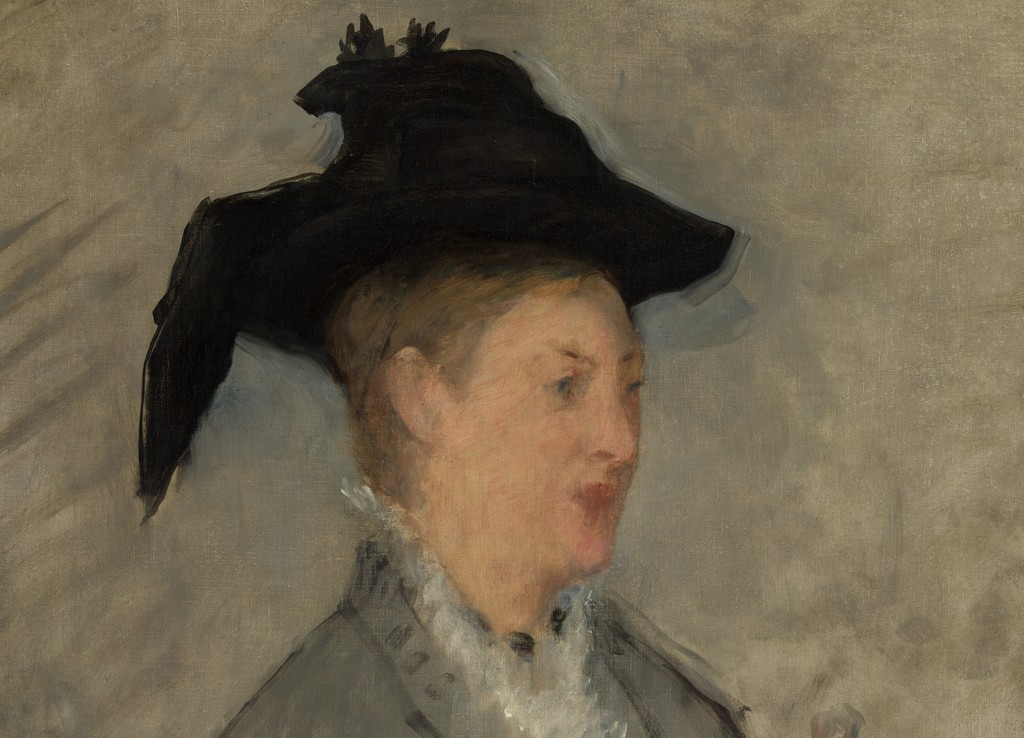
A large black hat extends to either side of her head. Beneath it, the face turns towards the right, above a high pale neckline and loosely described grey dress. The dark headgear occupies the upper part of the portrait much as the vessels concentrate darker tones below Suzanne's face in Woman with a Jug. In each, a few substantial dark shapes help organise a much lighter figure.
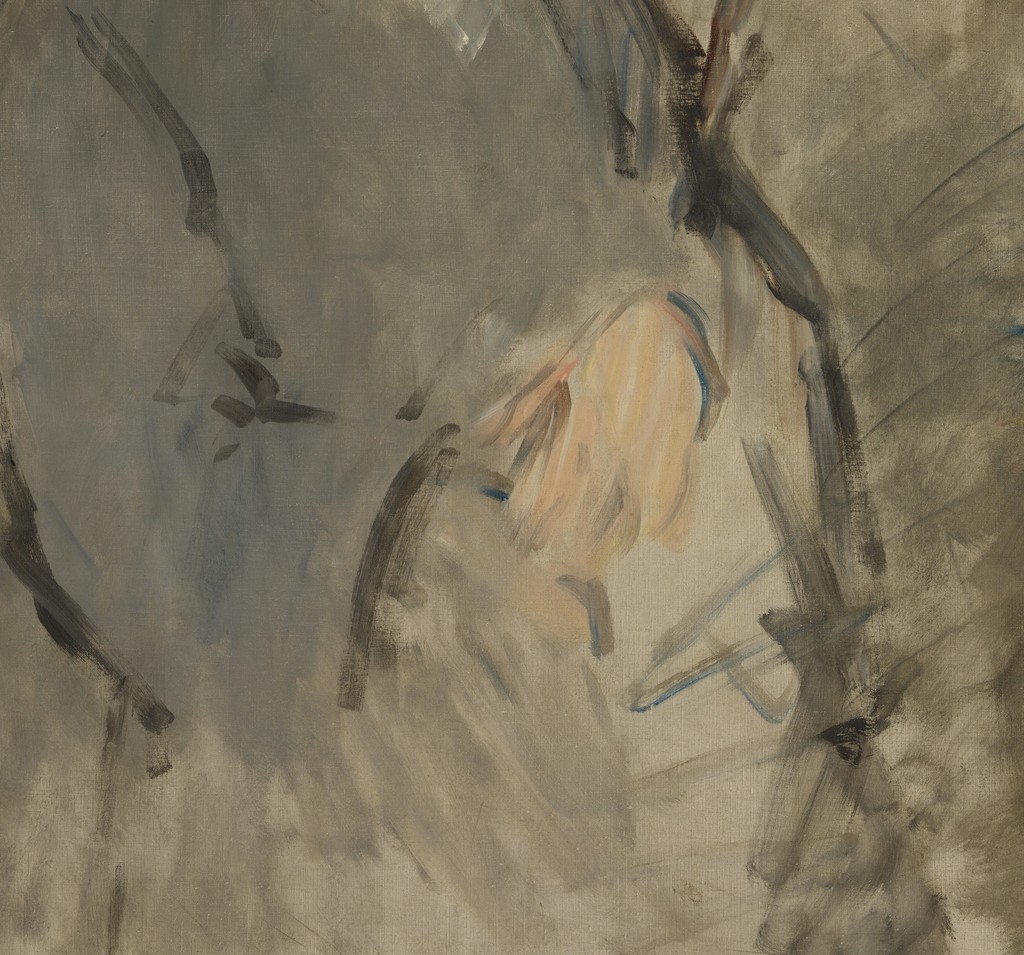
The later portrait leaves broad passages around the body and hands unresolved. The Met describes it as unfinished and reports that Manet scraped the face at least twice.[5] Those changes belong to this particular portrait. Its hat, dress and turned head offer a different presentation of Suzanne from the earlier figure looking down towards jug and basin.
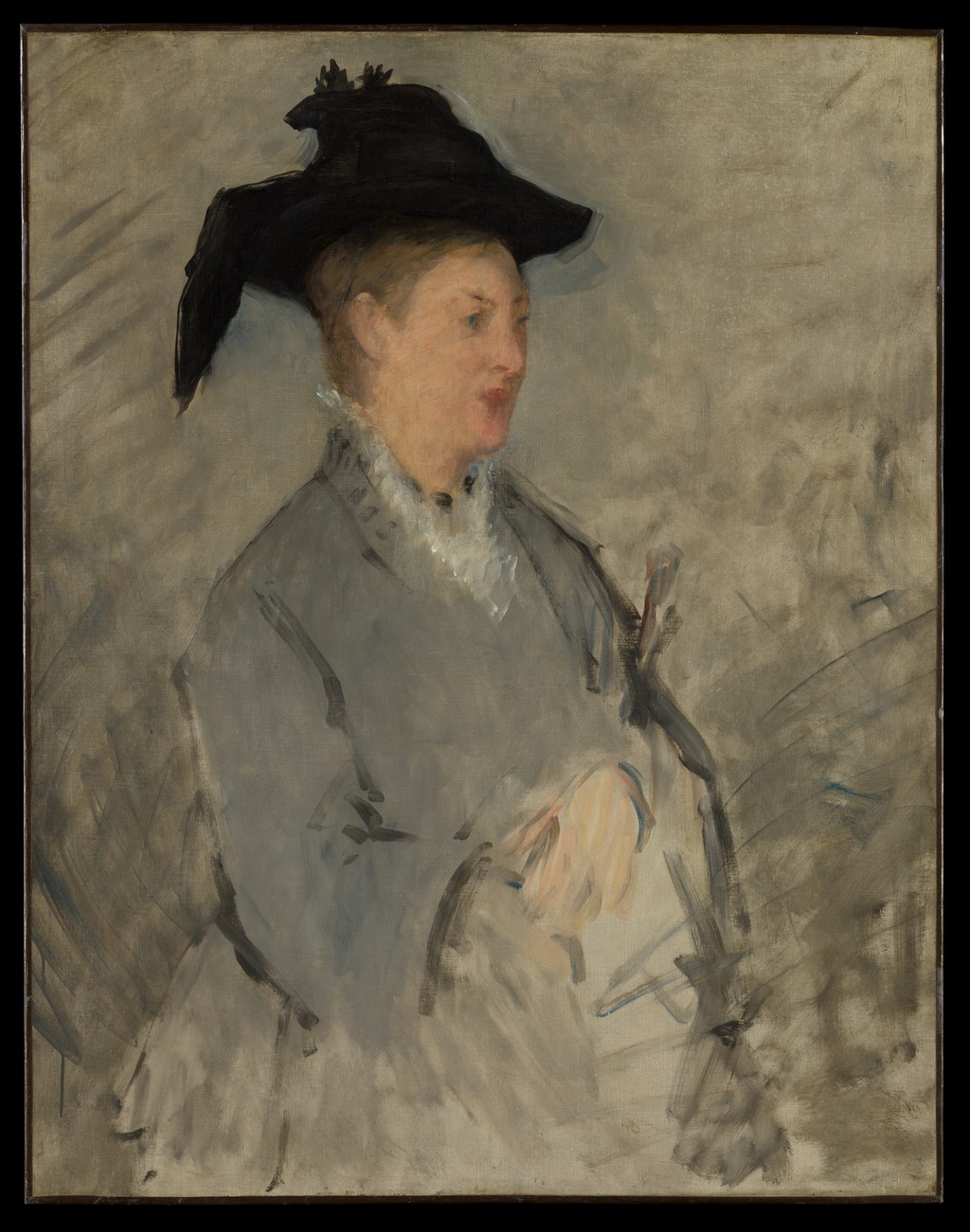
Édouard Manet, Madame Edouard Manet, about 1873. Metropolitan Museum of Art, 67.187.81. Metropolitan Museum of Art; CC0 Open Access. Image source. CC0 / Public domain. Whole supplied CC0 reproduction retained and resized. No enlargement or retouching.
Annotated Details from Madame Edouard Manet at the Met
The numbered points identify visible features discussed in this article. Return from each detail to the whole composition. Édouard Manet, Madame Edouard Manet, about 1873. Metropolitan Museum of Art, 67.187.81. Metropolitan Museum of Art; CC0 Open Access. Image source. CC0 / Public domain. Numbers added to a separate resized overview. Detail crops from the supplied CC0 reproduction; no enlargement or retouching.
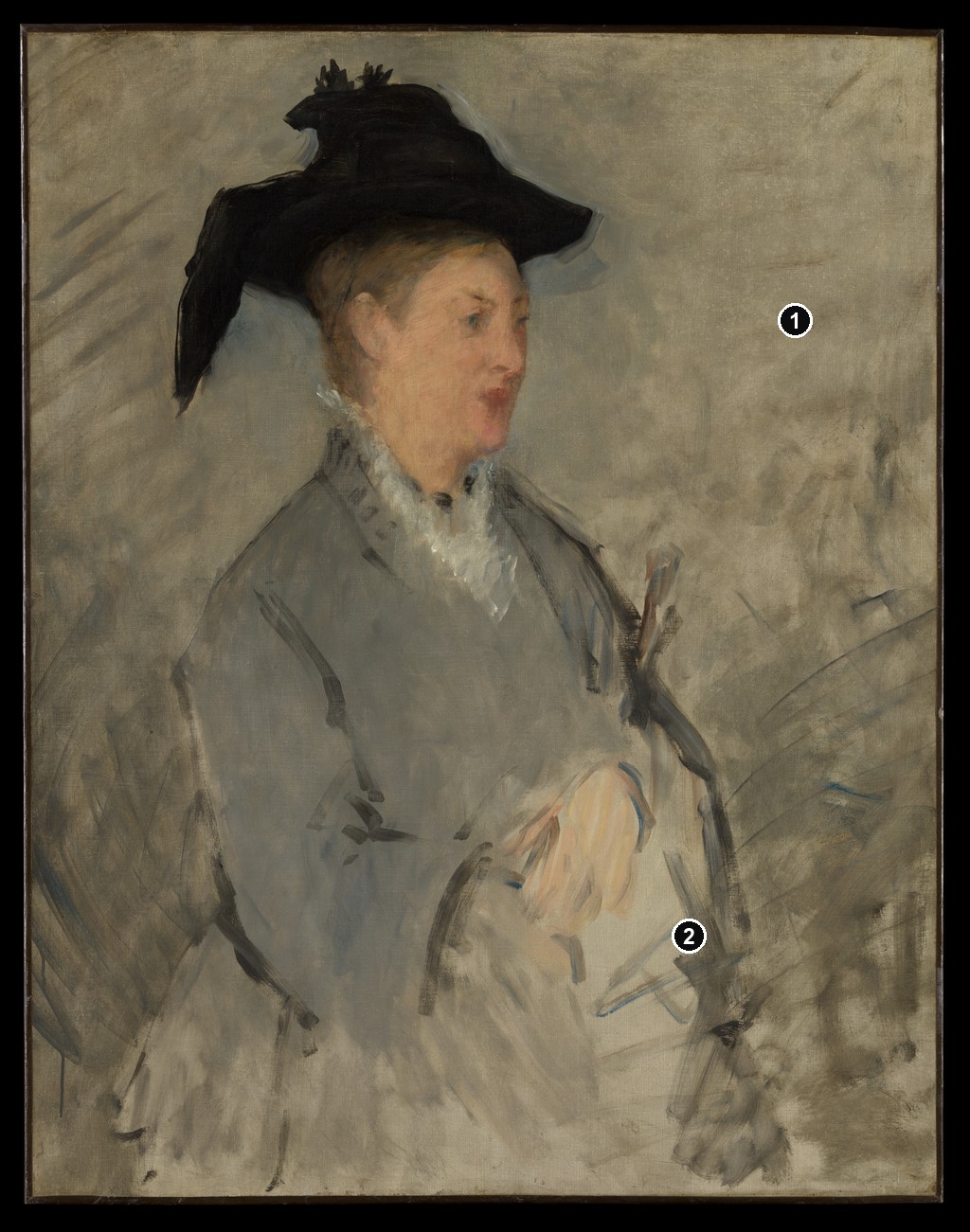
Details from MADAME EDOUARD MANET AT THE MET
Compare Suzanne's hat and turned head with the more loosely described hand and dress.
The Dark Hat and Turned Head
A wide dark hat frames the sideward-turned face above a high pale neckline.
Hand and Loosely Described Dress
Warm strokes indicate a lowered hand within broad grey passages of the dress.
Artworks directory
Explore selected paintings, drawings and prints by Édouard Manet. Search by title or another recorded name.
Frequently Asked Questions
Museum Ordrupgaard dates it to 1858–1860.[1]
Suzanne Leenhoff, later Madame Manet.[1]
At Museum Ordrupgaard in Charlottenlund, Denmark, inventory 282 WH.[1]
Discussion
Look again at the images and ideas explored in A Woman Pouring Water by Édouard Manet. These editorial prompts invite your observations.
Reader Insights
How do the fingers, loop handle and tilted vessel connect?
Which edges distinguish the basin from the surrounding clothing?
What makes the landscape appear separate from the space occupied by Suzanne?
Join the Conversation
Share a detail, comparison or question about A Woman Pouring Water by Édouard Manet below.
References
- Museum Ordrupgaard, Kvinde med kande, inventory 282 WH. In Danish. View source.
- Denis Rouart and Daniel Wildenstein, Édouard Manet, catalogue raisonné, volume I, 1975, no. 20, p. 40. In French. View source.
- Théodore Duret, Histoire d'Édouard Manet et de son œuvre, 1902, painting 15, pp. 194–195. In French. View source.
- Rolf Læssøe, Édouard Manet's Le Déjeuner sur l'herbe as a Veiled Allegory of Painting, Artibus et Historiae 26, no. 51, 2005, pp. 198–199 and note 10, pp. 215–216. View source.
- The Metropolitan Museum of Art, Madame Edouard Manet (Suzanne Leenhoff), accession 67.187.81. View source.
- Splash image, Édouard Manet, Woman with a Jug, 1858–1860. Museum Ordrupgaard, 282 WH.


