



 by Tom Gurney
Tom Gurney BSc (Hons) is an art history expert with over 20 years experience
Published on June 19, 2020 / Updated on October 30, 2026
Email: tomgurney1@gmail.com / Phone: +44 7429 011000
Women at the Races by Édouard Manet: Introduction
A green parasol shelters one woman while blue bonnet ribbons frame another in Édouard Manet's Women at the Races. Grey and yellow dresses fill the small canvas, crossed by the ropes of a racecourse barrier. Carriage wheels crowd the space behind them. Cincinnati Art Museum dates this oil painting to 1866 and records it under accession number 1944.105.[1] The focus rests on the spectators and the things immediately around them, with the wider sporting spectacle left outside the frame.
At a Glance
- ArtistÉdouard Manet
- TitleWomen at the Races / Champs de courses
- Date1866
- MediumOil on canvas
- Canvas dimensions42.2 × 32.1 cm
- CollectionCincinnati Art Museum, Ohio, United States
- CreditFanny Bryce Lehmer Endowment
- Accession number1944.105.[1]
- Catalogue numberRW I95.[2]
This work across Édouard Manet’s career
Contents
- The Green Parasol
- Grey and Yellow Dresses
- Ropes and Carriage Wheels
- Figures at the Edges
- Dating and a Larger Composition
- The Wider Racecourse in Watercolour
- The Painting in Cincinnati
- Annotated details
The Green Parasol
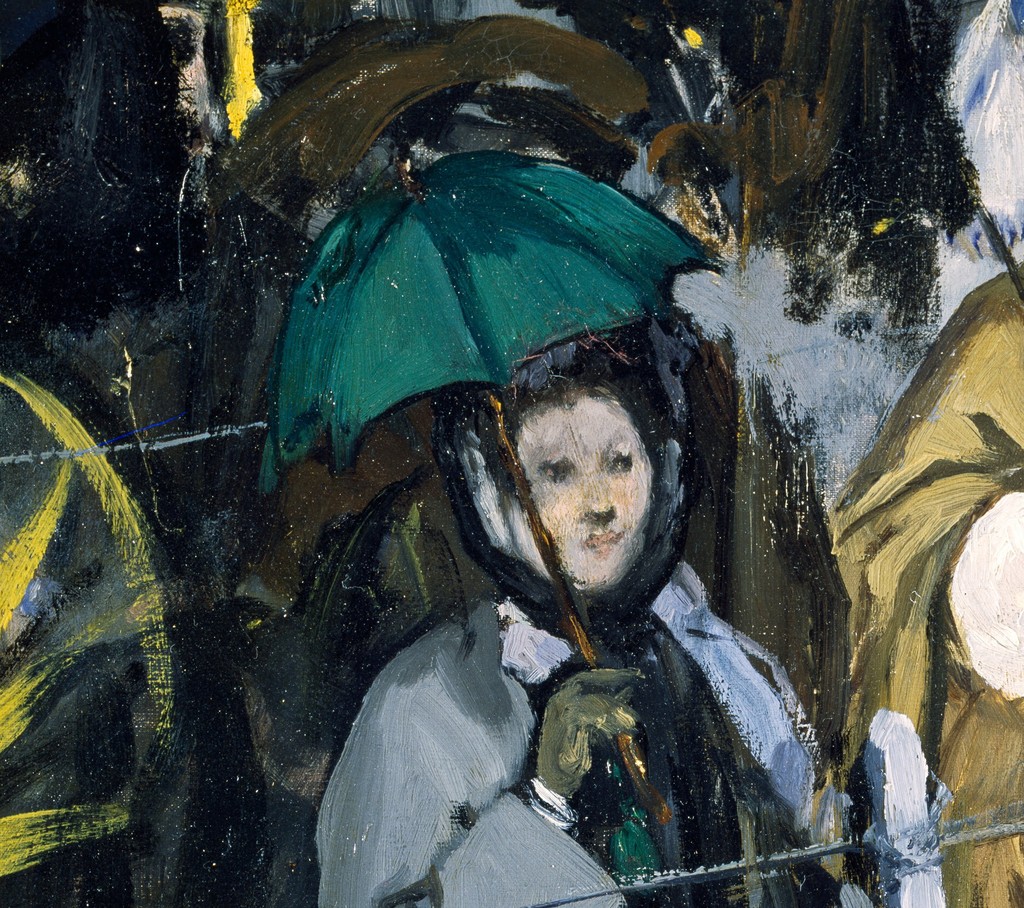
The parasol forms a curved canopy above the nearer woman's head. Its outer edge rises towards the centre and drops into small points at either side. Dark ribs divide the green fabric into broad triangular sections. The handle descends diagonally towards the glove held near her chest, connecting the shelter above her head with a compact gesture below it.
Beneath the canopy, the face is enclosed by dark headgear and ribbons. Pale strokes across the forehead, nose and cheeks separate it from this surrounding frame. The eyes and mouth are indicated with smaller, darker accents. The face turns towards the viewer more directly than that of the taller woman beside her.
The green parasol remains distinct even where its edge meets the dark carriage behind it. Its curved outline and clearly divided surface supply a readable shape within a crowded background. Lower down, hanging dark ribbons pass across the grey clothing. Their narrow lines contrast with the broad skirt.
Grey and Yellow Dresses
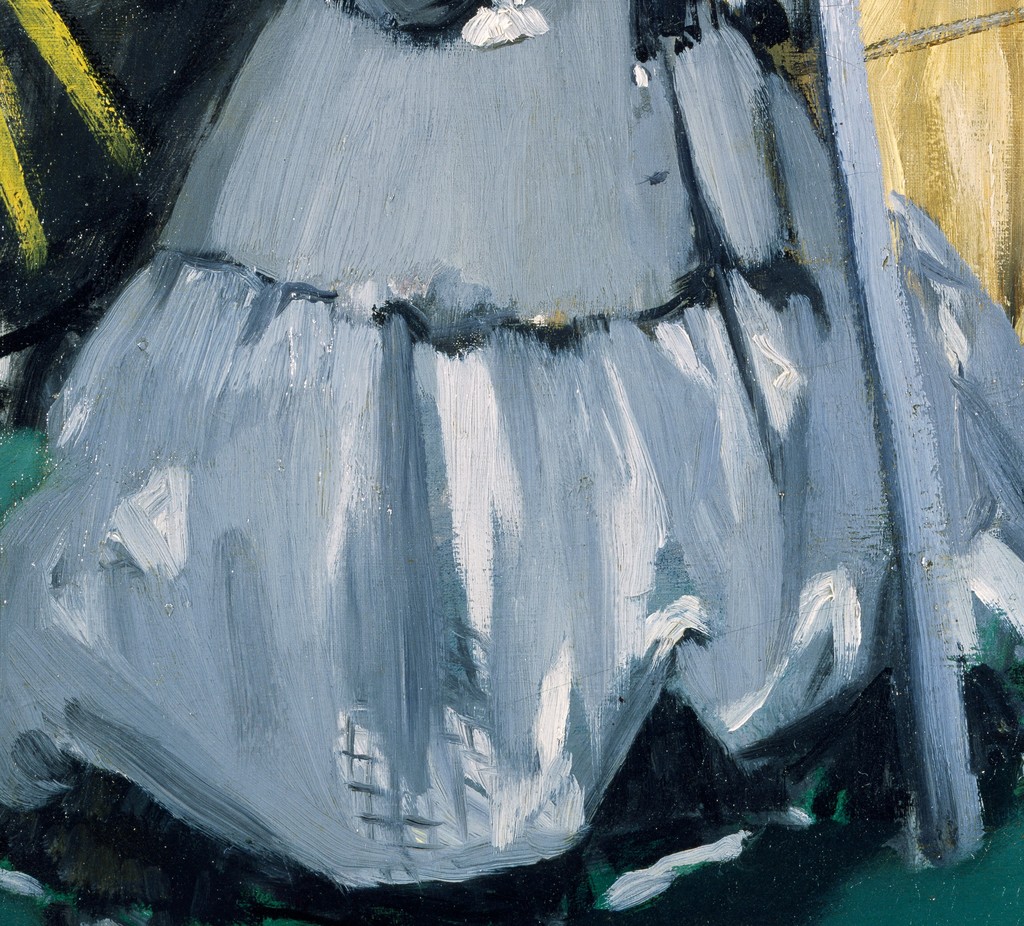
The foreground dress spreads across most of the lower canvas. A shorter outer layer ends in a dark, uneven band above the larger skirt. Below that band, long pale strokes descend through grey and lilac passages, bending as they approach the hem. Their changing directions give the fabric its volume without describing every fold separately.
At the left, the skirt's edge curves outwards before turning back towards the feet. On the right, a narrow pointed fold descends close to the pale post. The dark underskirt and small light shoe shapes break the broad lower contour.
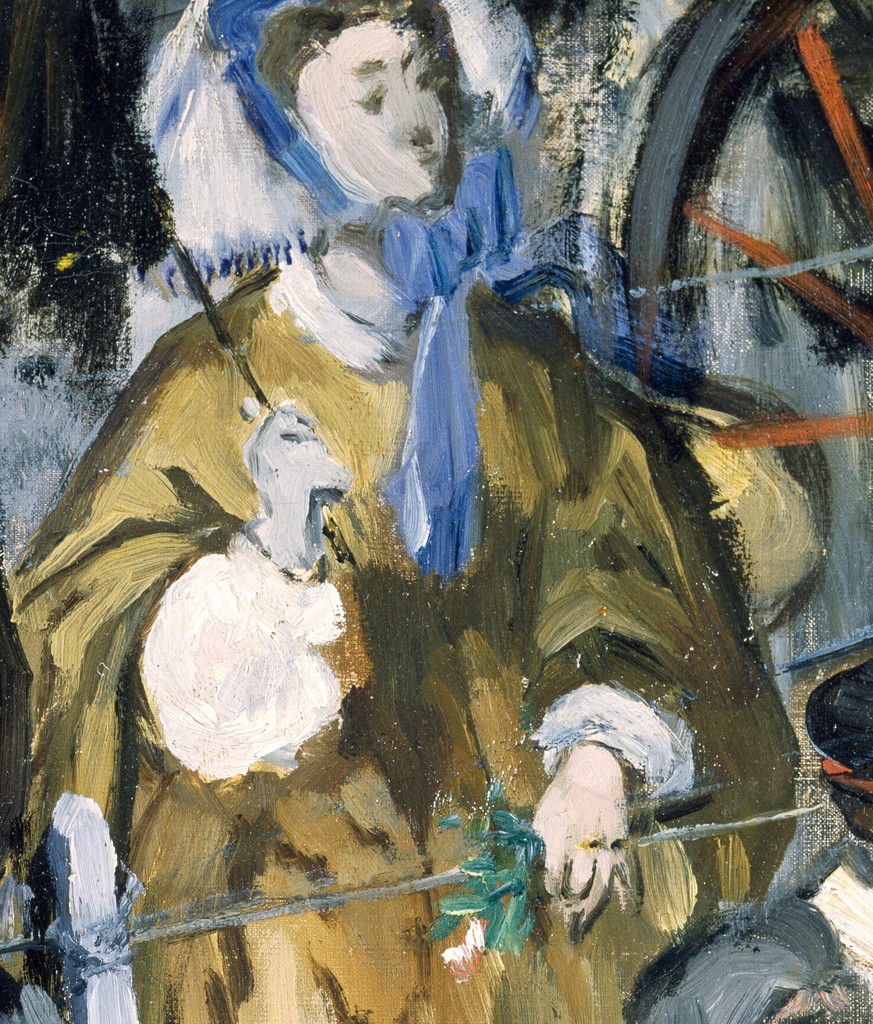
The taller woman's dress introduces a warmer range of yellow and ochre. Long vertical passages carry its shape down towards a dark band and pale trim near the bottom. The raised arm creates a large angular fold across the upper body, while a white cuff and glove make a bright rounded area near the chest. Another pale hand appears beside the upper rope.
Blue ribbons descend from the bonnet, crossing the pale neck covering and warm dress. Their length draws the eye from the partially cropped head towards the raised glove. Blue also appears in cooler marks around the sleeves and background wheel, linking this figure to the greyer clothing beside her.
Théodore Duret's 1902 description already singled out these contrasts: a grey crinoline and overgarment with a green parasol at the left, and a yellow dress with blue bonnet ribbon at the right.[3] Clothing supplies much of the composition's structure. Large areas of fabric establish the two figures before the smaller marks of faces, fingers and accessories become clear.
Ropes and Carriage Wheels
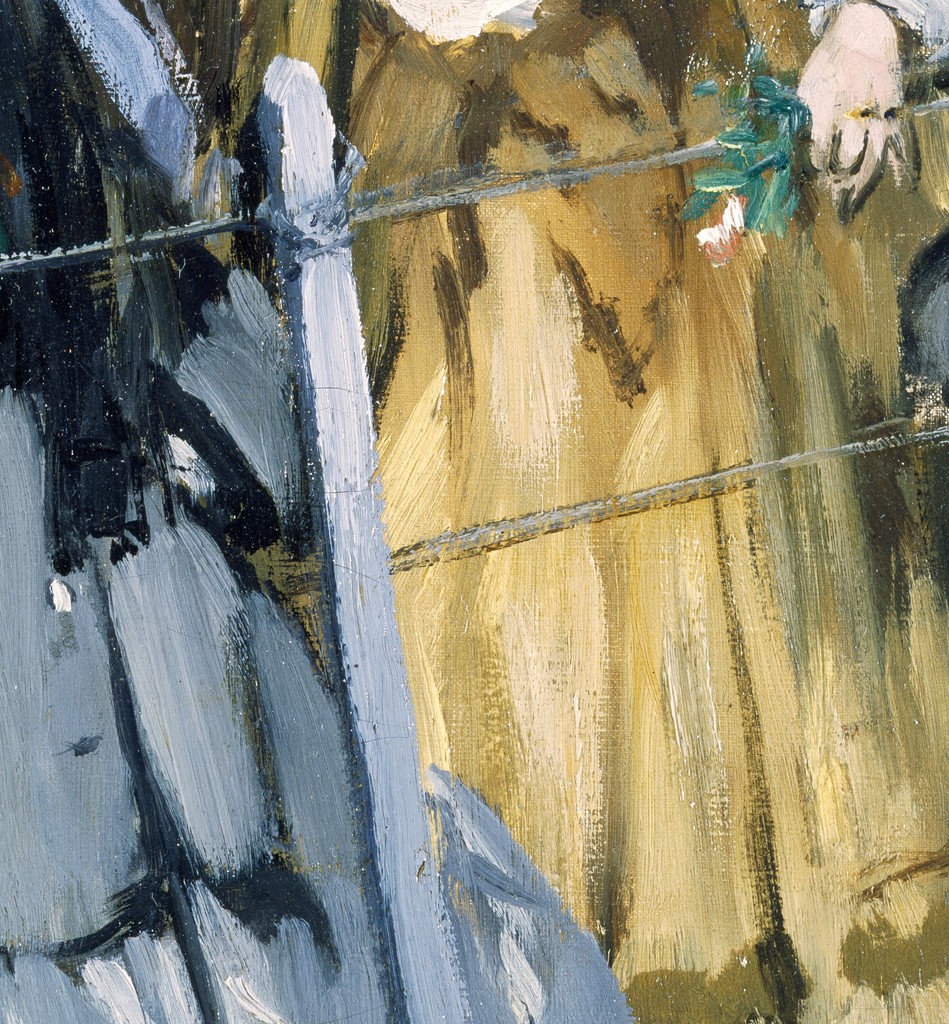
Two ropes cross the women at different heights. The upper line cuts across the nearer woman's sleeve and passes towards the hand of her companion. The lower line runs across the yellow dress. Between them stands a pale post, its upright shape breaking the broad expanse of skirts.
The barrier separates the spectator area from the space immediately in front of the figures. Yet the ropes remain visually thin: they cross the dresses without concealing much of them. Their taut diagonals contrast with the heavy curves and descending folds of the clothing. The post provides a more substantial interruption, dividing the lower part of the picture into unequal areas.
Behind the grey figure, a large wheel is cut by the left edge. Yellow spokes radiate through its dark interior, with cooler grey marks along the rim. Another wheel occupies the upper right corner behind the taller woman. Neither is shown completely, but the repeated circles make the carriages a strong presence.
The wheels leave little open background between their rims, the parasol and the women's shoulders. Dark vertical and curved shapes fill the gaps. The green ground below the skirts offers a less crowded passage, crossed by the dark shadows and small pale accents near the feet.
Figures at the Edges
The taller woman's bonnet reaches beyond the top of the canvas. At the far right, only part of another spectator is visible: a dark hat, fragments of clothing and a pale hand. The painting gives these incomplete forms enough definition to suggest a continuing gathering outside its borders.
The nearer woman is more fully contained, but even her skirt presses towards the lower and left edges. The space around her expands mainly through overlaps. Parasol stands before carriage; face lies beneath parasol; ropes pass before sleeves and skirts. Each overlap helps distinguish one object from another within the narrow upright format.
The two principal heads face in different directions. The nearer figure turns outwards, while her companion looks towards the right. The barrier and carriages place them among spectators, while their different orientations extend attention beyond the frame.
Annotated Details from Women at the Races
The numbered points identify visible features discussed in this article. Return from each detail to the whole composition. Édouard Manet, Women at the Races, 1866. Cincinnati Art Museum, 1944.105. Fanny Bryce Lehmer Endowment. Cincinnati Art Museum; Google Art Project reproduction via Wikimedia Commons; public domain. Image source. Public domain. Numbers added to a separate resized overview. Detail crops from the supplied public-domain reproduction; no enlargement or retouching.
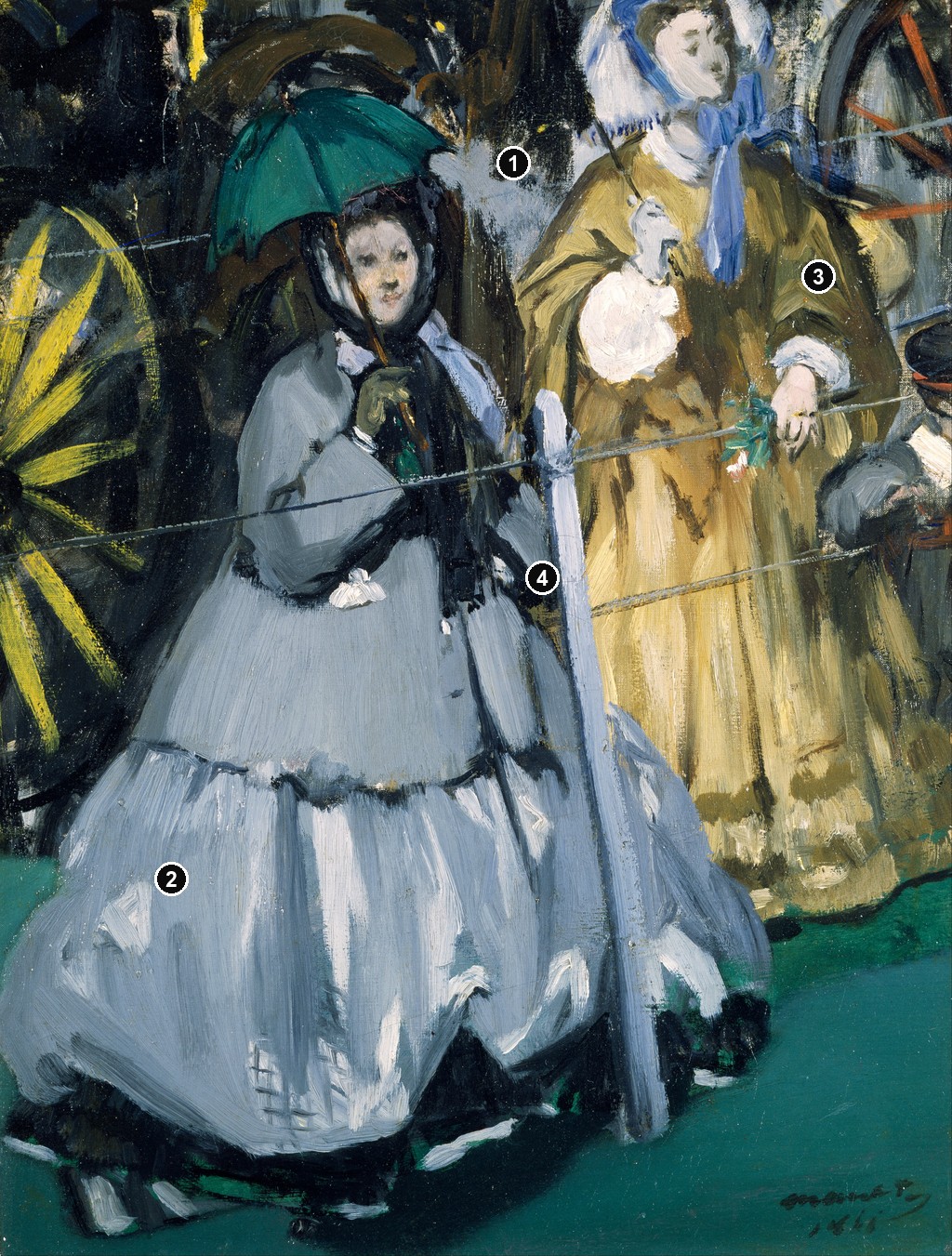
Details from WOMEN AT THE RACES
Look from the green parasol and grey skirt to the blue ribbons, white glove and pale barrier post.
The Green Parasol and Shaded Face
Dark ribs divide the green canopy above a pale face framed by dark headgear and ribbons.
Grey Tiers and Long Folds
A dark band separates the shorter outer layer from the broad lower skirt, described with long pale strokes.
Blue Ribbons and a White Glove
Blue ribbons descend across the pale neckline towards a raised white glove and ochre sleeve.
Ropes and the Pale Post
Thin ropes cross the dresses beside a pale upright post, interrupting the larger fabric shapes.
Dating and a Larger Composition
The painting's date has been read differently over time. Duret transcribed the inscription as 1863, while Rouart and Wildenstein's 1975 catalogue gave 1865.[2][3] Art historian Malcolm Park reports that examiners at Cincinnati in October 2006 agreed on a reading of 1866. He also notes that the signature and date were added after the underlying paint had dried, which does not establish when they were added or when the present image was created.[4] Cincinnati's current record uses 1866.[1]
Rouart and Wildenstein considered the work a probable fragment of a lost, larger racecourse painting, alongside another surviving scene of spectators.[2] Theodore Reff connected those figures with the women in a related watercolour now at Harvard. He argued that the watercolour preceded the larger oil, although its position in the sequence of Manet's racecourse works has been debated.[5] The figures and carriages recur across several designs, while the exact form of the lost canvas remains uncertain.
The Wider Racecourse in Watercolour
Harvard's Race Course at Longchamp, dated 1864, opens the setting into a long horizontal view. It is a separate work in transparent and opaque watercolour over graphite on two joined sheets of white wove paper, measuring 22.1 × 56.4 cm. It belongs to Harvard Art Museums/Fogg Museum through the bequest of Grenville L. Winthrop, accession 1943.387.[6]
Near the left, a grey-dressed woman stands beside a carriage wheel and pale barrier post. Another woman appears just beyond her. These figures recall the Cincinnati painting, but occupy a much smaller part of the whole. The carriage extends across the foreground, with drivers and spectators rising behind it.
From this group, the barrier leads diagonally towards the racing horses at the right. Its repeated pale posts and rail give depth to the scene, linking the close spectators with the distant course. Broad sky and wooded hills stretch above the gathering. The Cincinnati picture concentrates on an arrangement of people, clothes and wheels that the watercolour places within a much wider view.
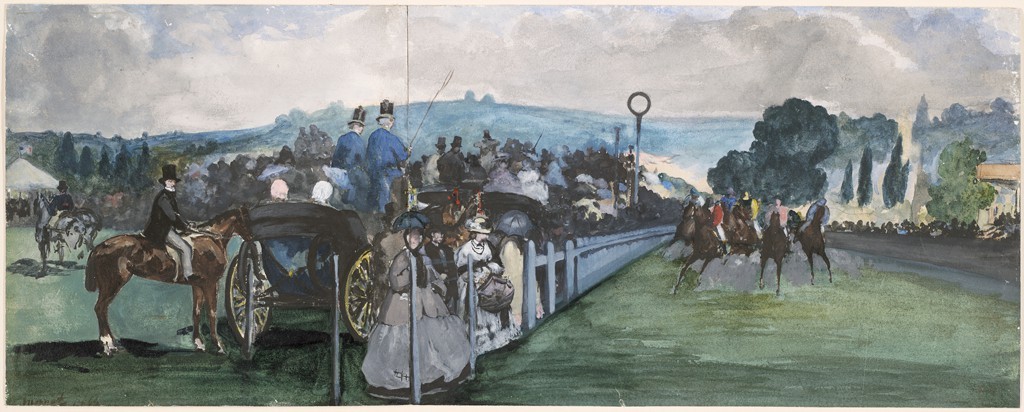
Édouard Manet, Race Course at Longchamp, 1864. Harvard Art Museums/Fogg Museum, 1943.387. Bequest of Grenville L. Winthrop. Harvard Art Museums/Fogg Museum; reproduction via Wikimedia Commons; public domain. Image source. Public domain. Whole supplied public-domain reproduction retained. No enlargement or retouching.
The Painting in Cincinnati
The museum's credit line names the Fanny Bryce Lehmer Endowment.[1] In a conservation post dated 6 October 2022, Cincinnati reported that Women at the Races had come to the laboratory for cleaning and revarnishing. Its small size allowed the conservator to work with it inside a fume hood.[7]
Artworks directory
Explore selected paintings, drawings and prints by Édouard Manet. Search by title or another recorded name.
Frequently Asked Questions
The two principal figures are spectators in fashionable dress. Their names are not securely identified.
It belongs to Cincinnati Art Museum, accession 1944.105.[1]
Discussion
Look again at the images and ideas explored in Women at the Races by Édouard Manet. These editorial prompts invite your observations.
Reader Insights
How do its ribs and curved edge frame the face below?
Which marks describe the largest folds, and which pick out smaller accessories?
How do the thin barrier lines relate to the heavier curves behind the women?
Join the Conversation
Share a detail, comparison or question about Women at the Races by Édouard Manet below.
References
- Cincinnati Art Museum, Women at the Races, accession 1944.105. View source.
- Denis Rouart and Daniel Wildenstein, Édouard Manet, catalogue raisonné, volume I, 1975, no. 95, pp. 98–99. In French. View source.
- Théodore Duret, Histoire d'Édouard Manet et de son œuvre, 1902, painting 50, p. 205. In French. View source.
- Malcolm Park, Edouard Manet's horse-racing project, 2012, subsection vii and notes 61–62. View source.
- Theodore Reff, Manet and Modern Paris, National Gallery of Art, 1982, catalogue 42, pp. 132–133. View source.
- Harvard Art Museums, Race Course at Longchamp; verso: Section of grandstand area, accession 1943.387. View source.
- Cincinnati Art Museum Conservation, Behind the Scenes in Conservation: Women at the Races, 6 October 2022. View source.
- Splash image, Édouard Manet, Women at the Races, 1866. Cincinnati Art Museum, 1944.105. Fanny Bryce Lehmer Endowment. Cincinnati Art Museum; Google Art Project reproduction via Wikimedia Commons; public domain. Image source. Public domain. Whole supplied public-domain reproduction resized. No enlargement or retouching.


