



 by Tom Gurney
Tom Gurney BSc (Hons) is an art history expert with over 20 years experience
Published on June 19, 2020 / Updated on October 30, 2026
Email: tomgurney1@gmail.com / Phone: +44 7429 011000
Young Lady in 1866 by Édouard Manet: Introduction
A woman holds violets beside her cheek while a grey parrot bends forward on its perch. Between them, a monocle hangs from a fine cord. The woman looks out towards us, leaving these small objects to suggest the pleasures, habits and possible stories of her world.
Édouard Manet painted this full-length figure in 1866. His model was Victorine Meurent, already familiar from Olympia and Le Déjeuner sur l’herbe.[1] Her expansive pink dressing gown gives the picture an immediate softness. A closer look reveals a more searching arrangement of eyes, hands, colour and things that invite the senses into play.
At a Glance
- ArtistÉdouard Manet
- Date1866
- MediumOil on canvas
- Dimensions185.1 × 128.6 cm
- ModelVictorine Meurent
- CollectionThe Metropolitan Museum of Art, New York
- Object number89.21.3
- AcquisitionGift of Erwin Davis, 1889[1]
This work across Édouard Manet’s career
Contents
- Two Hands and an Outward Gaze
- The Pink Peignoir
- The Parrot and Its Small Domain
- Victorine Meurent and the Painted Woman
- An Allegory of the Five Senses?
- A Bird That Might Keep Secrets
- Contemporary Dress on a Large Canvas
- Zola’s Elegance and Restraint
- From Young Lady to Woman with a Parrot
- The Journey to the Metropolitan Museum
Two Hands and an Outward Gaze
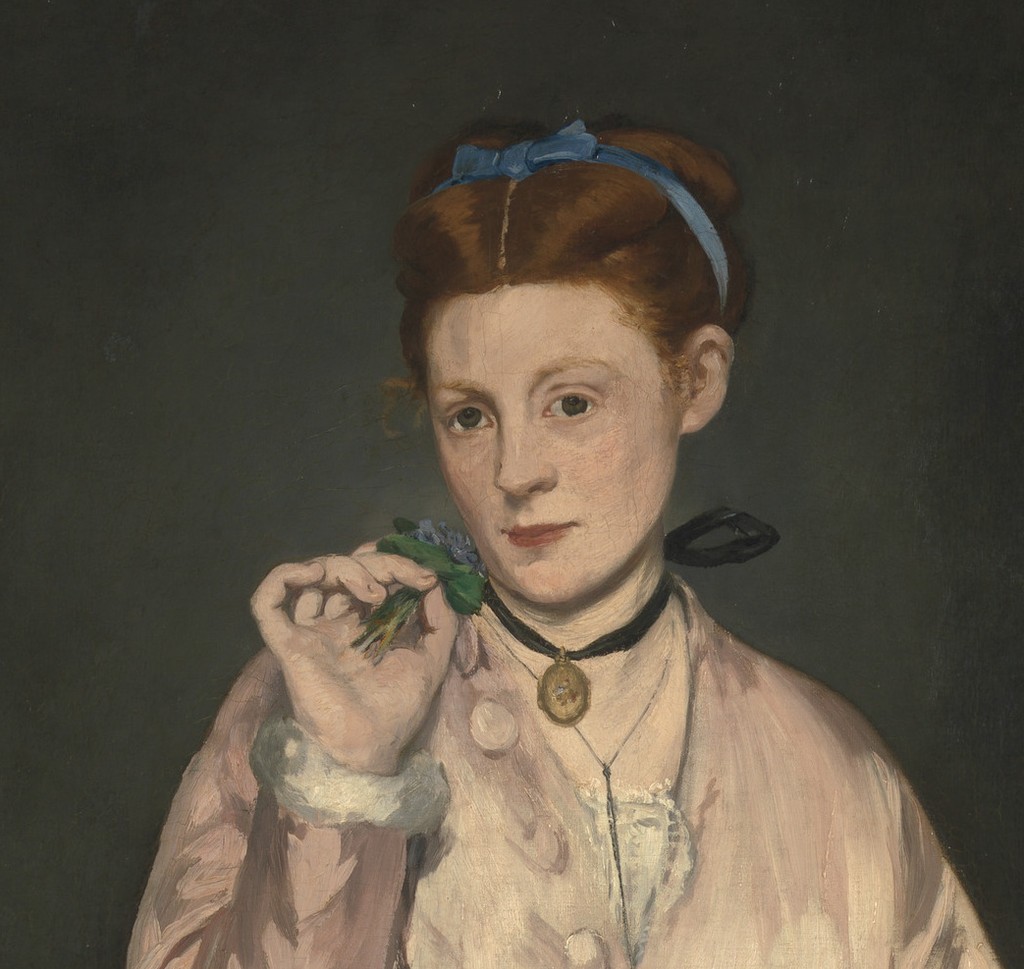
Victorine’s head sits high in the canvas, framed by reddish-brown hair and a blue ribbon. A straight parting divides the hair, whose rounded masses make the face seem narrow and pale. The ribbon follows the curve of the head, introducing a clear, cool colour above the warmer pinks below.
Her eyes look towards the viewer. They provide a point of contact within an otherwise self-contained arrangement: the parrot attends to its own position, the flowers remain beside her face, and the suspended glass has no immediate use. The gaze brings us into a scene whose activity is slight enough to feel momentarily paused.
The hands make that pause unusually precise. On the viewer’s left, her right hand raises the nosegay almost to her mouth and nose. Bent fingers surround its stems. Small blue-violet flowers and broad green leaves form a compact patch of colour where cheek, wrist and cuff nearly meet.
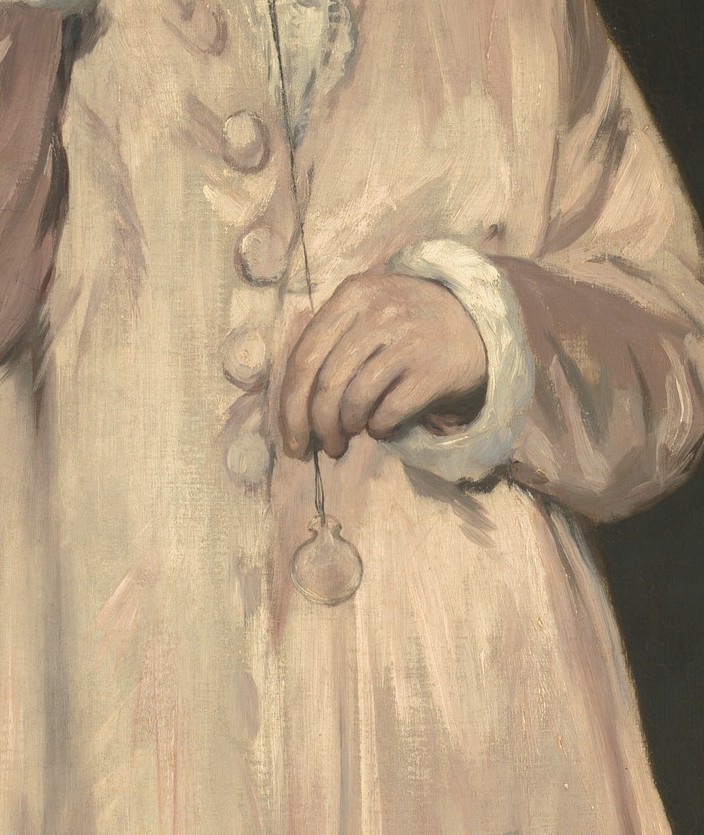
Her other hand rests lower, in front of her waist. The fingers approach the cord from which the monocle hangs, with the round lens just below. Its delicate outline is easy to miss against the gown. Once noticed, it creates a second, smaller circle beneath the buttons and pendant, extending the details of her dress into the space around her hand.
The two gestures set different scales of attention. We can understand the raised flowers from some distance; the fine cord asks us to move closer. Looking becomes an alternation between the broad silhouette and details that emerge only gradually. Victorine’s steady eyes remain above both movements, meeting the viewer who is busy examining her surroundings.
The Pink Peignoir
The robe is a peignoir, an intimate silk dressing gown.[1] Its generous length fills most of the lower canvas. The body beneath it is suggested through shoulders, sleeves and the position of the hands, while the cloth supplies a much larger, flowing shape that widens towards the floor.
Pink changes character across its surface. Near the chest, light cream and pale rose give the fabric a luminous openness. Darker mauve-brown passages gather beneath the raised elbow and along the other sleeve. Farther down, long strokes move through the skirt in broken vertical bands, interrupted by slanting folds and warmer patches near the hem.
These changes are broad enough to remain visibly painted. A fold may begin as a narrow dark stroke, spread into a pale plane and lose its edge before reaching the floor. The eye completes the movement through neighbouring marks. That freedom gives the gown its liveliness: it seems ample and mobile even though the woman stands still.
The buttons introduce a slower, more measured descent. Their rounded forms lead from the upper chest towards the lower hand. Some are lighter than their surroundings; others almost disappear into the gown’s colour. The line of fastening gives structure to a surface whose folds repeatedly pull attention sideways.
At the neck, the black ribbon creates a sharp interval between skin and cloth. Its gold pendant supplies a small, warm centre. White edging and the pale cuffs offer further changes of texture, while the blue hair ribbon and purple flowers keep the upper figure from settling into a single pink harmony.
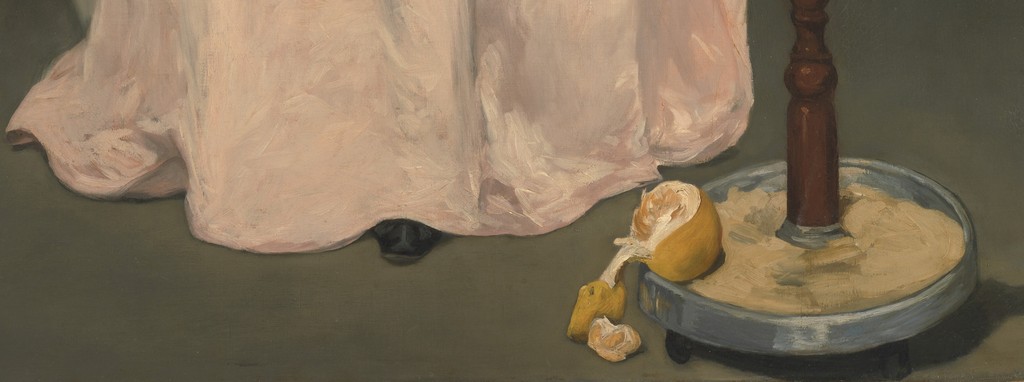
The hem spreads unevenly across the floor. A small black slipper appears near its centre, surrounded by much larger light shapes. It is an economical reminder of a standing body underneath all this fabric. The gown reaches almost to the bottom of the picture, bringing its mass close to the viewer before the eye rises again towards the face.
The Parrot and Its Small Domain
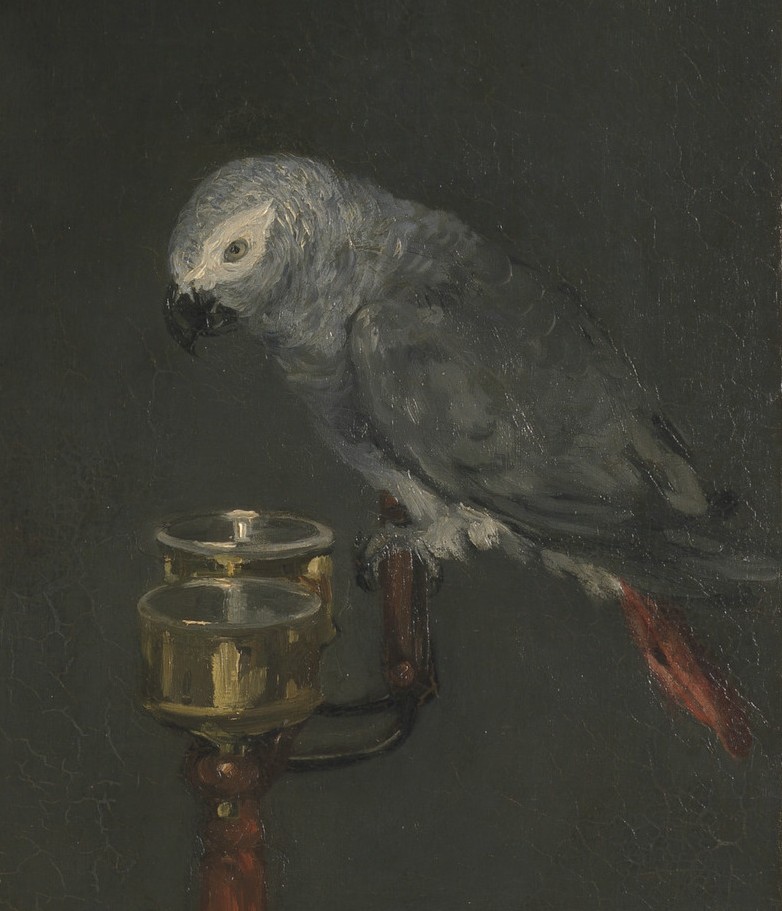
The parrot occupies a separate vertical strip on the right. Its grey plumage approaches the background’s colour, but the pale area around the eye, curved dark beak and red tail make the bird distinct. The forward tilt of its head gives it a concentrated appearance beside the woman’s more upright presence.
Its perch supplies an arrangement of materials as varied as the dress. Reddish-brown wood descends through several horizontal rungs to a turned lower section. Near the bird, two metal feeding vessels overlap. Their bright rims and darker bodies catch light in short, firm accents that contrast with the longer, softer movements of the robe.
The circular base establishes the stand’s contact with the floor. Its pale interior and darker metal edge are seen at an angle, making an ellipse below the tall post. An orange, partly opened, rests at its edge, with peel falling towards the foreground. Yellow and orange bring a sudden warmth into this otherwise grey, brown and pink corner.
The stand is narrow enough for the background to remain visible through it. The woman’s gown, by comparison, forms a nearly continuous mass. That difference gives the two figures their balance: one side is broad and light, the other open and interrupted, with the bird’s head placed well below the woman’s.
The background contains no window, door or furniture that would securely locate the scene. Grey-green space surrounds the upper figure and becomes a floor beneath the hem and stand. Manet provides enough setting for both to stand convincingly, while leaving the relationship between woman, bird and objects unusually exposed.
Annotated Details from Young Lady in 1866: Flowers, Monocle and Parrot
The numbered points identify visible features discussed in this article. Return from each detail to the whole composition. Édouard Manet, Young Lady in 1866, 1866. The Metropolitan Museum of Art, New York, 89.21.3. Gift of Erwin Davis, 1889. Image source. CC0 / Public domain. Numbers added to a separate resized whole provided overview. Detail crops from the immutable original; no enlargement, retouching or colour alteration.
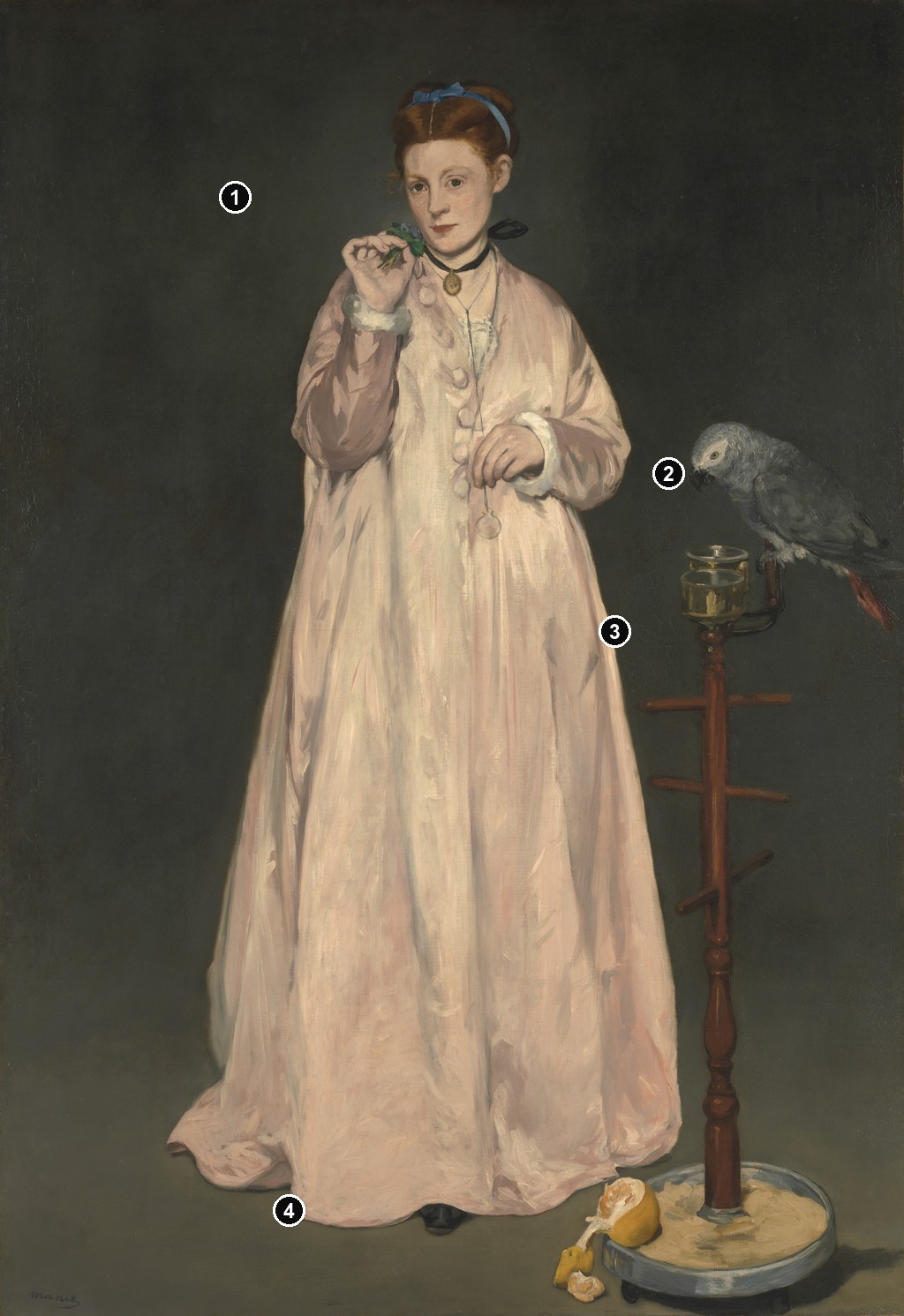
Details from YOUNG LADY IN 1866: FLOWERS, MONOCLE AND PARROT
Look from the flowers beside the face to the suspended monocle, the parrot and its cups, then down to the orange beside the stand base.
Face, Flowers and Raised Fingers
The eyes face the viewer as bent fingers hold the small blue-violet flowers close to the cheek.
Lower Hand and Suspended Monocle
The lower fingers meet a fine cord, with the round monocle hanging against the pale gown.
Parrot and Metal Feeding Cups
The grey bird bends its head above two bright-rimmed feeding vessels. Its tail meets the original right edge.
Gown Hem, Orange and Stand Base
The broad pale hem lies beside the stand base, with a partly opened orange and loose peel near its edge.
Victorine Meurent and the Painted Woman
Victorine’s appearances across Manet’s work make her face recognisable even as the settings change. She was herself an artist as well as a model, a point emphasised by the Museum of Fine Arts, Boston, which owns an earlier portrait of her.[2] Her contribution to these pictures belongs to a working relationship with the painter and to the different poses and presences the images required.
Here the distinction between model and subject is especially useful. A familiar face appears in a dressing gown beside a pet bird, inviting the intimacy of a domestic encounter. Yet the picture supplies few particulars of an actual household. We have a carefully arranged figure, a perch and several suggestive objects, rather than a furnished room with a clearly unfolding event.
The gown, flowers and monocle offer ways of imagining the woman’s circumstances. They do not settle what she has been doing, where she is going or whom she knows. Victorine’s identity gives the face a history across paintings; the unresolved situation gives this particular image its continuing openness.
An Allegory of the Five Senses?
One influential interpretation gathers the scattered objects into an allegory of the five senses. The Metropolitan Museum presents the violets as smell, the orange as taste, the parrot as hearing, and the monocle and fingers as sight and touch.[1] Juliet Wilson-Bareau likewise considers the possibility plausible, while stressing how understated such references would be.[3]
The appeal of the reading lies in its close fit with the objects. Flowers bring scent almost to the woman’s face. The opened fruit suggests flavour. A parrot introduces the possibility of a voice, while the lens makes seeing itself into a small, portable thing. The fingers hovering around its cord give touch a particularly delicate presence.
Each sense would have to be imagined. We see flowers without smelling them and a bird without hearing it. Even the monocle is suspended below the hand rather than being used to examine something. The painting places the means of sensation before us while leaving their fuller experience beyond the canvas.
That gap helps the interpretation remain engaging. The objects can work together as a set of sensory invitations, yet they also belong comfortably within the scene. A flower may carry meaning while remaining a flower held between fingers. The proposed allegory enriches the arrangement without requiring us to assign every fold, ribbon and colour a fixed symbolic equivalent.
A Bird That Might Keep Secrets
Mona Hadler approached the painting through a different tradition in her 1973 study. She traced images of women with parrots as intimate companions, creatures associated with speech and with access to private life. She also drew attention to the monocle, suggesting that it might belong to a man, and to the possibility that the flowers were a gift.[4]
Those suggestions give the scene the beginnings of a romantic narrative. A dressing gown, a bouquet and a borrowed possession could imply an encounter beyond the moment shown. Hadler imagined the bird as a confidant within that atmosphere. Her argument depends on possibilities carried by the objects, rather than a documented episode in Victorine’s life.[4]
The painting leaves room for that kind of speculation because the hands seem occupied with things that have arrived from elsewhere. Flowers have been gathered and the glass can be carried away. The parrot, meanwhile, belongs to a more settled arrangement of perch, cups and food. Different durations meet within a single quiet pose.
The bird’s reputation for speech can make the silence feel more pointed. It might repeat what it hears, but the painted parrot offers us no words. Victorine’s mouth is closed, too. Whatever intimacy a viewer imagines remains held within the image, whose most direct communication is the woman’s outward gaze.
Contemporary Dress on a Large Canvas
At more than 1.8 metres high, the canvas gives an everyday figure substantial physical presence. Its full-length format makes the long robe essential to how we encounter her: the dress controls the approach to the face, filling the space below it with a sustained field of colour.
The Met’s exhibition Impressionism, Fashion, and Modernity placed the painting within a wider interest in large figures wearing contemporary clothes during the 1860s. Artists including Monet and Tissot explored how dress could give figure painting an immediate connection with their own time.[5]
Manet’s gown offers a particularly intimate version of that encounter. Its loose sleeves and spreading hem allow paint to describe fabric through broad movements. The narrow neck ribbon and pendant retain the precision of accessories, but the overall effect depends on how pale colour expands across the canvas.
A critical remark reported by the Met accused Manet of failing to “value a head more than a slipper.”[5] The complaint identifies a tension visible here. A face conventionally demands special attention, while Manet also makes the gown, bird, fruit and footwear rewarding to examine. The figure remains the picture’s centre, surrounded by things that can repeatedly draw us away.
Zola’s Elegance and Restraint
Émile Zola found elegance in the same painting. In his 1867 essay on Manet, he described the long pink peignoir, the violets and the parrot bending over its perch. He admired the ample dress and the woman’s movement, then added a reservation that became a compliment: the picture might have been too pretty if the painter’s austerity had not marked the whole.[6]
The essay was written in December 1866, before the picture’s appearance at the Salon two years later. Zola placed it among four canvases that were still barely dry, giving his account the immediacy of a recent encounter with Manet’s work.[6] His response offers a contemporary route into a picture that later viewers have often approached through its possible symbols.
His pairing of beauty with restraint is useful when looking at the gown. Its pinks are inviting, but they are crossed by grey, brown and abrupt dark intervals. The figure’s face is clearly articulated, yet the expression supplies little of the easy sociability that a decorative portrait might encourage. The bird adds interest without becoming a charming anecdote acted out for the viewer.
Zola’s admiration also gives the work a place within his larger defence of the painter. He could find grace in a figure whose handling challenged familiar expectations. His praise allows the pink robe and quiet pose to belong to Manet’s developing art without making them an escape from its difficulties.
The following discussion in his essay turns towards still lifes and the recognition that even Manet’s opponents could grant his painting of inanimate things.[6] That proximity is suggestive here. The flowers, metal vessels, lens and fruit offer small concentrations of observation around the standing figure, joining the pleasures of a still life to the encounter with a person.
From Young Lady to Woman with a Parrot
The picture appeared in Manet’s independent exhibition in 1867 under the title Jeune dame en 1866. At the Salon of 1868, where it was accepted alongside his portrait of Émile Zola, it was listed as Une jeune femme, or A Young Woman.[3] The date in the familiar title therefore refers to the painting’s subject and year, not to its Salon debut.
The parrot supplied another way of remembering it. In his 1906 history of Manet, Théodore Duret described how the portrait of Zola received a comparatively moderated response, while the standing woman attracted harsher treatment. He singled out the pink peignoir, the characteristic face and the bird, reporting that the public called the picture Femme au perroquet.[7]
Duret wrote as a sympathetic historian looking back over the career. His account presents an opposition between the painter and his audience, rather than a complete record of what every visitor thought. Even within that partisan account, however, the bird emerges as the detail through which the whole painting could acquire an alternative identity.
That title also encouraged comparison with Gustave Courbet’s Woman with a Parrot of 1866. Hadler cautioned against making the two works into a neatly ordered exchange of successive replies: their early histories overlap more closely than their different Salon dates might suggest.[4] The comparison’s wider history is explored in Manet and Courbet’s women with parrots.
For this painting, the change of title shifts emphasis. Young Lady in 1866 foregrounds a contemporary person at a particular moment. Woman with a Parrot makes a relationship between two beings the identifying feature. Neither title resolves the monocle, violets or gaze, but each gives the viewer a different place to begin.
The Journey to the Metropolitan Museum
The canvas passed through the dealer Durand-Ruel and the collector Ernest Hoschedé before reaching other hands. In 1881, the American painter J. Alden Weir acquired it as agent for Erwin Davis. Davis gave it to the Metropolitan Museum in 1889.[3]
It entered alongside Boy with a Sword. The Met identifies the two gifts as the first paintings by Manet to enter a museum collection.[1] Their arrival brought together two full-length figures from different points in the 1860s: a child organised around a conspicuous historical prop and a woman surrounded by the smaller objects of an intimate contemporary scene.
In Young Lady, those objects continue to alter the pace of looking. The pale robe makes the figure immediately visible; the monocle delays recognition; the bird draws attention sideways; the orange brings it down towards the floor. Returning to Victorine’s eyes gathers these separate encounters around a person whose presence remains steadier than the stories we might tell about her.
Artworks directory
Explore selected paintings, drawings and prints by Édouard Manet. Search by title or another recorded name.
Frequently Asked Questions
The model is Victorine Meurent, who also posed for Manet’s Olympia and Le Déjeuner sur l’herbe.[1]
She raises a small bouquet of violets in her right hand. A monocle hangs from a cord near her left hand.
Scholars have proposed that reading, but it remains an interpretation.[3]
Discussion
Look again at the images and ideas explored in Young Lady in 1866 by Édouard Manet. These editorial prompts invite your observations.
Reader Insights
Start with the circular monocle and follow its cord up towards the hand.
Then compare the round buttons with the much larger ellipse of the stand’s base.
Notice how small, firm details keep interrupting the flowing pink robe, and how the parrot’s grey reappears elsewhere in the painting.
Join the Conversation
Share a detail, comparison or question about Young Lady in 1866 by Édouard Manet below.
References
- The Metropolitan Museum of Art. “Young Lady in 1866,” 1866, 89.21.3. Current object details, interpretation and audio transcript. View source.
- Museum of Fine Arts, Boston. “Victorine Meurent,” about 1862, 46.846. Collection commentary on the artist and model. View source.
- Juliet Wilson-Bareau. Manet, Monet, and the Gare Saint-Lazare. National Gallery of Art, 1998, pp.20–22 and checklist no.15, p.194. Interpretation, exhibition titles and collecting history. View source.
- Mona Hadler. “Manet’s Woman with a Parrot of 1866.” Metropolitan Museum Journal 7 (1973), pp.115–122. Historical conventions and proposed meanings of the bird, dress and objects. View source.
- The Metropolitan Museum of Art. “Gallery One—Refashioning Figure Painting,” Impressionism, Fashion, and Modernity, 2013. View source.
- Émile Zola. Édouard Manet: étude biographique et critique. 1867. Discussion of Jeune dame en 1866 and adjacent passages; written December 1866. View source. (in French).
- Théodore Duret. Histoire d’Édouard Manet et de son œuvre. 1906, pp.92–93. Retrospective account of the Salon of 1868 and the parrot title. View source. (in French).
- Splash image, Édouard Manet, Young Lady in 1866, 1866. The Metropolitan Museum of Art, New York, 89.21.3. Gift of Erwin Davis, 1889. Image source. CC0 / Public domain. Whole supplied reproduction resized within native dimensions; no enlargement, retouching or colour alteration.


