



 by Tom Gurney
Tom Gurney BSc (Hons) is an art history expert with over 20 years experience
Published on June 19, 2020 / Updated on October 30, 2026
Email: tomgurney1@gmail.com / Phone: +44 7429 011000
Young Woman in a Round Hat by Édouard Manet: Introduction
Black gloves, a blue garment and a pale cuff gather across the lower half of Édouard Manet's Young Woman in a Round Hat. Above them, a veiled face turns to the left beneath a rounded black crown. Painted about 1877–79, this oil on canvas belongs to the Los Angeles County Museum of Art, where the woman is catalogued as unidentified.[1] Her clothing is clearly described, but the person wearing it is harder to know. A photograph taken after Manet's death also shows that parts of the painting have changed.
At a Glance
- ArtistÉdouard Manet
- TitleYoung Woman in a Round Hat / Jeune femme au chapeau rond
- DateCirca 1877–79
- MediumOil on canvas
- Dimensions54.61 × 45.09 cm
- SitterUnidentified
- CollectionLos Angeles County Museum of Art
- CreditGift of the Henry and Rose Pearlman Foundation and Family
- Accession numberM.2026.1.2.[1]
- Catalogue numberRW I305.[2]
This work across Édouard Manet’s career
Contents
- A Figure Turned in Two Directions
- The Rounded Hat and Dotted Veil
- Blue Clothing and Broken Pale Marks
- Gloves, Cuff and Umbrella
- Long Strokes in the Background
- A Portrait and a Fashionable Appearance
- An 1883 Photograph of the Painting
- From the Studio to LACMA
- Annotated details
A Figure Turned in Two Directions
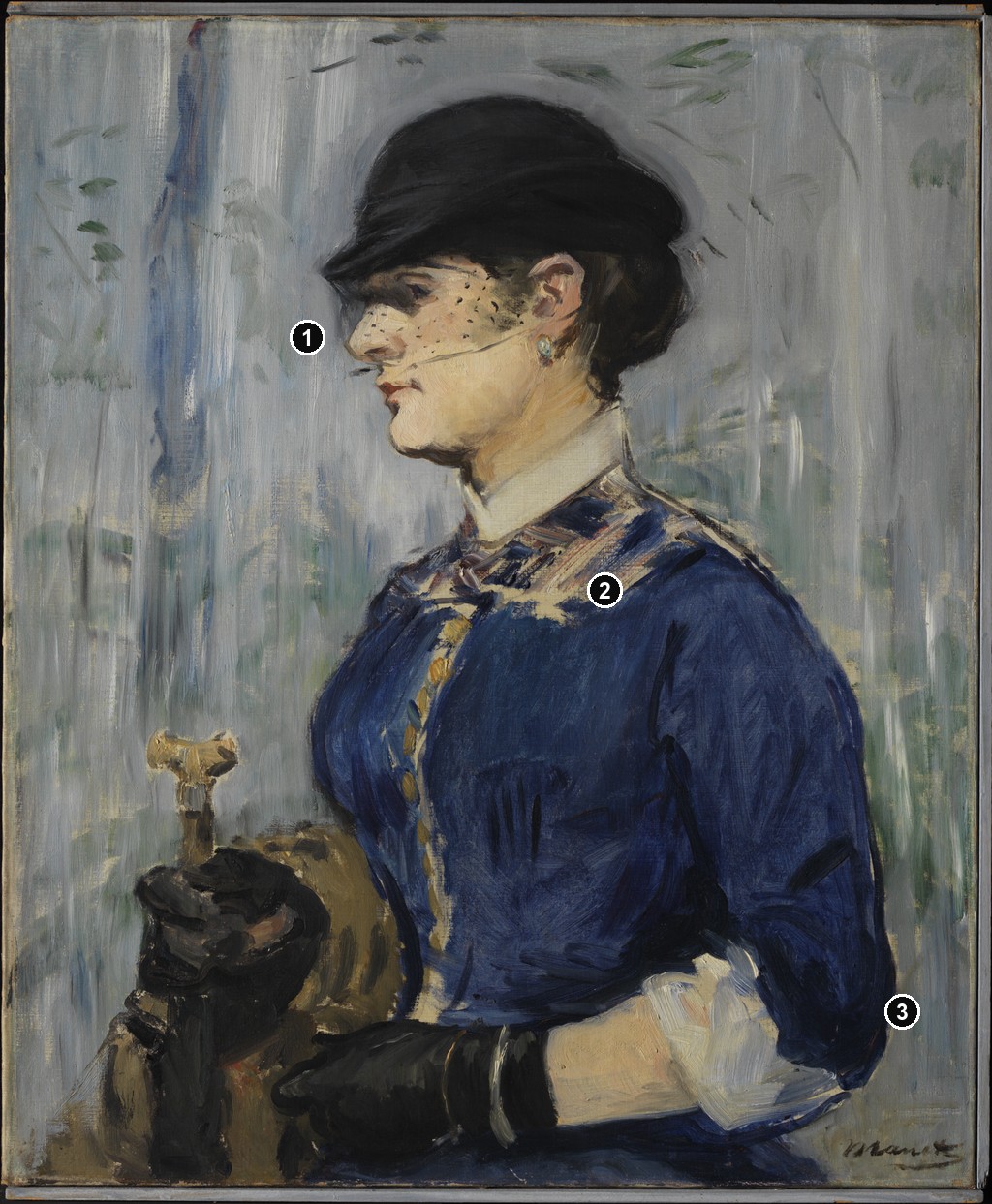
The woman occupies most of the canvas, but her pose gives the figure more than one direction. Her nose, lips and chin project towards the left, while the broad front of her blue clothing remains open to the viewer. The nearer arm bends down from a rounded shoulder before returning across the foreground. This turn allows the face and the hands to be seen together without making them face the same way.
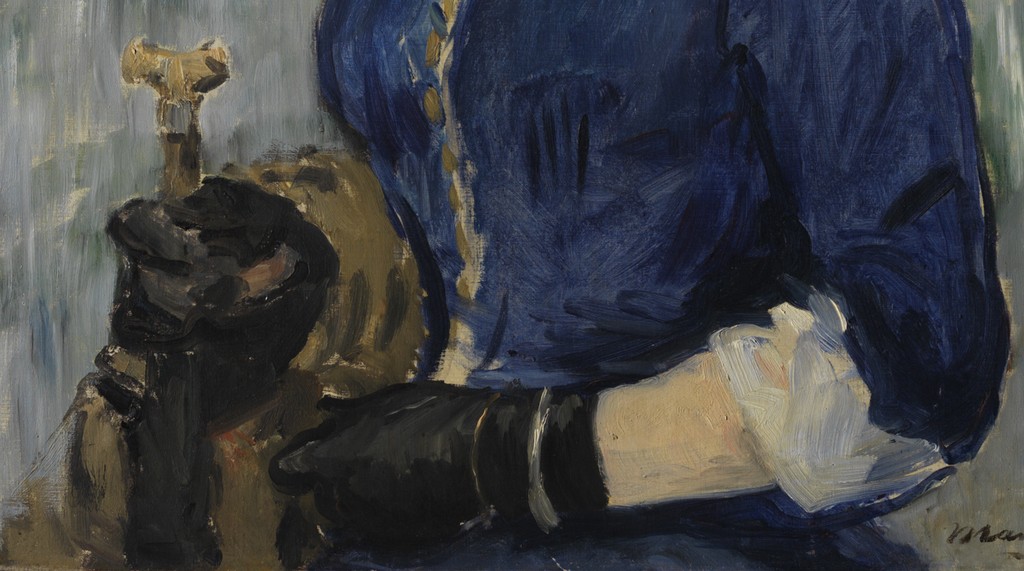
The pale forearm lies low in the picture, ending in a long black glove that points towards the opposite side. Above it, the other gloved hand closes around an upright handle. These dark forms meet near the lower left, where several overlapping shapes make the arrangement denser than the more open area around the head. The upper silhouette is readily followed; the lower grouping takes longer to separate into hand, clothing and carried object.
The figure is cut at the lower edge, bringing face, clothing and accessories close to the viewer without explaining her stance or a surrounding activity.
The Rounded Hat and Dotted Veil
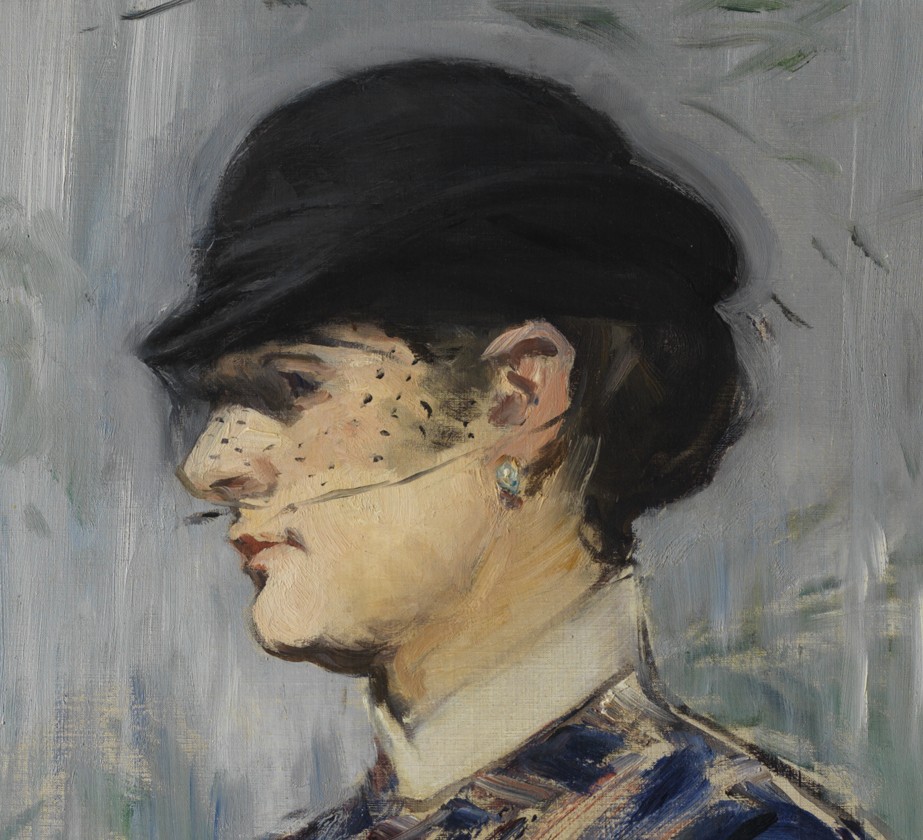
The hat's top rises in a broad curve, with a small change of direction near the back. Its brim slopes towards the forehead and projects beyond it. Against the pale background, the crown forms a clear dark shape, while smaller variations within the black suggest its rounded volume. Behind the ear, a separate mass of dark hair continues the head's outline.
The veil crosses the face as a much lighter structure. Small black dots are scattered over the cheek and nose, with a fine line running diagonally towards the ear. Beneath the brim, a denser patch of dark paint interrupts the area around the eyes. Flesh remains visible between the dots, while the upper darkness conceals more.
Warm touches at the ear and lips stand apart from the surrounding blacks. A small blue-green earring, edged with lighter and warmer marks, makes a particularly concentrated accent. The pale neck descends towards an upright collar, keeping a light interval between the dark hair and the blue shoulder.
Blue Clothing and Broken Pale Marks
The blue garment has a broad, almost continuous presence across the torso and upper sleeve. Yet its surface is far from uniform. Darker strokes bend around the arm, and lighter blue marks run across the chest. Near the elbow, several diagonal lines converge as the sleeve changes direction towards the cuff.
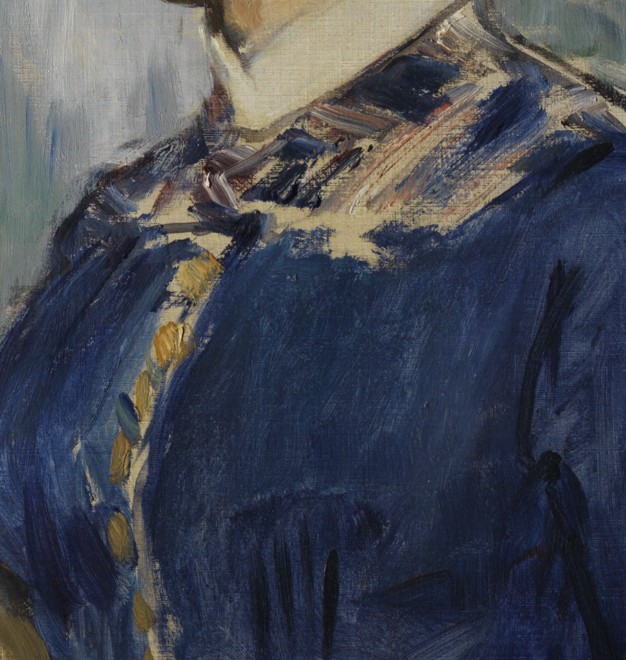
At the neckline, this large area of colour breaks into a more irregular arrangement. Cream, blue, brown and reddish strokes lie beside one another in a narrow band. A pale diagonal passage follows the top of the shoulder, separating it from the grey-green marks beyond. The upright collar is simpler, with long pale strokes rising towards the jaw.
Small yellow and ochre shapes descend along the front of the garment. They make an interrupted line between its two larger blue areas. Nearby, pale gaps and strokes prevent this boundary from becoming a neatly closed seam. Looking from these small marks to the broad sleeve reveals how differently the clothing is described within a single figure: concentrated touches at the front, larger sweeps around the arm, and an open, ragged edge at the cuff.
Gloves, Cuff and Umbrella
The nearer glove extends horizontally across the bottom of the picture. Grey highlights cross its dark surface, and a narrow light curve follows the wrist. Behind it, the pale cuff expands into an irregular fan of cream and blue-grey strokes. Its outer edge turns upwards near the elbow, where light cloth meets the dark outline of the sleeve.
The other hand sits higher and farther left. Its bent fingers surround an upright shaft topped by a broad yellow-brown handle. The fingers are separated by short lighter marks, while a folded dark shape continues downwards beneath them. A curved tan-brown form passes behind the hand and meets the blue torso, adding another overlapping layer to this crowded corner.
Théodore Duret's 1902 catalogue described the object as an umbrella in the woman's right hand.[3] The Pearlman Foundation's account records a wider range of identifications: parasol, umbrella or walking stick.[4] Its function is less immediately legible than its place in the composition. The vertical handle stands beside the much longer gloved forearm, making a small upright against a strong horizontal.
Long Strokes in the Background
The background is most exposed to the left of the face and above the shoulder. Long pale strokes descend through grey, blue and green, interrupted by shorter dark marks. A stronger blue vertical stands some distance from the nose. Nearby, small green touches have a leaf-like appearance, but they do not describe a detailed garden.
Around the hat, the surrounding greys change direction and density. Some follow its curve, while other marks continue the background's longer downward movement. The black crown remains clearly bounded against them. Lower down, the edges of the blue garment sometimes stand out sharply and sometimes approach the background in tone.
These marks suggest a setting without identifying a particular place. Their loose arrangement surrounds the more substantial head, torso and arms.
A Portrait and a Fashionable Appearance
Her hat, gloves and upright collar present a recognisable public appearance, while the veil makes parts of the face less available to us. The Pearlman Foundation describes the clothing as an ensemble suited to promenading.[4] That represented role does not establish the actual woman's wealth or identity.
Art historian Bridget Alsdorf places the work between portraiture and the painting of modern life. She connects its fashionable appearance and obscured face with Manet's interest in the modern Parisienne, while discussing its combination of loose, lighter brushwork and strong black forms.[5] Her reading brings together qualities that are often separated when considering Manet's relationship with Impressionism and his painting technique.
An 1883 Photograph of the Painting
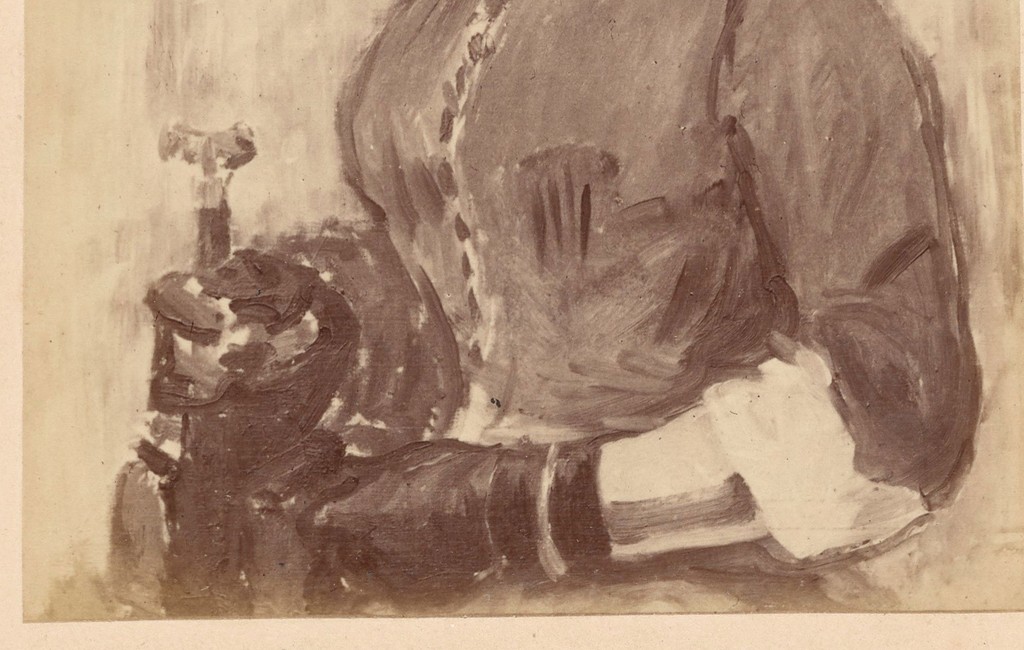
Fernand Lochard photographed the painting about 1883. Princeton University Art Museum explains that Léon Leenhoff commissioned photographs of works in Manet's studio after his death.[6]
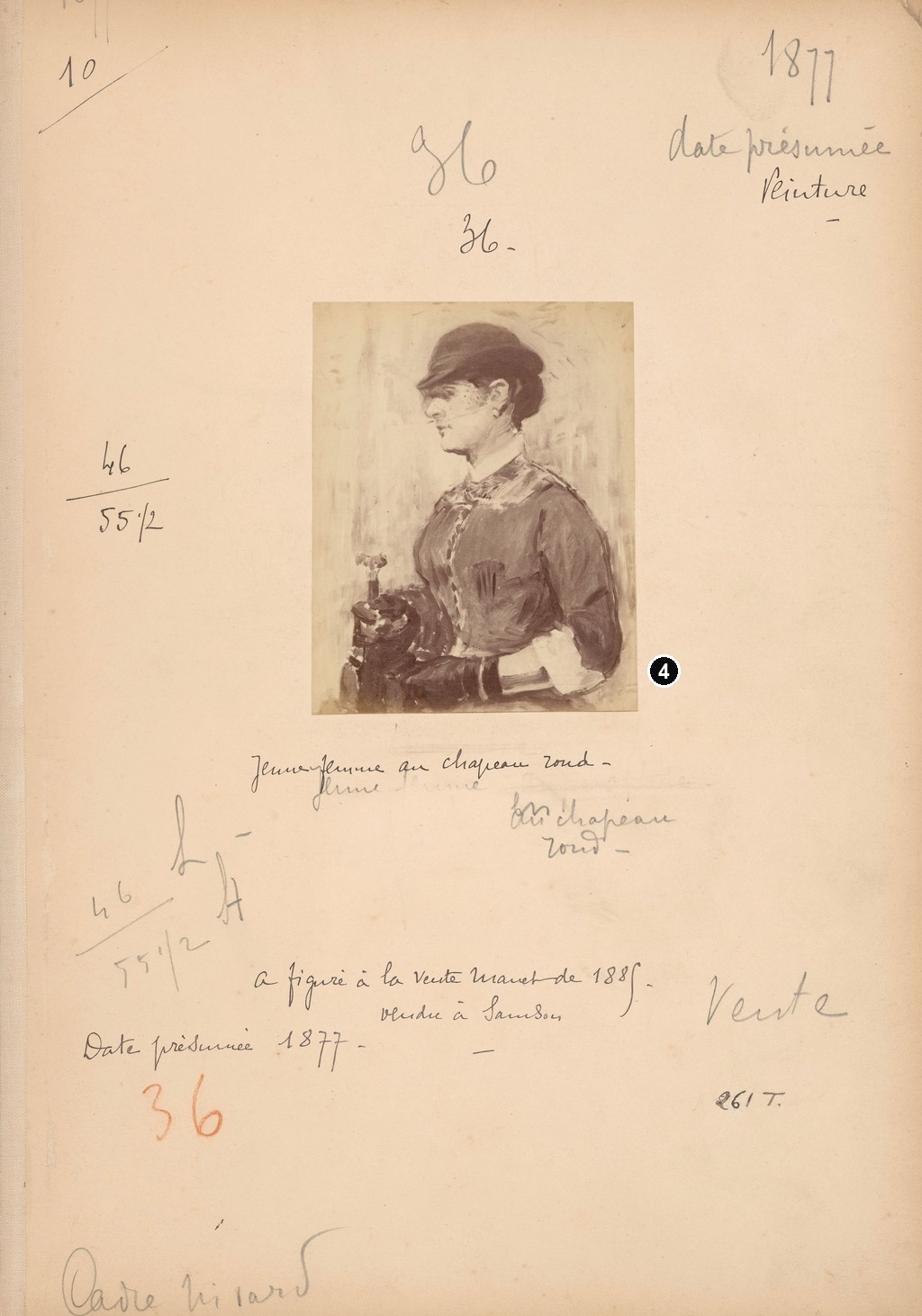
The card shows the portrait surrounded by broad margins, with handwritten numbers, measurements and a title. This presentation makes the painting part of an inventory rather than an isolated image. The small photograph preserves the familiar hat, profile, front details and bent arm, allowing the composition to be recognised despite its different colour and scale.
Princeton identifies later covering of a forearm line, filling between the fingers and addition of the signature. Its comparison also cautions that photographic response can make yellow buttons appear dark; tonal difference alone does not prove repainting.[6]
Alsdorf dates the finger and forearm retouching to before 1910 and regards the signature as posthumous, probably added around the same time.[5] The comparison therefore complicates any reading of the present surface as wholly untouched by later hands.
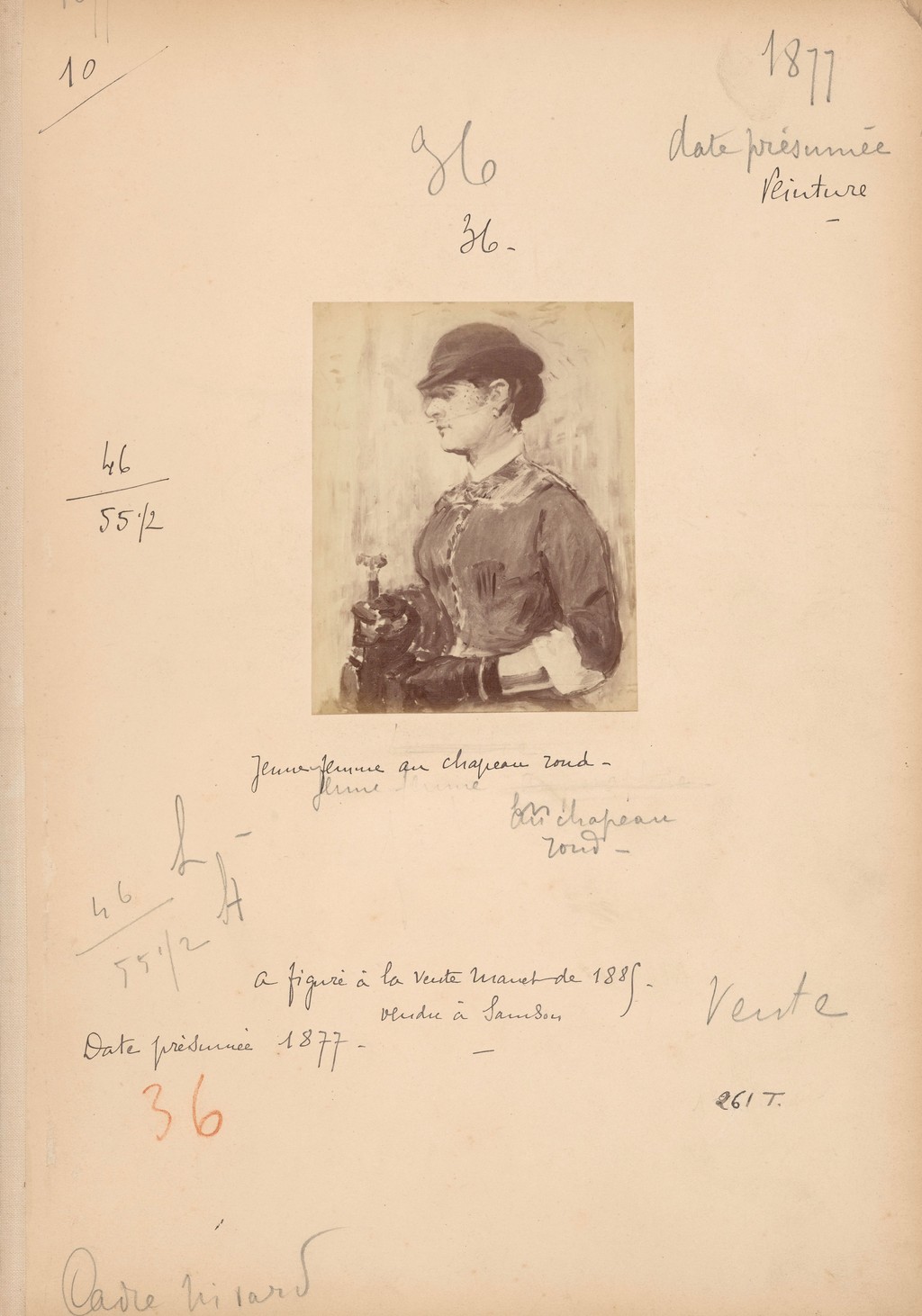
Fernand Lochard, photograph of Young Woman in a Round Hat on an annotated card, about 1883. The Morgan Library & Museum, MA 3950, Lochard volume 3, no. 10. The Morgan Library & Museum, purchased as the gift of Mrs. Charles Engelhard, 1974. Image courtesy of the Princeton University Art Museum. Image source. Public domain. Whole annotated card resized; mount and handwritten notes retained. No enlargement or retouching.
Annotated Details from Young Woman in a Round Hat and Lochard’s Photograph
The numbered points identify visible features discussed in this article. Return from each detail to the whole composition. Each caption identifies the work shown.
Young Woman in a Round Hat
Édouard Manet, Young Woman in a Round Hat, circa 1877–79. Los Angeles County Museum of Art, M.2026.1.2. Bruce M. White / Princeton University Art Museum; Henry and Rose Pearlman Collection; via Wikimedia Commons; public-domain reproduction. Image source. Public domain. Numbers added to a separate resized overview retaining the supplied edges. Detail crops from the public-domain reproduction; no enlargement or retouching.
Lochard’s Annotated Photograph
Fernand Lochard, photograph of Young Woman in a Round Hat on an annotated card, about 1883. The Morgan Library & Museum, MA 3950, Lochard volume 3, no. 10. The Morgan Library & Museum, purchased as the gift of Mrs. Charles Engelhard, 1974. Image courtesy of the Princeton University Art Museum. Image source. Public domain. Number added to a separate resized overview of the whole annotated card. One detail cropped from its historical photograph; no enlargement or retouching.
Details from YOUNG WOMAN IN A ROUND HAT AND LOCHARD’S PHOTOGRAPH
Look from the hat and veil to the neckline and hands, then compare the hand and forearm area in Lochard’s historical photograph.
Young Woman in a Round Hat
The Hat, Veil and Face
The rounded hat and dark hair enclose the face, crossed by scattered veil dots and a thin diagonal edge.
The Neckline and Front Accents
Pale and coloured strokes interrupt the blue near the neckline and descend beside the yellow front details.
Gloves, Cuff and Upright Handle
The horizontal gloved forearm meets a pale cuff, while the other hand grips an upright handled object.
Lochard’s Annotated Photograph
Hands and Forearm in Lochard’s Photograph
A dark band along the forearm and light shapes between the gripping fingers are visible in the mounted photograph.
From the Studio to LACMA
Rouart and Wildenstein's catalogue records the painting in Manet's posthumous inventory and as lot 36 in the 1884 estate sale.[2] The Pearlman Foundation names the buyer as Samson, possibly a pseudonym or agent. Its provenance places the work with Auguste Pellerin by 1902, then traces subsequent ownership through John Quinn, the Ryerson family and the Art Institute of Chicago before its sale to Silberman Galleries. Henry Pearlman had acquired it by May 1953; the Foundation followed after 1974.[4]
The painting now belongs to LACMA.[1] The black hat and blue torso remain readily recognised shapes, while the veiled face and crowded arrangement of hands reward closer attention.
Artworks directory
Explore selected paintings, drawings and prints by Édouard Manet. Search by title or another recorded name.
Frequently Asked Questions
LACMA dates it to circa 1877–79.[1]
The sitter remains unidentified.[1]
It belongs to the Los Angeles County Museum of Art, accession M.2026.1.2, a gift of the Henry and Rose Pearlman Foundation and Family.[1]
Discussion
Look again at the images and ideas explored in Young Woman in a Round Hat by Édouard Manet. These editorial prompts invite your observations.
Reader Insights
Where do the dots leave the face visible, and where does the darker paint conceal it?
How do the sleeve, cuff and gloves change direction across the lower half of the picture?
Which differences can be compared directly, and why might photographic colour response matter?
Join the Conversation
Share a detail, comparison or question about Young Woman in a Round Hat by Édouard Manet below.
References
- Los Angeles County Museum of Art, Young Woman in a Round Hat, M.2026.1.2, object record and curatorial notes. View source.
- Denis Rouart and Daniel Wildenstein, Édouard Manet: Catalogue raisonné, volume I, 1975, no. 305, pp. 238–239. In French. View source.
- Théodore Duret, Histoire d'Édouard Manet et de son œuvre, 1902, no. 221, p. 248. In French. View source.
- Henry and Rose Pearlman Foundation, Young Woman in a Round Hat, provenance and critical perspective. View source.
- Bridget Alsdorf, “Manet's Quarrel with Impressionism,” in Cézanne and the Modern: Masterpieces of European Art from the Pearlman Collection, 2014, pp. 87–93, including note 4. View source.
- Princeton University Art Museum, Young Woman in A Round Hat from Album of photographs of the work of Edouard Manet, Fernand Lochard, about 1883, Morgan Library & Museum, MA 3950, Lochard volume 3, no. 10; Princeton loan L.2019.9. View source.
- Splash image, Édouard Manet, Young Woman in a Round Hat, circa 1877–79. Los Angeles County Museum of Art, M.2026.1.2. Bruce M. White / Princeton University Art Museum; Henry and Rose Pearlman Collection; via Wikimedia Commons; public-domain reproduction. Image source. Public domain. External frame and edge strips cropped; painted subject retained. No enlargement or retouching.


