



 by Tom Gurney
Tom Gurney BSc (Hons) is an art history expert with over 20 years experience
Published on June 19, 2020 / Updated on October 30, 2026
Email: tomgurney1@gmail.com / Phone: +44 7429 011000
Young Woman with a Book by Édouard Manet: Introduction
Pale pages lie across a broad black skirt, while the woman holding them turns her face towards the brighter side of the room. A large patterned cushion supports her head and shoulder. In Édouard Manet's Young Woman with a Book, painted about 1875, these few elements fill a small horizontal canvas.[1] The book establishes an activity, but the woman's attention is directed elsewhere. Her face, the pages and the window give the eye separate light areas to follow within an interior dominated by dark clothing and warm brown tones.
At a Glance
- ArtistÉdouard Manet
- TitleYoung Woman with a Book / Jeune femme au livre
- DateCirca 1875.[1]
- MediumOil on canvas
- Dimensions24.5 cm high × 32.4 cm wide.[2]
- CollectionPrivate collection; present location unverified.[1]
- Catalogue numberRW I239.[1]
- MarkStamped initials E.M. at lower right.[2]
This work across Édouard Manet’s career
Contents
- The Seated Figure and Her Turned Face
- An Open Book on the Lap
- The Window and the Dark Dress
- The Large Patterned Cushion
- A Suggested Identity and a Later Stamp
- A Comparison with Stéphane Mallarmé
- From the Estate to the Wormser Collection
- Annotated details
The Seated Figure and Her Turned Face
The woman's body descends diagonally from the upper right towards the lower left. Her shoulder rests against the pale cushion, while the skirt spreads across the foreground and meets the bottom edge. The extended pose gives the dress a large presence, although the head remains close to the top. Little of the chair is described independently from the figure and its support.
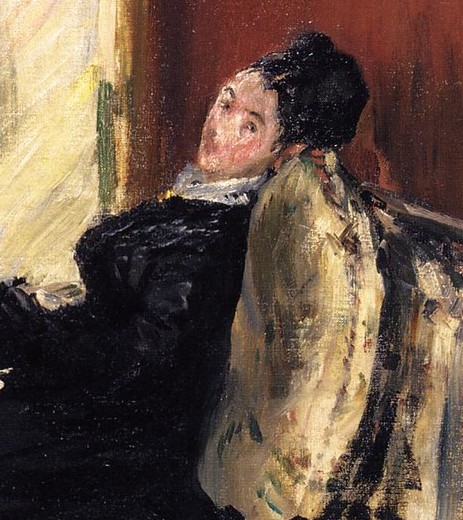
Her hair rises in an irregular dark mass, with shorter curved marks near the forehead. Against it, the face is small and light. Pink and reddish touches appear beside cream passages, with darker marks at the brows, nose and mouth. The head tilts back towards the cushion, while the eyes are turned away from the pages below. A narrow pale collar follows the line beneath the chin.
The face and the book have different directions, but no second person appears to account for the turn. The picture leaves the relation between reading and looking open.
An Open Book on the Lap
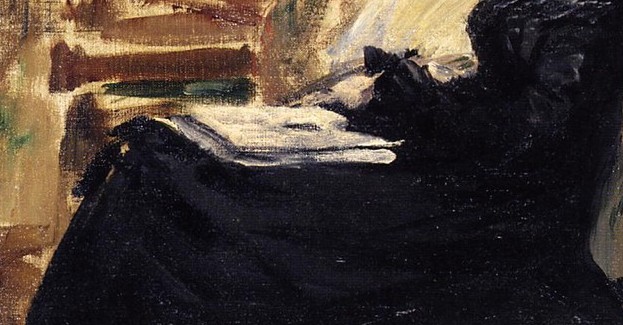
The book rests across the lap as a low, pale shape. Several overlapping edges extend towards the left, while a darker division separates the light areas near the centre. Its position follows the spread of the skirt rather than the more upright direction of the torso. The pages therefore make a short horizontal within the longer diagonal of the seated body.
The hand lies just above and behind the nearest page edges. A light cuff emerges from the dark sleeve, and a few darker marks separate the fingers from the paper. The compact gesture leaves most of the pale surface exposed against the dress. No particular title is legible.
Théodore Duret's 1902 catalogue described an open book on the woman's knees and a bright window background at the left.[3] His early account recognises the same arrangement of leaning figure, pale pages and lighter background.
The Window and the Dark Dress
At the left, pale vertical and diagonal passages interrupt the warm brown surroundings. A horizontal ledge crosses beneath a dark object, while narrower brown lines divide the light area above it. The brightest diagonal runs between this denser corner and the woman's torso. Small green and reddish touches gather along its edge, adding irregular accents beside the longer light strokes.
The dress has a very different structure. Its dark outline can be followed from the neck down through the torso and out across the lap. Within that outline, blue-black strokes cross one another and change direction around the arm. Some stand out as short light streaks; others almost disappear into the surrounding black. Near the knees, longer curves suggest the spread and weight of the skirt.
The bright window area and the dark figure meet beside the bent arm. Here, the cuff, book and window's lower light passages come near one another without becoming a continuous shape. Small dark intervals keep their edges apart.
The Large Patterned Cushion
The cushion rises behind the woman's head and continues down beside her shoulder. Its pale surface bends forward towards the seat, making a substantial rounded shape between the dress and the red-brown background. A dark line follows part of its outer edge. Within it, cream and ochre passages are interrupted by green, brown and reddish marks.
Near the head, small warm touches join the hair and collar; farther down, larger patches follow the cushion's curve. Its varied surface remains distinct from the broad dark skirt.
The cushion gives the backward tilt of the head a visible support and separates the shoulder from the chair behind. Its pale curve directs attention downwards towards the lap, returning the eye from the face to the book.
A Suggested Identity and a Later Stamp
Christie's reports Alphonse Tabarant's suggestion that the sitter might have been the daughter of painter Edmond Alphonse André.[2] That proposal leaves her identity uncertain; it does not supply an established name or explain the occasion of the sitting.
Rouart and Wildenstein classify the work as a sketch and state that its initials are absent from Lochard's photograph and were added later.[1] This distinguishes the stamped E.M. from an autograph signature without establishing exactly when it was applied.
Some areas, such as the face and book, contain concentrated marks, while larger parts of the dress and background are broadly differentiated. These differences give the sketch variety without establishing a single rapid sitting or an intended larger picture.
A Comparison with Stéphane Mallarmé
Manet's portrait of Stéphane Mallarmé, painted in 1876, belongs to the Musée d'Orsay, accession RF 2661. The museum describes the poet leaning against cushions, with papers beside his hand.[4] Christie's connects the two paintings through their dark clothing, pale pages and what its essay identifies as the same large cushion.[2]
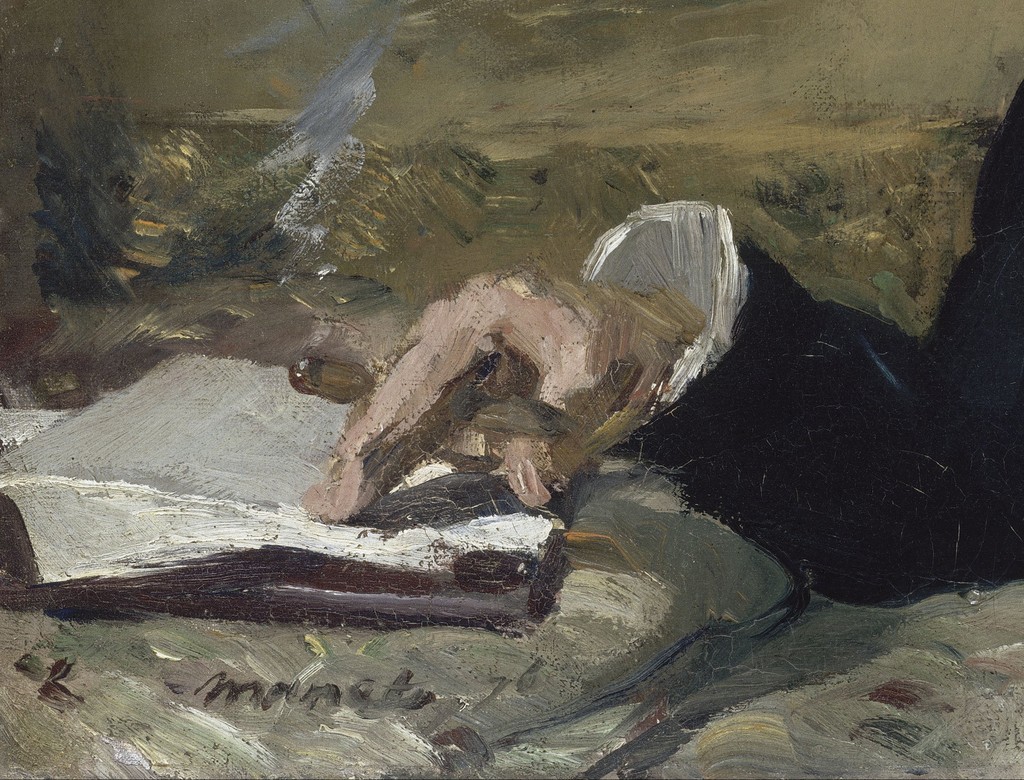
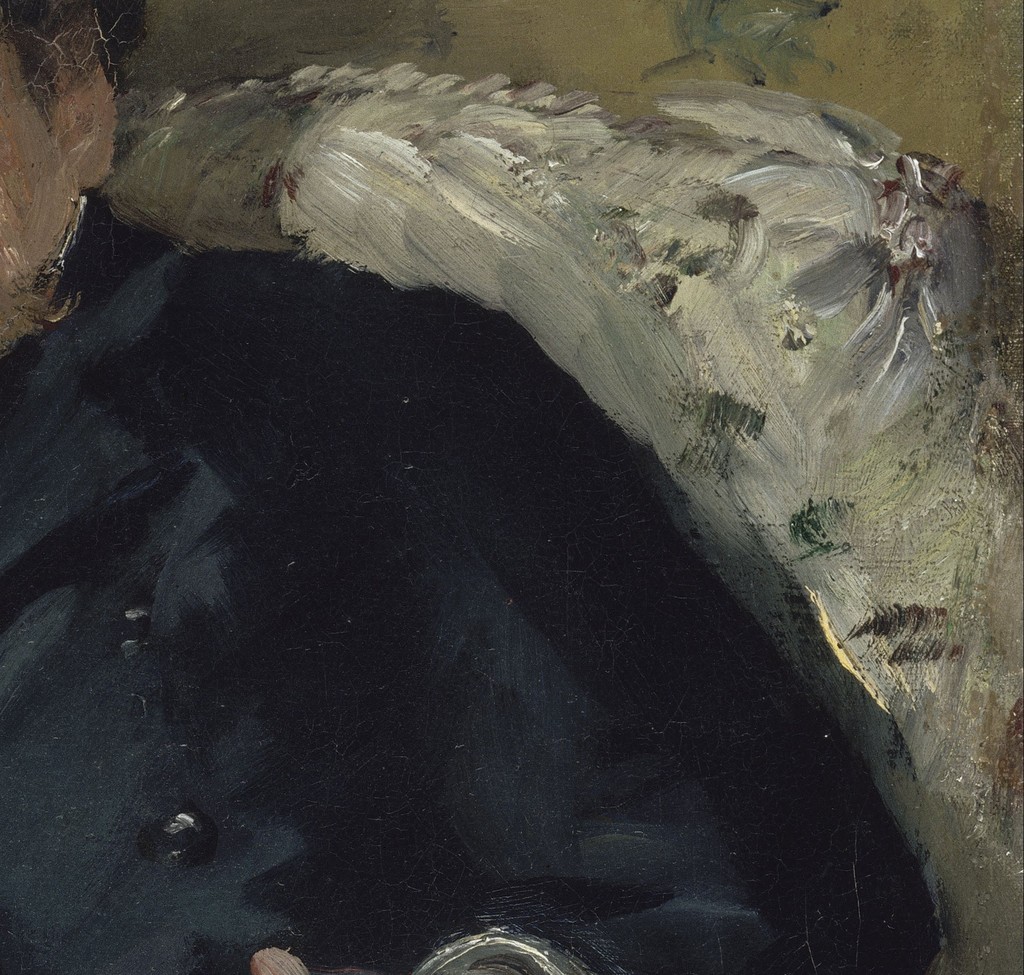
The comparison shows both a repeated arrangement and a change of emphasis. Mallarmé sits more upright, and the closer view gives his torso a larger share of the canvas. The pale pages lie low at the left, close to the hand holding a cigar. His other hand rests against the dark coat. A patterned cushion curves behind the shoulder, but the background has scattered plant-like marks rather than the young woman's conspicuous bright window structure.
In the earlier picture, the long skirt carries the figure farther across the foreground. The hand and book are smaller in relation to that dark area, and the woman's head is pushed towards the upper right. Familiar supports and accessories are reorganised around different bodies.
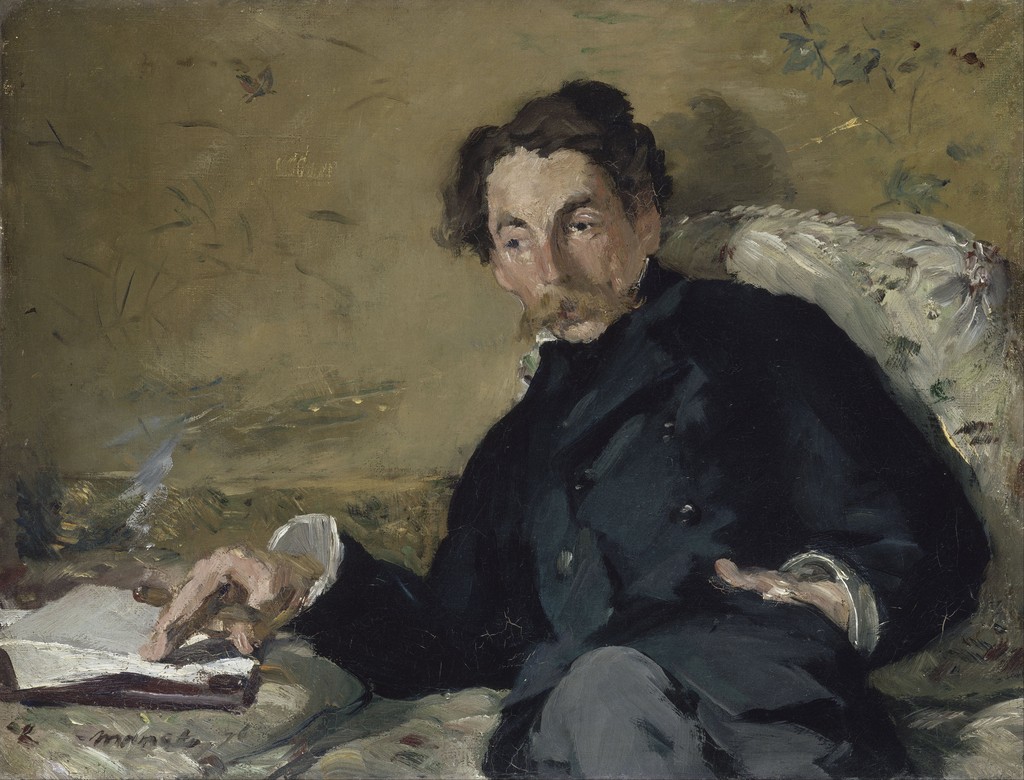
Édouard Manet, Stéphane Mallarmé, 1876. Musée d’Orsay, Paris, RF 2661. Musée d’Orsay / Google Art Project, via Wikimedia Commons. Image source. Public domain. Whole supplied reproduction resized; no enlargement or retouching.
Annotated Details from Young Woman with a Book and Stéphane Mallarmé
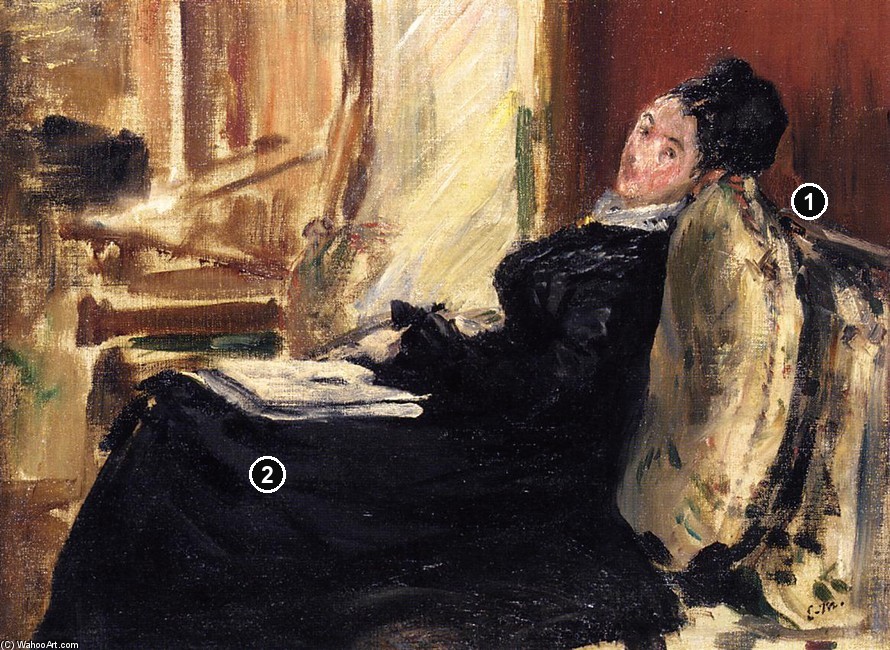
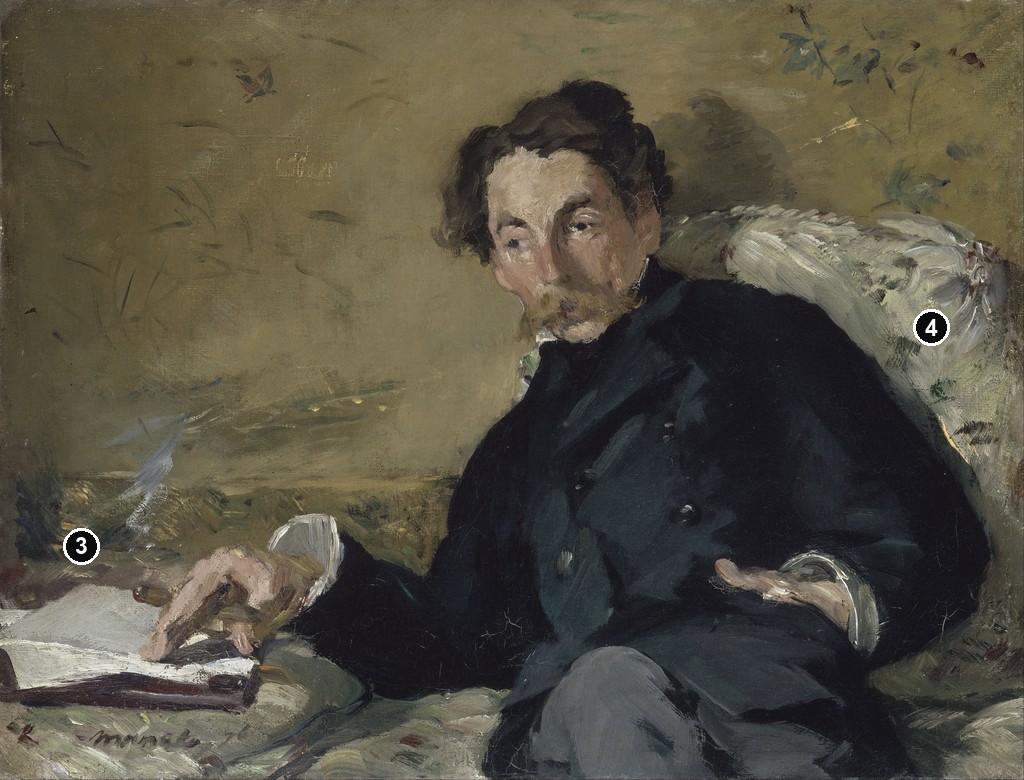
The numbered points identify visible features discussed in this article. Return from each detail to the whole composition. Each caption identifies the work shown.
Young Woman with a Book
Édouard Manet, Young Woman with a Book, circa 1875. Private collection; present location unverified. Public-domain reproduction via Wikimedia Commons; supplied image marked WahooArt.com. Image source. Public domain. Numbers added to a separate whole overview retaining the supplied source mark. Two broad details cropped at native size; no enlargement or retouching.
Stéphane Mallarmé
Édouard Manet, Stéphane Mallarmé, 1876. Musée d’Orsay, Paris, RF 2661. Musée d’Orsay / Google Art Project, via Wikimedia Commons. Image source. Public domain. Numbers added to a separate resized whole overview. Detail crops from the public-domain reproduction; no enlargement or retouching.
Details from YOUNG WOMAN WITH A BOOK AND STÉPHANE MALLARMÉ
Look from the woman’s head and cushion to the open pages, then compare the hand, pale pages and patterned cushion in the portrait of Stéphane Mallarmé.
Young Woman with a Book
The Head, Collar and Cushion
The head rests against a large pale cushion, while the narrow collar separates the face from the dark dress.
The Open Pages and the Dark Dress
Pale overlapping pages lie across the lap, close to the hand and cuff, against the much larger dark skirt.
Stéphane Mallarmé
Mallarmé’s Hand, Cigar and Pale Pages
The hand, cigar and pale pages gather near the lower-left edge, beside the dark coat.
Mallarmé’s Patterned Cushion and Shoulder
Pale patterned material curves behind the shoulder, meeting the broad dark form of the coat.
From the Estate to the Wormser Collection
The work appeared as lot 32 in Manet's 1884 estate sale, where Léon Leenhoff acquired it. Rouart and Wildenstein trace it through Bernheim-Jeune, around 1902, to the Wormser collection.[1]
Christie's identifies the small Manet at the upper-left edge of Vuillard's Madame André Wormser and her Children.[2] Now in London's National Gallery, that family group dates to 1926/7 and shows the Wormsers' drawing room hung with paintings by several artists.[5] It places this intimate sketch within a later setting of collecting and domestic display.
The woman's uncertain name and the book's unreadable pages leave much of her story unresolved. The arrangement remains specific: a head leaning back, a pale book held low, a large dark dress and a bright window beside it.
Artworks directory
Explore selected paintings, drawings and prints by Édouard Manet. Search by title or another recorded name.
Frequently Asked Questions
It is dated to circa 1875.[1]
Her identity is uncertain. Christie's reports the suggestion that she was Edmond Alphonse André's daughter.[2]
It is recorded in a private collection; its present location is unverified.[1]
Discussion
Look again at the images and ideas explored in Young Woman with a Book by Édouard Manet. These editorial prompts invite your observations.
Reader Insights
How do the directions of the head and the open book differ?
Where do the light and dark shapes meet around the arm, cuff and lap?
How does a similar pale support affect the young woman's pose and Mallarmé's more upright figure?
Join the Conversation
Share a detail, comparison or question about Young Woman with a Book by Édouard Manet below.
References
- Denis Rouart and Daniel Wildenstein, Édouard Manet: Catalogue raisonné, volume I, 1975, no. 239, pp. 196–197. In French. View source.
- Christie's, Jeune femme au livre, Édouard Manet, New York, 4 May 2011, sale 2437, lot 56, object details and lot essay. View source.
- Théodore Duret, Histoire d'Édouard Manet et de son œuvre, 1902, no. 179, p. 237. In French. View source.
- Musée d'Orsay, Stéphane Mallarmé, RF 2661, object record and commentary. In French. View source.
- National Gallery, London, Madame André Wormser and her Children, Edouard Vuillard, NG6488, object record. View source.
- Splash image, Édouard Manet, Young Woman with a Book, circa 1875. Private collection; present location unverified. Public-domain reproduction via Wikimedia Commons; supplied image marked WahooArt.com. Image source. Public domain. Whole supplied reproduction retained, including source mark. No enlargement or retouching.


