 by Tom Gurney
Tom Gurney BSc (Hons) is an art history expert with over 20 years experience
Published on June 19, 2020 / Updated on November 25, 2026
Email: tomgurney1@gmail.com / Phone: +44 7429 011000
The Wheel of Fortune by Edward Burne-Jones: Introduction
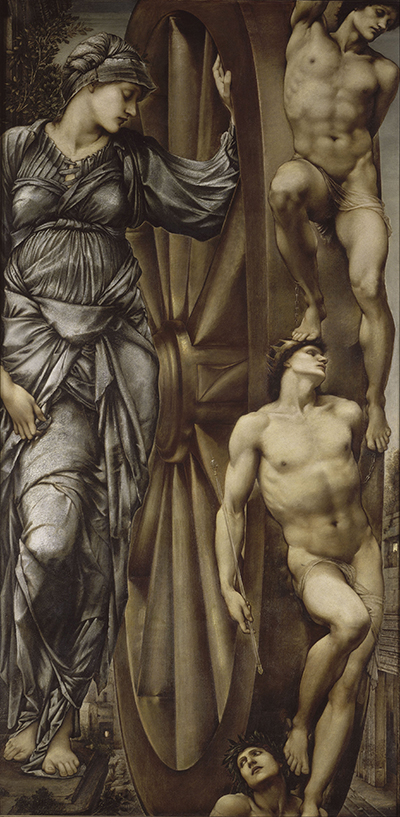
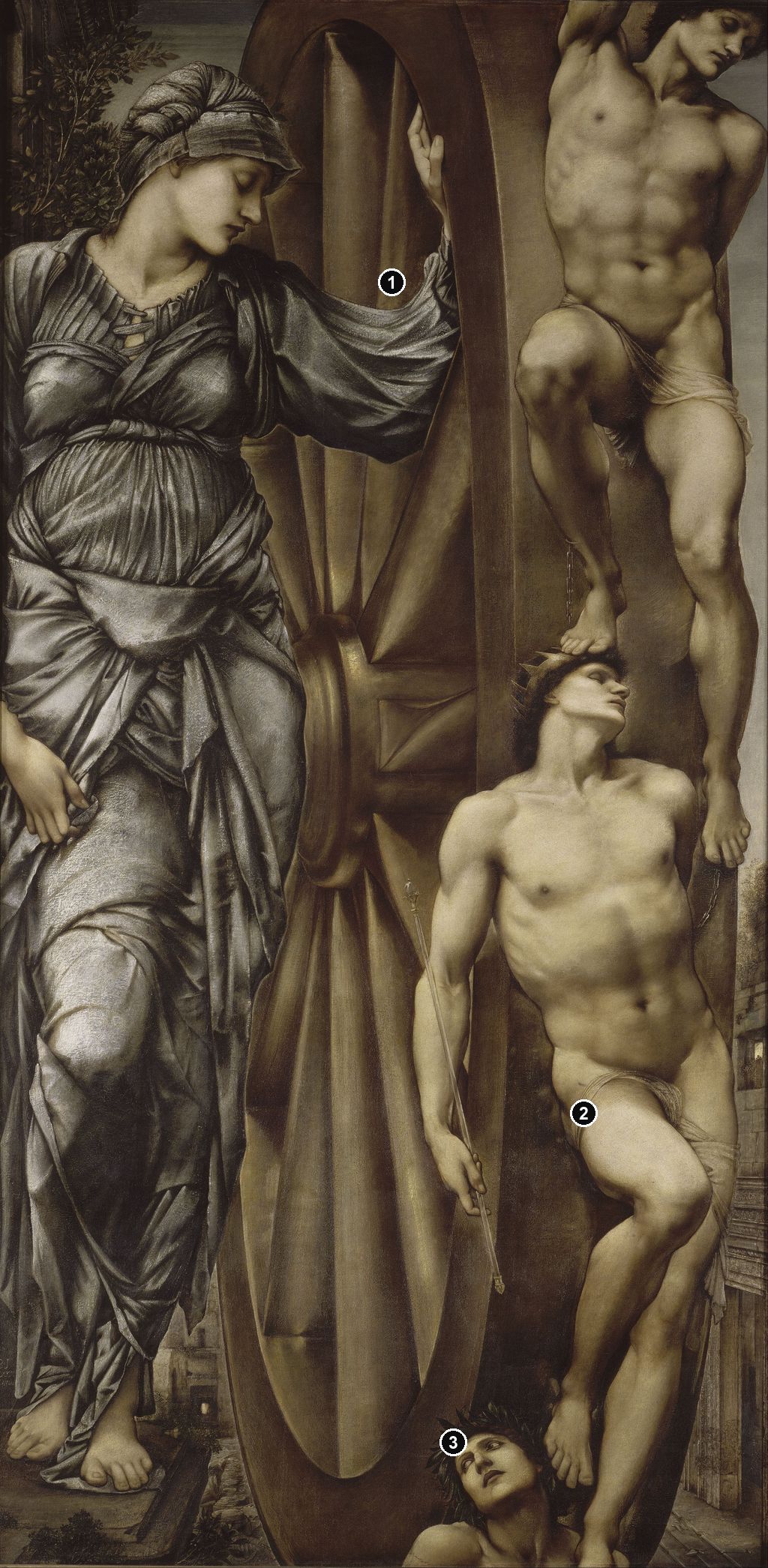
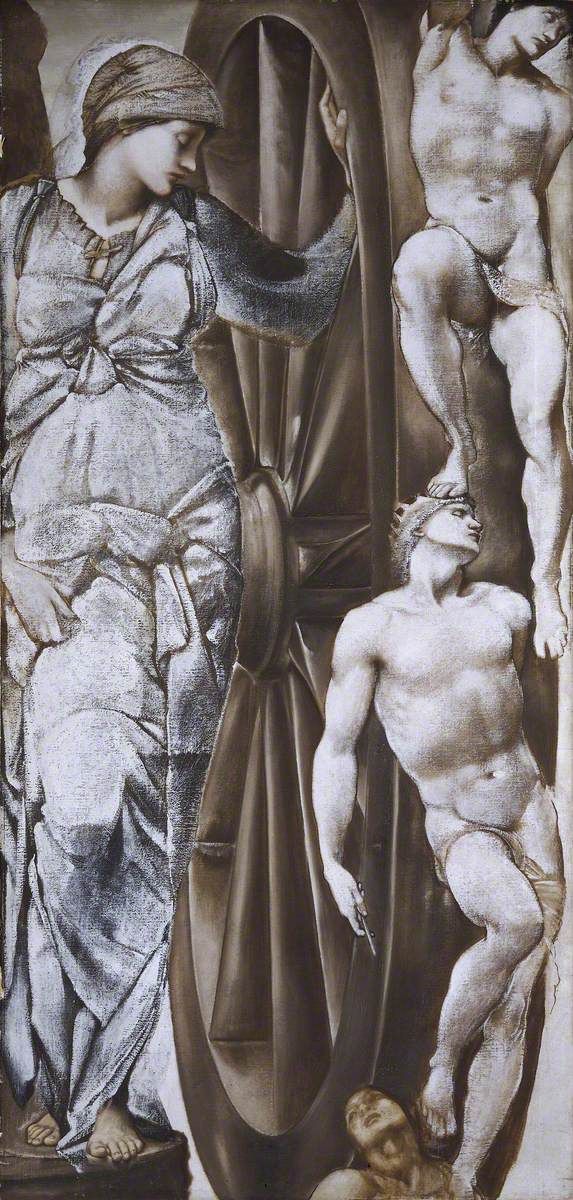
A bare foot comes down on a king’s crown. The man above him is a slave, carried so high on the wheel that his raised arms meet the top of the canvas. The king tilts his face upwards, still holding his sceptre. At the bottom, a poet looks up from beneath an arch of turning wood. Across from the three men stands Fortune, a woman large enough to reach up and turn the wheel with one hand. Edward Burne-Jones painted this version in oil between 1875 and 1883. The canvas measures two metres high by one metre wide and belongs to the Musée d’Orsay in Paris, where it is called La Roue de la Fortune. [1] [2]
At a Glance
- ArtistEdward Burne-Jones
- Date1875–83
- MediumOil on canvas
- SubjectFortune and the wheel
This work across Edward Burne-Jones’s career
The Mirror of Venus
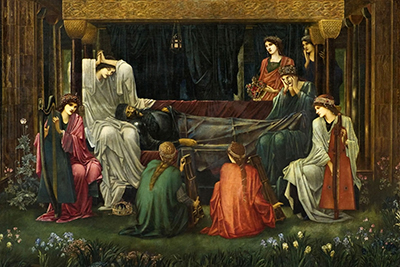
1870sThe Last Sleep of Arthur in Avalon
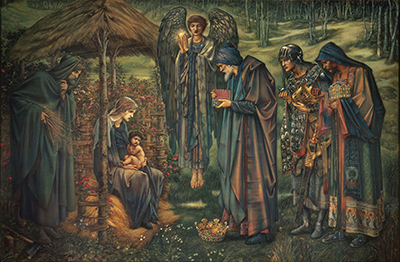
1880s–1898The Star of Bethlehem
Signed 1890Contents
- How the wheel fills the painting
- What Fortune gives and takes away
- From the Italian studies to Fortune’s face
- Two other versions in Cardiff and Melbourne
- The Grosvenor Gallery and the passage to Paris
- Annotated details
How the wheel fills the painting
The wheel stands almost edge-on. Its near rim rises through the centre of the picture, while the spokes angle back from the hub at about the height of Fortune’s thigh. Seen from here, a circle becomes a narrow oval. Burne-Jones can make it appear immense within a canvas scarcely wide enough for the two groups of figures. The top curve disappears above us, and the lower part seems about to carry the poet under. We have to look up and down to take in what the wheel is doing. Our glance keeps returning to the point where the slave’s toes touch the king’s crown, a small contact that makes their positions on the rim easier to judge. [1] [3]
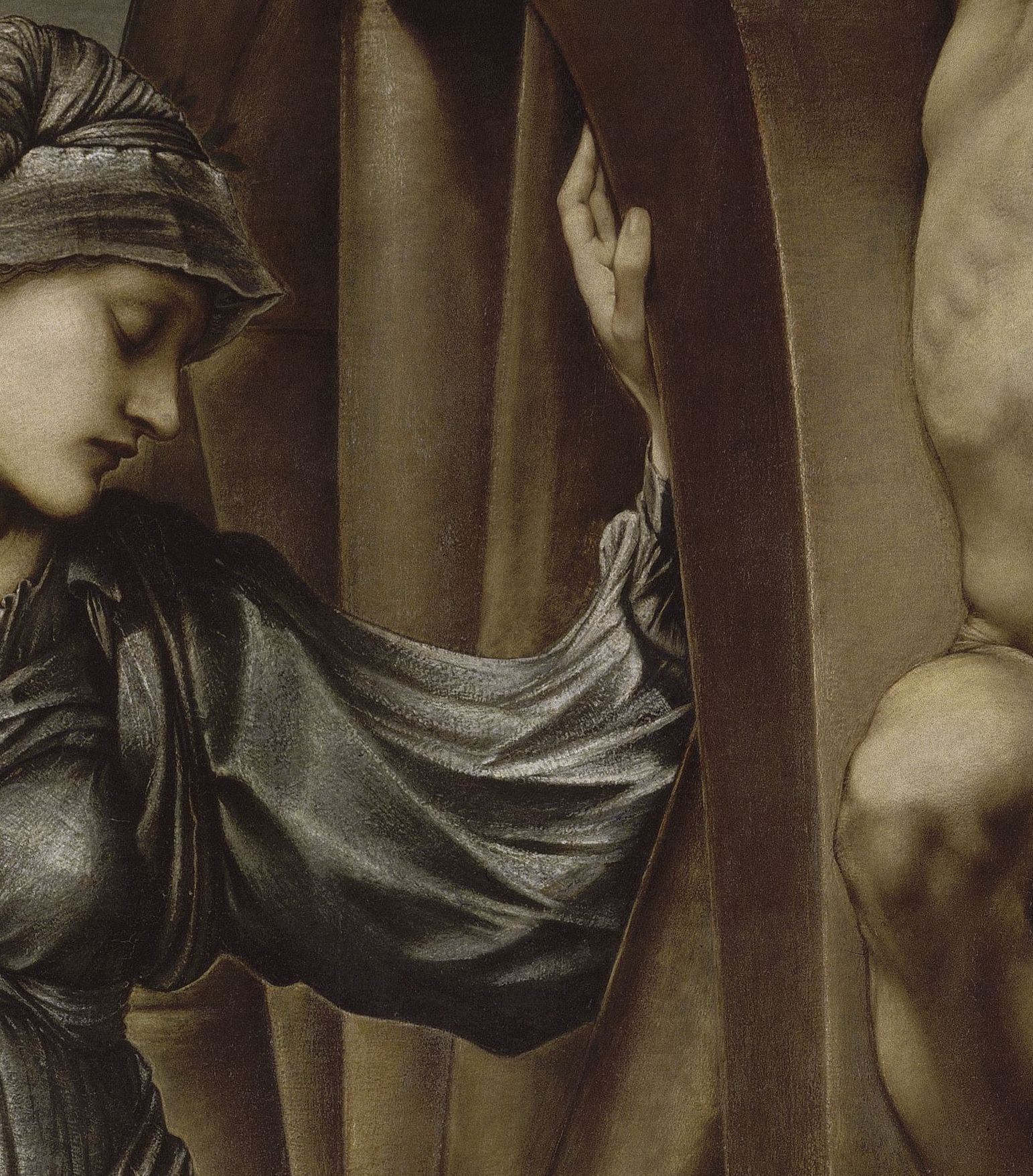
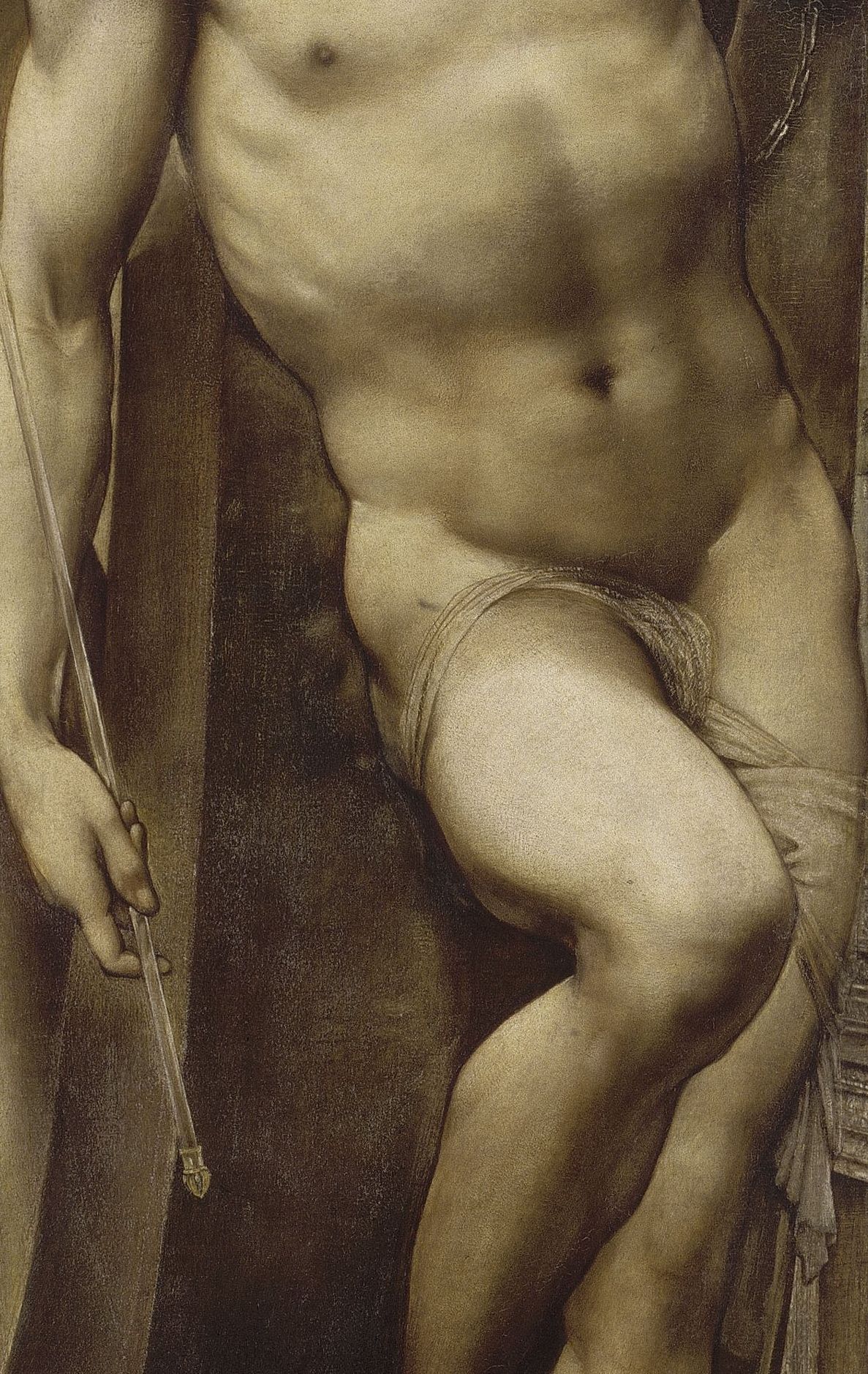
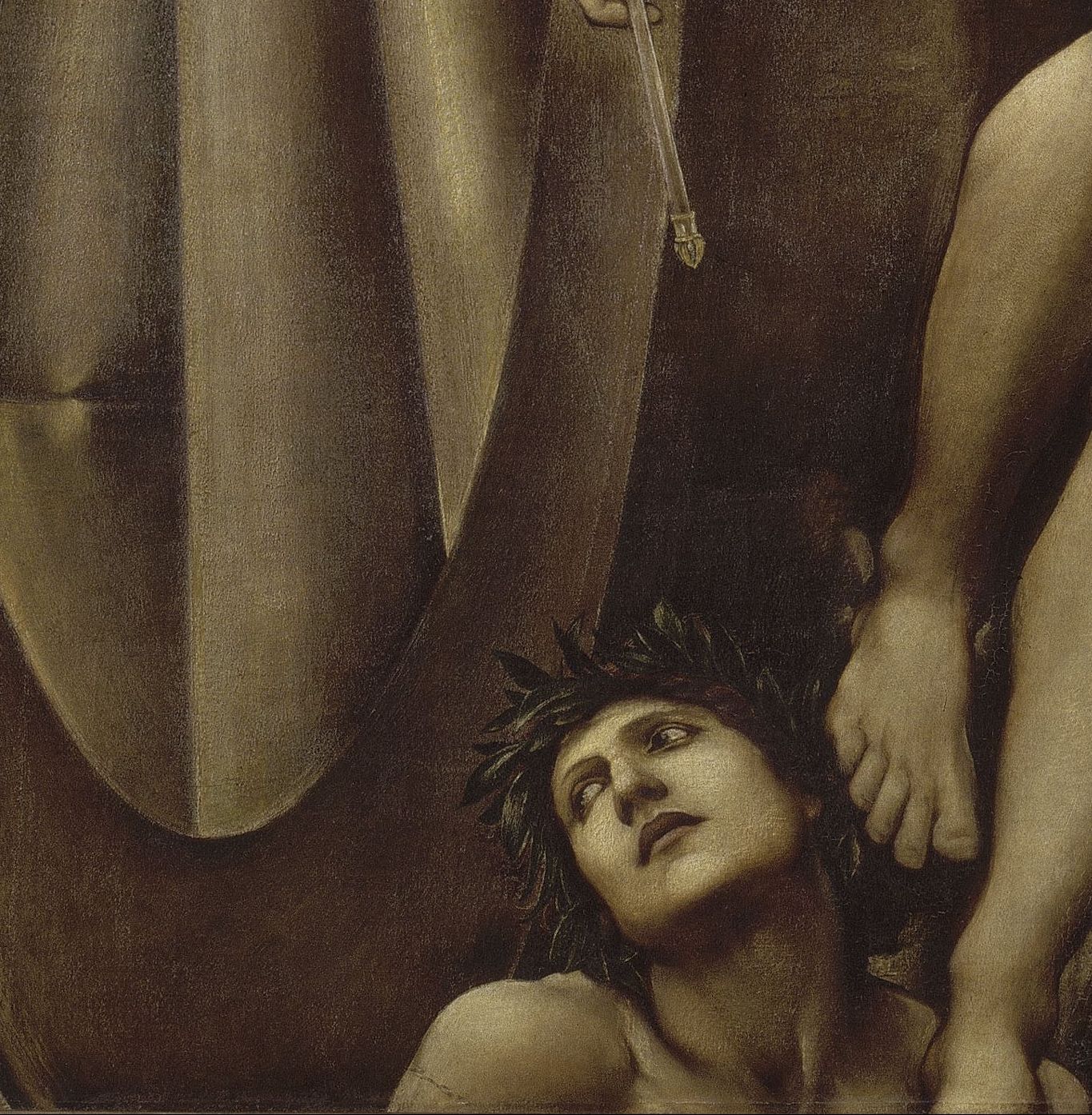
Fortune lifts a palm to the rim while the other hand gathers a fold near her hip. One foot is set just ahead of the other at the edge of a low platform. The position of her feet gives her a firmness the three men lack. The slave’s bent leg presses down, but the support it finds is the head of another man in motion. Slender chains run along the rim beside the bodies. Their thin lines are easy to miss against the much darker wood, but they explain how the men stay with the wheel as it turns. The king stretches one leg past the poet, whose head appears in the little space between the king and the wood. The change of pose from figure to figure makes the wheel feel as if it is moving under a load. Fortune’s bowed head, with its lowered eyelids and scarcely parted lips, makes the effort of turning it seem entirely routine. [1] [2]
The brightest lights pick out the faces, bare shoulders and raised surfaces of the drapery. Long creases run down Fortune’s skirt, while the lifted sleeve spreads in shorter arcs from wrist to shoulder. The Musée d’Orsay compares the fine pleating to Botticelli. Those repeated silver-grey folds make it possible to read the weight of her body through the cloth. Warm browns then take over in the wheel, so that the softened lights on the men stand out again at the right. Look between the legs and around the lower rim and there are scraps of buildings and a mill beyond the figures. Tate’s exhibition label draws attention to those fragments of landscape. They give the wheel something to dwarf and suggest a world going about its business outside the space Fortune occupies. [1] [4]
Annotated Details from The Wheel of Fortune
The numbered points identify visible features discussed in this article. Return from each detail to the numbered overview. Edward Burne-Jones, The Wheel of Fortune. Musée d’Orsay. Image source. Public domain.
Details from THE WHEEL OF FORTUNE
Compare the cropped details with the source images above. Notice how their colours, shapes and positions contribute to the larger compositions.
Fortune’s raised hand
Fortune lifts her hand beside the vertical rim. The turn of her wrist leads towards the wheel’s curved mechanism.
A body on the rim
The figure’s sharply bent leg gives the circle a visible interval. Hard edges on the rim press against the soft modelling of the body.
The low point
The lowest figure carries the eye down, leaving little room between the turn of the wheel and the edge of the canvas.
What Fortune gives and takes away
Fortuna personified luck in Roman culture. The wheel acquired much of its force in medieval Europe through the Consolation of Philosophy, written by Boethius in prison in the sixth century. In Book II, Philosophy asks the prisoner to imagine Fortune answering his complaints. The gifts he once enjoyed were hers to lend and to take back. Turning the wheel is her way of acting, and the man who consents to ride it can expect to occupy more than one position. Geoffrey Chaucer translated the Consolation into English, helping to give the story a long life in the language Burne-Jones read. [5] [6]
An illuminated copy of John Lydgate’s Troy Book in the British Library shows how medieval artists made such changes legible. On folio 30v, a king sits at the head of a wheel presented nearly face-on, with figures disposed around it so that the viewer can read several stages at once. In Burne-Jones’s painting the king is already below the slave. His crown, his sceptre and the poet’s wreath can still be made out, but the three bodies are all exposed to the same descent. The medieval page helps explain why the idea suited a story about the fall of a great city. The painted figures give it a more intimate scale, down to the pressure of one man’s foot on another man’s head. [1] [7]
Burne-Jones’s own connection with Troy began around 1870. He envisaged a large, multipart work about the judgement of Paris, the taking of Helen and the city in flames. Its design in Birmingham includes the Feast of Peleus in the lower register and four narrow allegories between the main subjects. Fortune opens that sequence. Fame overthrows Fortune, Oblivion overcomes Fame, and Love finally subdues Oblivion. The order gives the allegories their own story alongside that of Helen and Paris. The triptych remained unfinished. In its account of the preparatory studies, the National Gallery of Canada describes an earlier large attempt at the Wheel before Burne-Jones took up an even larger canvas in 1875. As the design developed into a painting in its own right, the narrow proportions persisted. At two metres high the old division between slender allegorical panel and expansive main scene became a way of giving one figure, one machine and three lives the space they needed. [3] [8] [9]
From the Italian studies to Fortune’s face
Burne-Jones studied Michelangelo’s work closely in Italy in 1871. He sketched the sculptor’s Captives in Florence and owned a small plaster version of the Dying Slave, the marble now at the Louvre. Georgiana Burne-Jones recalled his taking opera glasses into the Sistine Chapel and lying on his back to study the ceiling. The catalogue for the 1998 retrospective compares the men at the wheel with the Captives and connects Fortune with Michelangelo’s Sibyls. The slave’s elevated arm and the turn of his head make the Louvre comparison particularly legible. An apparently simple stretch carries the tension of having his weight poised on a poor foothold. Fortune has the gravity of a seated Sibyl even as she stands. Her bent head and great folds of cloth give the act of turning the wheel an almost sculptural stillness. [3] [9]
The studies let us follow the work at a more local scale. The Louvre catalogues a small graphite profile signed and dated 1872 as a study for Fortune. The young woman’s head turns down to the right. Her hair is scarcely indicated, which catalogue author Stephen Wildman associates with the artist’s plan to cover it with a headdress. Wildman also points out that some study dates were added retrospectively. The National Gallery of Canada describes the last phase of work on the head as a sequence of three monochrome oils. It identifies the Ottawa example, dated about 1877–83, as the final study and says the head there is the same scale as in the Paris canvas. [9] [10] Working in monochrome let the artist concentrate on the fall of light across the brow, cheek and fabric before those features took their place among the painting’s other greys and browns. The actress Lillie Langtry, who sat to Burne-Jones from 1879, later said she had been the final model. The gallery’s account distinguishes her claim from the evidence that he used a succession of sitters while retaining the downturned pose. [9] [11] [12]
A graphite sheet in the British Museum isolates the king’s pose. The sheet is inscribed “THE SLAVE IN THE WHEEL OF FORTUNE” and dated 1879. The British Museum’s research inventory describes it as a study for the king, as does Tate’s exhibition label. Wildman explains that the identification on the sheet was added retrospectively and is mistaken. The turned head and raised leg make the drawing easier to connect to the middle figure once the crown and sceptre are mentally removed. Birmingham holds a separate small oil showing a nude man lying against the curve of a wheel. The catalogue raisonné identifies it as a studio study for the slave and attributes it to Charles Fairfax Murray. In that study the body extends almost horizontally along the arc. In Paris, the slave is carried so far up the rim that we have to read the pose in a much tighter, upright space. The catalogue’s record of his work on the large painting places him back at it in 1879 and 1881. The variety of materials and poses in the surviving studies suggests what there still was to resolve after the main composition was in place. [3] [4] [12] [13] [14]
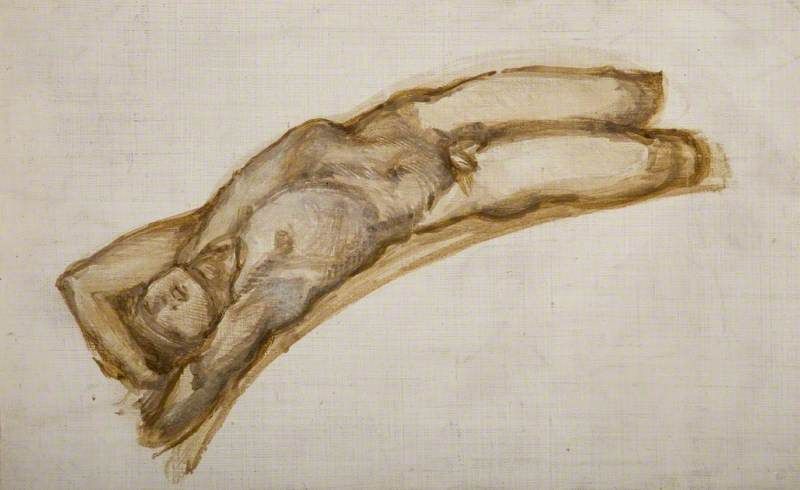
Study of a Slave for The Wheel of Fortune, attributed in the catalogue raisonné to Charles Fairfax Murray in Burne-Jones’s studio. Birmingham Museums Trust, 1904P224. Image source. Public domain.
Two other versions in Cardiff and Melbourne
Museum Wales holds an unfinished oil of about 1882, given by Margaret Davies in 1940. The wheel is strong and dark, while passages of Fortune’s robe remain much lighter and more open than in Paris. Broad divisions establish her sleeve, sash and skirt. The Paris oil draws those broad shapes together with a succession of closely spaced creases and with lights that follow the turn of the body beneath them. The Cardiff king and slave are already firmly placed. Their overlap works just as it does in the Paris painting, even where the modelling and colour are thinner. Museum Wales points to the Michelangelesque treatment of both the bodies and Fortune’s drapery, a relationship one can see particularly clearly when the dress has so much less surface detail. [1] [15]
The National Gallery of Victoria dates its smaller version 1871–85. Its oil measures 151.4 by 72.5 centimetres and entered the Melbourne collection through the Felton Bequest in 1909. In his 1902 account, Malcolm Bell places the completion of the smaller Wheel in the autumn of 1885, while the artist was also working on the last painting of the Briar Rose series. The London debut of the large wheel belongs to an earlier moment in that long period of work. The Melbourne colour is warmer and more golden, as Wildman observes. Its frame also has an unusually well documented history. The museum identified surviving parts of an original, altar-like surround after the painting had spent time displayed in the inner sections alone. The reconstruction drew on the surviving ornament and early photographs of the work in the gallery. Conservator Noel Turner describes removing overpaint, making missing members and carving and toning the new work to sit alongside the original material. In comparing Melbourne with Paris it helps to look at what the broad ornamented surround does to the picture. It gives the slim canvas the presence of a panel set into architecture, something close to the kind of relationship with a frame Burne-Jones had explored in the Troy design. [3] [8] [16] [17] [18] [19]
Edward Burne-Jones, The Wheel of Fortune, the Cardiff version. Amgueddfa Cymru, NMW A 206. Image source. Public domain.
The Grosvenor Gallery and the passage to Paris
The larger oil appeared at London’s Grosvenor Gallery in 1883, alongside Burne-Jones’s The Hours. Critics paid particular attention to how the figures were drawn and coloured. The Athenaeum reviewer F. G. Stephens thought Fortune resembled a colossal figure in coloured marble and compared her sadness to Michelangelo’s Night. The affinities the artist had studied in Florence and Rome were apparent to a viewer encountering the new picture in London. John Ruskin, lecturing on Burne-Jones and George Frederic Watts in 1883, drew out the significance of a wheel that turns gradually. The men’s fortunes are connected because one man gives way as another takes his place. That reading makes sense of the way Burne-Jones has kept them so close together. Each man’s position is easiest to see in relation to the man beside him. In a letter to Helen Gaskell a decade later, Burne-Jones spoke of everyone in turn being broken on the wheel. Ruskin had seen a reversal that bound people to one another. The artist’s words suggest how that same prospect could feel to someone waiting his turn. [3] [20] [21]
Arthur Balfour acquired the work in 1883. The future prime minister had already commissioned Burne-Jones’s Perseus cycle for his London home. Balfour lent the Wheel to the New Gallery, where it appeared in 1892–93 and again in the winter exhibition of 1898–99. The 1897 Brussels International Exhibition catalogue identifies the lender and lists the painting by its French title, La roue de la fortune. Those records let us follow this particular canvas even as other treatments of the subject circulated. The 1898–99 London catalogue actually listed another version in the same room, a small blue watercolour lent by Watts in which Fortune sits within the wheel. [1] [4] [21] [22]
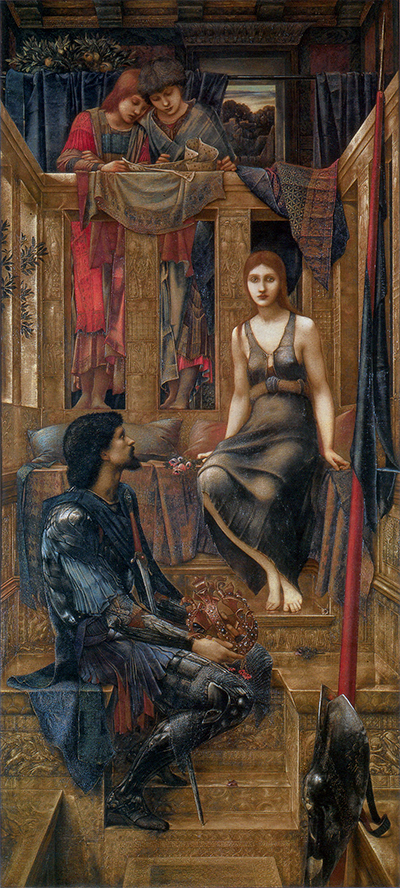
At the Paris Universal Exhibition of 1889, King Cophetua and the Beggar Maid brought Burne-Jones widespread attention. [4] A few years later French viewers encountered the Wheel through a drawing. Pierre Puvis de Chavannes hoped to secure Balfour’s canvas for the 1892 exhibition of the Société Nationale des Beaux-Arts. As the curator Laurence des Cars recounts, Burne-Jones ultimately sent drawings, including a study of Fortune, in place of the painting. Puvis wrote back praising both the originality and the grandeur of the figure. In 1893 Burne-Jones gave three drawings to the French state, including the head study now catalogued by the Louvre. By 1896 the photographic firm Braun was offering reproductions of the preparatory heads listed at the Musée du Luxembourg. A French audience could come to know the bowed head of Fortune through the artist’s work on paper while the finished painting still belonged to Balfour. [11] [23] [24]
The oil passed to Balfour’s brother Gerald and in 1932 to the Vicomte Charles de Noailles. It subsequently belonged to his daughter Nathalie. France’s national museums bought it in 1980 and the Grand Palais included it in an exhibition of recent acquisitions that winter. When the Musée d’Orsay mounted its Burne-Jones retrospective in 1999, curator Laurence des Cars opened a discussion of the artist by pointing to the Wheel as the work through which the museum’s visitors chiefly knew him. The 1998–99 retrospective exhibited the canvas in New York and Birmingham before it came to Paris. In 2014 the Orsay lent the painting to an exhibition on the male nude at the Museo Nacional de Arte in Mexico City. The exhibition put the study of the male body at the centre of a work the Victorian reviewers had discussed in terms of drawing and colour. Up close, one sees the wheel and the bodies built from separate studies. At a distance, the wheel seems almost impossible to stop. [1] [2] [25] [26]
Edward Burne-Jones on film
Explore Burne-Jones’s paintings, illustrated stories and stained-glass designs.
Edward Burne-Jones: Pre-Raphaelite Visionary | Exhibitions | Showcase
A look at Burne-Jones’s paintings and the Tate retrospective.
Watch on YouTubeArtworks directory
This directory records paintings, studies, designs and collaborative works, with separate entries for documented versions and series where known.
| Name | Date | Medium |
|---|---|---|
| Sidonia von Bork 1560 | 1860 | Watercolour and bodycolour |
| Clara von Bork 1560 | 1860 | Watercolour and bodycolour |
| The Merciful Knight | 1863 | Watercolour |
| Sibylla Delphica | c. 1886 | Oil on panel |
| Phyllis and Demophoön | 1870 | Watercolour and bodycolour |
| The Legend of the Briar Rose (Buscot series) | 1870s–1890 | Oils on canvas |
| The Briar Wood (Buscot series) | By 1890 | Oil on canvas |
| The Council Chamber (Buscot series) | By 1890 | Oil on canvas |
| The Garden Court (Buscot series) | By 1890 | Oil on canvas |
| The Rose Bower (Buscot series) | By 1890 | Oil on canvas |
| Group of Women, study for The Golden Stairs | 1872 | Drawing |
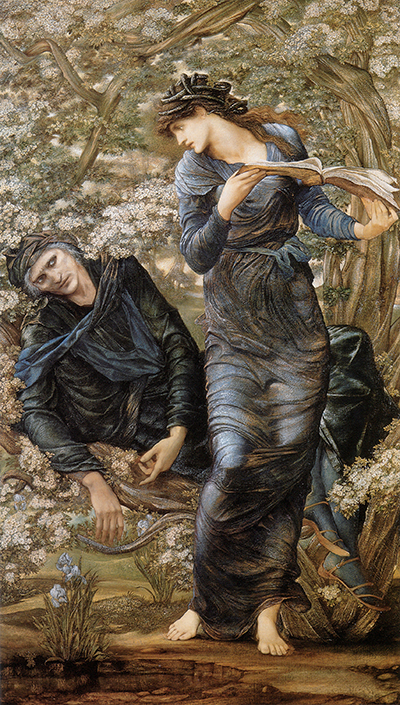
| The Beguiling of Merlin | 1870s | Oil on canvas |
| The Perseus Cycle | From 1875 | Paintings and full-scale designs |
| The Call of Perseus (Stuttgart) | From 1875 | Oil painting |
| Perseus and the Graeae (Stuttgart) | From 1875 | Oil painting |
| The Rock of Doom (Stuttgart) | 1884–88 | Oil on canvas |
| The Doom Fulfilled (Stuttgart) | 1888 | Oil on canvas |
| The Baleful Head (Stuttgart) | 1885–87 | Oil on canvas |
| The Baleful Head (Southampton design) | 1880s | Bodycolour |
| The Rock of Doom (Southampton design) | 1880s | Bodycolour |
| The Doom Fulfilled (Southampton design) | 1880s | Bodycolour |
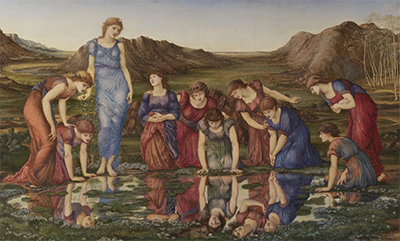
| The Mirror of Venus (Gulbenkian) | 1870s | Oil on canvas |
| Drawing associated with The Mirror of Venus | 1870s | Drawing |
| Laus Veneris (Laing) | 1873–78 | Oil on canvas |
| The Days of Creation | 1870s | Watercolour and bodycolour |
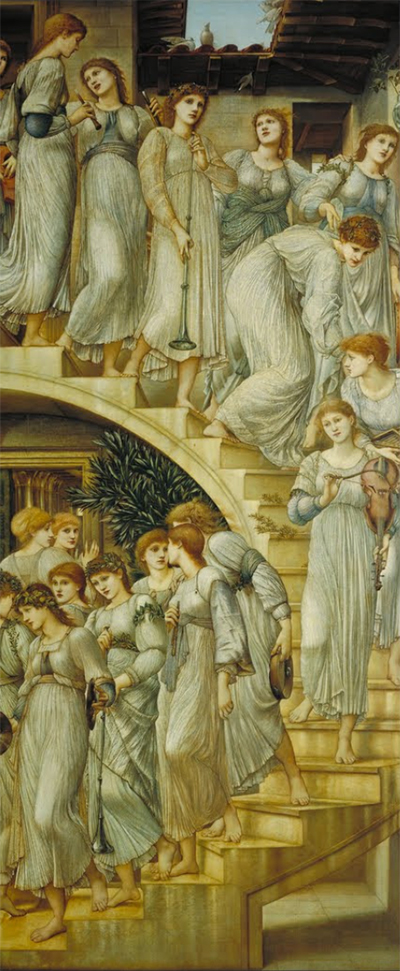
| The Golden Stairs | 1880 | Oil on canvas |
| An Angel Playing a Flageolet | 1878 | Watercolour, bodycolour and gold |
| The Tree of Forgiveness | 1881–82 | Oil on canvas |
| The Wheel of Fortune (Orsay) | 1875–83 | Oil on canvas |
| King Cophetua and the Beggar Maid | 1884 | Oil on canvas |
| The Depths of the Sea (oil) | 1886 | Oil |
| The Morning of the Resurrection | 1886 | Oil on panel |
| Study for the Head of Mary Magdalene | c. 1882 | Oil study |
| The Sleep of King Arthur in Avalon | 1880s–1898 | Oil on canvas |
| The Sleep of King Arthur in Avalon (modello) | ca. 1881 | Oil on canvas (modello) |
| The Star of Bethlehem | Signed 1890 | Watercolour and bodycolour |
| Study for The Star of Bethlehem | About 1887–91 | Drawing |
| Sponsa de Libano | 1891 | Watercolour and bodycolour |
| The Summons (Holy Grail tapestries) | 1890s | Tapestry |
| The Failure of Sir Gawaine (Holy Grail tapestries) | 1890s | Tapestry |
| Hope (Boston) | 1896 | Oil on canvas |
| La Belle au bois dormant (theatre programme) | 1894 | Collotype |
| The Wedding of Psyche | 1895 | Oil on canvas |
| The Works of Geoffrey Chaucer (Kelmscott edition) | 1896 | Illustrated book |
| The Ascension (Birmingham Cathedral) | 1885 | Stained glass |
| The Last Judgement (Birmingham Cathedral) | 1897 | Stained glass |
| Adoration of the Magi (Huntington) | 1890s | Tapestry |
| Love among the Ruins (Wightwick) | 1894 | Oil on canvas |
| The Merciful Knight (photogravure after Burne-Jones) | 1900 | Photogravure |
| The Garden Court (preparatory work) | 1870–75 | Graphite and watercolour with white gouache |
| Study of a Female Figure | 1885 | Graphite drawing |
| Psyche Throwing Herself into the River | 1865–68 | Wood engraving |
| Beauty | 1887–89 | Colour lithograph |
| Study for the Failure of Gawain | 1893 | Crayon and graphite on Japanese paper |
| The Prince Enters the Briar Wood (after Burne-Jones) | After 1890 | Photogravure |
| The Rose Bower (after Burne-Jones) | 1892 | Photogravure |
| Adoration of the Magi (Musée d’Orsay) | 1904 | Tapestry |
| Answers to Prayer (Lyndhurst) | 1860s | Stained glass |
| The Depths of the Sea (photogravure after Burne-Jones) | 1900 | Photogravure |
| Perseus and Andromeda (Adelaide composite) | 1876 | Oil on canvas |
| The Adoration of the Magi (Hamburg) | Woven 1900 | Tapestry |
| Love leading the Pilgrim through the Briars | 1874–76 | Embroidery |
| Musica (worked by Lady Jane Cory) | 1906 | Embroidery |
| Pomona (worked by Lady Jane Cory) | 1907 | Embroidery |
| Flora (worked by Lady Jane Cory) | 1909 | Embroidery |
| The Fourth Day of Creation (photogravure after Burne-Jones) | 1900 | Photogravure |
| The Morning of the Resurrection (photogravure after Burne-Jones) | 1900 | Photogravure |
| Musical angels of the St Catherine window (Christ Church) | Designed 1877 | Stained glass |
Discussion
Look again at the images and ideas explored in The Wheel of Fortune by Edward Burne-Jones. These editorial prompts invite your observations.
Reader Insights
How does the steep curve of the wheel affect the way you read the three figures?
How does Fortune’s posture differ from the bodily effort of the figures on the wheel?
Join the Conversation
Share a detail, comparison or question about The Wheel of Fortune by Edward Burne-Jones below.
References
- Musée d’Orsay, La Roue de la Fortune, RF 1980 3, painting, inscription, dimensions, provenance and exhibition history. View source.
- Ministère de la Culture, La Roue de la Fortune, Joconde notice 000PE018095. View source.
- Stephen Wildman, The Wheel of Fortune, cat. no. 52 in Edward Burne-Jones: Victorian Artist-Dreamer, reproduced in the Burne-Jones catalogue raisonné, with work-list, 1883 reviews, the letter to Helen Gaskell and exhibition entries. View source.
- Tate Britain, Edward Burne-Jones exhibition labels, study of the king and labels for the Paris painting and Perseus project. View source.
- Museum Wales, Painting Medieval Myths from Rome and Britain, notes on Fortuna and the medieval tradition. View source.
- Boethius, Consolation of Philosophy, Book II, prose 1 and 2, in Geoffrey Chaucer’s translation and Harvard’s Chaucer resource. View source.
- British Library, John Lydgate, Troy Book, Royal MS 18 D II, fol. 30v, digitised miniature. View source.
- Burne-Jones Catalogue Raisonné, The Story of Troy — The Troy Triptych, Birmingham Museums Trust 1922P1J8, with T. M. Rooke’s account of the project. View source.
- National Gallery of Canada, Annual Report 2001–02, p. 18, Study for the Head of Fortune for “The Wheel of Fortune”. View source.
- National Gallery of Canada, Study for the Head of Fortune for “The Wheel of Fortune”, Ottawa oil study, 40933. View source.
- Musée du Louvre, Tête de jeune femme, étude pour “La Roue de la Fortune”, RF 1950, recto. View source.
- Stephen Wildman, Study of a female head looking in profile down to the right for “The Wheel of Fortune”, cat. no. 53 in Edward Burne-Jones: Victorian Artist-Dreamer, reproduced in the Burne-Jones catalogue raisonné. View source.
- British Museum, research inventory of drawings with uncertain 1933–45 provenance, 1967,1014.47, graphite study for the king. View source.
- Burne-Jones Catalogue Raisonné, Study of a Nude Man on a Wheel for a Slave in The Wheel of Fortune, Birmingham Museums Trust 1904P224. View source.
- Museum Wales, Wheel of fortune, unfinished oil, NMW A 206. View source.
- National Gallery of Victoria, The Wheel of Fortune, 1871–85, Melbourne oil and frame notes. View source.
- Malcolm Bell, Burne-Jones, German edition, 1902, p. 25, on the autumn completion of the smaller Wheel. View source.
- Queensland Art Gallery | Gallery of Modern Art, Re-framing Edward Burne Jones “Aurora”, documentation of the Melbourne Wheel frame’s surviving ornament. View source.
- Noel Turner, “Reconstructing the Wheel,” AICCM paintings conservation symposium, 2004, programme abstract. View source.
- John Ruskin, The Art of England, lecture II, “Mythic Schools of Painting,” pp. 50–51. View source.
- New Gallery, Exhibition of the Works of Sir Edward Burne-Jones, Bart., winter 1898–99, cat. nos. 76, 93 and 95. View source.
- Exposition internationale de Bruxelles, Beaux-arts: catalogue général, 1897, Great Britain, cat. no. 57. View source.
- Laurence des Cars, “Edward Burne-Jones and France,” in Edward Burne-Jones: Victorian Artist-Dreamer, 1998, correspondence with Puvis de Chavannes and the Musée du Luxembourg. View source.
- Braun, photographic catalogue, 1896, p. 98, Luxembourg studies for La Roue de la Fortune, no. 64.041. View source.
- Laurence des Cars and Stephen Wildman, “Edward Burne-Jones (1833–1898), un maître de l’imaginaire,” La Revue du Musée d’Orsay, 1999, no. 8. View source.
- Museo Nacional de Arte, Reporte Anual 2013–2014, report on El hombre al desnudo: Dimensiones de la masculinidad a partir de 1800. View source.