in Detail Fra Angelico.jpg)
 by Tom Gurney
Tom Gurney BSc (Hons) is an art history expert with over 20 years experience
Published on June 19, 2020 / Updated on November 6, 2026
Email: tomgurney1@gmail.com / Phone: +44 7429 011000
Introduction
Fra Angelico’s Annunciation in the Museo Nacional del Prado is one of the most important early altarpieces of the Florentine Renaissance and one of the firmest chronological anchors in his career. The Prado dates the painting securely to 1425–26. It was painted in tempera on poplar panel and measures approximately 190.3 by 191.5 centimetres. The work was made for San Domenico at Fiesole, the Dominican convent where Fra Giovanni lived. It was one of three major altarpieces Angelico produced for the church.
The principal panel joins two theological moments. On the right, Gabriel announces the Incarnation to Mary. On the left, Adam and Eve are expelled from Eden. The relationship is deliberate. Humanity loses Paradise through disobedience. Mary’s acceptance begins the process through which salvation becomes possible. The Prado therefore describes the central panel as a cycle of humanity’s fall and redemption. The predella extends the story through episodes from the Virgin’s life. This structure makes the altarpiece much more than an isolated Annunciation.
It is a compact history of salvation centred on Mary. Artistically, the painting is equally important. The Prado’s research places Angelico at the intersection of late-Gothic refinement and the newest Florentine Renaissance ideas. Minute flowers and objects reflect the descriptive culture associated with Gentile da Fabriano. Architectural unification points towards new spatial thinking. The Virgin’s interior and perspective engage with developments associated with Masolino and Masaccio. The painting therefore demonstrates synthesis rather than stylistic replacement. [1]
At a Glance
- ArtistFra Angelico [1]
- TitleThe Annunciation [1]
- Date1425–26 [1]
- Mediumtempera on poplar panel [1]
- Dimensions190.3 × 191.5 cm [1]
- Current locationMuseo Nacional del Prado, Madrid [1]
- Original locationSan Domenico, Fiesole [6]
- Original positionassociated with the rood-screen area dividing friars and laity [1]
- Principal subjectsAnnunciation and Expulsion of Adam and Eve [1]
- Predellaepisodes from the life of the Virgin [4]
- Career significanceone of Angelico’s earliest securely dated major works [1]
- Key artistic dialoguelate-Gothic detail, Gentile da Fabriano, Masolino, Masaccio and new Florentine architecture [3]
- ProvenanceFiesole to Rome, Spain, Descalzas Reales, royal collection, Prado [2]
Contents
- Introduction
- San Domenico at Fiesole
- Gabriel
- Mary
- Adam and Eve
- The Loggia
- Angelico and Masaccio
- The Predella
- Provenance: Leaving Fiesole
- Why the Prado Annunciation Matters
San Domenico at Fiesole
San Domenico was Angelico’s own Dominican house. This gives the painting unusual institutional significance. He was not simply supplying an outside patron. The altarpiece belonged to the religious community in which he had professed. Fiesole was therefore both spiritual home and artistic laboratory. The Prado Annunciation belongs to a group of three major altarpieces created for the church. [6]
Prado exhibition research places the altarpiece within the rood-screen area of San Domenico. A rood screen separated the liturgical area of the religious community from the space occupied by lay worshippers. This original position affects interpretation. The painting stood at a threshold between audiences. Its Marian subject and predella could therefore communicate across both communal and lay devotional experience. [1]
Gabriel
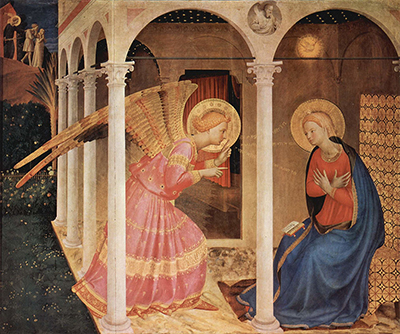
Gabriel approaches Mary beneath a Renaissance loggia. The angel’s body is elegant and brilliantly coloured. The wings retain the visual splendour of late-Gothic tradition. Yet Gabriel occupies coherent physical space. The supernatural messenger is therefore both precious and believable. This balance characterises Angelico’s early mature style. [1]
Mary
Mary sits within the architectural setting. Her response is controlled. The figure is physically present but spiritually receptive. Angelico avoids theatrical shock. The moment is one of attentive acceptance. Mary’s obedience forms the theological counterpoint to Adam and Eve’s disobedience in the garden. [1]
Adam and Eve
Adam and Eve are expelled from Eden on the left. Their presence transforms the Annunciation into a much larger theological narrative. The Fall and Incarnation appear simultaneously. The viewer does not need to move through chronological time. Painting joins beginning and remedy within one field. This continuous theological structure is one of the altarpiece’s greatest strengths. [1]
The relationship between the two episodes expresses a long Christian interpretation. Eve’s disobedience contributes to humanity’s fall. Mary’s obedience contributes to salvation. Medieval and Renaissance theology repeatedly contrasted Eve and Mary. Angelico makes that contrast visible across the painting. The left side moves away from Paradise. The right side receives divine promise. [1]
The garden is botanically rich. The Prado has identified numerous plant forms and links this descriptive precision with late-medieval botanical traditions. Angelico’s early training as an illuminator helps explain the attention. Tiny natural details remain legible even within a monumental altarpiece. The garden therefore connects manuscript precision with large-scale panel painting. [1]
Some plants can carry Marian or Passion associations. Yet not every flower needs one fixed symbolic meaning. The more secure point is that the garden evokes Eden, enclosed purity and a carefully ordered created world. Angelico’s naturalism is both observational and devotional. [1]
The Loggia
The architectural loggia provides the central Renaissance innovation. Rounded arches, columns and ordered recession make the scene coherent. The architecture unifies space rather than serving merely as ornament. Gabriel and Mary exist within one measurable environment. The supernatural encounter therefore becomes physically present. [1]
The Prado notes that Angelico looked towards contemporary Florentine architectural forms rather than reconstructing ancient Nazareth. This translation matters. Mary’s house becomes visually familiar to a fifteenth-century viewer. Sacred history enters the viewer’s own architectural world. The Incarnation feels present rather than remote. [3]
The Prado connects the minute descriptive detail with Gentile da Fabriano. Gentile’s art demonstrated how luxurious surface, flowers, objects and courtly refinement could enrich sacred imagery. Angelico absorbs this lesson. He does not abandon descriptive beauty when adopting Renaissance space. The new painting grows from older strengths. [3]
The Prado also connects the depth of Mary’s room with spatial experiments associated with Masolino and Masaccio in the Brancacci Chapel. This is one of the strongest pieces of evidence for Angelico’s engagement with the new Renaissance. He is watching what other Florentine painters are doing. Perspective enters his Marian art quickly. [3]
Angelico and Masaccio
The relationship should not be simplified into dependence. Angelico and Masaccio were near contemporaries working through related artistic problems. Both sought convincing bodies and space. Their emotional and devotional aims could differ. The Prado exhibition deliberately treated them as artists exchanging ideas within the same rapidly changing Florence. This is a more useful model than one-way influence. [3]
The principal panel is approximately square. This form belongs to the changing structure of Renaissance altarpieces. Prado research connects the architectural logic with the wider movement towards unified altar design in Florence. The square field allows architecture and figures to belong to one composition rather than separate Gothic compartments. [1]
The Predella
The predella contains episodes from the Virgin’s life. These include Mary’s birth, her marriage to Joseph, the Visitation, Christ’s Nativity, the Presentation in the Temple and the Dormition with Christ receiving Mary’s soul. The predella therefore expands the Annunciation into a Marian biography. The principal panel presents the theological turning point. The lower scenes provide narrative history around it. [4]
Mary’s birth establishes the beginning of the human life that will culminate in the Incarnation. The small panel requires compressed storytelling. Angelico’s illuminator background is especially visible at this scale. Figures remain clear despite the reduced dimensions. [4]
The marriage to Joseph establishes Mary’s social and sacred identity before the Annunciation. The scene also allowed Angelico to represent architecture and communal ritual in miniature. The predella therefore contains experiments that echo larger compositions. [4]
Mary visits Elizabeth after the Annunciation. The encounter brings together the unborn Christ and John the Baptist. The scene extends the consequences of Gabriel’s message. The Annunciation is not isolated. It begins a chain of recognitions and fulfilments. [4]
The Nativity represents the physical result of the Incarnation announced above. The divine Word has become visible child. This makes the predella narratively dependent upon the main panel. Annunciation and birth belong to one theological sequence. [4]
The Presentation introduces prophecy concerning Christ’s future suffering. The Marian life is therefore connected increasingly with the Passion. Angelico’s sacred narrative moves from joy towards foreknowledge. [4]
The final scene shows Mary’s death or Dormition with Christ receiving her soul. The predella therefore extends beyond Christ’s infancy to Mary’s own final destiny. This gives the whole altarpiece remarkable temporal range. Her birth, Annunciation, motherhood and death all coexist within one object. [4]
Illumination at Predella Scale
The predella demonstrates why Angelico’s early manuscript training matters. Small scale does not reduce complexity. Tiny figures, architecture and objects remain controlled. This precision made him one of the great predella painters of the century. The panels work almost like enlarged illuminations integrated into an altar. [4]
The painting is executed in tempera on poplar. Egg-based tempera dries quickly and supports crisp detail. This suited Angelico’s linear precision and luminous colour. It also demanded careful layering and planning. The material helps explain the brilliance of the surface. [1]
Poplar was a common support for Italian panel painting. A panel of this scale required substantial carpentry. Boards had to be joined, prepared and stabilised. The altarpiece was therefore a constructed object before it became a painted one. Workshop production began with wood. [1]
Gold
Gold remains important within the work. Halos, details and sacred accents preserve material splendour. Angelico does not see gold and perspective as incompatible. The painting can produce both reflected sacred light and illusionistic depth. This coexistence is fundamental to his early style. [1]
Prado research has connected the altarpiece with Dominican Marian devotion and the Salve Regina. The Dominican order had a strong liturgical relationship with Marian prayer. This makes the Annunciation especially appropriate to Fiesole. The image was not simply artistically fashionable. It belonged to the spiritual life of Angelico’s own community. [1]
Angelico entered an Observant Dominican environment committed to renewed religious discipline. The Prado exhibition places his early work within the broader revival of religious life following the end of the Western Schism and the papacy of Martin V. This larger religious history is important. The new Renaissance image emerges inside reforming Christianity rather than against it. [5]
Provenance: Leaving Fiesole
The Prado records the altarpiece at San Domenico until the early seventeenth century. It then left Italy. Mario Farnese acquired it in Rome and used it as a diplomatic gift to Francisco Gómez de Sandoval y Rojas, Duke of Lerma. This change transformed the painting from Dominican altarpiece into elite international possession. [2]
The work passed to the Monasterio de las Descalzas Reales in Madrid. Its sacred function continued but within a very different institutional environment. An Italian Dominican altarpiece became part of Spanish royal and conventual culture. This international movement reflects the high prestige of Angelico’s art by the seventeenth century. [2]
The painting later passed through royal ownership and entered the Prado in 1861. Museum display transformed its function again. The work became part of a national history of European painting. Its original Dominican context had to be reconstructed through scholarship. [2]
The Prado has conducted conservation and research on the predella. This is especially valuable because small narrative panels are vulnerable to abrasion, separation and later alteration. Restoration helps recover colour and minute detail. It also allows the lower sequence to be appreciated as an integral part of the original altarpiece rather than an accessory. [4]
The 2019 Exhibition
The Prado’s 2019 exhibition Fra Angelico and the Rise of the Florentine Renaissance placed the Annunciation at the centre of a much broader artistic dialogue. Works by Masaccio, Ghiberti and northern European painters were used to reconstruct the environment in which Angelico developed. This exhibition fundamentally strengthened modern understanding of him as an Early Renaissance innovator rather than isolated devotional painter. [3]
The Cortona Annunciation is more elaborate in some aspects of inscription, architecture and Marian narrative. Its exact dating is less securely documented. Comparing the two works shows how Angelico repeatedly reconfigured one subject. The Prado version remains especially valuable because its date and original Fiesole setting are unusually firm. [1]
The San Marco corridor Annunciation is dramatically more stripped down. Adam and Eve disappear. The predella disappears. The architecture becomes quieter. The comparison demonstrates maturity through reduction. The Prado work explains salvation history. San Marco assumes that history and concentrates on meditation. [1]
Why the Prado Annunciation Matters
The Prado Annunciation matters because it captures Fra Angelico at one of the decisive moments of the Early Renaissance. The artist is still deeply connected with illumination, Gothic colour and gold. At the same time, architecture becomes coherent. Bodies occupy space. Perspective begins to organise theology. The painting also has unusually strong documentary value. Its date is secure. Its original Dominican setting is known. Its predella survives. Its later provenance can be traced.
This makes it one of the best works through which to reconstruct Angelico’s early career. Most importantly, the altarpiece proves that Renaissance innovation and religious tradition were not opposing forces. The new spatial language makes the Incarnation more physically present. The old gold makes sacred presence more materially precious. The detailed garden links observation with Eden. The predella connects one miraculous moment with the whole life of Mary. Angelico does not choose between medieval devotion and Renaissance naturalism. He makes them work together. [1]
Frequently Asked Questions
Discussion
Which part of the Prado Annunciation most clearly unites late-Gothic refinement with Renaissance space?
Reader Insights
How does the expulsion of Adam and Eve reshape the meaning of Gabriel’s arrival?
What do the loggia and Mary’s room reveal about Angelico’s experiments with architecture?
How does the predella change the altarpiece from one episode into a Marian life cycle?
Join the Conversation
Share your reading of the Prado Annunciation below.
References
- Museo Nacional del Prado, Fra Angelico, The Annunciation, 1425–26, P000015. Museo del Prado collection record P000015.
- Museo Nacional del Prado, collection entry and full provenance for The Annunciation. Museo del Prado technical data and provenance.
- Museo Nacional del Prado, Fra Angelico and the Rise of the Florentine Renaissance, 2019. Fra Angelico and the Rise of the Florentine Renaissance.
- Museo Nacional del Prado, research on the predella and scenes from the life of the Virgin. Prado restoration of the Annunciation predella; Prado Annunciation restoration interactive.
- Museo Nacional del Prado, Fra Angelico artist biography. Museo del Prado Fra Angelico biography.
- National Gallery, London, Fra Angelico artist biography and Fiesole context. National Gallery Fra Angelico biography.
.jpg)
 Fra Angelico.jpg)