 by Tom Gurney
Tom Gurney BSc (Hons) is an art history expert with over 20 years experience
Published on June 19, 2020 / Updated on November 6, 2026
Email: tomgurney1@gmail.com / Phone: +44 7429 011000
Introduction
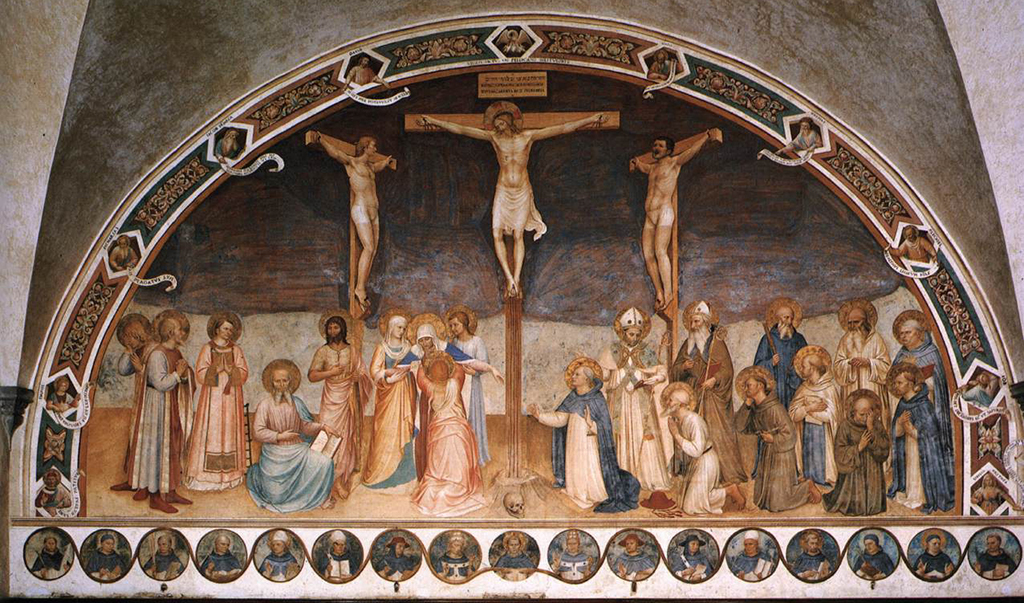
Fra Angelico’s Crucifixion and Saints in the Chapter House of San Marco is the largest and most solemn fresco he created for the Dominican convent. The Museo di San Marco dates it to 1441–42 and describes it as the most extensive and solemn fresco Angelico painted there. Its scale alone distinguishes it from the celebrated dormitory cells. This was not an image for one friar. It was made for the room in which the Dominican community gathered collectively.
The fresco therefore represents not only Christ’s death but the identity of the institution assembled around that death. The museum emphasises that the saints gathered around the three crosses are connected with several communities: the Medici family, the city of Florence, the Dominican order and other principal monastic orders. The painting thus creates a vast sacred society. Christ’s Crucifixion stands at the centre. Around it, historical saints who never occupied Calvary together are brought into one timeless devotional assembly.
This makes the fresco fundamentally different from narrative Crucifixions. Angelico is not reconstructing the historical event alone. He is showing the Church contemplating it across centuries. For the friars meeting in the Chapter House, this had direct institutional meaning. Their own community gathered before a painted community of saints. Living Dominicans were placed symbolically within a much larger history of Christian witness. The room therefore transformed ordinary chapter meetings into encounters with institutional memory. [1]
At a Glance
- ArtistFra Angelico [1]
- TitleCrucifixion and Saints [1]
- Date1441–42 [1]
- Mediumfresco [1]
- LocationChapter House, Museo di San Marco, Florence [6]
- Scalelargest and most solemn Fra Angelico fresco at San Marco [2]
- Central subjectCrucifixion of Christ [1]
- Additional crossesthe two thieves [1]
- Surrounding figuressaints connected with the Medici, Florence, Dominicans and other religious orders [1]
- Original functioncommunal Dominican Chapter House image [6]
- Core meaningChrist’s sacrifice placed at the centre of institutional and universal Christian memory [1]
- Distinctive featurehistorical figures from different centuries assembled together in devotional time [1]
Contents
- Introduction
- The Chapter House
- The Crucifixion
- The Virgin Mary
- Dominican Saints
- A Painted History of the Church
- Governance beneath the Cross
- Scale
- Historical Alteration and Conservation
- Why the Chapter House Crucifixion Matters
The Chapter House
A chapter house was one of the central rooms of a medieval and Renaissance religious community. Friars gathered there for communal business. Rules could be read. Discipline could be discussed. Institutional decisions could be made. The room therefore belonged to governance as well as devotion. This function explains why the fresco needed exceptional authority. A private cell could use a small meditative image. The Chapter House required a monumental statement about what the community was and what it served. Angelico chose the Crucifixion as the centre of that statement. [6]
The Crucifixion
Christ hangs on the central cross. The two thieves are crucified beside him. This triadic structure establishes the historical event. Yet the figures below do not belong simply to first-century Jerusalem. Angelico surrounds Calvary with saints from many later periods. The image therefore shifts immediately from history into devotional universality. The Crucifixion becomes an event contemplated by the whole Church. [1]
Christ occupies the ultimate visual and theological centre. Everything around him depends upon this fact. Saints may carry institutional identities. Medici patronage may shape saint selection. Dominican history may dominate important zones. Yet none of these groups displaces Christ. The community exists around the Cross. This hierarchy gives the fresco its disciplinary force. [1]
The thieves establish the narrative identity of Calvary. They also create theological contrast. Christ is innocent. The criminals suffer beside him. Christian interpretation traditionally distinguishes the penitent good thief from the unrepentant thief. The three crosses therefore introduce judgement and response into the image. Even at the Crucifixion, different human relationships with Christ are possible. [1]
The Virgin Mary
Mary’s presence establishes maternal grief. Her relationship with Christ is unique among the assembled saints. She belongs to the historical Passion narrative and to the devotional life of the Church. Angelico can therefore use her as a bridge between Calvary and later contemplative figures. Her grief becomes the model from which later compassion develops. [1]
John likewise belongs historically at the Cross. His presence reinforces Gospel memory. He also represents apostolic witness. Within a Chapter House fresco filled with later saints, John helps anchor the assembly to the original Christian community. The institutional Church surrounding Christ grows from apostolic witness. [1]
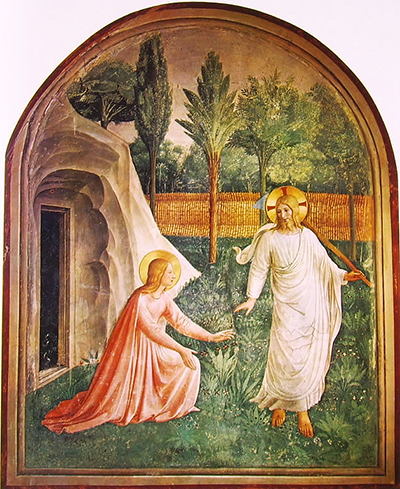
Mary Magdalene’s role is particularly important at San Marco. Recent museum interpretation emphasises her repeated presence throughout the Angelico cycle. She witnesses Crucifixions. She cares for Christ after death. She encounters the risen Christ in Noli me Tangere. Her place at the Chapter House Crucifixion therefore belongs to a larger Dominican devotion to her. As “Apostle to the Apostles”, she offered an especially powerful model to an order devoted to preaching. [1]
Dominic represents the order itself. His presence centuries after the historical Crucifixion makes the fresco explicitly devotional rather than archaeological. He contemplates Christ. The living Dominicans in the Chapter House could understand themselves through him. The founder becomes their representative before the Cross. [1]
Dominican Saints
Other Dominican figures expand this institutional identity. The order’s holy history is gathered around Christ. This visualises the idea that Dominican life derives meaning from participation in the wider Christian tradition rather than existing as an autonomous institution. The order’s saints become examples for the living community. [3]
The museum also emphasises saints connected with Florence. Their inclusion ties the Dominican convent to the city surrounding it. San Marco was a religious house but it was also deeply embedded in Florentine civic life. The saints make that relationship sacredly visible. The fresco therefore connects universal Christianity, Dominican identity and local civic devotion. [3]
Some saints also carry Medici associations. This reflects the patronal environment of San Marco. Cosimo de’ Medici financed the rebuilding. The family’s saints were prominent in the San Marco Altarpiece. Their appearance within the broader Chapter House programme connects patronage with institutional devotion. Again, the Medici do not need to dominate through portraits. Saints can translate family identity into sacred form. [3]
The fresco includes figures associated with other major religious orders. This broadens the image beyond Dominican self-celebration. The Dominican community sees itself as one part of the larger Church. Other forms of monastic and mendicant sanctity are acknowledged. The Chapter House therefore becomes ecumenical within the religious culture of Latin Christianity. [3]
A Painted History of the Church
Taken together, the saints form something like a visual history of Christian holiness. Apostles. Martyrs. Founders. Monastic figures. Dominicans. Local saints. Patronal saints. All gather around one event. The fresco therefore collapses historical time. Centuries coexist. The Crucifixion becomes permanently present to all generations. [3]
This collapse of time is central to Angelico’s San Marco art. Saint Dominic can appear at the Passion because devotional truth matters more than historical chronology. The Chapter House fresco expands the principle enormously. Instead of one later saint witnessing Christ, an entire sacred society does. The result is not narrative history. It is contemplative history. [1]
The original friars gathered in the Chapter House before this painted assembly. The relationship is powerful. A living community looks at a heavenly community. The saints look towards Christ. The friars are invited to follow their gaze. The fresco therefore structures institutional self-understanding through acts of looking. [1]
In this sense, the painted community becomes an ideal mirror for the real one. The friars below are imperfect, living and involved in daily decisions. The saints above represent perfected Christian life. The Chapter House is the place where discipline and governance occur. The fresco reminds the community of the standard against which its decisions should be measured. [1]
Governance beneath the Cross
This connection between governance and Crucifixion deserves emphasis. Institutional meetings can become absorbed by practical concerns. Property. Rules. Disputes. Responsibilities. Angelico places all such activity beneath Christ’s sacrifice. The image insists that administration is subordinate to religious purpose. This makes the fresco functionally appropriate to the room. [6]
The three crosses create the broad upper framework. Below, the saints spread laterally across the wall. This gives the fresco monumental width. Unlike a cell image built around one concentrated encounter, the Chapter House composition requires scanning. The eye moves through groups. Different identities emerge gradually. The painting rewards communal-scale viewing. [1]
Scale
The museum identifies the work as Angelico’s largest and most solemn fresco at San Marco. Scale transforms the bodily experience of the viewer. Christ is not a small devotional figure. The Cross dominates architectural space. Saints accumulate almost life-size or monumentally across the wall. The friar stands physically beneath sacred history. [2]
The fresco’s solemnity comes partly from repetition and restraint. The figures do not behave like a chaotic crowd. They gather in ordered grief and contemplation. This controlled response distinguishes the work from dramatic later Crucifixions. Angelico creates emotional seriousness without theatrical disorder. [1]
The cell Crucifixions are much smaller and simpler. Often Saint Dominic appears alone or with few witnesses. These images encourage individual contemplation. The Chapter House fresco expands the same basic devotional logic into institutional scale. Dominic’s private model of contemplation becomes an entire Church gathered around Christ. [1]
The contrast with The Mocking of Christ is equally revealing. Cell 7 reduces the Passion almost to Christ and disembodied torment. The Chapter House multiplies sacred witnesses. One image creates intensity through absence. The other creates authority through community. Both demonstrate Angelico adapting visual density to function. [1]
Comparison with the San Marco Altarpiece
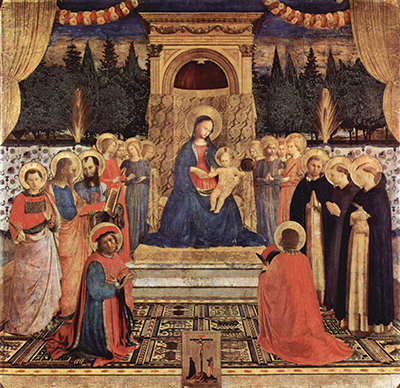
The high-altarpiece and Chapter House fresco are the two great public-facing sacred ensembles within Angelico’s San Marco work. Both organise communities of saints. Both respond to Medici and Dominican identities. Yet their media and liturgical functions differ. The altarpiece centres Mary and Christ above the Eucharistic high altar. The Chapter House centres the Crucifixion above communal governance. Different rooms require different sacred hierarchies. [1]
Dominican spirituality placed intense emphasis on Christ’s Passion. The repeated Crucifixions throughout San Marco confirm this. The Chapter House fresco gives that devotion its monumental institutional form. The order is visually defined by contemplation of the Cross. This makes the fresco almost a manifesto of San Marco spirituality. [1]
Antonino Pierozzi served as prior of San Marco during the convent’s formative years and later became Archbishop of Florence. His leadership belongs directly to the institutional environment in which Angelico worked. The Chapter House was therefore not an abstract monastic room. It belonged to an active reforming community under significant Dominican leadership. The fresco’s emphasis on discipline, collective memory and the Cross fits this context closely. [4]
Cosimo de’ Medici and Dominican Reform
Cosimo’s patronage likewise forms part of the background. He funded the rebuilt convent but did not control its religious programme simply as a private household chapel. The Chapter House remained a Dominican institutional room. This distinction matters. Medici saints can appear without transforming the fresco into a family monument. Patronage and community negotiate the imagery together. [4]
San Marco stood within the city rather than in remote monastic isolation. The convent interacted with politics, patronage, preaching and intellectual life. The fresco’s inclusion of Florentine saints therefore reflects a genuine civic relationship. The Dominicans understood themselves as serving a city as well as an internal community. [4]
The image also expands beyond Florence. By gathering saints from many orders and centuries, Angelico turns Calvary into the centre of universal Christian history. The fresco therefore moves through concentric identities: Christ; apostolic witness; religious orders; Dominicans; Florence; Medici patronage; the living friars in the room. All are organised around the Cross. [1]
The large scale required careful fresco planning. The wall had to be plastered in sections. Drawings and transfer procedures coordinated the enormous assembly. Assistants likely contributed under Angelico’s direction. The technical organisation itself mirrors the institutional organisation represented. A community of painters creates an image of a sacred community. [5]
Workshop Participation
As elsewhere at San Marco, a project of this scale should not be imagined as one person completing every material action alone. Angelico’s authorship includes design, principal execution and supervision. Workshop assistance was normal. The coherence of the fresco demonstrates the effectiveness of that organisation. [5]
The palette helps differentiate saints while preserving overall solemnity. Angelico avoids turning the wall into decorative noise. Garments create rhythmic colour across the lower assembly. The three crosses remain visually dominant. Colour therefore helps organise hierarchy. [5]
The fresco’s modelling gives bodies volume without excessive theatrical shadow. Figures inhabit a shared luminous environment. This clarity belongs to Angelico’s mature Renaissance language. The sacred assembly feels present within the room rather than suspended against abstract gold. [5]
The fresco is integrated with the Chapter House wall. This creates a direct relationship between represented community and actual community. Unlike a portable panel, the image cannot be separated from its function easily. The friars’ meeting room and the sacred assembly share one architectural surface. This in-situ survival is one of San Marco’s greatest strengths. [5]
Historical Alteration and Conservation
Like the rest of San Marco, the Chapter House has passed through centuries of use and conservation. The fresco’s modern appearance is therefore the result of survival, restoration and changing museum conditions. Recent museum investment in lighting and conservation has improved visibility while preserving the work in place. Such interventions need to respect both the painted surface and architectural environment. [5]
Today the Chapter House no longer serves ordinary Dominican governance in the same way. Museum visitors enter as spectators. This changes the relationship with the fresco. The original viewer belonged to the institution represented. The modern viewer stands outside it historically. Interpretation therefore needs to reconstruct the room’s communal function. Without that context, the assembly can appear merely as an impressive collection of saints. [2]
Reading the Saints
Identifying every figure is useful but should not become the only goal. The larger meaning lies in grouping. Dominican saints establish order identity. Florentine saints establish civic identity. Medici-associated saints acknowledge patronage. Other monastic figures place the Dominicans within a wider Church. The fresco works through communities as much as individuals. [3]
The Chapter House Crucifixion can almost be understood as a visual constitution for the convent. It tells the friars where authority lies. Christ is central. Sacred tradition surrounds him. The order belongs to that tradition. The city and patrons occupy legitimate but secondary positions. The living community must govern itself beneath this hierarchy. This is why the fresco fits the room so perfectly. [1]
Why the Chapter House Crucifixion Matters
The Crucifixion and Saints matters because it is the fullest institutional statement Fra Angelico made at San Marco. The private cell frescoes teach individual contemplation. The Chapter House teaches communal identity. Christ’s death stands at the centre. Around it gathers a Church extending across centuries. The Dominicans see their founder and holy predecessors. Florence sees its saints. Medici patronage is acknowledged through associated sacred figures.
Other religious orders are incorporated into the wider Christian community. The living friars then gather physically in front of all of them. This structure transforms the fresco into far more than a large Passion image. It is an image of belonging. It tells a Dominican community that its local life is part of universal Christian history. It also demonstrates Angelico’s extraordinary range.
At San Marco he could make a cell fresco powerful by removing almost everything. Here he does the reverse. He builds meaning through accumulation. Yet the wall never becomes chaotic. The Cross remains supreme. Communities organise themselves around it. That combination of scale, solemnity and institutional intelligence explains why the Museo di San Marco rightly treats the fresco as the largest and most solemn Angelico painting in the convent. [6]
Frequently Asked Questions
Discussion
Which feature most clearly turns the Chapter House Crucifixion into an image for an entire Dominican community?
Reader Insights
How do saints from different places and centuries reshape the historical Passion?
What does it mean for institutional meetings to take place beneath this fresco?
How does its monumental scale distinguish it from Angelico’s cell Crucifixions?
Join the Conversation
Share your reading of Crucifixion and Saints below.
References
- Direzione regionale Musei nazionali Toscana, Museo di San Marco institutional collection page, identifying Crucifixion and Saints, 1441–42. Museo di San Marco collection and dating.
- Direzione regionale Musei nazionali Toscana, current San Marco visitor information describing the Chapter House work as Angelico’s largest and most solemn fresco there. Current Chapter House visitor description; 2026 museum visitor information.
- Direzione regionale Musei nazionali Toscana, resources on saints associated with the Medici, Florence, Dominicans and other monastic orders in the fresco. Current description of the assembled saints.
- Direzione regionale Musei nazionali Toscana, research on Sant’Antonino Pierozzi and Dominican spirituality at San Marco. Sant’Antonino, reform and San Marco context; Sant’Antonino spiritual context.
- National Gallery, London, Fra Angelico artist biography and workshop context. National Gallery Fra Angelico biography.
- Museo di San Marco, institutional history of the Chapter House and convent. Museo di San Marco institutional history; Chapter House visitor route.
.jpg)
 Fra Angelico.jpg)