 by Tom Gurney
Tom Gurney BSc (Hons) is an art history expert with over 20 years experience
Published on June 19, 2020 / Updated on November 6, 2026
Email: tomgurney1@gmail.com / Phone: +44 7429 011000
Introduction
Fra Angelico’s Armadio degli Argenti, painted principally between about 1450 and 1452 and now preserved in the Museo di San Marco, is one of the final major Florentine enterprises of his career. The project was commissioned by Piero di Cosimo de’ Medici for Santissima Annunziata. The painted panels formed the doors or covering of a cabinet associated with the precious offerings and ex-votos presented to the highly venerated miraculous image of the Annunciation.
The object therefore belonged simultaneously to devotion, treasure, architecture and narrative painting. It was not a conventional altarpiece. Its purpose was to enclose and dignify a sacred treasury. The surviving cycle presents stories from the life of Christ. Museo di San Marco research describes the programme as a meditation on the concordance between Old and New Testaments, rooted in the theological thought of Thomas Aquinas. Recent scholarship has counted 168 inscriptions across the Armadio.
This extraordinary density of text makes the cycle one of the clearest examples of the relationship between painting, theology and literary culture in Angelico’s work. The project is also important because it complicates authorship. Most of the surviving narrative is associated with Angelico, but the panel containing the Baptism of Christ, Wedding at Cana and Transfiguration was completed by Alesso Baldovinetti after Angelico’s departure. Benozzo Gozzoli and the wider workshop context have also been discussed in relation to the enterprise.
The Armadio should therefore be understood as a late Angelico project carried through collaborative production. Its date overlaps with another revealing part of his career. Around 1450–52 Angelico was serving as prior at San Domenico in Fiesole and was still producing or supervising illuminated manuscripts for San Marco. The painter of the Armadio was therefore simultaneously friar, institutional leader, illuminator and organiser of major narrative painting. [1]
At a Glance
- ArtistFra Angelico, with late workshop collaboration [1]
- TitleArmadio degli Argenti / Silver Treasury [1]
- Dateprincipally c. 1450–52 [2]
- PatronPiero di Cosimo de’ Medici [1]
- Original locationSantissima Annunziata, Florence [3]
- Original functionpainted doors or covering for a cabinet associated with precious ex-votos and sacred offerings [3]
- Current locationMuseo di San Marco, Florence [2]
- Subjectextensive cycle of stories from the life of Christ [1]
- Scale of surviving narrativeapproximately 35 scenes [5]
- Textual densitymodern scholarship counts 168 inscriptions [1]
- Theological structureconcordance between Old and New Testaments [1]
- Important later handAlesso Baldovinetti completed a panel with Baptism, Wedding at Cana and Transfiguration [3]
- Key significancelate synthesis of painting, text, Medici patronage and theological narrative [1]
Contents
- Introduction
- Santissima Annunziata
- Piero de’ Medici
- A Cabinet rather than an Altarpiece
- Thirty-Five Scenes
- 168 Inscriptions
- Old and New Testament
- Alesso Baldovinetti
- The 2025 Restoration Programme
- Why the Armadio degli Argenti Matters
Santissima Annunziata
Santissima Annunziata was one of Florence’s most important Marian sanctuaries. Its miraculous image of the Annunciation attracted intense devotion. Pilgrims and worshippers offered ex-votos in gratitude or petition. These offerings accumulated around the sacred image. The Armadio was created within this environment. Its function therefore depends upon the culture of miraculous intercession. [3]
An ex-voto is an offering made in response to a vow, prayer or perceived divine assistance. Such objects could represent illness, recovery, danger, childbirth or other human experiences. The treasury around the Annunciation was therefore a material record of devotion. The Armadio enclosed objects carrying individual histories of fear, hope and gratitude. Angelico’s Christ cycle surrounded that devotional archive with sacred narrative. [3]
Piero de’ Medici
Piero was the son of Cosimo de’ Medici. His commission at Santissima Annunziata parallels, in interesting ways, his father’s patronage at San Marco. Both men supported Michelozzo-related architectural projects. Both created private spaces of devotion within major religious institutions. Both used leading artists to connect Medici identity with sacred environments. The Armadio therefore belongs to a second generation of Medici-Angelico patronage. [1]
Piero became deeply involved with Santissima Annunziata. He supported architectural and decorative work there. He maintained a private devotional relationship with the sanctuary. The Armadio belongs to this larger patronal programme rather than being an isolated commission. [3]
A Cabinet rather than an Altarpiece
The object’s function is unusual. It did not stand simply as a pala above an altar. Its painted surfaces opened and closed around a treasury cabinet. This made narrative painting physically interactive. The sacred stories could be revealed or concealed depending upon use. The object combined practical storage with theological meaning. [3]
Thirty-Five Scenes
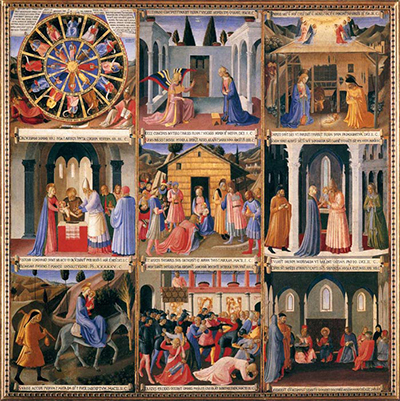
Museo di San Marco research describes the surviving Armadio narrative as approximately thirty-five scenes. The cycle is therefore vast. It covers many episodes from Christ’s life. Annunciation. Nativity. Circumcision. Adoration. Presentation. Baptism. Miracles. Passion. Resurrection. The object becomes almost a painted Gospel history. [5]
Thirty-five scenes on a furnishing require extraordinary compression. Angelico’s background in predella painting and illumination made him ideally suited to the task. Small spaces contain complete episodes. Architecture clarifies action. Figures remain readable. Colour differentiates narrative roles. The Armadio is monumental intellectually even when individual scenes are small. [1]
168 Inscriptions
Recent San Marco scholarship notes 168 inscriptions across the programme. This number is astonishing. Text is not secondary. It is structurally embedded. The viewer encounters scriptural quotation, theological connection and painted narrative simultaneously. The Armadio therefore belongs as much to learned textual culture as to visual storytelling. [1]
Angelico’s career began in manuscript illumination. The Armadio brings image and word together again at the end of his life. Painted scenes resemble visual exegesis. Text interprets image. Image makes text visible. The relationship demonstrates continuity across the whole career. [1]
Old and New Testament
The theological programme emphasises concordance between Old and New Testaments. Events in Christian history are related to earlier scriptural prophecy and typology. This mode of interpretation was central to medieval and scholastic theology. The New Testament fulfils patterns already present in the Old. The Armadio makes that relationship visual. [1]
San Marco research associates the programme particularly with the theological thought of Thomas Aquinas. This is especially appropriate for a Dominican painter. Angelico belonged to the same order as Aquinas. The Armadio therefore becomes a late example of Dominican theology translated into visual narrative. [1]
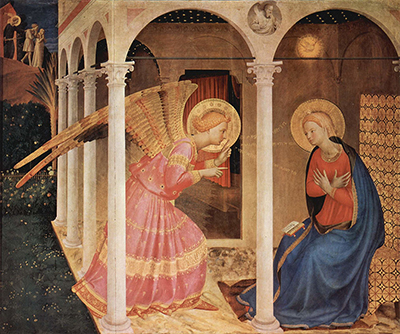
The cycle naturally begins or prominently includes the Annunciation because the cabinet belonged to Santissima Annunziata. The miraculous Marian image around which the sanctuary developed gives the scene special local significance. Angelico’s lifelong Annunciation theme therefore returns inside a new object type. [1]
The Nativity turns the promise of Incarnation into visible birth. Within the sequence, the transition from Annunciation to Nativity is immediate theological fulfilment. The small panel demonstrates Angelico’s ability to compress stable architecture, animals and sacred family into limited space. [1]
The Circumcision introduces covenant, law and embodied sacrifice. It connects Christ with Jewish ritual and foreshadows the shedding of blood in the Passion. This is precisely the sort of episode that benefits from Old-New Testament typological interpretation. [1]
Adoration of the Magi
The Magi bring the wider world to Christ. The scene introduces procession, costume and gifts. Angelico can expand visual richness while preserving narrative clarity. The subject also held strong Medici associations elsewhere in Florence, making its presence within a Piero-sponsored object particularly resonant. [1]
The Presentation introduces prophecy and future suffering. The infant Christ enters institutional sacred space. The episode therefore connects Incarnation with sacrifice. Angelico’s cycle repeatedly makes Christ’s life one continuous theological history. [1]
The Baptism belongs to the panel completed by Alesso Baldovinetti. This is one of the most important authorship cautions in the entire project. The scene belongs to Angelico’s overall programme. Its execution, however, is not wholly his. The distinction between design and hand must remain visible. [1]
The Wedding at Cana, also part of Baldovinetti’s completion, represents Christ’s first major public miracle in the Gospel of John. Water becomes wine. The scene links transformation, sacramental interpretation and Christ’s public ministry. Within the Armadio, it marks movement away from infancy narratives towards active revelation. [1]
The Transfiguration forms the third episode in the Baldovinetti panel. Christ’s divine glory becomes visible. The scene echoes Angelico’s earlier San Marco fresco but belongs to a different narrative context. The comparison demonstrates how compositions and theological themes could move through a workshop across decades. [1]
Alesso Baldovinetti
Baldovinetti was a younger Florentine painter. His completion of part of the Armadio after Angelico’s departure demonstrates how major projects could outlive the master’s direct presence. The object remains associated with Angelico because he conceived the wider programme. But authorship is collaborative. [3]
Benozzo’s relationship with the late Angelico workshop also forms part of the project’s broader context. He had collaborated closely with Angelico in the 1440s and Rome. Even where precise division of hand remains debated, the Armadio belongs to a network rather than solitary production. [1]
Around 1450–52 Angelico served as prior of San Domenico at Fiesole. This is an extraordinary biographical overlap. The artist supervising or producing one of his last major Florentine cycles was also exercising institutional Dominican leadership. This weakens the stereotype of an artist detached from administration. Angelico could manage both religious community and artistic enterprise. [1]
San Marco research also places his late Psalters around 1450–52. These manuscripts show that illumination remained part of his practice into the final years. The Armadio should therefore not be interpreted as a painter having outgrown miniature culture. Small-scale narrative remained central. [1]
The Armadio’s many compact scenes feel like a return to the logic of the illuminated page. Narrative has to be concise. Text is physically close. Colour and architecture clarify meaning. Yet the object is architectural and public. Angelico combines manuscript intelligence with Renaissance furnishing. [1]
Material Function
Because the paintings belonged to cabinet doors or covering, opening and closing affected viewing. The object had states. Narrative could be hidden. Treasury could be revealed. The physical action of the furnishing therefore interacted with sacred meaning. This is another reason the Armadio should not be treated as thirty-five unrelated little paintings. [3]
The relationship between painted narrative and stored ex-votos is conceptually rich. Inside: material offerings from individual believers. Outside: the universal story of Christ. Private gratitude is enclosed within public salvation history. The cabinet therefore connects personal devotion with Christian narrative. [1]
Piero’s patronage adds another layer. A wealthy family commissions imagery for a treasury whose contents include gifts from ordinary worshippers. The object therefore sits at the intersection of elite patronage and popular devotion. This makes the Armadio socially broader than many Medici commissions. [1]
Fragmentation
The original furnishing was later altered and dismantled. The painted cycle was cut into separate panels. San Marco research records that the surviving ensemble eventually became eight larger panel units. This physical transformation changed how the scenes could be displayed and understood. [5]
The modern museum therefore presents grouped fragments rather than the original working doors. This is another example of Angelico’s art surviving through altered object identity. The paintings remain. The furnishing mechanism does not. Scholarship must reconstruct use. [5]
The surviving panels now occupy a prominent wall in the Sala del Beato Angelico. They can be studied near other mature works. This allows viewers to compare late panel narrative with the San Marco Altarpiece, Annalena and Linaioli Tabernacle. The museum context is exceptionally useful for chronology. It is less able to reproduce the original cabinet function. [2]
The 2025 Restoration Programme
The Armadio formed part of the research and conservation activity surrounding the 2025 Fra Angelico exhibition. A dedicated restoration talk at San Marco focused on the cycle. This confirms that technical investigation remains active. The object is not a closed scholarly case. [4]
The late Armadio combines luminous colour with increasingly confident bodily form. Architecture is concise. Narrative is animated. The scenes sometimes display humour and vivid everyday observation. Late Angelico is therefore not becoming dry or repetitive. He remains inventive. [5]
The Niccoline Chapel and Armadio are close chronologically but radically different in scale. Rome: monumental frescoes, papal audience, classical architecture. Florence: small panels, ex-voto treasury, dense inscriptions. Both are intellectually complex. Both organise many scenes into one theological programme. Angelico’s late mastery lies partly in this adaptability. [5]
The Prado Annunciation predella demonstrates Angelico’s early skill at miniature narrative. The Armadio expands that ability into dozens of scenes near the end of the career. The comparison reveals continuity across approximately a quarter-century. [1]
Why the Armadio degli Argenti Matters
The Armadio degli Argenti matters because it brings almost every major strand of Fra Angelico’s career together near the end of his life. Dominican theology. Medici patronage. Annunciation devotion. Small-scale narrative. Illumination. Architecture. Text. Workshop collaboration. The cycle is not simply a set of Gospel illustrations. Its 168 inscriptions and Old-New Testament correspondences turn it into a dense theological system. Its physical function as a treasury cabinet connects sacred narrative with real devotional offerings.
Its collaborative completion reminds us that late Angelico operated through a workshop network. Most importantly, the Armadio shows that his final style was not one fixed visual manner. Soon after monumental Rome, he could return to intimate narrative. The painter of heroic martyrs could also tell Christ’s life in tiny luminous scenes. That range makes the Armadio one of the essential final chapters of his career. [1]
Frequently Asked Questions
Discussion
How does the Armadio degli Argenti change our understanding of Fra Angelico when painting, furniture, treasury, text and theology operate as one object?
Reader Insights
How does an ex-voto cabinet ask different things of narrative painting than an altarpiece or fresco cycle?
What do the dense inscriptions add to the relationship between Old and New Testament scenes?
How should Angelico’s authorship be described when Baldovinetti completed part of the programme?
Join the Conversation
Share your reading of Fra Angelico’s Armadio degli Argenti below.
References
- Museo di San Marco, “Beato Angelico ‘eccellente pittore e miniatore’,” on the Armadio, Piero de’ Medici, Thomas Aquinas and 168 inscriptions. Museo di San Marco research on Angelico as painter and illuminator.
- Museo di San Marco, new Sala del Beato Angelico display, dating the Armadio to 1450–52. Direzione regionale Musei nazionali Toscana account of the new Sala del Beato Angelico.
- Museo di San Marco, research on Santissima Annunziata and Alesso Baldovinetti’s completion of the Armadio. Museo di San Marco research on Santissima Annunziata and Baldovinetti.
- Direzione regionale Musei nazionali Toscana, 2025–26 Racconti di restauro programme devoted to the Armadio degli Argenti. Direzione regionale Musei nazionali Toscana Armadio restoration programme.
- Museo di San Marco, research on Angelico’s Roman period and the Armadio’s approximately thirty-five scenes. Direzione regionale Musei nazionali Toscana Armadio reconstruction and restoration record.
.jpg)
 Fra Angelico.jpg)